Feeds:
Posts
Comments

Archive for the ‘from the living room’ Category

Last year there was a wave of complaints from people about “over-tourism”. Several cities, like Venice, Barcelona, Prague and Edinburgh were accommodating so many tourists that locals felt life was becoming difficult. There were even problems with the number of people visiting the Isle of Skye in Scotland.

Well, this year, look what’s happened. Nobody last summer could have seen this virus coming, and none of us have lived through an experience like this, but as I read yesterday about Spain, Italy and France all experiencing a complete collapse of tourism and making plans to prevent holiday travel into their countries for the foreseeable future I couldn’t help but be amazed at how much things had changed.

That also got me thinking about the old phrase “Be careful what you wish for. It might come true.”

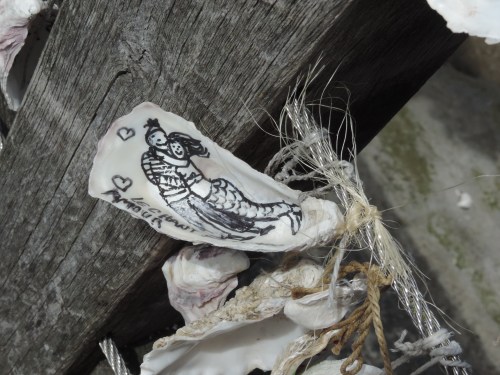
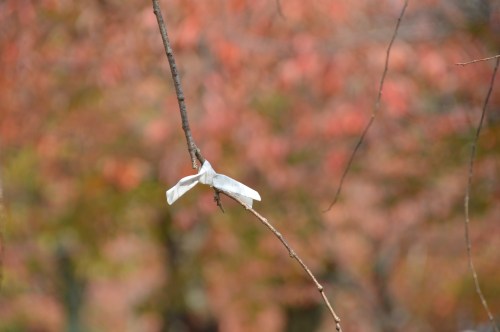
I’ve visited Japan a number of times and one thing which has always struck me is the practice of writing down wishes and hanging them up in temples and shrines. That photo above is of one such simple wish. Often you’ll see a whole tree covered in little paper wishes like that.

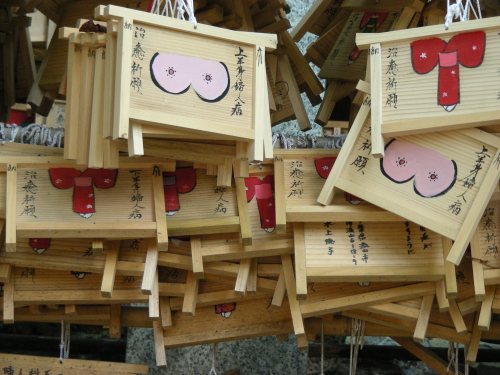
In some shrines, wish-making is more organised and focused. For example, in Nara, I came across this one –
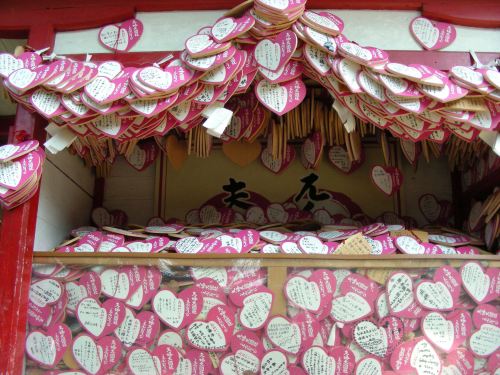
I understand these particular ones are from married or engaged couples and are hopes for a good future for their relationship.

Though, it would seem some non-Japanese speaking guy didn’t quite understand that….
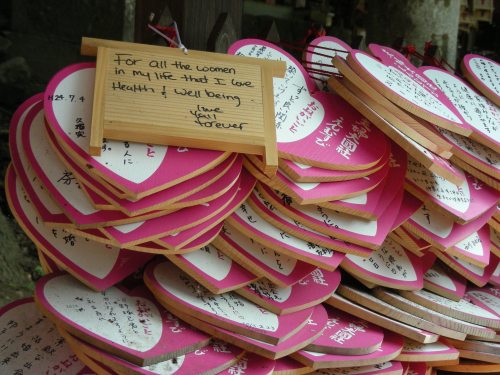
Of course, I don’t know if the author of this wish (and where did they get that different, non-heart shaped plaque?) was referring to their grandma, mum and big sister, but it sure struck me as strange!

Connected to that particular shrine in Nara is one where the focus is on women’s health and wellbeing.
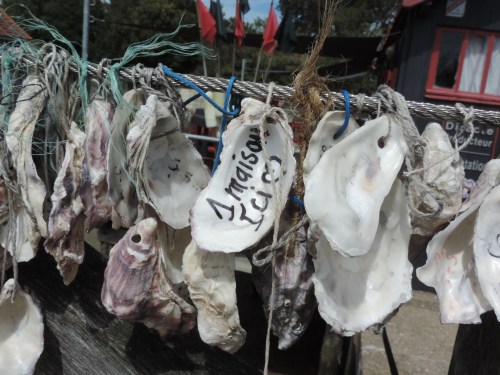
Back here in France, last year, I came across these wishes on an island where the main industry is oyster farming.
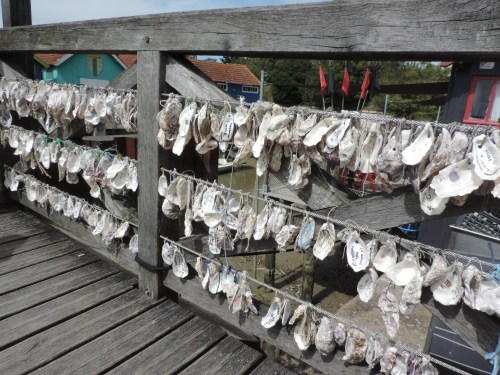
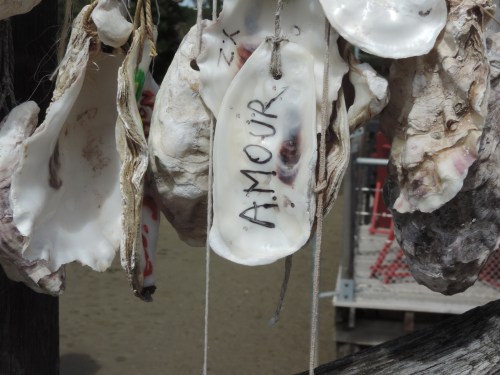
It’s interesting how many of these practices are perhaps not so much wishes but love hopes. They are declarations of love and an expression of desire for that love to last.

But not all, are about love. This person clearly loved their holiday on the island so much they’d like to live there full time.
In many parts of Europe you can find the padlock version of the love hope/wish –
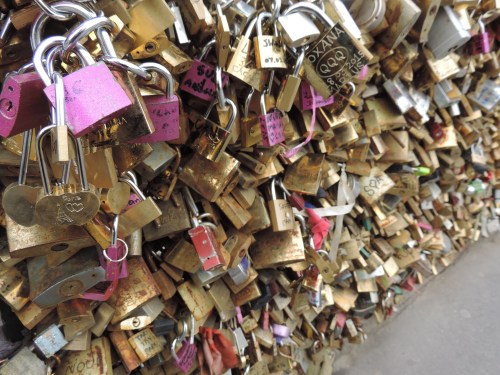
I do find it heartening that so many people choose to focus on a relationship and their hope/wish for sustainable love when they make these public declarations. The first time I came across the padlock version on a bridge in Paris I found it really incredibly moving.

So, I wonder what you are wishing for at this strange time in our lives.

And I wonder what will change if your wishes come true.
Read Full Post »

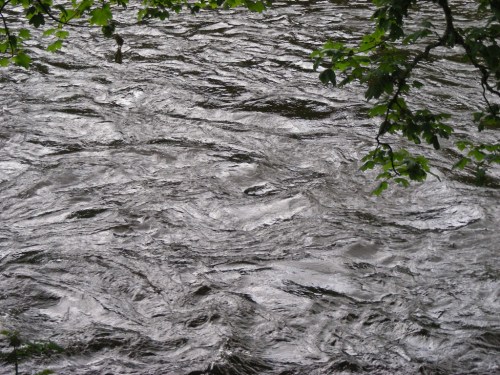
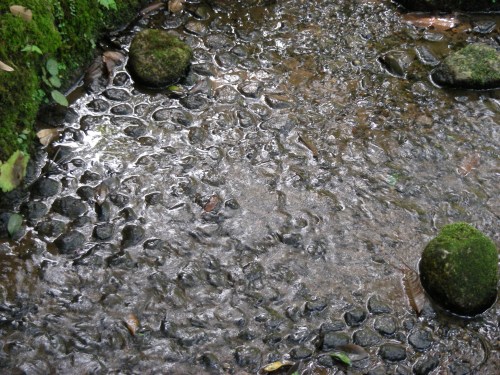
This is a stream I saw in the Japanese town of Nara several years ago. The water flowed in such an unusual way in this stream. It was more than a trickle but almost less than a steady flow. The bed of the stream had been made by laying many stones close together, mainly smooth, round-ish stones. The interaction between the water and the stones created this really fascinating texture. Quite unlike any stream I’d ever seen before.

In Scotland the streams (burns) and rivers flow over huge irregularly shaped rocks creating white foam and loud crashing noises. This stream flowed quietly, the water hardly making any sound as it slipped over the smooth surfaces of the stones. Where I live now, in the Charente, the river is well known for its constant smooth flow. It is never still, but it never breaks into foam or makes a noise. This stream in Nara has some similarities to both of these waterway forms.

So, as I look at this image now, I recall standing in Nara taking this photo. I can hear the gentle sound of the water over the smooth stones, but I also bring into my mental space waterfalls in the Trossachs, and a river just a few kilometres from where I am now. I love how the mind weaves the memories a specific scene with multiple others which had something in common – in this case, flowing water, but also turbulence and calm.

Then I notice the moss covered stone in the bottom right of the photo and I immediately recall another photo I took near this stream.

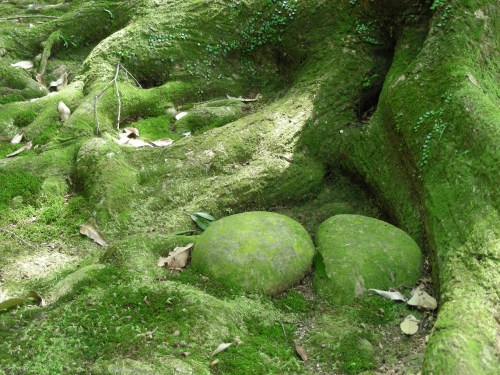
When I first stumbled across these I thought the tree had laid two eggs!

I imagined them hatching out millions of years into the future…..what kind of creature would emerge? Some tree-dragon?

The smoothness of these stones is just like that of the ones in the bed of the stream, and their mossy covering makes them look just like that larger stone at the bottom of the previous image.

I delight in following threads of similars.

Which ones will you notice and explore today?

Read Full Post »

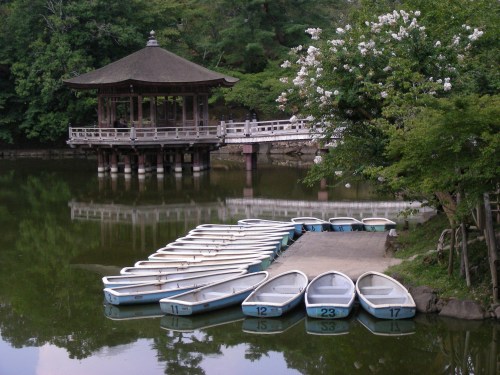
It strikes me that this is a pretty good image for this present moment.

All our boats are tied up at the dock. Empty. Nobody there.

Actually, when you look really carefully there is somebody in the pagoda. It’s hard to see them. I have the impression they might be a ghost!

Moored is the word we would use to describe the situation these boats find themselves in. They’ve been carefully set aside, brought home, tied up to the dock to keep them safe. I guess we’re all a bit moored just now, aren’t we? Although, frankly, an increasing number of people are feeling quite the opposite – un-moored!

But let’s stick with this image for a wee bit longer.

I see nineteen boats arranged around this platform, and, yes, it bugs me that they aren’t aligned by number – what does that say about me? – but, worse than that, one of them is number 23 – and I can only count 19 of them! Are there are at least four missing? Where are they? Are they OK? So, already, what at first glance looks like a completely peaceful scene, with the reflections of trees, clouds and blue sky on the surface of the still, still water, starts to become a little…..unmoored?

Then I see the blossom of the tree above the boats, and instantly, I’m back to enjoying the beauty of the scene. My gaze follows the hidden path to bridge, and across to that gorgeous pagoda, itself perfectly reflected in the calm lake. Then I notice that indistinct person, that ghostly presence, and I start to unravel again.

Now, here’s the thing, until today, every time I’ve looked at this image I’ve seen and experienced nothing but calm, and I’ve delighted in its beauty. This “un-mooring” is new. It doesn’t come from the photo itself. It comes from where I am, here and now.

Well, this is a great truth…..whatever we perceive, whatever we see, notice, appreciate and experience, is always, but always, an interaction between our “self” and what is around us. This is the way I understand the teaching that there is no real world “out there”. This is how I understand relativity. It’s not that there is nothing objective, or that nothing exists unless I see it, hear it, or otherwise sense it. It’s that my lived experience of reality always, but always involves my memories and my imagination.

We co-create our world.

Read Full Post »

Several years ago I visited the town of Nara, in Japan, and as I wandered through this park I came across all these people sitting drawing and painting. As I look at this again today I’m struck by how it would meet the requirements of social distancing that we are all being urged to follow (except, here in France, as in some other countries, parks and forests are currently out of bounds to everyone!).

But what really strikes me about this image is how it captures a fundamental human characteristic – creativity.

We are creative creatures.

We invent. We solve problems. We compose and perform music. We draw. We paint. We carve. We write and we share stories, poems, ideas and observations. We are brilliant at creating and manipulating symbols and signs. We make maps and plans. We build. We weave, sew, and knit. We create pots, cups and mugs from clay. We create jewellery from precious metals and stones. We make gardens, parks and forests, sewing seeds, nurturing seedlings, fashioning the landscape to our pleasing. We transform nutrient laden plants into nutritious food. We heal and develop new ways to heal.

I could go on……[add some of more of you own liking].

Yes, I know, some of you will be thinking, human beings are pretty damn destructive too. Aren’t we spoiling, ravaging and polluting too?

Yes, we are. And if we are to survive as individuals and as a species, we are going to have to tackle that. But what will we tackle it with? Creativity.

Has there every been a better time to foster, practice and share our creativity?

I don’t think so.

In this time of pause, when everyday life has been put on hold, we are going to need all our creativity to get out of this situation and wouldn’t it be wonderful if we used our creative powers to make a better world “after-the-pandemic”, to resist those who will want a return to the old ways which got us into this situation?

How might you change the way you live #after-the-pandemic?

What new habits are you going to create?

What new behaviours are you going to develop?

How do you think you can maximise your creativity today, and in the days and years to come?

What are you going to write, or draw, or paint, or build, or weave or……….?

Are you going to start today?

Read Full Post »

This little chameleon hugging the stalks of grass wasn’t easy to see. From the distance he was, to all intents, invisible. He’s designed to have that as his core quality.

We think of chameleons as creatures which are brilliantly camouflaged. Their colouring perfectly matched to their surroundings.

Many of we humans have that tendency too. We like to “blend in”. We like to be “one of the crowd”. Even in the earliest years of school, children will pick out the one who is different. And, often, that’s not a good thing. They’ll be singled out for insults or blows.

There’s a message there – it doesn’t pay to be different.

Conform! Keep your head down! Don’t attract attention!

There is a tendency in human communities to demonise “the other”. A new inhabitant might be treated as “an outsider”, or “an in-comer”. “You ain’t from round here, are you?” The more different they are, the more they are likely to arouse suspicion and prejudice.

It’s not very appealing, is it?

But this little chameleon….he’s pretty appealing, isn’t he? Clearly there is something potentially valuable in the strategy of blending in, and hiding, of not getting noticed.

There’s a safety in being “normal”, “one of the crowd”.

But it’s not enough, is it?

We need quite the opposite.

From the moment a baby is born they demonstrate their core skill – attracting attention! They scream and yell when they are hungry, when they are thirsty, when they are uncomfortable and when they want company. Failing to attract attention would be fatal. Literally.

None of us want to be ignored or passed by. None of us want to be unseen and unheard. Well, most of us don’t, anyway.

There are many paradoxes at the heart of being human and this is one of the biggest ones – how do I fit in, or belong, and at the same time, get noticed (at very least to avoid being neglected)?

There’s no one right way here is there? It’s not a binary choice. We need both.

As I became aware of paradoxes like these I developed a mantra – “And not or”.

That has become my core mantra. It’s a perspective of understanding, of tolerance, and of humility. It lets me open up to the views, beliefs and values of others. It allows me to avoid opting for reductionism and simplicism. I prefer to explore the whole, and the complex.

It’s NOT about “having your cake and eating it”. We have to make choices. But it does mean accepting that every decision should be made as best I can at the moment when I make it, knowing that, pretty quickly, things will change, my understanding and knowledge will change, and I might need to make a different decision next time, in the light of all that.

It means nothing is fixed in stone. Everything is fluid and uncertain. Does that scare you? Does that offend you, even?

And not or.

Can I suggest you just explore it? Play with it? Try it out? See if it helps you to navigate the world better than the binary, good/bad, right/wrong, abstracted and reductionist approach does. I find it’s more human.

But, seriously, explore it. That’s what I’m doing. And I would love to hear your experiences and thoughts about it.

Comments on this blog are “fully moderated”. That means I need to deliberately share them to make them public, so you can send me a comment, and tell me you don’t want it made public, and I’ll respect your wish. We can have a conversation privately. In fact, if you would like to start a conversation with me about anything on this blog, just comment on one of the posts, asking me to get in touch, and including your email address. I’ll reply from mine, and I won’t publish your comment or your address.

See, I welcome comments which people want to share with each other. I’ll publish those. But I also welcome personal conversations. I won’t publish those. And not or!


Read Full Post »

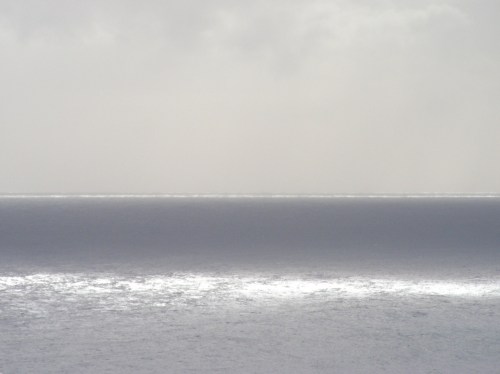
I love this photo, yet it’s probably one of the simplest ones I’ve ever taken.

You can look at this and, at first, think, “grey sky over grey sea”……so, what?

But look more carefully and you notice a fairly significant band of bright water created by the sun shining brightly on it, and the first thing I think, is, how interesting…..why such a narrow band of light? It’s pretty linear and it doesn’t seem to be related to a particular wave. The sky above looks so overcast I can’t see why only a slit of sunlight has appeared here.

Next, I look to the horizon. I’ve got a few photos like this where I capture just an expanse of sea and sky with an almost imperceptible edge where they meet each other, but in this particular photo, because the predominant colours are grey, the transition from sea to sky is even more subtle….except, wait, hang on, there is another bright, white band of sunlit water running across the entire view just immediately before the horizon!

What’s that about?

How come there are TWO bright, linear bands of sunlight, miles apart, with, apparently no other ones in-between?

That fascinates me and draws me into a longer, slower contemplation of this scene.

I looked at this image again this morning as I sat down to post this and I thought “less is more”.

There are very few distinct features in this scene but that minimalism somehow creates time and space.

It stops me.

I don’t rush on by, hurrying on to the next image, the next text, the next event, or whatever.

I thought, well, that’s a bit like this time in the world where the pandemic has brought the everyday hustle and bustle to a screeching halt. Millions of us have been at home for several weeks now.

Has that ever happened before? Not as far as I know.

One common theme which is emerging in the stories these days is of time slowing down, of routines, habits and tasks, melting away, and of small everyday experiences taking on a new significance and new quality. How many people are saying they hear more birdsong? I’ve never heard so much birdsong, and I’ve never heard such diversity of birdsong either. How many people are noticing blossom, flowers, sunrises and sunsets, the Moon?

This pared back life won’t last like this forever, but one of the most positive aspects of this time, for me, is an enhancement of what I value so much – “l’émerveillement du quotidien” – the wonder of the everyday.


Read Full Post »

What do you think when you look at these lemons?

Do you think some of them look lumpy and ugly? Does it bother you that some of them are really small, and others really big?

I think they look beautiful. I love their diversity. The fact that some are very nobbly whilst others are smooth fascinates me. I love the shades of yellow and green in their skins. I adore seeing the small ones cradled amongst the large ones. I’m fascinated by their shapes.

In this one basket you can see that every single lemon is unique.

It’s harder to see uniqueness if the producer, or merchant, sets standards with a narrow range, stipulating limits on the degree of diversity he will accept.

The practice of setting “norms”, “standards” and narrow expectations tends to obscure uniqueness, but uniqueness is still the essence of reality.

Diversity reveals uniqueness to us.

It shows us that every single lemon, every single flower, every single creature, every single human being is unique. Each one comes to life at a particular time in a specific place. Each one has its own unique experiences as it grows….experiences differences in weather, climate, interaction with other forms of life.

I think we humans have obscured the fact of uniqueness in two ways.

Firstly, through “mass” anything….from mass production to mass consumption. A focus on the mass blinds us to uniqueness.

Secondly, we tend to confuse “individuality” with “uniqueness”.

We all want to be treated as individuals, don’t we? I know I do. But a focus on individuality carries a danger of fragmentation. It separates us. Mary Midgely, the English philosopher wrote about the phenomenon of “atomisation” very well. She warned of the dangers of failing to the see the whole when we examined something only in its parts, or its “atoms”. And, in particular, she objected to the neoliberal idea that there is no such thing as society, that the best way to structure a society is for everyone to pursue their own selfish interests in a free marketplace. Those ideas have destroyed communities.

I don’t want to be “just an example of a group”. I don’t want to be treated as “just a number”, as a statistic. I want to be seen, known and treated as an individual. How do I square that circle? By focusing on uniqueness.

Our individuality is often defined by listing our differences from others, our separateness from others.

But our uniqueness combines our differences with our commonalities.

How so?

“No man is an island”

I don’t exist separate from something called Nature. I don’t exist apart from something called The Earth. I don’t exist disconnected from other human beings. I don’t exist separate from other forms of Life.

It’s taken the universe 14 billion years to make YOU. It’s never created YOU before. It will never create YOU again.

“Be yourself, everyone else it taken”

When you meet someone, when you make a new friend, when you get together with your family, you tell your story. You tell the story of where and when you were born, of the events and experiences of your life and how they shaped you.

That story is unique.

Just like everybody else’s.

It’s the circumstances, the contexts, the environments, the specifics of time, place, and experience which create our uniqueness, and the uniqueness of our story.

As a doctor, nothing gave me greater delight than to have the privilege of hearing unique human stories every single day of my work.

I love diversity.

I love uniqueness.

I find it beautiful.


Read Full Post »

I took a lot of photos from my windows when I lived on the edge of the village of Cambusbarron. Most of them looked out directly towards Ben Ledi. I never, ever ceased to be entranced by that view. It changed every day.

Of course, you’d tell me a mountain doesn’t change. At least, not visibly on a daily basis. But, look, this is typical of my idea of “Ben Ledi”. I never saw Ben Ledi, the mountain without any sky around it. I never saw it without the light illuminating it in different colours. I never saw it without the clouds casting shadows on it. Well, maybe there was the odd day when there were no clouds at all, but only rarely, and, even then, the light and colours changed constantly.

So, for me, whatever I look at, I see it in its contexts, its environment. I see its situation. I see the interplay of all the elements in the frame of my gaze. And then…..

….then I “see” it with my heart. I feel the emotions arise within me, shaded by memories and imaginings, coloured by symbols and significance.

When I look at this particular photo, I am in awe very quickly. I see the black hole darkness of the clouds which loom over the top third of the picture. I see how that darkness frames the sunlit mountain with the dark earth below. It’s almost like looking through a letter box. Looking through a letter box to see what the universe is delivering today.

I see the familiar shape of Ben Ledi, like a sleeping giant, an ancient ancestor of the elephants, perhaps.

I see the intensity of the sun peeking out along the edge of the cloud base, and how it lights from behind the low cloud or mist which sits at the foot of the mountain. Lights that low cloud so that it glows, not with a silver lining, but a golden one.

I see some of that low cloud rise up in the shape of dragon, looking towards the mountain….flying home, perhaps?

I see Ben Ledi, that great mountain, cradled in soft clouds, gently glowing with the sun’s golden light. Wrapping it in ephemeral, constantly shape-shifting cloth.

I see the life bringing energy of the Sun illuminating the Earth.

I see the life giving water of the sky kissing and caressing the Earth.

I feel calm.

I feel comforted.

I feel delighted.

I feel the stirring of my Soul.

Read Full Post »

When I noticed this tree in the forest I thought it had a long deep groove running the whole length of its trunk. It was as if it folded in on itself. But then I looked more closely and I saw that a better explanation was that there were two trees growing together. You could trace two distinct trunks all the way up, each spreading its own branches high above the forest floor.

I was even more taken with this when I saw it as two entwined, two organisms, two life forms, living, surviving and growing together. It reminded me of the myths of the soul….that each of us is in search of the other half….each of us longing for our soul mate.

But maybe I’m wrong. Maybe this is one tree which has partially divided itself…..partially, but not completely, so that now it appears as almost two trees instead of one. But does it really matter? Do I care whether these are two trees living intimately together, or one tree manifesting two clearly visible aspects of itself?

The first idea stimulates my thoughts about how important relationships are. It makes me think about how I can’t fully understand anyone, or any thing, in exclusion from its relationships. We are all embedded in vast networks of other people, other creatures, plants, micro-organisms, elements and molecules. We all come into being through a process of emergence within those networks. We all survive and thrive only because of those relationships and networks.

The second idea stimulate my thoughts about our multiple selves. I’ve never been able to understand anyone, including myself, by reducing them to a single, solitary self. Miller Mair’s “Community of Self” really impressed me. It struck me as true. I know a distinct self as a doctor, which is quite different from, yet completely connected to, my self as a parent for example.

A homeopathic doctor in Paris once told me he saw every patient as like a diamond, with different facets glinting in the sunlight. Each facet represented an aspect of that person. That impressed me too.

Then, much later, I read the works of the French philosopher, Gilles Deleuze, and his focus on “a multiplicity of singularities” seemed to me to be saying the same thing, just in a different language.

We are all multiple.

We are all a complex of multiple, distinct, unique “singularities” – both within ourselves, and within our world.

We are all One.

Read Full Post »

I love the concept, and the phenomenon, of flow.

Look at these grasses below the water. You can easily tell that the water is flowing strongly and making them all point in the same direction. You can even see the water. But you can’t see the flow.

It’s like when I’m in the garden. It can be a cloudless, blue sky day, or a grey, cloudy day, but at around 4pm I will feel the wind start to blow on my face. I’ll hear it rush through the trees, shaking their branches and rattling their leaves. But I can’t see it. I can’t see the wind. Just the effects of the wind.

Flow is like that. It’s an invisible force made visible by the way it shapes the world.

Look at this river. You can tell that it, too, is flowing fast, can’t you? There aren’t any rocks sticking up for the water to foam against but you could swear you can see the currents. Beneath, through, within, the water, is the flow.

We are like that too. We human beings. Life flows through us, shaping us, bending us, pushing us on, encouraging us, driving us onwards. Life flows through us making us grow, mature and develop.

It doesn’t help to resist that flow. Well, that’s not completely true, is it, because there is something in response, in reaction, which is a kind of resisting, a kind of pushing back on, leaning into, or standing against, which shapes us.

Flow doesn’t have a starting point.

Flow doesn’t end.

Flow is.

Many years ago, as I walked to the train station one day on my way to work, I came across an excellent example of how to respond to flow –

Surf it!

Read Full Post »

« Newer Posts - Older Posts »