Feeds:
Posts
Comments

Archive for the ‘from the living room’ Category

There’s a very human tendency to view ourselves as outside the world. What I mean is that we feel we are IN the world, but we remain APART from it. We are dualists. We think “there’s me” and “there’s the world”.

How did we get here? Just parachuted into it? Dropped down from outer space? We talk about “Nature” or the “the natural world” as if that’s something other than ourselves. As if it’s a place we can visit, and then leave again.

But that’s all a sort of delusion, isn’t it?

There is no “me” separate from “the world” or from “Nature”. We didn’t land on Earth from an alternate universe, we emerged within it, live within it, die within it. There is nowhere else. (Or if there is, we have no way of knowing that)

Yet, this sort of division persists, doesn’t it?

In fact, it seems this is a crucial and necessary part of being human. Our brain has evolved the ability to create what some call, “a necessary distance” between the flows of energy, information and materials pouring through ourselves and the planet we live on.

We are great pattern spotters, we humans. We see patterns, analyse them, name them, categorise and label them, then we can re-cognise them very quickly. We create maps in our minds. We create a “you map”, a “me map” and a “we map”, as Dan Siegel says in “Mindsight”. These maps contribute greatly to our sense of self, as well helping us to recognise others and develop confidence and belief in our relationships.

Our linguistic abilities are used to create the names and labels and to think about whatever we are applying them to, as well as enabling us to communicate about them. We use words, symbols and metaphors to take these processes of analysis and recognition to whole new levels. These are some of our super-powers as humans. They enable us to literally, and metaphorically, grasp the world in which we live.

To do all those things requires us to step back from the flow of experience. We use this “necessary distance” to momentarily step aside, to enable us to see more clearly, understand more deeply. With this comes this sense that we are “apart”. That there is “me” and “The Other”. When, in reality, there is only ONE, and we live inextricably IN the flux and the flow.

I don’t like judgements. They stop thought. But we need them. It’s just we need to be able to let them go more easily than we make them as our understanding deepens, as we see more and more connections, envisage the contexts in which whatever we are examining exists.

So, it’s interesting to me, to take the old school philosophical spiritual practice of “the view from on high”, literally from time to time. To climb up somewhere, to take the time to gaze towards the horizons, to see the landscape unfolding in front of me. To see the “bigger picture”.

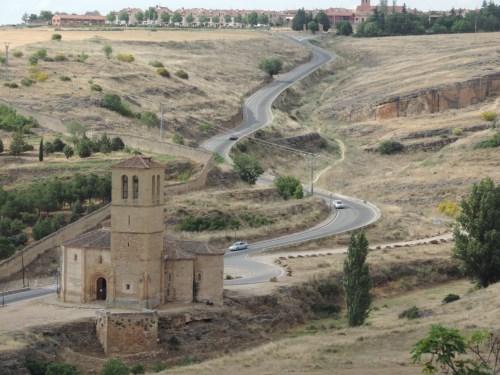
This photo is one I took the other day when standing outside the Alcazar in Segovia. I’m pretty sure that what caught my eye was the church. It seems to stand alone. Almost in the middle of nowhere. But as I framed the shot my eye was led from the church to the winding road which my mind then followed to the top of the hill. Up on the ridge I could see buildings. A lot of buildings. So not a church in the middle of nowhere at all. But still, a church set apart somehow. The curve of the road was immediately appealing and I made sure I included it in the camera frame.

Now that I look at this image I see, yes, the church, that physical symbol of the spiritual connected to the village at the top of the hill by a winding, beautifully curving road. You could argue the road leads to the church. Or you could see the road as leading from the church to the town where people live. In other words, you can see the church, the town AND the connection all at once. I find that immensely pleasing.

I don’t know if that will get you thinking about the place of the spiritual in human life. It might. Or maybe it will get you thinking about connections, contexts and the illusions of separateness?

Ah, before I go, one other thing……see the wall someone has built just to the left of the church and the road? Someone has claimed this piece of the Earth as their own and built a wall around it to strengthen their feeling of separateness. Most people live in the village on the ridge, or so it seems to me. Not many live behind the wall.

Oh yes, walls again. We are hearing a lot about them these days. Both literal walls, to separate Americans from Mexicans, or Palestinians from Israelis, and the toxic and divisive “US AND THEM” walls which divide “natives” from “immigrants”.

But it’s all one world, huh? We share the same planet, the same air, the same water, the same place in the evolutionary path of Life.

It’s a bit of a challenge isn’t it? To see differences and separations but to see them as inextricably connected in a bigger picture.
Read Full Post »

Sometimes I notice that something I’m looking at strongly reminds me of something else. In fact, isn’t that the fundamental way in which we engage with the world?

Whatever we are looking at, hearing, sensing….wherever we are….our experience is unique. Even a person standing right next to us in that same moment will have a different experience.

One way to consider this idea is to think of two people walking along the bank of a river. For the first person, throughout their whole life they have found something soothing and calming about the flow of a river. They look at this river, walk beside it, and feel calm. It delights them. For the other person, rivers are associated with danger. Maybe somebody they knew fell in a river and drowned one day. Maybe they, themselves, fell in and almost drowned one day. Every time they approach a river, any river, they feel anxious, insecure and unsafe. They are alert to the possible dangers.

These two people are sharing a moment in time and space, but neither of them is having the same experience as the other.

I often wonder about the connections we make in our minds….the memories which come to the fore, the emotions and thoughts which arise, in any particular moment. And how those memories, those thoughts, those emotions and, yes, beliefs, fashion each and every new experience.

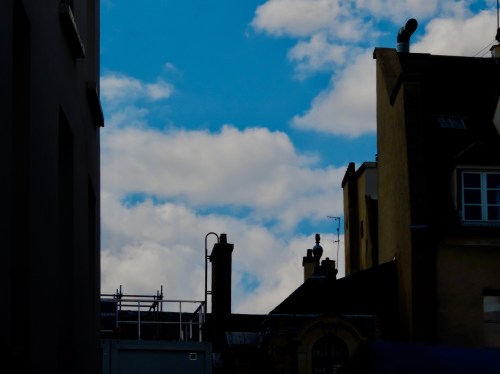
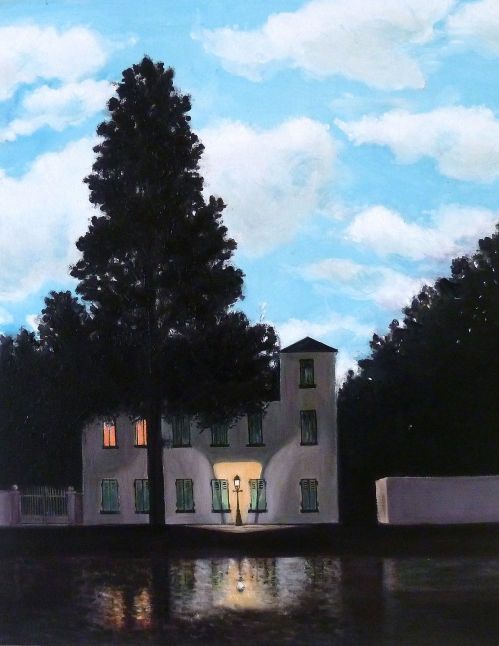
When I looked at this scene above through the viewfinder of my camera it looked pretty much like you see it here in this photo. Instantly I thought of Magritte’s “Day and Night”.

And in that moment I wasn’t seeing just some clouds in front of a blue sky over some rooftops. I was seeing a work of art. It reminded me of an early scene in the movie, Basquiat, where the artist looks up at the sky and see surfers.

It set me off thinking about the power of art to change the way we see, not only the moment we are looking at a particular painting, but the way we see the world ever after.

Read Full Post »

I’ve recently realised I have a dual speed approach to photography.

First of all, something catches my eye and I stop to take a photograph. Normally, I don’t spend long over this part. I see something. I stop in my tracks. I get my camera or phone out of my bag, frame the shot, and click. Photo taken. That’s the fast part.

Secondly, I upload all the photos I’ve taken that day, or that week, onto my computer. Then I make a first pass, deleting the ones which are just awful, and adjusting others, cropping, straightening, lightening, deepening…whatever seems to need done. That takes time. It’s the first phase of the slow part. As I do that, certain images strike me more than others do, and I mark them as “favourites”.

Thirdly, and this might happen, days or even weeks afterwards, I browse through them, or find myself searching out a particular photo because I’ve been thinking about something and that image has come to the front of my mind. I pick out the one I’m looking for, or I pick one that strikes me in that moment, and begin the fourth stage.

Fourthly, I upload the photo to my wordpress account and paste it into a new post. Then I take my time to look at it more closely and write what thoughts arise. This is the final slow part.

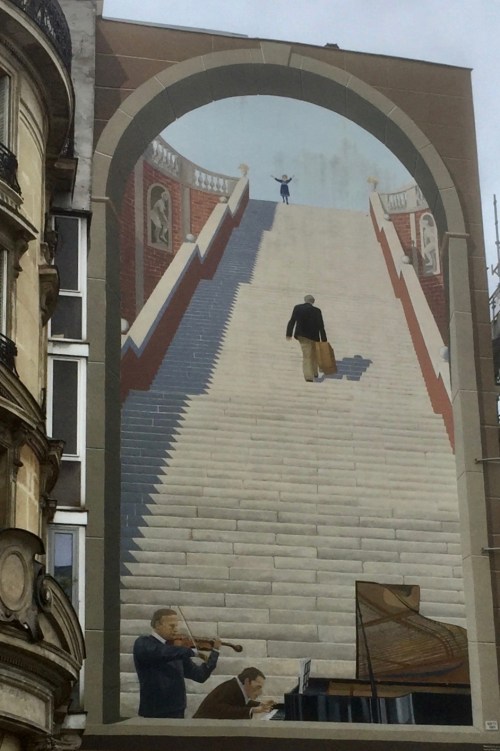
Here’s an example. I was in Paris for a few days a couple of weeks ago and one of the days as I was crossing a road I noticed this huge mural above the shops. I stopped (deciding not to cross with the green man yet!), took out my camera, framed the shot and clicked, then I continued on my way. Once I returned home I uploaded all the photos and when I saw this one I cropped it a bit to focus on the artwork itself. Then I inserted it into this post. The thoughts which have arisen included what I’ve just written about the dual speed nature of my photography, which, strangely, are a set of thoughts about thinking about this photo…..a kind of meta-view……an overview, if you like. Then I returned to the image itself.

This image intrigues me. It’s a huge flight of stairs. I was exploring Paris at the time and that always involves a LOT of walking and a LOT of stairs if you use the metro. I checked my phone and it told me I’d climbed 14 flights of stairs that day! Wow! In that sense, this image was a great motif – this is what a visit to Paris entails – lots of steps! By the way, have you ever climbed the steps up to Sacre Coeur? That’s quite a climb. Or made your way up the crowded Spanish Steps in Rome? Or have you climbed any of the long stairways in Edinburgh up to the Old Town? (You’ll have figured out by now I’m remembering some of the long stairways I’ve climbed. I could add a lot more, but I’ll leave you to add your own).

I’m of a certain age, so a particular piece of music pops into my mind at this point. Yep, Led Zeppelin, ‘Stairway to Heaven’.

And then I return to the image…..

Could the musicians be playing ‘Stairway to Heaven’? If not, what might they be playing?

What other characters are in this mural? There’s a young girl at the top. She’s looking pretty happy and welcoming, and there’s the central character, the man with the suitcase. I realise I’ve immediately identified with the man with the suitcase. Isn’t that something we do quite a lot? Identify with the hero? The central character in the story? Isn’t that how we make sense of our lives actually? Telling ourselves the stories where we are both the author and the main character? Which gets me wondering about the stories we tell. Maybe the man’s suitcase is full of stories? Maybe he’ll be telling some of them to his child (that is his child at the top isn’t it?) once he gets to the top. I suppose there are a lot of life stories about uphill struggles. And lots which are about things “all going downhill” too!

One of my greatest joys throughout my working life was to hear people’s stories, the stories of the patients who came to see me. I never heard too many. Maybe I could even say I never heard enough of them? I loved to sit and listen to them.

Hey, the other night there I watched the movie “Hector and the Search for Happiness“. Seen it? I recommend it. I laughed! And it’s gently thought provoking too. Well, one of the lines in that movie is “Listening is loving”. I liked that line.

I get the feeling that this man is coming home, don’t you? The girl looks like she’s gesturing “welcome back!”

But wait, there are two other characters in the image. Near the top of the stairs there are two statues, both of which seem to have just come to life, and are about to step out from their little platforms. Doesn’t it look like that? I mean, they could just be two statues, each captured in an action pose, but I don’t get that impression. It looks like they are starting to move. Are these two goddesses? If they are, then what are they about to bring into this man’s life, into his story?

What do you think?

……well, this is what I mean by dual speed photography – from noticing to contemplating.

I recommend it.


Read Full Post »

On a recent trip to Paris I came across this graffiti. It was the image of the girl with the balloon which caught my eye but, afterwards, when I looked more closely at the text, I saw it read – “Mange, et savoure la vie!” –

“Eat, and savour life!”

The two verbs, given as commands, are in the familiar, rather than the formal forms, which makes the advice somewhat more human, more friendly.

How do we eat life? I think it’s by consuming every experience, swallowing the everyday phenomena and making them a part of ourselves. Because, that’s what we do, don’t we? We encounter, we taste, we swallow, we digest, and we integrate our experiences into our selves. What we encounter, how we taste it, whether we swallow it, or spit it out, and how we process it, all goes to make us what we are. It all goes to make our lives what they are.

How do we savour life? By slowing down, consciously experiencing, and suspending judgement.

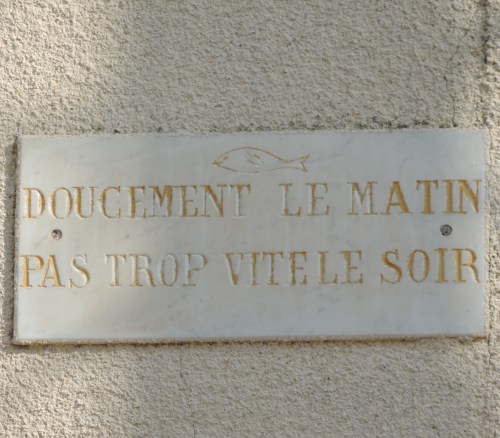
That reminds me of a plaque I once saw on the wall of a fisherman’s cottage in Provence –

Which can be read as “Go slowly in the morning, and not too fast in the evening”.

I think this is a key to happiness, a fundamental principle of how to live –

Savour the day

and slowing down, taking your time to notice and become aware, is the best way I know how to do that.

Read Full Post »

Do you get those experiences where something catches your eye, then when you stop to reflect on it, its significance gets deeper and deeper?

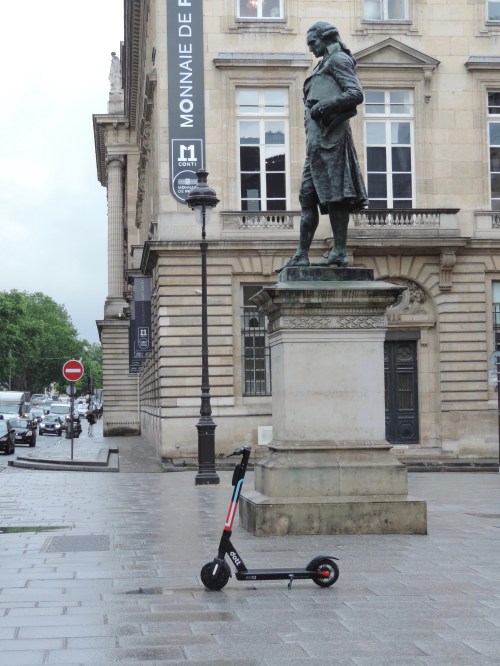
Last week I was in Paris, and on one of the rainy days was heading for a restaurant at lunch time but this scene caught my eye. Despite the fact it was raining, I stopped and took a photo. In fact, I took two….the first time my camera slipped as I pressed the shutter and I only caught the top of the scooter!

These electric scooters are everywhere in Paris just now. You can hire one using an app and drop it off anywhere you like. In fact, that’s become a bit of a problem. People are falling over them on the pavements and sustaining injuries, so the authorities are starting to consider new regulations to control them.

I took the photo because I thought it looked funny. To see this serious gentleman either looking down at the scooter somewhat disdainfully made me smile. Then I thought maybe he’s actually thinking about jumping down onto it!

When I got home, I decided to find out who this man is – turns out he is “The Marquis de Condorcet”, a leading Enlightenment thinker and writer, a mathematician and philosopher. One of his most deeply held beliefs was “progress”. He thought we humans, through learning and communicating with each other, would steadily increase our understanding of the natural, social and political worlds, continuously progressing and improving society. “However, Condorcet stressed that for this to be a possibility man must unify regardless of race, religion, culture or gender”

The wikipedia entry on him goes on to say this –

Condorcet was concerned with individual diversity; he was opposed to proto-utilitarian theories; he considered individual independence, which he described as the characteristic liberty of the moderns, to be of central political importance; and he opposed the imposition of universal and eternal principles.

He was a champion of diversity, equality and individual freedom. But he was also a champion of thinking – that progress required us to deepen our understanding of the world and of each other, comparing and reflecting on our individual experiences. He campaigned against slavery and for women’s civil rights.

So, it took an electric scooter to get my attention, but I’m glad I’ve discovered Condorcet. I think we could learn something from him about the importance of values, diversity and justice.

Read Full Post »

In 1960, the French magazine, “L’Express” published a series of extracts from the writings of American and Russian scientists about what our world would be like in the year 2000.

It’s fascinating to read them, and reflect on how well those “scientific” predictions have worked out.

  • “voyages to the moon will be commonplace” – the last time people walked on the Moon was in 1972.
  • “and so will inhabited artificial satellites” – the International Space Station? There is one!
  • “all food will be completely synthetic” – maybe not, but an awful lot of it is “highly processed” and, apparently, not so healthy as the natural kind!
  • “The world’s population will have increased four fold but will have been stabilised.” – it doubled, but it’s still rising.
  • “Disease, as well as famine, will have been eliminated” – that old prediction! How often are we told science is about to end all disease? Was the last time the Human Genome Project? And famine? Sorry, not disappeared yet!
  • “There will be universal hygienic inspection and control” – ooh, that’s a bit scary…what’s that? Mass immunisation with a shift towards compulsory instead of voluntary? There are some life insurance products around which link your premiums to the number of steps you take daily, recorded on an wearable device which transmits the data to the insurance company.
  • “The problems of energy production will have been completely resolved” – still trying to break free from fossil fuels, nuclear power plants have turned out to be way more expensive than predicted (remember when we were promised nuclear generated electricity would be so cheap they wouldn’t have to charge for it?) and renewables have a long way to go…
  • “Knowledge will be accumulated in electronic banks and transmitted directly to the human nervous system by means of coded electronic messages” – wonder how came up with that one back in 1960? Did they foresee Google and Wikipedia? Maybe these knowledge banks don’t send their coded messages directly into our nervous systems but they do to our hand held screens.
  • “Natural reproduction will be forbidden. A stable population will be necessary, and it will consist of the highest human types, using artificial insemination from persons dead long enough that a true perspective of their lives and works, free from all personal prejudice, can be seen” – wow! This is the scariest one for me! Forced population control by preventing ALL natural pregnancies and genetically selecting on the basis of “a true perspective” of peoples’ lives and works long after they are dead! And, get this, because this is still a common one…..selected “free from all personal prejudice”. There’s a lot in this one and the foundational beliefs behind it are that “objective”, “rational” science can produce “the highest human types”.
  • “they will be able to shape and reshape at will human emotions, desires and thoughts and arrive scientifically at certain efficient pre-established collective decisions” – whoah! From the “neuro-marketing” techniques used by advertisers and merchandisers, to Cambridge Analytica, targeted, disappearing Facebook ads, Twitter bot accounts, WhatsApp groups, robot-calling targeted voters, fake news generated from edited videos….there’s a LOT going on with this one. Increasingly pyschologists and neuroscientists say influencing emotions rather than arguing rationally is a better way to get the results politicians and marketers want. But it’s the last part of the prediction that gives me the chills – “arrive scientifically at certain efficient pre-established collective decisions” – not supporting the creation of new ideas, encouraging critical thought and debate, but manipulating people into making the decisions you want them to take. Have a listen to this (or read the text) – a Guardian article on the new digital populists.

Read Full Post »

I recently visited the Chateau de Clos Lucé in Amboise, in the Loire valley. This is where Leonardo da Vinci spent the last years of his life. He was invited to live there by François I in 1516. The king provided Leonardo with a place to live, 700 gold ecus a year, and financed his works, in turn for the pleasure of his company and daily discussions with him. Leonardo only lived three more years, dying in 1519, which is why, on this 500th anniversary year of his death, the chateau is hosting a major exhibition of his work. (As an aside I find it fascinating and inspiring that Leonardo was given free range “to dream and work” – what kind of society could we have if we funded creatives and academics to “dream and work” together, without goals, funding applications or publication demands?)

There are a number of Leonardo quotations around the chateau and the gardens. This one caught my eye –

You know that medicines when well used restore health to the sick: they will be well used when the doctor together with his understanding of their nature shall understand also what man is, what life is, and what constitution and health are. Know these well and you will know their opposites; and when this is the case you will know well how to devise a remedy.

After a lifetime career in Medicine, I’m less sure now that medicines do “restore health to the sick”. I think it’s biology which restores health. Human beings are complex adaptive systems, and all such organisms have both “self-healing” and “self-making” capacities. The best medicines stimulate those natural processes of healing. The next best support the processes. Many of the ones we use reduce symptoms, or reverse an imbalance in the body, both of which are reasonable goals and acts, but are they directly involved in restoring health to the sick? Do you think that’s just semantics? I don’t. I’d have a hope for the future that we’d develop the treatments which really do support and stimulate the natural processes of healing, and that’s what Leonardo says, in other language, at the end of that quotation – “when this is the case you will know well how to devise a remedy”.

When what’s the case?

Oh, yes, understand “what man is, what life is, and what constitution and health are”.

Ah! Well, there lies both the problem and the signposts to the solutions…..

A couple of years into my work as a General Practitioner I started to wonder what health is. Nobody taught us what health is at university, and the clinical training of a young doctor focuses on learning diagnostic and therapeutic techniques – identifying pathologies and treating disease states. I went back and looked at my Clinical Medicine textbooks. I searched the index for “health” – no entries. Nope, not one. That set me off on an exploration, looking for an understanding of what health is. The medical school textbooks were no help. Oh yes, there was that old World Health Organisation definition –

“a state of complete physical, mental and social well-being and not merely the absence of disease or infirmity.”

But all that really does is substitute the word “well-being” for “health”. It does suggest health is multidimensional – physical, mental and social – and it does suggest health is something positive, not just the absence of disease or infirmity. But does it really take us much further that irritating “Brexit means Brexit”?

While researching the issue of the absence of health in medical textbooks, I discovered there was a kind of parallel anomaly….biology textbooks didn’t have a definition of life. Really? Well, yes, it wasn’t uncommon to find a biology textbook without the word life appearing in the index.

So what is life?

One of the more satisfying descriptions I read was from Maturana and Varela’s, living organisms demonstrate a “self-making” capacity, which they termed “autopoiesis” and that lead me down the path of the complexity scientists and their definition of “complex adaptive systems”. I still find that a good starting place.

That leaves us with two more areas to explore, according to Leonardo. What is man? and What is a constitution? Remember he was writing 500 years ago, and we would probably now say “What is a human?”, rather than “what is man?”. Let’s leave constitution aside for just now, as it’s pretty embedded in the issues of what is a human and what is health?

What is a human being?

There have been a couple of books published recently which put this question centre stage again. Douglas Rushkoff’s “Team Human“, and Paul Mason’s “Clear Bright Future“. Both of these books are concerned about the impact of technology on human beings and on our societies. Rushkoff says –

being human is a team sport. We cannot be fully human, alone. Anything that brings us together fosters our humanity. Likewise, anything that separates us makes us less human, and less able to exercise our will.

In other words, he focuses on the innate sociability and need to act co-operatively in human beings. I’ve heard Paul Mason say at least two interesting definitions of what is a human – human beings “use energy to counter entropy” – in other words we are a creative species. And human beings are “co-operative, imaginative and linguistic” – the combination of which makes us a unique species.

All of these ideas are interesting to me. And I find it refreshing that these questions are coming to the fore now. Surely this is a timely and positive response to the mechanical, data and statistics driven reductionism which is so utterly de-humanising.

I continue to explore what it means to be human, and I find some of the more impressive answers in the works of philosophers, from the classical schools to Spinoza, Bergson and Deleuze (to name just a few!)

Of course, I could write about this for hours! Ha! Ha! But I’ll stop here and leave the possibility that these are questions you might like to pursue for yourself.

Let me summarise – because I think this is a lifetime project as well as potentially the basis for a whole curriculum –

  • What is Life?
  • What is a human being?
  • What is health?

The answers which appear from those studies could, possibly, give us the remedies of the future – the ones which actually do “restore health to the sick” – and, yes, more than that, allow us to create healthier societies filled with people who fulfil their potentials, creatively, co-operatively, and artistically…..can I even say “spiritually?”

Read Full Post »

I think it’s pretty well established that being out in Nature is good for us – good for our physical and our mental health – but also good for well-being and just feeling that life is worth living.

I know that since I moved from a second floor flat in Central Scotland to a house with a garden in the Charente that I’ve been out in nature much more, that I feel closer to nature, more a part of nature even – that I feel more in tune with the birds, the seasons, the plants, the rhythms of Life and this World.

I think it’s also pretty well established that one of the aspects of being human which distinguishes us from other creatures is Art. The philosopher, Giles Deleuze said there are three ways of thinking – philosophy, which is thinking about concepts; science, which is thinking about function; and art, which is thinking about percepts and affects. I’ve always found that model useful. I enjoy all three ways! In terms of visual art I do enjoy galleries, but there’s something especially impressive I find when I come across art in Nature.

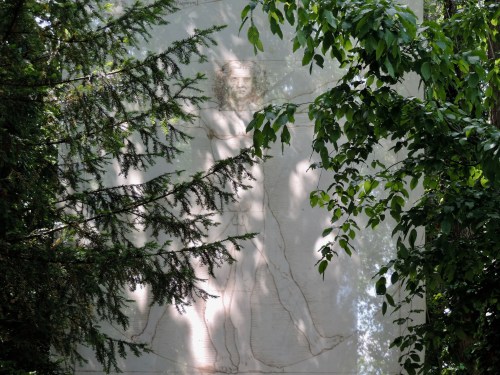
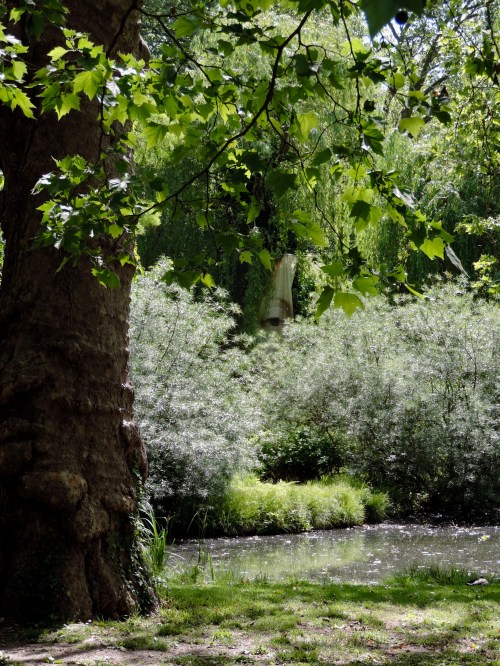
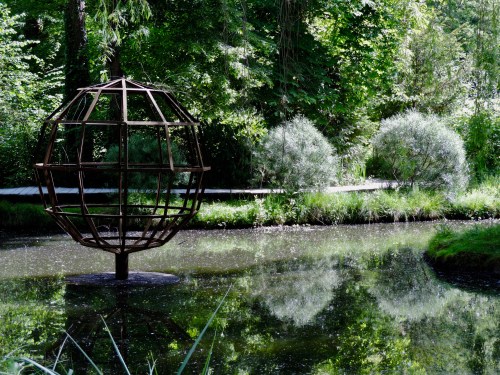
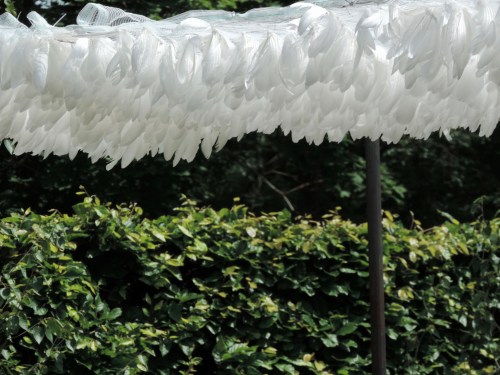
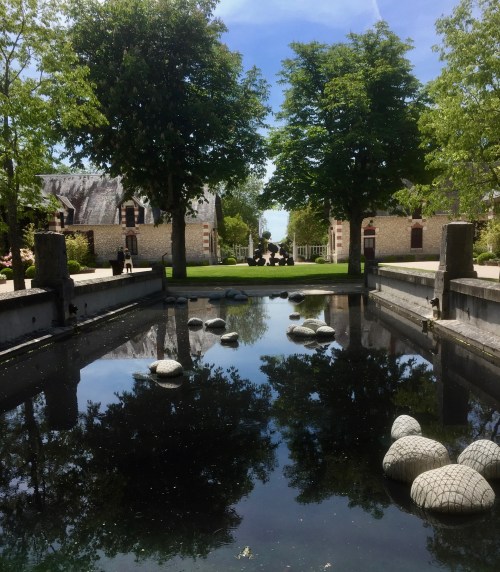
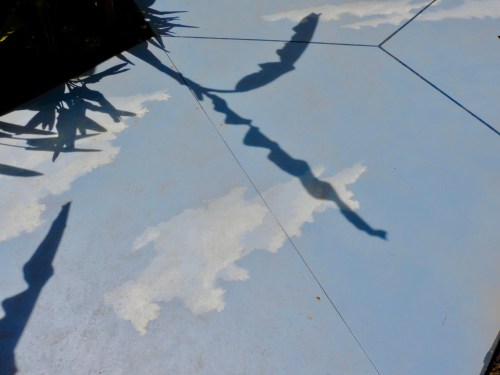
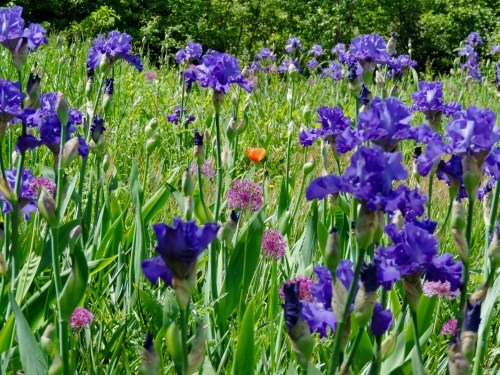
Here are some examples from a recent trip I made up to the Loire Valley –

What about you?

Have you any favourite examples of art in natural settings to share?

Read Full Post »

One of the most striking characteristics of any natural environment is diversity.

Diversity of species, diversity of colour, of form and size.

If you think two plants are identical, you’re not looking well enough.

Every single living organism is born into, matures in, and dies in, a unique time and space, a unique environment in which it experiences an life which has never been lived before, and which will never be repeated in its details.

You might find that hard to swallow when you are thinking about flowers, but I bet you don’t find it so difficult when you think about yourself, your parents, your siblings, your children, your friends and colleagues. Do you?

And yet, we live in societies which seem determined to flatten out, or ignore our differences. We are reduced to averages, to mere examples of a “mass”, to statistics. Yet in the lives we are actually living we don’t find these so-called averages. Nobody quite fits that mould. We are not elements of a mass, but unique creatures living together. Life can’t be reduced to what can be measured, to mere statistics. We lose something essentially human when fail to see what’s unique.

It seems there’s another power at work too – conformity. The social, economic and physical pressures to be the same…to consume the same products, to produce the same products, to have the same desires, wishes and opinions. There’s a terrible reductionism in the world, the worst of which are the binary ones – the ones which reduce life to “either/or” to “us/them” to “good/bad” to “citizens/foreigners”….you can find your own ones all around you, dividing the world into two groups on the basis of race, gender, belief, sexuality, nationality.

When I get overwhelmed by the stories of “the rise of the populists”, of xenophobia, prejudice and cruelty, I find it re-balancing to walk slowly in the plant world and remind myself how reality is based on uniqueness, how Life thrives on diversity. Then to bring those principles and values back into my everyday life.

Read Full Post »

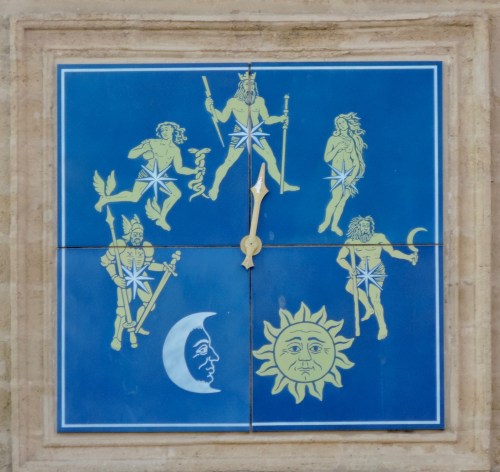
I’m having one of those synchronicity weeks. This one is about time. I stumbled across this old photo the other day. I took it in Salon de Provence. It was at the top of a tower in the middle of the town. I don’t think I’ve ever seen a clock like this before. Instead of dividing the day into hours and minutes, it divides the week into seven days. And it uses the ancient astrological/mythological origins of the names of each day – starting at the top, where the arrow is pointing, is Jupiter, for “Jeudi”, or Thursday (in English we swapped Jupiter for Thor, but both carry a thunderbolt), next in sequence is Venus (Vendredi, or in English, Friday, again swapping the Greek goddess and planet for Frigga, the Germanic goddess of married love), then Saturn, for Saturday, the Sun, for Sunday, the Moon for “Lundi” (or Monday), Mars for “Mardi”, (again, the English swapped Mars for the German god of war, Tiw) and Mercury for “Mercredi” (yep, you guessed it, the English went to the Germanic gods again, and swapped out Mercury for Woden).

Apart from the powerful use of the ancient symbols for the days of the week, what impressed me about this clock was its single hand, which slowly and smoothly moved from day to day. That felt immediately like a different pace of life.

This week I listened to the BBC’s Start the Week podcast about “Bergson and Time“, possibly the best, and clearest introduction to Bergson’s startling concepts of time I’ve ever heard. I recommend it. Bergson, in essence, talked about two kinds of time – lived time, the time we actually experience, (which he called “duration”); and measured time, which is artificial and divides the flow of time into discrete pieces we call hours, minutes and seconds.

I’m reading Jacques Ellul’s “The Technological Society” at the moment, and just this afternoon read this –

At most, life had been regulated since the fifth century by church bells; but this regulation really followed a psychological and biological tempo. The time man guided himself by corresponded to nature’s time; it was material and concrete. It became abstract (probably toward the end of the fourteenth century) when it was divided into hours, minutes and seconds. ….The first private clocks appeared in the sixteenth century. Thenceforward, time was an abstract measure separated from the traditional rhythms of life and nature. It became a mere quantity.

and

Today the human being is dissociated from the essence of life; instead of living time, he is split up and parcelled out by it.

Then, today, in Austin Kleon’s weekly newsletter he has a link to a post, “Working with time” –

“Like, you can always make more. I think that’s why I’m a time-based worker. I try to go at my work like a banker. I just have hours. I show up to the office and whatever gets done gets done. “And I’ve always been a time-based worker. You know, like, ‘did I sit here for 3 hours and try?’ I don’t have a word count when I sit down to write. It’s all about sitting down and trying to make something happen in that time period — and letting those hours stack up.

Now, there are writers who work in quite the opposite way, sitting down to write a certain number of words or pages each day and just doing that until it is done, irrespective of the hours passed. I’m not claiming one way is better than the other, just that it’s interesting to become aware of the difference between lived time and measured time.

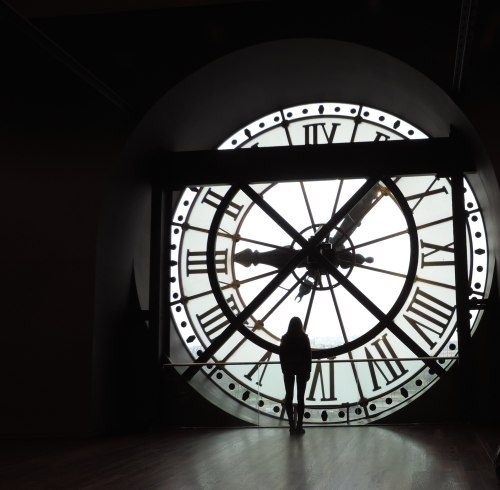
And to wonder about how the influences our everyday lives. (this second photo is one I took in the Musée d’Orsay, in Paris)

Are we distanced from the rhythms of Nature, of the World, by the machinery of time-pieces?

That’s Ellul’s claim, and I think we are. Whilst machines often allow us to achieve what we couldn’t have without them, I think it’s healthy to step out from that occasionally and re-connect ourselves to Natural Time…..re-connect ourselves to Nature. Get a dose of Vitamin N.

Read Full Post »

« Newer Posts - Older Posts »