Feeds:
Posts
Comments

Archive for the ‘from the reading room’ Category

Tokyo office

I’ve been thinking about bureaucracy recently so I dug out this photo I took in Tokyo one evening a few years ago.

It’s an office block and there are many like this in most cities I expect, but two things struck me when I saw this one. The first thing was how it looked like a cage or a prison, and the other was “what does everyone DO in there every day?”

I’ve been thinking about bureaucracy partly because last week was the deadline to submit a “declaration de revenus” (declaration of income) at the local tax office in France. I’ve only been in France since November last year so I hoped I’d manage to escape the tax forms until next year. On Monday I joined the queue at the tax office at 0830am (a queue which snaked out of the office, down the steps and along the pavement by the time I got there), and patiently waited until it was my turn. I explained in my best French that I was “Ecossais” and had arrived to live in France in November, so did I need to complete a tax return now, or could I leave it until next year? (Of course, I hoped the answer would be “next year”) The answer was “maintenant”. Yikes!

The second reason I’ve been thinking about bureaucracy recently is I’ve just read David Graeber’s new book, “The Utopia of Rules“. It makes a lot of sense to me. His book is a collection of three essays in which he explores the seemingly unstoppable rise of bureaucracy around the world. He does a good job of explaining how it’s happened. I think what he describes is a kind of “road to hell” – you know the one which is “paved with good intentions”? He makes the case that creating rules, regulations and standards partly arises from the desire to break “arbitrary power” – to produce common “transparent” rules which will be applied in all circumstances regardless of who the people are. Another source is the human desire for certainty and predictability which produces a preference for numbers and the simplification of complex situations.

So what does all this form-filling do for us? What kind of world do we get when give precedence to what can be measured and when we substitute figures for values? What happens when we try to run our institutions and our societies by applying algorithms?

We end up de-humanising our lives.

Whilst bureaucracy might have had the intention of taking away “arbitrary” power from individuals to produce something more “transparent” and “equitable”, it merely shifts the power up to the rule-makers and their enforcers. And this shift away from individuals who can be known, and with whom we can develop relationships over time, to faceless, nameless bureaucrats simply increases the alienation which we all experience in society.

I think the practice of Medicine is sadly de-valued by protocols, algorithms, “guidance” and rules. I preferred it when we trained professionals who developed their knowledge and their wisdom over their years, and who could flexibly adapt what they knew to deliver holistic, compassionate care always in the interests of the individual they were working with right now.

We see reports of teachers saying that working life has become unbearable under the constant auditing and “performance reviews”. We see health care workers suffering from stress from overwhelming amounts of paper-work, audits and bullying. We see doctors heading for the retirement door at the first possible opportunity as decisions are taken out of their hands and placed into those of bureaucrats who create “referral guidelines” and “treatment protocols” – Medicine by numbers.

One of the key themes of my blog is “heroes not zombies” and it seems to me that bureaucracy is one other way to create zombies – in addition to the tried and tested “bread and circuses” techniques.

Do we need more rules, more regulations, more “standards”, more monitoring, more surveillance, more audits, more “performance reviews”, more “elimination of variation”?

Or are we building ourselves cages to live in?
Read Full Post »

Cotard

I was watching an episode of Vikings the other day, and was startled when one of the character, King Ecbert recited a few lines of poetry which were completely familiar.

Time present and time past
Are both perhaps present in time future,
And time future contained in time past.
If all time is eternally present
All time is unredeemable.
What might have been is an abstraction
Remaining a perpetual possibility
Only in a world of speculation.
What might have been and what has been
Point to one end, which is always present.
Footfalls echo in the memory
Down the passage which we did not take
Towards the door we never opened

T S Eliot! From the Four Quartets! Dramatically it worked, even if you couldn’t help thinking, whoa there, T S Eliot in the Vikings??!

I studied Eliot at school and he is still one of my most favourite poets. I remember reading this passage and feeling enthralled by it, but I had no idea what he was talking about. Now, as I encounter it again, I’m surprised how well it fits with what I have since discovered about time and memory.

In fact, by one of those strange quirks of synchronicity, this month’s “Philosophie” magazine has a central section on Bergson’s concept of memory. Bergson was way ahead of his time and many of his philosophical ideas about the mind have since been backed up by research findings in the field of neuroscience.

Much as I can be thrilled by reading the work of a philosopher, or research work in neuroscience, neither of these comes close to the power and beauty of Eliot’s poetry.

Draw all three of these strands together, and we have a vision of experience which is not of the past filed away in some cabinet or pigeon hole in the brain, nor of the future lying like the landscape just over the next hill, waiting for us to discover it. No, instead we have a vision of the present which contains the past and the future. This is where we encounter time and reality, in a never ceasing interplay of the ripples of the past, the imagined possibilities of what might be, and the phenomena of the present moment.

So it isn’t just what happened which influences us now, but those passageways we didn’t take, and doors we didn’t open, are also still influencing what we see, hear, feel and think about today.

Read Full Post »

ava charlie

I was recently sent a copy of an article published in Norway back in 2011. The article’s title is “The human biology – saturated with experience“. Here’s the summary –

SUMMARY

BackgroundHuman beings are reflective, meaning-seeking, relational and purposeful organisms. Although experiences associated with such traits are of paramount importance for the development of health and disease, medical science has so far failed to integrate these phenomena into a coherent theoretical framework.

Material and methodWe present a theory-driven synthesis of new scientific knowledge from a number of disciplines, including epigenetics, psycho-neuro-endocrino-immunology, stress research and systems biology, based on articles in recognised scientific journals and other academic works. The scientific sources have been deliberately chosen to provide insight into the interaction between existential conditions in the widest sense (biography) and biomolecular processes in the body (biology).

Results. The human organism literally incorporates biographical information which includes experienced meaning and relations. Knowledge from epigenetics illustrates the fundamental biological potential for contextual adaptation. Intriguingly, different types of existential stresses can enhance disease susceptibility through disturbances to human physiological adaptation systems, mediated in part through structural influences on the brain. Experiences of support, recognition and belonging, on the other hand, can help to strengthen or restore a state of health.

It’s a fascinating review of research literature on the links between “biography” – an individual’s unique story, and “biology” – the biomolecular processes of the body. It seems clearer to me than ever that talk of “mind and body” as if these are two separate entities is both unhelpful and misguided.

We are certainly “reflective, meaning-seeking, relational and purposeful organisms” and it’s long seemed to me that to practice medicine without that understanding demeans both patients and practitioners. Human beings are not objects which can be reduced to genes, molecules or cells. We are complex adaptive organisms with consciousness. As these authors say, we have  –

a capacity for self-reflection, for designing sophisticated symbolic structures, for attaching metaphorical concepts to experiences and for building models and categories with the aid of the imagination.

We create art, music, poetry and stories. We play. We make sense of our daily lives. (See my recent series of posts on re-enchanting life for more about these very human activities) We connect. We live embedded in a mesh of relationships. We use language, myths and symbols to interpret and experience the world.

Unfortunately, such experience does not lend itself easily to standardised interpretation; it is always an experience of something for someone, in a unique context

All of our experiences are personal and unique. To be fully human, to really understand another person, we must consider the personal and unique. My contention is that we must not only consider it, but must hold that focus as central come what may.

Yet, as these authors point out, contemporary “evidence based” approaches to medicine have failed to include the subjective –

Human subjectivity is not only absent from contemporary evidence-based medicine, it is in fact explicitly eliminated by the mathematical analyses performed during assembly of evidence.

Should we allow statistics and “controlled” de-humanised research (with the experiences of the human beings who are the subjects of the research removed) be our “gold standard”? We need the research which incorporates the subjective and the personal if we want the findings to be relevant to the real, everyday lives of human beings.

Right up in the “Results” section of this paper the authors say “Experiences of support, recognition and belonging, on the other hand, can help to strengthen or restore a state of health”. That is completely congruent with the clinical experience of my lifetime’s work as a doctor. The essential elements of healing are based on the relationship – as a doctor it is my role to recognise each patient – to see each one as a unique individual with a particular issue or problem to discuss – and to be able to say “I see you”, “I hear you” and “I understand what you are experiencing” (and that includes making a diagnosis and being aware of the natural history of diseases). It is also my role to support, not judge. To provide what help and care I can. And finally, at the base of it all, it is my role to create a relationship with each patient, a meaningful connection which reduces the feelings of isolation or alienation a person who is suffering can experience.

It is heartening to see the beginnings of a scientific method which will help us all in the future to create the conditions for health. And if the start of that is to create “Experiences of support, recognition and belonging”, then we will be starting from a good place.

Read Full Post »

Thistle in the vines

A thistle in the vineyard.

I stumbled across this thistle in the vineyard up behind the house in the Charente where I’m living now. I thought the symbolism captured something about this phase of my life.

When I retired from clinical practice last year, I sold my house and Scotland and moved to France.

I had the idea to move to France, having never lived anywhere other than Scotland throughout my whole life, because I thought if I put myself into a different culture, and worked to become fluent in the language of that culture, then I might stimulate my imagination and my creativity. I thought that it would also be good for my brain – a lot of people suggest that learning a second language is good for the brain at any age. I thought that moving to a more rural community in France would also allow me to enjoy food which was grown locally and available fresh in the markets. (Adopting the Michael Pollan Food Rules – Eat food. Not too much. Mostly plants) I thought it would enlarge and deepen my experience of the world.

It’s doing all that, and more.

Then today, I read a review of David Graeber’s “The Utopia of the Rules“, which really inspired me, so I set off to read more reviews, interviews and articles by this author. In one of the first pieces I read he quoted the following –

Putting yourself in new situations constantly is the only way to ensure that you make your decisions unencumbered by the nature of habit, law, custom or prejudice – and it’s up to you to create the situations

(It’s from “Crimethinc.” – an anarchist collective which says it is “in pursuit of a freer and more joyous world”.)

Well, wherever it’s form, it’s spot on!

Putting yourself in new situations constantly is certainly a way to move from zombie mode to hero mode.

David Graeber, by the way, is the man responsible for the slogan “We are the 99%”, and his book, “Debt: the first 5000 years” called for debt to be written off around the world.

What new situations do you plan to put yourself in, in the year ahead?

Read Full Post »

rose

In Saint-Exupéry’s “The Little Prince”, the little prince talks about the rose he has been looking after.

“To be sure, an ordinary passer-by would believe that my very own rose looked just like you, but she is far more important than all of you because she is the one I have watered. And it is she that I have placed under a glass dome. And it is she that I have sheltered behind a screen. And it is for her that I have killed the caterpillars (except for the two or three saved to become butterflies). And it is she I have listened to complaining or boasting or sometimes remaining silent. Because she is my rose.”

Can you ever “park” the personal? Can you ever set aside the “subjective”?

In “The Little Prince”, the rose which the prince looks after means so much more to him than any other rose. Isn’t this an essential truth about one of the ways in which we experience difference in this world? We develop personal relationships. We don’t just form personal relationships with other people, but with other creatures, with certain plants, trees, even with certain inanimate objects. Children often form intense attachments with particular objects – a blanket, a teddy bear, a soft toy. Does this phenomenon disappear? Or do we just move our attachments to other “more grown up” objects – a pen, a car, a favourite cup?

Could you make a list? Could you describe the people, places, creatures or objects which you are particularly attached to? The ones which mean the most to you? You’ll find that your list is very specific – and very different from anyone else’s.

Read Full Post »

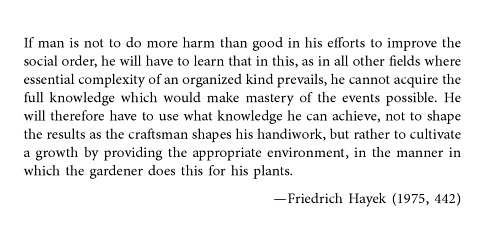
The dominant idea in our society seems to be one of control. From the economy, to society, to health and education, those who hope to improve matters have been seduced by a certain philosophy (typical of what is referred to as “scientific”) which is based on measuring starting points, setting end points and employing the tools to control the process of moving from the one to the other.

Actually, in “open systems”, which are “complex” (based on multiple non-linear relationships between the parts), this idea fails to match reality.

We cannot completely measure or control living systems.

The economist, Hayek, put it this way –

So, here’s the question – what is an “appropriate environment”?

What sets the conditions for health? For the creation of healthy individuals, healthy societies and healthy economies?

Read Full Post »

The living world is a realm of dynamic processes. A flower is not a thing, but an event, like a butterfly emerging from a chrysalis. But with the word, we take a living event and freeze it forever into a useful but stable category. As Goethe wrote, “How difficult it is, though, to refrain from replacing the thing with its sign, to keep the object alive before us instead of killing it with a word.”

  • David Fideler, in “Restoring the Soul of the World”

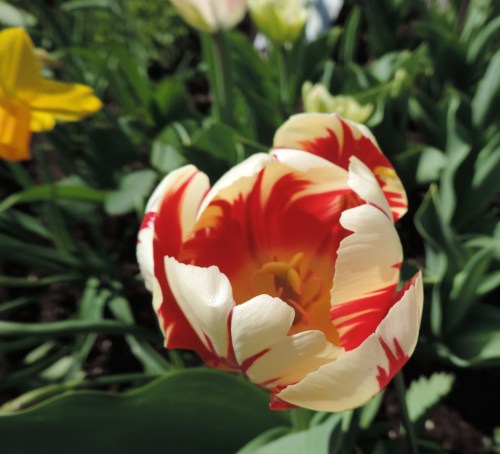
When you see a tulip opening in the warmth and light of the sun, you know in your heart this is not a thing, but an event.

Iain McGilchrist says, in “The Master and His Emissary”, that we use our left hemisphere to label and categorise. In so doing, we take the actions, the verbs of the real world and re-present them to ourselves as nouns, or as objects. If we stop there, we mis-understand the world. But if we re-present them to our other hemisphere then we can see the links, the connections, the what he calls “the between-ness” of the re-contextualised representations.

How much more wonderful the world seems to me when I see dynamic processes and connections all around me, rather than a collection of separate and separated “objects”.

Read Full Post »

cogwheel
Andreas Weber, who coined the term “enlivenment” (to follow the “enlightenment”) describes how biology is changing to a more life-focused understanding, than the till now dominant reductionist parts-focused one –

Such eminent biological and systems thinkers as Lynn Margulis, Francisco Varela, Alicia Juarrero, Stuart Kauffman and Gregory Bateson have opened up a picture in which organisms are no longer seen as machines competing with other machines, but rather as a natural phenomenon that “creates” and develops itself in a material way while continuously making and expressing experiences

I like that. It captures a lot in a few words. We are self-making, self-developing creatures who are bodies (not who have bodies). And we continuously make (co-create) and express (not least through our stories and our art) our experiences.

Read Full Post »

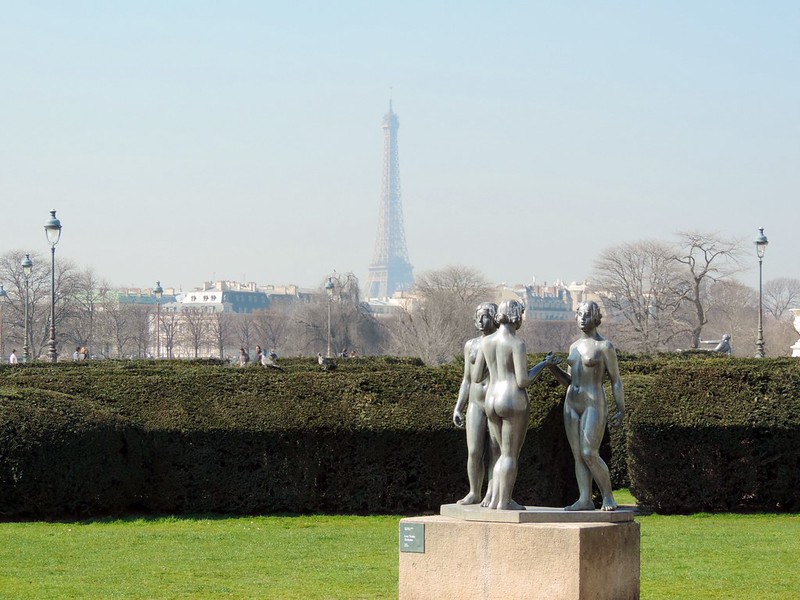
Tuileries

Having been inspired to write about the re-enchantment of life by my trip to Paris last week, I have started to write a series of posts. The day before yesterday I focused on beauty – how becoming aware of beauty can make life more magical.

Later that morning I opened a novel which I purchased last week. It is “Le Principe” by Jérôme Ferrari. I bought it because it’s about Heisenberg and his uncertainty principle, which is something which has fascinated me for ages, and because I decided to start reading French novels to improve my French language skills.

I won’t quote specific passages or try to translate them here, but on page 3, the author says that Heisenberg and other Physicists investigating subatomic phenomena were startled by how their experimental results could not be explained by classical physics, and it was all very confusing and baffling for them, but what drove Heisenberg on, what stimulated and supported his determination, was “his faith in beauty”.

His faith in beauty! Not his dedication to reason, mathematics or science, but his faith in beauty.

Wow! I didn’t see that coming! How does that happen? That synchronicity? I have a number of ideas about re-enchanting life, and beauty is one of them. I happen to pick that to write about that day, then two hours later I open this French novel about a scientist, and read that passage.

Suddenly, in that moment, I sit bolt upright, put the book town and sigh. How amazing! How incredible life is! How unpredictable and curious it is! I pick it up again and re-read it carefully (I’m still a learner and might have misunderstood) and there it is – beauty – the motivating principle.

So in that moment I find another way to re-enchant life – to be aware of, and to relish, the moments of synchronicity.

Those experiences are certainly not a daily occurrence for me, but they do happen frequently. How about you? Do you experience synchronicities? If you do, take your time to savour them. They are a gift.

Read Full Post »

Dragon

A few years ago I wondered why the twelve months of the year have the names they do, and around the same time I was thinking, for many of us, there is a lack of awareness of rhythm and ritual in our lives, so I put the two ideas together and came up with a theme for each month of the year.

I use the theme as a touchstone of a kind. It’s a reminder, a meditation focus, a thought to return to each day….

March, the month which is named after Mars, has become, for me, the month to focus on strength.

There are two aspects of that which have come up for me this year as I reflect on this theme.

The first has been prompted by my reading of an article by Richard Sennett about “open cities”. He focuses on the issues which arise from us trying to live together – as we do as human beings, clustering together and building huge cities. That reminds me of T S Eliot’s Choruses from the Rock –

When the Stranger says: “What is the meaning of this city?

Do you huddle close together because you love each other?”

What will you answer? “We all dwell together

To make money from each other”? or “This is a community”?

And the Stranger will depart and return to the desert.

О my soul, be prepared for the coming of the Stranger,

Be prepared for him who knows how to ask questions.

Before I wander too far off topic, one of the key points Richard Sennett makes is about boundaries and borders. He says

The boundary is an edge where things end; the border is an edge where difference groups interact. At borders, organisms become more inter-active, due to the meeting of different species or physical conditions; for instance, where the shoreline of a lake meets solid land is an active zone of exchange where organisms find and feed off other organisms. Not surprisingly, it is also at the borderline where the work of natural selection is the most intense. Whereas the boundary is a guarded territory, as established by prides of lions or packs of wolves. No transgression at the boundary: Keep Out! Which means the edge itself is dead.

That’s a pretty new idea for me, but I’ve long since known the importance of healthy borders. In thinking about health, we need healthy boundaries which are maintained by our immune systems, but we also need healthy borders where we meet and interact with what is “other”.

So, here’s the first thing I’m going to reflect on this month, the month of strength – how are my boundaries and how are my borders? How healthy are they, and how might I make them healthier?

I think the answers to those questions are unique for each of us, but if you are inspired by this, why not reflect on boundaries and borders in your own life? See what you come up with?

The second aspect which has come up for me is Seligman’s idea of strengths. If you’ve never done it, or it’s some time since you did it, go and take the free questionnaire on his site and find out what your own core strengths are.

Just as I reflected on the difference between positive and negative hope, I think we can build our strengths by paying attention to them – not by beating ourselves up over our weaknesses!

So, there you are – March – the month of strength. What does that mean for you?

Read Full Post »

« Newer Posts - Older Posts »