Feeds:
Posts
Comments

Archive for the ‘from the reading room’ Category

John O’Donohue used to talk about “invisible nearnesses” –

He said “…the mountains, particularly in Connemara, are huge dark mountains. There’s a lot of moisture and a lot of rain and a lot of mist. And some mornings you’d get up, and the fog would’ve come half way down the mountain, rendering the top of the mountain invisible. You’re in the presence of the mountain, and half the mountain has vanished. It’s there, but not visible to the eye. And I often think that it’s a wonderful image of the imagination, that image. In other words, that there are around every life a series of huge nearnesses, a whole invisible world that we can’t see with the eye but that is absolutely crucial to who we are. And I think that the imagination is the faculty that brings you in touch with these presences that are around your life. That’s where I think the divine, and the soul, and the magic of the world between us all, the world of betweenness – that’s where they all reside. And that’s where the imagination loves to dig its furrow and to disclose these hidden, oblique kind of presences.

Every morning for the last few years, when I’ve been at home, in Stirling, I’ve looked out at a mountain – Ben Ledi, but sometimes it’s not there.

rainbow no mountain

Recently, it wasn’t just invisible, the way John O’Donohue describes it, but there was a rainbow there instead! I immediately remembered his idea of “invisible nearnesses”, so I browsed around and found the original text I remembered from his film, “Anam Cara”.

Now I read that again, I’m struck by another of his points – “the world of betweenness” – and how that is exactly what Iain McGilchrist talks about when he describes the right hemisphere of the brain’s approach to the world.

Read Full Post »

Moonlight on water

I was struck today by this paragraph about Romanticism in Iain McGilchrist’s Master and His Emissary –

Romanticism in fact demonstrates, in a multitude of ways, its affinity for everything we know from the neuropsychological literature about the workings of the right hemisphere. This can be seen in its preferences for the individual over the general, for what is unique over what is typical, for apprehension of the ‘thisness’ of things – their particular way of being as ultima realitas entis, the final form of the thing exactly as it, and only it, is, or can be – over the emphasis on the ‘whatness’ of things; in its appreciation of the whole, as something different from the aggregate of the parts into which the left hemisphere analyses it in self-conscious awareness; in its preference for metaphor over simile, and for what is indirectly expressed over the literal; in its emphasis on the body and the senses; in its emphasis on the personal rather than the impersonal; in its passion for whatever is seen to be living; and its perception of the relation between what Wordsworth called ‘the life of the mind’ and the realm of the divine; in its accent on involvement rather than disinterested impartiality; in its preference for the betweenness which is felt across a three-dimensional world, rather than for a seeing what is distant as alien, lying in another plane; in its affinity for melancholy and sadness, rather than for optimism and cheerfulness; and in its attraction to whatever is provisional, uncertain, changing, evolving, partly hidden, obscure, dark, implicit and essentially unknowable in preference to what is final, certain, fixed, evolved, evident, clear, light and known.

Well, well….for those of you who are already familiar with Iain McGilchrist’s hypothesis about the differences between the left hemisphere and right hemisphere ways of approaching the world, I’m sure you’ll agree this is a terrific, comprehensive summary. He, of course, is at pains to point out, time and again, that he is not saying that the left approach is bad and the right is good, or vice versa…….that we need BOTH, and that we need to integrate the functions of the two hemispheres, not allow the left to dominate the right.

But take your time, and read through that paragraph carefully. He is highlighting what is consistent in the values of Romanticism with the tendencies, or preferences of the right hemisphere of the brain. 

I enjoy what the left hemisphere does for me, but I resonate SO strongly with ALL of these “right hemispheric” qualities he describes so beautifully in this paragraph. It captures my fascination for the personal, the particular, the transient, for “becoming not being…..”

Read Full Post »

Untitled

What was/is your experience of school?

David Richard Precht, the German philosopher argues that our schooling system continues to be based on the industrialism of about 100 years ago. We still seek to teach sets of facts to all children of the same age, and then test their ability to recall those facts in examinations leading to qualifications. The intention of the education is to produce compliant workers and consumers who will conform to the demands of industrial society.

He argues that we are not fostering creativity, emotional intelligence or relationship skills which enable communities and teams to work together, and individuals to develop and express their unique talents.

He draws his ideas from philosophy, from neuroscience (NOT materialist neuroscience which seeks to reduce all human experience and cognition to identifiable areas of the brain), and from an understanding of how society has changed over the last few years.

Many of his recommendations are in line with teachings from people like Montessori and Steiner, so he can be understood to be part of a more child-centred, holistic movement in education.

I found myself agreeing with much of what he had to say in a recent interview published in Cles magazine (“Notre école est un crime”). He points out that asking children to sit still for an hour and pay attention is not a good starting point – most children, and indeed most adults, are able to concentrate on one topic for about 15 to 20 minutes (which is why TED talks do so well, and why youtube is the new television), and that one thing we know about health is that sitting still isn’t good for you!

He thinks schooling de-motivates learners and that the average 12,000 hours of education leading to the “Bac” qualification in Europe are experienced as pure boredom by most children.

He also thinks we are not teaching the right kind of skills for the 21st century – we need more innovation, creativity, diversity, the ability to use the internet to gain knowledge and to connect with others, more emotional intelligence and a greater ability to form and grow healthy relationships with others.

His proposals include moving away from classroom curriculae to a more project-based system of education which is by its nature multi-disciplinary and encourages children to pursue their own curiosity.

What do you think? How would you change the educational system?

Read Full Post »

Sometimes reading a book creates a feeling of slipping into another world. Page turners do what they say on the tin and the way they are written makes it difficult to put them down, but they don’t always create a world to immerse yourself in. This week I read Alan Spence’s Night Boat and, for me, it is one of those books which creates a whole world to live in for a wee while. In fact, I think the particular feel of the Night Boat reminded me of the feeling I had at least 40 years ago when reading Kazuo Ishiguro’s Artist of a Floating World (I’ll need to go back and read it again and see if it does the same thing for me)

I’ve always had, and still have, a bit of a complex relationship with Zen – partly I feel incredibly drawn to it, and partly I feel it’s just not for me. Reading the Night Boat pulled me right into that complexity. Over all this isn’t just a novel, it’s an experience.

As a story, this is a fictionalised autobiography of the life of one of the great Zen teachers – Ekaku Hakuin.

I didn’t know the story of Ekaku Hakuin but I’d certainly heard the koan about the sound of one hand clapping and koans, those provocative conundrums of Zen teaching, are a core element of his story. There are also several haikus and poems which I think were written by Alan Spence, but maybe some of them are translations of Hakuin’s poetry?

At one point Hakuin talks about “Zen sickness” which is an illness experienced by many of the monks following the Zen path to Enlightenment. Here’s what he says –

Many years ago, I said, I met an old sage who cured my Zen sickness.
How did he do that?
Like with like, I said.
Hair of the dog. The cause of the sickness is also its cure. Zazen made you sick, zazen will cure you. 

Hmmm…..interesting! There’s a concept worth exploring!

One of the classic translations of Hakuin’s work is by Philip Yampolsky (“The Zen Master Hakuin. Selected Writings”) and early in that text he says this about doctors –

The inspired doctors of old effected cures even before a disease made its appearance and enabled people to control the mind and nurture the energy. Quack doctors work in just the opposite way. After the disease has appeared they attempt to cure it with acupuncture, moxa treatment, and pills, with the result that many of their patients are lost.

Hakuin lived in Japan between 1686 and 1768. Yet this idea of what made a good doctor is still something we are a long way from realising. His idea of the “inspired doctor” sounds to me like someone who helped people to be healthy rather than someone who tried to control disease. In fact he calls the doctors who used the various therapies available to “attempt to cure” disease “quack doctors”.

I’m also struck by his emphasis on “[enabling] people to control the mind and nurture the energy”. How much does the practice of Medicine these days “enable people to control the mind and nurture the energy”? Don’t you think we could do with a bit more of that?


Read Full Post »

Just read “The Fault in Our Stars” by John Green. A good read. As the endorsement from Markus Zusak said on the front “You laugh, you cry, and then you come back for more”.

I liked the humour and the constant determination of the main characters to say it like it is. It reminded me of some of the indie movies I’ve seen (I haven’t seen the movie version of this book). It’s a thought provoking book too.

I particularly enjoy it when a phrase or a paragraph in a novel leaps up and strikes me. Here’s one of the ones from “The Fault in Our Stars”. Hazel’s dad is talking about what he believes and recounts the story of his maths teacher talking about Fourier transforms, when she stops and says

‘Sometimes it seems the universe wants to be noticed.’
“That’s what I believe. I believe the universe wants to be noticed. I think the universe is improbably biased toward consciousness, that it rewards intelligence in part because the universe enjoys its elegance being observed.”

That works for me.

I have that belief too. It fits with Thomas Berry’s “moments of grace

Sometimes it seems the universe wants to be noticed.

Not controlled. Noticed.

(and I think we do too, but that’s another story)

Read Full Post »

OK, I’m going to take a guess….you love books, huh? I’m not going to ask you if you prefer e-books to physical books, or vice versa, but two things recently got me thinking about book buying.

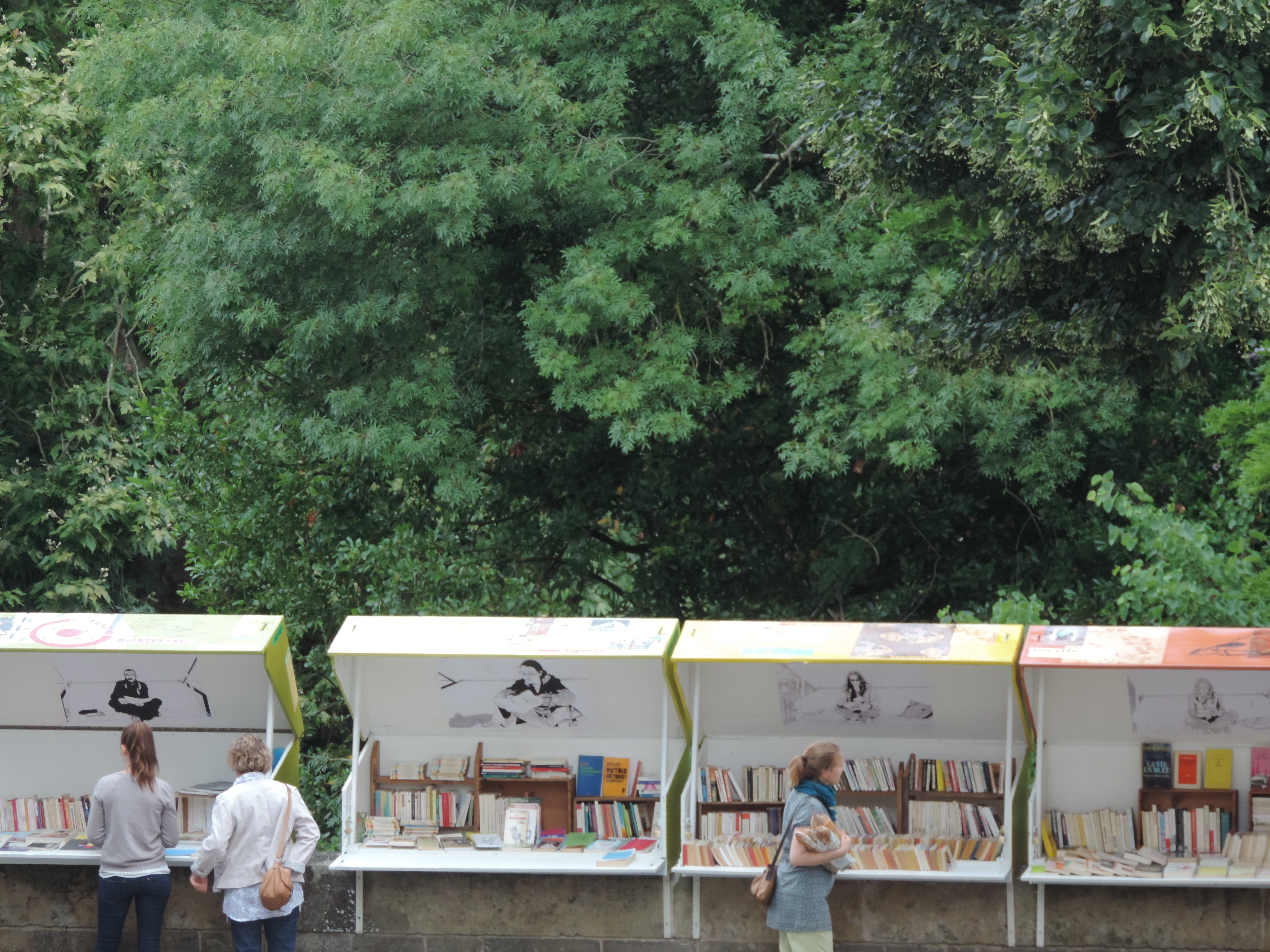
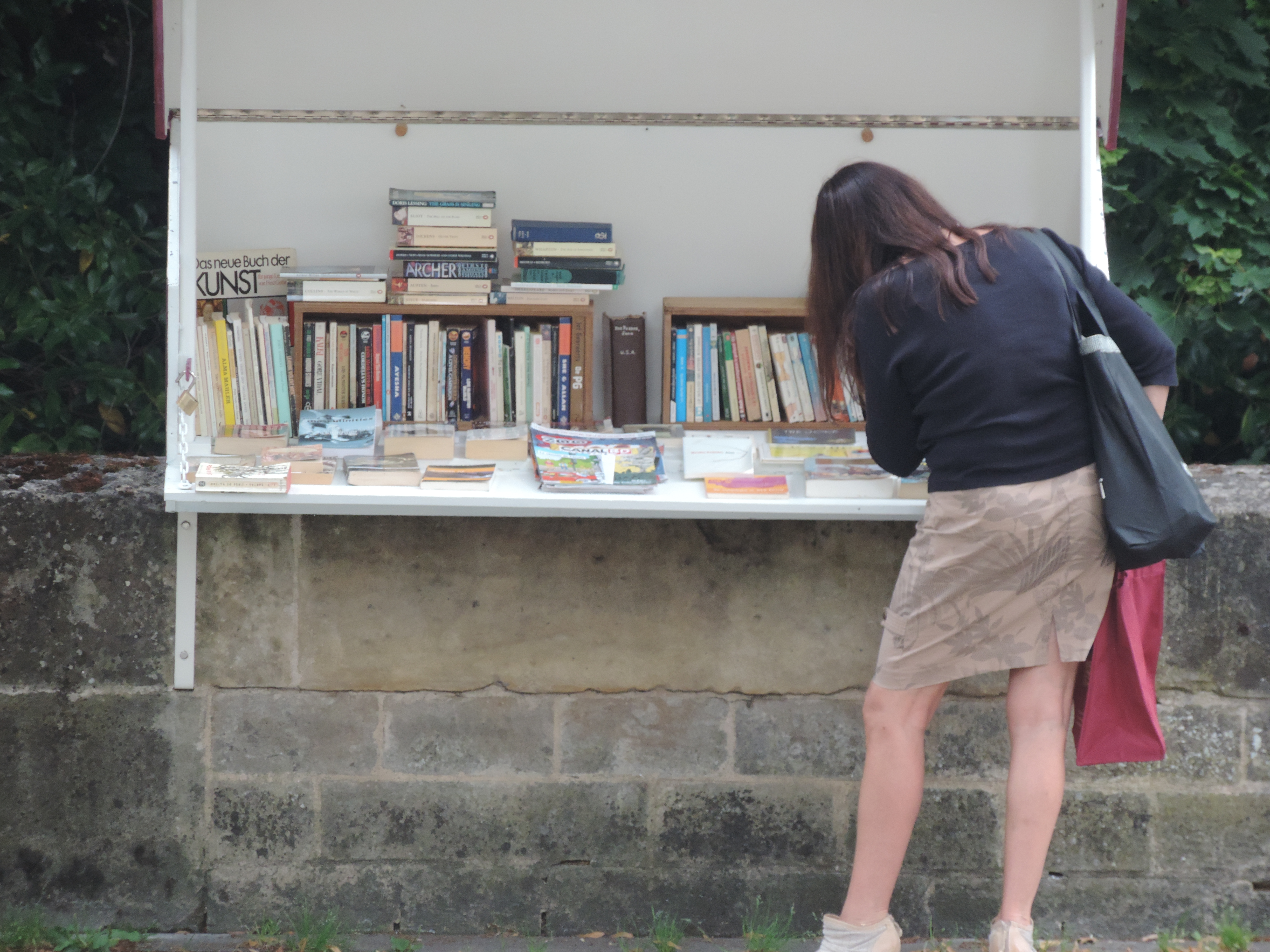
First up was the unexpected discovery of “bouquinistes” in Niort (I’ve only ever encountered this selling books from wooden boxes fastened to the wall at a the side of a river in Paris….didn’t know it happened anywhere else)

DSCN1741


DSCN1742


And the second was reading a fabulous essay by Gustavo Faverón Patriau about reading Borges and buying books. (Click through that link there, and read it, it is a treat)

He talks in that essay of buying books from a street of second hand booksellers in Lima and here’s the point he makes about buying the same books later in the US –

During these years, in Ithaca, New York and Brunswick, Maine, where I live now, I have bought once again many of the books I bought in those remote years, in different versions and editions, books that arrive by mail from unknown bookstores that I suspect do not exist, in parts of the country I have never been to, with yellow “used” stickers, impersonal, books that no human hand puts in mine, books without a context, that seem to materialize at my door. I read them and remember the first time I read them, how they impressed me, and I think of how, in my new copies, they seem to be different books, with different meanings. Now they tell me other things, or they do not tell me anything at all, certainly not what they told me then. The words seem weaker, immaterial, vague, powerless. What a contrast compared with the thrill they provoked in me when I saw those words in the yellow pages of the volumes I bought on Grau Avenue, in the second-hand copies I used to start reading while walking down the street or climbing on the bus, books that, later, when I placed them in my bookshelves at home, used to retain the smell of the street.

Have you ever had an experience like that?

Do you think that where you actually bought a book influences your reading experience of that book?

Read Full Post »

Big rock beach

I noticed this huge rock on a beach recently (OK, I agree, how could you NOT notice it!?)

I suppose I was a little surprised that some people had chosen to sit right in front of it……were they hoping to shelter from the wind? Or were they seeking some shade from the sun? Or, maybe, just maybe, they were working up to having a go at shoving it out of the way?

I’m guessing a LOT of people have wondered about moving that rock. I mean, there it is, sitting RIGHT in the middle of beach! So, why hasn’t anybody done it yet?

Then I got the answer – it’s down to “structured procrastination” –  as John Perry describes it –

All procrastinators put off things they have to do. Structured procrastination is the art of making this bad trait work for you. The key idea is that procrastinating does not mean doing absolutely nothing. Procrastinators seldom do absolutely nothing; they do marginally useful things, like gardening or sharpening pencils or making a diagram of how they will reorganize their files when they get around to it.

So maybe the people sitting on the beach there are doing some marginally useful things instead – like increasing their vitamin D levels by sitting in the sunshine, or measuring the temperature to check for global warming, or counting seagulls to for an RSPB environmental monitoring project, or……..

Or maybe this is not about procrastination at all, maybe it’s about being fully paid up members of the slow movement, like Christopher Richards, the founder of the International Institute for Not Doing Much (Christopher, thanks for sending me an email a few years back, I think my reply might be heading your way soon).

What an inspiration for slowness……..watching a rock change!

Hope you’re able to enjoy a nice slow holiday this summer (and if you haven’t figured out how to use structured procrastination to actually book that holiday up yet, check out John Perry’s book, “The Art of Procrastination” – just make sure you’ve got “Buy with 1-click” switched on)


Read Full Post »

There are something like 100 billion neurons in your brain – a literally mind boggling figure.  Are you really able to imagine what a 100 billion of anything looks like?

As if that weren’t challenging enough, each neuron has up to 50,000 connections with other neurons, and each connection (a synapse) is an electro-chemical switch of a sort – passing information and energy across the gap between two neurons. This makes the total number of states of the brain (number of “on” or “off” neurons) a figure which is……well, unimaginably huge!

I was taught at university that a synapse was a pretty simple connection between two cells where on neuron released a chemical, which then crossed the gap and stimulated the next neuron. This, of course, is a huge oversimplification.

Researchers have recently managed to describe a single synapse much more accurately.

0f9996a3aecb308bd7182564925c857c


The researchers say


The new model shows, for the first time, that widely different numbers of proteins are needed for the different processes occurring in the synapse,” says Dr. Benjamin G. Wilhelm, first author of the publication. The new findings reveal: proteins involved in the release of messenger substances (neurotransmitters) from so called synaptic vesicles are present in up to 26,000 copies per synapse. Proteins involved in the opposite process, the recycling of synaptic vesicles, on the other hand, are present in only 1,000-4,000 copies per synapse. The most important insight the new model reveals, is however that the copy numbers of proteins involved in the same process scale to an astonishingly high degree. The building blocks of the cell are tightly coordinated to fit together in number, comparable to a highly efficient machinery. This is a very surprising finding and it remains entirely unclear how the cell manages to coordinate the copy numbers of proteins involved in the same process so closely.

It’s not just the numbers which are astonishing, its the complexity, and that last sentence particularly struck me – “it remains entirely unclear how the cell manages to coordinate the copy numbers of proteins involved in the same process so closely”

Just how much DO we know about how the human body works? How much DO we know about how it evolves to this level of complexity, both through an individual lifetime from the fertilisation of a single egg cell to a fully grown human being, and throughout history from single celled life forms to the multi celled human beings?

Humility. That’s what we need as scientists. Humility. Our ability to discover and understand is astonishing, but so far pales in comparison with the complexity of a single human being.

I’m amazed.

Read Full Post »

IMG_0607


Over the first half of this year, I’ve written a post every Sunday under a series title of “The A to Z of Becoming”. I’ve picked 26 verbs and shared some thoughts about focusing on one verb a week as a way to consciously engage with the process of change in our lives.

We change all the time – as Henri Bergson says, in “Creative Evolution”

for a conscious being, to exist is to change, to change is to mature, to mature is to go on creating oneself endlessly

This process of “creating oneself endlessly” is largely an unconscious one, but we can engage with it consciously by making choices about what we DO. It’s our actions which create our selves and our world.

As Game of Thrones fans will know

Words are wind

Or to consider Bergson again….

we are, to a certain extent, what we do, and that we are creating ourselves continually

Our lives are creative processes of unceasing change, and consciousness gives us, uniquely in this universe (as far as we know!) the opportunity to escape from passivity and automaticity. We are not objects. We are not things. We are not zombies. Unless we choose to be……

Heroes, are the protagonists of the stories. Each of us is the hero, or protagonist of a unique story, a story untold by any other being in the history of the universe and a story which will never be told again by anyone else.

Heroes are “action heroes” – WE are these “action heroes” if we choose to become aware of the actions we take every day.

You can find a post on each of the verbs in that word cloud above by searching for the it using the search box on this page, or find the whole series by searching for “a to z” (use the quotation marks as well as the phrase)

Read Full Post »

If you haven’t heard about Thomas Picketty, the economist, and his vast work, “Capital”, then start here. His formula which explains increasing inequality is succinct and clear –

inequality grows when the rate of return on capital (“r”) is larger than the rate of growth in the economy (“g”); or, in his already well-known formulation, inequality grows when “r > g.”

He makes many, well argued points, but I want to focus just on this one about wealth producing wealth and how that trends towards a greater and greater share of wealth being inherited.

the share of inherited wealth in total wealth has grown steadily since the 1970s. Inherited wealth once again accounted for the majority of wealth in the 1980s, and according to the latest available figures it represents roughly two-thirds of private capital in France in 2010, compared with barely one-third of capital accumulated from savings. In view of today’s very high inheritance flows, it is quite likely, if current trends continue, that the share of inherited wealth will continue to grow in the decades to come, surpassing 70 percent by 2020 and approaching 80 percent in the 2030s. Piketty says that the “normal” state of affairs in which anyone has a crack at fame and fortune is a blip in the long run of human history that has been largely characterized by a self-serving, greedy hereditary aristocracy whose comfort was only possible because of the enmiseration of nearly everyone else. Absent some kind of extraordinary intervention, hereditary wealth will reassert itself as the primary political mover in our world. The people at the top have always convinced themselves that they live in a meritocracy, because hey, they’re the best people they know, and they’re at the top of the pyramid. QED. But this story is impossible to square with the data

He claims we now have a new aristocracy who increasingly live on the wealth created by their wealth…..not by their efforts, contributions, activities or anything else.

Take a particularly clear example at the very top of the global wealth hierarchy. Between 1990 and 2010, the fortune of Bill Gates — the founder of Microsoft, the world leader in operating systems, and the very incarnation of entrepreneurial wealth and number one in the Forbes rankings for more than ten years — increased from $4 billion to $50 billion. At the same time, the fortune of Liliane Bettencourt — the heiress of L’Oréal, the world leader in cosmetics, founded by her father Eugène Schueller, who in 1907 invented a range of hair dyes that were destined to do well in a way reminiscent of César Birotteau’s success with perfume a century earlier — increased from $2 billion to $25 billion, again according to Forbes. In other words, Liliane Bettencourt, who never worked a day in her life, saw her fortune grow exactly as fast as that of Bill Gates, the high-tech pioneer, whose wealth has incidentally continued to grow just as rapidly since he stopped working. Once a fortune is established, the capital grows according to a dynamic of its own, and it can continue to grow at a rapid pace for decades simply because of its size.

Picketty’s proposed solution is a global wealth tax, but I can’t imagine that being agreed any time soon! A Marxist (as opposed to Capitalist) analysis I suspect would say only revolution or total collapse of the economic/social order will bring this concentration of wealth to an end.

Read Full Post »

« Newer Posts - Older Posts »