Feeds:
Posts
Comments

Archive for the ‘from the reading room’ Category

In the A to Z of Becoming, Y stands for “yearn”.

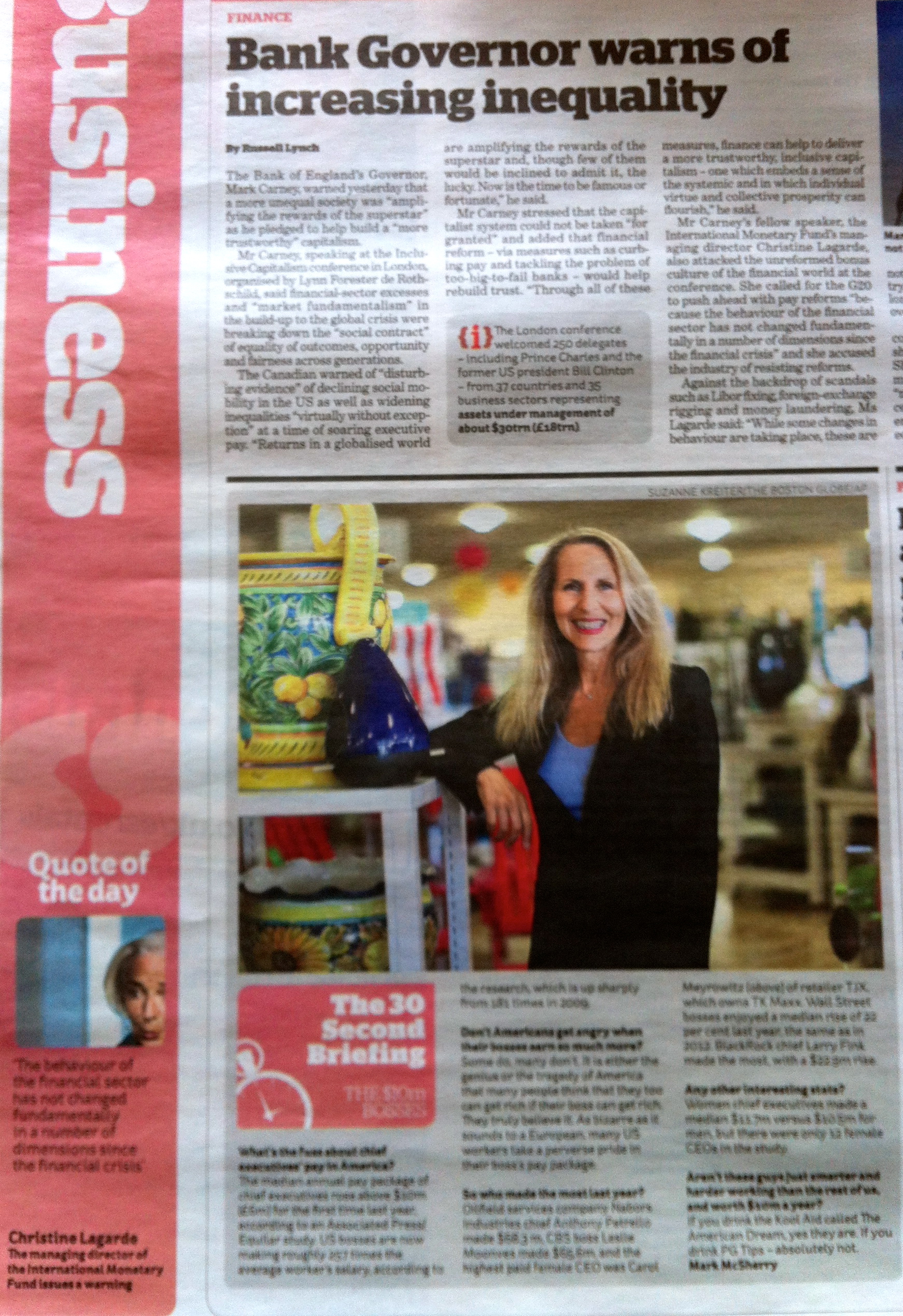
Afternoon moon

I’m not sure this is a verb we use a lot, but it has such a deep, heart felt quality.

Thomas Moore, who wrote “The Care of the Soul”, and “The Care of the Soul in Medicine”, captures what the word “soul” means to us by reminding us how we use the word. We talk of “soul mates”, “soul food”, “soul music”. It’s a deep, embodied concept. I think this is where we yearn from. To yearn is to become aware of what our soul hungers for.

Yearning involves longing. It’s more than desire, more than getting in touch with a goal, it’s a deep, heart-felt connection which fills us with its presence. Such a particular kind of presence…….the kind of presence which contains an absence. There’s something missing, and in yearning there is often an element of sadness, maybe even of melancholy. We’ve lost touch with the value of a feeling like this, I think. The thing is, we might yearn for something we no longer have, for the presence of someone who is no longer with us. But we can also yearn with an eye to the future, and it’s this yearning in particular which I think is of value for us.

If we stop to think about what we actually yearn for in the future, then we are likely to become aware of what matters most to us. We are likely to be able to clarify just what is that bliss which Joseph Campbell said we should follow?

I don’t think yearning is about joy. I don’t think it is about hope. And it’s about more than wishes, but its a way of revealing what is really important to us, what lies deep within our souls. To yearn is feel a sap rising…..


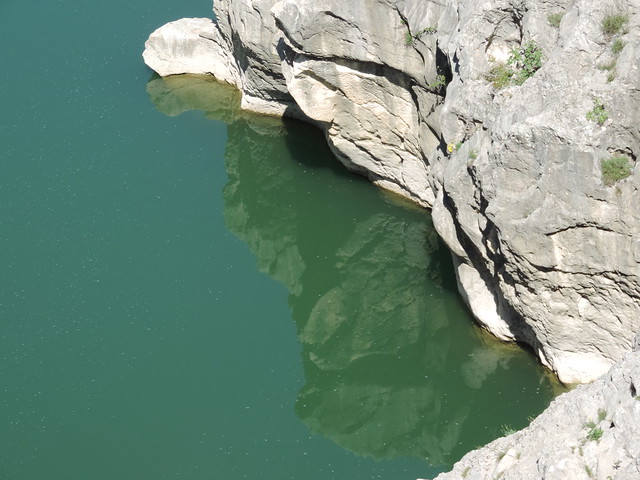
Tall pines

To yearn is to feel something deep unfolding….

fern

What do yearn for?

Read Full Post »

According to a government report workers who retire early risk “boredom, loneliness and poverty“.

Well, that’s something to look forward to, huh? Strange report – probably part of a fear campaign to try and keep people in employment for longer. What are they suggesting, actually? It’s better to retire later? Or that if you are working, even on a minimum wage, zero hours contract in your 60s and 70s you will avoid “boredom, loneliness and poverty”?

I suspect this kind of thinking says more about how we live than it does about the respective benefits of employment and retirement.

Funnily enough, I just stumbled over this quote from Goethe –

“A man should hear a little music, read a little poetry, and see a fine picture every day of his life, in order that worldly cares may not obliterate the sense of the beautiful which God has implanted in the human soul.”
― Johann Wolfgang von Goethe

I’ll be continuing to do that once I start my early retirement next month! And much else besides. I’m anticipating that the post-employment years will include lots of discovery, creativity, personal development and fun.

Meantime, here’s a little music

and a little poetry

Tell me, what is it you plan to do
with your one wild and precious life?

– from Mary Oliver’s The Summer Day

and

Here’s a fine picture

glorious seedhead


Read Full Post »

I don’t understand synchronicity but when it happens its always striking and exciting.

About a week ago I bookmarked a transcript of an RSA talk by Guy Claxton, and yesterday I sat down and read it. It’s a fascinating talk about what he terms “glimpses” (what others have termed spiritual or enlightenment experiences). I’ll let you read the full talk yourself, but in that talk he referred to W B Yeats’ poem, “Vacillation”, where he describes just such an experience –

My fiftieth year had come and gone
I sat, a solitary man
In a crowded London shop
An open book, an empty cup
On the marble table-top
While on the shop and street I gazed
My body of a sudden blazed
And, twenty minutes, more or less
It seemed, so great my happiness
That I was blessed, and could bless

Then, later the same day, I was researching the lifespans of different organisms (I’ll tell you why another time) and picked my copy of Richard Fortey’s “Life” off my shelf. I have a beautiful Folio edition which is a complete joy to hold. Imagine my surprise when on page 22, in his first chapter, where he is describing his early experience of an expedition, he writes about having a dispute with his colleague, then waking to a beautiful, perfect day and he says “The joy of such moments healed any differences between us. Like W B Yeats –

My body of a sudden blazed
And, twenty minutes, more or less
It seemed, so great my happiness
That I was blessed, and could bless

I don’t know how that happens. Do you? How do I read the identical passage of poetry in two such different, totally unconnected places within a few hours of each other?


Read Full Post »

Remember Maslow’s hierarchy of needs?

Maslow identified what he called a hierarchy of needs which motivate human beings, starting with survival needs, such as food, drink and shelter, then moving upwards to social needs (relationship needs) of connecting and belonging, to esteem needs of being recognised and respected. Beyond that he postulated being needs, as opposed to these “deficiency needs”, which became evident as self-actualisation, something he thought wouldn’t happen until the lower needs were met.

This hierarchy has been criticised and its certainly not the case that human development follows any rigid, layer by layer, step-wise progression. (I think integral theory provides a more interesting way of looking at old hierarchies – from an integral viewpoint its not so much a hierarchy at all as layers which grow on top of each other with every layer continuing to exist)

Well, Gary Lachman, in his Secret History of Consciousness, mentions the writer, Colin Wilson, once researching the history of murder and finding something curious.

At first it seemed murders were mainly committed for gain – food for example. Then other types of murder appeared, which involved murderers protecting their lifestyle, their homes or their property. Towards the end of the nineteenth century the sex crime emerged (think of Jack the Ripper) where the murder was a kind of sex act in itself. In the twentieth century he noticed the emergence of murders for fame – to become known, and then towards the end of that century the appearance of the “motiveless murder”, the unpredictable, random killing sprees.

Wilson was struck that there was a parallel here with Maslow’s hierarchy – food, the home, sex, self-esteem –  and where did that lead to? Murder as a creative act? Murder as an act of self-actualisation? Wilson rejected this idea, rightly claiming that crime is not a means to self-actualisation. Criminals try to grab what they want, instead of putting in the time and effort to self-actualise. They will murder a celebrity to gain celebrity for example.

He posed the interesting question in relation to this discovery – was murder a kind of Jungian shadow, reflecting the level of development of human consciousness? If so, it might be further evidence that we are indeed moving as a species to a new stage of development, towards a focus on self-actualisation and creativity.

Wow! That’s quite a leap, huh? But certainly a thought provoking one!

Read Full Post »

Maya Angelou was wonderful with words. You’re probably coming across some of them just now as the internet spills over with memories and thoughts about her provoked by the news of her death.

Here is one of my favourites

My mission in life is not merely to survive, but to thrive; and to do so with some passion, some compassion, some humor, and some style.

I especially like this one because I just don’t accept the sole point of living is to make it to the end. Is a Life survived for a number of years something you’d aspire to? Isn’t the sole goal of survival ultimately 100% doomed? (Nobody makes it out of here alive!). You can spend a life like a robot, or, in terms of this blog, like a zombie, on some kind of autopilot, surviving, but there’s something else you can do. You can thrive. You can flourish. You can express the uniqueness you are in this universe, and become what only you could become. You can live with passion, fully engaged with the wonder of the everyday (l’émerveillement du quotidien), you can connect, feel, respond, use your imagination to put yourself in the shoes of others, you can laugh, live with a twinkle in your eye, and you can do it with beauty, grace and, yes, style.


Read Full Post »

Here’s a page from today’s “i” newspaper –
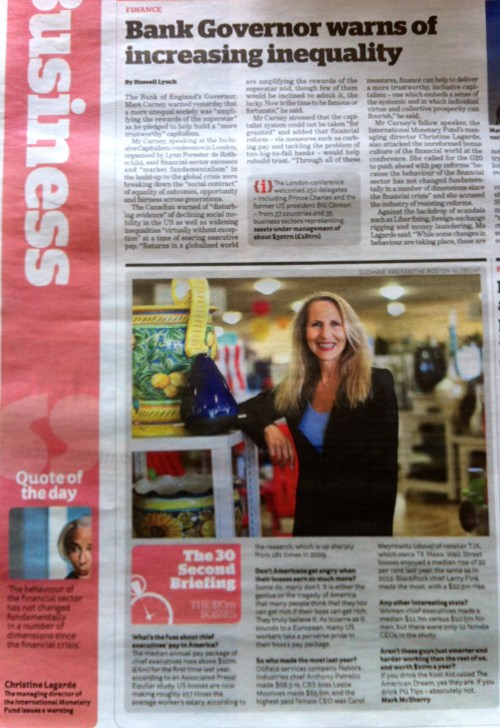
indy

There are three interesting stories here about inequality and the global financial system which probably have some bearing on the voting patterns of the people of Europe in this last week. (Just to remind you, a lot of voters in Europe have turned away from the “mainstream” parties to vote for “extreme right” or “extreme left” in a way which many interpret as a protest against the current powers that be)

Down on the bottom left of the page is a quote from Christine Lagarde, the chief of the IMF. She says

The behaviour of the financial sector has not changed fundamentally in a number of dimensions since the financial crisis

Not exactly a snappy or readily comprehensible quote, but what is she referring to?

Against the backdrop of several leading banks caught in scandals over the fixing of Libor rates, foreign-exchange rigging and money laundering, Lagarde said: “Although some changes in behaviour are taking place, these are not deep or broad enough. The industry still prizes short-term profit over long-term prudence, today’s bonus over tomorrow’s relationship.”

Well, that’s a bit clearer. She’s saying bonuses are too high and are given for high risk, short term gain behaviour, and that banks are still “too big to fail” ie that they can still expect the rest of us to bail them out when their gambles don’t pay off. (as an aside, look at that wee list of “issues” highlighted by the i – “the fixing of Libor rates, foreign-exchange rigging and money laundering” – who’s been found guilty and jailed for these crimes?

At the top of page is a piece on the Bank of England governor, Mark Carney, who says

financial sector excesses and “market fundamentalism” in the build-up to the global crisis were breaking down the “social contract” of equality of outcomes, opportunity and fairness across generations. [He] warned of “disturbing evidence” of declining social mobility in the US as well as widening inequalities “virtually without exception” at a time of soaring executive pay. “Returns in a globalised world are amplifying the rewards of the superstar and, though few of them would be inclined to admit it, the lucky. Now is the time to be famous or fortunate,”

So as well as referring to the “excesses” (that would include some of the things they’ve fined, but not jailed, for?) he says why he thinks it is important for capitalism to deal with the issue of inequality. I think he highlights an interesting aspect of this issue – how in our present time, being “famous or fortunate” is what brings the greatest rewards. In other words, it’s not about effort, contribution, talent, work etc….its about being famous (read anything about a wedding in Florence in this week?), or fortunate (who your dad was, who your spouse was, what lottery you won?)

Finally, the third piece on this page is an expansion of Mark Carney’s reference to CEO pay.

The median annual pay package of chief executives rose above $10m (£6m) for the first time last year

This gives them “roughly 257 times the average worker’s salary, according to the research, which is up sharply from 181 times in 2009.”

Two questions here – is any boss worth 257 times the average worker’s salary? And, what have these bosses done to merit such a substantial relative increase in the last five years? They’ve gotten THAT much better/more valuable??

Is it any wonder that people are losing faith in the current economic-political system?

Is it not clear we are not on a sustainable path? (see here or here for more, and if you’d like to explore the potential impact of inequality, read this)


Read Full Post »

I like Michael Pollan’s views on food. You might be aware of his “food rules”……summarised in the following seven words

Eat food. Not too much. Mostly plants

What he is great at doing is bringing together knowledge from a number of disciplines (nutrition, economics, agriculture, anthropology, politics and so on), and weaving them into a seamless, and convincing narrative. He does that wonderfully in this google talk where he discusses his latest book, “Cooked”. Settle yourself down and watch this. It’s just under an hour, but that includes the Q&A, and I recommend skipping the over two and half minute intro from the google staffer!

In “Cooked” he describes learning the four transformations of food – using fire, using pots (water), baking (air) and fermentation (earth). His argument is compelling and the area of fermentation (using microbes to produce cheeses, pickles etc) is a completely fascinating new subject to explore.

One of the gems from this talk is his telling of the answer he received from someone working in the food processing industry when he asked what we could do about the obesity epidemic. The answer was “Only eat what you have made yourself”. He thinks that one principle (probably hard to adhere to 100% but a good target to aim at) would result in a healthier and more nutritious diet.

This piece doesn’t just get you thinking about the place of food in your life, it gets you thinking about the food industry, about politics and about how we might create a more sustainable way of life just by considering this important (probably central) issue of what we eat, and how it is prepared.


Read Full Post »

fern


“For there is nothing that grows or lives that can approach the feathery grace, the symmetry of form, or the lacy elegance of pattern of the Ferns: and to be blind to all this beauty is nothing less than calamitous” – Herbert Durand, in “The Field Book of Common Ferns”, quoted in Mary Oliver’s poem, “More Evidence”, published in her collection, “Swan”.

Read Full Post »

From Mary Oliver’s “What can I say?”

The leaf has a song in it.
Stone is the face of patience.
Inside the river there is an unfinishable story


leaf

stone

river

Read Full Post »

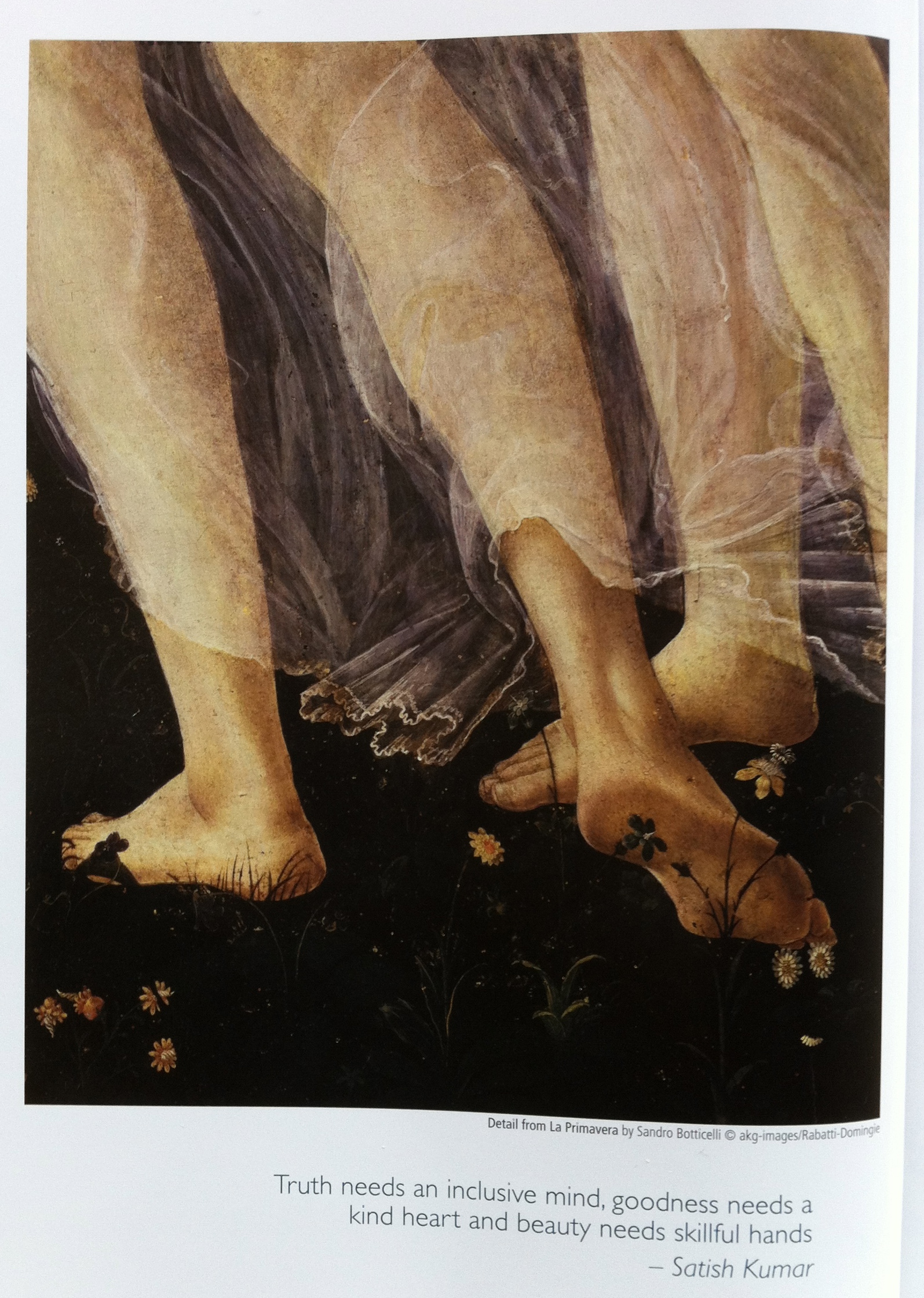
IMG_1550

I’ve been a subscriber to Resurgence magazine for more years than I can remember. The latest issue has an editorial by Satish Kumar which eloquently talks about the interconnections between Truth, Goodness and Beauty – which he refers to as TGB.

What I particularly like the way he embodies truth, goodness and beauty…..

There is a corresponding trinity: head, heart and hands. With our head, with our thinking and intellect, we comprehend truth; with our heart we experience goodness and with our hands we create beauty

I think it’s interesting how he highlights the issue of this consumerist society promoting physical goods and shopping so highly, with a constant drive to make these physical goods as cheaply as possible. It’s not that we hold our physical objects, or those who make them, in the highest esteem

According to the prevailing ethos of our society manual work must be done by machines as far as is possible, or by cheap labour, either at home, or by immigrant workers from poorer countries. Most ‘manually manufactured’ goods are expected to be made in countries like Bangladesh by poorly paid artisan craftsmen and women; the economy of a country like England aspires to be transformed into a ‘knowledge economy’. This is a very unbalanced state of affairs.

He concludes with a classically INTEGRAL vision

Our society needs a bigger picture – a holistic vision. The hallmark of a balanced society is to honour and respect mental work and manual work equally. We need both. Only then we can develop our head, heart and hands in total harmony; science, spirituality and the arts need to be in complete coherence leading to the trinity of TGB – truth, goodness and beauty – as an integrated whole.


Read Full Post »

« Newer Posts - Older Posts »