Feeds:
Posts
Comments

Archive for the ‘from the reading room’ Category

IMG_0571

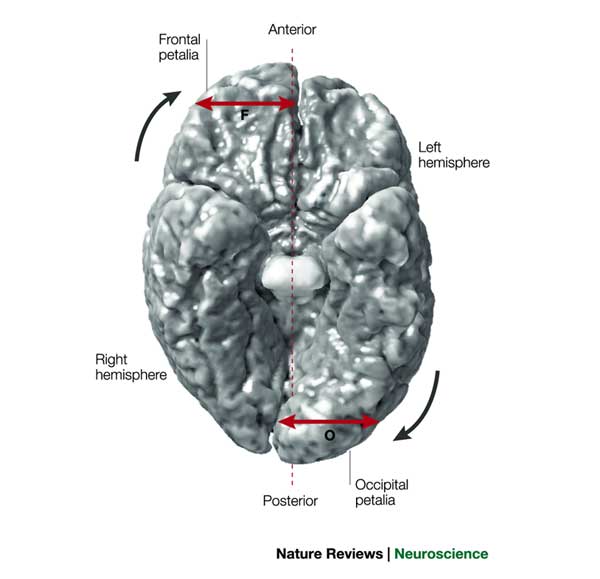
When I learned neuroanatomy at Medical School I was taught that the two cerebral hemispheres were symmetrical. There was no mention at all that they were in any way different. But look at this image above. (This is referred to as Yakovlevian Torque)

Clearly, the two hemispheres are NOT identical. In particular the right one is bigger at the front, and sits just a bit in front of the left, and the left one is bigger at the back, and sits just a little further back than the right.

Why might that be? Why the larger frontal area on the right, and occipital (back) area on the left?

Iain McGilchrist nicely summarises it by pointing out that how the left hemisphere approaches the world is by trying to grasp it. We try to make sense of the world by literally getting a hold of it – we want to understand it, to measure it, to predict what it going to happen by matching the patterns we see to those we have already learned from our experience, and we try to manipulate or control it. This is what the left hemisphere is really great at doing. Interestingly, the areas at the back of the brain are primarily for processing the outside world (our visual and auditory areas are toward the back, and the cerebellum which helps us to know whether we are standing up or falling over by orientating where we are in 3D space, is also to the back). The right hemisphere majors in making connections and maps. It has a significant role to play in all the skills we need to act as social animals.

So, one nice summary of why there might be this asymmetry in the brain, is to enable us to both grasp the world and to be social creatures. Amongst all the creatures on this planet we are probably the most able to manipulate our environment and the most developed as social animals.

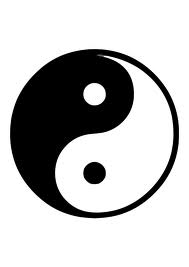
There’s a huge amount more to this left brain/right brain understanding but I do think this is a fabulous starting point. Oh, and by the way, look at this
IMG_0349

Interesting, huh? And how come this has been pretty much completely ignored for so long?

Well, Iain McGilchrist’s theory, written up in full in The Master and His Emissary, or summarised in the Kindle Single, The Divided Mind, is that we have over developed the left hemisphere approach so much that we have developed the tendency to see only what we have already “learned” – so if we were taught that it was symmetrical, and we haven’t explored the differences between the two hemispheres, then we’ve become a bit blind. Time to start using our whole brains?


Read Full Post »

shadow of an empty seat

No straight lines are to be found in the natural world……..Leonard Shlain has pointed out that the only apparently straight line in the natural world is that of the horizon, but of course that too turns out to be a section of a curve……..Straight lines are prevalent wherever the left hemisphere predominates. Iain McGilchrist. The Master and his Emissary

playing under the moon

By contrast the shape that is suggested by the processing of the right hemisphere is that of the circle, and its movement is characteristically ‘in the round’, the phrase we use to describe something that is seen as a whole, and in depth. Iain McGilchrist. The Master and his Emissary

Circular rainbow


So, if the left hemisphere prefers straight lines, and straight lines don’t really occur in nature, and the right hemisphere prefers to see things in the round, then why not go out this weekend, and see how many round shapes you can see? Strengthen seeing with your right hemisphere!

lily pond

through the round window

Read Full Post »

There are an increasing number of studies showing how plants have a much greater range of abilities than we realise. We tend to think that because they don’t have neurones and don’t seem to have even the most rudimentary brains, that they won’t be able to perceive, think, remember or imagine……ok, maybe I’m pushing this idea to its limit, but look at this recent study of how Berberis plants deal with infestations by parasites.

berberis


The Berberis berries can be infected by a species of fruit fly which injects its larvae into the plant’s fruit. Most of the berries have two seeds in them. To prevent the larvae from feasting on the second seed, the plant can “abort” that seed, resulting in the death of the parasite. A surprising strategy for a plant! But in fact, the plant is even more clever than this makes it seem. Not only has it “learned” how to prevent further parasitic infestation, but it can actually selectively “choose” to abort a seed depending on the chances of the parasite dying off….

If the Barberry aborts a fruit with only one infested seed, then the entire fruit would be lost. Instead it appears to ‘speculate’ that the larva could die naturally, which is a possibility. Slight chances are better than none at all. This anticipative behaviour, whereby anticipated losses and outer conditions are weighed up, very much surprised us. [say the researchers] The message of our study is therefore that plant intelligence is entering the realms of ecological possibility.” The Barberry, it would appear, has evolved a strategy where it’s able to adaptively and selectively abort its own seeds to prevent parasitic infestation. It’s considered the first ecological evidence of such complex behavior in plants, showing that they’re capable of structural memory, the ability to discern between inner and outer conditions, and anticipate future risks.

Read Full Post »

How would you define fitness?

Take a moment to think of some answers for yourself then read this (I suspect rather different) definition….

“resilience during change”

or

“an adaptation to an environment whose complexity co-evolves with the complexity of the system”

I DO like these definitions – because it does seem to me that fitness is indeed about the ability to adapt to change. In a paper entitled “Technological integration and hyper-connectivity: tools for promoting extreme human lifespans”, Marios Kyriazis suggests that it is by becoming fit that an organism increases its chances of survival.

This question of fitness reminds me (for the second time today) of Hans Georg Gadamer’s essays on health, The Enigma of Health. In those essays he discusses the idea of fitness from the perspective of how well something fits – or, in this newer language, how well it develops, adapts and changes with environmental change. (I was thinking of Gadamer when preparing for a talk I gave this evening about how to make health…..it strikes me that he hit the nail on the head when he talked about the mysterious invisible, even disappearing, quality of health…..that it is a natural quality of all living organisms. He says that if we have a wound in our hand then we notice our hand…our attention is drawn to it by the pain, the heat, the redness…but when that wound heals and the pain, heat and redness disappear, so we become unaware again of our hand)

How do you think of fitness? Is it something to do with resilience, and of adaptability?

If Kyriazis is right then the way to increase fitness is to increase the number and quality of connections. And THAT also strikes me as spot on.

Read Full Post »

I’m a bit of sceptic about putting collated data ahead of individual experience when it comes to finding what is best for this patient today.

So, I was very taken by this sentence from a Japanese doctor’s journal. This is a surgeon who has been the only doctor on a small Japanese island since 1978.

Initially, the locals were wary of this strange young doctor coming to their island. How would he win their trust? Show them some graphs of randomised controlled trials and run night classes on calculating odds ratios?

Nope.

I would have no choice but to wait and to rely on the power of positive results to build a relationship of trust here

This is what you call believing reality…..when time and again the lived experience steadily builds your confidence.

Read Full Post »


So, here’s a study which makes you go…..duh!? Is anybody surprised?? The conclusion is this –

When physicians spend too much time looking at the computer screen in the exam room, nonverbal cues may get overlooked and affect doctors’ ability to pay attention and communicate with patients

Using video cameras to follow eye gaze the researchers found that physicians using electronic health records were likely to spend a third of their time in the consultation looking at the computer screen (I’m surprised it was only a third!) and, more surprisingly, that the patient too gazed at the screen, even if they couldn’t see, or read, the details on the screen.

When doctors spend that much time looking at the computer, it can be difficult for patients to get their attention,” said Enid Montague, first author of the study. “It’s likely that the ability to listen, problem-solve and think creatively is not optimal when physicians’ eyes are glued to the screen.”

Can’t disagree with that….it’d be surprising if a doctor could pick up the non-verbal clues when they are looking at a screen.

What do the researchers recommend?

Nope, not putting a bag over the screen the way people used to put a bag over bird cages to get noisy parrots to go to sleep. Instead they say their findings could contribute towards

more effective training guidelines and better-designed technology. Future systems, for example, could include more interactive screen sharing between physicians and patients

Pssst! Researchers! I’m over here! How about getting Humphrey Bogart to teach doctors? If the norm was “here’s looking at you, kid”…..well, what do you think??

Read Full Post »

Peter Block, headlines his website with this quote from Thomas Merton –

Do not depend on the hope of results … In the end, it is the reality of personal relationship that saves everything.

(I wonder if we should have that painted onto the walls of every consulting room?!)

He was recently interviewed by Tami Simon in the Sounds true Insights at the Edge programme. She initially asks him about idealism, which he defends –

Well, when you defend idealism, you defend imagination. You defend possibility. You defend the world of ideas. The argument against idealism is the wish to be “practical”—the wish for an evidence-based world, the wish for proof. Idealism affirms the place of mystery, not knowing, and caring about things that are [immeasurable]. So I always see the argument against idealism as the argument against democracy, the argument against love, the argument against justice and equity, and all the things that our culture has abandoned in the name of privatization and economic well-being.

I was often “accused” of being an idealist as a teenager, and it was always a charge I was happy to accept. I still do. I completely agree with him about the place of mystery, and about caring about things which are immeasurable.

He then goes on to discuss how being “results minded” values doing what is already being done, and repeating it. I remember Sir Harry Burns, the Chief Medical Officer of Scotland saying how he worried that “evidence based medicine” was being used to stop innovation and development, how if all we do is keep doing what we have already “proven”, then we will hold back improvement and creativity.

It’s just [I know] that the conversation about results-orientation doesn’t produce results. When people say they’re “results-minded,” I know that they just want to recreate the past. Underneath it all, they’re kind of bored. So that language of a tough-guy adolescent—zero defects; failure is not an option; total results-oriented; if you can’t measure it, it doesn’t exist; evidence-based medicine; evidence-based education. All that language doesn’t take us anywhere.

I’m sure some people will find that view controversial, but it sure “sounds true” to me.

Finally, I really liked his suggested question for us to ask ourselves….

What would it take to create a future distinct from the past?

Read Full Post »

Swan cruising

Goldie Hawn said in an interview the other day

There’s so much left. You know if you lose wonder, you’ve lost everything, so I can’t tell you what I’m going to be wondrous about tomorrow, but I live now, and what I’m living right now is the world of wellness, helping as much as I can, being the voice and the creator of more applications and more ways to access happiness.

Yes! Wonder, or the “emerveillement du quotidien” gives daily life a constant quality. And “living right now” is the only way to really live.

Goldie was talking at the World Economic Forum about her MindUp project – a programme her Foundation has created based on mindfulness practices and positive psychology. I like her emphasis on neurobiology and her focus on children and schools.

Read Full Post »

Did you read “Stoner”, by John Williams last year? It’s been quite a phenomenon in the UK, having sold precious few copies in the author’s lifetime, then suddenly becoming a bestseller with rave reviews here this year.

I liked it. A lot. But let me just share with you a couple of wee passages which describe how the main character, Stoner, comes to think of love as he gets older. Firstly,

…he began to know it was neither a state of grace nor an illusion; he saw it as a human act of becoming, a condition that was invented and modified moment by moment and day by day, by the will and the intelligence and the heart

and, also

….that the person one loves at first is not the person one loves at last, and that love is not an end but a process through which one person attempts to know another.

Well, I’m sure if you’re a regular reader here, you’ll know why that first passage grabbed me – “a human act of becoming….” and I especially like the thought that love changes all the time, and that the will, the intelligence and the heart are all involved in creating that change.

Then, well, how wonderful….to describe love as a “process through which one person attempts to know another”. I do think that is so often forgotten….that love isn’t just a feeling or a state, but it is an ongoing act of trying to know another. Funnily enough, that makes me think of my verb of the week – attend, particularly, with regard to the latin origin of ‘attend’ being about a reaching or stretching out towards….

Read Full Post »

James Hollis, in “The Middle Passage”, says

The invitation is to shift gears for the next part of the journey, to move from outer acquisition to inner development

and

…it is this emphasis on inner, rather than outer truth, that distinguishes the second adulthood from the first.

Whilst I think these developmental shifts are a perpetual presence in our lives, there is no doubt that we are more aware of the transition phases at some times than we are at others, and this is where I am now, at the end of 2013, in one of those transitions. So, I’m enjoying shifting gears, and throwing myself more fully into the process of becoming.

Are you ready to accept the invitation to change gears? I wonder what inner truths we’ll discover?


Read Full Post »

« Newer Posts - Older Posts »