Feeds:
Posts
Comments

Archive for the ‘from the reading room’ Category

I’m a great fan of Seth Godin’s work. His latest book is “We are all Weird“. Seth’s great at picking an eye-catching and provocative phrase (remember the purple cow?). So, he makes it clear what he means by “weird” –

In this manifesto, I’m not talking about weird by birth, I’m talking about people who are making an affirmative choice to be weird. Most people who make that choice are paradoxically looking to be accepted. Not by everyone, of course, but by their tribe, by the people they admire and hope to be respected by.

The key element of being weird is this: you insist on making a choice.

We all need to belong. Seth focused on that in his book on “tribes”. We like to associate with like minded people, with people who share our values and beliefs. In short, with people who share our choices. But we also need to know that we are all unique, that we are individuals. Remember the battle cry from “Braveheart”? FREEDOM.

Well, we all need freedom. The freedom to choose for ourselves, not being the least of the freedoms we need.

In “We are all Weird”, Seth shows how over the last century or two the concept of the “mass” has come to the fore. Mass marketing, mass consumption, globalisation of brands which seek to treat everyone as the same. Politicians like that. It gives them control. Marketers like that. It’s gives them the control. Goodness, those who seek to tell us all what’s best for us in health care irrespective of our individual needs, like that. It gives them control.

But the world is changing. It’s easier than ever now to express yourself. It’s easier than ever to be your own person, to make your own choices, and to find the others in the world who share those choices, to find your tribe. And this is completely changing the game. Power is shifting away from those who want to control the “mass” and into the hands of those who celebrate their uniqueness.

We’re seeing that in Medicine with the frustration of health care professionals and patients at being corralled into protocols and guidelines based on “evidence” which is statistical analysis of group experiments extrapolated out to be applied to the “mass”.

Read this book.

I recommend it. Read it and share it with your tribe. Be part of the change in the world. Be a hero, not a zombie.
Read Full Post »

This week I had the enormous and delightful privilege of meeting Thomas Moore. He delivered a talk in the Medical Lecture Theatre at Glasgow’s Western Infirmary after visiting us in the Centre for Integrative Care, Glasgow Homeopathic Hospital, in the afternoon. So we had the chance to both meet him personally, and hear one of his really inspirational talks.

You know, Thomas, it felt like being “home”! I guess, you’d call it a “soul connection”. It all felt so right.

If you’re not familiar with his work, you’d do well to start with The Care of the Soul in Medicine, but really I’d recommend any of his books. I’ve enjoyed every one I’ve read.

He began by talking about mystery, and how none of us is completely knowable. Seems obvious, huh? But I’m repeatedly amazed how patients will say to me, at the end of a one hour first consultation, that I now must know “everything” about them. I usually respond by saying oh, we’ve only had an hour together, and you can spend a lifetime with someone and not fully know them, so really at this stage my knowledge must be very slight. But I know what they mean. The process of a holistic, non-judgemental, compassionate consultation, forms a strong (what Thomas would call “soul”) connection. The patient feels heard, they feel felt, they feel understood. However, I thought it was great to be reminded that we are all unknowable, that we all have unfathomable depths. It sets up a certain humility of practice and of living.

Thomas’ idea of “soul” seems very common sense and right to me – the best way to grasp it is to think about the phrases we use such as “soul music”, “soul food”, “soul mate” and so on. It’s a deep sense of being connected to other and to the world in which we live. He talked about some of the elements we identify as important in creating a good life, a soul-full life – friends, food, home, stories, the architecture of our living spaces for example. Everything about sharing, and about really experiencing our every day reality – what I’ve mentioned in this blog a number of times using the French phrase “emerviellement du quotidien” – the wonder, or amazement, of the every day….

If you ever get a chance to hear Thomas, grab it! You’ll have a soul-full evening!

Read Full Post »

I’m a great fan of stories. In fact, I think we understand ourselves and others by using narrative, and the central way in which I work as a doctor is to hear people’s stories, and help them to change them from stories of being stuck or in chaos, to stories of flow, and flourishing and growth.

I’m also a great fan of fiction and the importance of the imagination. I vividly remember Ian McEwan writing this, about this day, ten years ago…

If the hijackers had been able to imagine themselves into the thoughts and feelings of the passengers, they would have been unable to proceed. It is hard to be cruel once you permit yourself to enter the mind of your victim. Imagining what it is like to be someone other than yourself is at the core of our humanity. It is the essence of compassion, and it is the beginning of morality.

So, this recent article in the Guardian caught my eye, “Reading fiction improves empathy, study finds”. There are a number of studies described in this article, and it’s introduced me to something called “the pyschology of fiction”, and, specifically to the work of Keith Oatley. If I wasn’t so insatiably curious I wouldn’t keep finding these amazing new worlds to explore! One of the studies described in the article compared the effects of reading Harry Potter with the effects of reading Twighlight. They used a new measure – “Twilight/Harry Potter Narrative Collective Assimilation Scale”! Don’t you love that? Look at this conclusion from that research –

“The current research suggests that books give readers more than an opportunity to tune out and submerge themselves in fantasy worlds. Books provide the opportunity for social connection and the blissful calm that comes from becoming a part of something larger than oneself for a precious, fleeting moment,” Gabriel and Young write. “My study definitely points to reading fulfilling a fundamental need – the need for social connection,”

and read this fascinating comment by Keith Oatley

“I think the reason fiction but not non-fiction has the effect of improving empathy is because fiction is primarily about selves interacting with other selves in the social world,” said Oatley. “The subject matter of fiction is constantly about why she did this, or if that’s the case what should he do now, and so on. With fiction we enter into a world in which this way of thinking predominates. We can think about it in terms of the psychological concept of expertise. If I read fiction, this kind of social thinking is what I get better at. If I read genetics or astronomy, I get more expert at genetics or astronomy. In fiction, also, we are able to understand characters’ actions from their interior point of view, by entering into their situations and minds, rather than the more exterior view of them that we usually have. And it turns out that psychologically there is a big difference between these two points of view. We usually take the exterior view of others, but that’s too limited.”

Spot on. He really nails the importance and value of fiction as a tool for building empathy. We reduce the place of the Humanities in our education system at our peril!

Read Full Post »

I’m a long time subscriber to Resurgence magazine. It’s usually a very beautiful production and comes at things from both a “green” and a spiritual angle. The current issue flags up the theme of “harmony”, which is a great concept to rally around. Here’s a bit from Satish Kumar, the editor, in his lead editorial –

at the Tagore Festival, the Iranian Sufi scholar Hossein Ghomshei explained what he understood by the word ‘harmony’: “Harmony is the existential principle of the universe. Knowledge of universal harmony is science, expression of it is the arts, and the practice of harmony is religion. Which means there is no conflict between science, the arts and religion – all three operate within the context of the universal harmony.” The sun is in harmony with the soil and the seeds, the oceans are in harmony with the land, bees are in harmony with flowers, and the five elements harmonise and cooperate with each other to maintain life on Earth. We are all related. “Reality is not a thing, reality is relationship amongst things,” says Iain McGilchrist, author of The Master and his Emissary. Reality is reciprocity and mutuality; dark and light, below and above, left and right complement. And, in the words of E.M. Forster, all we have to do is “only connect”.

Oh yes, I like this. I often think about health, and what it is, playing with words like holistic, integrative, vitality, resilience etc….but for some reason I hadn’t considered the word “harmony”. What I love about harmony is, like beauty, or wellbeing, you just know it when its there. It’s both holistic and intuitive. Harmony is also produced by the fitting together of different elements. It’s not about everything being the same, so it’s completely consistent with the “integrative” idea of a good relationship between well differentiated parts.

We are such complex creatures, and the idea that healthy working together, or relating of the multiple different parts, is “harmony” is very appealing. In fact, we are embedded creatures, in constant relationship with others and with our environment. To be in “harmony” with others, with the rest of Nature, with the planet, (hey, even with the universe!) strikes me as an excellent goal.

I particularly like Hossein Ghomshei’s mention of science as knowledge of harmony, art as its expression and religion as the practice of harmony. Wonderful echoes of Deleuze and Guattari’s three ways of thinking – science about function, art about affects and percepts, and philosophy about concepts. And then a great quote from the magnificent Iain McGilchrist – “Reality is not a thing, reality is relationship amongst things,”

So, is my Life in harmony?

And, how can I work towards greater harmony?

On a daily basis, with each choice I make, is that choice likely to produce greater harmony? Or to produce discord?

Read Full Post »

One of my favourite lines from Bob Seeger is “I wish I didn’t know now what I didn’t know then”.

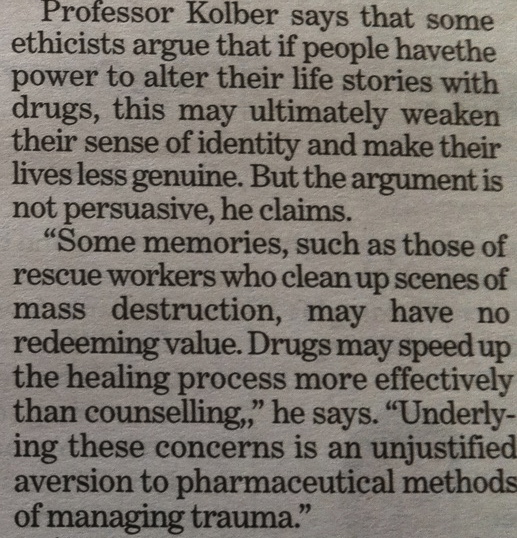
However, I was a little startled by a piece in the “i” newspaper last week about drugs which can wipe out memory. Here’s a jpeg of the bit of the article which really took me aback….


I don’t know about you, but as best I understand it our memories are a key part of the stories we tell ourselves and others to create both a sense of self, and to make sense of our lives.

Who’s to say that a painful memory has no value. A painful memory will probably always be a painful memory, but our responses to painful episodes can be the important foundations of who we become.

Before I go…..here’s the song in question (performed by Toby Keith)

Read Full Post »

Alva Noë’s “Out of Our Heads” [ISBN 978-0-8090-1648-8] makes a strong case for understanding consciousness as a phenomenon, not produced by the brain (in the way that the stomach produces gastric juices, as he says), but rather….well, this is how he puts it –

Consciousness requires the joint operation of brain, body, and world. Indeed consciousness is an achievement of the whole animal in its environmental context.

He rejects completely a reductionist view that you are your brain –

The subject of experience is not a bit of your body. You are not your brain. The brain, rather, is part of what you are.

and, further,

Brains don’t have minds; people (and other animals) do.

This way of thinking is entirely consistent with what Dan Seigel teaches from a perspective of “Interpersonal neurobiology” – we can find neural correlates of mental phenomena, but we have no way of proving either causation or direct linkage between the two. This is also consistent with those who argue for both and “embodied” and, in particular, an “extended” mind (see Andy Clark’s work). I particularly liked the phrase Alva quotes in his book (attributed to his colleague Susan Hurley) –

…the skull is not a magical membrane; why not take seriously the possibility that the causal processes that matter for consciousness are themselves boundary crossing and, therefore, world involving?

I love that. We are all deeply and intimately connected as open systems with our environments – our physical, social and semantic environments. The flows of energy and life flow into us, through us, out of us. They create us in interaction with our own bodies and minds. As Alva paraphrases Merleau-Ponty –

…our body is ours – the place where we feel and the means by which we act – insofar as the current of activity that flows toward the world passes through it.

There is so much to stimulate your thinking in this book – about consciousness, about a sense of self, about habits, language, how we create the world in constant interaction with that changing world. I’ll just highlight two other parts of the book for you. Firstly what he says about science and biology –

Science takes up the detached attitude to things. But from the detached standpoint, it turns out, it is not possible even to bring the mind of another into focus. From the detached standpoint, there is only behaviour and physiology: there is no mind.

..you can’t do biology from within physics. To do biology, we need the resources to take up a nonmechanistic attitude to the organism as an environmentally embedded unity. When we do that – and now we come to my critical claim – we also secure the (at least) primitive mentality of the organisms. The problem of mind is that of the problem of life. What biology brings into focus is the living being, but where we discern life, we have everything we need to discern mind.

…once you see the organism as a unity, as more than just a process, you are, in effect, recognising its primitive agency, its possession of interests, needs, and point of view.

I feel this is crucial if we are to achieve a better understanding of these big issues of life, mind and consciousness. We have to see people as whole organisms in constant exchange with their environment. There’s something inherently inhuman about the attempts to reduce biology to physics, or the attempts to reduce human beings to physiology and behaviour.

Finally, I could pick many, many paragraphs to make this point, but let me end with this one –

We are partly constituted by a flow of activity with the world around us. We are partly constituted by the world around us. Which is just to say that, in an important sense, we are not separate from the world, we are of it, part of it. Susan Hurley said that persons are dynamic singularities. We are places where something is happening. We are wide.


Read Full Post »


Once in a while, I get shocked into upper wakefulness, I turn a corner, see the ocean, and my heart tips over with happiness – it feels so free! Then I have the idea that, as well as beholding, I can also be beheld from yonder and am not a discrete object but incorporated with the rest, with universal sapphire, purplish blue. For what is this sea, this atmosphere, doing within the eight-inch diameter of your skull? (I say nothing of the sun and the galaxy which are also there.) At the center of the beholder there must be a space for the whole, and this nothing-space is not an empty nothing-space but a nothing reserved for everything.

This quote from Saul Bellow’s Humboldt’s Gift is used as an epigraph for the last chapter of Alva Noe’s excellent “Out of Our Heads”. As he concludes –

I hope I have convinced you that there is something perverse about the very idea that we are our brains, that the world we experience is within us. We don’t need to have the world within us: we have access to the world around us; we are open to it. I take this to be the import of Bellow’s language in this chapter’s epigraph.

Read Full Post »


These views suggest that we are not merely receptacles but channels of energy. Life and power is not so much contained in us, it courses through us. Man’s might is not to be measured by the stagnant water of the well, but by the limitless supply from the clouds of heaven…Whether we are to look upon this impulse as cosmic energy, as a life force, or what may be its relation to the Divine immanence in Nature, it is for other investigators to say.

Hadfield (writing in The Psychology of Power)

Read Full Post »

Reading

Johann Hari, writing in the Independent about books, reading and the distractions of the internet, includes the following quote

Reading is an act of resistance in a landscape of distraction…. It requires us to pace ourselves. It returns us to a reckoning with time. In the midst of a book, we have no choice but to be patient, to take each thing in its moment, to let the narrative prevail. We regain the world by withdrawing from it just a little, by stepping back from the noise

Fabulous! We all need this experience. We all need to withdraw a little, step back from the noise, gain what Iain McGilchrist refers to as a “necessary distance”, not just from other people, other activities, or the world, but from our own thoughts, habits and obsessions. Reading books can certainly create some necessary distances, but there are other ways too. Many other ways, actually.

What we need is focused, aware attention.

If we take a little time to focus, and to give our full attention to, a book, a movie, a song, a poem, our breath, this present moment……..then we’ll gain this necessary distance. Without it, we’re on autopilot – zombies not heroes!

Read Full Post »

passing the light

June is the month of the light. Next week in Scotland, it’s midsummer’s day – the shortest day of the year (you’d never know we’re in the middle of summer, given all the rain and wind we’ve had!). So, I’ve been thinking again about light.

Candle light in particular reminds us how sharing light increases it. Have you ever lit one candle from another? When you do, the first candle doesn’t get any dimmer. By lighting one candle from another, you end up with more light.

I wonder what kind of light I bring into this world? You might like to wonder about what you pass on to others too, because, although we might not physically pass light to each other, we certainly pass our emotions, our attitudes, our way of being onto to those around us and spread them the way that light can spread.

Around the turn of the year, when I was thinking about my Life (with a capital “L”), I played with this idea of light and I thought, actually, what I try to do, as a doctor, can be captured in three verbs about light.

Firstly, I try to lighten others’ loads. I try to ease their suffering. If I didn’t achieve at least that, I’d not be much of a doctor. I hope that everyone I see has their life, or the burdens in their life, lightened a bit as a result of my care.

But that’s not enough for me. I don’t want patients to come back and just say they feel a little lighter. I want their lives to be brighter. By that I mean I hope their days become better days, more fulfilling, more colourful, brighter days. I hope for others, and I hope for me, that life becomes brighter, and by that, I really mean an increase in that “emerveillement du quotidien“.

But even that’s not enough for me. I hope, at best, to enlighten, to show new possibilities, to support and stimulate new growth. I just love when I hear that a patient’s life has become lighter, brighter and, yes, transformed – that they’re experiencing a personal enlightenment.

If you think about light this month, why not think of it as a metaphor, as well as a physical phenomenon? What metaphors of light seem most relevant in your life?

Read Full Post »

« Newer Posts - Older Posts »