Feeds:
Posts
Comments

Archive for the ‘from the reading room’ Category

better before

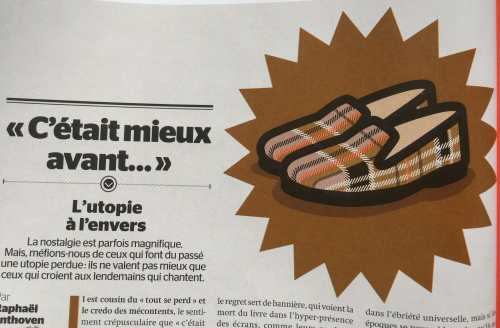
I came across this article in the French “Philosophie” magazine this month. Translated into English, the headline says “It was better before”, and the article goes on to explore this particular, common, state of mind.

It begins with a dissatisfaction with the present, but instead of that stimulating creative thinking motivating people to turn that dissatisfaction into positive action, the mind turns backwards to think back to a past which quickly becomes a utopian illusion.

When Donald Trump says “Let’s Make America Great Again” – what previous time is he referring to? When the UK Leave campaigners said “I want my country back”, which country were they referring to? A country of the past, but an illusory one. When they said “Let’s take back control”, when did we ever have it? Which controls are they referring to?

The fabulous Woody Allen movie, “Midnight in Paris”, beautifully plays with this way of approaching the world –

When was that time? The time of Hemingway’s “Moveable Feast“, or the time of the “Belle Epoque“…..or just when exactly?

The article argues that older people are more likely to think this way because they have less life left to look forward to. A young person might look at the future and see it full of potential, where an older person might look at it and see illness, decline and death.

refage

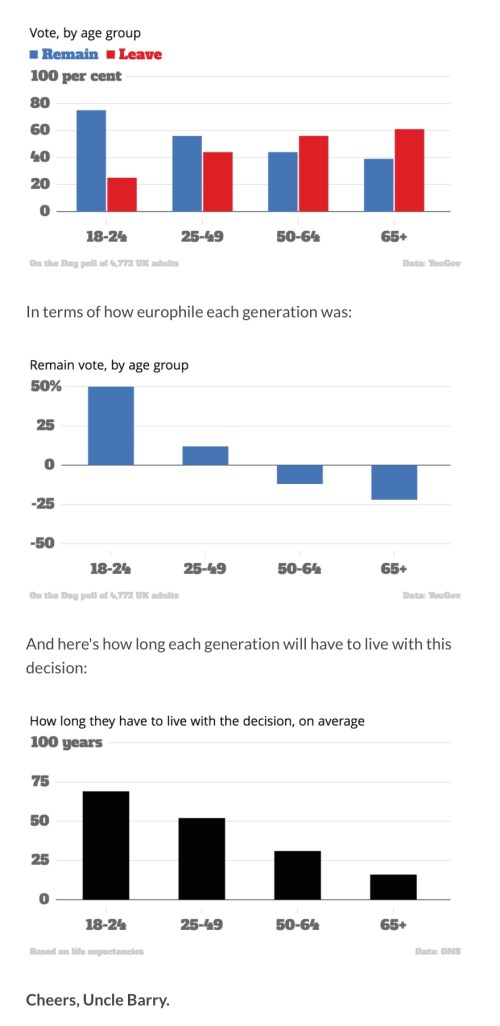
Maybe that partly explains one of the voting patterns seen in the EU referendum, where older people voted Leave, and younger ones, Remain.

I saw one elderly Englishman struggling to hold back tears as he said “I’ve got my country back”…..and I wondered, what country is that then? And how, exactly, have you got it back? But the emotional power of his view was clear.

I think there are many other factors at play in what’s happening in the UK just now, but I’ll leave them for other posts in the days ahead…..meantime, I think it’s worth asking people who have been seduced by the illusion of the utopian past to say more clearly what they intend to do now. Now that they have voted to go back to wherever they think it was, what do they want to do today?

In fact, I think that’s a question for all of us, because illusory past utopia or not, the present has changed for us all.

Let me modify my question so we can all join in…..what are YOU going to do today? Now that we are where we are? (And, yes, I’m asking myself for an answer too!)


Read Full Post »

night sky flower.jpg

I’ve just finished reading Andrea Wulf’s “The Invention of Nature” which is her biography of Alexander von Humboldt. I thoroughly recommend it. It’s a big read but a great one. I must confess I’m one of the apparently many who has never heard of Humboldt but am I glad I know something about him now.

One of the most amazing things about Humboldt is how he saw, described and wrote about Nature as a complete interconnected web, and he did this at the end of the 18th, and beginning of the 19th centuries. What an insight! What a vision! What an understanding! His enthusiasm for Nature and his insatiable curiosity are infectious, even now. But it’s his underlying fundamental insight which thrills me most. He describes ecology before the word was even invented. He sees the damage caused by short term economic greed and, more than that, he describes the environmental consequences of these short sighted actions. He demonstrates how the interconnected web of Nature means that these simple minded grabs for wealth will produce long term, far reaching negative consequences for many.

Seeing our world and everything in it as intimately, inextricably interconnected is the basis of holistic science. This is a science of wonder, exploration and discovery. He uses the best scientific instruments of the time to measure whatever he can measure, but he does something which scientists today so often fail to do. He uses the measurements to discover the connections. He puts things together rather than dividing them up. He sees nothing as existing in isolation. In other words he uses reductionist methods in a holistic way.

Reading about him is one of the clearest examples ever of integration. The two halves of his brain both worked brilliantly together. He pursued the new and climbed the highest mountains to see the world as a whole (right cerebral hemisphere). He measured, analysed and categorised (left cerebral hemisphere). Then he put it altogether in a vast web of contexts (right cerebral hemisphere again). What a great demonstration of using the whole brain. Of course I’m simplifying here. I’m sure he didn’t use his brain in such a linear fashion, but, still, I think it’s magnificent.

I thought about him again as I looked at this wonderful flower (see the image above). It’s called “Night sky”. Isn’t it stunning? Doesn’t it immediately show you how the human brain both discovers and creates connections?

That we can see the starry heavens in the soft purple petals of an earthy flower…….


Here’s a short video clip of Andrea Wulf talking about her book –

Read Full Post »

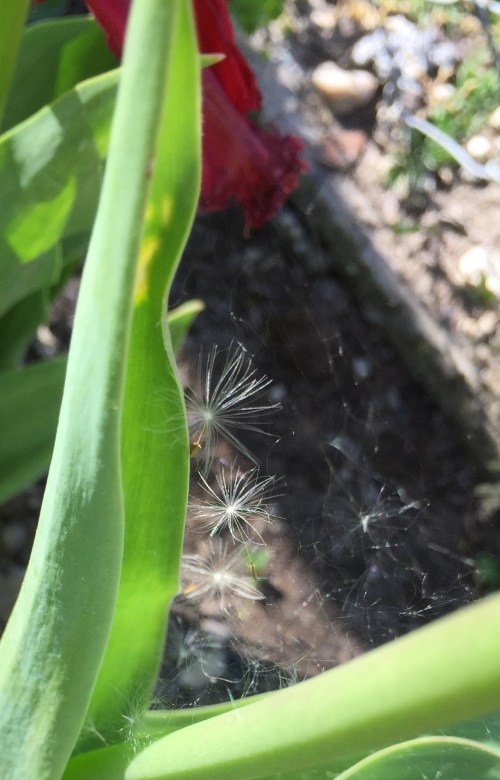
seedweb

In “Deux Idées de Bonheur”, Luis Sepúlveda says that he’s come to understand that happiness and wellbeing are a web or network of relationships, between ourselves and others, between ourselves and what is around us, between ourselves and Nature.

I like that. It seems very true to me. We all exist with an intricate and infinite web of connections. None of us exist without any relationships. We all have, or have had parents, we’ve all encountered many, many others over the course of our lives, people we’ve been taught by, looked after by, friends, rivals, people we are related to through genes and marriages. We all live our every day lives in a web of others who produce, transport, prepare and sell the food we eat. Others who make the clothes we wear, who make every object we handle in an ordinary day. We live with others with whom we share our stories, co-create our values, our purposes, our reasons to get up every morning.

And we are in an intimate and unceasing relationship of exchange of energy, information and substances with the natural environment. The air, the water, the soil, the way we work the land, change the landscapes, warm the atmosphere around the Earth.

The other dimension of these vast webs is time. Our lives are all like stories….we are continually describing and telling the present as it emerges from our personal and our shared past, and which, moment by moment, is already in the process of becoming the future.

Happiness and wellbeing are not states, not independent, self-sustaining, isolated characteristics or “data points” to be measured. They are experiences which emerge out of a web of moments, within a network of connected people and events.

They are qualities of life, not permanently present, but always in the process of creation, like an intricate cloth of threads woven across lifetimes.

Read Full Post »

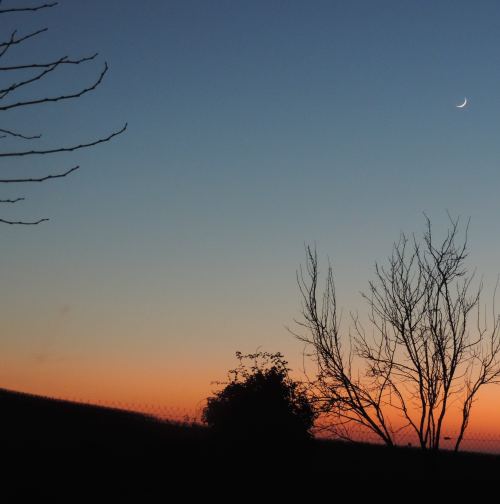
two lights.jpg

Just after the sun set I saw this moment – where the moonlight meets the twilight. Knowing, of course, that these are both the light of the same sun.

I watched a fascinating and moving documentary on French TV on Sunday. It was about a French family, a father, mother, teenage son and two younger daughters sailing a boat up the east coast of Canada to Greenland and as far north as they could go.

The further north they sailed the less they encountered towns and villages, but when they did stop, they’d be welcomed by local Inuit people. Although they couldn’t speak to each other in a common language, their interactions were friendly and curious. There were lots of smiles and a welcoming into homes to share some food.

I was reminded of holidays in Brittany many, many years ago, where our little son, probably only about 5 years old at the time, would spend all day playing on the beach with another child who was there. The children didn’t speak the same language but they had fun for hours. When we asked him what the little girl’s name was he replied “I don’t know” with an expression which suggested he didn’t even understand the need to ask the question.

It’s been my experience as I’ve travelled in other countries that strangers are helpful and friendly. There is some fundamental affinity between human beings.

I know all that can go very wrong very quickly however. A few days ago I was reading one of Montaigne’s essays (On coaches), where he described the reports of the “New World” which were just becoming known at the time (he lived in the 16th century). The tales he told were of the Spanish greeting the native peoples of Mexico and other “New World” countries, presenting themselves as peaceful and friendly, then deceiving and tricking them….slaughtering, capturing and torturing them. Demanding gold from them. The descriptions of the violence are as awful as anything you’d see in “Game of Thrones”! Montaigne was shocked by it –

Who ever set the utility of commerce and trading at such a price? So many cities razed, so many nations exterminated, so many millions of people put to the sword and the richest and most beautiful part of the world turned upside down for the traffic in pearls and pepper!

He mused about how things could have been so different –

What an amelioration for the entire globe, if the first examples of our conduct that were offered over there had called those peoples to the admiration and imitation of virtue and had set up between them and us a brotherly fellowship and understanding?

In other words, what if the explorers had presented the best of themselves instead of the worst? What if they had behaved in such ways that the native peoples had admired them and wanted to imitate them instead of fearing them? What if the whole goal of the exploration had been an increase in “brotherly fellowship and understanding” instead of exploitation and theft?

Makes you wonder, huh?


These tales of violence seem both far away and disturbingly close. We certainly haven’t evolved to a better way. There are still wars of religion, torture, exploitation and even domestic violence. However, I do think there is a glimmer at least of hope because there is something I can do. And that you can do. Every day.

We can tune in to our natural human attraction for other humans and approach them with our best selves rather than our worst. I can, and you can, meet others with a desire to “increase brotherly fellowship and understanding” (that’d be sisterly too by the way!!)

Can’t we?

Read Full Post »

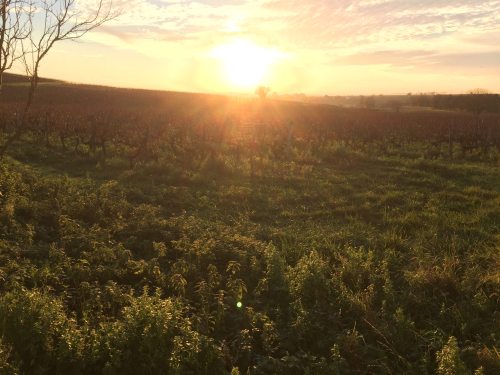
sun over the vines

Montaigne writes about life –

I enjoy it twice as much as others, for the measure of enjoyment depends on the greater or lesser attention that we lend it. Especially at this moment, when I perceive that mine is so brief in time, I try to increase it in weight; I try to arrest the speed of its flight by the speed with which I grasp it, and to compensate for the haste of its ebb by my vigor in using it. The shorter my possession of life, the deeper and fuller I must make it.

The first thing which struck me when I read this paragraph was “….depends on the greater or lesser attention that we lend it.” I’ve thought for a long time that attention is a great magnifier. Whatever we pay attention to gets bigger, more intense, or more significant, it seems to me. That’s what attracted me to the work of the positive psychologists such as Seligman. It seems to me that the more attention we give to a fear, the greater the fear becomes, so is it not better to give more attention to strengths, hopes and potentials and make them bigger instead?!

The second thing which struck me was his use of the terms “weight”, “speed” and “vigor”. In each and every one of these instances he is making the case for an intensity of engagement. This reminded me of the work of the philosopher, Robert Solomon, whose book, The Joy of Philosophy, is subtitled “Thinking Thin versus the Passionate Life”, and of Liz Gilbert, in her “Big Magic” where she talks of the “amplified life”.

Montaigne precedes this passage with a musing on the phrase “pass the time”, and here he is arguing that we shouldn’t just let time pass, we should embrace life fully and so experience it more intensely than we do when time is just drifting by.

The third thing which struck me was “The shorter my possession of life, the deeper and fuller I must make it”. He wrote this when he was older (it’s from the essay “On Experience” which is the last one in the third of the three volumes of the “Essais”). How often do you hear people who have had an accident or serious illness, say, in the full awareness of their mortality, that they now intend to live life more fully? Such crises are often described as “wake up calls”. This is the same idea, isn’t it?

So, what is Montaigne saying here that I’d like to take on board today?

That I want to live today with awareness, with passion and with intensity. I want to fully experience the one and only chance to live today.

That’ll do!

Read Full Post »

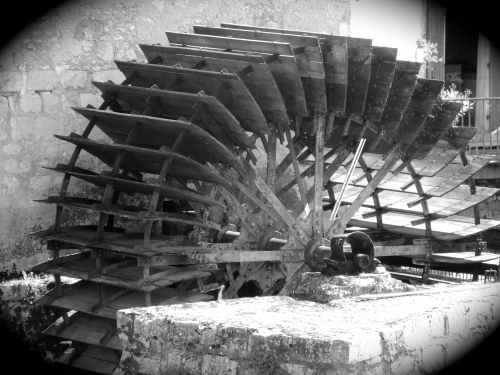
waterwheel

Here’s a couple of thoughts – is the scientific method the way to be sure of things? And, is there only one scientific method?

What provoked those thoughts? An article in the Guardian citing research about jihadists

What kind of person becomes a jihadi terrorist? Specifically, what kind of educated person? The overwhelming majority of graduates recruited into Islamist terrorism studied engineering, science and medicine. Almost none are social science or arts graduates, according to research. The insight could have important implications.

Almost half (48.5%) of jihadis recruited in the Middle East and north Africa had a higher education of some sort, according to a 2007 analysis by Diego Gambetta that is cited in Immunising the Mind, a new paper published by the British Council; of these 44% had degrees in engineering. Among western-recruited jihadis that figure rose to 59%.

The author of the paper, Martin Rose, describes what he terms the “engineering mindset” which, he claims, makes science and engineering graduates more susceptible to jihadist indoctrination.

The culture of science teaching, says Rose, resolves all too easily into a right and wrong, correct and incorrect binary. This damages the ability of science and engineering students to develop the skills of critical examination.

……three specific traits that characterise the “engineering mindset”: first, it asks “why argue when there is one best solution?”; second, it asserts “if only people were rational, remedies would be simple”; and third, it appeals to those with an underlying craving for a lost order, which lies at the heart of both salafi and jihadi ideology.

It does seem that the jihadists see the world in a binary way – black and white, right and wrong etc – “That is perhaps why, in Isis-controlled territory, university courses in archaeology, fine art, law, philosophy, political science and sports have been eliminated, along with drama and the reading of novels.”

This claim that a training in science and engineering leads to seeing the world in binary ways and assertions of certainty is totally contrary to what I just read in “Sapiens” by Yuval Noah Harari. He describes a number of revolutions in human development – the agricultural revolution, the cognitive revolution and finally, the scientific revolution. Of the scientific revolution he says

The Scientific Revolution has not been a revolution of knowledge. It has been above all a revolution of ignorance. The great discovery that launched the Scientific Revolution was the discovery that humans do not know the answers to their most important questions…….modern people came to admit that they did not know the answers to some very important questions, they found it necessary to look for completely new knowledge.

This seems to suggest that scientists might be best placed to say “I don’t know”, rather than to make claims about the possession of “THE TRUTH”.

Isn’t a good scientist always unsure? Does a good scientist ever claim they have the complete, final, definitive knowledge or understanding of anything?

Well that’s what I thought about science until I oversaw a science student’s notebook one day. The scientific method described there was of “Observation; description; explanation; prediction; control”. That shocked me when I read it but suddenly a particular approach to science made sense to me. I hadn’t taken on board that the ultimate goal of science was control. I thought it was explanation – possible explanations!

But a little further on in “Sapiens” Yuval Noah Harari writes

In 1620 Francis Bacon published a scientific manifesto titled The New Instrument. In it he argued that ‘knowledge is power’. The real test of ‘knowledge’ is not whether it is true, but whether it empowers us. Scientists usually assume that no theory is 100 per cent correct. Consequently, truth is a poor test for knowledge. The real test is utility. A theory that enables us to do new things constitutes knowledge

Aha!

Back to Bacon again! The sometimes claimed “father of the scientific method”. I never warmed to him with his desire to dominate Nature and human beings.

So also there are two kinds of empires, as rewards to those that resolve them. The one over nature, the other over men; for the proper and chief end of the true natural philosophy is to command and sway over natural beings; as bodies, medicines, mechanical works, and infinite other things

So maybe here’s the link – its a particular type of “scientific method” which is a quest for certainty in order to wield power.

Maybe it’s time for us to invest more in the humanities if that’s what is required to produce critical thinkers who can live with the reality of uncertainty.

Rose suggests that the British Council, the organisation funded by the UK to spread British cultural influence around the world, should involve itself in education reform, to “humanise” the teaching of scientific and technical subjects. A broader-based education would give vulnerable students the intellectual tools to develop an open-minded, interrogatory outlook – and to question authority, whether scientific, political, religious or scientific.

And maybe it’s time to promote a different scientific method – one based on wonder, curiosity, and the humble belief that we never know everything about anything.

But then, “que sais-je?”

Read Full Post »
birdwatch

Montaigne wrote

There is nothing that should be recommended so much to youth as activity and vigilance. Our life is nothing but movement…

When I read this I automatically reframed it into a more modern language and something which fitted better with the themes which are important to me – actions and awareness.

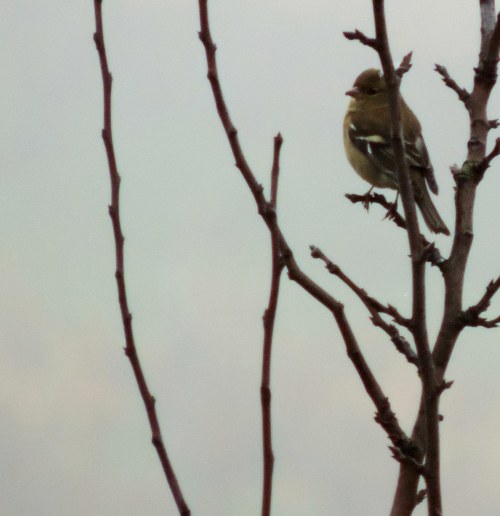
I also thought immediately of the birds in the garden. How they seem to be busy all the time and also, continuously “vigilant” or aware.

If I was to single out two characteristics which make the difference between zombie mode and hero mode in our lives it would be these two –

Activity

In some ways you could argue that we are what we do. When writing stories we create and reveal character by describing the choices they make. William Glasser developed a whole therapeutic approach based on making people more aware of the choices they are making all the time – because we do choose all the time. It’s just that for a lot of the time the choices happen automatically as part of habits, routines or manipulation. That’s the zombie way in my view.

The auto-pilot way. We’re not experiencing our human-ness to the full when we live that way. But we are active all the time. Even if that activity is simply sitting and breathing.

If you’d like to explore this in more depth, then search for my posts in the “a to z of becoming” series on this site where I reflect on 52 different verbs, each of which is an action we can take to further our “becoming”.

Life is difficult to define. I mean from a scientific or biological perspective. You can see that in the difficulty we have knowing whether or not a seed is alive. But amongst the most successful attempts to define life there is always some mention of action – of respiration, or metabolism. Or as Maturana and Varela said – of “self-making” – they even came up with a new word for that – “autopoiesis”.

If life is significantly about the activities we are undertaking, then might it not be better to be aware? To reflect and consider so that we can choose? Even if we choose to continue doing what we were doing anyway?

That leads to the second characteristic –

Awareness

People talk a lot about mindfulness these days, but that word is really just another word for awareness. To be “mindful” is to be aware.

Awareness is partly about paying attention. It’s about focus. Where are we directing our attention? What is catching our attention?

And it’s partly about reflection, because as we reflect on what has just occurred or what we have experienced we heighten our awareness and deepen our understanding of ourselves and our lives.

As Ellen Langer says, mindfulness is the opposite of mindlessness. Why would you choose the latter?

So, maybe there’s something to learn from the birds – and from Montaigne – that “activity and vigilance” are to be recommended!


Read Full Post »

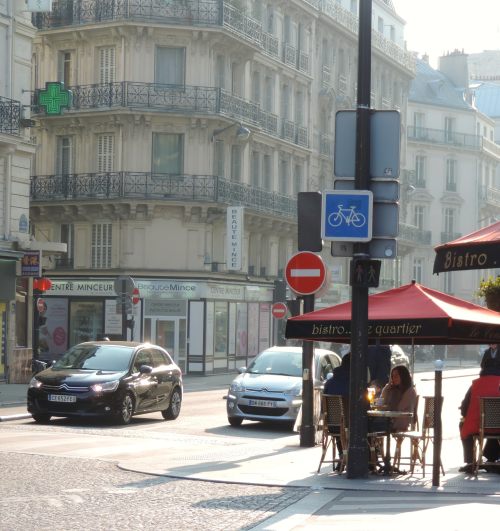
paris corner

Montaigne wrote in one of his essays that he once met a wealthy man who he found studying in a corner of his great hall, with only cloth hangings partitioning him from the noise and bustle of his servants. He told Montaigne

that he derived profit from this racket, as if, battered by this noise, he withdrew and concentrated in himself better for contemplation, and that this storm of voices drove his thoughts inward. While studying at Padua, he had for so long a time a study exposed to the rattle of coaches and the tumult of the square that he trained himself not only to disregard the noise but to use it for the benefit of his studies.

Have you had that experience? I’ve read of several writers who would write in cafes, but others who find such a buzz too distracting. Montaigne himself was one of the latter –

I am quite the opposite; my mind is sensitive and ready to take flight; when it is absorbed in itself, the slightest buzz of a fly is the death of it.

Since Montaigne’s day we could add another scenario – studying, or reading, while listening to music. Again I think there are some of find this beneficial, and others who just find it too distracting.

When I was studying Medicine in Edinburgh there were two places where I studied best. One was in the Botanic Gardens, and the other was in the Anatomy Museum! Well, what does that say about me??

How about you? Do you need peace and quiet? Or do you find a hustle and bustle around you conducive?

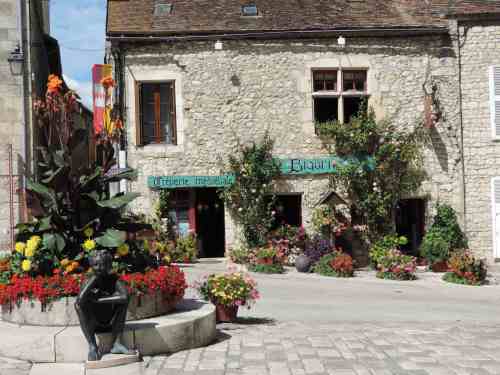
chauvigny

Read Full Post »

kaki

Here’s a passage from Montaigne –

Never did two men judge alike about the same thing, and it is impossible to find two opinions exactly alike (about the same thing) not only in different men, but in the same man at different times.

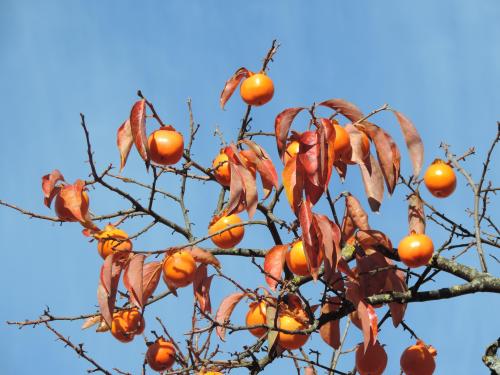
I’ve been passing a spectacular tree recently. It’s in the corner of somebody’s garden in Chateaubernard on the way into Cognac, not far from the Biocoop. Here’s a photo I took the other day. I think this is a “kaki” tree. Certainly that’s what the fruit looks like. It inspired me to buy one of the fruits and taste it. Mmmm….delicious. Or was it…..?

Montaigne says, it isn’t possible to find two opinions about the same thing exactly alike. You might taste a kaki fruit and think “yuk!” Yet, what can we do, other than say truly what we experience?

This passage of Montaigne’s made me think about all the reviews which surround us. The well established reviews of movies, music, theatre, and books which appear in most newspapers at the weekends have been added to enormously by reviews online. Amazon, for example, allows anyone to post reviews and it’s not at all uncommon to find widely divergent views on the same book – just as Montaigne said. But they also use their algorithms to show you what other books, other people who liked this one, liked (or bought). At least this second method helps you to find people with some tastes in common to yours. There are sites like Tripadvisor which let people review and rate restaurants, bars, hotels and so on. Again, there you’ll see reviews of any particular establishment which range from fabulous to awful. What do you do with that?

Add into the normal range of opinions and tastes, those who deliberately post positive or negative reviews for commercial or malicious purposes – making up reviews to try to affect the rankings.

So I wonder, what do you do? How do you find books to read, movies to watch, music to listen to, places to go? How often do you read the reviews and how do you find the reviewers you trust? Maybe you get familiar with a particular blogger and find you share a lot of their tastes. That can help.

Montaigne’s final point takes us back to the fact that everything changes. We all find that what we loved or hated in the past can turn the other way as we get older. Maybe there’s a certain kind of food you used to hate, and now you love? Or maybe there are authors or musicians who just don’t do it for you any more (or alternatively, who previously didn’t interest you, but now that you look again, you fall in love with them!). Have you had that kind of experience?


Read Full Post »

Untitled


The arts that promise to keep our body in health and our soul in health promise us much: but at the same time those who profess these arts among us show the results of them less than any other men. The most you can say for them is that they sell medicinal drugs; but that they are doctors you cannot say.

Montaigne is frequently pretty harsh about doctors and the practice of medicine in his “Essais”. The last sentence in that passage above did really strike me however. “The most you can say for them is that they sell medicinal drugs; but that they are doctors you cannot say.”

A number of thoughts sprang up from there.

First up was Professor Peter C Gøtzsche, a researcher who published “Deadly Medicines and Organised Crime”. Read this from the introduction to that book –

The main reason we take so many drugs is that drug companies don’t sell drugs, they sell lies about drugs. This is what makes drugs so different from anything else in life … Virtually everything we know about drugs is what the companies have chosen to tell us and our doctors … the reason patients trust their medicine is that they extrapolate the trust they have in their doctors into the medicines they prescribe. The patients don’t realise that, although their doctors may know a lot about diseases and human physiology and psychology, they know very, very little about drugs that hasn’t been carefully concocted and dressed up by the drug industry … If you don’t think the system is out of control, then please email me and explain why drugs are the third leading cause of death … If such a hugely lethal epidemic had been caused by a new bacterium or a virus, or even one hundredth of it, we would have done everything we could to get it under control.​

This is an “evidence based” book from an “evidence based” expert. It’s not a conspiracy theory – and that, actually, makes it all the more shocking. Montaigne might have said that doctors only sell drugs, but Gøtzsche says pharmaceutical companies sell “lies about drugs”.

Then I thought about a doctor friend of mine who was told by their Clinical Director to spend less time talking to patients because that wasn’t a doctor’s job. A doctor’s job, according to this senior doctor, was “to write prescriptions”. (The astonishing thinking behind this was that only doctors have the legal right to write the full range of prescriptions so that was what they should focus on)

And finally this week I read in the Huffington Post, a piece by John Weeks about Integrative Medicine and CAM in the USA.

Regular medicine’s dominant influence when “CAM” integration by medical delivery organizations began in the mid-1990s was the industrial value of service production. Mayo Clinic’s director of innovation captures this concisely when he recently spoke of medicine’s historic focus on “producing” services rather than on “creating health.”

What he is writing about is a report from the RAND corporation about Complementary and Alternative Medicine which focuses on the issue of practitioners being reduced to providers of “products” – e.g. a chiropractor does a manipulation, an acupuncturist puts in needles. In fact, although this is not where that article goes, doctors are being reduced to prescribers.

So, full circle, back to Montaigne again – what does he mean when he says “The most you can say for them is that they sell medicinal drugs; but that they are doctors you cannot say”? Personally, I think he is saying if you reduce a doctor to someone who just supplies you with medications, then you don’t have a doctor any more. I agree. A doctor undergoes an immense, broad, arduous training. I think a doctor should always keep the focus on the whole patient, seeking to understand them in their uniqueness. The doctor should be an expert in diagnosis, able to figure out what’s happening by great listening skills, great observational skills and the knowledge and experience of dealing with patients with a wide range of diseases. When it comes to doing something therapeutic (apart from understanding and supporting their patients, which is therapeutic in itself) then, surely, we want to be able to offer more than just a prescription for a drug?

A few days back I wrote a post about biomimetics. Wouldn’t it be great if doctors became experts in health? In how a human being stays healthy? And in how a human being recovers from injuries and illnesses (we used to call that “healing”). I reckon there’s mileage in the biomimetics idea. We could be learning how living organisms stay healthy, repair and recover when injured or ill, then developing techniques which support, or mimic, those strategies and processes.

Read Full Post »

« Newer Posts - Older Posts »