Feeds:
Posts
Comments

Archive for the ‘from the viewing room’ Category

Now the trombone is not an instrument I have much affection for but this little animation I found on youtube is immensely pleasing and the music is by the Voodoo Trombones – on this track they sound like a Carribean flavoured variety of Lemonjelly

Makes you want to dance, lifts your heart……

Read Full Post »

The movie {Proof} starring Gwyneth Paltrow, Anthony Hopkins and Jake Gyllenhaal got me thinking (well, there’s a surprise you might say!) It got me thinking about a number of issues. Here’s a couple of them.

How do you prove anything? The basis of the scientific method is (according to Popper) falsification. He meant that nothing can be proven but testing can reveal a hypothesis to be false – and so science progresses, coming up with more and more robust hypotheses which are harder to disprove. Of course, in mathematics, advances are made by writing “proofs” which are solutions to puzzles or dilemmas I suppose (don’t ask me, I’m not a mathematician!). A key part of this movie is how to show who actually wrote the groundbreaking “proof” – the father (Robert), or the daughter (Catherine)? What’s the solution? Well, can it be shown that the daughter could NOT have written the proof? If that can’t be shown, then her claim to have written it can gain strength.

OK, I know, that all sounds pretty convoluted. Don’t let that put you off. This is an intriguing and engaging movie, and not at all hard work!

So that’s the first theme – how do we know what we know? How can we ever be sure of anything?

The second one is the theme of how our traits, skills, and qualities come from our roots, from our origins. We can see qualities in ourselves that seem inherited and we can see some of our qualities in our children. We don’t start with a blank sheet, but neither do we start with a fully written script. We make our lives our own and each and every one of us is unique and different but there are threads that run through us which trail way, way back into other people’s pasts. Catherine seems destined to carry forward her father’s work having inherited his mathematical genius but she hopes she has not also inherited his madness. When her father dies, her challenge is to become herself in her own right. This reminded me of Kieslowski’s Blue.

In “Blue” Kieslowski considers how loss creates the possibility of new beginnings. The main character, Julie, loses her husband and her daughter in a car crash in the opening scenes of the movie and her way of dealing with her grief is to try to rid herself of all memories and connections with them. She tries to start again. But there’s no such thing as a clean sheet. Deleuze showed that we are in a continuous process of becoming and that in every present there is the past and the future. Interestingly, in “Blue” there is also the question of exactly who created a work. In this case, who composed the great music – Julie, or her husband? How can we know?

{Proof} also made me think about what it’s like for two people to create together and how, when it works well, what is created can NOT be attributed solely to one person. Yes, sure, an individual can sit alone and create, but something different manifests itself when the creative process is shared. I think that’s a good example of why its important to know a person within the contexts and connections of their life.

Here’s a fanvid of {Proof} – clips set to “I think I’m Paranoid”, by Garbage

And here are the last few scenes of Trois Couleurs; Bleu

Read Full Post »

Tonight I went to see the firework display over La Cite, Carcassonne.

Here’s the closing sequence captured on my K800i mobile phone

The display is known as L’Embrasement

Some of the photos I took are here

Read Full Post »

We’re all different. We cry for different reasons and in different circumstances. Sometimes it’s good to cry. A Scottish word for crying is “greeting” and there’s an old saying that “a good greet” will make you feel better. There are a lot of things that make me cry. I cry at movies, at songs, at the painful stories I’m told. I cry when I’m sad and I cry when I’m happy. I cry when I’m overwhelmed. It can feel good. Here’s a fanvid I found on youtube that made me cry. I find it very moving. Maybe if you’re not a Lord of the Rings fan like me, or you don’t like this kind of music, it won’t work for you, but maybe it will. Whether it does or not, what works for you? What do you watch or listen to or do to have “a good greet”?

Read Full Post »

Learning the materia medica of homeopathic remedies teaches us about the kinds of ways different people experience the world and cope with life’s challenges. There are amazing parallels and resonances between these patterns and significant characteristics of the starting materials of the remedies.

Let’s take a look at Lycopodium. This is club moss. A delicate looking type of fern moss which creeps along the forest floor looking pretty insignificant. However, back in the Carboniferous Period this plant was one of the greatest trees in the forest. Imagine what it might be like to have a knowledge of your greatness, your superiority over others trapped inside body and personality which is small, weak and insignificant. This gives you a sense of the essence of the materia medica of Lycopodium.

People who respond well to this remedy are often quite haughty, even contemptuous of those who they consider to be their inferiors. But in the presence of authority they become quite obsequious.

There are some great characters from literature like this. Think of Dickens’ Uriah Heep, or Peake’s Steerpike. Or think of Grima Wormtongue. Here he is ……..

That video clip is wonderful. I’ve always liked that song and the way Anyathe has put together the clips from Lord of the Rings to this soundtrack is just superb. It gives us a more sympathetic understanding of this rather distasteful character.

The person who needs Lycopodium after all is just struggling to survive and get on in life as we all are. There’s a duality at the core of their being. Two understandings of the self, each of which expresses itself in different contexts. The child who needs Lycopodium is often as good as gold at school and a very disturbed, difficult child at home, or vice versa, depending on which authorities they respect. The adult who needs it usually reveals their dual nature when they are in the middle of a hierarchy. They are good employees but bullying bosses.

Read Full Post »

Breaking and Entering is the new film by Anthony Minghella. I watched it on the plane last night on the way home and it completely grabbed me and reduced me to tears that took ages to stop. It’s Juliette Binoche’s acting that does it for me. I think she is SUCH an amazing actor. There are two scenes that really, really moved me and they both involved her. One is where she begs the Jude Law character for help. Begs desperately, hysterically. And the other is a very quiet scene towards the end where in response to his courageous act of kindness she looks at him, with an intensity that transfixes you, and then a tear appears from the corner of her right eye and slides down the side of her face. Oh, that did it! I started right there and didn’t stop, right through the credits which roll to the soundtrack of a beautiful piece by Sigur Ros that seems to hold you in that intensity of emotion, holds you steady, till you think this feeling, this upset, can’t go on any longer then it increases. Heart-rending.

Here’s the trailer

Read Full Post »

On the plane to Tokyo I watched three movies. The best one (the one I’ll buy on DVD to watch again and again) was “Stranger than Fiction”. One of my all-time favourite end of movie voice-overs is Kevin Spacey in “American Beauty”. I play that end scene frequently and it gets me every single time. Well, at the end of Stranger than Fiction we hear Emma Thomson as Kay Eiffel saying this –

As Harold took a bite of Bavarian sugar cookie, he finally felt as if everything was going to be ok. Sometimes, when we lose ourselves in fear and despair, in routine and constancy, in hopelessness and tragedy, we can thank God for Bavarian sugar cookies. And, fortunately, when there aren’t any cookies, we can still find reassurance in a familiar hand on our skin, or a kind and loving gesture, or subtle encouragement, or a loving embrace, or an offer of comfort, not to mention hospital gurneys and nose plugs, an uneaten Danish, soft-spoken secrets, and Fender Stratocasters, and maybe the occasional piece of fiction. And we must remember that all these things, the nuances, the anomalies, the subtleties, which we assume only accessorize our days, are effective for a much larger and nobler cause. They are here to save our lives. I know the idea seems strange, but I also know that it just so happens to be true. And, so it was, a wristwatch saved Harold Crick.

Kay is an author whose voice Harold (played by Will Ferrell) hears in his head. Hearing voices that nobody else can hear is usually regarded a sign of mental illness but Harold refuses to believe that. The voice is clearly narrating his life as if he is the main character in a novel. That would be disturbing in itself but when the narrator makes it clear she is about to kill off her main character Harold decides he has to find her and persuade her to change the ending – he doesn’t want to die yet! It’s a clever movie based on a really interesting idea. After all, aren’t we all the main characters in the stories of our lives? Where do the stories of our lives come from? Are we both author and reader as we create a sense of self? I think so!

There’s a good scene where he goes to consult a psychiatrist who diagnoses schizophrenia but when he declines medication and asks for an alternative solution she sends him to a Professor of English Literature (played by Dustin Hoffman). I love that this is the character who helps him make sense of this problem rather than a doctor who prescribes drugs. This is a scene I think I’ll use when teaching medical students.

A big added bonus is the character Harold falls in love with, Ana Pascal, played by the wonderful, always interesting Maggie Gyllenhaal. She plays unusual, challenging quirky characters so well. Did you ever see “Secretary“? Probably one of the worst packaged DVDs I’ve ever bought – terrible cover! It’s actually one of the most challenging movies about relationships and sexuality you’re ever likely to see.

So does Harold die at the end of the movie? Dustin Hoffman makes it quite clear the novel is great with the ending which kills Harold off (and tries, successfully, to persuade Harold, that’s that how it should be left), but, he argues with the author, that with a different ending the novel would be just ordinary. What do you think of that? Is it the ending that makes a novel great? Reminds me of that Penguin project Amy blogged about.

Read Full Post »

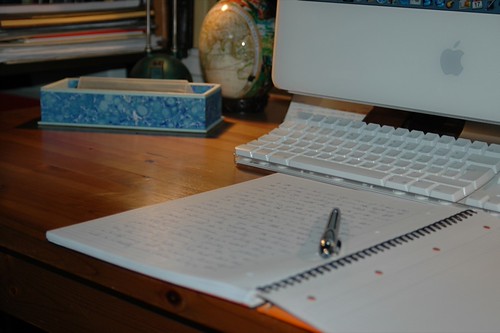
Morning pages, originally uploaded by bobsee.

What makes a space a creative space? Every Saturday in the Guardian there is a photo of a writer’s room. It got me thinking about the spaces which somehow make creativity flow.
A number of years ago I read The Artist’s Way and I two lessons really stuck with me (but for some reason I never got round to carrying them out until recently).
The first lesson was what Julia Cameron calls “morning pages”. Her idea is that you should write, pretty much stream of conscious writing, every morning until you’ve filled three pages of a notebook. Well, I never did it, until 27th December last year. Since then I haven’t missed a single day and it’s almost a kind of addiction now. If I don’t actually do it first thing there’s a kind of irritation in me, a discomfort, until I sit myself down and write the three pages.
I haven’t stuck to writing first thing but most mornings I do get up at 6am, shave, shower, dress, then sit myself down and write the three pages. If I’ve got time left, I have breakfast! I find it takes anything from 15 minutes to just over half an hour to write the three pages. I’m not precious about the stream of consciousness thing but I do try not to stop once I’ve started (I don’t pause for thought, worry about grammar or punctuation).
Sometimes I have written on the train, on a plane, in a cafe or in an airport. The variety gives me a bit of a kick. I let myself just ENJOY it and don’t give myself a hard time for not having written within an hour of getting out of bed. With this leeway, I’ve written 3 pages EVERY single day since December 27th and I really don’t see me stopping now.
I didn’t read what I’d written at all for the first six weeks and I haven’t kept up a time for writing what I’ve written (in fact, most of what I’ve written I haven’t read!). However, my creativity has been unleashed! I can’t tell you just how much but I take more photos than ever before, post up to Flickr for the first time ever, started this bog, wrote a few pages for a website……I could go on. I just feel that ideas don’t rattle around my head like hard peas in a tin any more, rather they come together, they develop and, more than anything, they turn into real world phenomena – words and images mainly.
I cannot recommend this habit highly enough. It is transformative.

Read Full Post »

Moonlit sheep, originally uploaded by bobsee.

Amy drew my attention to this beautiful blog. One of the key qualities of a hero’s life is to be aware of the environment in which he or she lives. Not just to be aware of it, but to be aware of our interactions with it. We are sensing creatures, with such a great range of sensory organs. We can appreciate light and colour and movement. We can appreciate smells and tastes and textures. We can appreciate sounds and vibrations and temperatures. But we can also appreciate a lot of influences that we don’t seem to have sensory organs for – mood, atmosphere, and, as jo(e) writes in this post, the moon.
I think its sad that so many people these days are not aware of the phases of the moon and how it affects our lives. Jo(e), you know it, you feel it, you respond to it.
Take a look at jo(e)’s blog. You’ll see exactly what I’m talking about. Beautifully observed, finely written, a real hero’s page.

Read Full Post »

A Matter of Life and Death was made in 1946. It’s a film by Powell and Pressburger. They tell the story of a pilot, Peter Carter, shot down during the Second World War. But as he falls to Earth, the angel sent to bring his soul to heaven loses him in the fog, and by the time they find him he has fallen in love so he pleads to be allowed to stay alive a while longer. A court case to decide the issue is set up in Heaven. OK, so far, you’re thinking “this is just crazy, isn’t it?” Well, it’s a much more interesting movie than just a fantasy. And here’s what makes it interesting for me – Peter’s new love, June, asks a doctor friend to see him. This doctor, Dr Frank Reeves, is a neurologist and diagnoses that the pilot is suffering from a brain lesion which is affecting his visual pathways and so causing these vivid hallucinations of angels, heaven and a court case. What Dr Reeves very cleverly realises is that Peter’s story of the court case in heaven is so coherent and convincing to him (Peter) that if the case goes against him he will die and if it goes in his favour he will live. He deliberately encourages Peter to develop a positive narrative of how the case may go while persuading a neurosurgical colleague to operate on Peter.

The operation is successful and so, of course, is the court case.

Although this movie was made way back in 1946 it is remarkably perceptive and knowing with regard to the human psyche. It shows the importance of narrative in making sense of our experiences and it shows neatly how two different narratives (the medical/neurosurgical one and the patient’s one) can intertwine, indeed, MUST intertwine to produce a successful result of a treatment. The key scene is just over an hour into the movie where Dr Reeves is explaining his diagnosis and the importance of Peter’s narrative. I especially smiled at this comment by Frank Reeves –

A weak mind isn’t strong enough to hurt itself. Stupidity has saved many a man from going mad.

This is part of his argument that this “delusion” of Peter’s is not madness but is a physical problem of the brain. He argues that the delusion has its own internal logic and that Peter has an exceptionally good imagination. This is an interesting early exploration of the relationship between psychiatric illnesses and organic brain disease. But mostly it is an interesting exploration of the importance of the patient’s narrative, not only as a key method of diagnosis (a skill I fear is being lost in Medicine today) but also as a determining factor in healing, even in tipping the balance between life and death. More than this, it makes me think about the age belief – that there is a fine line between genius and madness. However, there is no known link between IQ (one measure of “strength” of mind) and the chances of having a mental illness. But is this what Frank means by “strong” or “weak”? What IS a “strong” mind? Frank says nothing about Peter’s intelligence, what he emphasises are Peter’s imagination and his ability to be logical. Here is what he really means – a “strong” mind has at least two strong capabilities – imagination and logic. Aren’t these key tools in the creation of narratives? Aren’t the most compelling narratives the ones which have been well imagined and seem to the reader to make sense (within their own terms)?

So, what of this apparent danger in a “strong” mind? If we think of this the same way as Frank we can see that if the narrative we tell ourselves becomes dislocated from external reality but is a STRONG narrative then it becomes harmful. This is the way I understand psychosis – a psychotic state is one where the person’s beliefs, their narrative of self, is not well connected to external reality and so becomes a hindrance rather than a help in living.

What’s the lesson here? It’s good to develop a strong narrative ability (it is this, at least partially, which saves Peter’s life – OK, I know, some will argue it’s the surgeon’s skill which does it, but time and time again recovery depends on individual patient’s mental state even when the same pathology is excised by the same surgeon). The danger lies in creating stories which don’t make sense of external reality when the storyteller fails to realise that. We can protect ourselves from that by sharing our narratives to co-create with others the narratives that make sense of all our lives.

What a great movie! I haven’t even touched on the technique of this film, the use of colour and black and white, the special effects, the framing, lighting, scene setting. I should also warn you that if you are of a sensitive disposition (like me) you’ll be in tears in the first ten minutes of this movie (I was!!)

Read Full Post »
« Newer Posts