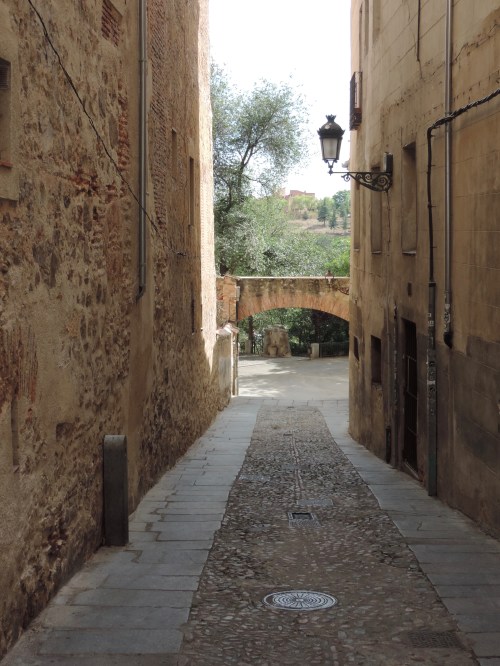
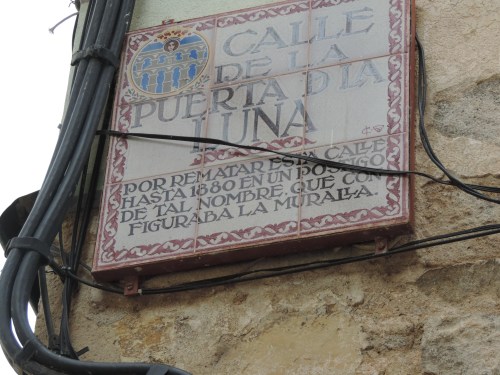
This small street in Segovia doesn’t look like much but up on the wall is this plaque –
Now, my knowledge of Spanish is very limited but I can see this is the name of the street – it’s the street of the door of the moon. The “Door of the Moon”! Oh, now, doesn’t that change things? What a name!
I’ve had a bit of a hunt online but I can’t find out much information about this street, or about the “door of the moon”, but I did discover there is also a “door of the sun” (of course!). When Segovia was a fortified town it had a wall around it, and to gain entry there were a number of “doors”, some of which were I think just wooden gates, and, as best I can tell, “the door of the moon” was one of those gates.
I haven’t come across any stories associated with these doors yet, but if any Spanish speaking readers here are inspired to do a bit of investigating I’d be delighted to hear what you discover!
For me, this is just such a romantic name. It inspires. It activates my imagination. Does it active yours?
See what a name can do? Doesn’t it whet your appetite for some stories? The stories which explain, or give meaning to, whatever has been named.
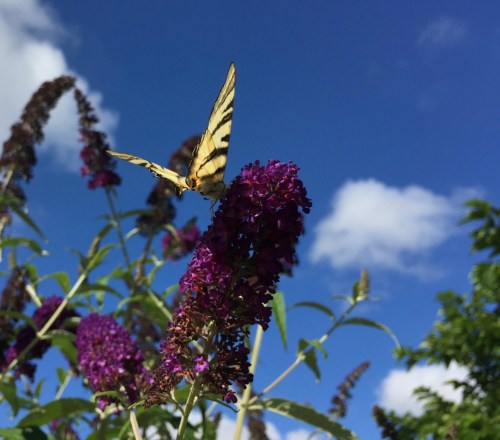
Every year I’m amazed to watch the butterflies appear in the garden the very same day the buddleia bushes flower. I’m convinced they both appear at exactly the same moment. No idea how that happens! Are the butterflies just hanging out around the corner somewhere waiting for the blossoms to appear, then zip round as fast as they can the moment that happens?
However it happens, it’s a delight to see so many varieties of butterfly (and the hummingbird moths, which are incredible creatures!), to watch how they fly in such utterly unpredictable directions, how they spread their wings in the sunlight, or close them up so they look like little leaves.
But here’s one thought which comes up for me time and time again when I see butterflies….they make me more aware of the cyclical nature of life. These little creatures have such different life stages, so different you wouldn’t realise they were stages of the same life. Do we think of them as having a beginning and an end? Starting with an egg, progressing through their caterpillar stages, becoming a chrysalis, then emerging as a butterfly which lays eggs, then dies. Is that the life?
I suppose we do all think of ourselves as having a beginning and an end. But where do we begin, and where do we end?
It depends on whether or not you want to reduce a person to just a physical body. My physical body began with a single fertilised egg and this body will die.
But what about ME?
Do I really think I’m only a physical body? Don’t I have a sense of something immaterial too? A consciousness? A sense of Self? A personality? Characteristics, behaviours, values, beliefs, creative acts, destructive acts? Is there anything I can do which doesn’t ripple out into the world beyond me?
When I look at Rodin’s “The Kiss”, or “The Thinker”, what do I see? The product of the imagination and creative skill of the man called Auguste Rodin. When I listen to music composed and performed by people who are long since dead, isn’t there something I’m sharing there which only they could have created? Aren’t these great works of art the ongoing ripples of unique human beings? Or do you think these are just their footprints? (It doesn’t seem that way to me….these works seem full of life and the potential to continue to create and send out ripples into the universe)
And what about those characteristics, quirks or tendencies that I have which others in my “family tree” also exhibited, even perhaps before I was born? Anyone who explores their genealogy encounters remarkable “coincidences”, talents, life events, behaviours which echo down through the generations. Weren’t those threads present even before the egg which became me even existed?
I think it’s inadequate to narrow a person down to a physical body.
But even if we did, there is still the fact that the body changes continually. It never stops. There is a constant turnover of cells, new beginnings, new endings, every hour of every day. There is a continuous exchange of energy, materials and information between my body and my environment, and we all share the same environment, the same atmosphere, the same air, water…..we are all made from the same molecules, all created from the same “star stuff”.
So it seems to me that beginnings and endings are everywhere……wherever, and whenever, we happen to look.
But it also seems to me that they are nowhere. They just don’t exist. We all emerge from, and dissolve into, the great cycles of the universe.
Beginnings and endings are just where we choose them to be. But we can always make a different choice. We can always take a broader view, a bigger view, a longer view, a more holistic view.
I’m reminded of a song from my school days….it’s by Jeff Beck, and it’s called “Hi Ho Silver Lining” – he sang this truth right there in the opening line of this song…in the first five words……
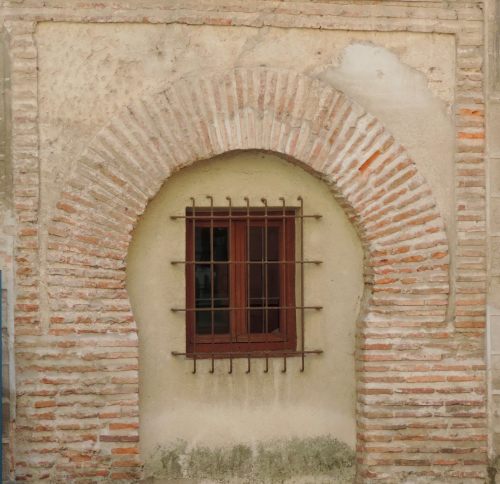
I see this sort of thing a lot when I look at old buildings in either France or Spain. This one is in Segovia.
What’s the first thing you notice?
The window?
Or the window in an arch?
See, when I look at something like this I really get to wondering….how did this come about? Did the original builders build a nice big entrance way, two verticals and a horizontal? Building a frame like a picture frame for an entrance? Maybe not….well, maybe not exactly anyway, because it looks like exactly the same bricks have been used to make the archway and some of the bricks seem to run between the two frames….the square frame and the arched frame. So maybe the original builders built an arched entrance and surrounded the arch with a frame?
But then it looks like somebody decided not to have an entrance there after all and filled in the space.
Then somebody else thought, hey, wait a minute, I’d like a window here and put in the window….but did they fit bars around the window at the same time?
So, has this window, this barred window, emerged over many years from a wall which was built in the space formed by an arched doorway?
And what was the thinking behind each of those steps in the development?
Make an entrance, an attractive, obvious entrance…..then block it up…..then make a window, but not one for letting that much light in, and certainly not one somebody might climb into, or out of…..was that, is that, a problem around here? People climbing in and out of windows?
Bear with me here but because I worked as a doctor for almost forty years this image sparks my thinking about patients and the problems they talked about in the consulting room. They’d bring the equivalent of this window….let’s say they’d talk about a pain (instead of a pane….ha! ha! sorry!)…..and I’d ask about the pain, asking them to describe it….its features, its characteristics, its exact location, what surrounded it, or accompanied it……and then I’d want to know how it arose. Tell me when it wasn’t there. What was there before it? What was happening when it began? And so, gradually, what a first glance might be a simple symptom turned into a unique, never before told, story…..and that’s where I began to understand what the problem might be.
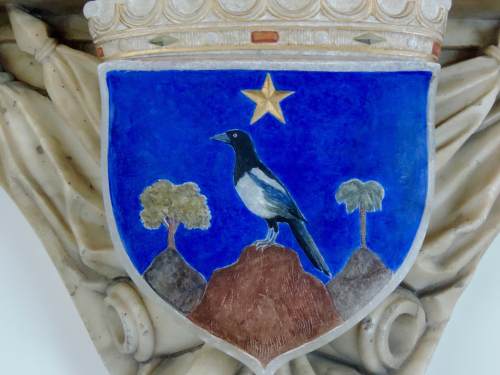
I noticed this emblem in the Alcazar in Segovia, Spain. This is where Isabella “The Catholic” was crowned queen Isabella I of Castille in 1474.
The most prominent part of this image is the magpie. So, here’s my first question – what is the symbolism of the magpie in this context? I know the magpie represents both good luck and bad (the old rhyme starts “One for sorrow, two for joy….?) but what’s it’s significance here, in the Alcazar? Secondly, there are two trees, clearly different species. The one on the right looks like a palm tree, but the one on the left? What is that? What are these trees symbolic of? The tree of life and the tree of knowledge? Islam and Christianity? Does anyone know?
Finally there is the five pointed star. A symbol of the Divine?
I’d love to hear any ideas or insights you might have……
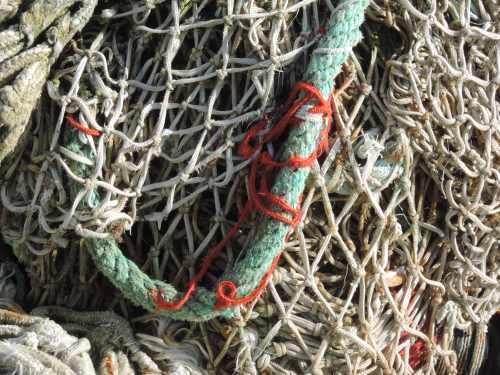
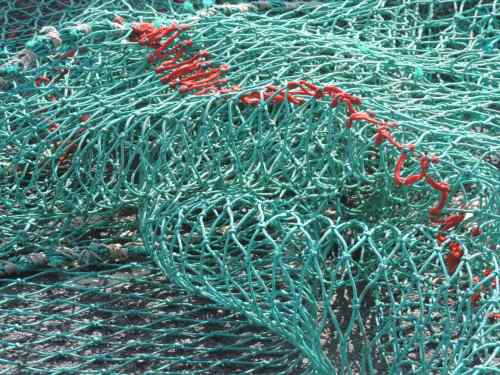
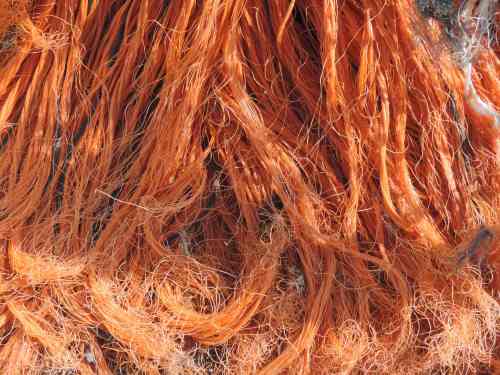
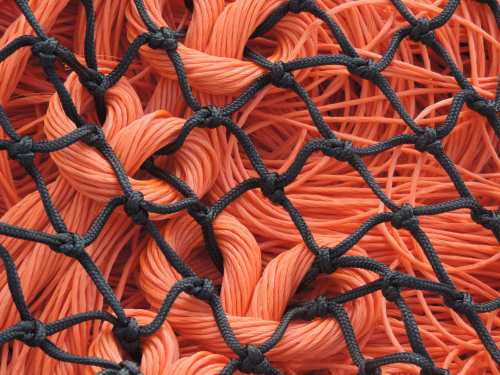
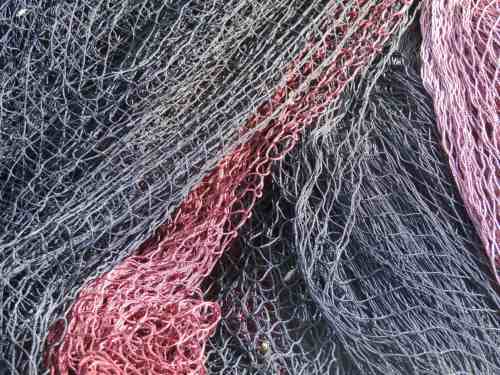
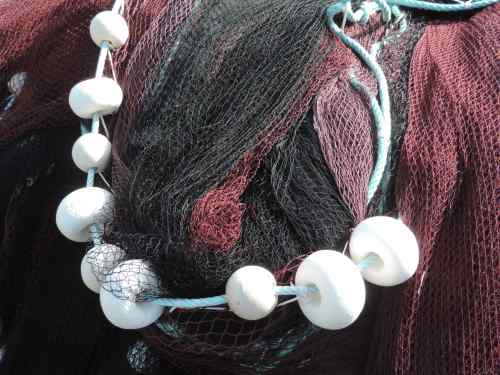
When I stroll along a quayside in any fishing village, I frequently come across heaps of nets, and bits of nets. There’s something engagingly beautiful about them.
One of the thoughts they provoke is the idea of the red thread…..that essential whatever it is that runs through our lives. There’s a red thread which ties all of our experiences and stories together. It’s a kind of metaphor of the self, the narrative self. For each of us that red thread is unique. No two threads have exactly the same point of origin, the exactly same length, twists, turns and knots.
And the red thread doesn’t exist in isolation. There is no red thread which doesn’t weave itself through all the other threads….the fibres which make up existence.
Whether those fibres are neurones, or storylines, or energy flows, or manifestations of “String Theory”, none of them are unconnected to others. It’s a kind of essential Truth of the Universe isn’t it? That every single thread is connected to others, and ultimately, if we start to follow one thread it will lead us onto and along ALL the others?
There are layers upon layers of these webs and nets. More dimensions than we can imagine, intersecting, co-existing, inter-acting, producing both wholeness and uniqueness.
There are more colours, more shades, more thicknesses and lengths than we can imagine. The diversity which exists in the universe is astonishing. And don’t you think this diversity is beautiful? Doesn’t it thrill you?
Whenever I see nets like these I think of the two fundamental elements of all webs – nodes and links. I find that such a helpful way to see Life, to see a human being, a community, a city, a planet……
Have you come across the increasingly large number of words which end in “-ome” these days?
Genome – the network of genes
Proteome – the network of proteins produced by our cells
Microbiome – the network of bacteria which co-exist with our own cells in and on our bodies
And other networks too – of the nervous system, the immune system, the hormone system.
Of family networks, of social networks, of cultural networks….
Of biomes – the environmental niches, each nested in ever larger networks of biomes.
As we evolve our understanding of the universe from the simplified, reductionist model of separate entities floating in empty space, we are moving towards a more holistic, more realistic understanding based on the inter-connectedness of everything.
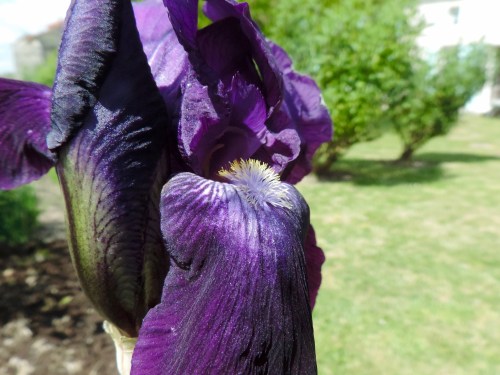
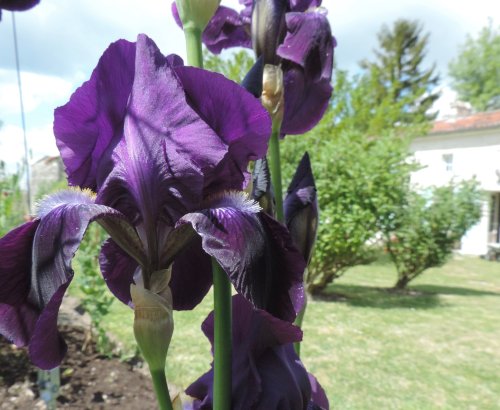
Irises are the most astonishingly beautiful and attractive flowers. Whenever I see them I think of the story ‘Iris’ by Herman Hesse where he wrote this –
He had a great love for this flower and peering into it was his favourite pastime; sometimes he saw the delicate upright yellow members as a golden fence in a king’s garden, sometimes as a double row of beautiful dream trees untouched by any breeze, and between them, bright and interlaced with living veins as delicate as glass, ran the mysterious path to the interior. There at the back the cavern yawned hugely and the path between the golden trees lost itself infinitely deep in the unimaginable abysses, the violet vault arched royally above it and cast thin, magic shadows on the silent, expectant marvel. Anselm knew that this was the flower’s mouth, that behind the luxuriant yellow finery in the blue abyss lived her heart and thoughts, and that along this lovely shining path with its glassy veins her breath and dreams flowed to and fro.
oh, I loved that the first time I read it and it’s stayed with me for over forty years now.
Iris, in Greek mythology, was the messenger of the gods. Her symbol was the rainbow, which in many cultures is the symbol of hope. But her main role was in carrying messages from one to another. She connected the sea to the sky. She was a bridge builder (not literally but in terms of making connections).
When I thought of her role in facilitating connections I thought of flow, of the to and fro of communication and I thought how much do we need that now? In a time where politics has become more about hate than love, where there are calls for more walls when we need more bridges, when there are demands to close down, isolate and see the ‘other’ as an enemy or a competitor to be defeated.
Oh, how we need Iris, to open peoples’ hearts and minds and to facilitate communication between them.
How we need her, the idea of her, the energy of her, the meaning of her, to create mutually beneficial relationships between different peoples with different ideas, different world views. To make the case for constructive co-operation rather than destructive competition and division….
Last November I was invited to address the Faculty of Homeopathy at their Congress in Belfast. I prepared a talk entitled “Images of Health. Pictures and stories” based around some of my own photographs and covering the key principles of health which guided me through my career as a doctor.
Here’s the video of that talk. I hope you enjoy it, find it interesting, or even inspiring. (by the way, if Google pops up any ads along the bottom of the video, just click the “x” box to make them go away 😉 )
I wrote a book to accompany this talk. It’s called “Escape to Reality” and I’ve published it (so far) only as a Kindle e-book. You can find it on Amazon.
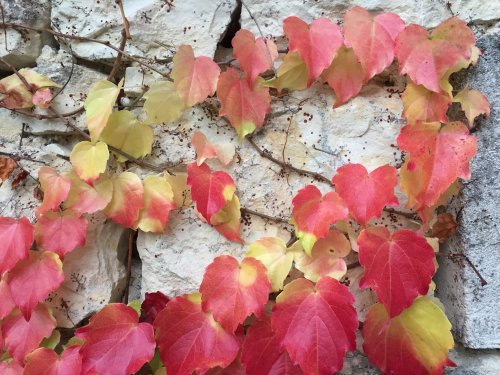
On a wall which runs the full length of one side of my garden grows a plant which isn’t like any other plant I’ve ever seen. It’s name in English is “Boston Ivy”, and its a kind of vine. One of my friends calls it “mile a minute” referring to its speed of growth.
One of the things I like most about it is its complexity. At different times of year its shape, colour and appearance is completely different. Right now in the winter when it’s lost all of its leaves it is a web of stems, creepers and woody trunks. In the height of the summer its lusciously green and is literally a-buzz with bees while providing protected hidden spaces for blackbirds to build their nests. There’s a point in the summer where the seed pods all pop and the sound of millions and millions of the pod shells falling through the leaves to the ground sounds for all the world like a waterfall. The first time I heard it I actually went to look for where the water.
But it’s in the autumn when the leaves turn these glorious shades of red, yellow and gold. It’s breathtakingly beautiful. Then once the leaves fall the plant reveals its gorgeous little bluish black berries on bright red stalks. The birds come in their dozens for those!
Having lived here for two years now I see every one of these phases in the context of the ones which came before and the ones still to come. It’s a very physical experience of the reality of stories, or better, of storied reality.
Day ten of my “twelve project” brings me to this photo which I took in October last year. It’s a picture of the river Charente as flows through the town of Jarnac, which is about a half hour’s drive from the village where I live.
The river gives its name to this whole region, the “Charente” and it flows to the Atlantic passing through the neighbouring region of the “Charente Maritime” on the way. But the river does more than give its name to this region. It is symbolic of, or maybe more accurately, it creates, the pace of life here. People say it flows steadily and calmly, just as you can see in that photo. I’ve been here just over two years now and I’ve never seen it churned up or terribly disturbed. It might happen sometimes but I’ve never ever seen it. Normally when you walk along its banks or look down from one of the bridges, it looks like this.
I encounter the river most commonly in three different towns. My “home town” of Cognac, half an hour to the East in Jarnac, where this photo is taken, and half an hour West to Saintes. In all three of these towns the Charente looks like this. Yet in each of these towns it is also unique and different, because a river isn’t just the water, it’s the banks and the land around the water.
I think it’s not just that it is calming to watch the water flowing so steadily, it slows you down. It slows you down by capturing your attention so that you stand and gaze at it for a while, or you are drawn to wander along one of the miles and miles of footpaths which follow its course, and as you wander it seems the river is keeping pace with you. It’s wandering too. Or is it the other way around? Do we unconsciously fall into step with the river? It slows you down another way too, because when it flows this way the surface is typically highly reflective. Look at the reflections in this photo. It was the sparkle of the sunlight on the lily leaves which initially caught my attention this day, and it was only just after that that I noticed the reflections of the little clouds floating by. It inspires you to reflect.
I love rivers. I grew up in the town of Stirling in Scotland. The River Forth winds its way towards, through and beyond Stirling like a great ribbon, or maybe a snake. You can see it best from Stirling Castle. Standing at the castle gazing down to the Old Bridge, following the curves of the river with my eyes as I look towards the Ochil Hills is one of my strongest memories. It’s one of those scenes which embeds that place in my identity.
I love the symbolism of rivers, how they are never the same two days in a row. As Heraclitus said “you can never step in the same river twice”, reminding us that every moment changes and every moment is unique. I love how you can’t look at a river without imagining both where it has come from and where it going to. It’s like a story. It is present in front of you now, but it brings into this present moment, the past, from the springs in the hills, through its journey of days or weeks, and it holds within it all the potential to become the river it will become as it flows towards the sea.
I can’t think of rivers without thinking of the incredible water cycle of the Earth. How the rivers flow to the sea, how the wind and the sun lift the water into the air, how it condenses to make clouds which then dissolve into rain on the hills and the mountains to create the streams which flow together to create the rivers again. I like that I can see at least part of that in this photo with both the river and the clouds sharing the same space in my picture.
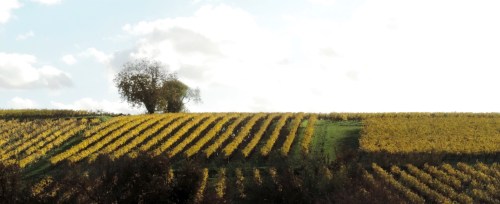
I’ve lived here for two years now, so this is the third time I’ve seen the vineyards turn golden like this. The vines are fascinating all year round but in this season they are particularly beautiful.
I was just recalling some of the thoughts I’ve had which have been directly inspired by this countryside. The landscape around here looks just like this. It is so different from the wild mountainous landscape of Scotland. But once the grapes are harvested, the processes involved in turning them into cognac are very similar to the ones used to turn barley into whisky. The culture of blending, tasting and savouring cognacs is very, very like that of whiskies with each distillery producing distinct flavours depending on the ground on which the plants were grown and the work of the master blenders in the distillery. Two or three hundred years ago some of the distillery workers from Scotland came to this part of France and applied their knowledge and skills from whisky production to the local cognac.
The vineyards around here are old. There’s a noticeboard just outside this village telling the story of how in the 1700s particularly hardy vines were brought here from America to improve the local crops. The vineyard where the noticeboard sits is called “the field of experiences”, or, probably a better translation would be “the field of experiments” (I think I prefer the “experiences” over “experiments”, but that’s just me).
From these two little discoveries I realise how the distinct, unique character of this environment has been influenced by other parts of the world, other peoples, other plants. Nothing exists in isolation.
The “vignobles”, or vine workers, are busy all year around. The harvest was completed last month and one of the next tasks is tending to the individual vines, to remove any less healthy ones, any which have passed their best. I was startled by this work the first day I encountered it because it can involve using a tractor with a type of drill attachment to dig out certain plants. It sounds more like roadworks than fieldworks. Throughout the year the vine workers tend to each plant over and over again. Every single vine is pruned by hand. That’s another thing which surprised me. I don’t think farmers attend to each plant individually in a field of grain. I’m not sure that would be possible. But these vines are not like fields of grain. They are, more obviously, rows of individuals. From a distance, as in these photos, it is hard to see them as individuals, but to the vine workers every single plant requires their full attention.
That balance between the one and the many is something which is often at the front of my mind. I thought of it often in my work as a doctor, always mindful that even if this next patient was bringing me a story of a particular disease or disorder, they were always more than “another case of…..”. They were always a unique individual who required my full attention.
One final thought, before I finish today…..I’ve learned that although the landscape around here features vineyard after vineyard, that each vineyard too is different. One of the most important differences is the soil. Take a look at this map –
Each of these coloured areas produces a completely different flavour of alcohol. The large distilleries which produce their own distinctive blends of cognac will select certain amounts of grapes from certain regions, knowing that the flavours of each region are very different. Those differences have a lot to do with the different soil types, and a lot to do with the micro-climates created by the particular landscapes and locations.
I often wonder about our relationship to the physical world. How the environment, the water, the climate, the shape of the landscape, all influence us, how we, as human beings respond to and, in turn, shape the very environment in which we live.
We hear quite a lot about “identity politics” at the moment. Over the summer I read a piece of research which investigated the beliefs and attitudes of young French people to explore what influenced their identity. The conclusion was that the strongest influence on their identity was geography. They felt French because they lived in this part of the world called France. Not because they belonged to a particular race or religion, but because they lived in this land. That gives me hope.
I welcome constructive criticism and suggestions. I will not, however, tolerate abuse, rudeness or negativity, whether it is directed at me or other people. It has no place here. ANYONE making nasty comments will be banned.



 Heroes Not Zombies