Feeds:
Posts
Comments

Archive for the ‘narrative’ Category

I was born and raised in the town of Stirling, in the middle of the central belt of Scotland. It’s an ancient market town, and the Old Bridge over the River Forth was one of the only crossings allowing movement between the Highlands and the Lowlands in the past. One of the nicknames of Stirling is “The Gateway to the Highlands”. Stirling is also almost equidistant between Scotland’s two biggest cities, Glasgow, to the West, and the capital, Edinburgh to the East.

There are old rivalries between the people of Glasgow and Edinburgh which persist into the present day, and the distinct sense of difference between Highlanders and Lowlanders also remains. Stirling, I always felt, sat right at the meeting point of those cultures and traditions. I’ve often wondered how much that has influenced my values and my world view.

I’m always keen to recognise, acknowledge and understand difference. I’m not competitive. I’m much more interested in building bridges, making connections and creating healthy relationships than I am at “winning” or gaining an advantage over “the other”. I am ceaselessly curious, always keen to encounter and explore “the new” – not least, new people. Maybe that’s why I enjoyed my work as a doctor so much, and why Mondays were always a day to look forward to because someone would come into my clinic that day and tell me a story I’d never heard before.

The River Forth is a very, very winding river at this point in its path towards the North Sea. The bends, turns and loops make it look like a ribbon blowing in the wind. If you look at old maps you can see where the river used to go and compare that to its current situation. It is a river which is always changing. Did that influence my world view too? Is that why I enjoy and accept constant change? Is that why I understand the reality of adaptation and flexibility which are the basis of resilience?

You can see “Wallace’s Monument” in this photo, but you can’t see behind me, “Stirling Castle”. However, those two buildings are surely the dominant characteristic ones of my home town. My grandfather used to read me the stories from Sir Walter Scott’s “Tales of a Grandfather” when I small, so I grew up with a knowledge of the stories of Bruce and Wallace, though I never aspired to be like them! However, there is one story about Robert the Bruce which I do remember, and that’s his moment of despair after suffering defeats where he hid in a cave and he watched a spider try, try and try again, to spin a web. Ultimately, the spider succeeded, and as the story goes, that inspired Bruce to carry on…..rescued him from his despair, and put him in touch again with his determination to succeed. I suspect that was an early, very formative story for me. I still put great store by my qualities of constancy, patience and persistence.

I think of all these things as I look at this lovely photo. I’d encourage you to do the same. Find a photo of the place where you were born and raised, and see what memories and thoughts arise. Maybe you’ll find the origin of some of your own personality characteristics there?

Anyway, I think starting with a strong image is a great way to reflect, and to begin to reach a greater level of self-understanding. I recommend it.

Read Full Post »

This little ice crystal mesmerises me. It’s beautiful. Look at the intricate branching structure of each little bristle of ice. It’s almost like a tiny tree, or, at least a snowy leaf. Look at the way it catches the sunlight and sparkles like a jewel. But maybe the most astonishing thing about it is how it is attached to the iron bar from which it is hanging. Can you see? There is a single icy spike holding the entire structure onto the metal. In an instant you can see that this little piece of frozen water is not only incredibly strong, but that the entire crystal has grown from that single point. Isn’t that amazing?

What I love about something like this is that no matter how much you describe water and its behaviour in cold temperatures, the singular, the actual, the specific, particular ice crystal you encounter takes you beyond the limits of your expectations.

I find that everywhere in life, but, especially so in the practice of Medicine. No matter how much general knowledge I had of diseases, their origins, their life histories, and their likely consequences, I never had enough to know precisely what this individual patient today was experiencing, nor how this disease had arisen in their particular life, nor how their illness would progress. On top of that, no matter how much general knowledge I had of therapeutics, I could not predict, with 100% accuracy, what this individual patient would experience as a result of what I was going to prescribe today.

You might say that sounds like a lot of uncertainty, and I guess it is. A GP’s job, after all, has been described as dependent on his or her ability to cope with, and manage, uncertainty. But there was nothing to despair in there. It was a simple recognition that we have to be humble, because there is always more we don’t know, than there is that we know.

More than that…..it meant, and continues to mean, that the individual can never be encountered, understood and helped as a mere example of the recorded experience of groups. That’s another way of saying that statistics are never sufficient to replace stories. Only this unique, singular human being can tell you what they experiencing, what has happened in their life, what sense they have made of it, and only this unique, singular human being can tell you what effect your treatment has had.

The singular can never be replaced by the averages or “norms”.

Read Full Post »

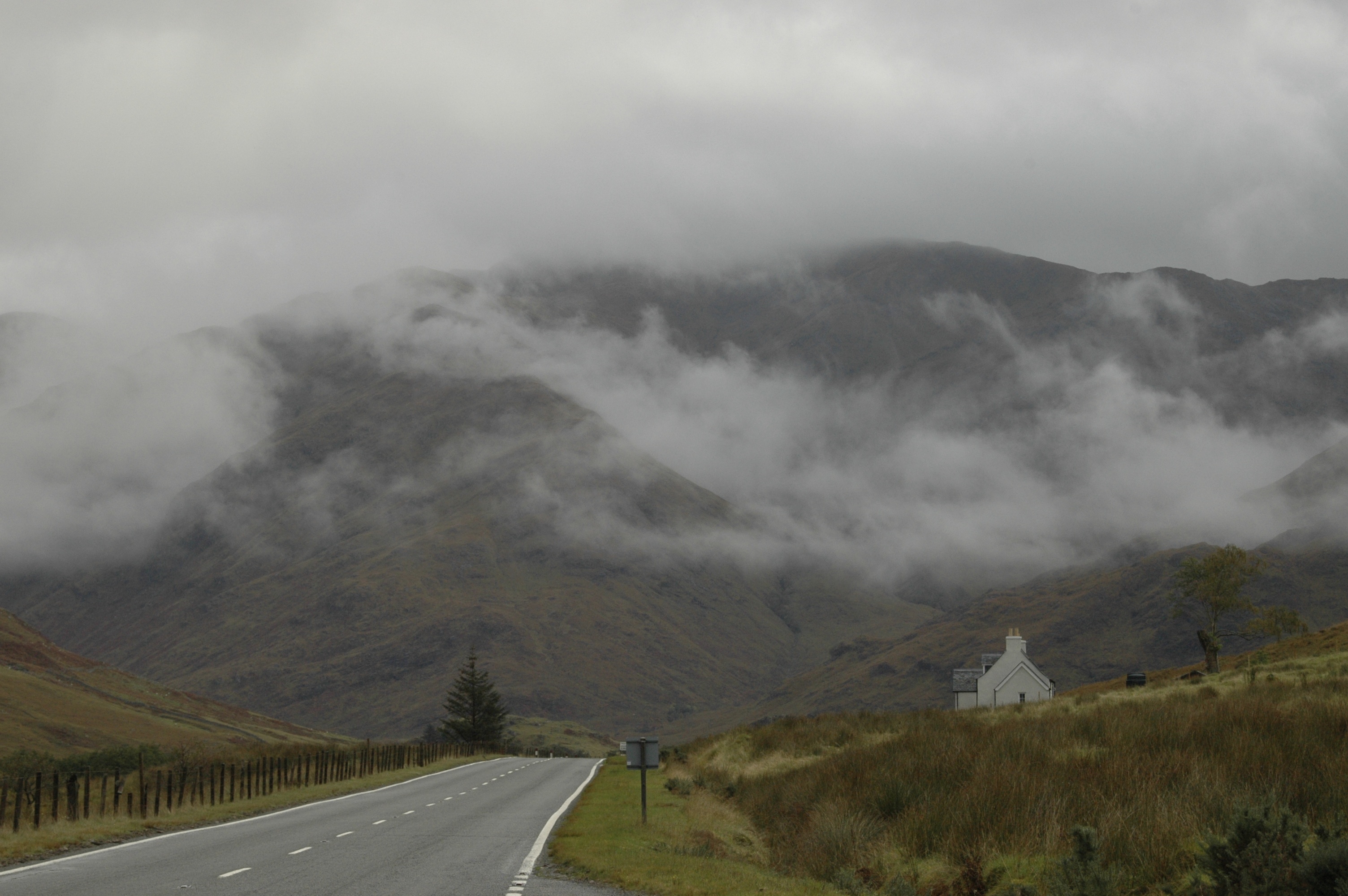
In my photo library I have this image entitled “The road north”, but when I looked at that title just now I thought, “Maybe it’s also the road south”? I know why I called it “the road north” – because I took it while driving north and I stopped to take some photos of the amazing mists travelling over the surface of the hills ahead. I was mesmerised with how they moved, how some grew bigger and how some disappeared into thin air. I was fascinated by the thought – are these mists or “low cloud” and realised I didn’t really know the difference – and did it matter anyway?

But when I took this particular photo of the mists, I included the road and the little house to make it an interesting composition. I had pulled up by the side of the road to take these photos and I know I was on my way north so the title seems appropriate.

However, without that experience and memory, this road can be seen from two different directions, can’t it?

You can look at it and see it as the road ahead. You can wonder where it is leading to. You can speculate about what lies over the crest of the hill, whether the road turns sharply to the left or the right, or carries straight on for a bit yet (there aren’t many straight roads in this part of Scotland!) In other words you can orientate your thought and your attention to the future.

On the other hand, you can see it as the road just travelled. You can see it as a moment’s pause on a journey, to look back, recall and reflect. If you weren’t the one travelling along this particular road, then it’s more likely you’ll be drawn to imagine the future, than to reflect on the memories from the past…..after all, if you didn’t actually travel along this road, then you don’t have any memories of it, do you? Interestingly, you can’t say the same thing, exactly, about the future. We can all imagine the future. In fact, we humans are doing that all the time. We are always imagining what lies ahead, or around the corner, or in some distant time later in our lives. We are always imagining, even fearing, what might happen next, falling down a rabbit hole of “what ifs”.

There’s a third option of course, which is mine. I can mix them together, the memories and imaginings. I can remember the day, but discover, as I have discovered, that I don’t remember what lies beyond the little white house. But I do remember stopping to take the photo, so memory definitely colours my imagining……

….now there’s a thought – the truth is we use memory and imagination at the same time all the time. We have no imaginings without memories to influence them, and we have no memories without re-imagining them (they don’t lie in some brain drawer or filing cabinet, waiting for us to pull them out and blow off the dust – we re-create them every single time)

Story telling. We humans are storytellers par excellence, aren’t we? We tell stories to make sense of our lives and our experiences. We tell stories to know who we are and to find out who other people are. We tell stories to express our uniqueness, to appreciate the uniqueness of others and to make empathic connections with each other.

This image begs us to tell a story, don’t you think?

So, why not activate a few memories and imaginings today and see what story might emerge for you when you look at this image…..does it produce a story of a journey you once took, or does it produce a story of a journey you hope to take one day?

The choice is yours.

Read Full Post »

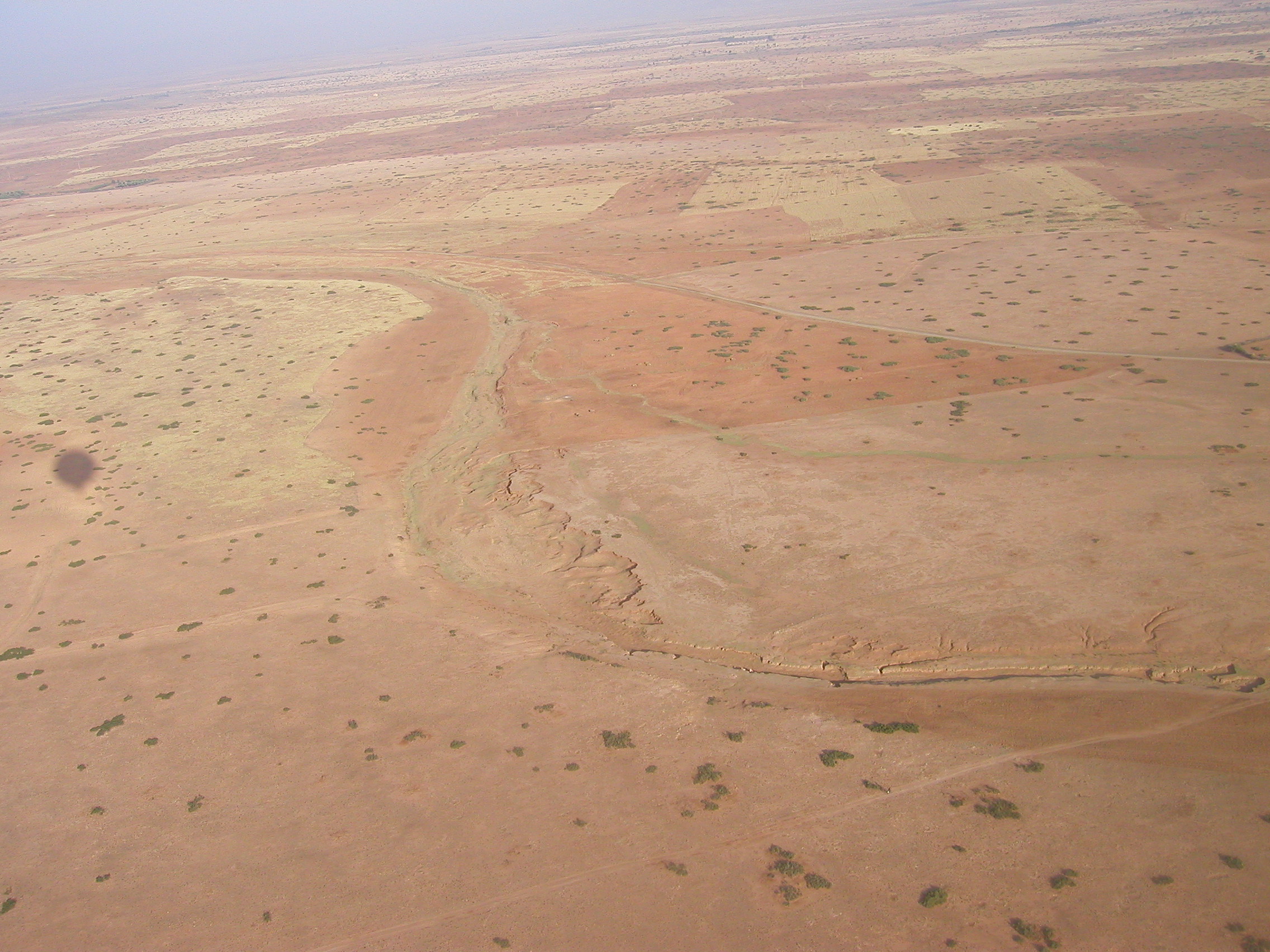
In 2004 I took a trip to Marrakesh and the day after my 50th birthday I took this photo. When you look at it I think you’ll be struck by hint of a river. There is a long, winding, irregular path in the desert below. Some of the sand looks dark, as if it is still wet, but most of it looks as dry as dry can be. But a river runs through here. Just not always reaching the surface I suppose. So we see the path of a river. A river bed, but the water is sleeping somewhere else. The water has passed through here, right along this very patch of sand, more than once. That’s why the traces it leaves is so deep on the right hand side of the image, and so easy to follow right up until it disappears into the distance.

You can see that from time to time the water comes in significant amounts. So much, in fact, that it broadens out the river, spilling over the edges, producing that clear swelling in its belly right in the middle of the shot. Where it swells, it gets a little wild, and carves out one of the sandy banks creating what looks for all the world like a large bite mark in the desert. And just beyond that zone of intermittent turbulence the water seems to seep under the surface in both directions, creating the conditions for plants to grow.

Maybe you can see a dark rounded patch to the left of the image? That’s the shadow of the hot air balloon I’m in. This is the only time in my life I’ve had a ride in a hot air balloon…..and for me, this was above the desert at the foot of the Atlas mountains, at dawn. That one small shadow brings all that back to me. I remember the day vividly. I remember the French pilot, the cool air, the bright morning, the way that I had the distinct sensation that I was standing still in a square basket as the world fell away below me – that it was the world which was moving, not me, not the balloon. Such a strange sensation. I remember the markings in the sand showing where water flowed from time to time, the well someone had dug to find the hidden water, the walled towns and the scattered flocks of skinny sheep.

You don’t have those memories, so the shadow of the balloon won’t mean much to you, but I wanted to share this with you today because of the images of both the shadow of the balloon, and the carved out markings in the sand, left by the water which passed by in the past. In their own different ways these “marks” (one fleeting, one lingering for much longer) tell us stories…..or to be more precise, provoke curiosity and/or memories. We try to make sense of them. We try to figure out just what we are looking at, and it doesn’t take long for imagination and memory to kick in and contribute so that we see much more than could be captured by simply measuring and describing the shapes we can see.

I think this is an example of how we see and experience so much more in the world than can be captured in the form of measurements and data.

Read Full Post »

Can you think of any works of art which changed you? Any which changed your worldview? Changed how you understand yourself, your life, your world?

I was reading about Stendhal Syndrome the other day, which is the phenomenon of overwhelming emotions and physical symptoms experienced by some people in front of particular forms of art. Stendhal described it in relation to his visit to the Basilica of Santa Croce –

I was in a sort of ecstasy, from the idea of being in Florence, close to the great men whose tombs I had seen. Absorbed in the contemplation of sublime beauty … I reached the point where one encounters celestial sensations … Everything spoke so vividly to my soul. Ah, if I could only forget. I had palpitations of the heart, what in Berlin they call ‘nerves’. Life was drained from me. I walked with the fear of falling.

What grabbed me about this concept is how art can have a profound impact on us – not just on the way we think, the emotions we feel, but in changing our inner physical reality…..speeding up the heart, releasing a whole cascade of different hormones, causing us to feel a little breathless, a little light headed, to give us butterflies in the stomach, to make us weak at the knees…….but it actually does something else too….

Every experience we have sets off patterns of activity in the neurones in the brain. In neuroscience there is a phrase used which is “what fires together, wires together”. That’s a description of how these patterns of activity, when repeated, actually change the shape of the microstructures of the brain. Art, literally, can sculpt our brains. No wonder it can change us!

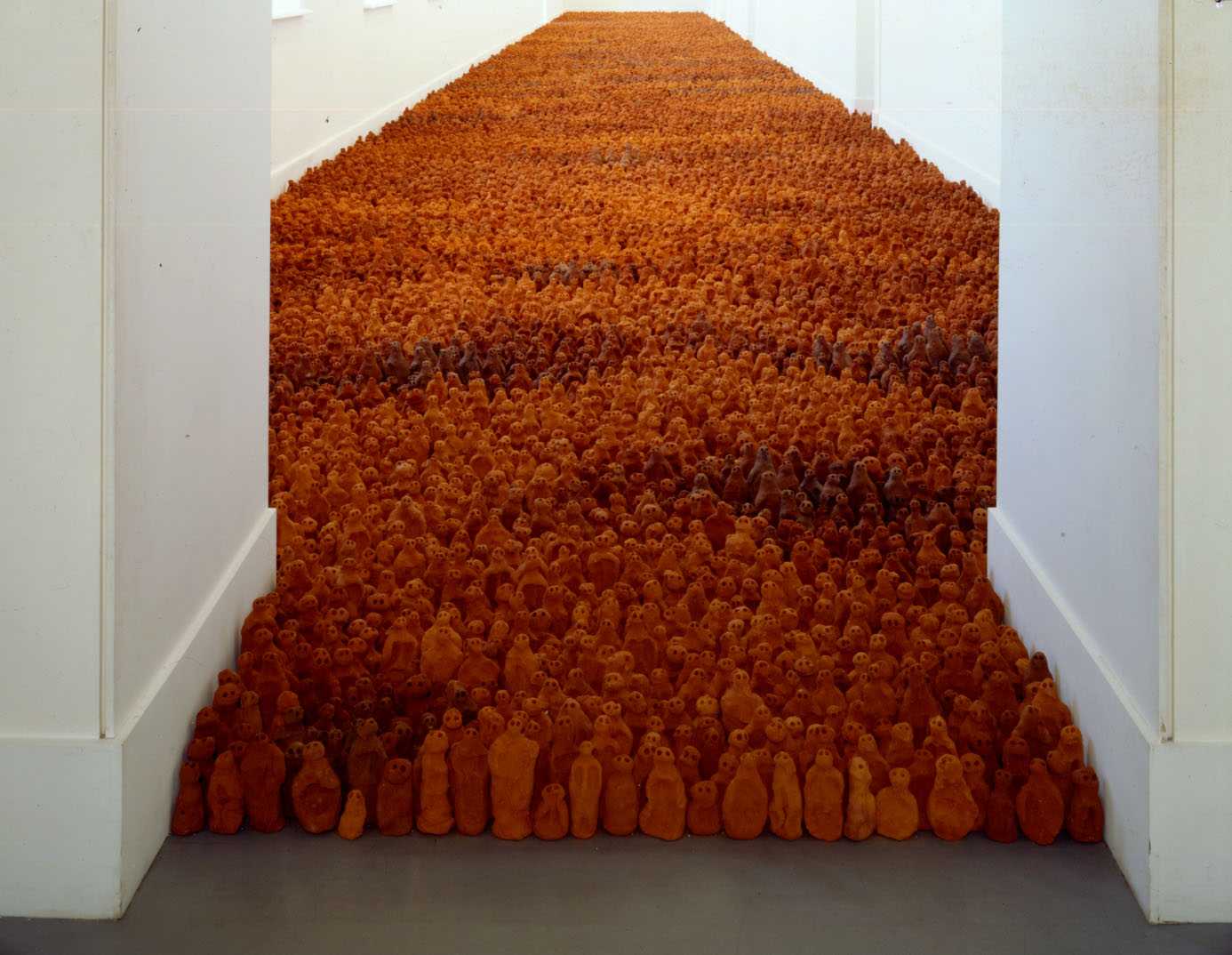
Well, this image here is of Anthony Gormley’s work entitled “The Field”. I saw this for the first time in Inverleith House, in the middle of the Royal Botanic Gardens in Edinburgh. I stood in the doorway and looked at these thousands of little creatures, all looking up at me, all the same. Then, as I looked a little more closely I realised that each and every model was different. Not only were they not all the same, but every one of them was unique.

That’s it, I thought! This is the paradox at the heart of my work as a doctor. Every single patient who I meet has some characteristics, some symptoms, some signs of change in their body, in common with other patients I’ve met before. That’s why I needed to learn anatomy, physiology, pathology, the natural history of disease. That’s why I had to learn how to make a diagnosis. But, at the very same time, every single patient who I meet is unique. Every single patient has a story to tell me which I’ve never heard before because nobody has lived an identical life to them. The diagnosis of the “pathology” or “disease” isn’t enough. I need to understand it in the context of a life story, and a present life. What exactly is this person, today, experiencing? How has this present experience and change come about? What sense do they make of this “illness”? What does this “illness” mean to them, mean in their life, mean to the others in their life?

Well, that became the core of my understanding of the Practice of Medicine.

But it went further than that, because I realised, just as quickly, that this insight wasn’t relevant only to my work as a doctor. This is the essence of what it is to be a human being. We share a lot, you and I. But we are also unique, you and I. We can’t be reduced to a single characteristic, demographic, or “data set”, but we can be gathered into those groups…..we can find some common values, beliefs, desires in those features and factors. But we can never, ever, stop there. We can never rest in our understanding of a person by summing up their data, by figuring out what group we want to put them into. We have to discover the individual. What makes this particular person different? What is distinct and different about this person’s life story?

Even as I write this today, I find this excites me. It delights me. It moves me. It activates my thinking, my feelings, even my body.

Art really can be that powerful.

Read Full Post »

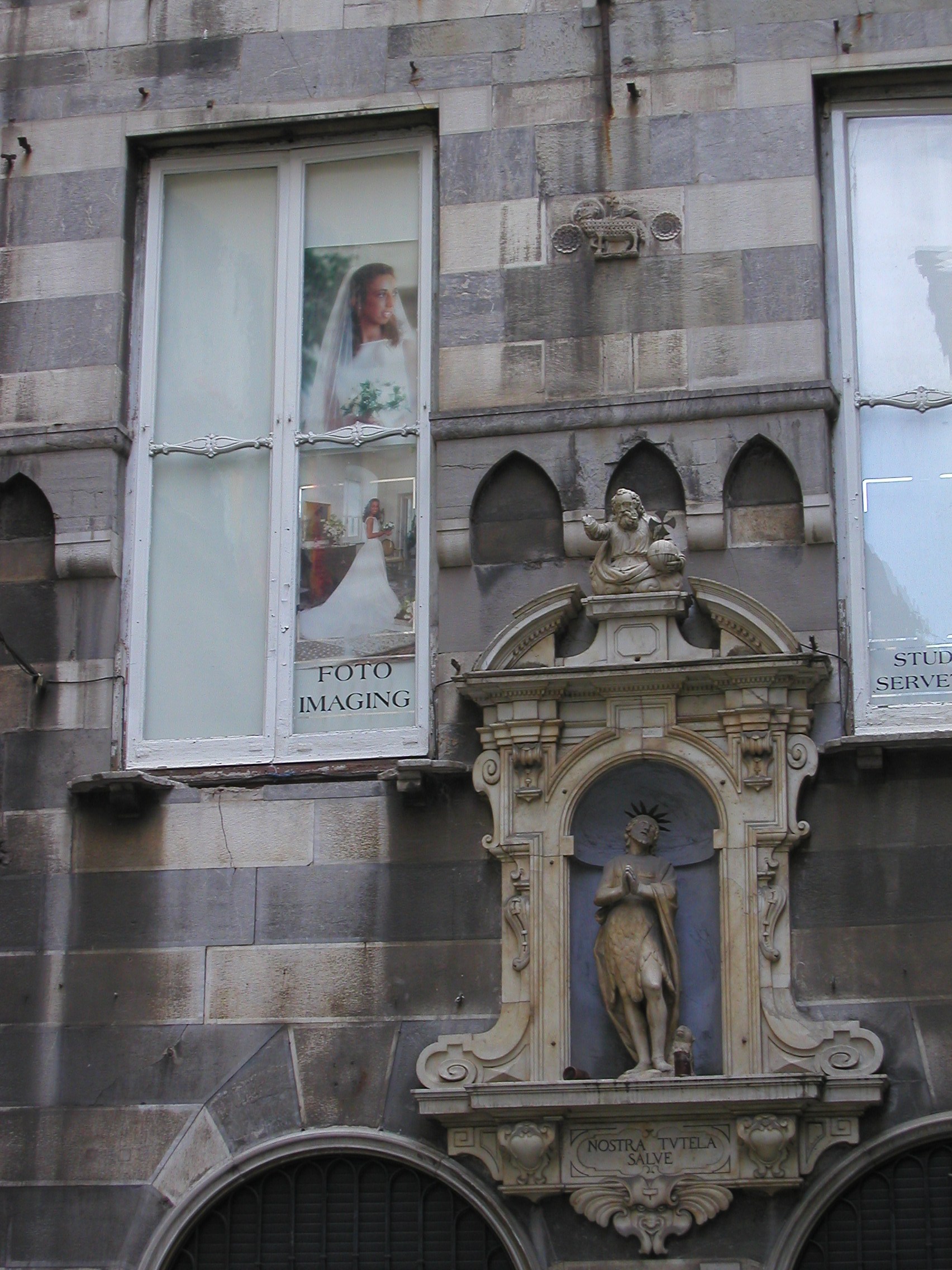
What caught my eye here was the juxtaposition of the advert for the photographer and the statue in the alcove.

The older work is the statue. It’s a representation of prayer. France, Italy and Spain are three of the countries I know best on the continent, and all three share a rich religious tradition. To be more exact, they share a Catholic tradition. Representations of the crucified Christ, of the Virgin Mary, and of various saints can be found everywhere…..not just in churches and cathedrals, but on street corners, city centres and in small villages. What struck me about this particular statue was the act it portrays – prayer.

I know there are many different kinds of prayer, not least prayers of intercession (asking for help), and prayers of gratitude, but the image of the wedding photos in the windows just next to it led me quickly onto thinking of dreams, of hopes and desires. So, that context drew me into the consideration of prayers of that type – prayers of hope.

I don’t think we can underestimate the importance and the power of hope. I don’t think people can live without it. I’ve seen that many times in my medical career. People with no hope slip into despair and decline. I once I had a patient I knew say to me that her husband had just been diagnosed with cancer and that the doctors had given him six months to live. I asked her how she felt about that and her response surprised me. “Angry”. I asked why, and then came the bigger surprise. “How come he gets to know how long he’s got and I don’t know how long I’ve got?” Well, I didn’t see that one coming. However, it did lead to an interesting discussion about prognosis and what we can, and can’t, predict. Too often predictions like that turned into self-fulfilling death sentences. Because the reality is that, in any individual, we cannot make such accurate predictions. I learned that the hard way as a young doctor.

But let me return to prayers and dreams. I’m sure you’ll have come across the idea of visualisation? Of creating “mood boards” or “vision boards”? Of creating “goals” and “targets” even? Well, those are psychological methods we can use to create the life we want to lead. And isn’t that one of the things which prayers and dreams can do?

Have you noticed how many athletes seem to say a short prayer before the start of their race? Have you noticed how many perform an act of gratitude to the heavens, or to their god, when they win? I’m sure in our more materialistic, so-called rational, times, that prayer, belief, faith and dreams are dismissed more than ever before, but I always wonder if that’s really a rational response?

Because without hope, without dreams, without prayers, without vision, then what kind of life can we co-create?

My answer would be – the kind of life other people create for us! “Heroes not zombies” folks! We human beings really are the co-creators of our own lives. A person cannot be reduced to molecules and random events if we want to understand them. More than that, I suspect that fear and resentment are powerful factors in creating the kind of world we live in, and that there are plenty of players out there who know exactly how to stoke up both.

So, I’m a fan of prayers and dreams. I’m a fan of dreams and visions. I think that what we imagine, what we put our energy into, what we pay attention to, all contribute to both our personal experiences of daily life and to the reality of the world that we share with every other living creature on this little planet.

What kind of life do you want to lead? What kind of world do you want to live in? One focused on fear and despair, or one focused on love and hope? I do think we have a choice. Not in an “either/or” way, but in what we give emphasis to, what influences our world view, what lenses we use to understand the world, and as an act of co-creation.

Read Full Post »

I took this photo about twenty years ago. I’m not brilliant at organising my photos, so I’m not totally sure where this is. I think it’s Genoa. Well, it sits between photos taken in Florence and others taken in Genoa and it looks a lot more like Genoa than Florence to me. Either way, it’s definitely Italy.

What I love about this photo is that isn’t static. You know I’m a great fan of “becoming not being”. I love the concept of the constantly changing, every evolving, moment. I love the experience of the present emerging from the streams of the past, and fashioning the possible futures in every lived moment.

I have many photos of paths, and when I look at a path, I feel pulled towards it, to go exploring and discover what lies along that path…..not just where the path might lead, but what I might find as a follow that path. This street adds another level of dynamism, in my opinion, because of the steps. The steps entice you to climb, or to pause, and look back to see where you came from.

The first thing I notice in this image are the two people, a woman wearing a white shirt, and striped skirt, carrying a bag in her right hand, and a young man, dressed in black, hands jammed into both pockets of his not quite full length trousers, his black dog keeping so close to him that at first I didn’t even spot the dog was there! Both of these characters are heading towards the archway, but haven’t quite got there yet.

Above the archway is a statue of, I presume, the Madonna. Her gesture catches my attention. It looks as if her arms are positioned to hold or caress an infant, but there is no infant there. So I see her, I interpret her gesture as caring, and I see a void, a space waiting to be filled? Maybe that’s one of those half glass of water events – is she preparing to care for a child, or has she just lost one? Either way, I find the statue surprisingly emotional. Well, that’s what art can do.

The next thing I notice is that this seems a residential street, with many apartments in all the surrounding buildings, each painted in, what is for me, the typical colours of the North of Italy and the South of France (more Italy than France). I see the washing hanging out of one of the windows, and, again, I’m on the Med…..at least, that’s where I remember seeing washing hanging from the windows of old city apartments.

So, I don’t just feel physically drawn to move up or down this stepped, narrow street. I feel my heart stirred. I feel my curiosity provoked. I feel the rising of my desire to hear what stories these people have to tell.

This might, at first, seem like a static, urban landscape shot, but, pretty quickly it becomes something which declares and demonstrates life and movement.

It provokes the movement of curiosity, of wonder, of the heart.

Read Full Post »

I think this skeleton of a leaf is beautiful. For me it reveals the often hidden, or difficult to see structures which underpin reality. But what it does most is make me think about the two forces of the universe….

The flowing force – the energies which vibrate throughout the entire cosmos. And the structuring force – which gathers some of the flowing forces together to make patterns, shapes, forms and objects.

I like this way of thinking. It’s definitely not new! The yin and yang forces of Chinese thought are sometimes described as “active” and “passive” and I can see how that relates to “structuring” and “flowing”. Others translate these forces into “masculine” and “feminine” and while I do love the ancient myths and legends, the rich symbolism of art throughout the ages, a lot of people find it difficult to apply gender to these forces, and, sadly, once you add in hierarchies and male-dominated culture, then the “feminine” seems to lose out to the “masculine”, so, for me, thinking of the “flowing force” and the “structuring force” is more helpful.

Clearly we need them both to be working in harmony, or in an “integrated” way with each other if we are to have the reality which we experience.

One of the key books I read which helped me understand these concepts was “The Crystal and the The Dragon” by David Wade. I highly recommend it. He uses the crystal as the symbol of the structuring force, and the dragon as the wild, flowing force. But “the universe story” as described by Thomas Berry in “The Great Work” is a brilliant, engaging, description of this same idea. Thomas Berry calls them the forces of “wildness” and “discipline”.

Whatever the metaphors, symbols and words you find work best for you, I think it really helps to understand and be amazed by the reality of every day life, if you raise your awareness of these two fundamental forces.

Try it, and see what you think…..

Read Full Post »

I reckon one of the most important lessons I’ve learned in life is the importance of context. There’s a huge tendency to “abstract” elements from reality – to take things to pieces and examine the pieces; to reduce the whole to a selection of parts; to consider only a single episode or moment in a life story; to pull a single thread from the entire matrix and try to follow just that; to measure what can be measured and disregard the rest. This tendency to “abstraction” is coupled with a tendency to “generalise”, so all is labelled, categorised and filed away; to give precedence to the “average”, the “norm” and the “typical”, over the “individual”, the “specific” and the “unique”.

Our left hemisphere is the champion of all that. Abstraction, labelling, categorisation and generalisation are at the heart of the way it engages with the world. All that can be useful. It can help us to “get a grip”, to “grasp” things, to make predictions and exert some control over the future (at least in small ways for short periods of time).

But it isn’t enough.

Throughout my decades of work as a doctor I interacted with people one-to-one, one after the other, always encountering a unique human being in a specific situation with a particular life story. I never saw two identical people in two identical situations with two identical life stories.

To make a diagnosis, to achieve a better level of understanding, and to establish a personal bond with each patient demanded that I brought my right hemisphere into play. I had to seek the connections, make connections, discern the meaning from the contexts, the contingencies and the uncover the unique, singular story. Only by doing that could I understand this person, in this situation, at this point in their life.

I got thinking about all that again this morning as a I looked at this photo. I mean, at first glance it’s a photo of someone in traditional Japanese dress. At second glance they are standing in front of a statue of Hume, the Scottish philosopher, dressed as a classical Greek scholar. Well, there’s a combination you don’t see every day! I have seen lots of people in traditional Japanese dress, but mainly when I’ve been visiting Kyoto. Not in Scotland. I’ve walked down the High Street in Edinburgh countless times past this statue of Hume

Only once did I see someone wearing a kimono, standing having their photo taken next to it.

So it’s the context of these two figures which makes this photo what it is. Either character by him or herself might tell a different story. But seeing them together here is a sort of “satori” – a “kick in the eye” – it makes me stop, take note, and reflect.

It inspires me to reflect about the importance of contexts and connections, of juxtapositions and synchronicities. And it inspires me to reflect on the two great traditions of philosophy and thought – the Eastern, Taoist/Confucian/Shinto/Buddhist with the Western, Enlightenment/Rationalist/Greek and Roman.

That’s an incredibly rich source of inspiration!

Follow your own special way through the thought chains and connections which unfurl, unravel, and open up before you when you look at this.

Read Full Post »

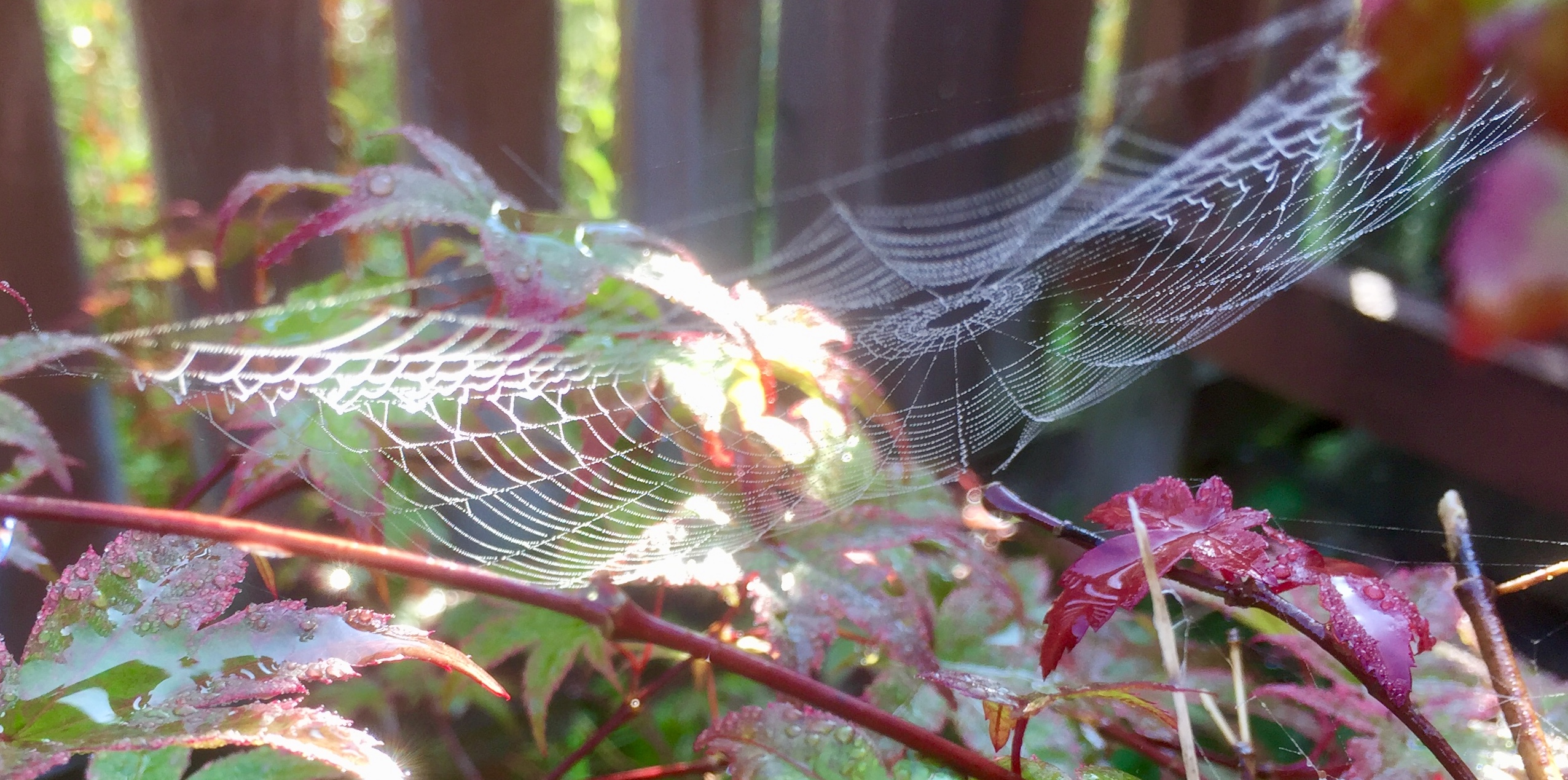
Webs fascinate me. They are such beautiful structures woven each by a single spider. How do they do that? Spiders have far more rudimentary neurological structures than mammals, but they certainly have brains which enable them to create these webs. Exactly how they know how to spin a web is a mystery. I also think it’s pretty incredible that the actual material from which the web is made is created in the spider’s body.

I wrote yesterday about the underlying structure of reality which is built upon the concept of a network – nodes with connections. In a spider web, the nodes are where the threads meet and the threads are the connections. The fact that the entire web is inter-connected is what enables the spider to detect the movement of a fly when it is caught on the web, and to know exactly where to find it.

But as that example hints, webs exist, not as separate entities, but in complex dynamic relationship with other creatures and with the environment in which they are created.

This photo is of a complex of wind-borne seeds stretched between several stalks of a plant. I don’t know if there is a spider web hidden in the middle of these seeds. I couldn’t see one. But it is reminiscent of the web I’ve shared at the top of this post. But there needn’t be a web inside this seed group. Perhaps they just all attached onto each other as they were released by the plant, and have formed a structure that looks just like a web, because each seed is connected to several other seeds through those fine filaments which are designed to carry the seed on the wind.

However this structure came about it shows how nothing exists in isolation. Not only are these seeds connected to each other, but they are connected, both physically and historically, to the plants which produced them, and so on back in time to the seeds from which these particular plants grew, connecting back over decades, centuries, aeons. They are also connected to the visible and invisible surrounding environment in which they exist. They interact with the wind, with passing creatures, and with other plants.

When you pause to consider anything from the perspective of its connections, you find yourself following trails which extend both back and forward in time, as well as connections to other objects, creatures, energies, physical and environmental phenomena. Really, if you were to attempt to tell the story of a single seed from the moment you encounter it back beyond its origins, and forward into the rest of its life story, then you’d find yourself lost pretty quickly. There seem to be no limits to the chains of connections and relationships we can uncover for any single object, creature or person.

So, really, nothing is completely knowable. There is always more to discover. There are always paths, connections and relationships which change our understanding of what we see in this present moment.

I think that fact keeps us humble, and stokes the fires of our wonder.

Read Full Post »

« Newer Posts - Older Posts »