I took a photo of this little street in Segovia for one reason – it’s name. I mean, look at the street. I’m standing at one end taking the photo so you can tell it’s a pretty small street. I don’t think the buildings on either side of it would entice you to go and explore it, but the cobblestones are attractive, and, probably more than anything that arch at the end looks very inviting. Which is interesting because seeing the arch, which invites you to pass through it, and seeing the countryside rising up the hillside beyond it is definitely tempting. But the truth is there are wonderful views of the countryside all around Segovia.
Here’s what caught me and convinced me to take this photo.
Now I don’t speak much Spanish but I know that this is the street name – and that the name is “Street of the Moon Gate”.
Street of the gate of the moon!! I mean, how can you read this and not feel your curiosity and your imagination start to stir! That archway at the other end of the street was probably where the original gate into the old town was. But why was it called after the moon? Was it the gate to enter by moonlight when you hoped not to be noticed? (actually you are less likely to be noticed on a moonless night)
I don’t know. Maybe one of you does. If you do, please let me know what you’ve found out. There is a Sun Gate in Segovia, but the other gates are all named after Christian saints.
However, here’s my point. It’s the name which caught my attention. It’s the name which has stimulated my curiosity and fires my imagination. I’m sure there must be stories set in Segovia which mention this gate, but if there aren’t, maybe I’ll try and write one!
Have you come across any places where the name made the location special?
Reflecting – I’ve long since thought this is a vital tool in life. There are two main modes of being – reactive and responsive. When some information, some energy or a substance evokes something within us our default is to react.
For example, when we see something threatening our “fight or flight” system kicks in fast and prepares us to do one of those two things…..fight or flee! It’s a complex system involving nerve pathways like the “autonomic nervous system”, certain nodes within the brain, like the “amygdala”, and a release of chemicals such as adrenaline and cortisol. Accompanying all that are the organising influences of the emotions. It happens fast.
The energy of heat makes us react too. When we get too hot our body re-routes the blood flow towards the surface of our skin, and we start to sweat, to try to maintain a steady body temperature in the face of the environmental change. There are many such reactive feedback systems in our bodies to enable us to react to environmental changes. All without requiring any conscious, active role, ourselves.
When we inhale an allergen, such as pollen, then, if we have the potential to be “allergic” to it, we react instantly with sneezing, runny nose, itchy eyes, or whatever, all provoked by an automatic activation of part of our defence system.
All of these are reactions.
But we humans can also respond. We don’t need to be 100% on auto-pilot. We respond, rather than react, by creating what the psychiatrist and author, Iain McGilchrist refers to as “the necessary distance”. We have this remarkable super-power to create a pause, a bardo, or a gap, between the stimulus and the response. We can stand back, stand apart, and change our perspective. This gives us our chance to reflect and it is a major factor in enabling us to move beyond an auto-pilot way of living.
Meditation practices of all types help us to step out of auto-pilot mode too. They strengthen our ability to become more aware in the present moment, and so open up the opportunity for us to play a more active role in our own lives. But reflection, I think, brings an additional benefit.
If a major benefit of meditation is heightened awareness and a breaking of the automatic stimulus-reaction loops, then reflection allows us to bring both our analytic functions of reasoning and our ability to imagine to bear. We can look back, unpick and unpack an experience and use the benefit of hindsight. We can “figure out” what happened and why and choose to act differently on any similar future occasion. We can think through a series of “what if”s to become aware of different potential outcomes.
As a doctor, I was encouraged to do this all the time. It is a common practice for doctors to reflect on their clinical work. That’s how we learn. That’s how we improve. But it’s the same in all walks of life. Stopping regularly to reflect frees us up – you could say it turns us from “zombies” into “heroes” (hero in the narrative sense – the main character of our own story).
There are many ways to build habits of reflection into your everyday. I think the top three are “Morning Pages” – where you write continuously to fill three pages of a notebook, preferably before you do anything else in the day; “Gratitude Journals” – where you end the day by thinking back and noting anything today for which you feel grateful; “Journaling” – whether in diary form, sketching, painting, whatever you prefer, but some regular time spent reflecting and then turning that reflection into something creative – a short essay, a poem, a letter to an imaginary friend, a letter to your older, or younger self, a cartoon, a drawing…..it’s up to you.
Oh, I should add, that it’s essential that all reflection is as non-judgemental as possible. It’s not about beating yourself up, or finding people to blame. It’s about learning and growing and a judgemental attitude isn’t going to help that.
What works best for you? How do you encourage yourself to reflect?
I saw this door panel in the Chateau Chenonceau. Isn’t it wonderful? What an incredible piece of craftsmanship carving this scene. I love the waves below the characters and the clouds above them, and I especially like how the clouds break out of the frame.
The scene is Poseidon and Amphitrite (I think!), the God of the Sea and his wife. They are being blessed with a wreath and a flower (a lily perhaps?) by two creatures with human bodies, fish tails and wings……nymphs I presume…from Amphitrite’s ancestry.
Apart from the beauty of this image in it’s own right, it is laden with symbolism, as are many of the carvings and tapestries of that period. Exactly what the significance is of each symbol and, indeed, of the myths of which they are integral part can be uncovered to a certain extent with study and research.
I invite you explore this for yourself. What can you find out about the characters represented and what stories are there about them? What can you find out about the nymphs, about the cupid figure, the trident, the bow, the wreath and the flower?
Some historians say that in their time the people who had these works of art created were well versed in the answers to all those questions. They could “read” a scene in the light of the knowledge they’d gained. They had been told these stories, taught these symbols, and they wouldn’t just look at an image like this and think “how beautiful” – the work would evoke whole sets of emotions, memories and fantasies for them. When I think of that I feel we’ve lost something because most of us haven’t had the education which allows us to have a similar experience.
Symbols and myths are an integral part of human life. Creating works of art is fundamental to our nature. I was listening to a BBC podcast the other day about cave art and the experts said the wall drawings of bulls, aurochs, deer and so on date way back to the times of not just the earliest humans, but to neanderthals too. Some of the cave art was created in caves so deep that not only were they in perpetual darkness but there could be no real reason for human beings to go there….other than through sheer curiosity, or to hide and protect their art works.
Who were those images created for, and what part did they play in their lives….of both the artists and the spectators? We don’t really know. But whatever the answers to those questions there is no denying that we are a species which does more than hunt, gather and farm. We create and live with art. It’s in our bones!
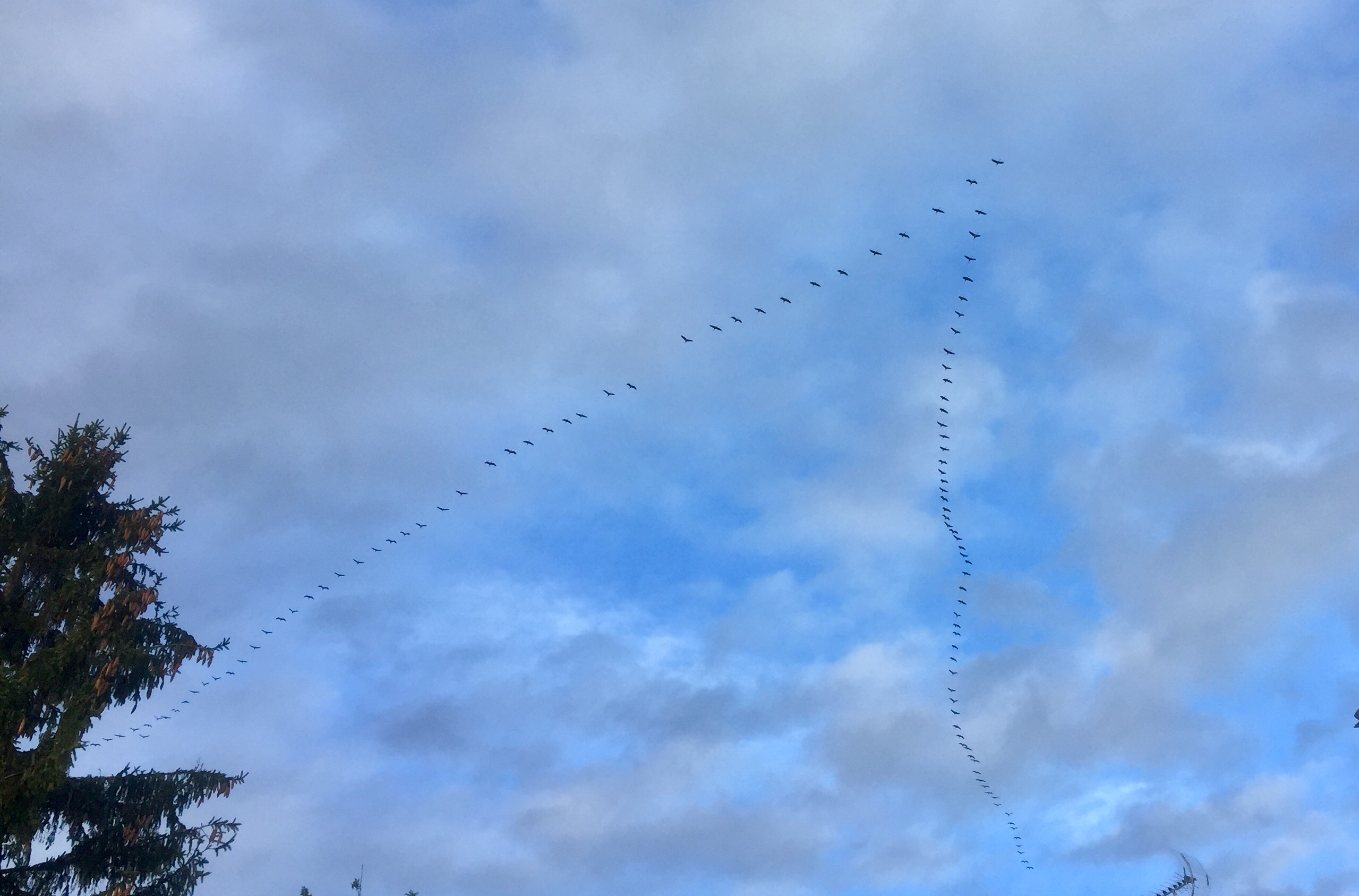
Here in Europe autumn is a season of great change where we move from summer to winter. One of the most astonishing phenomena of this season is migration. Look at this fabulous flying V of cranes heading south! I wish I could let you hear the incredible noise they make, but my little phone recording really doesn’t do them justice.
These are only one of the species of bird which migrates. The hoopoe and the redstart have already left my garden and I still have no idea where they go or how they manage to find their way back to exactly this small square of the Earth every Spring. The other birds I see around here flying in similar great V shapes are geese, but I haven’t seen any passing by yet.
Don’t you think it’s an astonishing phenomenon, this ability of these little creatures to navigate and fly across thousands of miles from one exact place to another? As far as I know nobody has managed to fully understand how they do that. But it’s also amazing to me that they have the energy and the determination to make the huge effort of flight over these enormous journeys.
Birds, of course, are not the only creatures to migrate. Many others do, from fish to butterflies. So it’s an important, significant natural phenomenon of Life. Many many more creatures migrate in the sense of moving from their original habitats to other ones, but don’t do this regular back and forth seasonal migration. In fact whilst millions of creatures live their entire lives in on physical location, or niche, millions of others either travel long distances within their lifetimes or over generations…….like humans, for example!
The BBC show, “Who do you think you are?” is often fascinating, tracing someone’s ancestors over centuries past. Normally, the stories take the subject to several countries, and as they tend to focus on only a small number of this person’s ancestors in a one hour show, we know that if they explored more fully they’d find origins in multiple and diverse locations.
The only living creatures to experience nation-state borders and barriers to this freedom of movement are human beings. Why do we do that? Why do we erect these utterly artificial and pretty arbitrary barriers to human movement, if it’s in our nature, as it is in so many other species, to migrate?
I find the rules and regulations around “citizenship” difficult, confusing and unjust. I don’t understand why two families living in the same street, with children in the same schools, adults working, shopping and enjoying life in the same offices, factories, stores, cinemas, theatres and sports halls, should have different rights and responsibilities. It sets up discrimination, prejudice and resentments.
Why don’t we change that? Change it to habitats. Why can’t we have the same rules, rights, obligations and responsibilities for all the inhabitants of the same habitats? Call that habitat a nation state if you must, but the important point is to treat all inhabitants equally under the same law.
I know that the whole issue of borders and migration is a difficult one, and I’ve read Rutger Bergman’s “Utopia for Realists” where he advocates no borders. Maybe that’s an aim worth having, but I think it will be a long and difficult road to get there. However, would it be so difficult to argue that all the inhabitants of the same habitat be given the same right and obligations?
This isn’t an issue of “nationality”, not even of an individual’s life story of several “homes”, or of ancestors from particular areas of planet Earth. It’s about how we live together in the present time, based on the present, not the past. It’s about developing fraternity, solidarity, equality, justice, fairness, and freedom. Can’t we learn this from Nature?
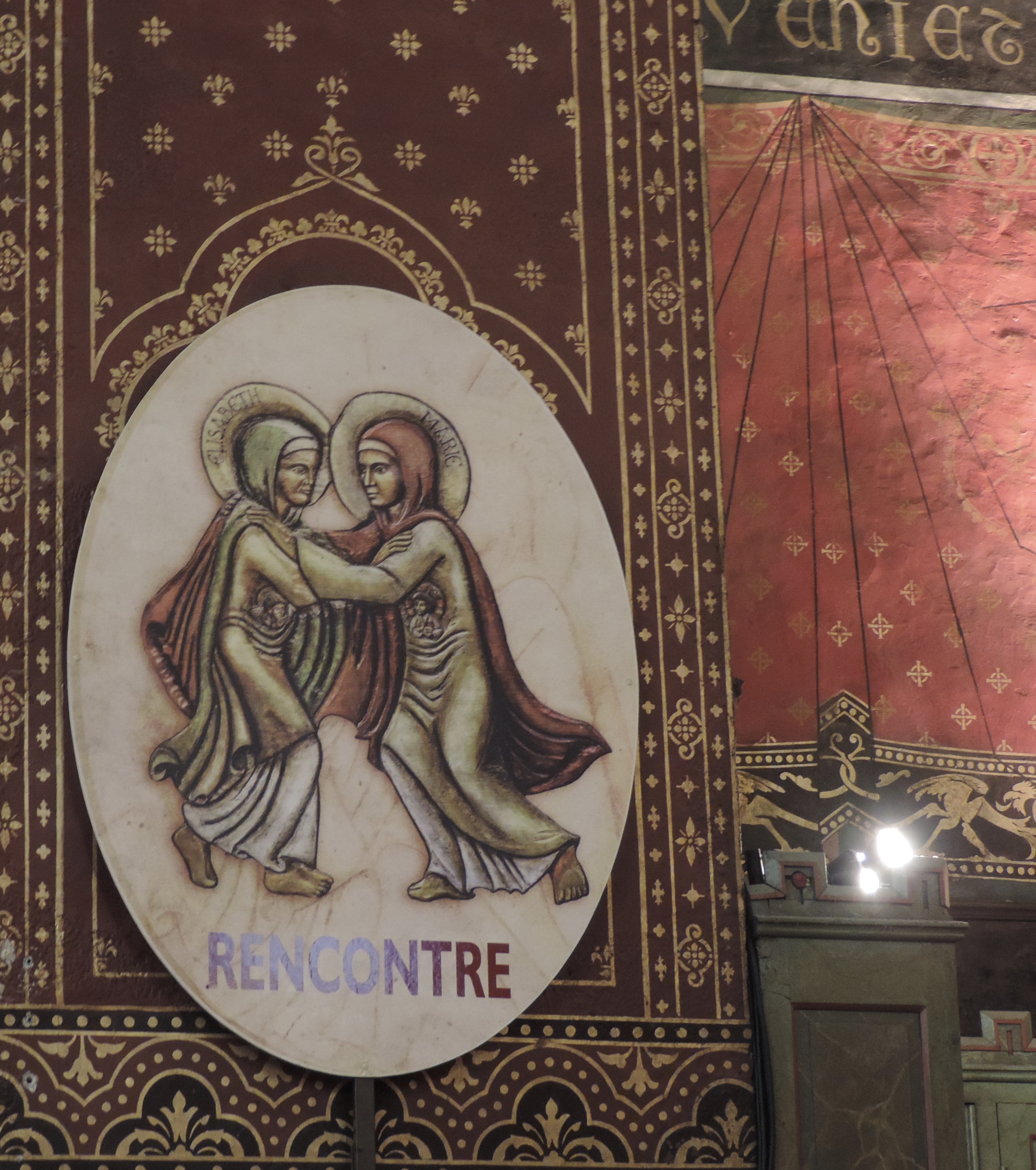
I saw this on the wall of a church in Saint-Jean-de-Luz in Southwest France. A “rencontre”, as you can probably tell from the drawing, is a meeting. I haven’t seen this portrayed in other churches but I really liked that it was displayed so prominently in this one.
For me, the key to understanding Life is revealed in connections, relationships, or bonds. In fact, it is revealed in a very special kind of connection – one which increases “integration”.
Integration is “the formation of mutually beneficial bonds between well differentiated parts”. I think this is easily understood when you think of the human body. We have several organs, from a heart, a liver, a pair of kidneys, a pair of lungs, a brain, and so on. All of these separate, distinct, structures have their own particular functions to carry out and they must carry them out in a way which is more than harmonious…..they must act to promote mutual benefit. The “integrative” connections exemplify collaboration and co-operation. Our organs do not compete with each other….not for energy, food, or protection. Not in a healthy state, anyway.
So, here is the basis of natural health – harmonious, well-integrated, collaborative relationships between distinctly different parts.
You can scale that up – so that a healthy society is a diverse one composed of unique individuals who relate to each other in mutually beneficial ways. You can scale it up further to consider whole ecosystems, or even the global biome, and see that this is the basis of Nature.
Much has been made of the role played by competition in Nature, and in particular in the story of evolution. But, competition has only ever been one part of the story. Without collaboration, without the creation of mutually beneficial bonds, Life would not exist, and it certainly wouldn’t evolve.
When I see this image of a “rencontre” I’m also reminded of the story of the Little Prince and the fox, as told by Saint-Exupery in his “The Little Prince”. In particular I remember the passage where the fox asks the Little Prince to “tame” him – by which he means to create a bond between them, and gives the example of rose which the Little Prince tended to in his home. The Little Prince claims that his rose, of all the roses in the world, is special to him. He cares for her, looks after her, and feels for her. What makes her special is the bond – the bond of care. The fox points out that if he and the Little Prince form such a bond, then they will be very upset when they have to part – because these bonds of care matter to us. They matter to us more than anything.
We can’t have too much of this type of connection in our world. In fact, we need a whole lot more of them – we need the bonds of “integration”, the “mutually beneficial” ones, the bonds of “care”.
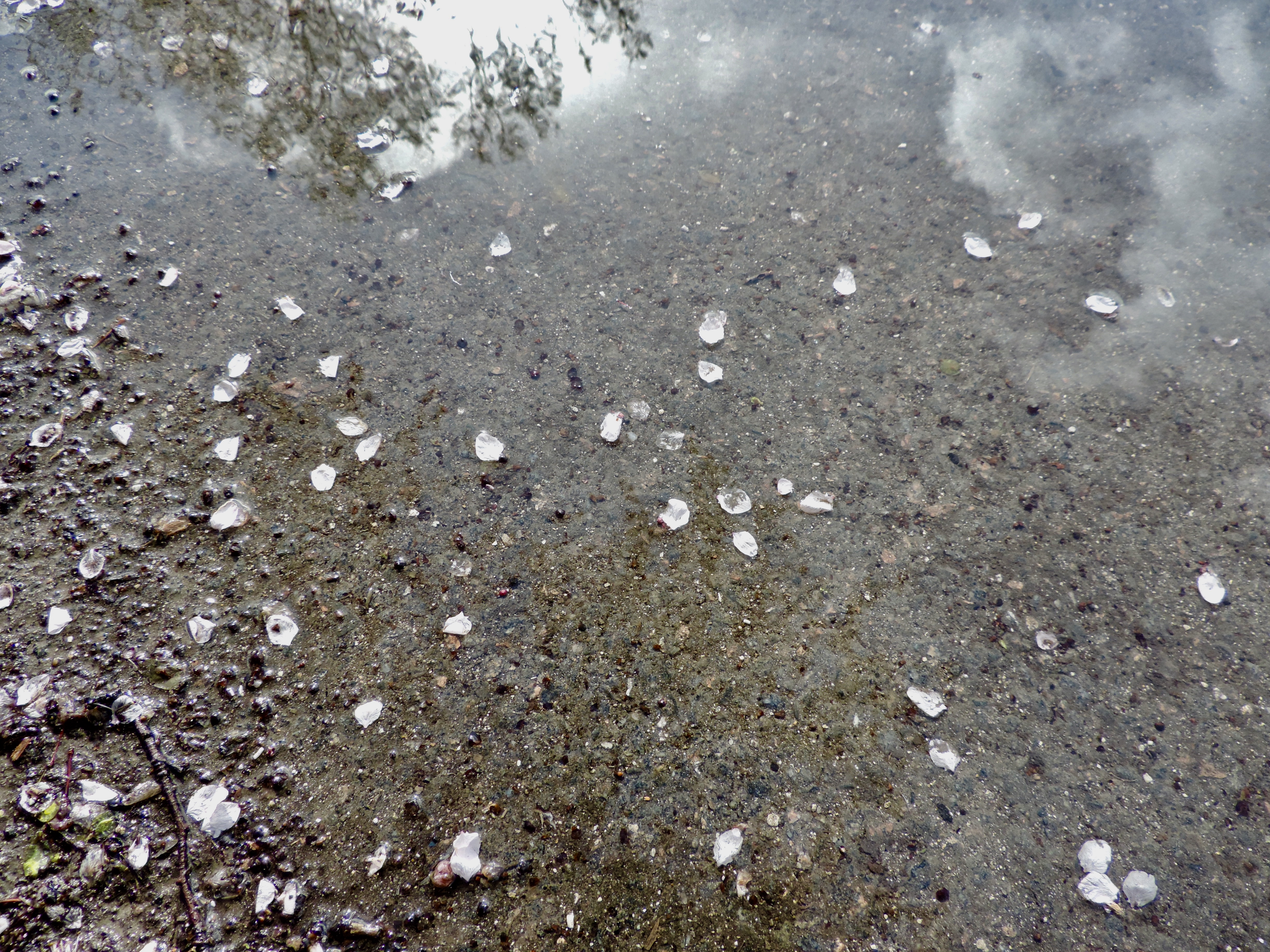
I like photos like this one. At first glance it’s a scattering of petals on the ground, but on closer inspection they are spread across both gravel and water, and when we look at the surface of the water we see more than the petals….we see the reflection of the sky, of clouds and of a tree.
Once we’ve taken that in we are able to see something of how those petals got there.
So what, you ask?
Well, I’m pretty sure none of us think petals just appear out of thin air, or out of the ground, do we? We know they came from a tree, and we know the wind was likely involved in blowing them to the ground, just as it blows the clouds across the sky. We know that the clouds dropped rain and the rain formed the puddles that now hold the delicate petals on its surface. We could follow any of threads in any direction. We could choose to explore the life story of the tree. We could follow water molecules through their global cycle between oceans, sky, mountains, rivers and sea again. We could explore the soil at the edge of the puddle, that same soil in which the tree is spreading its roots. And so on…..
In other words, petals are not the result of spontaneous combustion. They don’t appear “out of thin air”. And that’s the same for everything. Here we are in a middle of a pandemic and we are so focused on the virus that we are in danger of understanding why the pandemic is unfolding this way.
This virus seems to cause no symptoms in 80% of the people who it infects. But it makes some so sick they need to be treated in hospital, it kills a proportion of them, and it leaves another proportion with debilitating symptoms for months.
Why the difference? A number of factors have been identified so far….it hits hardest at the elderly, the frail, those with chronic health conditions such as diabetes, obesity, heart and lung diseases, and so on. It hits BAME groups harder. It hits the poor harder.
So, the widespread and severe disruption and damage occurring during this pandemic can only really be understood if we explore the contexts….if we follow the threads, study the environments in which it spreads. It’s not all about the specific potentials of a particular virus.
There are some things we can do as individuals to reduce our chances of suffering from this virus, but, ultimately, we’re going to have to act together to change the underlying vulnerabilities of our whole society.
It seems to me that this pandemic is shining a bright light on a whole number of weaknesses and failings in our current system – the effects of poverty and inequality; the effects of poor quality overcrowded housing; the effects of fragile work contracts in conditions which cause stress and harm; the effects of making schools too big, with class sizes too large; hospitals too big, with too little staff; of insufficient health care and long term care of the elderly; of discrimination and injustice; of poor diets and of societies built on consumption rather than creation.
I’m pretty keen on biology….as you might imagine for a doctor! I’m interested in how the body works, the way the different cells, organs and tissues all function so beautifully together. I’m interested in discovering the connections within us with all the incredible feedback loops and cascades. I find it all fascinating.
But it was very clear to me from very early on in my work as a family doctor that human beings can’t be reduced to biology. There’s more to us than biology can explain. I often refer to the three flows which pulse through our very beings every moment of every day – the flows of materials, energy and information. Biology is pretty good at shining a light on the first two flows, but its the third one where things start to get so uniquely interesting when thinking about human beings.
One of the aspects of information flow is art. Now, I don’t mean to reduce art to information, or at least, not in the sense that information is “data”. I mean information as signals, not simply data. Information as meanings. So language, music and visual art all connect with us, and our whole being responds. You can blush because someone says something to you. Your heart can race because you hear a certain song. You can catch your breath, or feel a range of emotions, from disgust to delight, when you see a work of visual art.
Our lived environment is not just physical. We imbue it with meaning. We react to particular colours, designs, patterns, sounds, scents and physical touch. A particular taste can set off a cascade of memories….one of the most famous examples being Proust’s “madeleines”.
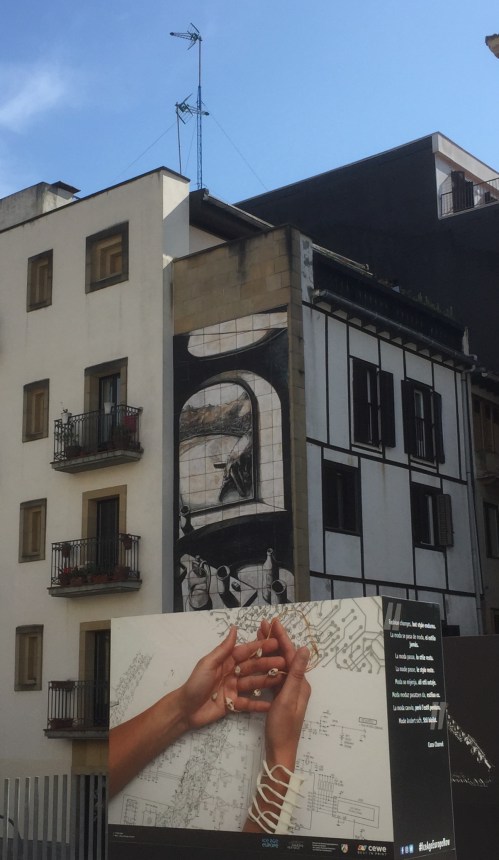
I think both street art, and advertising, affect us deeply. The images trigger certain responses within us…..maybe certain emotions, certain thoughts, or particular memories. But whatever they do, they change us. And because we are not compartmentalised, those changes ripple through our entire being. We don’t keep them in our heads.
I think we’re often quite unaware of the images and art around us. They often exert their influence in sub-conscious ways. But I like to be aware of them. I like to notice them, stop, and reflect.
In this photo I’ve captured both street art and advertising. What do you feel when you see them? What do you think when you see them? What effect do they have on you? (If any….because of course we are all affected differently by different images)
We co-create our lived reality, we humans. We do it collectively and we do it as individuals, creating and publishing, or “showing” our creations. We do that whether we are artists, or writers, or whether we simply talking to each other. We change the lived environment by constantly changing our behaviour, our language and by using our creative powers.
What kind of reality are you going to co-create today?
Maybe one the most important concepts at the base of all my understanding of people, of Life, and of the world, is that everything is connected. Nothing exists in isolation.
If I want to understand a patient, a friend, a relative, or myself, I have to follow as many of the threads which create the rich tapestries of Life as I can. I can never know them all. The daily judgement is deciding that I know enough to act, keep an open mind and awareness, and watch to see how things change after the act. I don’t really know any other way to live.
In scientific terms we humans are “open systems”. That means we don’t have impermeable walls or borders which separate us out from the rest of existence. It is just not possible to know an individual in total isolation. Our whole being is continuously immersed in flows of materials, energies and information which change us as we change them. We are influenced by, and impacted by, the environment in which we live, the food and drink we consume, the behaviours and emotions of other human beings, and the experiences of all non-human life every day. And vice versa……everything we do, what we consume, what we discard and excrete, how we act towards other humans and other forms of life changes the planet we share every day.
I loved hearing the stories patients had to tell me. Every single story was unique. Every story was a story of events, experiences, and change as a result of interactions between the person and their vast interconnected webs of environment and relationships.
I was taught that good medical practice is based on making a good diagnosis. A diagnosis is an understanding. It was my job to listen to the story, examine the patient, and, if necessary order some tests, to discern the patterns within their experience which I had been taught to recognise. In my early years as a doctor those patterns were almost exclusively pathologies, or diseases. Over time I came to understand that diagnosis, or “understanding”, needed to be both deeper and wider than that. It wasn’t enough to name the disease. A doctor had to learn to see and understand the person who was experiencing the disease. That shift from pathology to person involved teasing out the threads, exploring the influences, the impacts and the personal responses.
Each of us have distinct patterns which occur and re-occur throughout our lives. Patterns of thoughts, emotions, behaviours run through our stories. Patterns of memory, experience and fantasy cycle and spiral across whole lifetimes.
They are amazing. They are remarkable. They are astonishing. I can’t see a time will come when I’m done with this. It seems to me that every day there are new patterns to discern, threads to follow, new connections to find and to create.
What a life! What a remarkable, awe-inspiring, wonderful phenomenon is Life.
I’ve got a shelf on one of my bookcases where I keep some of the books which have most significantly changed the way I think. OK, to be honest, there are too many books in that category to fit on one shelf but I do like the little collection I’ve gathered together there. I think of them as sources of light – they have all shone some light of illumination for me – and they still have the power to do that.
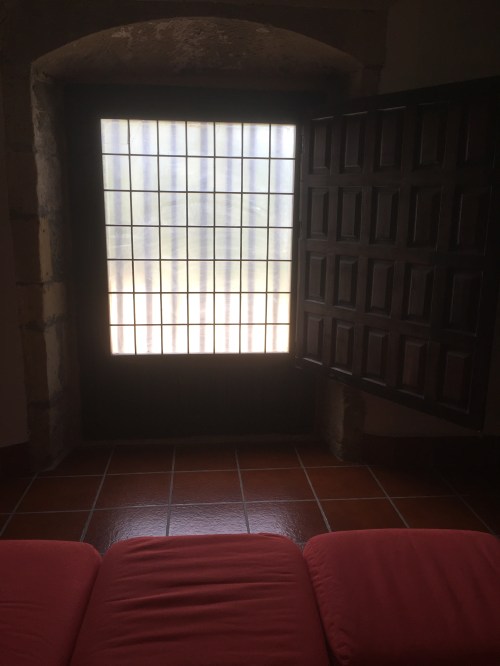
I thought of one of the insights I gained from those books when I looked at this photo I took in a museum in San Sebastian. It’s a photo of a window, but isn’t it a strange kind of window? I mean, you can’t see anything out of it…..you can’t see the outside world from inside the room. But then I thought, what it is doing is letting the light in. What it’s doing is illuminating the room, changing what and how you see the world around you as you stand inside this room. And it isn’t just any old window, is it? It’s not just a plain rectangle of clear glass. It’s filtering the light, softening it, changing it, before it enters the room. The window might be passive, but it’s still actively changing the experience of being in this room. Being in this room would be different if the window was different.
All that got me thinking about flow, because that’s one of the key insights I gleaned from some of the books on my special books shelf……that all that exists emerges from within a constant flow – a flow of material substances (atoms, molecules, compounds etc), a flow of energies (light waves, sound waves, heat, gravity, strong and weak forces of attraction etc), and flow of information (symbols, words, language etc) All three of those flows are modified by contexts, changed by the world around the perceiving, experiencing subject.
I find that becoming aware of these flows makes me appreciate the world more, makes me wonder more, makes me delight more. I love to look for the connections, for the relationships and bonds between each of us, and between us and the non-human world. I love to consider the directions of these flows – to visualise the flow of materials, energies and information which are surging through my being – and to consider how they are changed within me – how they are modified just because I exist – how they are modified by the choices I make.
That makes me aware of my role as a window in other people’s worlds too. How do I illuminate (or shade) the worlds of others? How do I modify these flows and send them onwards to enter the lives of others?
Because one thing is for sure – I don’t exist in isolation – I emerge from within these three genres of flow and I affect the lives of others as I modify and/or pass on these molecules, energies, words, stories, images and ideas. So maybe I should pay attention to how I am living and how I am interacting with all these currents, these waves, these whole rivers of flow.
Maybe I should be aware of what kind of window onto the world I am, and what kind of window you are too. How do we change the rooms/communities/worlds we each live in?
It’s tempting to think that time is linear, especially when we look at a calendar and can mark off first one day, then the next and then the next. The sequence seems clear and if it’s Saturday today I know that tomorrow will be Sunday…..”as night follows day”.
So what’s going on when we get that feeling of “a return”? Either a “deja vu” experience where you FEEL you’ve been exactly here before, seeing the same scene, hearing the same words, feeling the same feelings. Or, like now, with a daily rise in Coronavirus cases, followed by a daily rise in hospital admissions, and we think “Oh no, here we go again” and dread we are back to where we were about four or five months ago.
Well, in both those cases, we are joining up some dots with straight lines. We are recognising something, or several things, which are strikingly similar to something we experienced already and we think we have jumped back down that straight line to the past.
But that’s a pretty superficial understanding of Life, isn’t it? Because time isn’t linear. Lived time (as opposed to artificially measured time) goes at different speeds, flying by some days, dragging on others. And lived time is influenced by three different streams…..streams of memories, streams of perception, and streams of imagination. The “I remember”, “I can see”, and “I imagine” actions which never seem to cease…even when we are asleep. That means that events don’t neatly flow from one to the other. They leap, jump, circle round, associate, resonate and echo (amongst other things!)
And here’s the other thing to keep in mind…..Life is a creative process. We are “emergent” creatures, constantly changing, transforming…becoming not being. Every day is a first for us. Every day is a last for us.
So, as people talk about a “second wave” of this pandemic, there is definitely a feeling of “here we go again”. Except a lot has changed since this pandemic began. We can’t go back to the beginning and hit the reset button. (I know, I know, much as many of us would like to!) We bring our changed selves into this “second wave” and that means, whilst there might be much that we recognise, there will be more which is truly brand new.
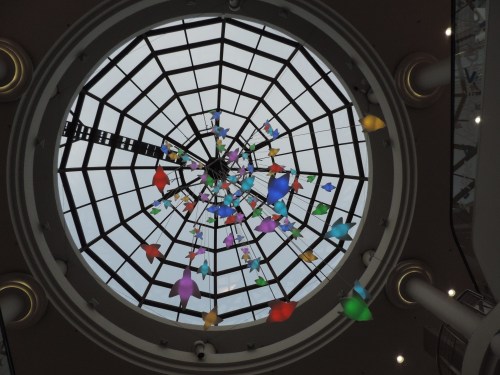
I thought of this when I looked at this photo of this circular ceiling window, with the paper birds flying round in it. I thought, yes, this is what it is like….cycles and spirals which change with every turn around the circle.
We have learned some things, you and I. Learned some things about our lives, our selves and our societies. We will bring these changes to this new cycle, some in a way which reinforces some of what we learned first time around, and some in a way which transforms what we learned first time into something brand new.
Do you feel that?
Does that encourage you to make any different choices? To act differently? To engage with the problems and the solutions differently?
I welcome constructive criticism and suggestions. I will not, however, tolerate abuse, rudeness or negativity, whether it is directed at me or other people. It has no place here. ANYONE making nasty comments will be banned.







 Heroes Not Zombies