Feeds:
Posts
Comments

Archive for the ‘narrative’ Category

The other day I came across this. Doesn’t this look like an entrance to you? The curve of the branch from that tree on the right looks like it forms a perfect arch over towards the tree on the left, and the whole structure looks like a delightful, pleasing, enticing doorway. It’s more than a space. It’s more than a frame. It’s an invitation.

So I step forward, and this is what I see…….

Same two trees, same space, completely different perspective. The doorway has gone. The archway has gone. Over the course of half a dozen steps what I was looking at has literally changed shape.

Well, not changed shape in itself….it’s what I could see which has changed shape. Don’t you think that’s interesting? That the form, the shape, of what I could see could entice me, draw me towards it, only for it to change completely before my eyes, as I changed my position, as I took some steps.

I think this happens a lot. When we do more than look, when we act, when we move, then the world changes around us. And, I’m sure, we change with the world too.

Did the attraction disappear?

No, not at all. But the focus of attention did. I was attracted to the doorway, literally drawn towards it. It sparked my curiosity. But a few steps on, that curiosity had shifted. I was no longer wondering what lay through the doorway, what I might discover if I walked through it. I was standing, astonished. Astonished by two things.

First, astonished that the shape could change so completely. That the doorway could become two trees, one with a branch which had a completely different shape from what I initially saw.

Second, astonished at the actual shape of that branch. I mean, look at it! It does way more than curve towards the neighbouring tree. It suddenly changes course. As if it had hit an invisible wall, and so had to grow now in an entirely different direction.

I can’t see that without wondering…..what’s the story here? How did this shape arise? How did this branch arch itself through the air for a bit, then, suddenly, change so completely? What happened? What influenced this change?

Those are the kinds of thoughts I’d have every day with patients. As they described the patterns of their illnesses, shared their unique stories, I’d be astonished. Astonished at the details of the story, astonished at the coping mechanisms the patient had learned, astonished at their powers of adaptation, and curious…..thirsting to understand, to discover, to know….how had this come about?

What events were there in this person’s life, what impacts did those events have, and how did the person adapt to those impacts?

To understand, I had to shift my perspective. I had to act. I had to take some steps to make an active connection, build a trusting, functional relationship, create a bond of care and attention. Without doing that, I wouldn’t know what I was really looking at.

Read Full Post »

One day I looked out over the vineyards and I saw this cloud formation. It looked like a tornado, but it wasn’t.

Now that I see it again, as a photo, I realise that this particular view, due to the phenomenon of perspective, makes this band of cloud look cone shaped.

But it wasn’t cone shaped. It was a band of dark cloud, like a wide path, moving across the sky.

That got me thinking about the whole phenomenon of how things appear to us….how everything has a distinct shape, or form, or looks patterned in a particular way….but that is always informed, or even, determined, by where we are standing….we the observers.

I think we tend to forget about that. Especially with social media where echo chambers are created as the algorithms push similar viewpoints and opinions towards us.

The truth is that we humans see reality most clearly when we share perspectives and communicate them without judging them.

We would all benefit from more diversity in science, in education, in health care, in government. Multidisciplinary and rich, inclusive teams, groups and communities offer us the chance to see the world as it really is….not just the way we are used to seeing it from only our own viewpoints.

After all, there’s a huge difference between a band of cloud, and a tornado!

Read Full Post »

I’ve had a couple of days thinking about beginnings, so it seemed kind of obvious to have one about endings!

This photo shows a number of berries, all part of the same plant, even the same part of the same plant, but each in a different stage of maturation. Some are still green, some have turned yellow, some red, and some are even beginning to get wrinkled (like me, ha! ha!) and so appear the most mature.

When I think about beginnings, I realise that they are all pretty arbitrary – a beginning is where we begin – if you pick a thread or two you’ll always find your way back to an earlier beginning.

I don’t think that means there are no beginnings. I think there are. All the time. Every day. Every moment of every day. There are beginnings. There are phenomena and experiences which have only this moment come into being for the first time ever. It’s pretty great to notice that.

Endings have exactly the same quality. It’s not that there aren’t any. There are endings all the time. Every day. Every moment of every day. There are endings. There are phenomena and experiences which have only this moment slipped into the past. You’ll never have them again. It’s pretty great to notice that.

Outcomes, targets and goals

In Medicine, there is a lot of focus on “outcomes”, sometimes called “clinical outcomes”, which, somehow are a bit different from “patient reported outcomes” (“PROMS”). These are all endings. They are points to be reached. Measurements to be attained, or ratings to be completed. But when your working life is that of a family doctor, (a “GP”), then you’re never done with outcomes. The patients don’t reach the intended outcomes then go away. Life, it turns out, goes on. What was an ending today, turns out to be just another chapter in an ongoing story, just another time and place sensitive reading in the midst of a flow of a whole life.

Oh, yes, you’ll say, but there is one outcome which isn’t like that isn’t there? Death. The final outcome. The ultimate ending. Except it’s not really, is it? Well, it is for the physical body of the person who has died, but we are more than physical bodies aren’t we? We are experiences, stories, events and memories, aren’t we? And those continue long after the physical body has gone. Are the people you loved who are no longer alive completely gone from your life? I don’t think so. Their life continues to influence our lives. The experiences we shared, the memories we made, whatever we created together, the stories told, the photographs taken, the objects held…….

Have you ever seen a BBC TV programme called “The Repair Shop”? I love it. People bring old objects to a workshop of artisans. The old objects are usually in a poor state of repair, but they mean something to the person who has them. Once restored by the craftsmen and women, the person comes back to reclaim the object, and time and time again, it is an immensely emotional experience. They are put in touch, deeply, and significantly with a loved one, long gone. It’s lovely to watch and it shows how a person, an individual, continues to influence others long after they’ve gone. How their “presence” I suppose you could say, is made more real through what they’ve touched, what they’ve handled, what they played with, or made.

Targets are a kind of outcome. They are useful as ways of getting you to somewhere you want to get. For example if you want to save up a certain amount of money then setting a target of that amount is a good aid to getting there. The trouble is that targets are used inappropriately. Whose targets are they? And are they the same, most important targets, which others want to achieve? Because the selection of targets is an individual, value-based, subjective, exercise of choice. But if they are set for others then they direct the efforts and lives of others towards those targets instead of others. I’m not a fan of targets. At least, not ones I don’t have a say in the creation of!

Goals are a bit like targets. I’d say the same about them. They can be helpful to get us to places we want to get to. But they are aspirations, not predictions. And they are not endings. Or at least, they are not final endings. Are they?

I think this unique and unpredicted pandemic is forcing us to face up to the reality of beginnings and endings. It’s making us more aware of connections, of webs of influence, of the non-linear, multifactorial, dynamic, ever flowing, ever changing nature of reality.

This morning I read an article in Le Monde about how management methods are already starting to change in the light of this experience. Here’s the main point I got in that article – management is having to move away from “control” to “coaching”. Three things have come to the fore – the need for individual autonomy, the need for good team working and relationships between workers, and the need for transparency.

Well that all seems pretty good to me! I look forward to seeing the end of de-humanising “Taylorism” and “command and control”, and the beginning of an emphasis of autonomy, relationships and transparency. Imagine if we governed countries according to those principles?!

Read Full Post »

Yesterday I wrote about new beginnings, about choosing what and when to start, but I’ve been thinking about it since then and I realise beginnings are paradoxical. They are both easy to find and impossible to find. Why do I say that?

Well they are easy to find because every action, every thought, every experience is, in fact, brand new. Life moves and flows continuously. This present moment has never existed before, not for you, not for anyone you know, not for the planet, not for the universe. So every present moment is a beginning (and, yes, it’s an ending too, because no experiences are exactly repeatable)

They are also impossible to find because everything is connected. We human beings are “complex adaptive systems”. That is we are massively interconnected, both in our own being, and in our contexts, relationships and environments. We are “open systems”. That is there are no impermeable barriers between an individual and the rest of the universe. The atoms, molecules and cells which make up our bodies are changing all the time, as we breathe in, ingest and absorb new materials, and breathe out, expel and excrete other ones. Energy and information flow into and through us continuously.

So what? Well, all this means it can be very hard to trace back from now to a “start point”, or a “beginning”. For example, when a patient would come to see me and complain about a particular problem, and I diagnosed a certain disease, where did that disease start? With the first symptom? With the first symptom which was troublesome? With the pre-conditions before the first symptom began? I was taught to explore a patient’s “past history” to see how this illness might fit in the trajectory of their life. I was taught to explore their “family history” to see if there were family patterns or dispositions. I was taught to explore their “social history” to find out what was happening in their work and social life. I could go on……

A beginning is pretty much arbitrary. It’s where we choose to begin. Think how you would tell your life story to another person. What would you say first?

As I progressed in my work experience I changed my introductory question to each patient, from something like “What’s the problem?”, or “How can I help you?” to “Tell me your story”.

Yep, “tell me your story”. Sometimes a patient would be a bit taken aback with that beginning, but I’d just maintain eye contact, show I was listening and wait. Sometimes I’d have to say a little more to get things going, for example to explain that I wanted to understand what they were experiencing and how it might have come about so I’d like them to just tell me about it in their own way, but usually, people would just start to speak.

Where a person chose to start, and how they told their unique story, was always interesting and relevant. As the consultation progressed I’d often ask another question “When did you last feel completely well?” This was a particularly useful question to be followed up with “Tell me about the weeks and months leading up to that time”.

Those were beginnings. Different beginnings. All useful and all relevant.

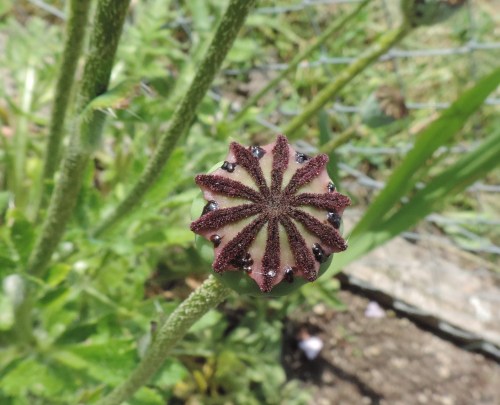
I came across this photo of the seed head of a poppy the other day and it’s so beautiful that I just decided I’d like to share it with you. How does it fit with today’s thoughts about beginnings? Well, all plants live cyclical lives, with phases passing through seed, germination, growth, perhaps blossoming or fruiting, and scattering the new seed before dying back for the next cycle. Does the beginning of that cycle start with the seed in the ground, or the seed in the seed head waiting to be dispersed? Or somewhere else?

So, back to beginnings. Whatever you want to begin, begin today. Even if its a habit, a routine, a task you’ve experienced before and stopped, because even when you stop, you can start again. You can start today. After all, you’ve never lived this day before.

Read Full Post »

Sheer beauty.

What is it that I love so much about this world?

The wonders of the everyday. Or “L’émerveillement du quotidien”. It’s normal for me to find myself wondering about something I’ve just seen or heard.

I suppose for most of my working life my days were filled with patients. I never tired of that. I never got bored of that. Every day each patient would present to me a unique a story, a new, and singular problem, puzzle or conundrum to unravel. Each patient would be asking me to help them make sense of what they were experiencing and to support their abilities to heal, to cope, to adapt. Maybe they didn’t quite use that language but that’s always what I heard.

Before I became a doctor, way before, right back as early as I can remember I was driven by curiosity. I wanted to learn, discover and explore. It strikes me now that it isn’t a long way from curiosity to wonder.

People have always amazed me. They still do. Life has always amazed me. This Earth, this planet, the solar system, this universe which we all live in have always amazed me, filling me with an infinite supply of curiosity.

But there’s something else.

Beauty.

Look at this photo of a glorious, immersive sunset, where every single element of the sky and the Earth changes colour. Look at the palette! It is just breathtakingly gorgeous.

I see beauty everywhere. Which isn’t to say I find everything I see beautiful, I don’t. But there is “so much beauty in this world” (do you know what movie that comes from? Here’s the answer).

I am a very visual person. I think visually. I sketch and diagram as I think. I love photography and I think I “have an eye for it”. I see what I find amazing, curious or beautiful and I try to take a photo or two. Then I return to those images again and again, year after year, and I find that, like with this one, the delight, the pleasure, the amazement in beauty like this never fades.

Of course there are other senses and I don’t just experience beauty visually. I love music. I collected “records” long before people starting calling them “vinyl”. I still have them. I still play them. I spent hours and hours ripping CDs onto iTunes and I don’t even know where those libraries are any more! But I stream music now. Every day. Several times a day. I used to discover new music on the radio. I took the back off an old radio when I was a teenager, attached two wires to the speaker using clips, and fed the audio directly into a cassette recorder. I still have some of those recordings…..studio sessions on John Peel’s programme on Radio 1.

I’ve long had a love for movies. I love them for their stories and for their beauty, oh, and I often love them for their music. I compiled short clips of about a hundred movies to teach doctors and other health care workers about our unique human strategies for coping and adapting. I could have taught those strategies without movies but the beauty, wonder and emotional engagement which came with the movies made them much easier to learn and to remember. I probably have a whole vocabulary of coping and adapting based on movie characters, scenes and plots.

There is beauty all around us. I delight in images. I delight in music. I delight in movies.

Where do you find beauty? Where did you find beauty today?

Read Full Post »

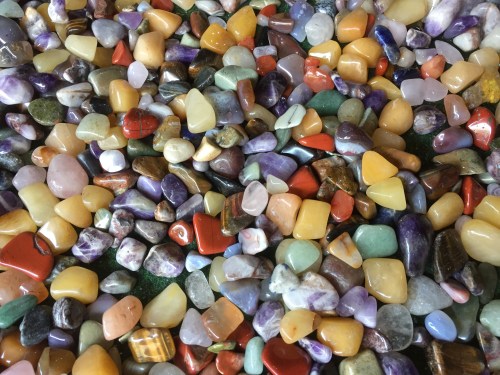
This is a photo of a small part of something called a “Scratch Patch”. It’s an area about the size of a large room. The floor is covered with polished stones. You pay for a container/jar and can then spend as long as you like filling it with the particular stones which attract you most.

I shared a photo of a pumpkin stall at a farmers’ market the other day to demonstrate the beauty of diversity but then I came across this photo which shows exactly the same thing in the mineral world.

We have a bit of an ambivalent attitude towards stones I think. Maybe because they are inanimate we don’t often value them as much as we do plants or animals, but on the other hand, “precious” stones are considered to be amongst the most valuable objects in the world.

At a simple level many of delight in spotting and picking up a few “interesting” stones when we are out walking – whether it’s through the vineyards, or along a beach. You probably have some favourite stones of your own. Maybe in your pocket, at the bottom of a bag, or on a shelf somewhere in your house.

We must know, instinctively, that stones are not all the same. Otherwise how would we notice some but not others? Why would we choose to pick up and keep certain ones?

I think the attraction of uniqueness runs right through everything in this universe. We humans, each of us unique in our own right, are delighted by uniqueness, whether we find it in our gardens, the paths we walk along, the flowers and trees which grow around us…….

I have often said that what I looked forward to most on a Monday morning was the first clinic of the week. Every single week I knew I’d meet unique patients. Every single day I knew I’d hear unique stories which I’d never heard before. Every single consultation was unique, never to be repeated.

For me, good Medicine couldn’t be reduced to protocols, guidelines and algorithms because every single human life is a unique one. Every single human being is “extraordinary”, not reducible to a class, a type, or a disease. Every encounter occurs only once.

Read Full Post »

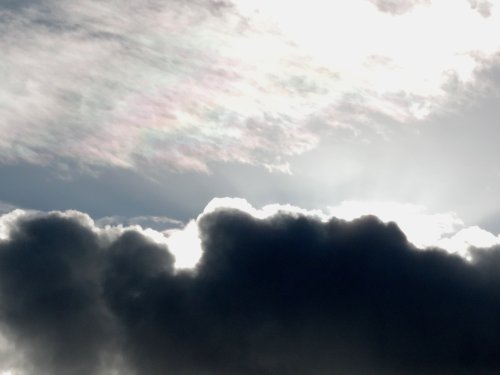
I see two symbols of hope in this one image – a cloud with a silver lining, and the beginnings of a rainbow (or, if you prefer, the emergence of colour out of monochrome)

We human beings need hope. I’m not sure if it’s possible to live without it. That might sound dramatic but I expect you’ve heard tales of seriously ill people “turning their face to the wall”, and dying. Or, maybe the opposite, maybe you’ve heard those who recover from serious illness described as “fighters”, which doesn’t mean they have defeated an enemy, it means they have dug deep, found wells of hope and belief, and have healed.

Whenever I saw a patient with a serious disease I knew there were roughly three possible future paths – improvement, deterioration and something inbetween (a kind of continuation of the present). You can see that with common, acute infections, such as a cold or flu, and you can see it with this COVID-19 virus too. Some people make a complete recovery, some go downhill quickly and die, others recover well enough to leave hospital but continue to have disabling symptoms (people are calling them “long haulers”).

Perhaps one of the silver linings from this latter group is the growing recognition in Medicine that some viral infections can produce seriously disabling chronic states. Sadly, in my own work, I saw patients with diagnoses from “Post Viral Syndrome”, to “ME”, to “Chronic Fatigue Syndrome” who had been dismissed and/or not believed by other doctors. These patients were hit by a double whammy – illness and disbelief. That was always hard. I hope this pandemic might have changed the mindsets of some physicians who have dismissed such chronic states as “psychological”, “depression”, or “fraud”.

But to return to the issue of hope. What makes the difference? What influences which of these three paths lie ahead for you when you get sick? The improvement path, the decline path, or the chronic illness path? The truth is we don’t know. But I sure hope there are people invested in research projects to try to shed a light on this issue. The other truth is that nobody can accurately predict which of these paths lie ahead for any single patient.

Yes, of course, we can use statistics and probabilities, but when it comes to an individual, those generalities don’t determine the outcomes. I’d be explicit about that with patients, and I’d say, the truth is that for this individual, their path may well be the improvement path, so why not take on board that truth? Taking that on board is a kind of hope.

A little further down the road things might look very different. Someone who was getting better might decline. Someone who looked as if they had no chance might make a stunning, and unexpected recovery….and so on. But as the story proceeded, so did the three options. At every point, every day, those three paths lie ahead – improvement, decline or staying much the same. Is it ever helpful, then, to give up hope? If we hope, then don’t we try our best? Don’t we put in our greatest efforts? If we don’t hope, the danger is that we give up.

Because, here’s the other piece – the self-fulfilling prophecy. How often does it seem that what we anticipate, what we expect, comes to pass? Is it possible that hope can contribute to improvement and that despair and hopelessness can contribute to decline?

What do you think?

I think we human beings need hope. And I think hope contributes towards improvements. And even when things don’t improve, we can always change what we are hoping for. Changing what we hope for keeps us realistic, but being realistic doesn’t mean we have to give up all hope.

What’s your experience?

Read Full Post »

I’m convinced that the Self isn’t a thing. There is no entity, or measurable, directly observable object, called “the Self”.

Some say the Self is an illusion, but I was always impressed by the philosopher, Mary Midgely’s response to that…..which was to ask if the Self is an illusion who, or what, is having this illusion? I’m not convinced that the Self is an illusion.

Some say the Self is multiple, that there is a “community of selves”, or that the Self is multidimensional. Different dimensions, or aspects, of the Self are activated and expressed in different relationships, and different contexts. I’m convinced that the Self is multiple.

Some say the Self is a narrative, a story. I’ve got a lot of time for that idea. I’m pretty sure we weave together the events and experiences of our lives into our personal story both to make sense of life, but also to have a sense of Self, a sense of identity.

But that isn’t enough.

There’s more to who I am than my story. There’s my body. There’s my unconscious and subconscious reality, all the breathing and heart beating, and organ and cell and tissue function that is vital to me but of which I normally have zero awareness so can’t weave into a story.

I’m convinced of a Life Principle, a Life Force, or a “Vital Force”, not as an entity, not as an object, not as something “outside” of the body and the Self, but as something manifest AS the body and the Self and probably more besides….

There’s a red thread runs through life…..the thread of the Self as more than a construct, a narrative, an illusion, a force…..isn’t it just wonderful to experience that, to savour that, to enjoy that, to get to know that?

Read Full Post »

There was a craze hundreds of years ago for “chimera” – originally an idea from Greek mythology, medieval peoples took it a whole stage further and created all kinds of bizarre animals.

The chimera is an invented animal made up of the parts from other animals…so maybe a human head, a lion’s body, wings, a serpent tail etc. You can see lots of them carved onto the sides of old churches, and they illustrated old texts as well.

What do you think of them? Are they horrifying? (I think they were often intended to be so) or are they fun? Fascinating?

They just aren’t “natural” are they? You would never imagine that a creature like this existed anywhere. Maybe, once upon a time, some people did. Maybe they believed that they lived in unexplored regions…..remember the old maps with the unmapped areas labelled “Here Be Monsters”?

Probably the commonest reaction to them is a sort of disgust. We find them a bit repulsive….even the more beautiful ones!

I wonder if both chimera and genetically modified plants and animals touch that same core discomfort in us. There’s something a bit unsettling about cutting some DNA out of one creature and splicing it into another, don’t you think?

I think it’s no surprise that many people want GM foods labelled so they can choose not to buy them if they don’t want to. I think it’s not a surprise either that many people think there are complex ethical challenges to be addressed, and a need for intense oversight and control of the whole business of mixing DNA from creature into another……

Read Full Post »

I saw this a few years back in the town of Saintes, about a half hour drive from where I live. You have to agree this is a pretty impressive attempt to bar the door! There was nobody going to go through there easily!

The trouble is, as we can now see, that the rest of the building fell down. And there’s not much value in a locked door when the other three walls have disappeared! There’s definitely a story here, but I don’t know it. I mean, who went to such great lengths to bar this door? And why? And what happened to the whole building? Setting all that aside though, I think this image inspires a couple of streams of thought.

You know the phrase about barring the barn door after the horse has bolted? Well, that’s the first thing that came to mind when I looked at this photo today. Throughout this pandemic authorities have been playing catch up. Some countries have been slower than others, (and, goodness me, some countries still haven’t got a grip!), but everyone has been trying to learn as we all live this thing. Still, it’s often felt that lockdowns have come too late, or have been too sloppy, that there hasn’t been enough Personal Protective Equipment for those who need it, that testing and tracing have been slow to get off the ground, and so on, and so on.

What does that tell us?

Well, partly that our societies have been way more vulnerable than anyone has admitted, and partly, that this is life…..that life emerges, continuously evolving and developing into the unknown. We can’t live life backwards, and we are never going to be able to accurately predict the future, so maybe we need to learn how to make the present the best we can make it instead?

The other thought stream which this image set off for me, is that one about dealing with life, and, in particular, health, holistically. It’s just never going to be a successful long term strategy to focus on short term, narrow solutions. We don’t just need well defended front doors. We need strong walls, healthy buildings, safe, clean and secure places to live and work. We need them in the present…..not just once a crisis is upon us, and it’s too late!

Read Full Post »

« Newer Posts - Older Posts »