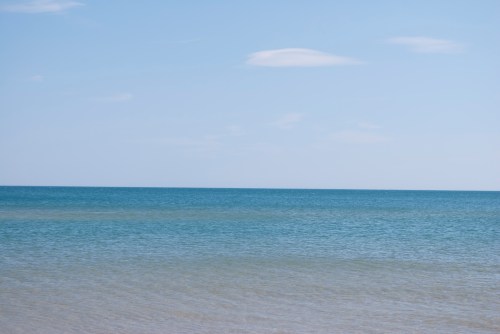
When I look out at a view like this I see the ancient teaching about the four elements – air, fire, water and stone.
I suppose the most obvious one is the water – just look at it! Look at the rich palette of colours! Look at the expanse of it! I heard someone the other day say we shouldn’t say “Planet Earth” we should say “Planet Ocean” because much more of the Earth’s surface is covered with water than with land. As best we know Life began in the sea and evolved from there.
Above the sea, the next most obvious element is air – well, we say sky really, because we can’t actually see “air”. Look at the colour palette there too, and the expanse. That unbroken horizon where the sky meets the sea with no land in-between has some kind of magical attraction for us, doesn’t it? Do you remember the story about “The Green Ray“? It’s based on the old belief that if you watch the sun setting on a horizon of sky and sea alone then for a brief moment before the sun disappears a bright green ray of light might appear. I don’t know if that’s true. I’ve never seen it. The story goes on to suggest that whoever you see next, after seeing the green ray, will be the love of your life. Romantic, huh? Eric Rohmer made it into a beautiful movie. Another thing we can’t see in the air is wind. We can only infer it from its effects on other elements. We can watch it blow the clouds (and what are clouds other than the temporary appearance of otherwise invisible water molecules which saturate the air?). We can watch it whip up waves.
The element of fire comes from the Sun. We can’t look at it directly without damaging our eyes. But we can close our eyes, turn our faces towards the Sun and feel the heat of the incredible furnaces and explosions which send out waves of energy to our Earth. Waves, without which there would be no Life. And in that air that we can’t see are gases we can’t see, including ozone, which, when it breaks down, allows way too much of the Sun’s fire through. We can’t see the carbon dioxide building up and trapping the energy of the Sun’s fire between the sky and the sea and earth, warming the oceans, the lands, and threatening the existence of all that lives.
Finally, there’s the earth, or stone. If you look carefully at the front of this image you can see the colour of the sand under the water. Isn’t it amazing that those un-countable grains of sand are created by the constant moving of the water? That they started out as rock and ended up almost too small to see. Well, of course, sand is more than little rocks. It’s got gazillions of tiny shells and pieces of shells in it too. Those protective homes created by billions of tiny sea creatures – all without the use of machines or technology!
I love to stand at the edge of the beach and harmonise my breathing with the rhythm of the breaking waves. Breathing out as the water breaks on the sand, and breathing in as the ocean draws its edges back in towards itself. When that harmony falls into place its one of the most calming, centring, but also expansive boundary-dissolving experience I know.
One of my most favourite phrases in French is “L’Emerveillement du quotidien” – which translates as something like “the wonder of the everyday”, but actually there are other layers of meaning which I find hard to capture in English.
I suppose the thing I love about the word “wonder” is that has several connotations. It suggests a certain curiosity, a “wondering” what something is, or how it came about. But it also suggests a kind of awe, something amazing, astonishing, or, at very least attention-catching. The sense of “everyday” also has a couple of nuances. It means something common, as in something you might encounter any day, and it means something ordinary. So you immediately find yourself dealing with a paradox – how can the “ordinary” seem “extraordinary”? How does something “common” become both “particular” and “special”?
I’ve come to believe that there is always something extra-ordinary in the ordinary, and, after working with thousands of patients over four decades of clinical work, I’m convinced that every human being is “special”. Special not in the sense of above or superior, but in the sense of particular and unique. In fact, I think it a dehumanising act to reduce any person to “ordinary” or “common”. It’s a failure to really meet and get to know the individual.
So, although these terms seem somewhat paradoxical I find no conflict in them. I find that every single day I can have my attention captured and feel a sense of wonder and amazement develop inside me, just by living my “ordinary”, “normal”, “everyday” life.
I think there are two important principles to bring to this idea and practice – attention and imagination.
We humans have remarkable powers of unconscious and subconscious functioning. We can easily slip into auto-pilot. Have you ever had that experience of driving somewhere with you head full of thoughts to such an extent that on your arrival you have virtually no memory of the actual journey? This happens especially if your trip is one you have taken many times before. You navigate, without much conscious thought, from one familiar landmark to the next, through one well known intersection to another, but you might be hard pushed to describe any of the details of the journey. We are equally great at acquiring habits, and once we set those routines off, unless anything interrupts the expected flow, then we cruise through those activities, “without a second thought”, or, maybe more accurately, without a first one!
These are great powers and they enable us to get on with living without having to stop and make sense of life in every lived moment. But it comes at a price. We miss a lot. In fact, it comes at another, perhaps even greater price. We open ourselves up to being controlled. There are vast industries of advertising, propaganda, and persuasion designed to hustle us along towards somebody else’s desired goals without stopping to consider them.
So, how do challenge that? By slowing down and paying attention. OK, maybe not all the time, but more than we are in the habit of doing. The more often we slow down and pay attention to what is here and now, the more we notice. And, my contention is, the more we notice, the more we wonder.
Repeated experiences of wondering undermine the belief that there is nothing interesting or different about any individual, that all flowers are the same, that nothing changes, or that generalisations are more true than specificities. In fact, repeated experiences of wondering create the exact opposite. They affirm, every single day, that every person is unique, that every plant is unique, that no experience is ever really repeated, and that the truth is always found deeper than in a surface generalisation.
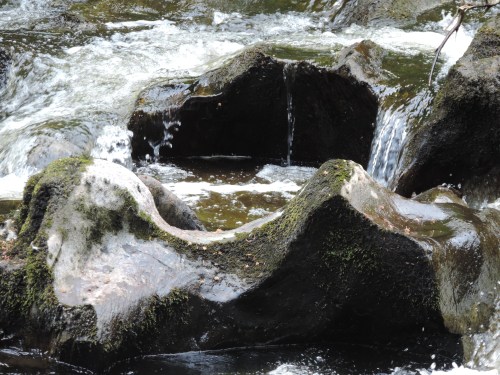
When I walked along the banks of this stream, which you can see in the photo at the start of this post, I noticed rocks and water. Everywhere I looked the rocks looked different, and I spent a long time mesmerised by the flow of the ever changing water.
Have another look at this particular shot. Don’t you find yourself starting to wonder? Starting to wonder about the shapes of the rocks? How smoothly they have been carved by the water. Don’t you start to wonder how each rock becomes this particular shape, and how the rock got to this position in the stream in the first place? It’s pretty easy to let a whole river of questions pour through your mind, and even without answers, those very questions start to stir a sense of amazement, of awe, of wonder.
The second element is imagination. We humans don’t just “see” the way a camera “sees”. We select, represent and interpret. We pick certain elements out of the immense flow of materials, energy and information which constantly course through our minds and bodies. We re-present those original flows and turn them into mental images, thoughts and ideas. And we interpret those representations, colouring and shading them with meanings which we draw from our memory banks and conjure up with our imagination.
I look at these particular rocks and I see a giant wide open mouth. I can imagine that some great monster fell, or was thrown or chased, into the water some time in the distant past. I can imagine that “once upon a time” something happened here, and there’s a story to be told to “explain” what we can see now. In Celtic traditions there is an abundance of such stories about the landscape. The mountains, rivers, forests, lochs, boulders, trees and ponds have stories attached to them, names given to them. Those stories and myths enrich the landscape, and add an extra, invisible layer to Life on Earth. Some people refer to this phenomenon as “enchantment” and I rather like that.
Here’s to a life of wonder and enchantment bursting up into our consciousness every single day.
Here’s to finding our inner heroes and discarding our inner zombies!
At the beginning of the year I received an invite to speak at a conference in Canada. The invitation was to talk about my experience of four decades of work as a doctor who used homeopathy. I was surprised, but it was a very kind invitation and I accepted.
The way I prepare for talks is to let some ideas and questions rattle around my brain for a bit, then start making notes. The kinds of notes I make are sort of mind maps. They aren’t as formal as those you’d find in books about the mind mapping. I just put down key words and phrases on a page, then draw circles, squares or diamond shapes around them and link them up. I’ll do a few versions of that, then I open up “Keynote” and I make a slide for each element in the mind map, pull in images from my photo library, write a few words (not many) on some of the slides, then arrange them to create a sequence which enables me to tell the story I want to tell. Well, I ended up with a set of three presentations, each of which would take about an hour to tell. I’d been told I’d be allocated two 90 minute slots in the schedule.
Then before the time arrived for the conference, along came COVID-19 and the event was cancelled. Maybe it will happen some other time, but maybe not. I’d enjoyed putting the presentations together so that gave me an idea. Why not write a book covering the same ground? I’d had an idea for a long time that I should tell my own story. I didn’t want to write a textbook, or a polemic, an argument for a way to live, a way to practice Medicine, or even make the case for the use of Homeopathy. I just wanted to make a record of my own life, my own experience.
I’m sure if any of us sat down to write our own story we’d immediately come up against the question, “But which story?”, because there are many stories of our lives. I didn’t want to write an autobiography which told the story of my family, my relationships, and my personal development. I wanted to tell the story of why I became a doctor, what kind of doctor I became, and how that came about. Not least because I thought it would help me to understand my own life better. I suppose it’s my “professional story”, but really, it’s the story of my “calling”.
I wanted to publish the book too, because I wanted others to be able to read it. Not to earn money from sales, nor to try to convince anyone of anything, but more to add to my over all project of sharing my personal experience of curiosity, wonder and joy – that’s what this blog is all about – and that’s what I committed to do daily from the day of lockdown. I’ve been writing a post based on one of my photos every day since the middle of March and I don’t feel like stopping any time soon. I already know, from feedback from some of you, how much you appreciate these posts and that completely delights me. Writing them adds to my life, so I’m very, very happy if reading them adds to yours!
Now, more than ever, I want to set off some positive, loving, inspiring waves. I’ve no idea where they will go, or what effect they will have, but it feels like a way to make a positive contribution to our times.
With lockdown, with the presentations already mapping out a story, and with the daily practice of writing for the blog, it all came together and I wrote this book – “And not or” – “A calling and a listening”.
This is how I did it, the tools I used, and what I had to learn.
I wrote the text using an A4 sized notebook and a pen. I wrote and wrote and wrote, till I thought I’d written all I wanted to write. Then I used that handwritten text to write the digital version using a program called “Ulysses“. Listen, before I go any further, I’m just laying out what I did, not saying you should do exactly what I did if you want to write your own book! But, on the other hand, I’ve always found it helpful to read what other writers have done. So, you could use any software you want. I started with Ulysses. I use this program on my desktop Mac, as well as on my iPad (for which I have a proper Bluetooth connected keyboard).
When I wrote the first digital version, I didn’t just copy out all the words I’d written in my notebook. Instead, I’d read a section, then start to transcribe the words into the wordprocessor, but I found I often decided to write it differently, to leave out whole sentences or passages, and to write brand new ones instead. By the time I’d done that I had what I called “draft 2” (the written text constituting “draft 1”). The way Ulysses works is that you write “sheets” – for me, each “sheet” was a chapter. I like the simple markdown language you can use with Ulysses. If you put a # sign at the start of a line it turns that line into a heading. If you put two ## signs it turns that line into a secondary heading. I only used those two levels of headings. The first level heading were the chapter titles, the second level to navigate sections within a chapter. The other main markdown tools I used were for inserting images (hey, you know how much I love my photos!), for marking a paragraph as a quotation, and for creating lists. That’s pretty much it. Ulysses presents you with a left hand column of your sheets, each one showing just the first line or two. I used that to get an overview of the whole book. That let me see what I thought was repetitive, and what I thought was missing.
Next step was “draft 3” – read through the whole digital text, correcting and editing as I went. Once I got to the end of that, I felt, well….dissatisfied! Something wasn’t right, and I couldn’t see what it was. So I put the whole project away for a week. Then when I came back to it I saw there were half a dozen chapters which seemed problematic. They were in two groups of three, and each group had overlap and repetition in it. I still couldn’t see the way ahead though. So, here’s the next neat thing about Ulysses, you can select whichever sheets you want to review and print them off. I printed off the six in question. Then I read through the printouts with pencil in hand, scoring out, adding in, and linking up different paragraphs. Once I’d done that I went back into the program and changed the text according to that latest “edit”. I also chopped out three other chapters that just didn’t seem to fit well at all. What do they call that? “killing your darlings” – dropping some of the sentences you love the most – because they just don’t fit. I guess I now I had gone through “draft 4”, to “draft 5”.
Time for another complete read through, correcting and editing as I went – “draft 6”. OK, this felt good now. Time to try and turn it into a published book. I decided I wanted a physical, paper version, and a digital version (and not or….get it?).
For the paper version I decided to use Blurb. This is a company I’ve used about once a year to make a photo album of my best, or most memorable photos of that year. I love their quality of print. And I’d already taught myself the basics of their software – “Bookwright“. Now, I’m sure with all the software I use that I’m no expert and there are probably easier ways to do things, but, hey, I only know what I know, so I don’t know any easy way to import all the text into “Bookwright”. Instead I created the pages, inserted either text or photo “layout boxes” onto each page, copied and pasted the text, chapter by chapter into Bookwright, imported all the photos I’d used, and dropped them into the right places, then ran the “preview” option, and the error checking, both of which identified things that needed fixed. Then I uploaded it to the Blurb site and ordered up my proof copy.
Meantime I had to think how to produce a digital version. Apple have something called “iBooks Author” which I’d used before, (I’ve since learned Apple are about to discontinue that software) and there were ebook creation tools I knew existed to produce “Kindle” or “ePub” versions.
Whoa! Too much to think about it! I then discovered that Amazon had produced new software called “Kindle Create“. I downloaded it, discovered you could import a “Word” file into it, make a cover, preview it, then upload it to Amazon. Ulysses makes it easy to export your sheets as a single “.docx” file so I did that, opened it up in “Pages”, then exported the document from there as a “Word” doc into Kindle Create. It was easy, and straightforward, just took time and care.
Now, I’m sure if you use Windows your workflow and the tools you can use will be different, and maybe some of you know a lot more about these programs and methods than I do – and if that’s true, please go ahead and share what you know in the comments here, or share links to your own articles if you’ve written them.
and a Kindle version – https://amzn.to/2UozjIw – if you are in the UK. If you are not in the UK, go to your local Amazon site and search for “Leckridge” – you’ll find it quickly that way (let me know if you don’t!)
Here’s my summary of the book –
Why become a doctor? This is one doctor’s response to that question. It begins with a calling, then continues through listening. Patient after patient, over four decades of Practice, tells their own unique story. Each one is an attempt to find healing. To find healing, the doctor and the patient embark on a relationship which allows them to uncover Nature’s pathways to health. Each pathway is a life of adaptive strategies revealed through the body, the emotions, and in patterns of behaviour, language and thought. Two small words open different doors of understanding. “Or” divides, separates and focuses attention on single parts. “And” connects, integrates and focuses attention on the whole. We need both approaches but if we are to heal, individually, together, and at the level of the planet, we need to shift the balance away from “or” to “and”. Through an exploration of narrative, psychoneuroimmunology, neuroscience, complexity and complementary medicine, this is one doctor’s experience of shifting the balance from “or” to “and”.
If you fancy reading it, go ahead, and if you’d like to give me feedback you can find me most places by searching for “bobleckridge” – I’m here on WordPress, but I’m also easily found on Facebook, Twitter, Flickr, and I use gmail.com (just put “bobleckridge” before the @ sign)
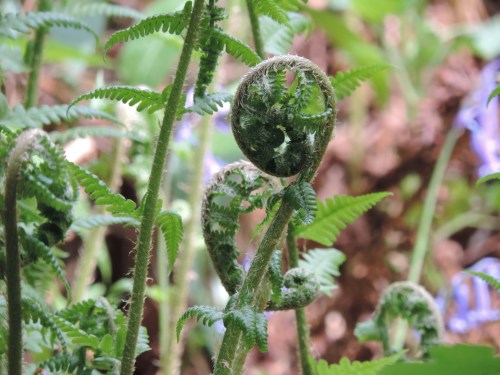
One of the most beautiful shapes in the universe is the spiral. From the spirals of galaxies to the double helix spiral of DNA, and so, from the largest scale to the smallest, there are spirals.
One of the commonest places to see them around you is where ferns grow. I love those spiral shapes you see as a fern unfurls.
Spirals make me think of the kind of path that life follows.
Clearly life does not follow a straight line. It doesn’t run directly and steadily from birth to death with no curves, pauses, deviations or ramblings.
And although there are many cycles in Nature and in our lives, the life story doesn’t follow a circular path either. Although sometimes it feels that way when you have one of those “How did I end up HERE again?” moments. When we don’t learn, when we try to solve our problems using the same solutions which brought those problems about in the first place, it often doesn’t go so well, or, at least, not so differently.
It seems to me that life is more spiral in character, and that, yes, we revisit unresolved issues, unhealed traumas, and unsolved problems repeatedly until we resolve them, solve them, until we heal. But each time around when we revisit something, when life throws up what seems like the same challenge yet again, it’s different. We are different. Because we change all the time. Every experience we have changes us, contributes to our memories, influences our choices and our actions, creates new behaviours, thoughts and habits. So when we hit that “How did I end up HERE again?” we are not exactly “HERE” again!
That always gives me hope.
We have a chance to respond differently this time, to make a different choice, and maybe set off along a brand new path…..another path with its own new spirals to come.
But here’s the thing about that fern in this photo – is it spiralling or un-spiralling? Is there even a word “un-spiralling”? I think instead of “unfurling” because that’s what it seems to be doing. It’s unfolding, opening up, stretching out, expanding. But, hey, I guess that’s a kind of un-spiralling…..something to learn from that I think!
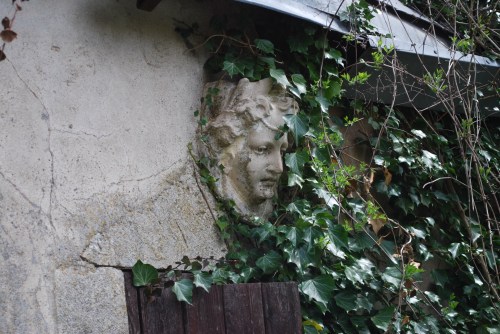
This always makes me smile, and wonder. It’s a sculpture of a human head and it’s built into the wall of a house, just above the door. I came across it in a beautiful, old village in the South of France.
I don’t know anything of the history of this but it sure gets me wondering…..who is this supposed to represent? Was it the person who lived here when the house was built? Was it someone famous or important from the village? Or was it created as a representation of a mythical person….a god, an angel, or….well, I’m never going to know.
The fact that I’m never going to know partly bugs me. I have had insatiable curiosity as a major personality characteristic since I was a young boy. So there is a frustration there. But, on the other hand, it doesn’t bother me, because it means I can engage with it, as I find it, clear of any complications from its past.
We do that all the time. There are works of art, buildings, geographical features which make an impact on us every time we encounter them. Some of those impacts are layered with story, personal stories as well as those from history. But there are others where we come upon them with a “beginners mind” – where we can open our hearts and our attention and just note what arises.
Taking this second approach, I start with the expression on this face. At first glance this person looks sad. Their eyes seem somewhat downcast, gazing to the side and down towards some point on the ground a few metres away perhaps. Along with the gaze, the mouth seems a touch downturned too, the lips just slightly parted, conveying a kind of displeasure or even disgust to me. They don’t seem very happy. And I think, well, no wonder, really, look how this vine has grown up over their face. They seem somewhat neglected.
But the next thing I notice is their fine features. This is quite a beautiful face. Maybe that curl of the lips is more the beginning of a smile, than an expression of weary displeasure? Then I notice the string of pearls on the person’s forehead and I realise this is a more sophisticated, perhaps more noble a person than I had first thought. Look at their hair, and what’s that on their head? A hat? Is there a bird on their hat?? I think I’ve convinced myself now that there is a small bird sitting amongst the person’s curls, right at the edge of their hat.
So, now I return to the vine, which has been allowed to grow naturally I think, to find its own way….or did someone train it up around the head? It looks natural to me. And so when I bring the bird into the picture with the vine, this face takes on an appearance of an Earth Goddess now. Is that a step too far?
Well, what would it be like to see the almost smiling (I’m pretty much convinced now that this is an incipient smile on their lips, not an expression of displeasure after all), face of an Earth goddess, welcoming you home every time you walked up to your front door?
Here’s my final thought on this……whoever carved this face literally set an expression in stone. It doesn’t change any more…even if my impression of it changes. My granny used to say “Be careful the wind doesn’t change!” if I ever showed an unhappy, grumpy or fed up face. She said that if the wind changes then your expression would be fixed forever. Strange old saying that…..because the wind changes a lot! But behind it was some teaching that your habits of expression could come to shape the way the world sees you, and the way you see the world.
I don’t really see anything in a fixed way any more. I think everything constantly changes. And I think that, every one of us brings our memories and our imaginations to engage with the present moment, whatever it holds, making each and every day unique….unique for me, and unique for you.
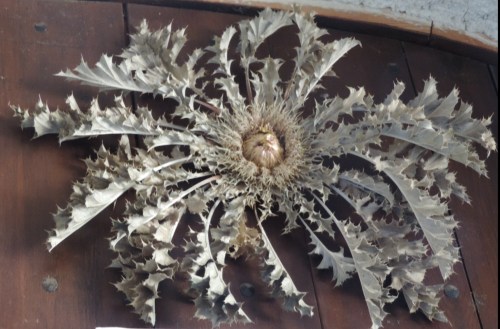
In one of my most favourite villages in France, Saint-Guilhem-le-Desert, there are two natural objects hanging on doors, above doors, and on walls, throughout the whole village. This is one of them. It’s a “cardabelle”.
A cardabelle is a kind of thistle which grows abundantly in this area.
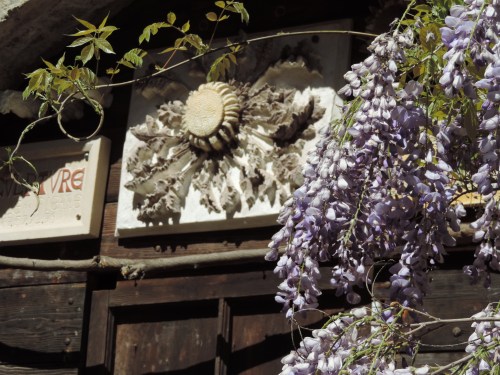
Mostly you see dried specimens pinned to doors, but in some places there are copies sculpted in stone.
The other natural object you find is…..
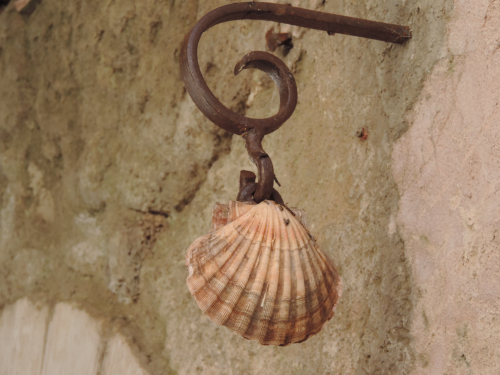
….the scallop shell.
Why these two objects?
Well, the cardabelle is thought to be a good luck token. I suppose in a similar way to the horseshoe you see in some other cultures. It’s also been used traditionally to make predictions……about the weather! That’s partly because it changes shape according to the humidity levels and atmospheric pressure, so it acts a bit like a natural barometer. I’m told it’s also eaten and tastes a bit like an artichoke (not my favourite vegetable!). But I think its utility is a lot less significant than its power to give meaning. It changes life through the power of symbol.
The scallop shell is the symbol of the pilgrim. Specifically, the pilgrim making his or her way along the “Camino de Santiago”, or, in French, “Chemin de Compostelle”. It is used along these paths to indicate some support for, or welcome to, any passing pilgrims. The photo above indicates drinking water (“eau potable” in French, which is worth remembering if you are thirsty while walking in France!). It is also hung outside certain inns and hostels for the pilgrims to find something to eat or somewhere to rest for the night. I hadn’t realised just what an extensive network of paths make up the “Camino de Santiago”.
What really interests me about the cardabelle and the scallop shell is that both are transformed from their original, natural purpose in the world by this distinctly human capacity to make one thing represent another.
They both become powerful symbols. Symbols of place, of belonging, of tradition, of belief, and of purpose. There are a million stories connected to them.
How are we to understand this? I think symbolic thought, metaphoric thought, represented by objects, artistic creations, words and stories, are a kind of invisible, global network connecting us all. They are part of Jung’s “collective unconscious” drawing from our archetypes and myths. They are part of Teilhard de Chardin’s “no-osphere”, that extra layer of atmosphere encompassing the Earth, composed of human reason and thought. They are a world wide web of deep, complex, living and growing sense-making and meaning-giving phenomena which we can draw on to make more sense of our individual lives.
I love this power we humans have – the power to create this vast uniquely “human layer” of existence which is embedded in, and emerges from, the natural world, deepening and widening our experiences and understanding. It’s a shared phenomenon, a collective effort stretching back over centuries and we are adding to it every day, drawing from it every day, living it every day.
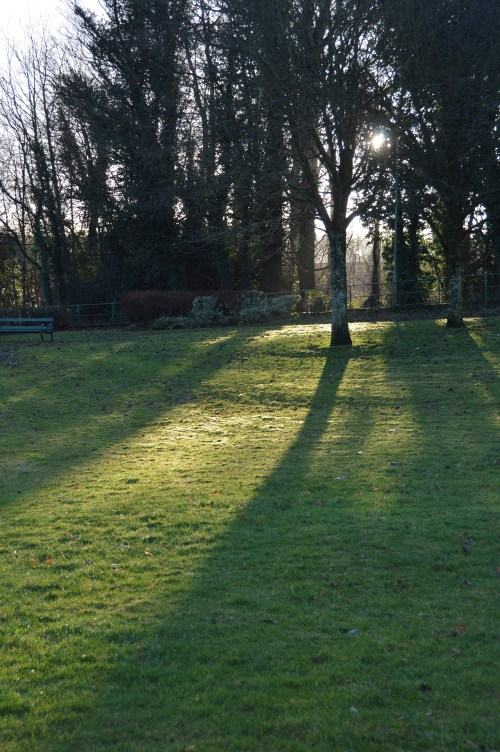
You might think its pretty much just a photo of some grass, so, hold on, let’s look more carefully, and consider the contexts. If it was simply a photo of a patch of grass it wouldn’t be particularly interesting but what caught my eye wasn’t the grass, it was the interplay of shadow and light.
Despite it being noon, the Sun is still pretty low in the sky. Well, it’s taken in the wintertime in Scotland, so that’s normal. But, normal or not, the effect of the low sunlight streaming through the trees is spectacular. The angle of the light makes the shadows SO long and the spaces between the trees show frosted grass sparkling brightly.
I love the forms and the patterns of the shadows, the light, the frost and the grass. It takes all of them together to create the scene.
Here’s another scene –
This is a huge puddle which is there more often than it’s not in this particular field. I once saw swans swimming on it! But today, what makes this image so beautiful is the trees and their reflection. Without the trees, the clarity of the light and the stillness of the water, this just wouldn’t be the same. It has echoes of the previous photo but it’s completely different. However, both photos were taken within minutes of each other, the flooded field lying just a short walk along the road from the shadowed park.
I’m struck by how important the contexts are in these photos. If I’d “abstracted” just one element in each – a grassy patch, a section of the puddle, a single tree – I’d lose all the context. It’s the interplay of all the elements which makes these images more than the sum of their parts.
Life is like that.
When we focus too narrowly, when we consider only a part in isolation, we achieve only a partial understanding. It’s the whole experience, in all it’s contexts and environments, with the story which holds them together, and the remembered subjective experience of being there which makes them so unique, so particular to me.
So, if I am to share any of that with you, I need to show you, and tell you, at least some of the contexts. That way, you’ll come closer to experiencing what I experienced.
That was my everyday working reality. Every single patient who came to see me had a unique story to tell. If I were to understand them I had to hear their story. I had to try to have some experience of their experience, to feel what they were feeling, to know what they knew, if I was to understand, diagnose and help them.
But it’s the same for all of us. If we are to understand anyone, friend, relative, colleague, stranger, we have to hear their story, and try to experience some of their experience.
It’s always partial. It’s never fixed. It’s never completely knowable. But there’s no substitute.
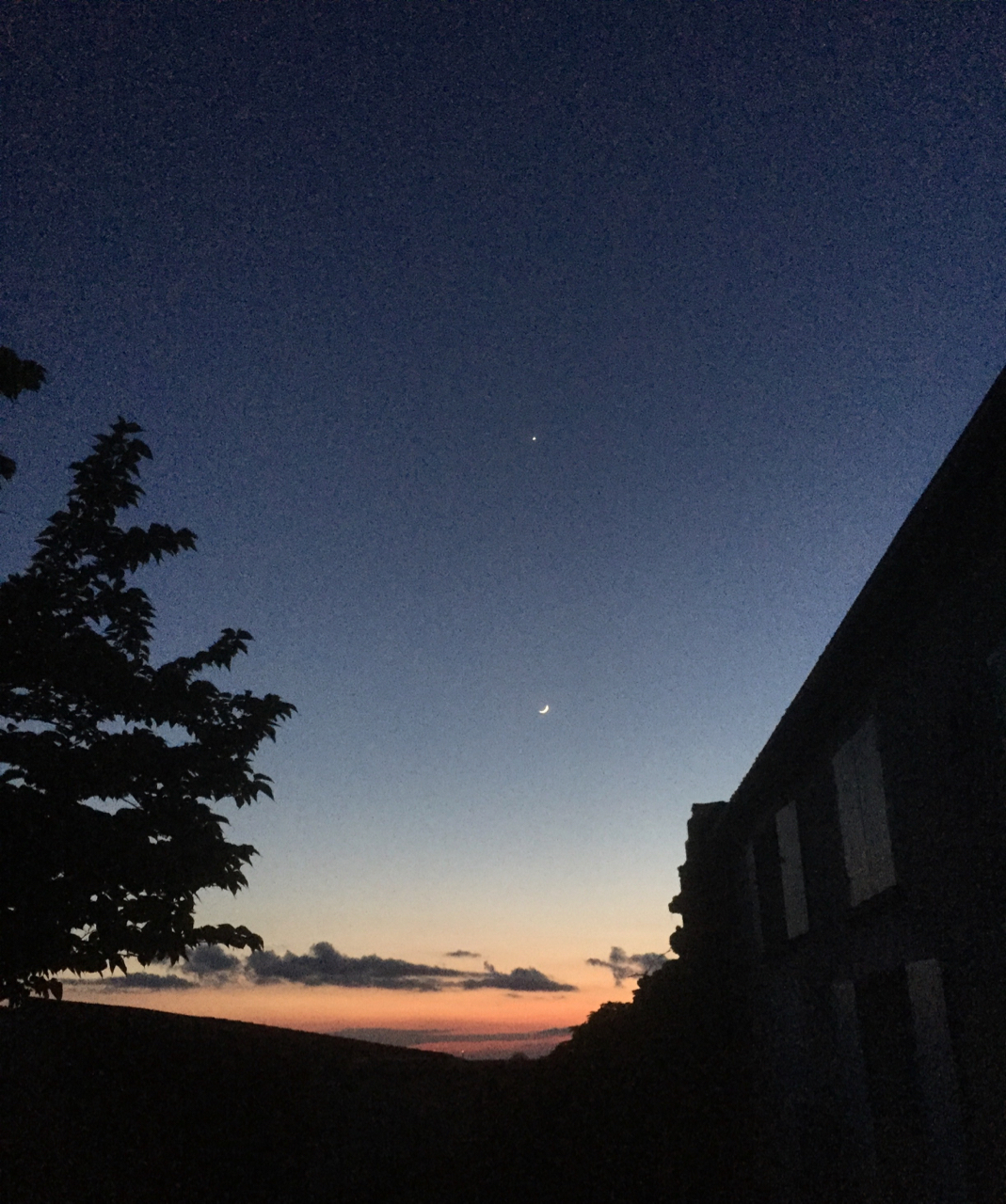
When I stepped out to close the shutters on the windows a couple of nights ago I looked up and saw Venus and the Moon shining so brightly they were almost dazzling. When I looked closely I could see the full black disc of the moon with just a thin silver crescent on the lower right edge. Above the Moon sat Venus, like a queen on her throne.
Both Venus and the Moon are symbolically and mythologically linked with the feminine. And, oh how we need that energy now. Actually, oh how we are seeing the flourishing of that energy now.
Taking a perspective from myth, symbol and spiritual experience, I have always found it helpful to think of two energies, two streams or channels of flow, within each of us at an individual level, within our societies, and, within Life. We call these two forces the masculine and the feminine. I’m not talking about gender or culturally determined social roles for men and women here. I’m thinking instead of something much deeper, something more fundamental.
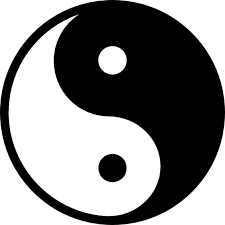
I wear a yin-yang symbol around my neck. I’ve worn it for decades. Although I was born in Scotland and brought up in the Church of Scotland during my childhood years, by the time I was a teen I discovered Buddhism and Taoism. I bet the way I came across those schools of thought is pretty unusual. It was in reading the novels of Jack Kerouac. Books like Dharma Bums and Satori in Paris. I guess we all have our own particular paths and stepping stones which we’ve followed to develop our beliefs and values. I have never called myself a Buddhist or a Taoist but I’ve read a lot of books about these and other Asian philosophies. They are a constant source of inspiration for me.
Probably the single most powerful and useful concept I learned in those readings was idea of yin and yang. The feminine yin and the masculine yang, sometimes referred to the receptive and the active principles. I don’t intend exploring these ideas in detail here but when I look up at the Moon like this I immediately think of the yin-yang symbol.
Interestingly, when I looked up a couple of night ago and saw what I’ve photographed in that image at the start of this post, I saw vastly more yin than yang.
That seems appropriate. I see signs of a strengthening feminine energy all around.
I’m sure there are whole books exploring these two forces but one simple version which I’ve found helpful is to think of the male energy as “provide and protect”, and the female as “nurture and nourish”. Remember, I’m not talking gender or gender-based social roles here. I think these two forces exist in all of us and an imbalance produces illness and dysfunction at both the levels of the individual and of society.
In the UK Thursdays at 8pm have become the time for people to get to their window or front door and “Clap for the Carers”. This is an astonishing new level of recognition and collective expression of support and gratitude. It’s not only happening in the UK. It’s happening around the world. And it extends out from front-line nursing, medical and care staff to all kinds of workers who are now seen as “essential” – all the people without whose daily efforts society would collapse. I saw a photo online today of someone’s garden gate in a French town. The person living there had made a variety of posters, covered them in plastic to protect them and pinned them up on their gate post. One said thank you to the refuse collectors. One said thank you to all the health workers. One said thank you to the postie.
I’m seeing those sentiments expressed every day now. I’m seeing and hearing people say thank you to others every day now. Saying thank you and declaring support. Showing appreciation. How ironic, you might think, given how under-valued these very jobs are. Often they are poorly paid with precarious job contracts and work which is under-resourced. If there is one sliver of silver lining (like at the edge of that moon up in the sky just now) then I hope its a re-evaluation of what is important in society and how we resource and reward those who make life possible.
How often are women the ones who are the carers – both from nursing and caring professions, but also in child care, teaching, in nurseries, and on the checkouts in the supermarkets? This is a strong feminine energy and these new “heroes” we are asked to clap for, are more often “heroines”!
Of course, there are many, many men who are doing essential jobs too, from the refuse-collectors to the lorry drivers, delivery men, farmers, emergency services and those who keep the power supplies and communication systems flowing. Employment and work activity is too gendered. Are we ready to recognise that more clearly?
There’s much to think about and discuss about the economics of work and social life, and I do really hope this pandemic is shining a light on the dysfunctions which have made us more vulnerable as well as laying out new paths to follow as we go forward.
I think there is a surge of the yin – we are seeing an increased emphasis on the importance of relationships, of caring and of collaboration.
Can that surge flourish? Can it change the landscape? Can it move us away from acquisition, consumption and competition? Can we build a new world by pouring our energies and resources into nurturing and nourishing…not just bodies, but minds and spirits too?
This little chameleon hugging the stalks of grass wasn’t easy to see. From the distance he was, to all intents, invisible. He’s designed to have that as his core quality.
We think of chameleons as creatures which are brilliantly camouflaged. Their colouring perfectly matched to their surroundings.
Many of we humans have that tendency too. We like to “blend in”. We like to be “one of the crowd”. Even in the earliest years of school, children will pick out the one who is different. And, often, that’s not a good thing. They’ll be singled out for insults or blows.
There’s a message there – it doesn’t pay to be different.
Conform! Keep your head down! Don’t attract attention!
There is a tendency in human communities to demonise “the other”. A new inhabitant might be treated as “an outsider”, or “an in-comer”. “You ain’t from round here, are you?” The more different they are, the more they are likely to arouse suspicion and prejudice.
It’s not very appealing, is it?
But this little chameleon….he’s pretty appealing, isn’t he? Clearly there is something potentially valuable in the strategy of blending in, and hiding, of not getting noticed.
There’s a safety in being “normal”, “one of the crowd”.
But it’s not enough, is it?
We need quite the opposite.
From the moment a baby is born they demonstrate their core skill – attracting attention! They scream and yell when they are hungry, when they are thirsty, when they are uncomfortable and when they want company. Failing to attract attention would be fatal. Literally.
None of us want to be ignored or passed by. None of us want to be unseen and unheard. Well, most of us don’t, anyway.
There are many paradoxes at the heart of being human and this is one of the biggest ones – how do I fit in, or belong, and at the same time, get noticed (at very least to avoid being neglected)?
There’s no one right way here is there? It’s not a binary choice. We need both.
As I became aware of paradoxes like these I developed a mantra – “And not or”.
That has become my core mantra. It’s a perspective of understanding, of tolerance, and of humility. It lets me open up to the views, beliefs and values of others. It allows me to avoid opting for reductionism and simplicism. I prefer to explore the whole, and the complex.
It’s NOT about “having your cake and eating it”. We have to make choices. But it does mean accepting that every decision should be made as best I can at the moment when I make it, knowing that, pretty quickly, things will change, my understanding and knowledge will change, and I might need to make a different decision next time, in the light of all that.
It means nothing is fixed in stone. Everything is fluid and uncertain. Does that scare you? Does that offend you, even?
And not or.
Can I suggest you just explore it? Play with it? Try it out? See if it helps you to navigate the world better than the binary, good/bad, right/wrong, abstracted and reductionist approach does. I find it’s more human.
But, seriously, explore it. That’s what I’m doing. And I would love to hear your experiences and thoughts about it.
Comments on this blog are “fully moderated”. That means I need to deliberately share them to make them public, so you can send me a comment, and tell me you don’t want it made public, and I’ll respect your wish. We can have a conversation privately. In fact, if you would like to start a conversation with me about anything on this blog, just comment on one of the posts, asking me to get in touch, and including your email address. I’ll reply from mine, and I won’t publish your comment or your address.
See, I welcome comments which people want to share with each other. I’ll publish those. But I also welcome personal conversations. I won’t publish those. And not or!
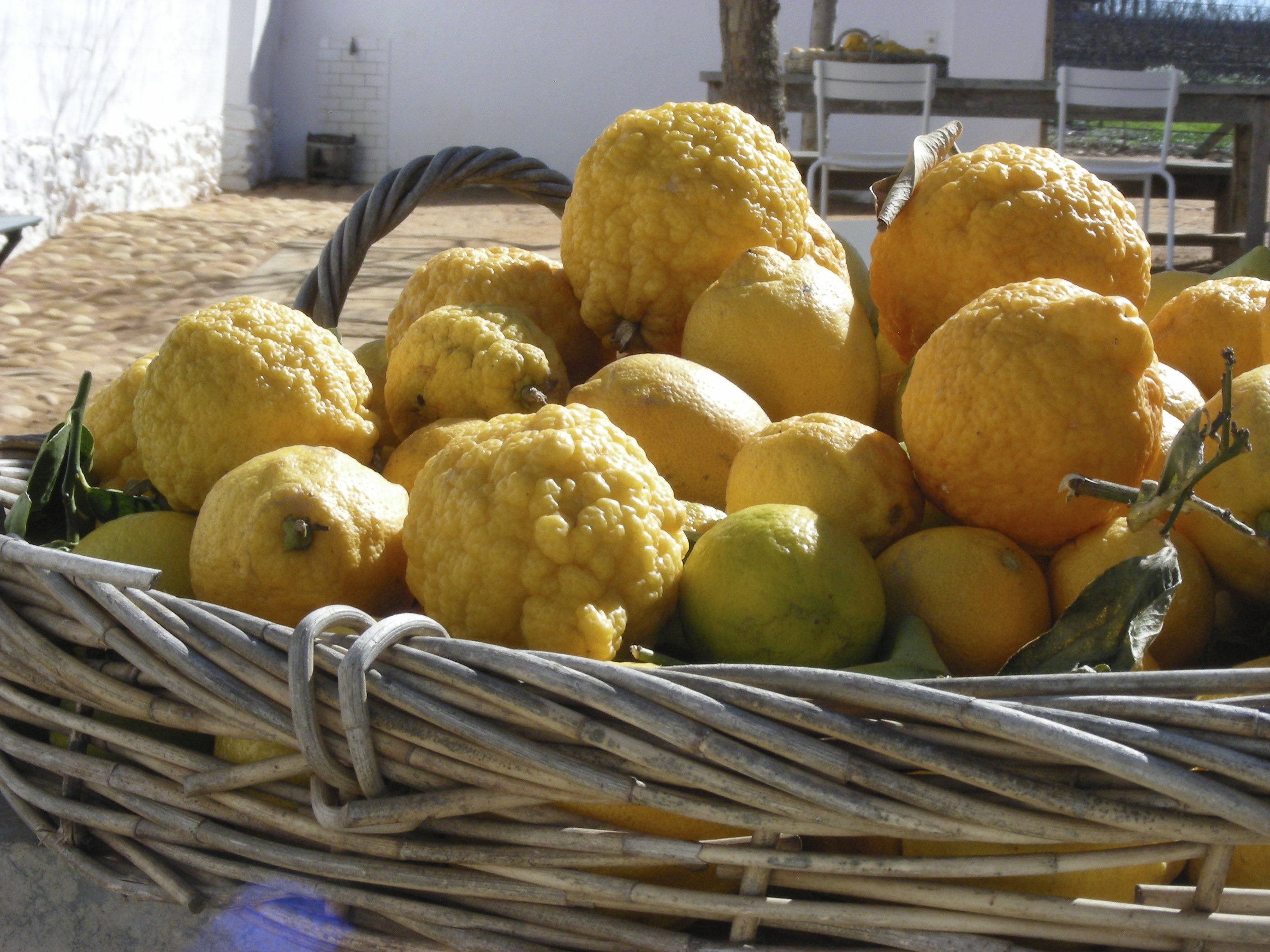
Do you think some of them look lumpy and ugly? Does it bother you that some of them are really small, and others really big?
I think they look beautiful. I love their diversity. The fact that some are very nobbly whilst others are smooth fascinates me. I love the shades of yellow and green in their skins. I adore seeing the small ones cradled amongst the large ones. I’m fascinated by their shapes.
In this one basket you can see that every single lemon is unique.
It’s harder to see uniqueness if the producer, or merchant, sets standards with a narrow range, stipulating limits on the degree of diversity he will accept.
The practice of setting “norms”, “standards” and narrow expectations tends to obscure uniqueness, but uniqueness is still the essence of reality.
Diversity reveals uniqueness to us.
It shows us that every single lemon, every single flower, every single creature, every single human being is unique. Each one comes to life at a particular time in a specific place. Each one has its own unique experiences as it grows….experiences differences in weather, climate, interaction with other forms of life.
I think we humans have obscured the fact of uniqueness in two ways.
Firstly, through “mass” anything….from mass production to mass consumption. A focus on the mass blinds us to uniqueness.
Secondly, we tend to confuse “individuality” with “uniqueness”.
We all want to be treated as individuals, don’t we? I know I do. But a focus on individuality carries a danger of fragmentation. It separates us. Mary Midgely, the English philosopher wrote about the phenomenon of “atomisation” very well. She warned of the dangers of failing to the see the whole when we examined something only in its parts, or its “atoms”. And, in particular, she objected to the neoliberal idea that there is no such thing as society, that the best way to structure a society is for everyone to pursue their own selfish interests in a free marketplace. Those ideas have destroyed communities.
I don’t want to be “just an example of a group”. I don’t want to be treated as “just a number”, as a statistic. I want to be seen, known and treated as an individual. How do I square that circle? By focusing on uniqueness.
Our individuality is often defined by listing our differences from others, our separateness from others.
But our uniqueness combines our differences with our commonalities.
How so?
“No man is an island”
I don’t exist separate from something called Nature. I don’t exist apart from something called The Earth. I don’t exist disconnected from other human beings. I don’t exist separate from other forms of Life.
It’s taken the universe 14 billion years to make YOU. It’s never created YOU before. It will never create YOU again.
“Be yourself, everyone else it taken”
When you meet someone, when you make a new friend, when you get together with your family, you tell your story. You tell the story of where and when you were born, of the events and experiences of your life and how they shaped you.
That story is unique.
Just like everybody else’s.
It’s the circumstances, the contexts, the environments, the specifics of time, place, and experience which create our uniqueness, and the uniqueness of our story.
As a doctor, nothing gave me greater delight than to have the privilege of hearing unique human stories every single day of my work.
I welcome constructive criticism and suggestions. I will not, however, tolerate abuse, rudeness or negativity, whether it is directed at me or other people. It has no place here. ANYONE making nasty comments will be banned.








 Heroes Not Zombies