Feeds:
Posts
Comments

Archive for the ‘neuroscience’ Category

pink

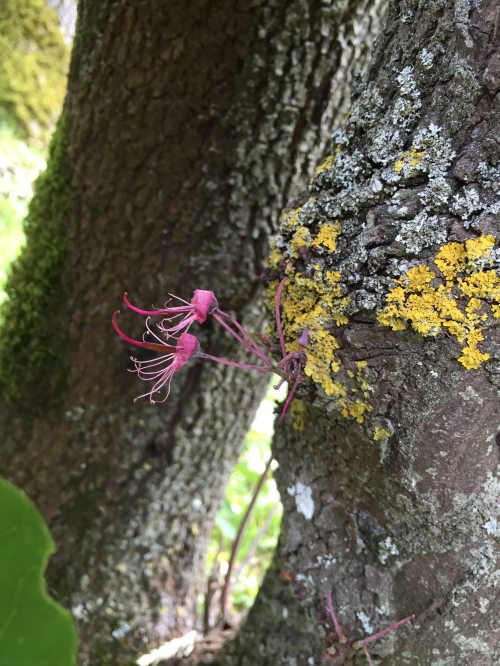
As I walked between the trees at the side of the Charente in Jarnac this caught my eye.

I don’t think it was only the pink and yellow colours together which grabbed me. It was the surprise at seeing this delicate flower growing right out of the trunk of the tree. Now, I’m not a botanist, just someone who is insatiably curious, so I don’t know what this flowering plant is. But I’m pretty sure it isn’t a usual part of the tree it’s growing from. There weren’t any other flowers like this further up the tree.

As usual, an image like this sparks a few trains of thought.

How do we notice what we notice?

Difference.

Isn’t it usually difference which catches our attention?

One of the commonest kinds of difference which we notice is movement. By definition, motion is difference. It’s a change of place in time. It’s the flight of the barn owl from my house to my neighbour’s barn. It’s bats flying round and round the garden at dusk. It’s the sudden appearance of light and shadows as the sun appears from behind a cloud.

Another common difference to catch our attention is sound. Any sudden new sound. The wailing of a siren in a city street, the alarm call of a blackbird which has just spotted a cat, the distant church bells striking noon. The sounds we don’t hear are those which are constant. We only notice them when they stop.

What’s new is different too. We’ve got two cerebral hemispheres, and the right one, in particular, is wired to seek out whatever is new. The left might seek the familiar, but the right is attracted to novelty.

So maybe that’s another reason I noticed this strange and beautiful pink flower growing out of the tree trunk. I’d never seen anything exactly like it before.

Not least because I don’t know what this flower is, I don’t know what the nature of the relationship is between the flower and the tree. Is it parasitical? Is the flower gaining something from the tree, but not contributing anything? Or is it commensal, with both the flower and the tree benefitting from the relationship?

One of the keys to creative development and growth is integration. Integration can be defined as “the creation of mutually beneficial relationships between well differentiated parts”. In other words, it’s when there is a bond, a good, healthy, mutually supportive bond, between two very different organisms or objects.

I’d like to think this image represents that. It certainly increases my awareness of such an idea.

Integration isn’t just about the relationship of course. It’s about the well differentiated parts as well. And that brings me back to the idea of difference.

When we are surrounded by attempts to force us into pre-determined moulds, by monocultures of chain stores and pressures to conform, it can be hard to express our differences in a positive way. There’s so much fear these days of “the other”, of strangers, immigrants, of other races, other genders…….

How different might the world be if we pursued integration instead…..by not only tolerating, but celebrating difference, and finding ways to create mutually beneficial relationships between them?

Might be beautiful. Might be surprising. Might be attention grabbing.

Read Full Post »

I love the places where different elements meet. There’s a magic there. Here are three I saw recently.

Where sun, air, clouds and rain meet the sea…..

rainatsea.jpg

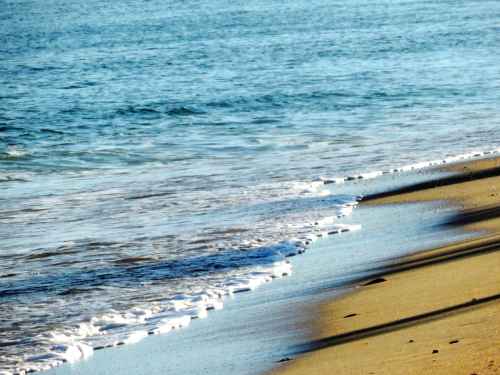
Where the sea meets the land…..

seasand

and where the snow meets the forest and the clouds meet the mountains…

snowline

Iain McGilchrist, in his Master and His Emissary, describes how our right cerebral hemisphere has an approach to the world which focuses on “betweenness”. I think looking out for, and noticing, the meeting points, these boundaries, margins and connections in the world is a great way of activating your right hemisphere.

It’s a good way of just enjoying the sheer beauty of the world too!

Read Full Post »

Iain McGilchrist, in The Master and His Emissary, says we use our two cerebral hemispheres differently. The hemispheres, remember, control the opposite sides of the body, so the right control the left hand, and the left hemisphere control the right. It’s the same with vision where the right field of vision is the responsibility of the left hemisphere and the left field of the right hemisphere. I’m simplifying here, but you get the idea. In birds which have their eyes on the sides of their heads instead of in the front of their faces, each hemisphere controls the opposite eye but the idea is the same.

The right hemisphere supports a broad, vigilant attention. In a bird the left eye, therefore, is taking everything in to be aware of predators.

left eye

See how this duck is looking at me?

They use the left hemisphere to focus the right eye on details….for example, when picking out food.

right eye

There’s something else interesting about the field of view of interest to each hemisphere.

In we humans, the right hemisphere is more interested in what is far from us….

distance

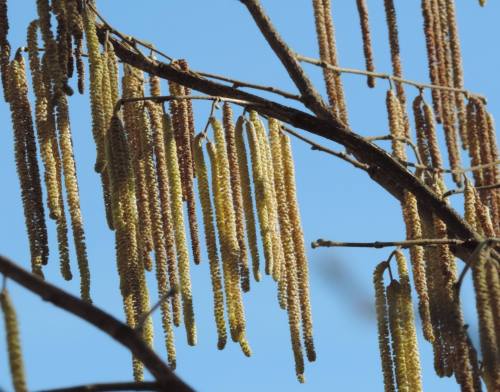
while the left is more interested in what is close up….

catkins


Read Full Post »

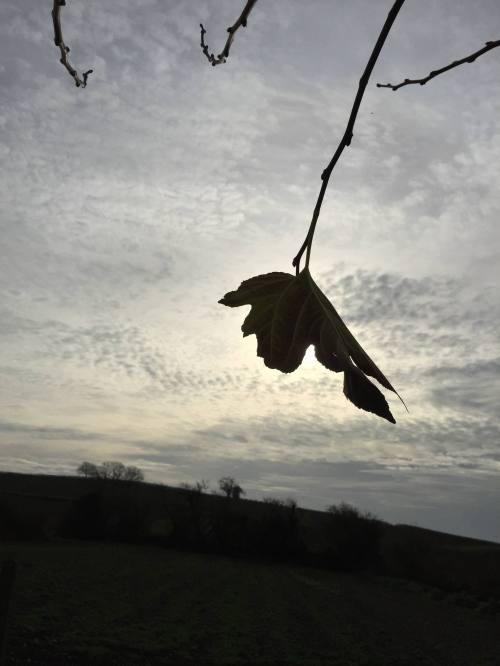
last leaf

There’s a growing body of evidence that using your brain is good for your brain. Who’d have thought it?!

There’s also a growing body of evidence that what is good for your brain is good for you. The old mind-body duality is breaking down in the light of neuroscientific findings about the connections between the brain, the rest of the nervous system, and the rest of the body.

Using your brain is one of the key themes of this blog. I believe it’s just too easy to drift through life in zombie mode, influenced by others, manipulated by others, controlled by others. And yet, I also believe it very, very possible to make our own choices, to become “self-directed”, conscious creators of our own, unique stories and, hence, lives.

One of the most commonly promoted ways to use our brains is “mindfulness“. A sort of clumsy word which describes a certain state of awareness.

You can practice “mindfulness” by learning certain meditation techniques, and/or, you can do what Ellen Langer says, and “seek novelty”. 

I find that choosing to be aware, stoking the natural curiosity for the day, seeking “l’émerveillement du quotidien” is one of the easiest, and most delightful ways, to achieve this – this is the main way I try to be “mindful”.

There are two related techniques which help me to live this way. They both date way back thousands of years but both work just as well here and now.

Here are two photos to illustrate the techniques.

The first one is the one at the start of this post. It’s “the last leaf”. There’s a mulberry tree in my garden here in France and this is my second season of raking up and gathering the leaves as they fall. The first year I arrived here I wasn’t prepared for this phenomenon. This tree really sheds a LOT of leaves. I confess, I found that clearing up the leaves was a bit of a burden. But this year? This second season for me? I’ve loved it. Pretty much every other day I’d take the rake and gather up the leaves into huge canvas bags and every other week I’d make a trip to the “déchetterie” (“the tip”, we’d say in English). I enjoyed taking my time, rummaging through the different shapes, sizes and colours of the leaves. I enjoyed seeing the green grass again once the leaves were gathered, but quickly, of course, the grass would recreate a “wabi sabi” appearance with just two or three newly fallen leaves adding interest and attracting attention.

As more and more of the tree shed its leaves I decided I’d like to photograph the “last leaf”. That’s my first image in this post. And that’s the first technique – “live today as if this is the last” – that’s not as morbid as it first sounds…..due to the constancy of change, every day is unique, and the truth is, you will never have a chance to live this day, exactly like this, ever again. So it might be a good idea to savour it. To notice what you can, to hear what you can hear, touch what you can touch, smell what you can smell, take your time to taste and savour the food you are eating.

Because this will be your last opportunity to do so.

Here’s the next image –

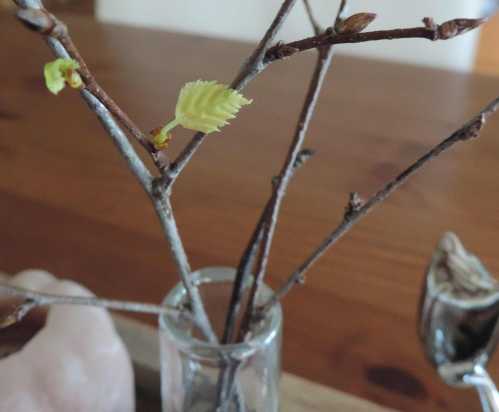
first leaf

We have twin birch trees in this garden, and when the wind blows in the autumn, they shed, not only leaves, but lots of small twigs and branches. Yep, most of these head to the “déchetterie” too, but Hilary picked some up, finding their shapes pleasing and used a couple as a table decoration. There was a little water in the bottom of one of the vases she used, and look what happened! A few days later, there was a new leaf!

So, here’s the second image, “the first leaf”, and the second technique, “live today as if it’s the first”.

That’s true too. Due to the uniqueness of every day, of every experience, of every moment, whatever you encounter today, you encounter for the first time. Sometimes that’s not so obvious. Our habits and our routines deaden our awareness and we become oblivious to the small changes which can make a big difference.

You have never lived this very day before. So why not approach it with the sense of wonder, curiosity and amazement which you did so naturally as a child? (This is “l’émerveillement du quotidien” – the wonder of the every day)

I mean look at that little twig! It’s grown a leaf! A perfect, bright green, little leaf! Isn’t that amazing? I wondered a wee while ago about how difficult it was to know whether a seed was dead or alive, but I didn’t wonder about these (apparently discarded) twigs. They were dead as far as I knew. But add a little water, and, hey presto! Life magically emerges!

If you don’t stumble across something new, something for the first time, today, you’re just not looking.

So, there you go, two photos, two ancient techniques, “last and first”, and a step in the right direction from “zombie to hero“!

Read Full Post »

tele bird

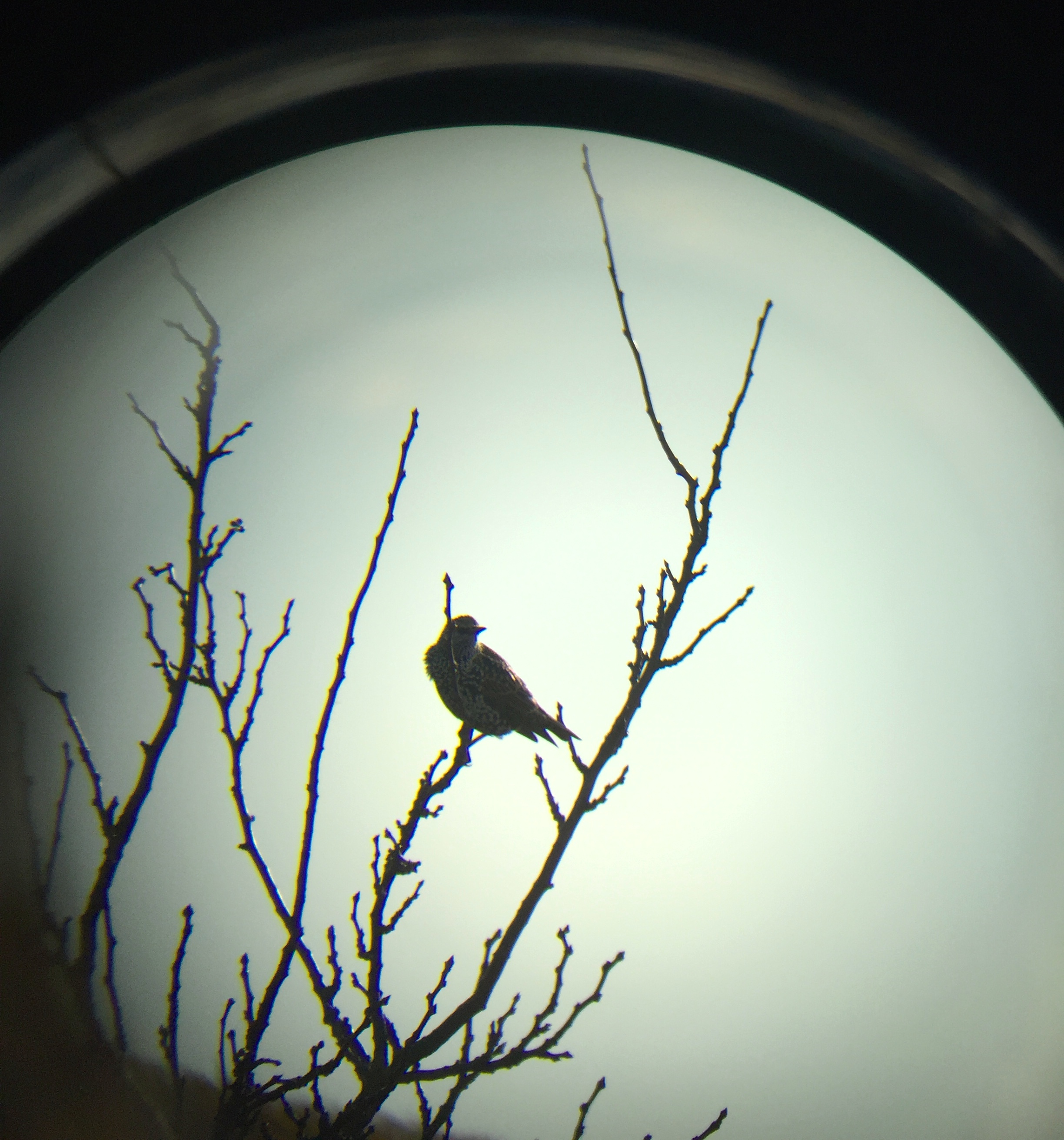
I looked out of my study window yesterday and could see a bird sitting on the tree in the corner of the nearest vineyard. I couldn’t make out much more than it was a bird so I pointed my telescope at it, zoomed in, and saw it clearly. Covered in speckles. A thrush I guess.

Just for fun I held my camera up to the eyepiece of the telescope and got this shot.

I quite like it! It’s got almost a vintage feel to it.

It got me thinking of the way we look at things.

We focus in on parts of reality to try to clarify what we are looking at. We do that all the time. We might focus on certain parts of what we see and hear because they catch our attention, spike our curiosity or whatever. If we weren’t able to do that how could we make sense of our world? Our brains are receiving information from the external world (and at the same time from our inner bodily world) through our senses of sight, hearing, taste, smell and touch. How could we make sense of this information tsunami if we didn’t sift, select, and focus? Our left hemisphere is especially good at doing this. It’s no coincidence that the left hemisphere controls the right hand and that’s the hand most of us use to “grasp” things. That’s what this focus-ability does for us. It helps us to grasp things.

But I think it does something else too. It frames and it excludes. It sets whatever it is we are paying attention to not just centre stage, but often fills the entire stage. I’m not sure it’s helpful to think of these skills are either “good” or “bad”. They just have advantages and disadvantages. The major disadvantage is that this framing removes the object of our attention from its context. So unless we take the results of our grasping and let go off them as we pass them back to the right hemisphere for re-contextualising, then we form incomplete and, actually, imprecise understandings of things.

Funny that, really. You’d think we could be more precise by being more focused. Turns out focus is only part of the process. We need the context too.

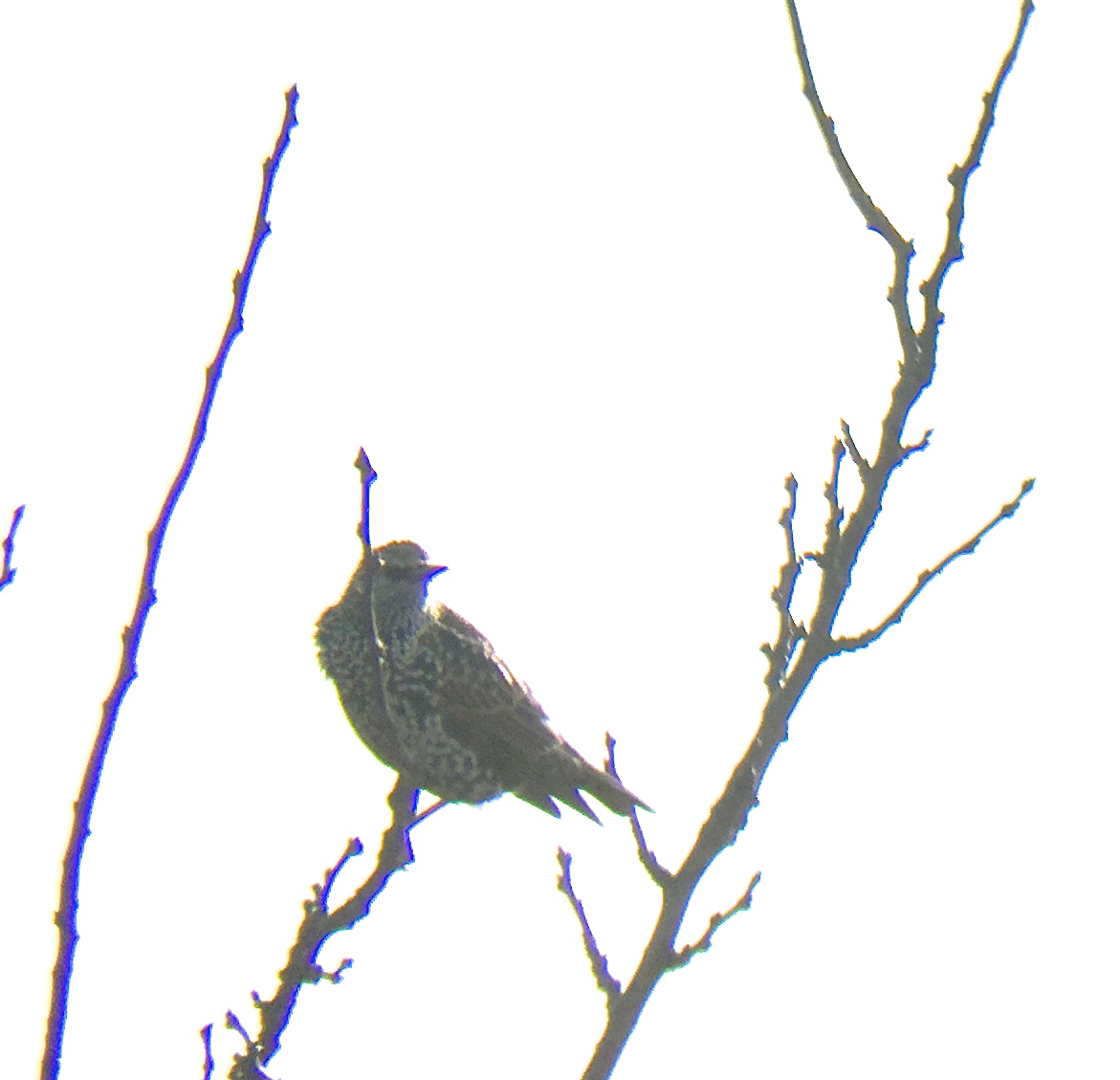
Here’s a crop of that photo above to let you see the thrush a bit more like it was when I put my eye to the telescope.

crop thrush


Read Full Post »

DSCN4508

Over the last few weeks I’ve noticed a number of articles about “hormone disruptors” in the French language newspapers. I’ve not noticed this issue getting much coverage in English language media so I thought I’d share some of it here with you today.

“Hormone disruptors” are chemicals which have the power to affect the “endocrine system” in human beings. The endocrine system is the network of glands and communication channels in the body which produce natural chemicals called “hormones”. Hormones are the key to the regulation of a lot that goes on in the human body. As well as having specific effects on certain tissues, the whole endocrine system is intricately connected to both the nervous system and the immune system. There are even fields of study known as “psychoneuroendocrinology” and “psychoneuroimmunology” to research the connections between these whole body systems.

The first article which caught my eye was the report of a study published in Nature where the researchers had shown that two chemicals in the environment, neither of which had much of a biological effect on human cells, could combine to have a dramatic effect. Figaro described this as the situation where one plus one didn’t equal two, but maybe fifty.

Humans are chronically exposed to multiple exogenous substances, including environmental pollutants, drugs and dietary components. Many of these compounds are suspected to impact human health, and their combination in complex mixtures could exacerbate their harmful effects. Here we demonstrate that a pharmaceutical oestrogen and a persistent organochlorine pesticide, both exhibiting low efficacy when studied separately, cooperatively bind to the pregnane X receptor, leading to synergistic activation. Biophysical analysis shows that each ligand enhances the binding affinity of the other, so the binary mixture induces a substantial biological response at doses at which each chemical individually is inactive.

There are an estimated 150,000 chemicals in the world which are all licensed as safe but have been tested only singly, and not in combination with the others which are found in our environment, and indeed, in our bodies.

At the beginning of October, the International Federation of Obstetrics and Gynaecology (FIGO) published a warning about the effects of all these chemicals which are now routinely found in mothers’ bodies during pregnancy. They said –

Exposure to toxic environmental chemicals during pregnancy and breastfeeding is ubiquitous and is a threat to healthy human reproduction.’’ It cites research showing that virtually all pregnant women bear a chemical burden and that babies are born “pre-polluted”

What problems were these doctors concerned about?

« Miscarriage and fetal loss, impaired fetal growth, congenital malformations, impaired or reduced neurodevelopment and cognitive function, and an increase in cancer, attention problems, ADHD behaviors, and hyperactivity ».

In addition, they referred to other problems which have a hormonal element – obesity, diabetes, infertility, endometriosis and polycystitic ovarian disorder.

Where are all these chemicals coming from?

Hormone (or endocrine) disrupting chemicals (EDCs) are found in food packaging, pesticides, cosmetics and chemical coatings on household products.

Then, this week, in Le Monde, I read an article about the hormone disrupting potential of the chemicals used as fire retardants. A group of researchers at “L’Anses” concluded that

il est plausible que les retardateurs de flamme n’aient eu, en près de quarante ans d’utilisation, qu’une utilité marginale, voire nulle. Les risques, eux, sont bien réels : certains de ces composés sont cancérogènes, perturbateurs endocriniens, toxiques pour la reproduction, persistants ou neurotoxiques. Ou tout cela à la fois.

….in other words there is little evidence that they’ve done much to prevent serious problems from fires, but plenty of evidence to show that the health risks are significant – cancerogenic, hormone disruptors, fertility suppressing and neurotoxic.

Hormones are a key component in the maintenance of human health. As the obstetricians and gynaecologists pointed out disruption of the endocrine system may well be playing a significant role in our modern epidemics. If that’s true then we won’t achieve population health by just trying to persuade individuals to eat less carbohydrates!

Read Full Post »

DSCN4485

One of my favourite podcasts is “onbeing with Krista Tippett”. Recently she interviewed Ellen Langer on the Science of Mindfulness.

Ellen Langer has carried out some really interest research, some of which she mentions in the interview, but I first encountered her work when studying Dan Seigel’s Interpersonal Neurobiology course. Her take on mindfulness is different from that of the more dominant meditation based one.

She says that meditation can be a good form or mindfulness practice but, it’s not necessary.

She says we can go through life either mindfully, or mindlessly.

Doesn’t that seem crystal clear?

I like it, because, for me, it maps directly onto my heroes not zombies. I do think we tend to slip into autopilot, or “zombie mode”. But if we wake up and become aware we can become the conscious authors of our own stories (the ones where we are the main protagonist, the hero)

How do we do that?

How do we wake ourselves up? Jolt ourselves out of autopilot/zombie/mindless mode?

She says – search for the new.

It’s novelty and the search for novelty which creates the mindful state.

And I think she’s right, because to search for the new involves intention and attention. We wake ourselves up first of all by deciding to do so. We live consciously by choosing to live consciously. Then when we are looking and listening out for what is new, different, or changed, then we not only paying attention, but we are paying attention to reality. (Instead of painting over reality with habit)

Try it for yourself.

She says see if you kind find out something new about the next person you speak to.

But what about right now?

Right now, wherever you are. Once you stop reading this, look around you and see if anything is new, if anything has changed since yesterday. Look for what’s new, different or changed.


Read Full Post »

DSCN4446

There are many theories about memory, and as far as I can see, nobody has really got it figured out yet. Probably one of our most common models is a filing cabinet. We have the idea that everything that happens and everything we ever learn is stored away in some drawer inside our brain. When we want to remember it, we just need to go to the right drawer and take it out.

The trouble is, we haven’t been able to find anything remotely like this filing cabinet in the brain. At the neurological level there seem to be many regions of the brain involved in the processes of memory, not just the hippocampus, although that does seem to be very important.

Rupert Sheldrake, in his Science Delusion, proposed an interestingly different model – one of resonance. Briefly, he suggests that memory is stored outside the person and in the universe, so recalling something is more like tuning in to a radio station. Once you hit the right wavelength you have access to the memory.

Henri Bergson had a different theory –

His intriguing theory was that all memory is like the muscle memory that enables the body to recall how to ride a bicycle or to swim. These muscle memories are not stored as representations and, similarly, the mind does not store recollections but in perceiving a situation instantly brings into play the appropriate previous mental responses, just like the body discovering itself on a bike or in the sea. So memory does not wait patiently in some dusty archive but is constantly and urgently pressing forward into perception, to the extent that the characteristic movement of memory is not from present into past but from past into present

In some ways, this is close to the neurological teaching of “what fires together wires together”. Memory, in other words, isn’t like a photographic image, a book, or a film archive. It’s a constantly active process of engaging with the world. It’s not about a file waiting to be found with the help of the right card index. It’s more like the way we learn to use our bodies – to walk, ride a bike or swim. When we do those actions we don’t have to go back into our brain stores and find the manuals!

The memory functions involved in these skills are embodied.

This is a surprisingly holistic model to develop years before we began to uncover the ways in which all of our mental processes are embodied.

One of the enticing aspects of this theory is that all that we have ever done, experienced or learned, is actually ever present, ever “urgently pressing forward into perception” in ways which deeply influence what we perceive, and also, what we do, now.

Of course, I bet some of you are thinking “memory is constantly and urgently pressing forward into perception”? So, why can’t I remember somebody’s name when I think about them? Why do I come back from the shop without some of the things I went to buy?

I don’t think a dynamic, active model of memory means that we have 100% recall. In fact, clearly, that isn’t the case for any of us, and however memory works, it sure doesn’t include the ability to remember every experience and piece of knowledge we have ever encountered. That’s probably for a very good reason.

I suspect it would be impossible to get through life if we didn’t manage to forget, as well as being able to remember……but then, that’s probably the subject of another post!

Read Full Post »

DSCN4404

In Life Lessons from Bergson, Michael Foley writes –

What happens when we fail to live in duration, no longer hear the inner melody and lose touch with the intuitive self? We become frozen, petrified – automatons, slaves of habit or convention or both. 
“Living in duration” is living in the experience of life, being fully present, attentive and aware. The opposite is to live in our inner worlds of representations and labels. Iain McGilchrist describes this brilliantly in his The Emperor and His Emissary, showing how the right hemisphere of our cerebral cortex processes the raw information as we pick it up from the world, then hands off some of it to be re-presented and analysed in the left hemisphere. What should happen next is that the analyses and representations are fed back to the right side to be re-contextualised. McGilchrist makes the point that, sadly, we’ve created a world where we forget the importance of the activities of our right hemispheres, and give primacy to those of the left.
“Hearing our inner melody” is a beautiful phrase. When we experience music we don’t experience it as separate notes and pauses. We experience it as rhythm and melody.
And our “intuitive self”? That deep, natural, heart-focused knowing….
What happens when we lose touch with those things? We get rigid and stuck.
There is no doubt that the pressures to conform in our society are enormous. It seems to me we are becoming less and less tolerant of difference, fearing “others” and suppressing diversity.
Every day we need to freely choose what to do, what to say, and what to think. As Michael Foley says –
Our freedom, in the very movements that affirm it, creates the developing habits that will stifle if it fails to be renewed by constant effort: it is dogged by automatism.
This is the fundamental theme of this blog – we all tend to default into autopilot and in so doing we live in a more limited, and less fully human way – like zombies – with habits and routines and “norms” on loops. Our alternative is to wake up, become aware and consciously choose to become the author of the one unique story in which we are the hero, the protagonist, the main character.
William James, who shared many of the same views as Bergson said
Could the young but realize how soon they will become mere walking bundles of habits, they would give more heed to their conduct while in the plastic state. (Psychology: The Briefer Course, 1892)
My only issue with that statement is I don’t accept we completely lose our “plastic state” – what he means by “plastic” is dynamic, malleable, capable of being changed. Sure, as we become constrained by our habits and automatisms, it becomes harder to change.
But with awareness and will, change is possible!

Read Full Post »

image

Reality no longer appears essentially static, but affirms itself dynamically, as continuity and variation. What was immobile and frozen in our perception is warmed and set in motion.

Those are the words of Henri Bergson, quoted in Michael Foley’s excellent “Life lessons from Bergson”.

I love that. The experience of life as dynamic, “warmed and set in motion”.

Life isn’t “frozen and immobile” to me, and that’s why I am wary of categories and labels. I’ve always resisted being put into a box, defined by one or two of my characteristics. When I think of that I recall the adage of the General Semanticists – “judgement stops thought”. So often fixing someone or something into a category or type stops us from really seeing, really understanding.

Reducing an individual to a type diminishes them in all senses of the word.

Every patient I ever encountered was unique, presenting experiences and stories unique to them. To reduce them to diagnostic categories, or to types of any sort, blocked my understanding of them. Everyone always has more to reveal, more to share, more to experience and be understood.

Michael Foley says he came back to Bergson’s work after dismissing it decades earlier. His way back is interesting. It’s not the same as mine. My first encounter with Bergson came when I was reading Deleuze but I didn’t find him easy. I later stumbled into complexity theory and, in particular, the idea of complex adaptive systems. At that point I remembered some of Bergson’s ideas and went back to explore his writings further. Michael Foley’s path was through his encounter with “process philosophy” and with particle physics –

I learned from twentieth century philosophy of mind that memory and the self are processes rather than fixed entities – and suddenly this connected with the theories of particle physics, which claim that at the heart of matter there are in fact no particles but only processes…….everything is process…and everything is connected to everything else.

In the process view nothing is fixed, nothing is final and no circumstances ever repeat in the same way.

This strikes me as very true. Dan Seigel, one of the founders of Interpersonal Neurobiology, worked with colleagues to come up with a definition of the mind. What they concluded was that ” the mind is a process of regulation of energy and information flow. ”

The mind is not an entity or a thing, it’s a process.

The body is not a fixed entity or thing either – it’s a dynamic ever changing network or community of cells.

Disease is not a thing either. That really startled me when I read that once I was a practising doctor. As a medical student I picked up the view that disease was pathology and pathology was the changed organs or cells. Once I became a GP I encountered dynamic, hard to pin down illnesses that certainly couldn’t be reduced to pathological entities. Hearing that disease was a process not an entity was liberating for me.

I will return to some of the issues raised by this thinking in other posts but let me finish this one by returning to the title, because once we gain the insight which shifts our attention from entities to processes we discover diversity – we find out that variation is a key characteristic of Nature and of Life. But I think we find out something else too – that the universe, the world, and our lives are not completely random, chance, accidental phenomena. Instead there is continuity. We are in a process of continuous creation and emergence. We are who we are in our networks of family, nature, society and the world. We emerge from the past, as the past encounters and interacts with the present. Our future doesn’t contain just anything you could ever imagine. It emerges from here and now, from that flowing river of life and connections.

Continuity and variation. Just like the flow of a river. Just like the natural history of a plant, an animal, or any other living organism.

Read Full Post »

« Newer Posts - Older Posts »