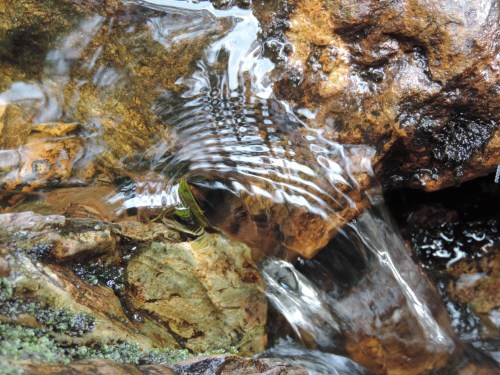
This photo of water flowing over rocks in a Highland stream transfixed me the first time I saw it, and it’s lost none of it power.
When you watch water pouring down over, around, and between rocks in a stream or a river, you can see how the water itself is shaped by the rocks and the earth which create its edges (the banks of the river). If you look carefully you can often see that there is an ongoing lengthy relationship between the water and the rocks. It’s not just that the rocks make obstacles which the water has to flow around. You can see that as the water flows over the rocks, it shapes them.
However, what you see in this photograph is an additional dimension. You don’t just see that the rocks are making the follow a particular path. You can see that the surface of the water itself is shaped. Those bands, or ridges, look waves spreading over the surface of the water, except you wouldn’t expect to see waves in a stream or river as it pours down a rocky hillside. Where do they come? Maybe it’s something to do with the rocks on the river bed, or the rocks within the river itself, but it looks like something different. It looks like this pattern, this shape, emerges from within the water itself. As if it looks this way because of some influence within the water.
So, this photo always makes me think of that. It makes me think of how each of us is shaped by external structures, and the environments in which we live – by which I mean the physical, social, and cultural environments at least. But how we are also shaped by our constantly evolving inner structures and environments……our memories, imaginings, thoughts and ideas, as well as our physical bodies and all the cells, tissues and organs which lie hidden inside.
Who we are, what we are like, what we look like to others, what our characteristics are, are all shaped, are all constantly being shaped, by an alchemical mix of the external and the internal, of the visible and the invisible.
In most countries the response to the Coronavirus pandemic has been to enact a lockdown. In France, it’s called “Confinement”. The same word used in English generally refers to imprisonment, but in Obstetrics it has another meaning related to the time between labour commencing and the baby arriving. Both of those situations come with quite a degree of stress!
Many people have found the restrictions tough but as long as they were in place then a kind of predictability began to emerge. In fact, each day could seem so similar to the previous day that sometimes it could be hard to work out exactly which day of the week it was. I’ve no doubt these lockdowns have produced their own particular stresses.
However, pretty much everywhere, the lockdown is ending (in France we have moved into “De-confinement”). The restrictions are being lifted in varied ways at different speeds. Because I live in France and would like to visit family in Scotland, I have to keep up with three sets of rules – those in France, those in the UK, and those specific to Scotland. Week by week that’s getting harder and more confusing. This period of lockdown easing has, in turn, its own, particular stresses. Not least because the rules keep changing now.
In addition to the stresses induced by trying to factor in different regulations in order to make future plans, I’m hearing an increasing number of people say that although they are now allowed to leave their home, they are too afraid to do so. On top of that, when you do venture out, what with all the perspex panels, instruction signs, brightly taped lines on the ground to stand behind or to follow, wearing masks, standing in long spaced-out queues (I don’t mean spaced-out in a drugged way!), and trying to maintain distance from everyone else…..well, it sure doesn’t feel like it used to do. It all takes some of the pleasure away. It all produces a sense of un-ease.
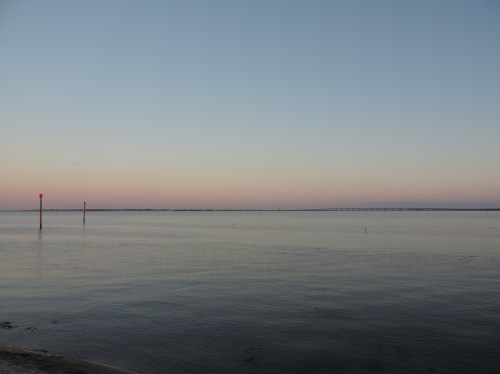
So, I thought today might be a good day to share a calming image. I’ve seen people sharing calming images on social media but I must say I don’t often find them very calming. I guess we all find different scenes calming. However, here’s one that works for me.
Take a wee while to yourself and gaze at this scene. Look at the wide and extensive calm water, stretching to every edge of the scene and beyond. See the red guide markers on the left, subtly guiding any boats to or from the shore. Look into the distance and see the long flat bridge, connecting the mainland on the left, to an island on the right (take that from me, you can’t see that you are standing on an island looking out at the sea from here) . Then notice the colours, the deep blue of the sky at the top of the scene fading into the pink from the last light of the sun which has just this moment set below the horizon. See the light blues in the sky just above the band of pink, and the similar light blues in the sea just in front of the bridge, and notice how the blues become darker and richer as the water reaches the shore just in front of you.
I find this scene wonderfully calming and peaceful. I hope you do too.
Do you have any photos on your phone, your pad, or your computer, which you can turn to, to absorb your attention in the beauty of this world we live in?
I am very attracted to liminal spaces…..the zones of change, the places where the boundaries dissolve, the areas where the elements mingle at their far edges creating new, different and unique phenomena.
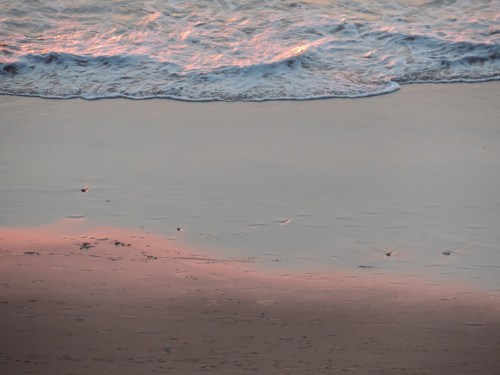
One of my most favourite such space is the shore line. That magical rhythm of the sea dissolving on the sand as the big waves turn to foam and flatten themselves out as they land on the beach, followed by a rush of water, sand and pebbles as the closest waves to dry land retreat speedily back into the sea again.
On this one particular evening an extra layer of “liminal” came into play, as the light turned pink and tinted both the sea and the sand with the colours of a setting sun.
So, simultaneously, in both the dimensions of space and time, that liminal zone emerged….that place of wet sand, not quite beach any more, but not yet wholly ocean yet. And that time of the day, not quite daytime any more, but not wholly night yet.
It makes me tingle just to remember it.
These phenomena of borders, of liminal spaces, of junctions and transitions….they all appear in the “between-ness”. That means they all share that characteristic of revealing connections, influences, bonds and relationships. Whilst the left hemisphere of the brain is so brilliant at selectively focusing on parts, analysing them, classifying them and categorising them, it’s the right hemisphere which sees the “between-ness” and in so doing reveals the singular, the unique, relationships and connections, and, so, the “whole”.
I think it’s good to stimulate your right hemisphere with these experiences. If we are to re-balance the influences of the two hemispheres and move towards more human, more humane, more holistic values, the more we can develop our right hemisphere powers the better!
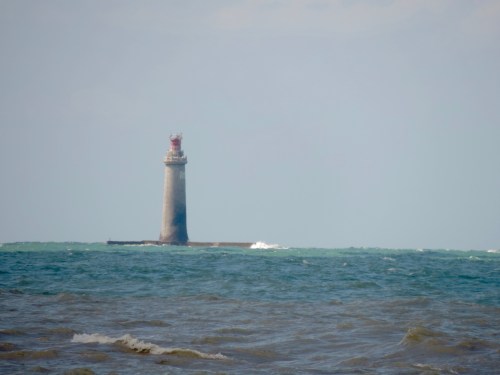
Lighthouses are fascinating aren’t they? It really felt as if we had lost something when they all went automatic and the lighthouse keepers disappeared. Well, maybe there are still lighthouse keepers who look after the lighthouses but they don’t live in them any more. Putting aside the questions about what kind of life that was lighthouses make me think about the significance of light.
I mean, lighthouses were never intended to be giant torches lighting up the night sea so a sailor could see where he was going! They are warnings. They say “Beware! There are dangerous waters around here!” They also acted as navigation points. My maternal grandfather was born on the island of South Ronaldsay, in a little croft. From his house he could see nine lighthouses at night. I remember trying to count them when I visited there as a young boy.
In a very real sense the purpose of the light from the lighthouse was to convey information. This is something very human. I think of us as vibrant, living creatures embedded in constant flows of materials, energy and information. The materials bit is perhaps the most obvious. We ingest and inspire molecules from the environment, process them inside our bodies then expel them back into the environment. What we can’t see are the energy flows, but we are aware of some of them because we have sensory cells to pick them up. We see light, we hear sound, we feel heat and cold…and so on.
Information is something of yet a third quality. It wouldn’t exist without our bodies and brains to process the other two flows. So when we see the light of the lighthouse we don’t just see light, we interpret it. It tells us something.
In the case of the light from the lighthouse this is still quite a utilitarian phenomenon. We USE the it to guide us, or to orientate ourselves. But we interpret everything, and we surely don’t reduce all information to the level of utility.
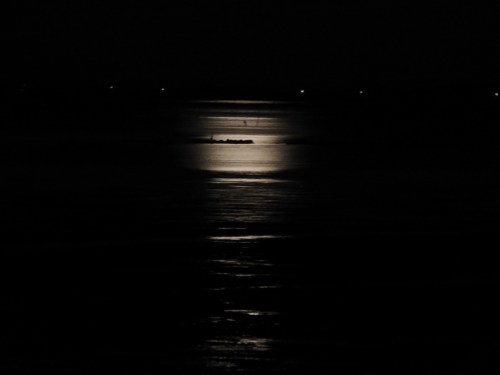
This is moonlight on water.
On this particular night (a 14th of July) there was a full moon so the intensity of the light was great. You could actually see objects illuminated by it. But that wasn’t its attraction.
Moonlight on water is beautiful to us. It’s romantic, perhaps. It’s inspiring, even. Maybe it makes us think of Venus, the Goddess of love and beauty. Maybe it stirs our memories and our imagination to inspire certain emotions. Looking at the moonlight can induce feeling.
Moonlight, it seems to me, isn’t primarily a practical light. It’s purpose, if I could call it that, is more to inspire reflection. And that’s especially interesting, isn’t it? Because moonlight IS reflected light.
Do you see what happened here? I started with a light which I claimed was primarily practical, then went on to consider a light which was primarily inspirational. But if you go back and read the beginning of this piece again, you’ll see that much of what I wrote about the lighthouses came from my memory and my imagination. It inspired wonder. It generated feelings.
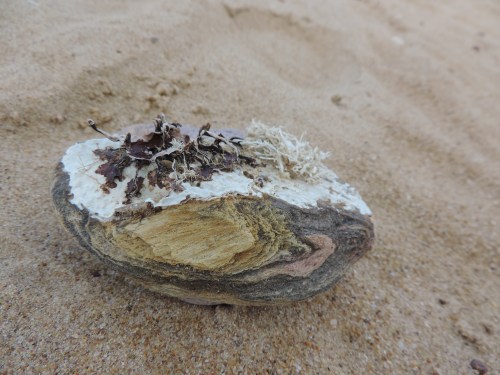
When I noticed this stone on the beach I was entranced. It looks like a whole small world. Look at the layers of minerals, their colours, their extent and shape. Look at the top of the stone with several species of lichen and/or seaweeds living there.
It makes me think of illustrations I saw when I was a child. Colour drawings of the Earth with a segment removed to show you the multiple layers all the way down to the core.
It also makes me think of the concept of the ecosystem, or even a biosphere….a complex of elements, some living, some non-living (which reminds me….I came across a quotation yesterday which said the opposite of “life” is not “death”, it’s “non-living”……must look that up!)
The idea of networks of connections and relationships between minerals, uni-cellular and multi-cellular organisms, air, water and sunlight co-creating the reality we live in…..I just love that.
It makes me think of the idea of viewing whatever we are looking at from different scales, because everything which exists, exists in nested layers of everything else……remember the old funny story about the teaching that the world floats on the back of a turtle? How the enquirer asked “And what does the turtle sit on?” The answer “Another turtle”. To which the enquirer asks “What does THAT turtle sit on?” The answer “Another turtle”. After a few minutes of this exchange continuing along the exact same question and response, the teacher finally responds to one of the “What does THAT turtle sit on?” with “It’s turtles all the way down, son. It’s turtles all the way down.”
On a more serious note, I found Lynn Margulis’s theory of “endo-symbiosis” hugely convincing. Briefly, she claimed that all multi-cellular organisms (that includes you and me) are made up an incredibly complex co-operating network of single cells, and that inside each of our cells are individual elements, like mitochondria, for example, which, way back in history were single celled creatures in their own right. She hypothesised that the evolutionary path of development was driven by collaboration and co-operation, with single celled organisms combining to live together at new levels. In other words all the different elements of a single cell came from smaller single “celled” creatures merging. Maybe that idea was a bit too challenging for some people, but it’s pretty undeniable that multi-cellular organisms like humans can actually be understood as whole worlds of vastly networked individual cells. It’s reckoned that only a tenth of the cells of your body are genetically “you”, the other ninety percent being bacteria and other unicellular organisms. Pretty mind boggling isn’t it? But it seems to be true all the same.
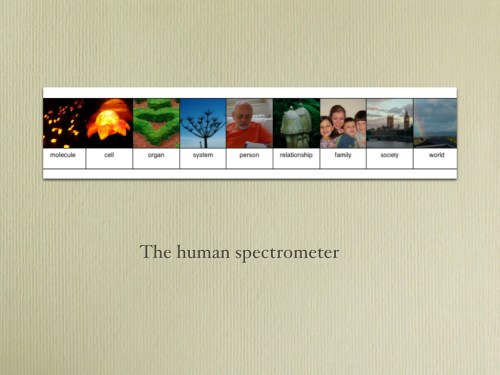
This idea of scale…..a long time ago I created a “human spectrometer” to help me discuss a patient’s issues with them at different levels of scale. Here it is
I’d start in the middle with the “person” because that’s where we met, person to person. Then I could move left zooming in on smaller and smaller parts of the person to consider the problems and their effects….perhaps in the “nervous system”, or the “digestive system”, then further “in” to disturbances in particular organs, “the heart”, or the “liver”, then further in yet to consider the role of cells, like white blood cells, or the cells of a specific organ, or, at an even smaller level the circulating levels of individual molecules, like hormones, antibodies, chemical messengers and so on.
I’d then return to the “person” and start moving right to consider the person within their significant relationships, within their family, within society, considering cultural, economic and work issues, or, finally within the “world”, by which I meant the environment.
I didn’t usually work through this whole thing methodically, step by step, but used it as an illustration to consider everything from pathology, to pathogenesis, to the impacts from and on the vast networks of life in which an individual lived.
I created a post about it back in 2007, so patients could explore the idea a bit more in their own homes.
It’s only now, many years later, after reading Iain McGilchrist’s “The Master and His Emissary“, that the left hemisphere zooms in to consider the parts, while the right zooms out to consider the connections, the relationships, the whole! Funny, how the universe works!
This notion of nested scales was also explored by Arthur Koestler who coined the term “holon” to describe the idea of multi-level hierarchies. You can read a bit more about that here.
Every one of us is a multitude. Check out Bob Dylan’s new release “I contain multitudes” for a very recent expression of this idea. In fact, as he sings it, maybe we are multitudes, plural.
The Scottish psychologist, Miller Mair, coined the term “community of selves” back in the 1970s. It remains a powerful metaphor for the complexity of an individual personality. That idea made a lot of sense to me, and helped me to understand not only my patients but also myself. We all have that experience of at very least tapping into different strands of our lives when we act within our different roles – parent, child, friend, neighbour, employee, professional, artist, consumer etc etc. We know all those roles are just a part of who we are but it can be very hard to untangle them, to see how they inter-connect.
The French philosopher, Deleuze, wrote about “multiplicities” as a way of understanding the complex universe, and described any particular instance as a “singularity of multiplicities”. I liked that idea the moment I read it. I happened upon his writings at the same time that I was exploring the new “complexity science”, and in particular the concept of the “complex adaptive system“, which fundamentally changed how I saw our lives and our world.
I once spoke to a “Chef de Service” at a Parisian Homeopathic Hospital and he described to me that he saw each patient as like a diamond, with multiple facets shining, each one different, but together all part of the same individual. He saw his therapeutic strategy as being based on addressing several of the most prominent of a patient’s “facets”. A rather poetic way to think of the same underlying issue.
What is the underlying issue?
Life is messy.
On the “inside” and the “outside”. I put those words in quote marks because I’m pretty sure that frequently there is no clear boundary between the two. I think wherever we look we can find multiple threads to follow. We can identify particular paths, storylines, themes, chains of cause and effect, which run through a lifetime.
And, here’s the important point, brought back to the front of my mind by this photo today, all those paths, storylines, threads or whatever, are entangled. They are connected. They are inextricably interconnected, astonishingly woven together to create a unique, beautiful tapestry of a single life.
I’m not a fan of labelling a patient with several different concurrent diagnoses then sending them off to separate specialists to have each disease treated as if it exists in isolation. In Medicine this is referred to as “silo-ing“, a strange word which means separating out someone’s problems into separate baskets, boxes, or “silos”, then treating each one separately. Most of the evidence used in “Evidence Based Medicine” comes from trials where patients have been selected on the basis that they have only the single disease which is under study, and that they are receiving only the single drug which is being trialled. But the real world isn’t much like that. Much more common is the finding that an individual patient will have several different diagnoses active at the same time and that they will already be on a cocktail of drugs. Medicine is more messy than some people would have you believe.
So what? Is this a counsel of despair? Am I saying life is too complex and entangled to make any sense of it? No. Absolutely not.
What I find is that this complex entangled life is beautiful. That it manifests in the most unique, most varied, most astonishing individual narratives you could imagine.
What I find is that when you look for the connections between the parts, you get insights and understanding which you’d miss if you kept your attention only on single parts.
What I find is that it’s best to use your whole brain, not just half of it, as Iain McGilchrist, author of “The Master and His Emissary“, would say. It’s not enough to separate out the threads and elements and study them. You have to weave them back together to see the contexts, the contingencies and the connections. In other words, you need both your left hemisphere ability to see the threads, and your right hemisphere ability to weave them together into a whole.
What I find is that when you look at life this way, then you encounter the “émerveillement du quotidien” – that you find yourself wondering and marvelling every single day. You find diversity and uniqueness. You find infinite trails of connections. You find that curiosity is constantly stimulated and never ends. You find that you are humbled by how little you actually know. You find that you doubt predictions and develop a distaste for judging people.
You find that Life is astonishingly, endlessly, fascinating.
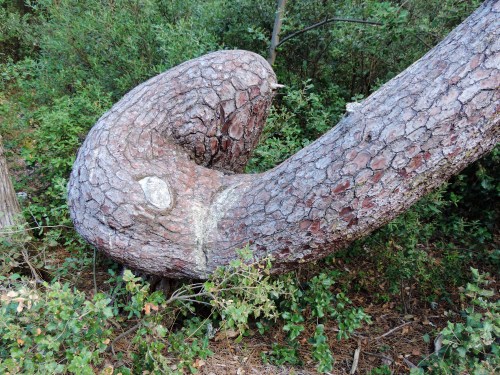
But when you look at a tree like this you realise something has happened, not once, not twice, but several times. This tree seems to have started growing pretty normally but then, for unknown reasons, has take a right angled turn to grow horizontally for a bit. Was that a storm? A strong gust of wind? An animal or a human who bent the young tree over like that? Then a little later, the tree keeps on the horizontal but takes another right angle turn. How do you explain that one? I can’t. But surely we’d agree both turns were significant. On both occasions the future path of the tree was changed enormously. Not long after this second swerve, it starts on an upward path again, as you might expect any tree to do. But we can’t explain why it happened then.
You know, I think life is often like this.
Here’s one of the most useful questions I’d ask a patient – “When did you last feel completely well?” I liked that question because over the course of weeks, months and years an illness changes. It can change so much that at the point of presentation it looks quite different from how it began. So, I didn’t ask “When did this [insert diagnosis here] start?” Or, “When did you get sick?” Those questions often missed the origins of the illness. Also, many times, people would present with more than one diagnosis. Human beings can’t be compartmentalised into neat separate diagnostic boxes without losing sight of them as human beings. Sometimes a story, or narrative if you prefer that word, would begin with a certain illness, but then others would emerge on top….either replacing the original one, or blending in somehow. It was, therefore, more revealing to ask “When did you last feel completely well?”
You’d be surprised how often that was a difficult question to answer. Often I needed to prompt and coax, sometimes going right back to early school days, before someone would say, yes, that’s when I last felt completely well.
Once they’d told me when they had been well, we’d then start to discuss two things. Firstly, what was happening in life around the time you began not feeling well, and, secondly, tell me about what you experienced when you first started to feel unwell. I don’t claim that the revelation of significant traumatic events, be they accidents, infections, emotional traumas or abuse, then enabled me to say it was this or that event which caused your illness. But pulling together these pieces of a person’s story frequently opened up a new level of understanding. And, actually, somewhat surprisingly for the patient, it often revealed just how amazingly they’d coped with significant traumas.
So when I look at an image like this tree, I’m immediately wondering what the story is……how did the tree develop in this particular way? What was going on when these dramatic twists and turns took place?
I’m not finished yet…….because the other thing this tree tells me is to consider the wider, fuller picture. It’s hard enough to unpick key events, but you need a longer view, a more holistic view, to make sense of the fuller life story.
Here’s what seems to have happened next…..
That upward movement we looked at a few moments ago continued until the tree managed to contact its neighbour. Then they bonded. They made a connection. And they grew upwards together for the rest of their lives (OK, I don’t actually know how much longer these trees lived so maybe it wasn’t for the rest of their lives, but we say that when we tell stories, don’t we?)
We still don’t know what happened in those early phases of life, but with this longer, fuller view, we can at least make sense of the final turn upwards. We can see what appears to be a seeking for a connection, a movement towards an-other. Or at least, our story-telling brains make it easy to make sense of what we are seeing by interpreting it this way.
I don’t think you ever fully know another person. I don’t think anyone can ever make complete sense of another person’s life. In fact, I’m not sure we can even do that for ourselves. But we can spot patterns. We can see shapes, and movements, and directions, and rhythms. And when we weave those together into a lifetime narrative they really can help us to make sense of our experiences.
Have you ever noticed how we like to complete what we see?
This photo which I took turns a semi-circular bridge into a complete circle by including its reflection in the water. I like it better that way!
That makes me think of two things – how our vision works, and what kind of symmetry pleases us.
The simple way to think of the eye is that it is a kind of prism….that the light enters through the pupil and then casts an upside down image onto a screen – except where is the screen? At the back of the eye ie the retina? Or at the back of the skill ie in the brain? Whoa! Not so fast! Because that’s already NOT what happens.
Light enters the eye through the pupil and stimulates specialised cells embedded in the retina – rods and cones. When they are stimulated they send electrical signals along the “optic nerve” directly into the brain where different parts of the signal are processed in several different regions scattered across the back of the brain. The brain then merges all the processed information and, somehow, (we’re not quite sure how) turns it into a complete image. So we have the experience of seeing the world as if its a photo or a video.
Now, quite honestly, I think that is mind boggling. I think it is utterly incredible. But it’s even more weird than light being turned into electricity then split up, processed and merged, apparently instantly, to create whole images. Because for all the signals to travel from the retina to the brain they have to pass along the “optic nerve” and this “optic nerve” obviously doesn’t have the rods and cones which the rest of the retina has. It’s literally a blind spot. In other words, at no point does our eye, or our brain, “see” a whole image the way a prism, or a mirror would. We literally create what we see. Moment by moment, second by second. Astonishing huh?
Symmetry. In Western civilisations it’s common for people to prefer symmetry. By that I mean the typical “classical” symmetry of whole circles, balanced pillars and so on. But in Japan, for instance, such symmetry seems too static for most folk. They prefer things to be left a little “incomplete” or “asymmetrical” believing that such a view is more dynamic, and more TRUE because reality is never static or complete. You can read more about that if you explore “wabi sabi“.
I can find both pleasing. Lucky me, huh?!
But when I stop to think about it, the Japanese idea of leaving the mind (including the imagination) to “complete” an image is actually a more true representation of our vision functions.
How about you? What do you find most pleasing? The symmetry which looks balanced and “complete”, or the symmetry which encourages you to “complete” the vision with your own creative mind?
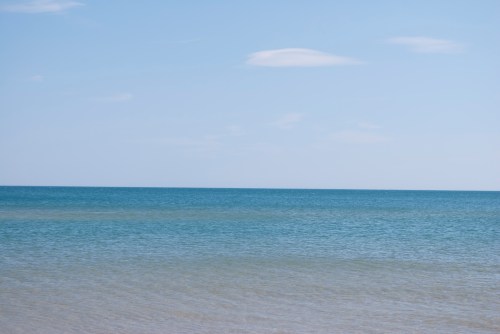
When I look out at a view like this I see the ancient teaching about the four elements – air, fire, water and stone.
I suppose the most obvious one is the water – just look at it! Look at the rich palette of colours! Look at the expanse of it! I heard someone the other day say we shouldn’t say “Planet Earth” we should say “Planet Ocean” because much more of the Earth’s surface is covered with water than with land. As best we know Life began in the sea and evolved from there.
Above the sea, the next most obvious element is air – well, we say sky really, because we can’t actually see “air”. Look at the colour palette there too, and the expanse. That unbroken horizon where the sky meets the sea with no land in-between has some kind of magical attraction for us, doesn’t it? Do you remember the story about “The Green Ray“? It’s based on the old belief that if you watch the sun setting on a horizon of sky and sea alone then for a brief moment before the sun disappears a bright green ray of light might appear. I don’t know if that’s true. I’ve never seen it. The story goes on to suggest that whoever you see next, after seeing the green ray, will be the love of your life. Romantic, huh? Eric Rohmer made it into a beautiful movie. Another thing we can’t see in the air is wind. We can only infer it from its effects on other elements. We can watch it blow the clouds (and what are clouds other than the temporary appearance of otherwise invisible water molecules which saturate the air?). We can watch it whip up waves.
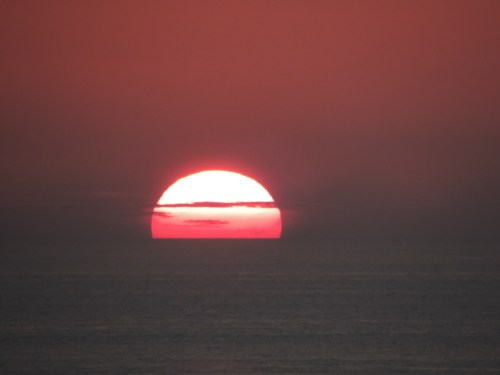
The element of fire comes from the Sun. We can’t look at it directly without damaging our eyes. But we can close our eyes, turn our faces towards the Sun and feel the heat of the incredible furnaces and explosions which send out waves of energy to our Earth. Waves, without which there would be no Life. And in that air that we can’t see are gases we can’t see, including ozone, which, when it breaks down, allows way too much of the Sun’s fire through. We can’t see the carbon dioxide building up and trapping the energy of the Sun’s fire between the sky and the sea and earth, warming the oceans, the lands, and threatening the existence of all that lives.
Finally, there’s the earth, or stone. If you look carefully at the front of this image you can see the colour of the sand under the water. Isn’t it amazing that those un-countable grains of sand are created by the constant moving of the water? That they started out as rock and ended up almost too small to see. Well, of course, sand is more than little rocks. It’s got gazillions of tiny shells and pieces of shells in it too. Those protective homes created by billions of tiny sea creatures – all without the use of machines or technology!
I love to stand at the edge of the beach and harmonise my breathing with the rhythm of the breaking waves. Breathing out as the water breaks on the sand, and breathing in as the ocean draws its edges back in towards itself. When that harmony falls into place its one of the most calming, centring, but also expansive boundary-dissolving experience I know.
What instruments do you have, and use, to help you make your way through this life?
Although our smartphones have compasses in them, how many times do you actually use one? I’ve used both Google Maps and Apple Maps to help me find my way through a city, and while they both let you mark, in advance, a place you want to visit, I’ve found that several times, when I come out of a metro or a station, that I set off in totally the wrong direction! Maybe I need to use the compass to figure out where north, south, east and west are…..but I haven’t done that so far.
Many of us have GPS in our cars now, and a couple of years ago we had a visit from some friends who live in Provence. Their car had GPS but they’d never used it because they are both a bit resistant to new technologies. However, I took the time to show one of them how to set her destination in her in-car GPS, then asked her to choose whether she wanted “the fastest route”, “the shortest route”, or the “optimised route” (which I explained balanced the other two options). She said, “I want to take the prettiest route”. Well, the Michelin maps in France mark many roads with green lines along each side. These “green roads” are the “prettiest” or “most attractive” ones, so I knew what she meant. I told her the GPS didn’t offer that option. She replied, “Well I don’t want to use it then”. I’ve been thinking that the “prettiest route” option is THE big missing function in most (all?) in-car GPS units ever since…..
Clocks or watches must be amongst our oldest, most used, instruments for helping us to get through life. There have been town clocks since the thirteenth century, but it wasn’t until the twentieth century that personal watches became common.
I once organised a weekend workshop at the hospital where I worked and invited a Dutch colleague to come to Scotland to deliver it. He stayed with me for the weekend and we travelled to the venue by train. On the first day, the train got held up, then moved a bit, then got held up, and so on. I was getting increasingly anxious, checking my watch every few minutes. My friend said to me “Relax, in all the times I’ve been presenting workshops, they’ve never started before I arrive!” He then went on to explain to me that about 15 years earlier he had removed his watch because he thought that constantly checking it just made him anxious. He pointed out that I could look at my watch as often as I liked but the train wouldn’t go any faster. I took my watch off that weekend and haven’t worn one since.
However, it’s not that I never check the time. There are plenty of clocks and timekeeping devices around us all the time – especially as most of us have phones which show the time now. But I definitely cut back on my watch/clock/time checking after that.
The French philosopher, Henri Bergson, wrote clearly about the difference between measured time and lived time (duration). My normal working day centred around fully booked clinics, divided into regular time slots. I found that I didn’t need to check the time in the consulting room. I had developed an unconscious ability to “know” how much time had passed, and, normally, my clinics ran to time. I used the same skill when teaching. If I was given a 30 minute slot, I’d deliver my lecture, then check the time, and 30 minutes would be about to lapse. If I was given an hour, I’d deliver my lecture, check the time, and the hour would be about up. Not always. But usually. So, I understand this phenomenon of lived time, and I don’t need a device to measure it.
I have seen some utterly beautiful public time-keeping devices however.
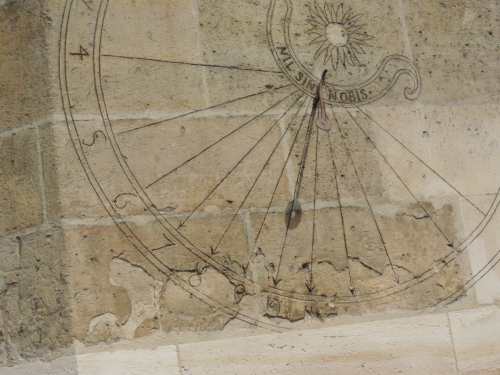
Before the invention of clocks, we used sundials. Some of them are delightfully beautiful.
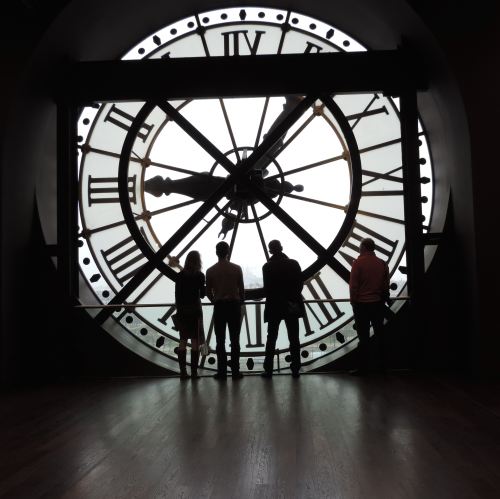
Here’s another clock, this one in the Musee d’Orsay in Paris. It’s a favourite of mine…not least because you can look through it, out across the city.
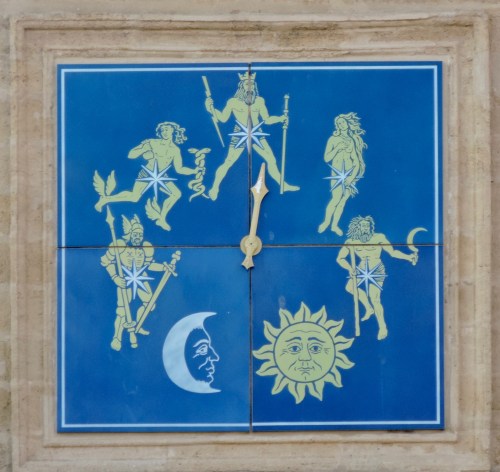
This next one shows the days of the week, representing each day according to the planet which gives the day its name (you knew that’s where the names of the days of the week came from, right?) I like this, because it suggests a slower pace of living – knowing the day, rather than knowing the hour, minute and second!
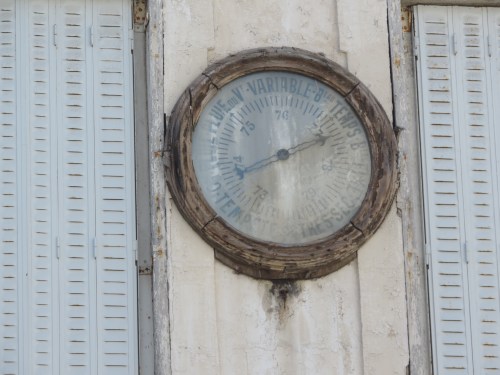
Another type of instrument we use is the barometer.
When I was a young boy, I had a “weather station”, which included a barometer, a thermometer, an anemometer to measure wind direction and speed, and a hygrometer to measure humidity. I learned how to recognise different kinds of clouds and I measured the daily rainfall. Not sure I ever learned how to predict the weather though!
Nowadays, it’s back to that smartphone with its weather apps! What strikes me about the one I use which shows predictions for the next ten days, is just how often the prediction changes before the day arrives. If rainy, stormy days seven days ahead turn into dry days with sunny spells before the seven days are up it feels like I’ve gained something. It feels like a win! How weird is that? I get to avoid the bad weather that was never going to happen anyway!
Which instruments did you use in your life in the past, and which ones do you use now (or do you only use apps on your smartphone or smartwatch now?)
And what do you pay most attention to? Direction, time, weather….or what? I’ve often thought that what we pay attention to influences what we experience.
I welcome constructive criticism and suggestions. I will not, however, tolerate abuse, rudeness or negativity, whether it is directed at me or other people. It has no place here. ANYONE making nasty comments will be banned.