I have a Nigella plant in the garden. This is the time of year when it flowers.
OK, I know, flower pictures are often beautiful, although after a while I can have enough to them, but, stay a moment and allow yourself to fall into the wonder of this gorgeous Nigella flower.
I find it entrancing. Almost other-worldly – except I don’t know any other world where a flower like this would bloom, so it’s kinda typically this-worldly! Do you know what I mean?
I’ve read a few authors who claim we have lost touch with enchantment in our hyper-speed, consumerist, material culture, and I understand what they mean. This pause which has been enforced on so many of us by this Covid-19 virus, has allowed us to slow down, consume less, savour more and pay attention to the present moment world around us.
All that, I find, makes room for enchantment. That’s the word I think of most when I look at this flower. I love the milky, indefinite bluish purple blush of its five leaves. I like that it has five leaves, which sets me off wondering about the number five, and how many flowers have five petals, not three, or four, or more. I think of five pointed stars and pentacles, of magic and alchemy. I love the spiky branching leaves – are these leaves? – they don’t look like leaves – how they seem to reach further and further, like fingers or whiskers feeling their way through space, to see what they can encounter.
I just find it utterly beautiful. Made my day a better day. Hope it casts some enchantment in your life today.
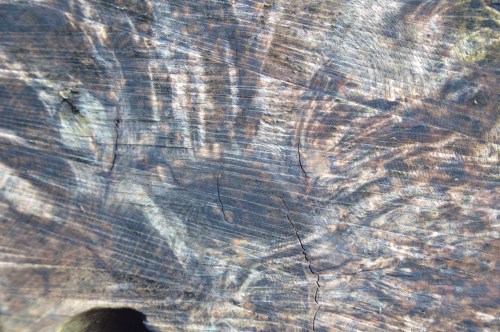
Every now and then I’m stopped in my tracks by what seems to me to be “found art”.
This image is of the end of a tree which has been cut down. There are often beautiful and intricate marks to be seen on the insides of these trees. Marks and patterns which are only revealed when the tree is cut open (which is a bit sad). You know the kind of thing. Concentric rings and swirls and knots. But something has been added here by human hand. The marks of the saw are very visible. What makes them obvious is how straight they are. I remember the first time I read that there are no straight lines in Nature and thinking, “really?” Well, it’s probably not absolutely true but they certainly aren’t common. The longer a straight line, the more likely it is to have been made by a human.
So I’m pretty certain that the patterns, (could I say the “design”?) on the end of this fallen tree, are the result of a combination of the life of the tree and the work of the woodsman.
But just look at it.
What does it seem like to you? What does it remind you of? Where does your mind go when you see this? I expect your mind will intermingle memories with imaginings and you might see……
….an eye – like the eye of Horus, the eye at the top of the pyramid, or some other eye you once saw.
…..a sunburst through the clouds, rays of white or pink or red light spreading across the sky.
….[or add your own images and sensations here]
I like this kind of “found art”, this apparently “accidental art”, partly created by forces of Nature, partly by forces of the human hand, partly by forces of memory and imagination.
I took this photo one winter in Scotland. It’s a particular kind of image which really pleases me. There is straight line running across the entire scene and splitting the image into two parts, but the two parts, at first glance, don’t seem enormously different.
However, there are clear differences. The foreground field is flat and the earth beneath the snow forms parallel lines running up to the border from the front of the photo. The field over the border is on a hillside and it’s markings are like contours of a map of a hill. The snow on the hill is whiter than the snow on the field and, somehow looks deeper.
Between the two there is a border zone. That appeals to me. There is not a solid wall or fence, more a rough line of stones, containing an unworked area of land partially marked off with a fence. In fact, as I look more closely now, I think that line of stones is the top of a dry stone wall and there is a dip in the land just beyond it.
Apart from the trees at the bottom and the top of the image the only “Life” in the picture is one sheep and one tree, both in that in-between zone.
That reminds me of the fact that Life itself exists in a kind of in-between zone. The zone between order and chaos. Thomas Berry describes this beautifully in his “The Great Work” where he calls the two forces of the universe “wildness and discipline”.
When first the solar system gathered itself together with the sun as the center surrounded by the nine fragments of matter shaped into planets, the planets that we observe in the sky each night, these were all composed of the same matter; yet Mars turned into rock so firm that nothing fluid can exist there, and Jupiter remained a fiery mass of gases so fluid that nothing firm can exist there. Only the Earth became a living planet filled with those innumerable forms of geological structure and biological expression that we observe throughout the natural world……….The excess of discipline suppressed the wildness of Mars. The excess of wildness overcame the discipline of Jupiter. Their creativity was lost by an excess of one over the other.
For Life to exist there needs to be an ordering principle, something which builds and creates, turning small, apparently disconnected pieces, like atoms, into elaborate complex networks, like the multicellular human body and the astonishingly interconnected human brain.
But too much order is counter to Life. Rigidity isn’t much good without flexibility. We live in a changing universe. Year by year, month by month, week by week, day by day, even second by second. We have a word for that kind of phenomenon – dynamic. The universe is a manifestation of a dynamic, living, breathing, integration of order and chaos, of discipline and wildness.
All of Life exists in this dynamic, “far from equilibrium“, zone. It never stands still. It’s never “complete”, “finished” or “done”. It’s a flow, a process, a complex, vastly inter-connected network. Maybe that’s why it’s hard to pin down definitions of “Life” and “Health”. They aren’t fixed objects.
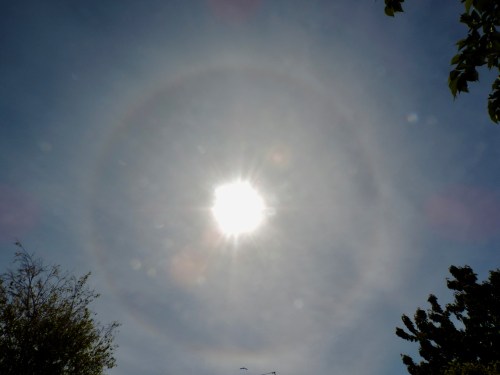
Last week, one day, while sitting in the garden having a coffee, we looked up and saw what looked like a rainbow all around the Sun.
Have you ever seen anything like this?
I hadn’t.
Do you know what it is called?
A corona.
Can you believe that? A corona round the Sun during a pandemic of coronavirus.
Seriously?
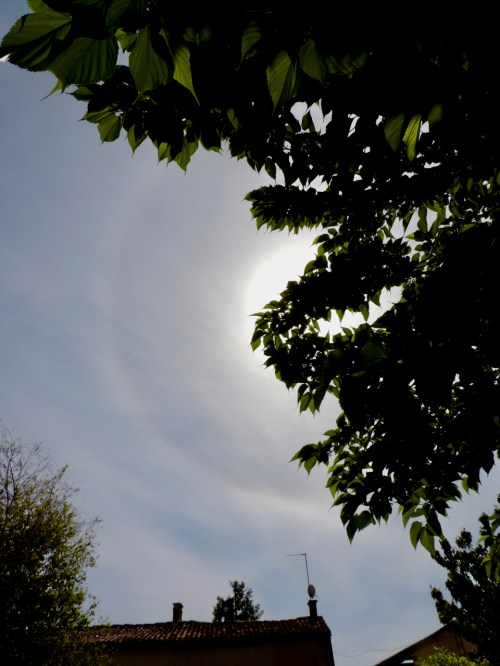
There it is, up there, behind the mulberry tree, clear as anything in the morning sky.
Now I think that’s pretty spooky.
But there’s more…..because don’t you think this looks like a giant eye? Doesn’t it look like a iris, with a white pupil?
Well, you know what? This is reality. These are the kinds of things which actually happen. Maybe only once in a lifetime. But they happen. And it feels special, feels a privilege, to witness it.
Reality looks like this. It’s amazing every day. You just have to be present and aware and you’ll see, hear, smell, taste, or touch something wonder-full every day. Everything you notice will seem to connect to something else, and those connections, echoes, memories, symmetries, imaginings…..well, they are quite simply breathtaking.
If you don’t believe me. Just try it. Find out for yourself.
When you really look, there are a lot of strange features in trees. Look at this one!
What is this? You think maybe it’s an ear? Can the tree listen to the birds singing their welcome chorus to the dawn every morning, chasing each other excitedly through the forest, and calling goodnight to each other at sunset? Or maybe it’s listening to the other trees. To the sounds of the wind in the leaves. Or to the sound of another tree falling. What do you think a tree would hear, if it could?
Maybe it’s not an ear, but a mouth. What if it is a mouth? What sounds could a tree make? What’s the language of trees? Do you think they communicate with each other? Actually, they do. A lot! Just not by using either mouths or sounds. Trees in a forest are connected above and below ground. They communicate through the air by sending out a variety of molecules, especially to alert other trees to the presence of a predator. Under the ground their vast root systems have gigantic webs of fungi embedded in them which extend the number and distance of connections between them many, many fold.
I like the phrase that certain tree specialists use – the “wood wide web” – it provokes an image of an intricately, multiply connected, living network really well.
Every living organism, animal, plant, or any other form of life from the other “kingdoms”, survives and thrives through communication and connection.
I like to contemplate three flows which travel into, through, and beyond every single person, every single animal, and every single plant – flows of materials; energy; and information. These flows connect us all. They know no borders. They wax and wane across this entire, small planet. We couldn’t live without them.
I showed you a photo of a wounded rock the other day to illustrate how whatever impacts our lives changes us forever. Here’s another similar image. This time it’s a tree.
Look at the shape of this tree! What’s happened here? It’s quite extraordinary. I’ve never seen such a dramatic “folded” form within a tree. What caused this? We’ll never know.
But it’s changed this tree forever. This astonishing fold is way more than the twists and turns in a ordinary day. Perhaps for that reason it makes me think it’s relevant to this time of pandemic and physical distancing where our societies, our lives, have closed up.
I’m sure we are all preparing to write the next chapter of our stories, but, first of all, it seems, we’ve closed the book. At least while we close our eyes and rest.
The time will come, soon, maybe, when we pick up the book again, open it up to the page we last read. Will the next chapter be a continuation of the story so far? With the same characters, the same plot, the same themes? Maybe not.
Maybe the characters will have changed. Some will have grown in importance, some will have shrunk. Yet others will have disappeared.
I suspect this twist in the plot is a big one.
Time to re-consider, re-evaluate, and make new choices. We might have thought we had a good idea of the way the plot was developing but, whoah! we weren’t expecting this!
Exciting, huh?
Or just plain scary?
What do you think? There’s no getting away from it. The story is going to change now. There’s no going back. Just forward. Maybe we’ll pull some of the characters and themes out of the story so far and develop them in completely unexpected ways. Maybe there’ll be some equally dramatic twists ahead. I think it’s up to us. You and me, and everyone we know.
What shall we create now? What shall we say? What shall we do?
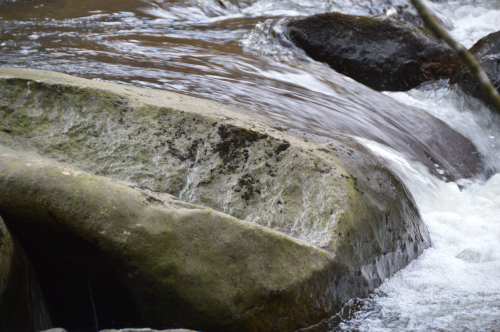
This is a photo I shared with many patients and students over the course of my career. I saw this rock, a long, long time ago, just down from a waterfall in woods in the Scottish Highlands.
How did this rock come to have such a shape? It’s as if it had been struck by a Viking axe! What’s even more interesting is that it will never “heal”. That cleft, that wedge in the body of the rock, will never disappear.
It’s pretty common to think of healing as the complete resolution of something. We think of a cut, or a broken bone, and imagine that once it has healed, the skin or bone will return to how it had been before, forgetting somehow that all injuries leave scars. We think of infections as “self-limiting” – that is, once they have gone, they are gone. The body returns to some prior condition. We talk of “defeating disease” and use a lot of war imagery to suggest we can remove it (whatever “it” is) from our bodies, “defeat it”, and then it will be gone…for good. Job done.
But Life isn’t like that.
And neither is healing.
We don’t go backwards. Injuries, infections, traumas and diseases of all kinds change us. Even when we make a “complete recovery”, our lives have now changed. Something is altered….in the body and in the psyche. Whatever we encounter, whatever we have to “deal with”, becomes part of our story. Every event, every experience, changes our lives forever.
So, what are we to do with these wounds?
It would be nice if we could just ignore them. And in many situations they are minor enough for that to be a reasonable strategy. But the bigger impacts can’t be ignored, they can only be denied. That’s never a great strategy.
Maybe we could fill in the gap. Fill that wedge with prozac-a-filla or something like that. Would that work? Unfortunately, suppressing, and hiding the wounds tends not to work for very long. All those “anti-” medicines that we use – antibiotics, antihypertensives, antacids, anti-inflammatories, antidepressants etc combined with opiates and other sense-numbing drugs, don’t actually directly promote healing at all. They just “take the edge off” things….for a bit. You think antibiotics cure infections? I’m afraid not. They can do a very important job. They might even save your life. But what they do is kill bugs. The inflamed, swollen, and damaged tissues in your body need to heal. The antibiotics don’t do that. It’s your ability to self-repair that does. And antibiotics don’t stimulate the self-repairing functions of the body.
So what do we have to do?
Take a look at the photo again. See the river rushing by the rock? I think of the life force when I see that. The wound has become part of our internal landscape now. The illness, the experience of it, the memory of it, the impact it had on our psyches and our lives, is part of who we are now. It’s an integral part of our story. But life continues. We adapt. We find new ways to live and to thrive with this changed landscape. We evolve our inner environment.
I’m not saying we shouldn’t use our modern medicines. They can reduce our suffering and even, sometimes, save our lives. But they don’t directly help us to heal. We still need to recover, repair and adapt. How much of “Medicine” or our “Health Service” is directed towards that life-long, important issue of healing?
I hope that, whatever the answer to that question, the answer will be “a lot more in the future”.
Our lives are not going to be the same once this coronavirus pandemic is over. How are we going to heal? How are we going to adapt? How are we going to live differently?
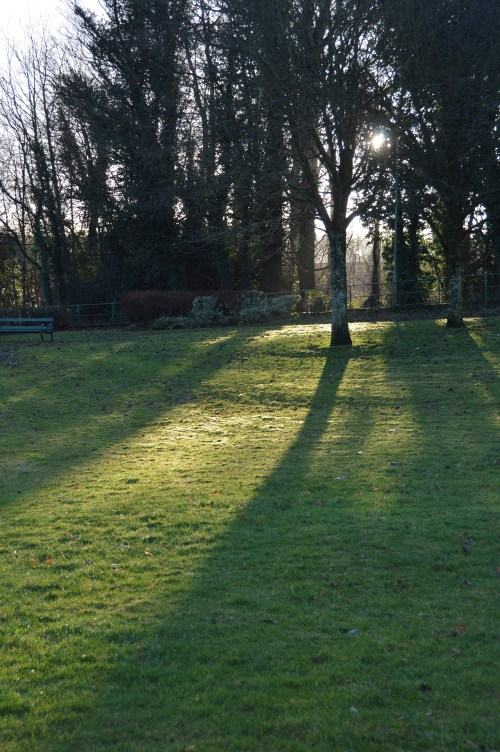
You might think its pretty much just a photo of some grass, so, hold on, let’s look more carefully, and consider the contexts. If it was simply a photo of a patch of grass it wouldn’t be particularly interesting but what caught my eye wasn’t the grass, it was the interplay of shadow and light.
Despite it being noon, the Sun is still pretty low in the sky. Well, it’s taken in the wintertime in Scotland, so that’s normal. But, normal or not, the effect of the low sunlight streaming through the trees is spectacular. The angle of the light makes the shadows SO long and the spaces between the trees show frosted grass sparkling brightly.
I love the forms and the patterns of the shadows, the light, the frost and the grass. It takes all of them together to create the scene.
Here’s another scene –
This is a huge puddle which is there more often than it’s not in this particular field. I once saw swans swimming on it! But today, what makes this image so beautiful is the trees and their reflection. Without the trees, the clarity of the light and the stillness of the water, this just wouldn’t be the same. It has echoes of the previous photo but it’s completely different. However, both photos were taken within minutes of each other, the flooded field lying just a short walk along the road from the shadowed park.
I’m struck by how important the contexts are in these photos. If I’d “abstracted” just one element in each – a grassy patch, a section of the puddle, a single tree – I’d lose all the context. It’s the interplay of all the elements which makes these images more than the sum of their parts.
Life is like that.
When we focus too narrowly, when we consider only a part in isolation, we achieve only a partial understanding. It’s the whole experience, in all it’s contexts and environments, with the story which holds them together, and the remembered subjective experience of being there which makes them so unique, so particular to me.
So, if I am to share any of that with you, I need to show you, and tell you, at least some of the contexts. That way, you’ll come closer to experiencing what I experienced.
That was my everyday working reality. Every single patient who came to see me had a unique story to tell. If I were to understand them I had to hear their story. I had to try to have some experience of their experience, to feel what they were feeling, to know what they knew, if I was to understand, diagnose and help them.
But it’s the same for all of us. If we are to understand anyone, friend, relative, colleague, stranger, we have to hear their story, and try to experience some of their experience.
It’s always partial. It’s never fixed. It’s never completely knowable. But there’s no substitute.
I reckon a lot of us have a fascination with water. Little children love to play with water, whether its in a sink, a pool, or at the beach. Pretty much all children can spend hours filling up brightly coloured plastic pails with sea water and pouring it into holes they’ve dug in the sand.
I’ve certainly always had a fascination for water. One of the few experiments I actually remember from schooldays is “a little goes a long way” where we put a few crystals of potassium permanganate into a big trough of water and watched with amazement how quickly the entirety of the water turned purple.
Learning about the “water cycle” of nature, where water evaporates from the sea, forms clouds in the sky, falls as rain on the mountains and runs down the rivers back to the sea, was probably my first encounter with the idea of cycles and ecosystems.
But ice – now isn’t ice just completely fascinating? Not simply because it expands in volume as the water freezes, which is counter to our instincts (which tell us that heat expands things and cold shrinks them). But because it is utterly beautiful.
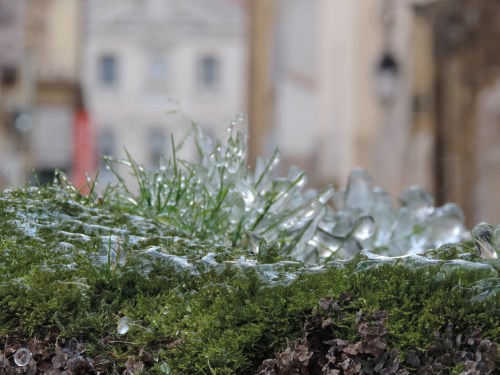
The town of Aix-en-Provence is partly famous for all its fountains. I can’t remember how many it has, but there are a lot. These photos I’m sharing today are all taken one day in winter on the Cours Mirabeau in the centre of Aix. They remind me that just when I think I’ve seen all the shapes which frozen water can make, one day, I discover something new to me.
At first glance that image at the top of this post is typical of a frozen fountain. There are many long dangling pointy icicles. (Poetic, huh?).
But, look more closely and you’ll see something pretty weird.
On top of the moss the water has formed ice which looks more like jelly than anything else. It actually still looks liquid, but, you can see, it isn’t. It’s frozen. Not in a smooth level way, like you’d expect to see when water lies in a puddle or pond, but undulating, almost like frozen waves, but smooth waves, not spiky ones. It’s really not like anything else I’ve ever seen. When you imagine water lying on top of moss, you think it would have a level surface, just like a puddle would. So, it should freeze like that – level. But this didn’t.
Here’s another close up.
Look at the shape of this! These tiny stalagmites of ice are so rounded. Not at all spiky or pointy like the stalactite forms higher in the fountain. How does water form into shapes like that? And, if you look at the left hand side of this image, you’ll see that frozen flow appearance I showed you in the previous photo.
Wonder.
That’s what images like these provoke in me.
A sense of wonder…..that combination of curiosity and amazement tipping over into astonishment.
This is the “émerveillement du quotidien” which I love so much – that “everday wonder”. Makes life all the more special I find.
I’ve mentioned several times how much, in the years gone by, that I enjoyed looking out from my flat in Cambusbarron towards Ben Ledi. Here’s another one of many photos I have from that time.
What grabbed me about this view?
The beauty.
That’s the short answer. I find it utterly beautiful. The pale blue sky, the grey and pink clouds (“Caravan” reference in there for those of you who know 😉 . The shape of the mountain with its snowy peak, the surprisingly warm shades of the uncovered hillside. The low lying mist in the mid ground with just a row of trees appearing through it, and the familiar farm in the foreground.
But there’s more.
Yes, there are the birds flying past, which bring some life to the scene. But I mean the shape of the mist. Look at it! You’d expect mist just to fade out as it rose, but this mist, for some reason, has fashioned itself into a peak, that looks for all the world like an echo of Ben Ledi itself.
So what engages me about this image is every single element, plus how the whole adds up to a lot more than the sum of the parts.
I adore discovering these symmetries and they challenge my day to day perception that water changes quickly and that mountains never change. The most dynamic part of the scene is the birds in flight, creatures whose unceasing change (movement) keeps them flying through the invisible air. But the next most dynamic part is the water in three of its forms – mist, snow and clouds. Every one of those forms is changing moment by moment, but that’s not nearly so easy to spot as the movement of the birds. Then there is the mountain. The mountain which changes moment by moment in appearance as the Sun changes his angle and casts shadows from the ever-changing clouds. But the mountain changes too. In its substance, shape and form. Maybe it takes millennia to be able to spot that, but doesn’t everything have its own innate pace?
So, here’s the core paradox of this image – stillness and movement.
At first glance, this is an incredibly peaceful, quiet, static scene. But it doesn’t take much to see there is nothing static about it.
I welcome constructive criticism and suggestions. I will not, however, tolerate abuse, rudeness or negativity, whether it is directed at me or other people. It has no place here. ANYONE making nasty comments will be banned.