Feeds:
Posts
Comments

Archive for the ‘personal growth’ Category

butterfly

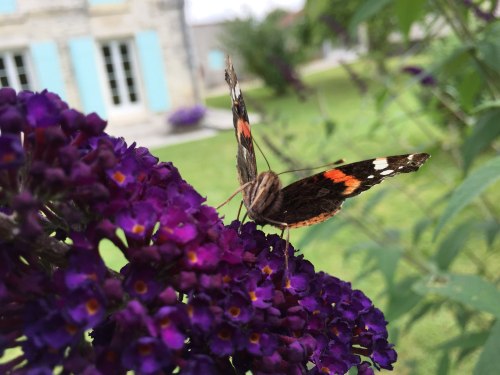
I was sitting in the garden yesterday next to some buddleia bushes which are very, very popular with the butterflies. I watched a few of fly around, then took this one’s photo when he landed on the blossom near me.

Isn’t this creature both beautiful and astonishing? The colours and patterns on its’ wings, its’ delicate antennae, the long proboscis probing deep down into each little flower to gather up nectar? Have you watched a butterfly flying and feeding like this? Its’ movements seem completely random. It doesn’t start on one flower then move outwards or around in some obvious pattern. It will select this flower, then that one over there, then that one next to it, then it flies up into the air and lands on a completely different part of the bush, only to reappear again on the original flower a few moments later.

We can’t predict exactly which direction a butterfly is going to fly next.

Butterflies are almost a symbol of unpredictability. The apparent randomness of their flight is one of their key characteristics. When scientists discovered that everything on Earth was actually connected, they picked the butterfly as an example to explain how small changes lead to large, unpredictable ones. “The butterfly effect” poetically describes how the flapping of a butterfly wing in one part of the world can change the air movement there, which sets off a cascade of interconnected changes, leading to a hurricane in another part of the world.

Small changes that we make can lead to huge changes down the line. That always makes me think two things – first that if I want to bring about a big change, the way to do it is to keep making small changes. In other words, the choices and actions I make in my daily life, are the best, indeed maybe the only, way to bring about the changes in the world I want to see. The second thing is there are no guarantees. Despite the claims of some to know that if we do this or that, then the outcome will be exactly this other thing, that’s just not true. It’s better to stay humble and realise that not only is there much I don’t know, but I have no way of knowing exactly how things are going to turn out. Some people find that frustrating, but I think it’s empowering. It means I need to make my choices and actions on the basis of my values, not on the basis of control. I can’t control the future. But I can sure choose to act in loving ways. I can sure choose to act in “integrative” ways, building healthy, mutually beneficial bonds between me and the others (the well differentiated parts). I can choose to create. I can choose to increase diversity. I can choose to tolerate. I don’t need to be in control of the future.

Butterflies are magnificent examples of change. They go through four utterly different, distinct phases of life – egg, caterpillar, chrysalis, then winged insect. The four phases are so different that some people still think a butterfly is more than one creature. No wonder they are the symbol of change and metamorphosis.

All of life is change.

We are all in a continual process of becoming. It’s a characteristic of life – emergence – an unfolding, a developing, a creative changing reality.

Butterflies are also great examples of connectedness. I see that two ways. First of all, the day the buddleia bushes in my garden began to bloom the butterflies appeared. The more the blossom, the more the butterflies. You could almost think both the blossom and the butterflies emerge from the same source. They are certainly intimately connected. Mysteriously connected.

Secondly, some butterflies, like some birds, are migratory. They spend some part of their lives in one part of the world, and some in others. For the British “painted lady” butterfly that involves distances as far apart as Africa and the Arctic Circle. If that’s not enough to astonish you, wait till you hear this! They complete this migration over SIX generations. Yep, no single butterfly makes the full trip. No butterfly and its’ immediate offspring makes the single trip. It takes SIX generations to make the round trip.

How does that work?

I read that they navigate “using a time-compensated sun compass” – a what?! How does THAT work?

No wonder we see butterflies as symbols of change, metamorphosis, mystery and complexity.

Don’t we live on just an incredible planet? Isn’t life, literally, astonishing?

Every, single, day.


Read Full Post »

tulip new

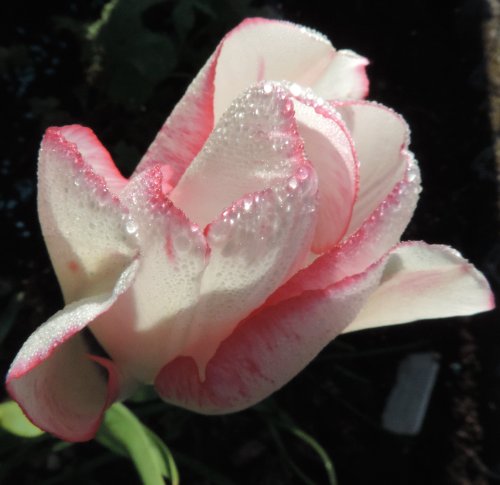
A new day, early morning, the sun rising, the dew glistening on the unfolding petals of the flowers which were just buds yesterday…..

Ellen Langer, the mindfulness researcher, says there are two ways to live your life – mindfully, or mindlessly. Her research shows that the simple way to live mindfully is to search for, and to be aware of, the new.

Neuroscience has revealed that we use our two cerebral hemispheres for different purposes. One of the key differences is that the left seeks out the familiar, whilst the right prefers what’s new.

Our preference for what’s familiar, or what’s new, is inextricably linked to our attitude towards difference. If you are averse to difference, you’ll prefer the familiar. What’s different, or unfamiliar, is then experienced as something to be afraid of, or anxious about.

“You ain’t from round here, are you, stranger?”

It seems the driver underpinning the preference for the familiar is often fear.

Whereas, the driver underpinning the preference for the new is more likely to be curiosity.

The good news is we all have both hemispheres, and we can all choose to focus on fear, or on curiosity. (Remember the story of the hungry wolves?)

If you want to develop certain muscles, you have to exercise them. If you want to develop certain attitudes to the world, you have to exercise those as well.

How much do you exercise your fears? How much time and headspace do you dedicate to them? And, on the other hand, how much do you exercise your curiosity?

Remember, as Ellen Langer says, if you want to live mindfully, seek out the new….

Or, as I’d put it “If you want to be a hero instead of a zombie, be curious”


Read Full Post »

alone

When I worked at what’s now called the NHS Centre for Integrative Care in Glasgow, every patient attending for the first time had a sixty minute appointment. 60 minutes doesn’t seem a lot in the context of a life time but to receive a whole hour of undivided, focused, non-judgemental attention feels like a gift.

My colleagues and I would frequently have patients tell us “You’re the first doctor to have actually listened to me.” I don’t think that feedback ever lost its power to shock. How did so many people get so far into the health care service and not have the experience of being listened to?

We all need to be heard. We all have the right to be heard. All of us.

The recent EU Referendum in the UK, and its political fall-out has made it even clearer to me that, politically, we are not being heard. There is a disenchantment with politics and politicians across the so called democratic world. Maybe one of the reasons for that is that our democracies are not enabling people to be heard.

In the UK there is a whole chamber of government, the House of Lords, which is 100% unelected. There is nothing democratic about it. Nobody voted for them and they aren’t accountable to the electorate.

The electoral processes based on simple majorities lead to government after government which does not represent the majority of the electorate. In the recent referendum 52% of those who voted, voted Leave and 48% voted to Remain. About 30% of the electorate didn’t vote. The 52% of the 70% are heard (on this question). The rest of the population are ignored. Parliamentary elections are like that too.

Is handing power to the largest minority the way to ensure that most people in the country are heard?

How can it be?

Most people don’t have the experience of being heard and, in consequence, don’t feel the elected governments represent them.

There’s an additional problem and that is that politics, as currently practised, is about power, not consensus. Those minorities who are elected believe they have the power to act according to their own beliefs and values. They act to exert power over others. If politics was about creating consensus, rather than wielding power over others, it would be an entirely different kind of politics. It would be more democratic. More people would have the experience of being heard.

Being heard isn’t enough.

We need to be cared about too.

Whilst it’s a good thing to listen to someone, to give them the time and attention to enable them to tell their unique story, it’s not enough. The response to that story, the doctors’ responses, the politicians’ responses, need to show that they give a damn. They need to show that the individual human being matters.

If we don’t have a system based on the principle that every one of us is unique and valuable then we get what we’ve got – politics, economics, education, health care, as if people don’t matter.

Isn’t it within the capacity of we human beings to create something better? What would the world look like if we did?

Read Full Post »

better before

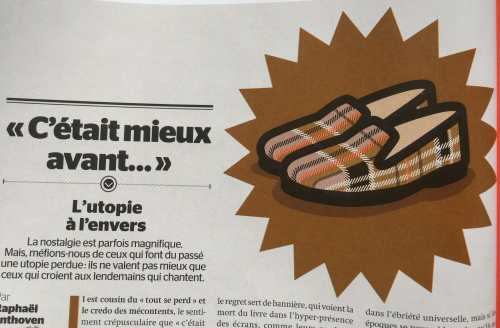
I came across this article in the French “Philosophie” magazine this month. Translated into English, the headline says “It was better before”, and the article goes on to explore this particular, common, state of mind.

It begins with a dissatisfaction with the present, but instead of that stimulating creative thinking motivating people to turn that dissatisfaction into positive action, the mind turns backwards to think back to a past which quickly becomes a utopian illusion.

When Donald Trump says “Let’s Make America Great Again” – what previous time is he referring to? When the UK Leave campaigners said “I want my country back”, which country were they referring to? A country of the past, but an illusory one. When they said “Let’s take back control”, when did we ever have it? Which controls are they referring to?

The fabulous Woody Allen movie, “Midnight in Paris”, beautifully plays with this way of approaching the world –

When was that time? The time of Hemingway’s “Moveable Feast“, or the time of the “Belle Epoque“…..or just when exactly?

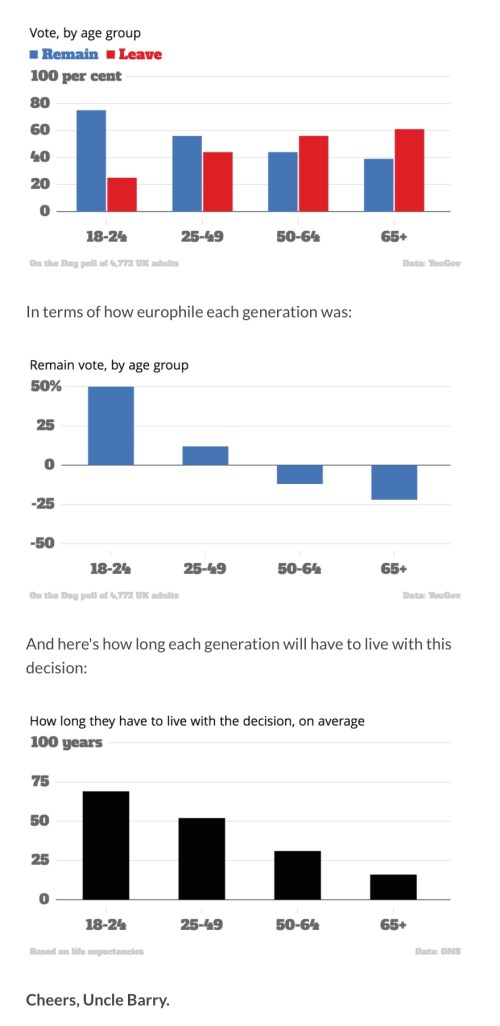
The article argues that older people are more likely to think this way because they have less life left to look forward to. A young person might look at the future and see it full of potential, where an older person might look at it and see illness, decline and death.

refage

Maybe that partly explains one of the voting patterns seen in the EU referendum, where older people voted Leave, and younger ones, Remain.

I saw one elderly Englishman struggling to hold back tears as he said “I’ve got my country back”…..and I wondered, what country is that then? And how, exactly, have you got it back? But the emotional power of his view was clear.

I think there are many other factors at play in what’s happening in the UK just now, but I’ll leave them for other posts in the days ahead…..meantime, I think it’s worth asking people who have been seduced by the illusion of the utopian past to say more clearly what they intend to do now. Now that they have voted to go back to wherever they think it was, what do they want to do today?

In fact, I think that’s a question for all of us, because illusory past utopia or not, the present has changed for us all.

Let me modify my question so we can all join in…..what are YOU going to do today? Now that we are where we are? (And, yes, I’m asking myself for an answer too!)


Read Full Post »

redstart close.jpg

This morning I woke up to the news that the referendum vote on the UK’s membership of the EU had been won by the Leave campaign.

I immediately felt sad, not least because I see this as a victory for the forces of xenophobia and misinformation. I’m a great proponent for diversity, for the celebration of uniqueness and for integration (the definition of which is “the creation of mutually beneficial relationships between well differentiated parts”).

But I found something else happened too. I tumbled into anxious feelings of uncertainty. Question after question flooded my brain.

Will I have to give up living in France? Will I need a residency permit and visas to visit other European countries instead of having the right to live here and to drive across the borders into Italy, Spain, Belgium or wherever I else I want to visit freely? What will happen to the currency exchange? To the value of my pension? What about my children and my grandchildren? Will they now lose the right to travel, study and live in this richly diverse continent?

Oh, the questions kept coming, and the answers are unknowable.

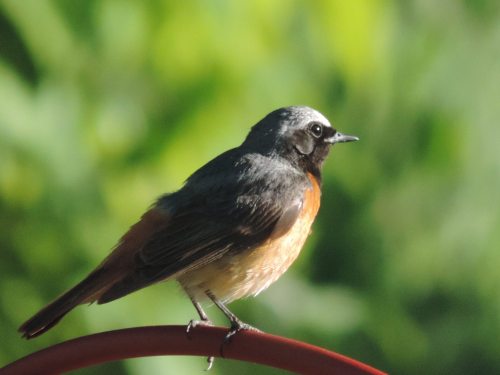
Then I looked outside and there he was again. The redstart. I’ve written before about my experience of a particular redstart in this garden but since yesterday he’s been perching on a chair right outside my front door and whistling loudly. He’s never done that before and it got me wondering.

What’s he trying to tell me?

Is he in trouble? I even went and looked where his nest is but couldn’t see anything wrong. He can’t be hungry. There’s an abundance of food around just now. He looks healthy and vigorous. Nope, I couldn’t figure it out.

Then I thought, well maybe he just likes it there. On the back of that chair.

Or maybe he’s just enjoying being close and asking for some attention.

Well, you know what he did? He called me right back into the here and now. The worries, the unsolved problems which might not even ever exist, all faded away. I just enjoyed looking at him, listening to his song, and taking his photograph.

Attention to the present and the particular does that for us. It makes today, this moment, more real, more vivid, and more enjoyable.

Thank you, Mr Redstart.

Read Full Post »

ceramic plate.jpg

I came across this medieval ceramic plate in a museum recently. Here’s what I thought.

How beautiful!

How unique!

Look at the two birds and how together they almost seem to create third bird in the middle, looking out at me!

What a delightful scene! Two birds kissing. Or one bird feeding another.

What a great example of integration – the creation of harmonious bonds between individuals.

I still think all of that.

But something else struck me as I uploaded this photo to share with you……maybe some people will look at this and see it as two birds fighting? Maybe they’ll see it as conflict and competition, not bonding and dancing?

Then I realised that everything we encounter has an element of the Rorscharch Ink Blot test to it – what we see in it is what we bring to it.

If that’s true, then we can experience more love by bringing more love to the table.

Here’s one of the reasons I immediately saw an image of bonding –

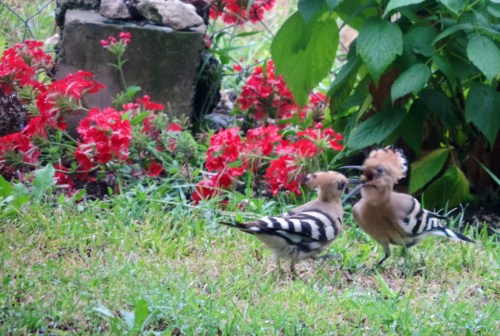
hoopoes feeding.jpg

This is a picture of one Hoopoe feeding another in my garden last year.

Read Full Post »

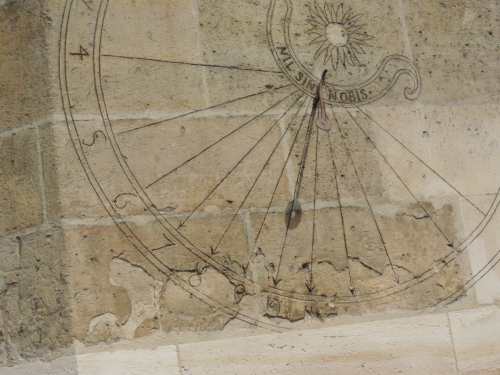
sundial

A number of things struck me as I looked at this sundial.

The first thing I did was look at my phone to see “what time it is” and my phone said midday. Yet, the sundial said ten o’clock. How come? Is the sun slow today? Or did someone make a mistake when they carved out this sundial? Or has time changed since this sundial was created?

The next thing I noticed was that the sundial starts at 4 am. That’s quite early for France. I know up in Scotland in the summer time it will be light by then but in Paris? Maybe….I don’t know. Perhaps more strangely though, it seems to finish about 3 pm. Surely that wasn’t anywhere near sunset, even centuries ago! So there must be a reason they didn’t think it useful to measure time after three in the afternoon. Or was it just that the sun didn’t cast any shadows on this particular sundial after that time in the afternoon..?

Henri Bergson, the philosopher, wrote a lot about time and he mentions two kinds of time – measured and experienced. I hadn’t thought about time that way until I read him. But it’s true, we humans haven’t always measured time. With our sundials, our clocks and watches, we divide everyday life into pieces, naming the pieces as hours, minutes or seconds, and counting them. But this is completely man-made. It’s totally artificial.

In reality time passes, not in discrete pieces, but as a continuous flow. This chopping it up into bits is a human invention. I’m not saying it hasn’t been useful to do that, but it’s just a bit of a surprise when you suddenly realise that. We could have agreed to chop it up differently. Couldn’t we? Have you ever thought about that?

I saw a watch for sale the other day. It was called a “slow watch”, not because it ran slowly but because the face had 24 hours on it and it only had one hand which moved slowly from hour to hour. Maybe that’s not so different from this medieval sundial!

Bergson talked about experienced time as “duration” – we experience time passing, but we don’t experience it passing in a steady, consistent of constant way do we? Sometimes “time flies past” and sometimes “it drags”.

Csikszentmihalyi, describes “flow” as being a particular experience of time. I love his description of that. Here’s his TED talk about it –


So how do you experience time?

Might be fun to stop and think about that a few times over the next few days and see just how differently we experience, or make, time in our own lives.

Read Full Post »

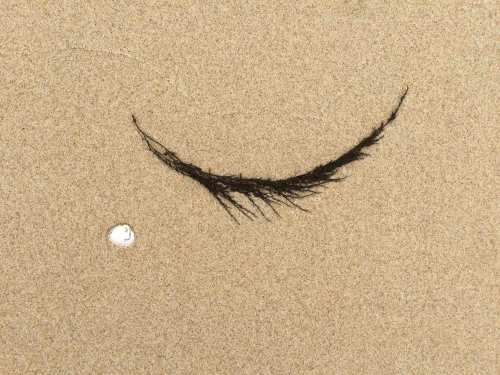
mermaid sleeping

As I walked along the beach I stumbled across this mermaid sleeping…

The man who has no imagination has no wings. Muhammad Ali


Everything you can imagine is real. Pablo Picasso

The world of reality has its limits; the world of imagination is boundless. Jean-Jacques Rousseau


Read Full Post »

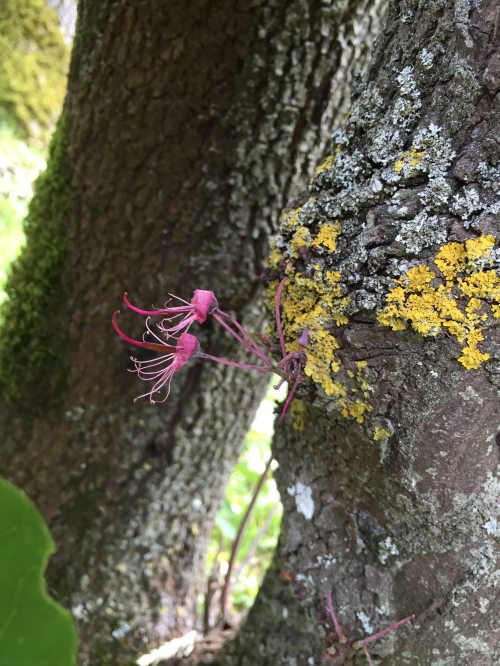
pink

As I walked between the trees at the side of the Charente in Jarnac this caught my eye.

I don’t think it was only the pink and yellow colours together which grabbed me. It was the surprise at seeing this delicate flower growing right out of the trunk of the tree. Now, I’m not a botanist, just someone who is insatiably curious, so I don’t know what this flowering plant is. But I’m pretty sure it isn’t a usual part of the tree it’s growing from. There weren’t any other flowers like this further up the tree.

As usual, an image like this sparks a few trains of thought.

How do we notice what we notice?

Difference.

Isn’t it usually difference which catches our attention?

One of the commonest kinds of difference which we notice is movement. By definition, motion is difference. It’s a change of place in time. It’s the flight of the barn owl from my house to my neighbour’s barn. It’s bats flying round and round the garden at dusk. It’s the sudden appearance of light and shadows as the sun appears from behind a cloud.

Another common difference to catch our attention is sound. Any sudden new sound. The wailing of a siren in a city street, the alarm call of a blackbird which has just spotted a cat, the distant church bells striking noon. The sounds we don’t hear are those which are constant. We only notice them when they stop.

What’s new is different too. We’ve got two cerebral hemispheres, and the right one, in particular, is wired to seek out whatever is new. The left might seek the familiar, but the right is attracted to novelty.

So maybe that’s another reason I noticed this strange and beautiful pink flower growing out of the tree trunk. I’d never seen anything exactly like it before.

Not least because I don’t know what this flower is, I don’t know what the nature of the relationship is between the flower and the tree. Is it parasitical? Is the flower gaining something from the tree, but not contributing anything? Or is it commensal, with both the flower and the tree benefitting from the relationship?

One of the keys to creative development and growth is integration. Integration can be defined as “the creation of mutually beneficial relationships between well differentiated parts”. In other words, it’s when there is a bond, a good, healthy, mutually supportive bond, between two very different organisms or objects.

I’d like to think this image represents that. It certainly increases my awareness of such an idea.

Integration isn’t just about the relationship of course. It’s about the well differentiated parts as well. And that brings me back to the idea of difference.

When we are surrounded by attempts to force us into pre-determined moulds, by monocultures of chain stores and pressures to conform, it can be hard to express our differences in a positive way. There’s so much fear these days of “the other”, of strangers, immigrants, of other races, other genders…….

How different might the world be if we pursued integration instead…..by not only tolerating, but celebrating difference, and finding ways to create mutually beneficial relationships between them?

Might be beautiful. Might be surprising. Might be attention grabbing.

Read Full Post »

niche

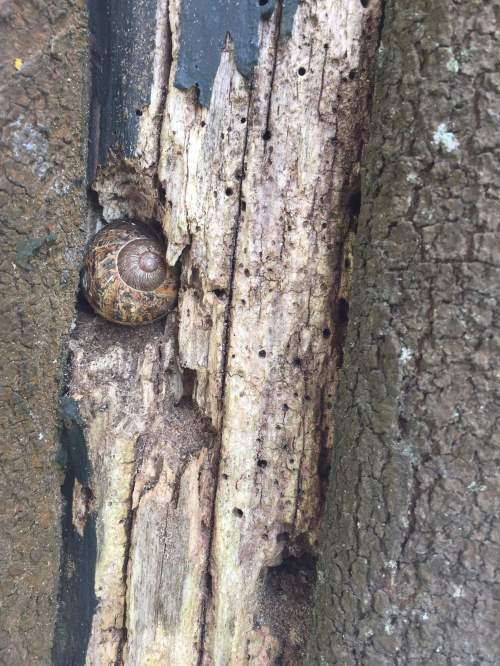
I happened across this little snail in a tree the other day. It immediately caught my attention and got me thinking.

Look at it…..

Doesn’t it look a perfect fit for that space? Doesn’t it look like it fills the space it’s living in quite completely? Doesn’t it look like it’s adapted well to where it’s found to live?

So what about you?

Hans Georg Gadamer, in his “Enigma of Health”, discusses ideas of health and refers to the concept of “fitness” – but not just the fitness of an athlete – the overall concept of “fitness” – when something is just right, when it just fits well. There is something in that idea which speaks to us of health. When we are in the groove, in the flow, in harmony….when everything falls into place……

What would you say about the fitness of your life? How well do you fit your life? How well does your life fit you?

Then I thought about how this snail seems somehow to be living fully or completely within its niche. And I wonder what you’d say about that?

We all live with certain boundaries, limits, “the hand we have been dealt”, influences from Nature and nurture, from the past and from the future, which set the parameters of our potential lives. Aren’t those parameters immense? Aren’t they almost infinite? But do we stretch ourselves out to fill our available life-space as well as we can? There’s something there about flourishing I think. Not just growing and developing, or being “the best you can be”, but of constantly expanding, flexibly adapting, to manifest ourselves, to express our uniqueness in our own vast life-space.

Adaptation. That’s such a good word. I find some people use it in a negative way as if adapting is about compromise and being less than you could be, but I don’t see it that way. Adaptation is how we grow, how we develop, how we live. Adaptation is how all of Life emerges and flourishes. I think we can get caught up in military and/or capitalist metaphors too much, thinking about the world in terms of competition, territory, power, and aggression. But actually, although all those things do exist, seeing the world that way often goes hand in hand with ignoring the co-operation, collaboration, compassion and kindness which also exists.

And when it comes to adaptation, there’s a lot to be said for negotiating your life-space, rather than killing for it!

If integration can be defined as the creation of mutually beneficial bonds between well differentiated parts, then adaptation becomes a process of a living in a way which maximises the abilities of you and I to explore and inhabit our personal, unique, life-spaces.


Read Full Post »

« Newer Posts - Older Posts »