Feeds:
Posts
Comments

Archive for the ‘personal growth’ Category

passageway Angles-sur-l'Anglin

There are a lot of medieval villages in France and this passageway in Angles-sur-l’Anglin is typical.

Here’s what appeals to me about this view. I love the archway first of all. There’s something very appealing about the arch of a bridge or a passageway. I love the tunnel-like nature of the passageway too. You know the phrase about “light at the end of the tunnel”? Well, there’s light at the end of that tunnel and draws you towards it. You feel like you want to go that way, to follow the light.

Then there are the plants. Both the flowers up close (down on the bottom left of the photo), and those in front of the houses we can see in the light.

There’s an extra appeal from the easel someone has placed at the entrance. It stimulates my thoughts about creativity and about art, and so tunes me in to the aesthetic qualities of the scene. And it’s facing the other way! So there’s a mystery there. What is on the easel? You have to use your imagination to get the answer.

I also like the cobbles. I know it’s not much fun walking or cycling over cobbles but there’s something very pleasing about them and that got me wondering about the Japanese “wabi sabi” aesthetic which doesn’t try to make something “perfect”….or at least only perfect in the way that Nature is perfect. There’s something of that in the appearance of most of the buildings in these old villages. There’s nothing shiny or sparkly or gleaming about them, and that gives them a greater quality of age and having been lived in.

Finally, I like the contrasts of the light and shade. The one needs the other and together they make something that feels very whole and appealing.

Read Full Post »

south of Genté

I like the panorama function on the iPhone.

Here’s a shot I took yesterday standing at the viewpoint just above the village where I live.

There’s a long-standing philosophical concept referred to as the “view from on high” (or, variously, “the view from above“, or even, the “view from Sirius“) which I really like.

It refers to that ability we have to change our perspective. It’s not just about taking an overview so you can see better the context of whatever you are dealing with. It’s also a good way of managing stress.

When we are in a stressful situation it can become quite overwhelming. It can be difficult to “see the wood for the trees”! (another variation on this theme). Often the best way to defuse a situation is to pause, and see if we can put this issue into a bigger context. Doing that can reduce the intensity of the stress within seconds.

I think this works partly because it’s a way of changing our focus. Remember that what we focus on always gets bigger!

Read Full Post »

Bench with tree or tree with bench

When did you last just sit? And where was that?

Do you have a favourite place to sit? And what do you do while you are sitting?

When I was a busy GP in Edinburgh I’d often drive through Holyrood Park on the way from one house call to another, or one clinic to another, and if I saw someone sitting on one of the park benches….just sitting….I’d get a sudden longing. I’d think “How great to be able to just sit”.

In our busy lives, we’re always doing. In the midst of that we are encouraged to “live in the present moment”, to learn to be “mindful”, learn how to meditate, learn to “soyez zen” (as I’ve heard it said so often in this part of France).

I know it’s important to be active but I also know it’s important to slow down sometimes (I have a whole series of posts on verbs…. Here’s one on slowing down) . Yes, maybe to meditate. Maybe to focus on my breathing. Maybe to day dream even.

Sometimes I go outside and sit down under the mulberry tree, listen to the birdsongs around me, look at the blues and greens and other colours in the world around me, breathe deeply and fill my lungs with the clear air, close my eyes and feel the warmth of the sun on my skin.

Sometimes I practice some form of meditation, sometimes Heartmath, sometimes I just let my consciousness flow, drifting from a sensation to a feeling to a thought.

I find some of my best ideas arise in those moments and I’m reminded of David Lynch talking about TM and diving for the big fish….

ideas are like fish. If you want to catch little fish, you can stay in the shallow water. But if you want to catch the big fish, you’ve got to go deeper. Down deep, the fish are more powerful and more pure. They’re huge and abstract. And they’re beautiful. Everything, anything that is a thing, comes up from the deepest level. Modern physics calls that level the Unified Field. The more your consciousness – your awareness – is expanded, the deeper you go toward this source, and the bigger fish you can catch.

(from David Lynch’s “Catching the Big Fish: Meditation, Consciousness and Creativity”)

Seriously, if you are busy doing all the time, you aren’t going to catch the big fish! Pull up a chair, sit on that bench, and “take a moment”. Who’d have thought it? Moments are there for the taking!


Read Full Post »

out there

The skies above this part of the world are often very clear so I’ve taken to star gazing at night when I can. Wherever I point the telescope it shows me more stars than I ever knew existed. It’s hard not to be humbled by the immensity of it all. But what struck me last night as I looked at the stars was how much I didn’t know.

It’s not a new thing for me to wonder about what I don’t know. I remember years ago reading an article in the British Medical Journal about medical education saying that all the best ongoing education starts with saying “I don’t know” – yet that was the one phrase we were all terrified to say as we our teachers singled us out to ask us questions on teaching ward rounds or in the lecture theatre. It’s a phrase which brought shame and condemnation. If you didn’t feel an idiot before you said it, you sure did afterwards! So, it was refreshing to read the opposite – to read the idea that only if you could say “I don’t know” could you open up the chance to learn something.

Many, many years later I came across the works of Montaigne, and was delighted to find that one of his most used phrases was “Que sais-je?” (not exactly I don’t know, but “what do I know” – still a humble admission of the limits of personal knowledge).

Throughout my career, although I practiced as a holistic doctor and was fortunate enough to work for much of my life in a service which prioritised time spent with patients, I often found myself saying to patients that even if they’d told me things they’d never told another soul (and that was a common remark made by patients), I thought it took a lifetime to try to really know yourself, let alone another person, so although I was about to share some insights with them about what was happening in their life, those insights were limited by the small amount I knew about them. You see, how much you know is always a relative term, but it surely is always (in the bigger scheme of things) a small amount.

When I posted yesterday about the Japanese lantern I had to check out on wikipedia just what those lanterns were and yet again I was faced by having to say to myself that I didn’t know enough about botany.

Strange that that awareness and the sharing of it is still something which comes with a discomfort, because, really, I believe that the world would be a much better place if we were all more aware of the fact that what we don’t know is always so much more than what we do know.

While I was writing this, Hilary (who didn’t know what I was writing about) read out a quote to me –

The problem with the world is that the intelligent people are full of doubts, while the stupid ones are full of confidence.

……Charles Bukowski

Earlier today, what provoked me to write this post was reading the following quotation from Parker Palmer on the Brainpickings site

What I really mean … is be passionate, fall madly in love with life. Be passionate about some part of the natural and/or human worlds and take risks on its behalf, no matter how vulnerable they make you. No one ever died saying, “I’m sure glad for the self-centered, self-serving and self-protective life I lived.”

Offer yourself to the world – your energies, your gifts, your visions, your heart – with open-hearted generosity. But understand that when you live that way you will soon learn how little you know and how easy it is to fail.

To grow in love and service, you – I, all of us – must value ignorance as much as knowledge and failure as much as success… Clinging to what you already know and do well is the path to an unlived life. So, cultivate beginner’s mind, walk straight into your not-knowing, and take the risk of failing and falling again and again, then getting up again and again to learn – that’s the path to a life lived large, in service of love, truth, and justice.

I couldn’t agree more.

Read Full Post »

freesia

Beauty.

Pretty undefinable really, but obvious when we see it.

This is certainly one of the most beautiful sights I know – rain drops hanging from the buds of a flower.

I’m looking forward to these buds blossoming into full flowers too, because the scent of the freesia is, to me, one of the world’s most beautiful scents.

What beauty have you stumbled across today? Did you take the time to enjoy it? I recommend it.

Immerse yourself in beauty today – even if only for a few seconds (I recommend a LOT longer if that is possible!)

Read Full Post »

hollyhock

It would be easy to get lost in the petals of this flower.

Isn’t it just astonishing?

The curving shapes, the layers, the shades and tones of colour, the light and the shadows.

Sometimes, in our busy, bustling lives, it’s good to stop for a moment. Still the mind by focusing on just one small part of the world – in this case a single flower, close up. Just let yourself take the time to gaze, to explore, to wonder.

Flower meditations are easy to practice – you can do them just for a few seconds, or you can take a few minutes. It’s up to you.

Try it and see how you feel. Because as well as the flower itself being a great wonder, the engagement of your focus and attention changes what’s happening inside you as well…..and that’s the extra bonus of a flower meditation….becoming aware of what’s changing inside you.

Read Full Post »

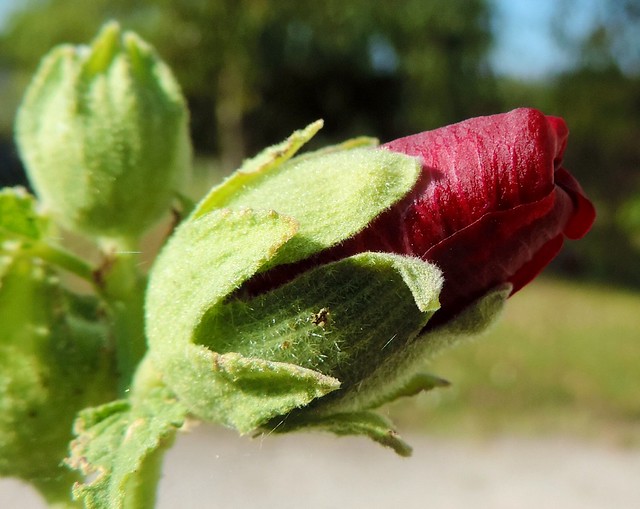
hollyhock

What makes this rose special? (Ah, some of you will be looking at this saying, “that isn’t a rose, it’s a hollyhock!” But a hollyhock in France, and there are masses of them here in the Charente, is a “rose trémière”).

Well, it’s special to me, because it’s growing in my garden and I’ve become pretty fond of all these incredible flowers in this garden.

When I think of roses now I think of the story of the Little Prince, and in particular, the section of the story where he meets the fox, and learns the secret the fox has to tell him.

The secret, apart from the much quoted “what is essential is invisible to the eye”, is that we make individuals special to us by creating relationships with them. In the story, the fox asks the Little Prince to “tame” him, and I tripped up over that word a few times (even checked out all the possible means of the original French word “apprivoiser” that I could find). I don’t really like the word “tame” as it seems to include changing the creature which is “tamed” to make them docile, and subjugated in some way. However, in the context of the story, it is clear that what is meant is how we create special bonds by paying attention, caring for and looking after another, and that when we do that, that person, or animal, or plant, becomes special to us. He, she or it becomes unique.

That might not seem that comfortable a thought at first. After all don’t we like to think of ourselves as compassionate and caring, so we should be able to “care for” or “care about” pretty much anyone? Well, that may be true, but any potential we have to do that remains just that – a potential – until we create actual, real bonds with actual, real individuals.

In the story, the fox explains to the Little Prince that the garden full of roses shouldn’t make him sad that his rose is not as unique as he thought. His rose, in fact, is still unique, and how the Little Prince feels (or doesn’t feel) about all the roses in the garden even emphasises that point.

Here’s a nice reflection on this whole issue.

So, as we create a relationship with the particular – with this rose, with this creature, or with this person – we reveal their uniqueness. And as we continue and develop that relationship, they become even more unique, even more special to us. That’s one of the essential kinds of bonds we have to make to deepen our experience of living in this world.

And it takes nothing away from the fact that, potentially, any person, any flower, any creature can become special to us.

Read Full Post »

I live in a typical Charnetaise house –

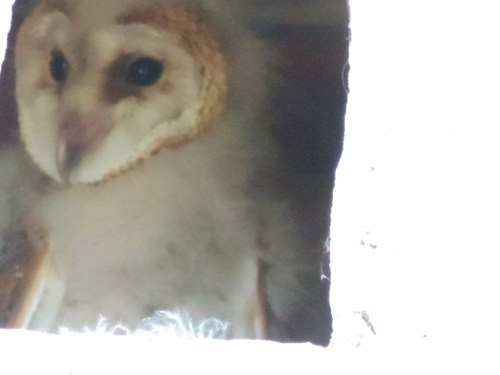
Can you see those two little arch-shaped holes/windows up on the top left? Well, there’s been such a lot of hissing coming from there in recent nights, and a bit of research revealed that the noise is the sound of barn owl chicks (barn owls don’t hoot, they hiss!)

Today I thought I could just make them out when I stood under the mulberry tree, and with a lot of patience, a camera on full zoom maxed up to a 3200 ISO setting, I managed to get these photos –

and

Wow!

I mean – wow!

OK, not exactly nature photographer of the year material but WOW!

This is just the kind of thing which makes an ordinary day an extraordinary day!

Read Full Post »

DSCN4108

In my twelve monthly themes, August is the month of travel.

I came up with this as the theme for this month because in France every August is the month of the “grand depart” – it’s the beginning of the annual holidays for thousands and the roads, airports and ports become very, very busy this month (starting this weekend)

I am a great believer in travel. I love to visit other places, encountering other cultures, traditions, foods, architecture, art and history, as well as other natural environments from the one I happen to live in. Where I live now is vine country and to visit a forested area, a mountainous region or the coast can be a stimulating change.

I think most of us also need a break now and again. We need to step out of the routines and habits and demands of our daily lives to be able to see them from “on high“. And we also need to rest.

I was taking photos of clouds the other day (as I do!) and I noticed this plane’s trail with a strange and clear break right in the middle of it and I thought – what a brilliant visual metaphor for August – travel AND taking a break!

So, where are you going to go? When are you going to take a break? Even if it’s just for a day, or a weekend, I think it’s important.

Read Full Post »

Sunlit raindrops on hollyhock
Ever since I was a child I’ve had a fascination with science. For me, science was, and still is, a form of exploration. It’s about learning and knowledge. Finding out how something works, how a creature lives, or learning the names of clouds, constellations, trees and birds. I’d say science is about wonder and curiosity.

Many, many years later I came across the writings of the French philosopher, Gilles Deleuze, who wrote that there were three ways to think – science, philosophy and art. I was a bit surprised when I first read that, but the more I came to understand it, not only the more it made sense, but it became, for me, a basic tool.

Briefly, he said that science was thinking about function – how something worked; philosophy was thinking about concepts – our frameworks and our world views; and art was thinking about percepts and affects – what we perceive and what we feel. I took all of that into my daily medical practice, figuring out what wasn’t working in somebody’s body, mind or life; developing my concepts of health, illness and disease; and working with both what I perceived and what I felt in a consultation.

A couple of years ago I had an experience on my daily commuter train which really woke me up – you can read about it here – but, let me just rehearse it for those of you who don’t want to diverge off down a link – I was sitting next to a student who seemed to be revising notes (I presume for an exam. Her subject was “clinical research” and what struck me was her key points about the “scientific method” – they were – Observation, Description, Explanation, Prediction and Control.

Well, I am very, very keen on observation and I like to describe what I observe. I’m also very keen on finding explanations for things (I think one of the definitions of a doctor’s job is “a person who tries to understand” – but that’s another story!). I also know that I was taught how to diagnose (which I see as a level of understanding) and to prognose (predict).

To be honest, neither diagnosis nor prognosis are nearly as simple as they are often taught. The older and more experienced I became the more I came to realise that diagnosis is never complete (you can always understand more deeply and/or more widely), and that prognosis is about possibilities and probabilities not about certainty.

So I was particularly surprised to find the student’s notes on “clinical” research describing the final step of the “scientific method” as “control”.

Since then, I’ve come to see that for many science is exactly about this – control. Scientism, the belief that everything can be explained using science, seems to be about power. This way of understanding and approaching science seems to be what has been adopted, not only by the industrial-commercial-military complexes, but by all those who seek control over others and over the world. It seems to be based on an understanding that if we take enough measurements, collect enough data, analyse it with statistical and computing tools, then we will be able to make accurate predictions which allow us a high degree of power to control.

Well, for some reason, I woke up this morning with this phrase in my mind – “The Power OR the Glory – two approaches to science” – and so, this post!

I’d like to re-state the case for a science based on wonder and curiosity instead of one based on power and control. For me, the joy of that scientific method is the revelation of, and the revelling in, the GLORY of this Universe and of our lives.

I was looking for some paper to start to jot down some thoughts about this and stumbled across an old notebook where I’d made some notes about the book “Planet Narnia” by Michael Ward (haven’t even thought about that book for a long, long time) – and here’s what I read –

The glory of science is to progress as new facts are discovered to be true, and such progress meanest that ‘factual truth’ is a provisional human construct. Which is why the wise man does not think only in the category of truth; the category of beauty is also worth thinking in.

Wow! How does that happen? How do I stumble across exactly the phrase “the glory of science” in a notebook stuffed away in a drawer full of scrap paper on exactly the morning I wake up with the phrase “The Power OR the Glory – two approaches to science”? In fact, who on earth wakes up with a phrase like that in their heads anyway? OK, I do!

Seriously, there’s way too much to explore there than I can write a post about this morning, so let me just finish with what I wanted to say in the first place –

There are two approaches to science – power (what I’d say is our current dominant model) OR glory – based on a humble curiosity and a joy in the awe and wonder of this life.

My hunch is, we could do with cultivating more of the latter, and less of the former!


Read Full Post »

« Newer Posts - Older Posts »