Feeds:
Posts
Comments

Archive for the ‘philosophy’ Category

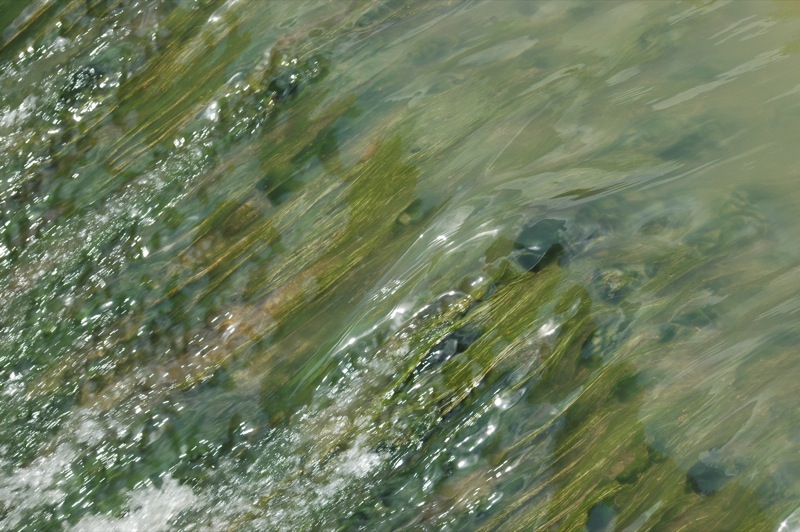
For me, this is a photo of flow. It’s a still image, and you might say if I wanted to illustrate flow I’d be better sharing a video but I like the juxtaposition of stillness and movement which this single frame shows us.

There’s a lot of advice to live in the present moment, to “be here now”, to draw your attention into the current time and space. I know, I’ve shared such advice many times. I get the value of it. But there’s a paradox at its heart which we often ignore.

Life, time, and reality, is not divided into neat frames. It doesn’t exist as a series of isolated, bounded, limited, even disconnected pieces. So when we stop to think about what we actually mean by “the present” or even “this moment”, it rapidly becomes hard to pin down. Does the present moment last for a minute? Does it last a few seconds? Does it last only for a fraction of a second? Isn’t it the case that the very act of reflecting on the present turns into a reflection on the past……ok, maybe the immediate, very close, past, but the past, all the same. And where does the future come from? If it isn’t sitting waiting for us like the next train station along the line (and I don’t think it is), if it is, rather, “emergent”, that is created out of the present moment, then, again, as we stop to reflect on this moment, we pretty quickly find it’s being changed by the future unfolding before our very eyes.

No, the truth is that life, time and reality are more like flow than frames.

I’ve wondered about that too when looking at a river. Exactly what is a river? If it’s the water in it then that water is constantly flowing right by. It doesn’t stay. If it stayed, it wouldn’t be a river, it’d be a stagnant pond. (actually even stagnant ponds don’t stay the same!) So is it the course of the flow of the water? In other words the actual path which the water traces out? The banks of the river? Not so sure about that either, because if you look at old maps, or even some aerial photographs, you can see that the so-called “same” river changes its shape and direction continuously, sometimes in small ways, and at other times in starkly dramatic ones!

The Italian physicist, Carlo Rovelli, says that

A stone is a prototypical “thing”: we can ask ourselves where it will be tomorrow. Conversely, a kiss is an “event.” It makes no sense to ask where the kiss will be tomorrow. The world is made up of networks of kisses, not of stones.

In other words, the way out of this dilemma is not by trying to pint down our experience, label it a and stuff it into separate boxes. Instead, we just need to think of the world being made up of “networks of kisses”. Life is “made” of “events”.

Events are happenings. The don’t have terribly easy start and finish points, and even those points which we can see turn out to be inextricably bound up in networks of other relationships and happenings. Nothing exists in isolation.

I like this view of life. I like the practice of becoming more aware in the present by becoming more aware of the flows of energy, information and forms around me. I like the focus on “becoming not being” – as you’ll see at the top of the blog.
Read Full Post »

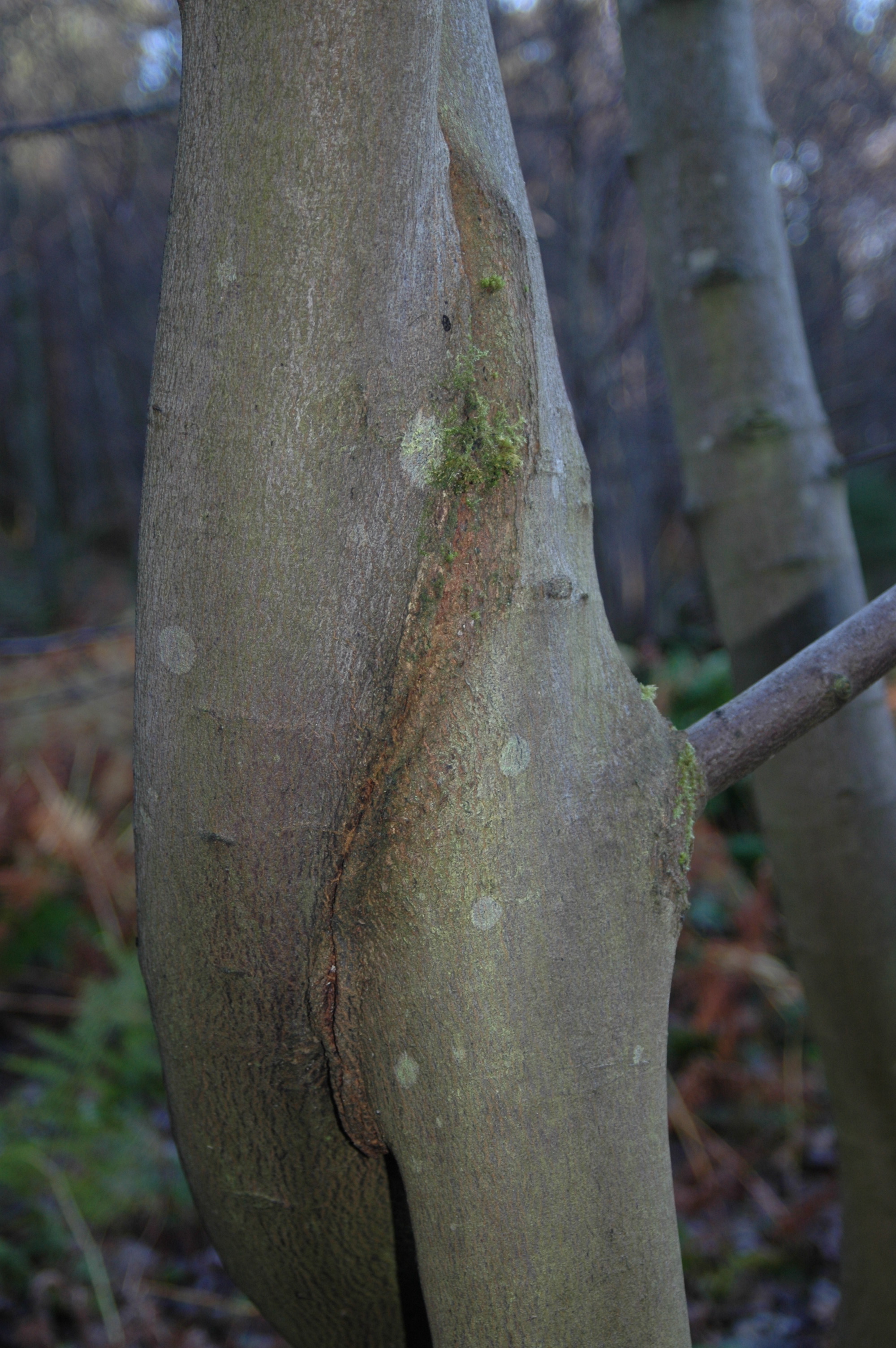
When I came across these trees in a forest I was stopped in my tracks. The forest was quite a wild one, and I don’t think these two trees were grafted together artificially. What I mean is I don’t think there was a human hand involved. Which makes it all the more remarkable, because it looks like these two trees got really close to each other, starting kissing and never stopped!

Whatever the mechanisms involved I just love this image. It speaks to me of that most essential natural drive – to connect…..not just connect, but connect lovingly.

There is a key phenomenon which underpins all of evolution. No, not competition, which is what you’d think from the dominant orthodox view. Competition plays a role, but without integration, there would be nothing….no growth, no development, no evolution. Integration is the creation of mutually beneficial bonds between well differentiated parts.

Let me say that again. Integration is the creation of mutually beneficial bonds between well differentiated parts.

How did Life progress from single celled existence to the vast, diverse, web of complex multicellular organisms? Only by the individual elements getting together to make bonds which would be beneficial to both.

This drive towards integration is a loving drive.

It’s a movement based on “bienveillance” – on meaning and/or wishing well. It’s a drive to support and be supported, to nurture and be nurtured, to love and be loved.

Without these loving connections, we simply wouldn’t exist. Maybe it’s time to put competition into its proper place…..and that’s not THE most important place. I think we have to learn to live by loving instead of dominating, by co-creating rather than trying to come first. If we are going to compete let’s put that competition into the context of improvement…..of supporting all of us to grow, to become stronger, more resilient, to improve. Not to destroy, dominate, control, and grab the most for ourselves at the expense of the wellbeing of others. That old way just isn’t working.

Read Full Post »

Can you think of any works of art which changed you? Any which changed your worldview? Changed how you understand yourself, your life, your world?

I was reading about Stendhal Syndrome the other day, which is the phenomenon of overwhelming emotions and physical symptoms experienced by some people in front of particular forms of art. Stendhal described it in relation to his visit to the Basilica of Santa Croce –

I was in a sort of ecstasy, from the idea of being in Florence, close to the great men whose tombs I had seen. Absorbed in the contemplation of sublime beauty … I reached the point where one encounters celestial sensations … Everything spoke so vividly to my soul. Ah, if I could only forget. I had palpitations of the heart, what in Berlin they call ‘nerves’. Life was drained from me. I walked with the fear of falling.

What grabbed me about this concept is how art can have a profound impact on us – not just on the way we think, the emotions we feel, but in changing our inner physical reality…..speeding up the heart, releasing a whole cascade of different hormones, causing us to feel a little breathless, a little light headed, to give us butterflies in the stomach, to make us weak at the knees…….but it actually does something else too….

Every experience we have sets off patterns of activity in the neurones in the brain. In neuroscience there is a phrase used which is “what fires together, wires together”. That’s a description of how these patterns of activity, when repeated, actually change the shape of the microstructures of the brain. Art, literally, can sculpt our brains. No wonder it can change us!

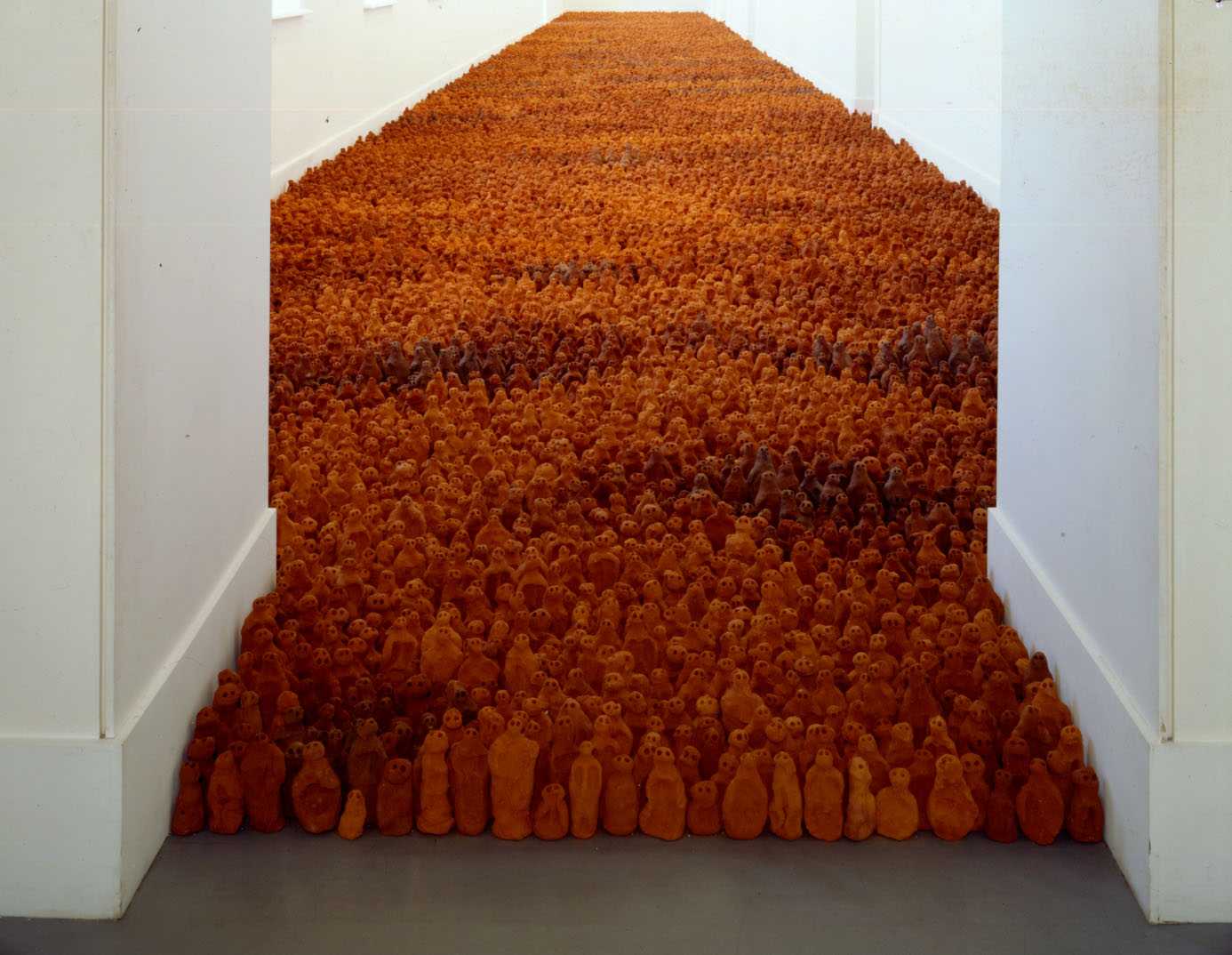
Well, this image here is of Anthony Gormley’s work entitled “The Field”. I saw this for the first time in Inverleith House, in the middle of the Royal Botanic Gardens in Edinburgh. I stood in the doorway and looked at these thousands of little creatures, all looking up at me, all the same. Then, as I looked a little more closely I realised that each and every model was different. Not only were they not all the same, but every one of them was unique.

That’s it, I thought! This is the paradox at the heart of my work as a doctor. Every single patient who I meet has some characteristics, some symptoms, some signs of change in their body, in common with other patients I’ve met before. That’s why I needed to learn anatomy, physiology, pathology, the natural history of disease. That’s why I had to learn how to make a diagnosis. But, at the very same time, every single patient who I meet is unique. Every single patient has a story to tell me which I’ve never heard before because nobody has lived an identical life to them. The diagnosis of the “pathology” or “disease” isn’t enough. I need to understand it in the context of a life story, and a present life. What exactly is this person, today, experiencing? How has this present experience and change come about? What sense do they make of this “illness”? What does this “illness” mean to them, mean in their life, mean to the others in their life?

Well, that became the core of my understanding of the Practice of Medicine.

But it went further than that, because I realised, just as quickly, that this insight wasn’t relevant only to my work as a doctor. This is the essence of what it is to be a human being. We share a lot, you and I. But we are also unique, you and I. We can’t be reduced to a single characteristic, demographic, or “data set”, but we can be gathered into those groups…..we can find some common values, beliefs, desires in those features and factors. But we can never, ever, stop there. We can never rest in our understanding of a person by summing up their data, by figuring out what group we want to put them into. We have to discover the individual. What makes this particular person different? What is distinct and different about this person’s life story?

Even as I write this today, I find this excites me. It delights me. It moves me. It activates my thinking, my feelings, even my body.

Art really can be that powerful.

Read Full Post »

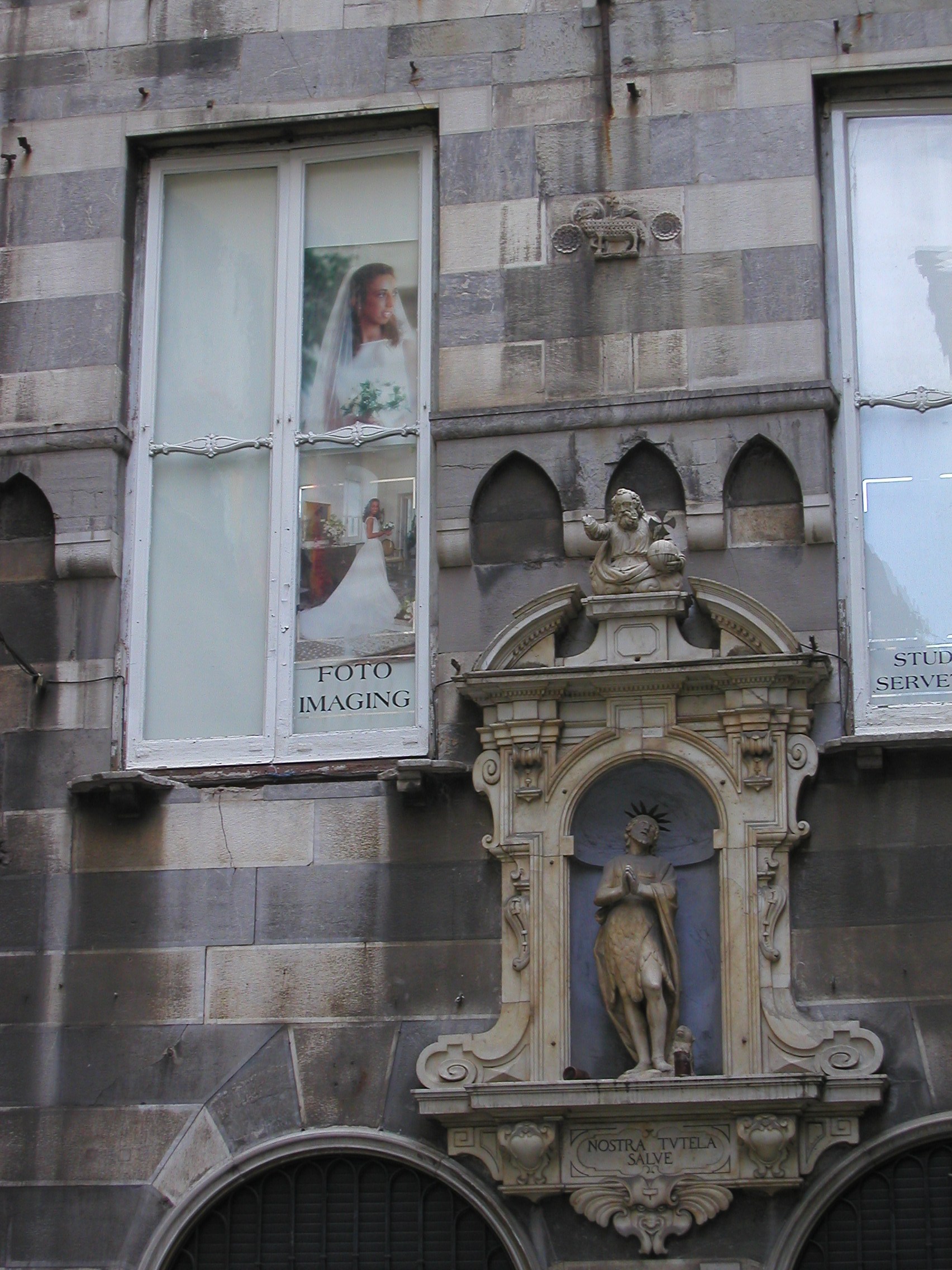
What caught my eye here was the juxtaposition of the advert for the photographer and the statue in the alcove.

The older work is the statue. It’s a representation of prayer. France, Italy and Spain are three of the countries I know best on the continent, and all three share a rich religious tradition. To be more exact, they share a Catholic tradition. Representations of the crucified Christ, of the Virgin Mary, and of various saints can be found everywhere…..not just in churches and cathedrals, but on street corners, city centres and in small villages. What struck me about this particular statue was the act it portrays – prayer.

I know there are many different kinds of prayer, not least prayers of intercession (asking for help), and prayers of gratitude, but the image of the wedding photos in the windows just next to it led me quickly onto thinking of dreams, of hopes and desires. So, that context drew me into the consideration of prayers of that type – prayers of hope.

I don’t think we can underestimate the importance and the power of hope. I don’t think people can live without it. I’ve seen that many times in my medical career. People with no hope slip into despair and decline. I once I had a patient I knew say to me that her husband had just been diagnosed with cancer and that the doctors had given him six months to live. I asked her how she felt about that and her response surprised me. “Angry”. I asked why, and then came the bigger surprise. “How come he gets to know how long he’s got and I don’t know how long I’ve got?” Well, I didn’t see that one coming. However, it did lead to an interesting discussion about prognosis and what we can, and can’t, predict. Too often predictions like that turned into self-fulfilling death sentences. Because the reality is that, in any individual, we cannot make such accurate predictions. I learned that the hard way as a young doctor.

But let me return to prayers and dreams. I’m sure you’ll have come across the idea of visualisation? Of creating “mood boards” or “vision boards”? Of creating “goals” and “targets” even? Well, those are psychological methods we can use to create the life we want to lead. And isn’t that one of the things which prayers and dreams can do?

Have you noticed how many athletes seem to say a short prayer before the start of their race? Have you noticed how many perform an act of gratitude to the heavens, or to their god, when they win? I’m sure in our more materialistic, so-called rational, times, that prayer, belief, faith and dreams are dismissed more than ever before, but I always wonder if that’s really a rational response?

Because without hope, without dreams, without prayers, without vision, then what kind of life can we co-create?

My answer would be – the kind of life other people create for us! “Heroes not zombies” folks! We human beings really are the co-creators of our own lives. A person cannot be reduced to molecules and random events if we want to understand them. More than that, I suspect that fear and resentment are powerful factors in creating the kind of world we live in, and that there are plenty of players out there who know exactly how to stoke up both.

So, I’m a fan of prayers and dreams. I’m a fan of dreams and visions. I think that what we imagine, what we put our energy into, what we pay attention to, all contribute to both our personal experiences of daily life and to the reality of the world that we share with every other living creature on this little planet.

What kind of life do you want to lead? What kind of world do you want to live in? One focused on fear and despair, or one focused on love and hope? I do think we have a choice. Not in an “either/or” way, but in what we give emphasis to, what influences our world view, what lenses we use to understand the world, and as an act of co-creation.

Read Full Post »

I managed a trip to the coast this week, for the first time in months. Walking along the sandy beach listening to the sound of the breaking waves and breathing the salty, fresh air, was a real tonic.

There were hardly any other people on the beach, and that particular beach is so big that you can have a couple of hundred people on it and it still feels almost deserted.

One of the things a lot of us like to do at a beach is to look for shells, driftwood, and whatever else the sea might have thrown up onto the sand. But something else which always catches my attention is a pattern. I love to see the patterns left in the sand by creatures who have moved across it, trails left by rivulets of water as they run back to the ocean, impressions imprinted by seaweed and shoes……you name it.

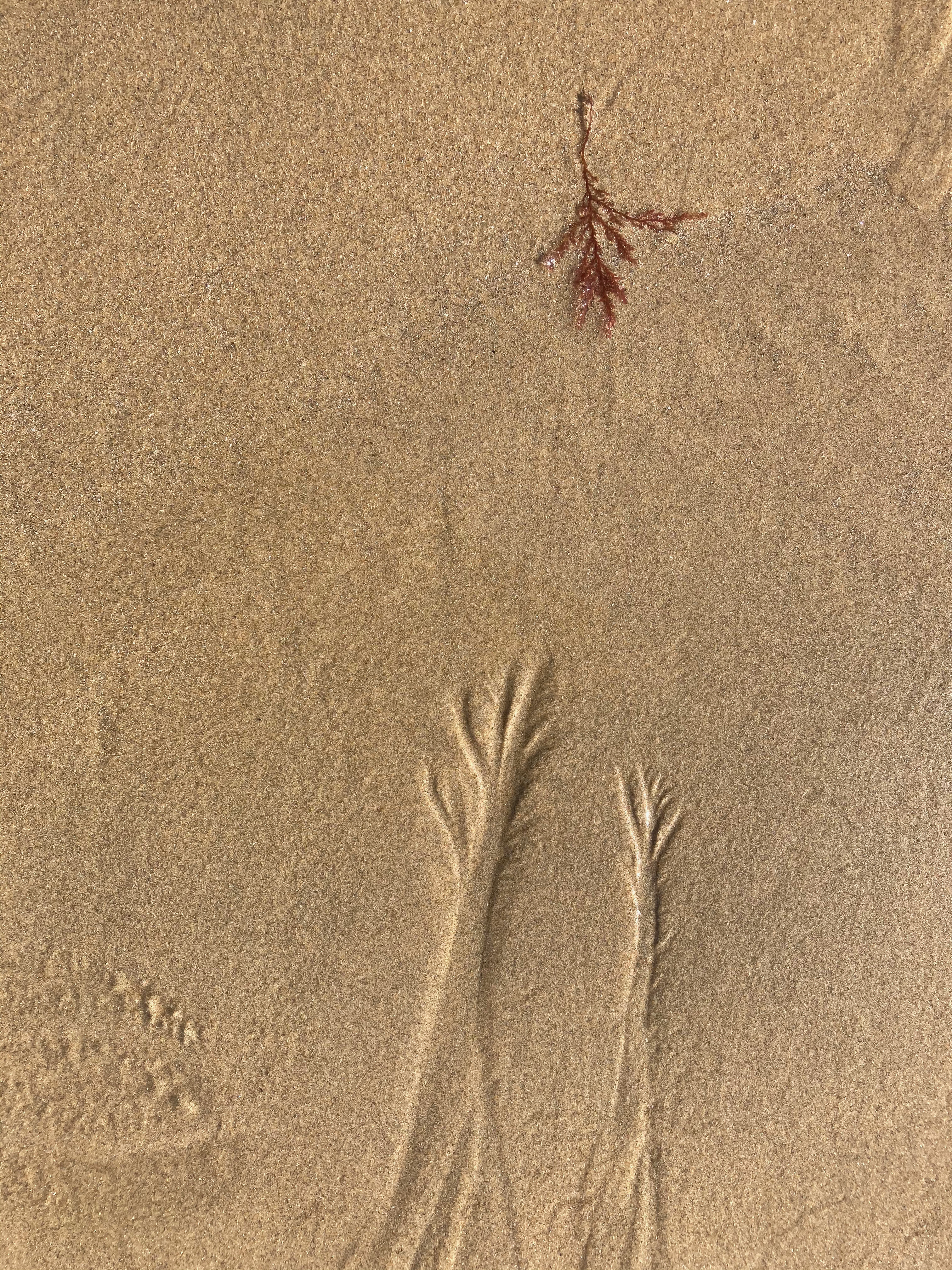
This photo today shows you one of the patterns I stumbled across. Actually there are three elements on this sandy canvas. There is the little piece of red seaweed, demonstrating the classic branching pattern of trees, plants, our lungs, our blood vessels, the way streams gather together to make rivers…..and so on. Then opposite that are the marks left by what? Water trickling away back towards the ocean? Seaweed which has been washed away? I’m not sure. Actually, when I look at it in this photo, that pattern is strangely convex. It seems to be sticking out of the sand. But when I was there it looked convex, grooves imprinted into the sand. The third element is the trace of a shoe. Someone before me stood here. Perhaps. Stood and looked at this very pattern. Or else they were just walking by and only by chance did they miss standing on the patterns in the sand. (I think it’s the former because I looked and couldn’t see other prints to the right of the pattern, so I saw no evidence that someone had just walked right through it. Besides, I like to think that someone else also experienced that “stopped in your tracks” effect of this piece of natural sand art!)

It’s the first two elements which really interest me. There is a sort of symmetry between them. There is an echo, a mirroring almost, between the red seaweed and the tracings on the sand. The similarity is so striking to me that I can even imagine that the sand and the seaweed are reaching out towards each other…..stretching out long thin fingers to almost touch each other.

I see this and I think “attraction”. Perhaps the most basic characteristic of the universe. There is a universal movement of elements, particles, and objects towards each other….to connect, form bonds, make relationships, to become attached to each other.

Curiosity is one of my strongest features, and what is curiosity other than an attraction to whatever it encounters? A drive to get closer, to understand, to connect, to make a bond?

Yes, I know, some of you will be thinking, hey, wait a minute, what about repulsion? Because don’t a lot of things repel each other, rather than attract each other? That’s true, repulsion too, is a fundamental characteristic of the universe. In fact you could say there’s a dynamic, constant balance between attraction and repulsion, which lies at the art of all the phenomena of the universe. Everything that exits is held in an ever changing, constantly moving tension between attraction and repulsion.

But if you stand back a little from that ongoing dance of attraction and repulsion, you can see what holds both of those opposites together…..a relationship. It’s the fact that they are connected which enables the interaction. Or the fact that they interact which enables the connection!

Either way, here it is, right in front of us, in the sand……..the essential nature of reality…….connections.

Read Full Post »

I must admit I have a penchant for bridges, and I have several photos of beautiful ones I’ve seen in different parts of the world. It’s pretty amazing how different a bridge can be. You could say that every single bridge is unique. Even two bridges of the same design will be built over different rivers, or different parts of the same river, and will connect two quite distinct, and particular areas of the Earth (banks, fields, towns, or whatever)

I think we need bridges more than ever. We need to make better connections between ourselves, and between human beings and the rest of the living world. In fact, between human beings and the rest of the entire planet.

Building bridges are about creating integrative relationships – the creation of mutually beneficial bonds between well differentiated parts. In other words they are about connecting diversity and difference in ways which enhance, support and nurture both of the parts.

We need that physically. We need it emotionally. We need it socially. We need it metaphorically and literally.

Here’s to more beautiful bridges! Let’s make the connections!

Read Full Post »

Yesterday I wrote about “unfurling” and this morning I came across this photo in my library.

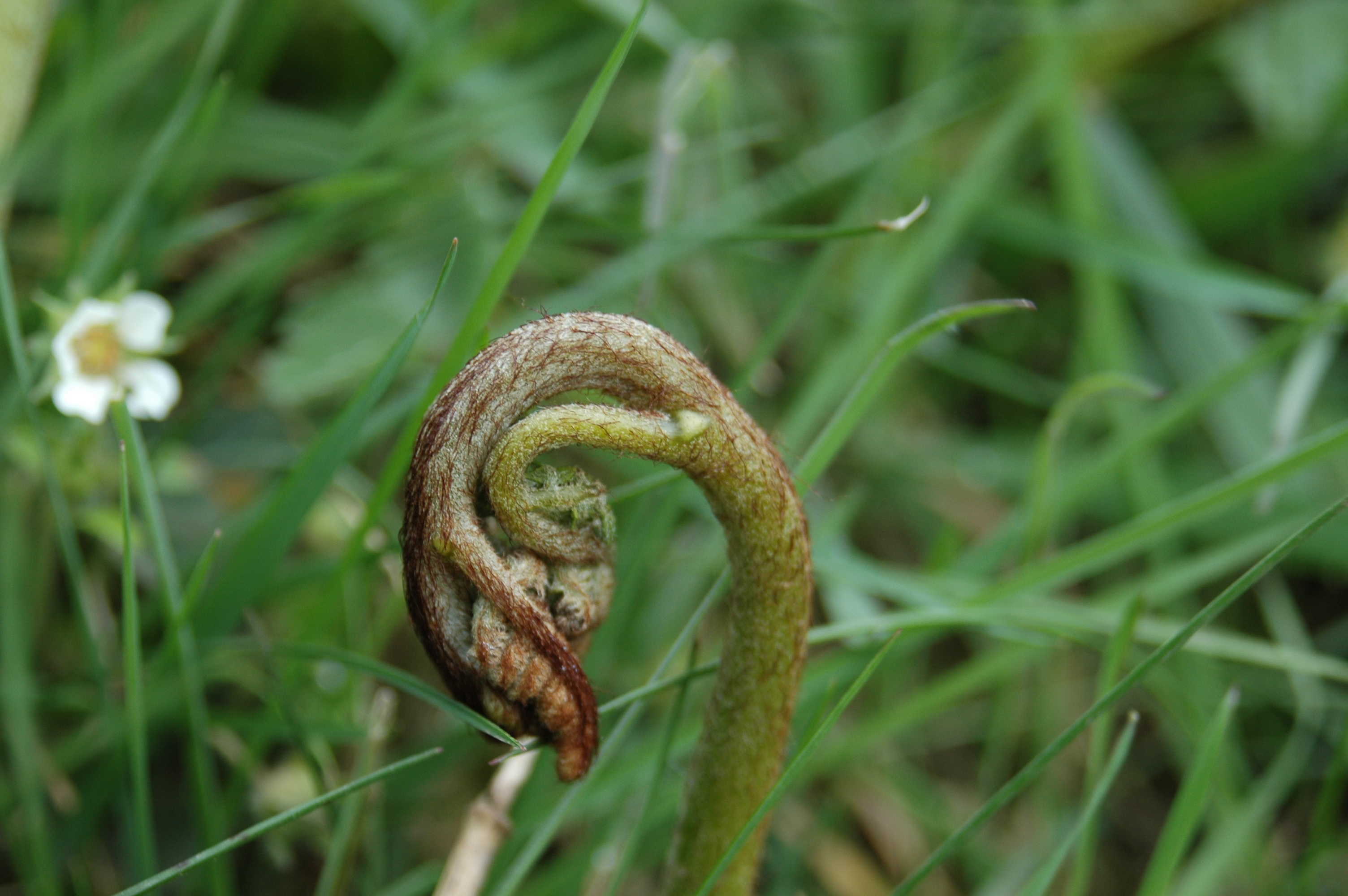
It’s another example of this process we see everywhere in Nature – the opening up of a bud as the flower expands itself at the end of a stalk. It’s an “unfolding”, a “revealing”, or even, a “revelation”.

Really at this stage of a flower you get a strong sense of what is to come…a strong sense of potential. But it’s not quite there yet. It’s in the process of getting there. I like images which capture that concept because I have long been taken by the primacy of “becoming” over “being” – see the phrase at the top of the blog “becoming not being”!

I first encountered the importance of the concept of becoming in the works of Giles Deleuze, but having seen it there I went on to see it everywhere. Really, as I understand it, it involves a significant, and important shift of focus from looking at objects with fixed dimensions to looking at experiences and events which literally unfold before your very eyes. When you shift away from seeing, or trying to see, reality as composed of discrete, separate, bounded parts…..like marbles in a sac……to seeing reality as composed of flows and connections, then you stop wanting to pin things down and fix them. You delight, instead, in the dynamic, living, changing, nature of the universe.

This thinking helped me understand my patients and their illnesses, because instead of looking for discrete pathologies, I became more interested in how those pathologies arose, how they were affecting the person in their everyday life, and trying to understand how to influence the direction and nature of their development into the future. I became less interested in “outcomes” because every “outcome” is an arbitrary point, and more interested in a “life” and a “life story”, and therefore far more interested in following that patient over many years, rather than seeing Medicine as a tool applied to a thing at a particular time – not “getting it done” but “understanding, supporting, encouraging and teaching” instead.

I don’t know if that brief summary is enough to help you see what a radically different way this is to live and to make sense of the every day, but I suggest you try it…….try to notice the processes of becoming, the unfolding, the revelations, the unfurling today, and then let your curiosity follow the threads back to the past and origins, as well as forwards, to potentials and maturity.

Read Full Post »

During this pandemic our horizons have been drawn closer, our worlds have become physically smaller and our social worlds have either diminished completely, or have been translated into the virtual world of messaging, video calls, and emails……something which can be enriching, even vital, but which still seem second best to the physical-social world of shared time AND space, and, especially of touch.

It’s a time where there’s a sense of collapsing into ourselves, of withdrawal, and of separation. Which is one of the reasons why this image is particularly appealing to me today. It reminds me of the fact that in Nature there are cycles and seasons. There are times, for example in the winter, when creatures and plants withdraw into themselves, hibernate, go dormant, on in old Scots “courie in“. In other words, there is a time in Nature when it makes sense to fold inwards, to snuggle, to curl up. But the appearance of a first crocus plant in my garden this week reminded me that there is another season around the corner – Spring – and that in the Spring time we see the opposite direction of movement…..a shift towards expansion, reaching up and beyond, of unfurling and unfolding.

I chose the French word “epanouissement” for my word of the year this year…..it means to flourish, to open up, to unfurl, in the way you see a plant move from the phase of a bud to a fully opened, multi-petalled blossom or flower. So I think of that word as I look at this fern unfurling.

I don’t think this unfurling motion is something we need to wait for. It’s not just that we are in winter and spring is around the corner (if you live in the Southern hemisphere, of course, you are in summer, and it’s autumn that’s just around the corner!).

No, I think that every day we can find a way to tune into this unfurling – this expanding, developing, growing, shift from potential to realisation. One way I try to do that is to deliberately choose two activities every single day – one activity of learning, and one of creating. Because I think learning and creating are our two most fundamental ways of growing and developing.

I have had a love of learning all my life, and my curiosity and appetite for discovery and understanding has only grown over the years. It utterly delights me to learn something every day. Amongst my learning activities I do language learning. Every day I learn a little French and/or Spanish. It’s become a habit (I use Duolingo to embed that habit) and I do it formally, following exercises, and informally reading in French, every day. I’m just a beginner at Spanish but I’ll move on to reading Spanish soon. I’m always learning other things too. Questions pop into my head as I live an ordinary day, and I pursue some of those questions online, using wikipedia, blogs, youtube, podcasts and articles.

I also love to create – for me that’s primarily photography and writing – but playing music is part of it as well. Well, in the creative areas of life, I find there is also always something more to learn – whether that be at the piano, on the guitar, on the computer, or in writing exercises.

So, I think unfurling happens all the time for we, humans. We just have to choose to become aware of it and give it some time and attention.

Read Full Post »

I think this skeleton of a leaf is beautiful. For me it reveals the often hidden, or difficult to see structures which underpin reality. But what it does most is make me think about the two forces of the universe….

The flowing force – the energies which vibrate throughout the entire cosmos. And the structuring force – which gathers some of the flowing forces together to make patterns, shapes, forms and objects.

I like this way of thinking. It’s definitely not new! The yin and yang forces of Chinese thought are sometimes described as “active” and “passive” and I can see how that relates to “structuring” and “flowing”. Others translate these forces into “masculine” and “feminine” and while I do love the ancient myths and legends, the rich symbolism of art throughout the ages, a lot of people find it difficult to apply gender to these forces, and, sadly, once you add in hierarchies and male-dominated culture, then the “feminine” seems to lose out to the “masculine”, so, for me, thinking of the “flowing force” and the “structuring force” is more helpful.

Clearly we need them both to be working in harmony, or in an “integrated” way with each other if we are to have the reality which we experience.

One of the key books I read which helped me understand these concepts was “The Crystal and the The Dragon” by David Wade. I highly recommend it. He uses the crystal as the symbol of the structuring force, and the dragon as the wild, flowing force. But “the universe story” as described by Thomas Berry in “The Great Work” is a brilliant, engaging, description of this same idea. Thomas Berry calls them the forces of “wildness” and “discipline”.

Whatever the metaphors, symbols and words you find work best for you, I think it really helps to understand and be amazed by the reality of every day life, if you raise your awareness of these two fundamental forces.

Try it, and see what you think…..

Read Full Post »

When I lived in Scotland the first snowdrops to appear each year always caught my attention. These small white flowers hang like little bonnets, which gives them the appearance of being discrete. They aren’t showy, or majestic, but they are obvious all the same. I think it would be hard not to notice them.

Here in France we don’t have snowdrops. Well, not in this part of France anyway. I’ve never seen them growing wild, and I’ve looked many times in nurseries and garden centres for the little bulbs so I could try growing some in my own garden, but I’ve never found them. Somehow, that makes them even more precious, and, perhaps, somewhat obviously, it gives them a new significance for me. I see them now as emblematic of the country of my birth.

Snowdrops don’t appear for long but they are one of those flowers which marks the cycle of the seasons. There are many other flowers which do that, of course, but the snowdrops seem to manage to break through the winter soil, push up their thin, delicate, green stalks, and unfold their beautiful white petals before most of the other flowers do. In that sense, they are like the beginning of something for me. I know that after I see the first snowdrops, the crocus flowers won’t be far behind, and already I find I’m starting to look forward to the daffodils and tulips.

Every flower is new, of course.

No individual flower repeats itself. Every year each unique, particular bulb wakes up, pushes upwards and shares the beauty of its own petals in its own time, its own place, and its own way. That reminds me of the classical spiritual practice of approaching every day as if for the first time……because that’s the truth…..this day has never been lived before. Everything you see, everything you hear, everything you smell, taste and touch, everything you feel, everything you do, will be for the first time today. It might be a lot like yesterday, but, actually, it’s different.

Starting your day with the knowledge that this day is a new day, and that every experience and event which occurs will happen for the very first time, opens up your potential to wonder and to learn. It opens up your curiosity and your consciousness, filling your day with discoveries, delights, and wonder.

All of that is good for the health of your right cerebral hemisphere – this is the part of the brain we use to discover novelty, to see things in their singularity, to appreciate the holistic nature of reality. And just as we develop muscles by exercising them, so we develop mental functions and neurological structures by exercising them.

New every time – a great way to increase the quality of your life, a great way to encourage growth, a great way to become enchanted again by this world we live in.

Read Full Post »

« Newer Posts - Older Posts »