Feeds:
Posts
Comments

Archive for the ‘philosophy’ Category

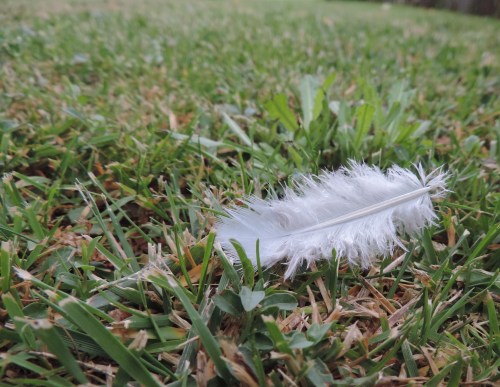
I remember reading that Paulo Coelho, the author, had a practice of starting a new book whenever he came across a white feather. I’m not sure if he still does that, or whether or not he always started a new book every time he came across a white feather……however, this has got me reflecting on the issue of beginnings.

Here I am, sitting in my studio office, near the French town of Cognac. It’s the second last day of August 2020 and we are now….how many months? into this COVID-19 pandemic.

I’ve had some recent experiences of thinking the pandemic was easier to cope with when we were in full lockdown than it is now. It seems that life was simpler because it was so constrained. Now there are an ever-changing host of regulations, laws and guidelines depending on where you are. Different in different places in the town, different in different towns, different in different countries. And the stats seem to be changing all the time as well now, as testing numbers increase, positive cases increase, hospital admissions and COVID deaths don’t increase…..just how widespread is this virus? Just how lethal is this virus? What are the best ways to minimise its impact? The answers to all these questions and more seems to change almost by the week now.

So this feels a particularly unsettled period. And, here’s a weird thing, so is the weather! I’ve never known a summer like this here. More wind, cooler mornings and evenings, high afternoon temperatures, unexpected showers, thunderstorms, and weather forecasts that are literally different between going to bed and waking up in the morning.

I find I can’t help wondering from time to time….”when is this all going to end?” Then, I realise, it might not end. The world might be changed by this. Life might be changed by this. We are not in a cycle of return where we will re-inhabit the past, pick up our “old ways” and carry on as if nothing had happened.

I think some people were thinking this way. Sure, a lot of people have talked about the “world after COVID” suggesting many things that could, and should, be changed. But others are more cynical and expect the predominant forces and power groups to steer things back to what suited them up till now.

The truth is none of us know. The truth is none of us can know. We haven’t lived through this particular event before and we haven’t even lived through an event which is “just like this”. We are still trying to understand what we are dealing with. And the future is never a place sitting like the next destination along the railway line just waiting for us to arrive. The future arrives as we live it. The future emerges from the present, from today’s choices and actions.

I got to thinking that maybe a bit like the “glass half full or empty” dilemma, maybe as life is lived it feels full of endings, but maybe it can also feel full of beginnings. Both are true. They are different perspectives. Isn’t there a saying somewhere about life being understood backwards but lived forwards? Something like that. How we make sense of things through reflection and memory, but how we live in a present which is constantly changing as possible futures come into being…..

So, maybe this as a good a time as any to concentrate on beginnings.

What shall I, what shall you, what shall we, start today? If the future really is like a path which emerges as we walk it, which path shall we take today? Which path will we start to create today?

This is my beginning. This is me just thinking of this. But over the next few days I’m going to devote some time and energy to this and ask myself, what shall I begin? How shall I begin to live now, in the light of this recent past, and this ongoing present?

Want to join me? Feel free. Share if you want, or just take some time this week to explore what you’d like to begin. Then begin.
Read Full Post »

Yesterday I shared a post about two forms of growth….unfurling (unfolding, opening, flourishing or blossoming) and connecting (reaching out to make bonds, relationships and links).

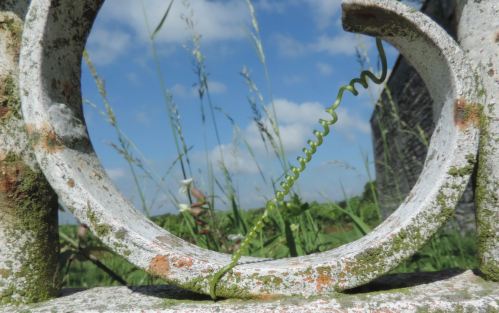
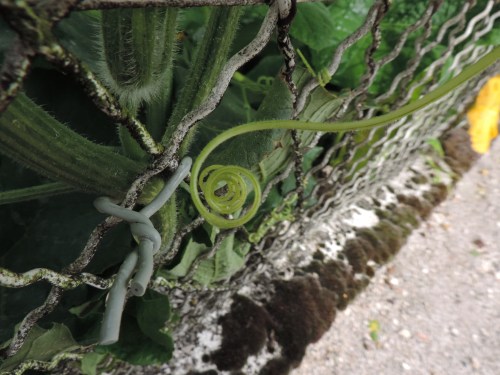
Today I came across a couple of photos from my garden which show both of these processes occurring at the same time. In this first photo you can see how the tendril or creeper which is reaching out is doing so in a kind of spiralling or un-spiralling way. It doesn’t consider that a straight line is the shortest distance between any two points! Perhaps there is something to learn from this – a sort of melange of meandering and spiralling around.

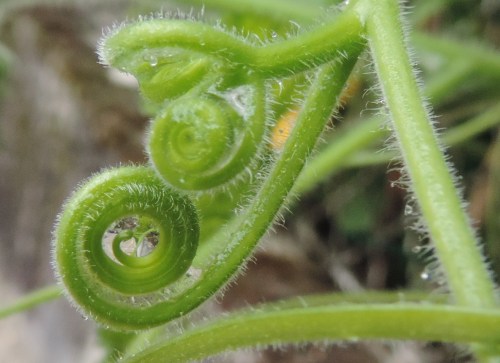
But what really struck me was this photo because I took a close up of these beautiful spirals and because I was focussing on the near distance the background has gone nicely blurred (something photographers call Bokeh I believe!) – but, wait! Look more closely! Look at the centre of the spiral which is in the bottom left corner of this image!

Through that spiral the distance suddenly becomes clear as crystal.

I don’t know what you think, but that reminded me of my favourite “And not or” theme – when you take BOTH of these processes of growth together suddenly you can see the world more clearly!

If you’re interested to read more about “And not or” check out my book.

Read Full Post »

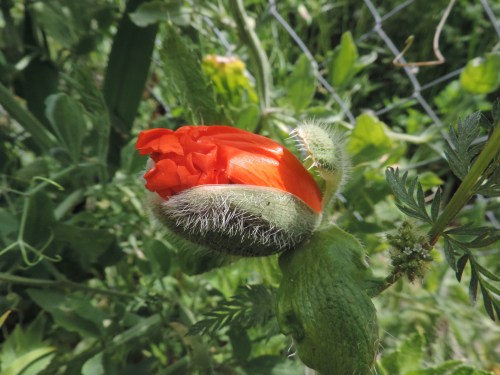
Both of these images are beautiful and I think that in each of them we see a way of growing.

The image on the left is an unfurling. It’s an opening up, a revealing, a bursting out. The outer surface splits apart to allow the inner flower to come into the world. Buds are a powerful example of growth. We see them everywhere in the Spring. They start as small swellings, then their appearance becomes more complex as they grow, then they open up. This opening up, this “flourishing”, is one of the main ways of growing in the world. It’s a blooming, a blossoming. Beautiful. Isn’t this what we hope for in ourselves and our loved ones? That we are able to realise our potentials, that we are able to unfold and reveal our uniqueness, that we develop, grow and mature in a way which we could only call “blossoming”?

The image on the left is a connecting. This is a reaching out, a stretching out, a spiralling upwards, downwards, along until we find something else to catch on to, then investing power and energy is creating a strong, resilient bond. This is a second, equally important, way of growing. We grow by making connections, forming bonds, developing strong, resilient relationships. We grow by finding and connecting to “the other”…..to other beings, other parts of our environment, other parts of ourselves even.

So, in these two images I see two of the most fundamentally important ways of growing and developing – unfurling and connecting.

Read Full Post »

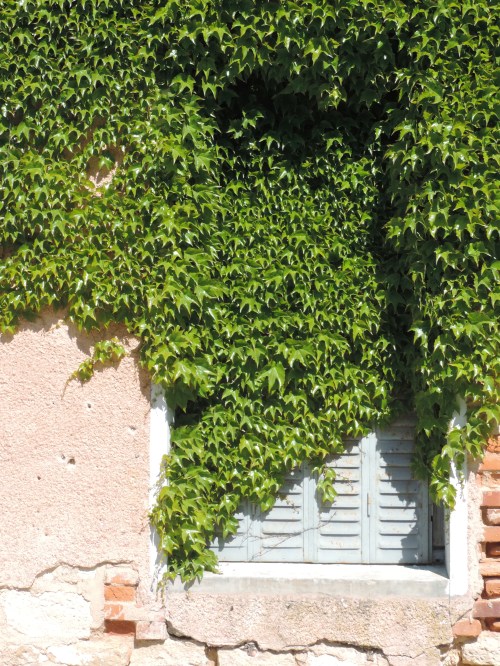
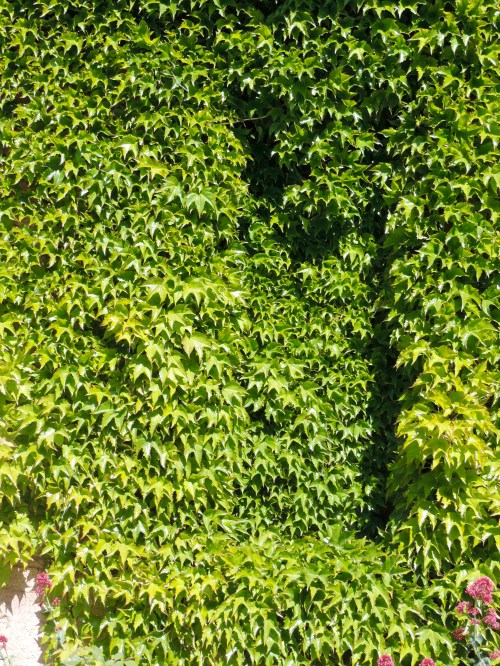
In the chateau down in Blaye there are some abandoned buildings. Look what happens when a man-made structure is left unattended. Nature begins to reclaim the territory. In the photo on the left you can see the advance of the ivy over the window, and in the one on the right you can still make out where the window is, you just can’t see it any more.

During the lockdown and even during this time of eased restrictions, it is clear that human beings have to a certain degree retreated and the rest of Nature has been left to reclaim the world. Many people have commented on the amount of birdsong they can hear now, and that’s not all down to there being less traffic. Some of it seems to be there are more birds in and around our gardens and streets now.

This summer has seen a sudden surge in wasp numbers in this part of the world and one of the explanations given for that is also the temporary retreat of human beings into their houses and gardens. It seems there has been less vigilance on the part of park and grounds authorities so wasps’ nests have been left unattended and allowed the wasp populations to proliferate.

I think each of these examples reveals how intricately interconnected we all are on this planet…..and by “we” I don’t just mean “we humans”, I mean “we living organisms”……humans and other animals, birds, insects, and plants too.

Read Full Post »

I’m pretty keen on creativity. I have an eye for what’s new. In fact, I’ve been pretty impressed with the old philosophy which says to treat every day as if it’s the first time you’ll have experienced it. Because it is. Each patient who came into my consulting room was coming in to tell me a new experience, a new story. Even if I already knew them quite well they’ll still come and tell me something I hadn’t heard them say before. Everyone had the capacity to surprise me.

I love the Spring time of the year because I love to see the new seeds pushing up the first green shoots, love to see the buds beginning to form and unfurl, love to see the first sight of the migratory birds returning from their winter travels.

But Autumn is sort of opposite to that. It’s a time of a certain paradox – a time of fruition and therefore harvest, but also a time when the world begins to wind down, go to sleep, or even die off. It’s a time you might call the “down cycle”. I love that too. I love to see the leaves turn yellow, red, brown, golden. I enjoy sweeping up the leaves that fall from the mulberry tree.

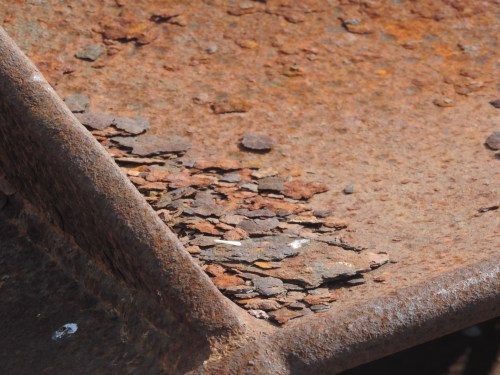
This photo reminds me of the down cycle. Here’s a piece of iron. Some large, once strong panel or plate which someone created. But it’s been cast aside for a long time, and Nature has begun to break it down. The once smooth and shiny surface is breaking up into these little chips and flakes. The chips and flakes will, finally, turn to dust.

Does that seem like a loss?

I suppose viewed from one perspective it is. But Nature has down phases as well as resting phases, waking, growing phases, and maturing phases too. Could anything exist if any of these phases didn’t exist?

I think we need to remember that sometimes, and not get too upset and anxious about change. Nothing stays the same. And because nothing stays the same we are able to start each day as if we had never lived it before….because we haven’t. Imagine! How much there will be to discover today. How many new experiences and sensations you will have. How many new thoughts and feelings you will experience.

Life is dynamic. As Carlo Rovelli, the physicist says

A stone is a prototypical “thing”: we can ask ourselves where it will be tomorrow. Conversely, a kiss is an “event.” It makes no sense to ask where the kiss will be tomorrow. The world is made up of networks of kisses, not of stones.

I think an awareness of the phases and cycles of life reminds us of that. There’s beauty in every phase.

Read Full Post »

Plants send out creepers and tendrils which twist and turn and spiral on their way are always fascinating. For the last five years I’ve been composting grass cuttings and “garden waste” then spreading it on the veggie patch. It’s turned a stony, hard, bare piece of ground into something of a mini-jungle once each year’s vegetables start to grow. This year there must have been some viable pumpkin seeds in the compost because a couple of pumpkin plants started to grow in places where I definitely hadn’t planted them. Once they started to grow they took off, spreading all around the entire patch, weaving between other plants, sending spiralling tendrils out to grasp onto to anything it could touch, reaching each of the two boundary walls (the veggie patch is in a corner), climbing those walls, the fences above them and by now developing over half a dozen huge pumpkins. Every morning you could see how much further the plant had managed to grow since the previous morning. It’s astonishing.

This photo isn’t of a pumpkin plant. There are many, many varieties of plant which have this ability to send out these incredible tendrils. They reach out, touch and catch on. They connect, they bind, they tie together. Look at the size of these ones! You can sense how strong they are.

I was thinking this morning about how pretty much every single atom on the Earth has been here since the planet was formed. They arrived here from distant stars. I was contemplating how the Earth doesn’t make new copper atoms, gold atoms and so on. But what Nature does is create what’s unique and new every single day. She does that by making connections, reaching out, touching, drawing together, blending and binding. In other words, the world is full of newness every day….not new elements but new forms. Nature is like the most inventive creative artist you could imagine, fashioning brand new, individual, unique, forms every single day.

Making connections. Making new connections. That’s the essence of creation.

Read Full Post »

Emanuele Coccia, the Italian philosopher who brings a new and refreshing perspective to the life by considering plant life says that what plants do so well is capture “extraterrestrial light” and turn it into energy and forms.

Two things struck me when I first heard him say that – “extraterrestrial light”? What’s that? Well it’s the light which comes from outside of the Earth isn’t it? Natural light. The light of the Sun, and the light of stars. The light of the moon is reflected light, so is just another dimension of the light of the Sun.

Without this “extraterrestrial light” from the Sun there would be no Life on Earth. Plants are THE way of transforming light into energy. We get all the energy we need by consuming other life forms at different stages on the food chain, but all of what we eat has plant life at its core. We fundamentally consume the light of the Sun through plants. Maybe through some animals we eat, but they do didn’t capture the energy directly from the Sun. All animals get all the energy they need AFTER the plants have captured it from the Sun.

The second thing which came to mind was Richard Feynman’s observation that trees make themselves “out of thin air“. That startling observation was based on the fact that trees capture carbon dioxide from the air, turn it into carbon based structures and emit oxygen as a “by product”. They also capture all the energy they need directly from the Sun using photosynthesis (a trick no animal ever managed to acquire!)

Then a third thing came to mind….the fact that we are all made from the atoms created in the stars. All the natural elements we find on Earth didn’t originate here. They originated in the great furnaces and explosions of distant stars millennia ago.

All of Life pursues this “extraterrestrial light” – all the plants, all the animals, all living creatures get the energy they need either directly from the Sun or indirectly through the consumption of other creatures which have already captured the sunlight.

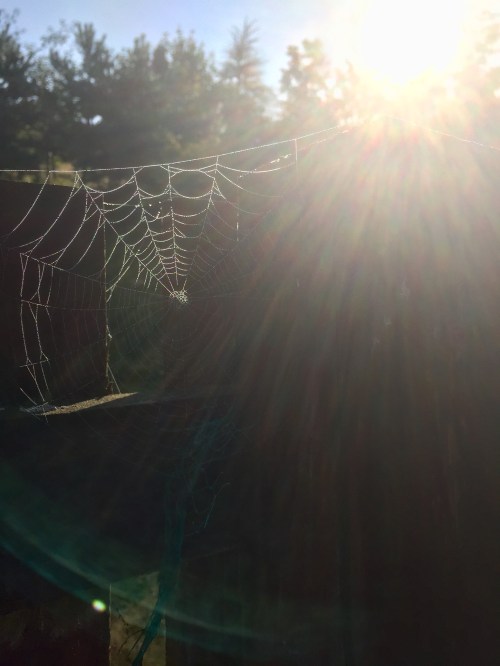
Isn’t that a startling thought? That we are ALL light-seekers! All of us surviving and growing by finding and consuming the “extraterrestrial light”.

Read Full Post »

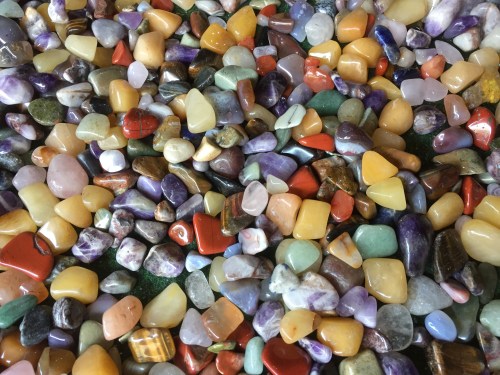
This is a photo of a small part of something called a “Scratch Patch”. It’s an area about the size of a large room. The floor is covered with polished stones. You pay for a container/jar and can then spend as long as you like filling it with the particular stones which attract you most.

I shared a photo of a pumpkin stall at a farmers’ market the other day to demonstrate the beauty of diversity but then I came across this photo which shows exactly the same thing in the mineral world.

We have a bit of an ambivalent attitude towards stones I think. Maybe because they are inanimate we don’t often value them as much as we do plants or animals, but on the other hand, “precious” stones are considered to be amongst the most valuable objects in the world.

At a simple level many of delight in spotting and picking up a few “interesting” stones when we are out walking – whether it’s through the vineyards, or along a beach. You probably have some favourite stones of your own. Maybe in your pocket, at the bottom of a bag, or on a shelf somewhere in your house.

We must know, instinctively, that stones are not all the same. Otherwise how would we notice some but not others? Why would we choose to pick up and keep certain ones?

I think the attraction of uniqueness runs right through everything in this universe. We humans, each of us unique in our own right, are delighted by uniqueness, whether we find it in our gardens, the paths we walk along, the flowers and trees which grow around us…….

I have often said that what I looked forward to most on a Monday morning was the first clinic of the week. Every single week I knew I’d meet unique patients. Every single day I knew I’d hear unique stories which I’d never heard before. Every single consultation was unique, never to be repeated.

For me, good Medicine couldn’t be reduced to protocols, guidelines and algorithms because every single human life is a unique one. Every single human being is “extraordinary”, not reducible to a class, a type, or a disease. Every encounter occurs only once.

Read Full Post »

Here’s where I’m for “efficiency” – in machines and in situations where you can accurately predict the outcomes.

Here’s where I’m against “efficiency” – in human situations. Human beings, all other living creatures, Nature and the environment are all complex, open systems. You cannot predict the outcomes with accuracy and certainty from any starting point. For three reasons – change is constant (nothing stays the same), everything is connected so subject to unpredicted influences, and the phenomenon of “emergence” where a complex system develops new characteristics and behaviours which couldn’t have been predicted from its prior state.

Everywhere you look in Nature you find something called “redundancy” – natural systems have more checks and balances, more options in play, than logic would lead you to believe was either necessary or “efficient”. This is the key to their robustness.

As Professor Margaret Heffernan, author of “Uncharted”, points out, aircraft are built with more control systems than they “need”. They have more engines than they “need”. It’s these backups, alternatives and “redundancies” which make a plane robust. She clarifies the difference between “resilience” which is the ability to recover, and “robustness” which is the ability to avoid failure in the first place.

Austerity economics plus managerial philosophies of “efficiency” plus neoliberal politics created the perfect conditions for the pandemic to be a disaster. In many, many countries the health care services had been cut to the bone. They weren’t robust. In many countries social care services had been cut to the bone. They weren’t robust either. In many countries industry, employment conditions, education…..you name it, had all been pared back, trimmed down, downsized, made “more efficient” by under-resourcing them, failing to replace staff who left, and, in fact, doing the exact opposite of developing and strengthening any of them.

How do we cope better with the next pandemic?

Well a good place to start would be to set our sights on “robustness” instead of “efficiency”. After all, in human beings and in all of Nature, the future cannot be predicted, the exact outcomes cannot be known. We are not machines.

Ok, you’re asking, what’s all that got to do with a table of pumpkins at a market? Well, that photo is from a fabulous Saturday morning farmers market in Capetown, and I love this display of diversity and abundance. I love how DIFFERENT they all are! No standardisation by size, shape of colour. Nature is like that. Diversity, abundance and redundancy are key features of healthy natural systems.

Read Full Post »

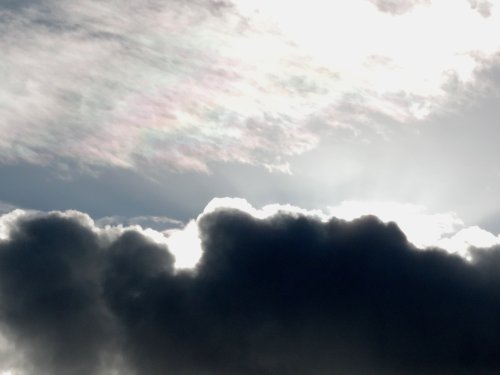
I see two symbols of hope in this one image – a cloud with a silver lining, and the beginnings of a rainbow (or, if you prefer, the emergence of colour out of monochrome)

We human beings need hope. I’m not sure if it’s possible to live without it. That might sound dramatic but I expect you’ve heard tales of seriously ill people “turning their face to the wall”, and dying. Or, maybe the opposite, maybe you’ve heard those who recover from serious illness described as “fighters”, which doesn’t mean they have defeated an enemy, it means they have dug deep, found wells of hope and belief, and have healed.

Whenever I saw a patient with a serious disease I knew there were roughly three possible future paths – improvement, deterioration and something inbetween (a kind of continuation of the present). You can see that with common, acute infections, such as a cold or flu, and you can see it with this COVID-19 virus too. Some people make a complete recovery, some go downhill quickly and die, others recover well enough to leave hospital but continue to have disabling symptoms (people are calling them “long haulers”).

Perhaps one of the silver linings from this latter group is the growing recognition in Medicine that some viral infections can produce seriously disabling chronic states. Sadly, in my own work, I saw patients with diagnoses from “Post Viral Syndrome”, to “ME”, to “Chronic Fatigue Syndrome” who had been dismissed and/or not believed by other doctors. These patients were hit by a double whammy – illness and disbelief. That was always hard. I hope this pandemic might have changed the mindsets of some physicians who have dismissed such chronic states as “psychological”, “depression”, or “fraud”.

But to return to the issue of hope. What makes the difference? What influences which of these three paths lie ahead for you when you get sick? The improvement path, the decline path, or the chronic illness path? The truth is we don’t know. But I sure hope there are people invested in research projects to try to shed a light on this issue. The other truth is that nobody can accurately predict which of these paths lie ahead for any single patient.

Yes, of course, we can use statistics and probabilities, but when it comes to an individual, those generalities don’t determine the outcomes. I’d be explicit about that with patients, and I’d say, the truth is that for this individual, their path may well be the improvement path, so why not take on board that truth? Taking that on board is a kind of hope.

A little further down the road things might look very different. Someone who was getting better might decline. Someone who looked as if they had no chance might make a stunning, and unexpected recovery….and so on. But as the story proceeded, so did the three options. At every point, every day, those three paths lie ahead – improvement, decline or staying much the same. Is it ever helpful, then, to give up hope? If we hope, then don’t we try our best? Don’t we put in our greatest efforts? If we don’t hope, the danger is that we give up.

Because, here’s the other piece – the self-fulfilling prophecy. How often does it seem that what we anticipate, what we expect, comes to pass? Is it possible that hope can contribute to improvement and that despair and hopelessness can contribute to decline?

What do you think?

I think we human beings need hope. And I think hope contributes towards improvements. And even when things don’t improve, we can always change what we are hoping for. Changing what we hope for keeps us realistic, but being realistic doesn’t mean we have to give up all hope.

What’s your experience?

Read Full Post »

« Newer Posts - Older Posts »