Feeds:
Posts
Comments

Archive for the ‘philosophy’ Category

“Now, Life is living you”

This sign is on the wall of a buddhist temple smack in the middle of Kyoto city.

Just take a moment and contemplate it.

Ever since the moment I saw this phrase and it stopped me on the pavement outside this temple, I often think of it, and the more we learn about Life on Earth, the more true this statement seems to me.

As best we know, planet Earth was formed from atoms which were created in the great furnaces and explosions of distant stars. Every single one of us has been created from those atoms. Nature doesn’t create new atoms, it recycles and rearranges the existing ones. So the atoms which can be found in your body were once found in other bodies, other species, other members of other kingdoms on this Earth.

Our bodies are Star Bodies. We are the children of the Stars.

Emanuele Coccia, the Italian philosopher challenges us to think about the Plant Kingdom differently. He has a new book out, “Métamorphoses” (I’ve got it in French…..you’ll need to wait for an English translation if you don’t speak Italian or French). One of the central themes of this book is that we are One….that there is only One Life which never ceases to change forms whilst never changing its substance. In other words, there are only the atoms which made up the substance of the Earth at its creation, but Life turns these atoms, continuously into new forms – new species, new individuals within each species. The process of evolution is a kind of sculpting, produced by the vast complex web of all that exists, to create ever more adapted forms of Life.

We are each like the individual waves on one great ocean of water, every one of us unique and transitory, emerging for brief periods of time before dissolving back into the vast sea.

It’s Life which fashions each of us, and each of us, in turn, interacts with, metabolises and changes the other forms of Life. So, as Emanuele Coccia says, once we understand the one-ness of everything, all ownership and frontiers lose their significance.

Life is living you.
Read Full Post »

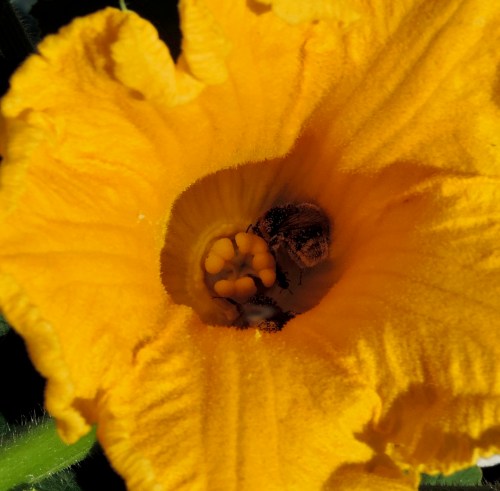
The other day the bees were going crazy for the pumpkin flowers. Each flower had two or three bees tumbling around in its depths, covering themselves with yellow pollen, and staggering as if they were drunk.

It was an amazing sight. Every single flower was filled with powdered bees. It was hard to photograph, but, I think you’ll agree, persistence paid off.

Strangely, (well, I never really understand how the universe does this), I had just read an interview in “Le Monde” with the Italian philosopher, Emanuele Coccia. He has a new book out, “Métamorphoses”, where he lays out his insights about the unity of Life, and the prime importance of plants. I read his earlier work, “La vie des plantes” some time ago and was hugely inspired by it – he gave me a whole new perspective on the world, teaching me to consider life from the perspective of the plant kingdom. In his interview he said a few things which came flooding back into my mind as I photographed these bees.

I’ll paraphrase what he said because the original is in French…..

Flowers contain the sexual organs of the plants but in order to reproduce they need the intervention of third parties – primarily insects or the atmosphere. So, what we learn from this observation is that flowers involve agents from other kingdoms in their individual sexual acts. This means that plants place their genetic and biological destiny into the hands of other species.

That’s quite a thought by itself, but he then goes on to ask “How do the insects choose which flower to pollinate?” The answer is, not by rational thought and logic, but by TASTE and AESTHETICS. So the evolution of plants is based on the tastes of other species.

Isn’t that a stunning idea? Or, rather, observation?

He has much more to say, but this is the part which I thought was most relevant to my experience of witnessing the crazy desire of the bees and the massive spread of pollen which was the result.

Life based on desire and taste……well, what do you know?

Read Full Post »

I’m convinced that the Self isn’t a thing. There is no entity, or measurable, directly observable object, called “the Self”.

Some say the Self is an illusion, but I was always impressed by the philosopher, Mary Midgely’s response to that…..which was to ask if the Self is an illusion who, or what, is having this illusion? I’m not convinced that the Self is an illusion.

Some say the Self is multiple, that there is a “community of selves”, or that the Self is multidimensional. Different dimensions, or aspects, of the Self are activated and expressed in different relationships, and different contexts. I’m convinced that the Self is multiple.

Some say the Self is a narrative, a story. I’ve got a lot of time for that idea. I’m pretty sure we weave together the events and experiences of our lives into our personal story both to make sense of life, but also to have a sense of Self, a sense of identity.

But that isn’t enough.

There’s more to who I am than my story. There’s my body. There’s my unconscious and subconscious reality, all the breathing and heart beating, and organ and cell and tissue function that is vital to me but of which I normally have zero awareness so can’t weave into a story.

I’m convinced of a Life Principle, a Life Force, or a “Vital Force”, not as an entity, not as an object, not as something “outside” of the body and the Self, but as something manifest AS the body and the Self and probably more besides….

There’s a red thread runs through life…..the thread of the Self as more than a construct, a narrative, an illusion, a force…..isn’t it just wonderful to experience that, to savour that, to enjoy that, to get to know that?

Read Full Post »

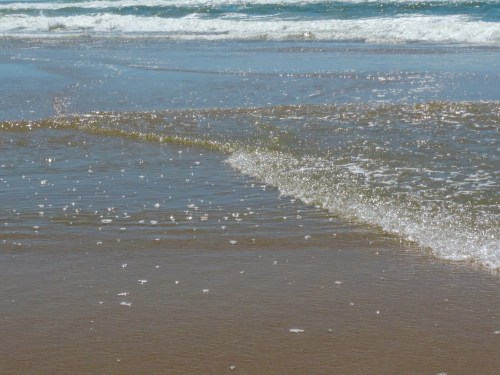
There’s a stretch of coastline about an hour directly west of here. It’s known as “La côte sauvage” – the wild coast. It’s beautiful but a bit dangerous. There are rip tides and ever changing flows within the Atlantic Ocean which can trap and carry off a swimmer.

This photo captures something of that unpredictability. If you look at the lines of the breaking waves you can see the water is arriving from at least three different directions at once, and there are layers of water running in several directions.

Actually, I think life is like this. There are forces, attractions, repulsions, triggers and stimuli influencing us from multiple origins in every waking moment. We are complex creatures, we humans. And the world we live in is complex too. That’s why I doubt simplistic analyses and confident predictions.

Human life cannot be reduced to “cause and effect”, to “rationalism”, to “measurements”, “categories” and “data”. Life is full of surprises and every single experience emerges within multiple contexts with us responding, mostly unconsciously, to an almost infinite number of factors.

Somehow, that makes life all the more beautiful, all the more mysterious, all the more engaging……

Read Full Post »

There was a craze hundreds of years ago for “chimera” – originally an idea from Greek mythology, medieval peoples took it a whole stage further and created all kinds of bizarre animals.

The chimera is an invented animal made up of the parts from other animals…so maybe a human head, a lion’s body, wings, a serpent tail etc. You can see lots of them carved onto the sides of old churches, and they illustrated old texts as well.

What do you think of them? Are they horrifying? (I think they were often intended to be so) or are they fun? Fascinating?

They just aren’t “natural” are they? You would never imagine that a creature like this existed anywhere. Maybe, once upon a time, some people did. Maybe they believed that they lived in unexplored regions…..remember the old maps with the unmapped areas labelled “Here Be Monsters”?

Probably the commonest reaction to them is a sort of disgust. We find them a bit repulsive….even the more beautiful ones!

I wonder if both chimera and genetically modified plants and animals touch that same core discomfort in us. There’s something a bit unsettling about cutting some DNA out of one creature and splicing it into another, don’t you think?

I think it’s no surprise that many people want GM foods labelled so they can choose not to buy them if they don’t want to. I think it’s not a surprise either that many people think there are complex ethical challenges to be addressed, and a need for intense oversight and control of the whole business of mixing DNA from creature into another……

Read Full Post »

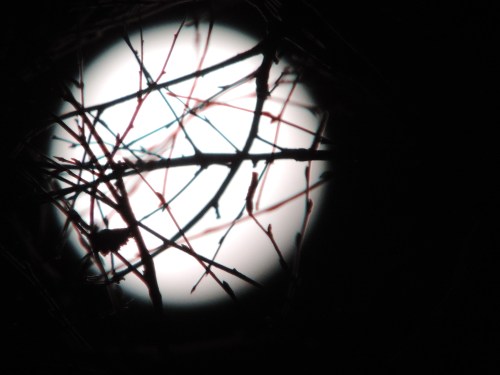
These two images were taken within seconds of each other. Both are a picture of the full moon through the branches of a tree.

But they look very different don’t they?

In the first one, the tree is to the fore. We notice the pattern of twigs, buds and branches, with the full moon as a white, circular background. If you look carefully, you can even see different colours, some reddish, some bluish, in the tree….although I’m still not sure where those colours came from!

In the second one, I’ve allowed the light of the moon to dominate, whiting out the tree in front of it….almost completely, but what this has done is reveal the parts of the tree lit by the moon, but just outside of the intense white light of the moon itself. This does two things…..it creates a sense of a swirling circle of branches around the moon, with an opening in the tree which just happens to be moon-shaped. This is an illusion – there is no moon-shaped gap in the tree.

I love both of these images, and don’t actually have a preference, but I realise that just by altering the exposure setting in the camera, I alter the entire frame of the shot….and that the two different frames give very different experiences of reality.

That’s what frames do. They shape our experience of reality. The frames we use all the time are fashioned out of our beliefs, values, habits of thoughts, and established attitudes. They aren’t easy to change. They aren’t even that easy to see. But I think it’s important to try to become aware of them, given how powerfully they shape our perception of reality.

Read Full Post »

Here is my secret. It is very simple: It is only with the heart that one can see rightly; what is essential is invisible to the eye.

Le Petit Prince. Antoine de Saint-Exupéry

I often notice, and photograph heart shapes, but in this particular photo what I like best is that the heart is in a path.

I like that because I think this is the most fundamental value for me. It’s not a simple value….this heart-focused one….but its complexity adds to it, rather than diluting it.

The heart is a symbol of love for us. If I want to live the best life I can live, I believe it has to be a life of love. Love in all its forms. Love in the form of care and compassion. Love in the form of passion and desire. Love in the form of bonds and relationships. Maybe we don’t speak much about these forms of love these days, but it’s always something I think we can do with more of.

The heart is also a symbol of the soul. “Heart felt”, “heart warming”, “good hearted”, “heart to heart” are all phrases which suggest authenticity and depth. It is the antithesis of the superficial and careless. It nurtures. It supports. It nourishes.

The heart is an important part of the body for processing emotions. We now know there is a neural network, of the kind of cells we used to thought you found only in the brain, around the heart. What does that network do? It seems to be involved in the generation and management of emotions.

The heart also focuses us on qualities rather than quantities. What we see, what we feel, what we know, with the heart can’t be examined under a microscope, weighed, measured or have a monetary value attached to it.

A path of the heart is a path of love, emotion and quality.

What is essential is invisible – and can only be seen with the heart.

Read Full Post »

Human beings are very, very social creatures. By that, I mean we connect with others, cast our thoughts and imaginings into whatever we are paying attention to, and by creating these bonds, these links, these resonances with “others” we change ourselves.

We’ve known this in biology for a few years now but it’s still a concept which is developing. We continue to isolate the individual from their environment and their relationships when we study them. But that is never going to be a successful strategy. If we really want to understand someone we must, at very least, consider their social environment. Why?

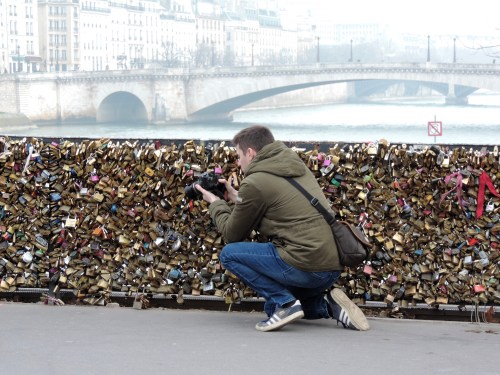
Because we become what we do, and we do what we notice others doing. Look at this photo. Did this phenomenon start in Paris? This “love locks” idea of fastening a padlock to a bridge? Maybe, but you can find the same phenomenon around the world now. However, just looking at this example in Paris – it’s hard to see any spaces left to fix another padlock…..SO many padlocks have been attached! I wonder who fixed the very first one?

Of course, there’s a “meta” level in this photo, because I didn’t just photograph the locks, I photographed this guy taking a photo of the locks. I, sort of, did what he was doing…..which makes me wonder now if anyone was taking a photo of me taking a photo of this guy photographing the locks…..

Social media platforms like Facebook, Instagram, Youtube and Tiktok thrive on this basic human characteristic…..we seem compelled to copy, to mimic, to repeat and to share what we witness. How quickly has “taking the knee” spread around the world in recent weeks? And why now? It’s not that this gesture appeared for the first time this year…..but this year, it’s caught on and spread like wildfire.

As I understand it the field of economics hasn’t caught up with this insight yet. The currently dominant “neoclassical” or “neoliberal” model seems to think of every human being as an individual, living autonomously, independently making their own choices in complete separate isolation from everyone else. Well, human beings are not like that. Happily there are newer schools of economic thought which are based on the understanding that human beings are such social creatures…..that it’s a mistake to assume we are all independent free agents making uninfluenced personal choices.

When I started out on these daily posts at the beginning of the lockdown period here in France back in mid March, I mentioned the fact that we are all influencers. Whatever we do influences other people. And that’s why I decided to share these little pieces of wonder, amazement, delight, beauty and understanding……to, hopefully set off all those fabulous phenomena in other people wherever they live……to hopefully increase the wonder, amazement, delight, beauty and understanding in YOUR life, as well as in mine.

Read Full Post »

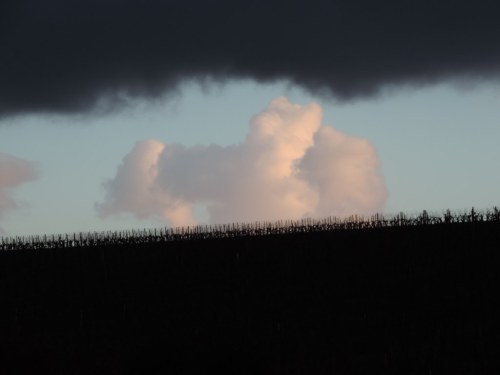
This is one of those “Are you a glass half full, or glass half empty, person?” images. When you look at this I’m guessing you’re either going to be thinking “Yikes! Look how BLACK that cloud is! There’s a storm coming!!” or “Look how pretty and soft those clouds look just above the vines! Better weather is coming!”

And not or.

I’m neither glass half full, nor glass half empty. I can be optimistic some days, and pessimistic others. But what pleases me most is a sense of wholeness. I love the contrasts, polarities, and their dynamic relationship with each other. So, in fact, this is just the kind of image which really appeals to me.

I love how the blackness of the storm cloud is echoed in the blackness of the vineyard (which only happens because I exposed for the bright blue sky and white, fluffy clouds). That makes this image a bit like a yin yang symbol for me, and you know how much I like that!

I was reading some articles in the French Press about what kind of world might lie ahead for us after this pandemic. They use the term “L’après” – in English we’d use the phrase “The After World”….or, more likely, “the world afterwards”, but just using the term “The After” in the French way conjures up connections with that other “after” term – “The After Life” – which traditionally relates to life after death, doesn’t it? Well, many of the articles are in fact about the “after life” but not in that traditional sense. They are about life after the pandemic…..or how could/might/should we live in the light of what we have experienced?

That’s a really ancient question, isn’t it? “How to Live?” It’s one of my favourite questions, and I think its interesting that we humans have been wrestling with it for centuries. There are, of course, a myriad of answers based on different world views and beliefs, but, somehow, I find, it’s not answers I’m looking for…..what thrills me is the hunt….the enquiry….the exploration. Maybe one of my strongest drives is curiosity. That and wonder. And I find both of those incredibly satisfying.

So, I’m drawn to the “whole”. I’m drawn to dynamic change. I’m drawn to “émerveillement” (wonder and amazement – or “enchantment” perhaps?). I’m drawn to explore, to understand and to learn. As I move forwards through 2020 and beyond those will be my foundations – along with love and care.

Do you remember the two words I picked for this year? Based on two books I received for Christmas?

Émerveillement and Bienveillance.

How about you? What values are going to help you to navigate the weeks and months ahead?

Read Full Post »

The tendency to think that whatever we see is made up of small parts goes back a long, long way. You can trace it at least back to the Greek concept of the “atom” – that basic unit, or building block, from which everything else is made.

Well, maybe it took the 20th century splitting of the atom to discover that there are no basic units after all…..that when you look inside the “smallest” component part, there are even smaller ones inside, then when you look inside of those, there is……well, it all fades into invisibility somehow. Turns out there are no fixed, fundamental building blocks after all.

The Italian Physicist, Carlo Rovelli, who wrote “Seven Brief Lessons in Physics”, and “Reality is not what it Seems”, describes this well. Here are a few passages from him…..

The world of quantum mechanics is not a world of objects: it is a world of events.

The world is not a collection of things, it is a collection of events. The difference between things and events is that things persist in time, events have a limited duration. A stone is a prototypical “thing”: we can ask ourselves where it will be tomorrow. The world is made up of networks of kisses, not stones.

A handful of elementary particles, which vibrate and fluctuate constantly between existence and non-existence and swarm in space even when it seems that there is nothing there, combine together to infinity like the letters of a cosmic alphabet to tell the immense history of galaxies, of the innumerable stars, of sunlight, of mountains, woods and fields of grain, of the smiling faces of the young at parties, and of the night sky studded with stars.”

“Elementary particles which vibrate and fluctuate constantly between existence and non-existence” feels like a totally different universe from the one built from indivisible, fixed, discrete atoms.

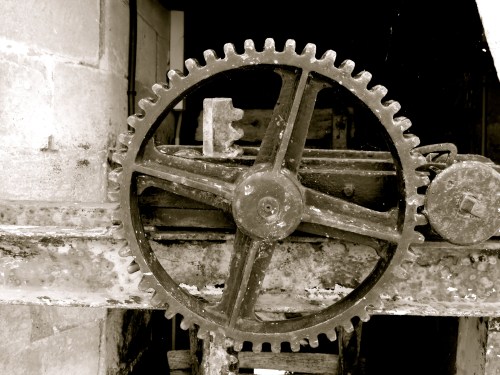
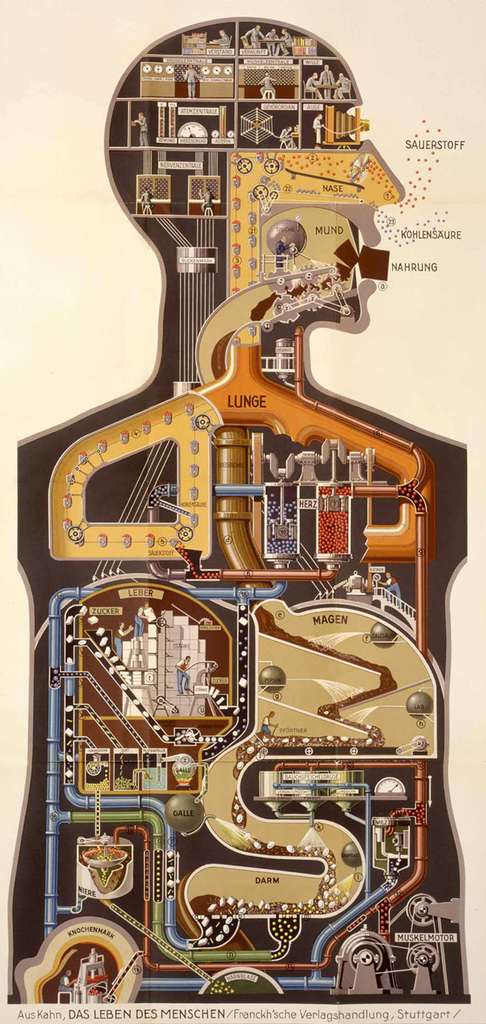
The deluded idea that the universe is made of bits was compounded during the Industrial Revolution where the machine became the dominant model for interpreting the world. It still is.

Human beings are not like this.

But we still interpret experience using this lens of the machine. We want what was described by Arthur Frank as the “Restitution Model” in Medicine – just fix the broken bit and I’ll be on my way – Diagnosis is finding the wonky part and sorting it or removing it. A patient with multiple disorders is compartmentalised with each disease treated by a different team of specialists….some to deal with the heart, another one to deal with the stomach, yet another to deal with the bones and joints. We even turn symptoms into parts, treating “pain”, for example, with “pain specialists”, as if pain was an entity in its own right.

We take the same machine model and apply it to society as well, reducing human beings to mere cogs in the great machine.

The English philosopher, Mary Midgley, in her “Beast and Man”, said

I had better say once, that my project of taking animal comparisons seriously does not involve a slick mechanistic or deterministic view of freedom. Animals are not machines; one of my main concerns is to combat this notion. Actually only machines are machines.

Animals are not machines, human beings are not machines, and society is not a machine. Using machine models to understand and create institutions, policies, methods of health care, education…….I’d like to see all that disappear.

Life is not machine-like.

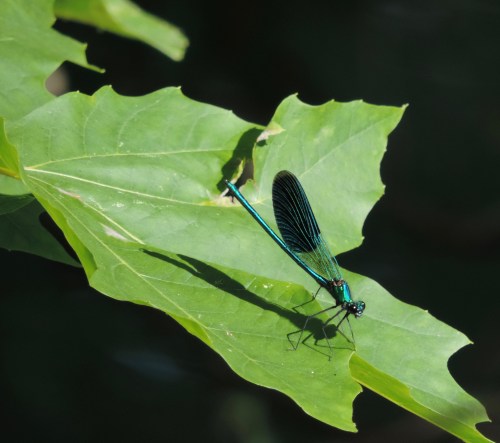
You think you can understand, and explain the existence of, a creature like this by seeing it as a machine?

Read Full Post »

« Newer Posts - Older Posts »