Feeds:
Posts
Comments

Archive for the ‘philosophy’ Category

With all the “social distancing” that is going on, and being urged upon us, I thought it might help to remember this line from Saint Exupery’s “The Little Prince” –

The important things in life you cannot see with your eyes, only with your heart.

I don’t really like the term “social distancing” because I think we need each other now more than ever.

What’s important during this pandemic is to reduce the time you spend in the same physical space as other people. The more physical contacts you have, the more chance you will catch this virus and spread it to other people. A French official put it well the other day when he said – don’t think how can I avoid catching this, think how can I avoid spreading it to everyone else?

I think that’s a useful flip because people spread this virus without having any symptoms, and while, chances are if YOU get this virus then it won’t be serious, for about one in every five people it will be. Reducing your physical contacts now is the most caring thing you can do.

But that does NOT mean to minimise your relationships.

More than ever this is a good time to tell the people you love, that you love them.

Now more than ever this is a good time to share…..to share thoughts, to share feelings, to share our stories.

We humans are perhaps THE most social of all creatures. We die without social contact. So let’s pay attention to that and increase our communications. Phone more, text more, FaceTime, or Skype more, blog more, instagram more, WhatsApp more…….whatever means you have at  your fingertips use them now.

Have you seen any of the video clips online of Italians or Spaniards on their balconies? Singing, cheering, banging pots and pans…….all saying “we are here, and we are in this together”.

As we minimise our physical contacts for now, let’s over-compensate for that, by increasing our “invisible” ones, the ones we can see only with our hearts.


Read Full Post »

It’s so many years since I read The Tibetan Book of Living and Dying that I can’t remember how old I was at the time, but the concept of the “bardo” really struck me and stayed with me ever since.

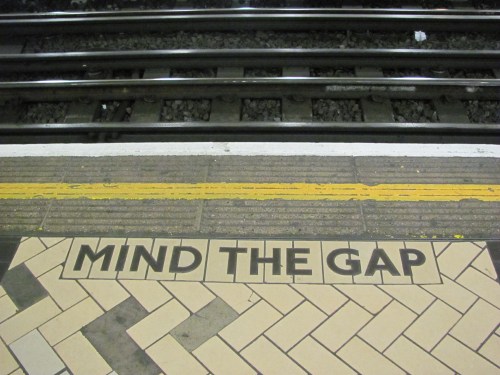
The bardo is the gap (if I understand it correctly). It’s the gap between the in breath and the out breath. Do you ever notice that gap? Try it. Don’t try to change it, just try to notice it.

Then, here’s something harder, try to notice the gap between two thoughts.

Have you ever noticed how thinking is so incessant?? How our minds constantly run from worry to worry to memory to concern to plans to, just, well, thinking…….it’s like it never stops. But no single thought goes on for ever does it? So they all must have a beginning and an end, just like stories do. Is there any space in between? Are their any periods at the ends of your thoughts, or has all the punctuation disappeared?

This time, this time of Coronavirus, is, for many of us, a bardo.

I live in the Charente region of France. Since Tuesday midday daily life has tangibly changed. All the cafes, bars, restaurants, cinemas, theatres, have closed. All shops apart from “essential” shops, have closed. Nobody is allowed the leave the house without a signed form, an “attestation”, stating why you are going out – and it has to be one of the limited, allowed reasons.

It sounds like Sunday around here.

Sundays near my house have always had a deep quietness. You know how you can tell it’s snowed before you look outside? Because the snow damps down all the sounds? Well, it’s sort of like that, but different……it’s an absence of most of the sounds of human activity. It’s been sounding like that every day since Tuesday. I guess we’re in for a “month of Sundays”. It’ll be a blue moon next!

This bardo, this pause, this suspension of the routine is waking us up to a lot of things. Or, at least, it’s giving us the opportunity to waken up to them. It’s giving us the opportunity to reassess what is important to us. And one of those things is love and connection. Have you seen any of the videos of Italians or Spanish people out on their balconies in the cities? Clapping, singing, making a noise together? We need to be connected. We are intensely social creatures. OK, maybe a lot of that has to shift online just now, because we are confined to our houses, but it still strengthens the importance of our relationships.

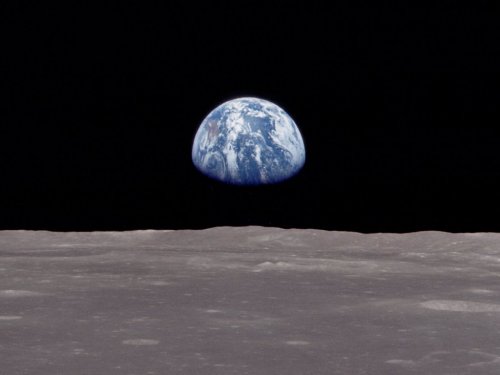
It does something else too. It shows us that we really do live on the one, single planet. Remember the “blue marble” image?

There are no real borders.

There are no real boundaries.

We humans just make them up.

We are connected. We breathe the same air, drink the same water, eat food grown in the same soil.

Maybe it’s time to think again about how we do that.

Of course, I understand, that this is not a bardo for everyone. The health care workers in particular are facing and already dealing with exhausting, increasingly demanding challenges. But maybe that too can be a lesson learned. Maybe we should pay health care workers more than we pay footballers, bankers and “celebrities” for example? And there are plenty of other people working hard to keep us fed and safe too.

Maybe it’s time to change the system, away from grab and hoard to valuing, savouring, caring and sharing?

Hey, there’s plenty to think about……just –


Read Full Post »

Coronavirus, epidemic, pandemic, deaths, school closures, travel bans, hospitals overloaded, patients in the corridors, floods, fires, plagues of locusts, hurricanes, tornados, earthquakes, snowstorms, climate change, immigration, deportation, walls, cancer…….

It’s not hard to make a list of threats, to find things to be afraid of.

Every headline screams – be afraid, be very afraid!

“Prepare for the worst and hope for the best”

Sounds good advice, huh? Said this way around the first thing to do is focus on the worst, then once you’ve done that you might get around to dragging up a bit of hope. Said the other way around you hope first, but what you do, what actions you take, are determined by imagining the worst.

Is this a good way to live?

Imagining the worst every day? Feeling fear every day? Feeling anxiety every day?

Maybe not, huh, but isn’t it just common sense? Isn’t it just “sensible”?

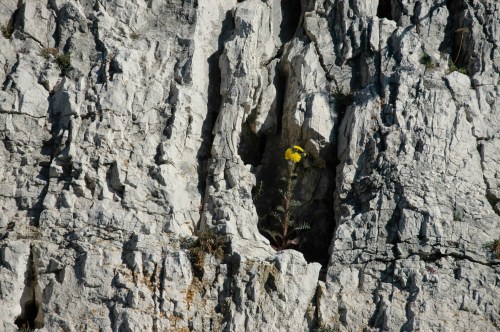
One day I was out walking along the Mediterranean coast and I looked up at this immense grey rocky cliff and a patch of yellow caught my eye. I zoomed in with my telephoto lens and took this photo. Wow! Look at this single, beautiful yellow flower. I was about to write “delicate, little flower” there but stopped myself because “delicate”?? I don’t think so. How did that little seed, blown there by the wind, or dropped by a bird, find enough to sustain it, enough to keep it alive, enough to make it burst out of its shell and stand tall and reach for the yellow sun and spread its petals to say to the world “Here I am” “I am alive”.

People die without hope. I’ve seen it. Many times.

If my mind is flooded with daily fears, if my thoughts swim in an ocean of dread, what kind of day is it going to be today? What kind of life will I experience? And what if this is “my one wild and precious life“? Is this how I want to spend it?

What’s the alternative?

Denial? Delusion? Escapism? I suppose so…..but I think there are better options –

“Hope for the best, and adapt”

If we start the day with hope, make our plans based on hope, then we set off positively. If obstacles appear, accidents happen, luck runs out, then we can adapt. I used to commute from Stirling to Glasgow on the train every day to go to work. I never set off thinking “maybe I won’t get there”. I never went to Queen Street Station after work thinking “maybe I won’t get home”. I never planned for the worst, then got round to trying to hope all the dreadful things wouldn’t happen.

Well, I didn’t always get there, and I didn’t always get home. One day the G8 Summit was held in Gleneagles. The authorities closed Stirling down. No trains. No buses. Motorways blocked. I didn’t get to work that day. One day at work it started to snow. It snowed and it snowed and it snowed. By the time I finished work there were no trains leaving Glasgow. The buses were all full, then there were no more buses because the motorway was blocked. I found a hotel room using my smartphone, stayed the night, and next morning, stopped off in Marks and Spencer for a new shirt on my way to work.

Many, many times, trains were cancelled or ran late. Many times the train would stop in the middle of the countryside for half an hour, or an hour, or sometimes, even longer. The journey wasn’t always as straightforward as it should have been. But I still never set off thinking “maybe I won’t get there”.

So that’s one way……

“Hope for the best, and adapt”

Here’s another –

“Look for the good and adapt”

This isn’t quite the same because it isn’t based on a starting point of hope. It starts with an intention. An intention to seek, to be curious, to be on the look out for what delights, and what amazes. To find “L’émerveillement du quotidien“. Because it’s always there. There will always be beauty to discover, music to excite or delight, scents and flavours to savour, textures to relish. There will always be acts of kindness, acts of courage and acts of love. You can see that all the time. In how many terrorist attacks do we see the cruelty of one person, followed by the courage, kindness and love of many, many others.

What if every day I look for the good, and when obstacles, accidents, infections, bad luck come my way, I find a way to adapt?

I look at that flower, flourishing (because that’s what flowers do, isn’t it, they flourish?) in what looks like barren adversity, and I think, well, that’s amazing, that’s beautiful, that’s life.


Read Full Post »
I don’t think of myself as a separate object any more. There is a constant stream of materials, energies and information flowing into me. I ingest some when I eat, I breathe some into me when I inspire. Heat, light, sound, gravity, and many other energies I can’t detect, influence and shape me, some stimulating my senses, some influencing the flow of fluids and elements around my body and into and out of my cells. The way my body and brain have evolved allows my whole being to interpret all these flows, to make sense of them, attach values to them, to allow me to respond and react.

I am changed.

Second by second, minute by minute, day by day and year by year, I am changing. Not a single cell remains the same over my life time. The idea of an “internal environment” is quite an old one now, but more than ever we understand that this is a dynamically changing environment, not a fixed one.

We process all these streams and flows. We create new cells, break down some molecules, make some new ones. We make new connections in our brains, strengthen some feedback loops in our body and weaken others. We make sense of now in the light of the past and the myriad of possible futures.

Then these streams continue on their way. We breathe out certain molecules, subtly changing the mix of gases in our immediate environment. We radiate heat, make noises, and we act.

We send out materials, energies and information into the universe every single moment of our lives.

These flows influence, disturb, change and shape our environment, other people, and all the other forms of life we share this planet with.

So, sometimes, I think it’s a good idea to pause, take stock, reflect, and ask ourselves – what shape are the waves that I’m making?

Because these shapes repeat and echo and ripple out way, way beyond the worlds we can imagine.

What kind of world do we create when we send out angry waves? Waves of fear? Waves of kindness? Waves of joy?

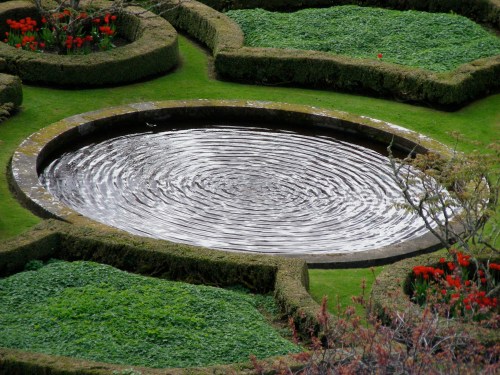
I was thinking about this today because I came across this photo I took at Dunrobin Castle many years ago. The concentric shapes of the ripples in this fountain completely fascinate me. It’s mesmerising. Alongside that, I heard from a couple of people in the last couple of days how much they enjoy my blog posts, and how they have been reading them for years. I didn’t know that. Like any author who publishes a book, I don’t tend to hear from my readers. Yes, I know, some of you hit the “like” button, or make a comment, but I have realised before that only a tiny minority of readers do. And that’s how it should be. After all, when I think of all the books I’ve read and enjoyed in my life, how many of those authors (even just the living ones! 😉 ) have I contacted to let them know that? Almost none.

I know people blog, and tweet, and put posts on Facebook for many reasons, but I think it’s always important to wonder about what shapes the waves are that we are sending out into the world. They will travel further and for longer than you think.

I hope I’m sending you some waves of wonder, some waves of joy, some waves of kindness and some waves of beauty. Because that’s my intention.

Read Full Post »

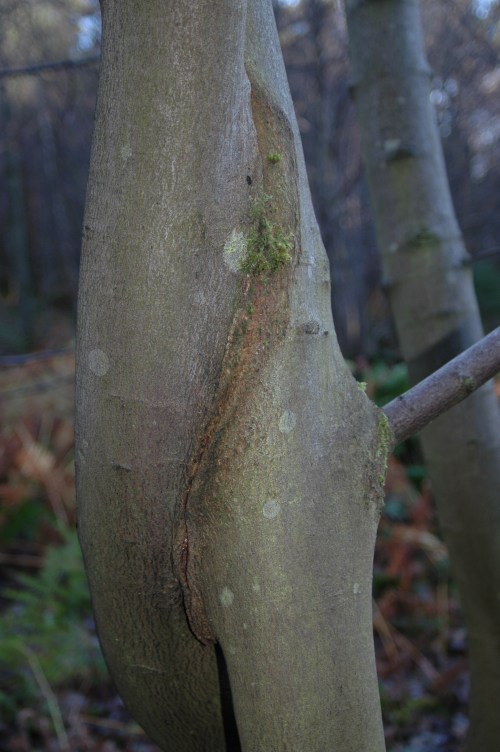
It’s many years since I stumbled across these two trees in a forest, but it’s an image which still captures me every time I see it.

I mean, just look at this….as best I could tell these are two trees growing close to each other in a wild forest. So close that one day they joined together. What began as closeness grew into entanglement. In my photo library I’ve labelled this photo “loving trees”. Of course, I don’t know if trees do love each other or not, but I do know there is a growing body of evidence revealing that trees communicate and co-operate much, much more than we ever thought they did.

I don’t mean to anthropomorphise the trees but I do think this kind of phenomenon reveals something about the underlying life forces which shape our universe. It’s natural for living organisms to connect, to get close to each other, to share and to collaborate. I know the dominant narrative of Nature and Society for many years now has been one of competition with every single plant, insect, animal or whatever fighting for its life and competing with every other creature for the common resources. But competition is just one phenomenon we see in Nature, and it may turn out not even to be the most important one.

I think we haven’t paid enough attention to co-operation and collaboration in our world. Look at human beings for example. Our extraordinarily developed brains absolutely excel at making connections and creating relationships. Human babies wouldn’t survive for long with out these innate skills. We understand the importance of infant-parent attachment much better now. We even know that without healthy, loving attachment in the earliest years a baby’s brain will grow less neurones, and make less connections between them. These early experiences of love, care, attention and belonging set us up for life. Conversely, their lack limits us and makes life a whole lot tougher.

I’m always struck by how you can see in any emergency, whether it be a road accident, someone falling ill in the street, or something even more dramatic like a natural disaster or a terrorist attack, there are always many people rushing to help. It’s a human instinct. Actually I don’t think this is reserved to humans. We can see all kinds of co-operation and collaboration in the other kingdoms of life – other primates, other mammals, birds, insects, flowers and trees. The word “ecosystem” refers to the complex, inter-twined, co-dependent, elaborately connected webs of inter-being, connecting all sorts of living creatures and creating the conditions for life and growth.

I often think we get more of what we pay attention to, so I often think it’s a good idea to pay attention to relationships, to love and to care.

I’d like to see a world where we recognise that co-operation, collaboration and sharing is the natural counter to competition, grabbing and hoarding.


Read Full Post »

Yesterday I wrote about sunsets. This morning when I opened the shutters I saw the most gorgeous example of “The Belt of Venus”.

It was every bit as compelling as the sunset I had just described…..and it was in the exact same direction…..looking West.

If the Sun was the greatest magnet we’d be drawn to watch it rise at dawn (if only we were awake and up early enough!), and it’s true that the rising of the Sun can be every bit as impressive as its setting. In fact, that phenomenon often makes me think of the scenes from “City of Angels” where the angels stand on the beach to watch the dawn. But the dawns are not usually as colourful as the sunsets, are they? When they are, when they fill the sky with rosy pink clouds, then what pops into my head is “Red sky at night, shepherds delight. Red sky in the morning, shepherds warning.” I know there are other variations of that saying in different parts of the world, but it does somewhat detract from the delight and attraction of the dawn sky versus the one at dusk, doesn’t it?

Most mornings, however, the sky isn’t pink and I’m not that aware of the Sun rising above the Eastern horizon. After moving here to the Charente I began to notice that the Western horizon was definitely pink some mornings and that spiked my curiosity. It turns out to be a phenomenon called “The Belt of Venus” and it comes about just as the Sun rises in the East but casts a shadow of the Earth just above the Western horizon. Well, both the phenomenon itself, and it’s rather romantic and glorious name, really engaged me, and now I’m much more likely to spot it. (That makes me wonder just what else we miss every day because we don’t recognise it. How much is invisible to us, passes us by, because we don’t pay sufficient attention, and we don’t know what we are looking at?)

Well, this is February now, and according to my monthly themes, February is the month of Love. So, how appropriate that Venus should make herself known so clearly this morning. Actually, we’ve had really clear skies these last few nights and one of the brightest objects in the night sky here is currently the planet Venus, so she’s around at night, as well as leaving her mark on the dawn.

So, I’m just reminding myself of all this today…..that February is a month to practice love, and loving kindness. That fits in with one of my two words of the year as well…..”bienveillance” – which is about “meaning well”, or acting with good intentions.

I like it when things come together like this….a phenomenon, how we name that phenomenon, and all that we attach to that name, the stories which spin off in all directions along a common theme, and the influence all that has on our daily behaviour.

Read Full Post »

Do you do that “word of the year” thing? Where you choose a word at the beginning of each year, a word which will be some kind of touchstone, theme or “north star” for you?

This year, I’ve decided to choose two…….because I received two books as presents for Christmas and it immediately struck me that between them they lay a foundation for a way of living I highly value.

These are French books, so here’s another innovation for me…..up until now my Word of the Year has been an English word, but, hey, I’ve been living in France for the last five years and I’ve read a LOT of French, so, I reckon it’s high time I choose a couple of French words.

Here’s where things start to get interesting, because I can’t find direct, single word translations of these two words into English. Perhaps, more accurately, I should say I can’t find any direct translations into English which I find satisfying. I think that’s a great example of how learning a second language can both widen and deepen your world.

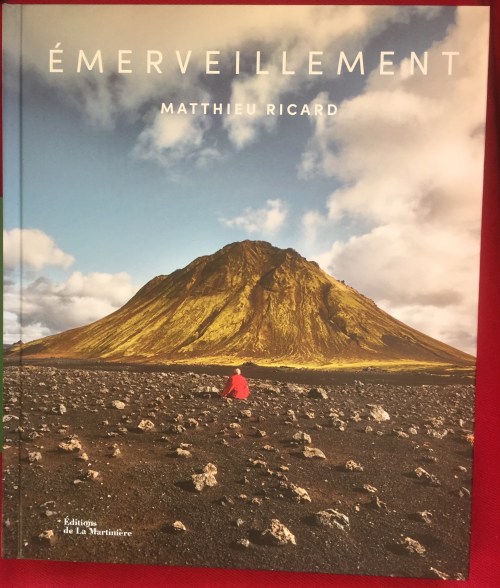
If you’ve read other posts on my site here you’ll have come across my use of the term “émerveillement” already. The first time I read the phrase “l’émerveillement du quotidien” I was entranced by it. It sort of means “the wonder of the every day”. The word “émerveillement” captures my core value of curiosity, of amazement, of awe and of wonder. I adore those moments when you notice something and it stops you in your tracks, where you pause, savour, and reflect. The more that happens in my life, the better my life seems to me. To really experience “émerveillement” you have to be open minded. You have to be curious, aware and non-judgemental. So the pursuit of “émerveillement” every day brings along with it a whole set of other attitudes and behaviours which I value.

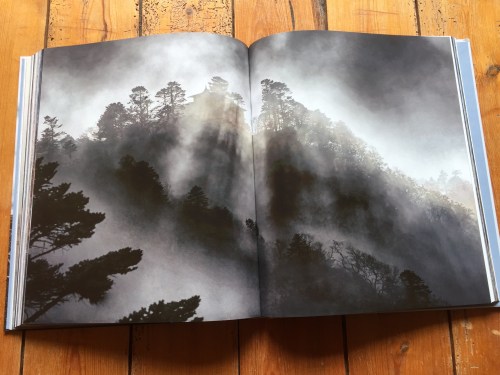
Here are a couple of pages from the book which give you a flavour of why it entrances me –

The second word is “bienveillance” which could be translated as “well-meaning” but again, that direct translation doesn’t quite cut it for me. It is used to cover well-meaning and well-wishing, but also kindness, gentleness and care. So, another set of values and behaviours I really rate and aspire to every day.

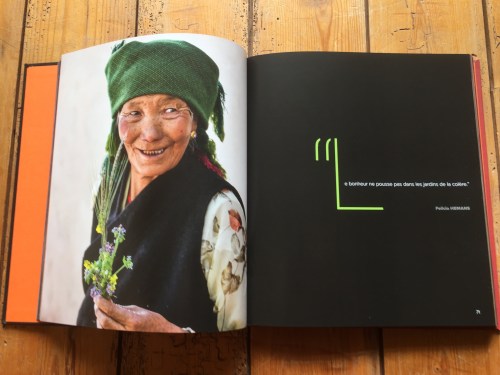
Here a couple of pages from that book which might stir the same feelings in you. If they do, then, yet again, a picture will have proven to be worth a thousand words.

That quote in the middle image is from the poet Felicia Herman and it translates as “Happiness doesn’t grow in the gardens of anger”, which is an interesting line to consider in these days of conflict and polarisation.

Read Full Post »

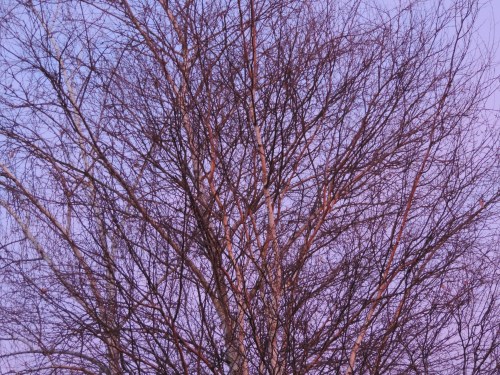
I was out looking at a particularly spectacular sunset the other evening then I turned around to look in the opposite direction and saw the birch tree at the other end of the garden.

Look at the colour of it!

Yes, the colour of the sky is pretty gorgeous too, but look how the normally almost black and white birch tree has turn shades of pink and violet.

If you’ve been reading my posts for a while you’ll know it’s pretty common for me to have two main streams of experience in relation to my photos. The first stream is beauty. I just love this for itself. It’s what someone might describe as “uncommonly beautiful” because it’s beautiful AND it doesn’t look like this on most days. When I see something like this, it stops me in my tracks. I had turned around to head back into the house but I stopped walking when I saw this, took a photo, then stood for a while just admiring what I was looking at. It seemed to me that this part of the world had momentarily been transformed by a Celestial Painter. I think what I’m trying to say here is that sometimes I am entranced by the beauty of the world I live in. Not just that I’m in admiration of it, or even that I’m having one of those moments of “emérveillement” that I keep mentioning here. I am “entranced” by it. It’s beauty like this, moments like these, which re-enchant the world for me, and I think that’s something we could all do with – more experiences of enchantment.

The second stream starts up when I’m at my computer, looking through the photographs I’ve taken. Slowly. When I got to this one I had the following thought-stream start up –

You know that phrase “seeing the world in a new light”? Well, usually it’s used when we have a new insight, a different, deeper, understanding of something or someone. But this literally looks like “the world in a new light”! So what? Well, when we have an insight, or a revelation, a lot changes. Not only does the world seem different now, but we are changed too. We’ve changed our perspective perhaps, or we’ve changed our opinions, our beliefs or even our values? Maybe not changed them from something into something else, but changed them in their intensity, their prominence, their power.

The truth is the world is in a new light every day. There’s been much talk these last few days about this being the beginning of a New Year, 2020, and the beginning of a new decade. I wonder if it feels like that to you? I do have a heightened sense of change underway….change in me as well as change in the world.

Isn’t this reality?

That today is a day which has never occurred before. That today is a day you are going to experience for the very first time. That today is a day which will never be repeated (Groundhog Day being a fiction). I think it’s very, very easy to forget that. When we get caught up in the “stuff” inside our heads, the repeat loops of ruminations and fears, we just don’t see reality any more.

Our internal fantasies mask our lived realities.

So, sometimes we need something remarkable to happen. I like that word, “remarkable” – something which induces comment, inspires us to make a “remark”, to pause, to reflect, and then to share that experience with others. Something which prods us into noticing.

Look! This is new! You haven’t been here before, in this very place at this particular moment. Savour it. Enjoy it. Then reflect.

The world looks different in the light of awareness.

Read Full Post »

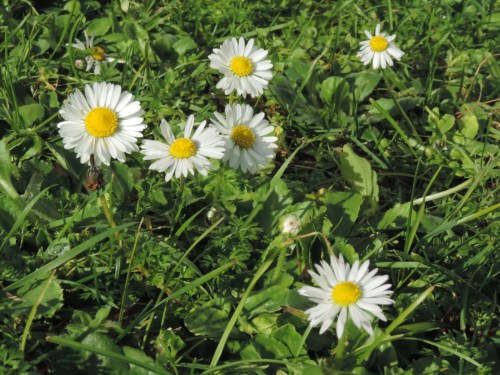
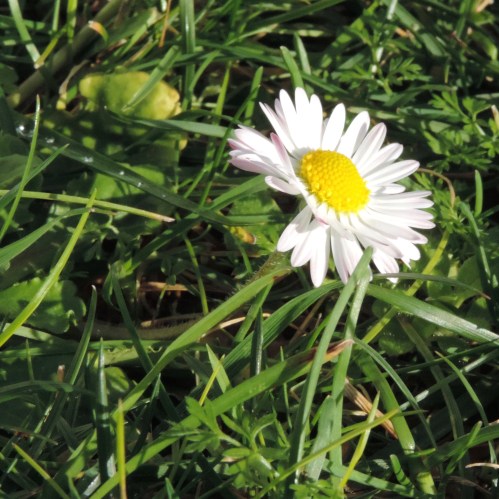
It’s almost the end of the year and a few days I go something caught my eye when I walked out into the garden here in the Charente – daisies!

I don’t know why, but I’ve always associated daisies with the summer, and I don’t remember ever seeing them flower around the time of the winter solstice, but, who knows? Maybe they do! Perhaps if you’ve more botanical knowledge than I have you’ll be able to enlighten me. However, what I’m saying is this is the first time in my life that I’ve been aware of daisies flowering in the winter time.

So what, you might ask?

Well, here’s why this interests me……

I find that when I notice something different, something new to me, that it slows me down, draws me into the here and now, makes me more present. I felt compelled to turn around, get my camera, then go back out and take some photos of these daisies. I enjoy getting down in the grass to take a close up of the small flowers which grow there, and for a few moments, as I frame and focus, I lose myself in this action. Lose myself in the sense of interrupting the almost chaotic nature of the endless flow of thoughts which seem to occupy my busy brain, and focus for a bit, on looking, on discovering, on photographing these little flowers.

So, there’s the first thing. They take me to another place, to another pace.

Second, as is often the case when I slow down, notice, savour and become absorbed by something, I find a sense of wellbeing, of joy, and of transcendence occurring. I feel nurtured by that.

Third, I start to think about what I know about this family of plants – the daisy family – what I know about them is that they have been used by humans, for hundreds of years, to treat injuries. They have a reputation for stimulating and encouraging repair and recovery. Bellis perennis (this common lawn daisy), Chamomilla, Calendula, Echinacea, Millefolium, Arnica, are all members of what we now call the Asteraceae (the daisy family). And they are all members of Nature’s Pharmacy of healing plants, used particularly in the treatment of injuries. There’s an interesting quality which many of the flowers share which relates to this repair-ability they seem to have – when you walk across the grass, standing on daisies as you go, if you stop and look back, it’s hard to see which ones you stepped on – they have great resilience, great ability to withstand and recover from trauma. Isn’t that interesting?

Fourth, and this is because of what I’ve learned over the years about these little plants, as I wander around the garden, crouching down to take the photos, I start to wonder about resilience. How resilience, which incorporates both an ability to withstand trauma, and an ability to recover from it, is much neglected in Medicine. Even in the treatment of injuries, I wasn’t taught much at Medical School about resilience or how to stimulate and nurture it. But isn’t this an essential part of all healing? This poorly understood phenomenon of self-defence, self-regulation and self-repair. I know now it’s a common feature of all “complex adaptive systems“. But that’s not something taught at Medical School either…..

Fifthly, and, if you are familiar with my thought from other posts on this site you’ll see this one coming, I feel humbled. I feel humbled by the astonishing phenomenon of the lives of these pretty flowers. I feel humbled by the realisation of the limits and partial nature of all human knowledge, and, certainly my own! I feel humbled to be in touch with the natural phenomenon of resilience, and ponder what I can do, what we can do together, to stimulate and support the resilience of ourselves, our loved ones, of other living creatures, of ecosystems, of Nature, of our planet Earth.

Read Full Post »

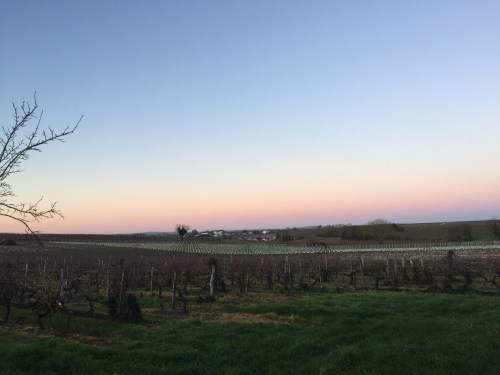
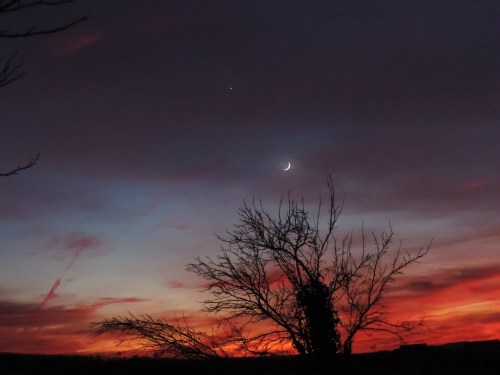
I’ve seen many fabulous sunsets in my five years here in the Charente, and I never, ever tire of them. A glimpse out of the window, catching sight of the fabulous colours spreading across the sky from the western horizon, always, always gets me up for a better look. I either open the window and lean out to see more of the sky, or, more frequently, I step outside, with, or without a camera in hand. I took this photo of one of the sunsets I saw this week. It was one of the longest, deepest, widest sunsets I’ve ever seen and I took many photographs. But I also stood for a while simply watching it.

The more I watched the more absorbed I became. It really felt as if the glow in the sky was being replicated with an inner glow. As if my heart, my soul, was resonating with the setting sun as it painted the sky with fabulous pinks, reds and purples.

I also noticed, as you can, that there was a sliver of the Moon up there, and at just about the 11 o’clock position to the Moon was Venus.

We humans have at least two astonishing characteristics. We create and handle symbols, and we tell stories.

Venus and the Moon are symbols of feminine energy, and amongst the many other themes, nurturing and nourishing are two of the fundamental themes of femininity for me. They represent the Mother, who creates and gives birth to her children, who feeds them with her milk, feeds them with the food she prepares, and who nourishes not just their bodies, but their minds, their hearts and their souls. So, when I see this combination of Venus and the Moon in the sky it stirs my gratitude for, and my awe at, the creation of Life in this Universe, the nurture and nourishment which literally grows each baby’s body, brain, heart and spirit, and for the incredible importance of Love in bringing Life into being, in sustaining, and developing each living being.

It’s beautiful. And it’s easy to remember the stories of Venus, the Goddess of Beauty and of Love, who we embed into our every single week by naming one of the days “Vendredi” (or, “Viernes”) although in English, we’ve disguised that connection by switching to the Norse goddess, Frigga, and calling that day “Friday”. It seems incredibly apt to be experiencing the resonances between the beauty of the setting sun and the Goddess of Beauty.

Doesn’t the experience of beauty so often stir our feelings of love?

But there’s more, because the silhouetted tree in this photograph is a plum tree without its leaves. The Moon, which constantly changes, which constantly measures and influences the cycles of the tides and which has given we humans a sense of time cycling rather than running along in a straight line, is sitting there above the plum tree, in its winter phase. Seeing them both together turns my thoughts to rhythms, to seasons, to the constantly changing nature of time, to the cycles of activity and dormancy, to the cycles of hibernation and growth and flourishing. And, that, is beautiful too.

My point is, however, what about you?

What do you see when you look at this image?

What feelings, thoughts, memories, hopes, and desires does it conjure up?

Because the truth is, no two of us ever have exactly the same experiences. This moment, this image, this experience, will be unique for each of us because every one of us brings a unique response. I know, there are shared themes, common aspects, to the experience, but when we slow down, allow our personal thoughts, feelings, images and stories to rise to consciousness, then it becomes something incredibly special.

What a gift it is to be alive. How astonishing it is to be a human being living in this immense universe.

Read Full Post »

« Newer Posts - Older Posts »