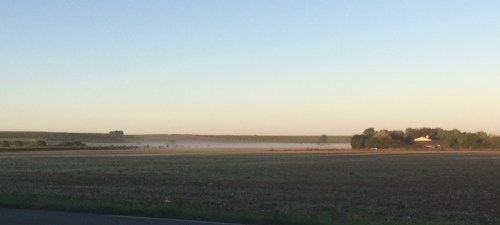
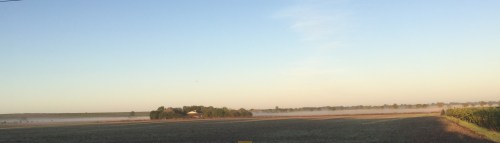
As I was driving into Cognac early in the morning I noticed this ribbon of low mist lying on the fields just in front of the vines.
I pulled over and took a couple of photos.
When I look at them again I’m drawn into the flow of wonder, to awe, to transcendence.
I begin by wondering how the air is full of water even when the sky is blue and there’s no hint of dampness to feel. How this invisible water condenses to become visible and lies along the face of the earth for a short while before evaporating back into the invisibility of the air.
I find that amazing.
I’m reminded of the writings of the physicist, Carlo Rovelli, who described how what we see as solid substance looks as if it is made of molecules when you look closer with a microscope, how those molecules look like separate atoms joined together once you examine them even more closely. How, with the ability to look inside atoms, once considered “indivisible”, the fundamental building blocks of reality, we discovered many other smaller “particles”, right down to protons, electrons, neutrons, which, in turn seemed to be made up of even smaller “quarks”. But that now we can see even closer and what we see is……nothing. What we see are waves and particles shimmering and sparkling into, and out of, existence.
That fills me with awe.
That provokes the sense that reality is all One, that the so called boundaries and barriers are artificial, transient, insubstantial, and in that moment I feel a dissolving of the Self, a feeling of One-ness with the Universe, a moment of transcendence.
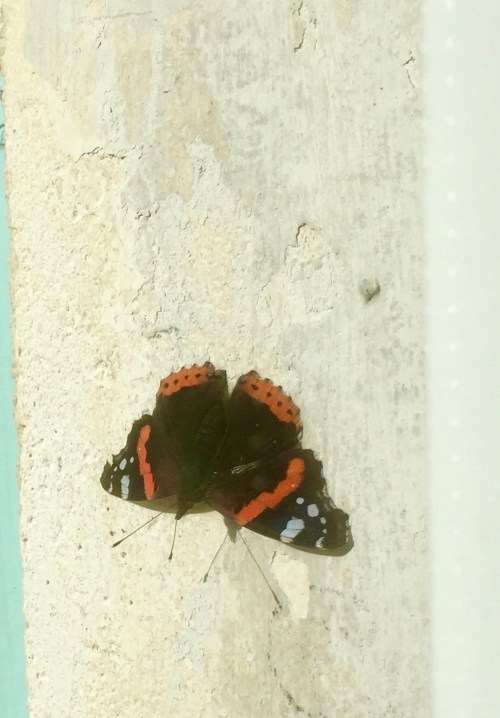
When I looked out of my window the other day I saw a butterfly sunning itself on the wall. I carefully took my phone out of my pocket and photographed it through the glass. Then I opened the window carefully to try for a better shot, and the butterfly flew off. Gone.
So, here’s the photo I took. It’s not going to win any wildlife photographer of the year awards but look carefully…..you can see the shadows of the butterfly’s antennae.
Isn’t that amazing?
Maybe I’ve seen this before but as far as I can remember this is the first time in my life that I’ve seen the shadows of a butterfly’s antennae.
I’m struck by the sense of delicacy and fragility in this image. A butterfly’s life is not a long one, but a butterfly’s shadow is even shorter! A cloud just has to pass over the sun and the shadow has gone. The butterfly just has to do what butterflies do….flit off somewhere else….and it’s gone.
This sense of impermanence coupled with the delicacy of the tiny slim antennae of the small fragile butterfly combine to make this a very special moment.
It’s one of those intense fleeting experiences of “first and last”. It’s the first time I’ve seen this, and could be the last – both in general terms, and, of course, this is the one and only opportunity to see this specific, this unique butterfly in this particular place at this particular time.
Life if full of these moments. If only we can be aware of them.
Here’s something else I think about this…..in the midst of all this impermanency, all this transience, all this fragility, I see the vibrant, colourful, intense flow of LIFE – the LIFE that flows through every living creature, every moment of every day. The Life Force. The “green fuse that drives the flower”. Spinoza’s “conatus” – by which he meant the “striving to survive” which separates the living from the inanimate.
It never fails to astonish me. It never fails to stimulate my sense of wonder, of marvel, of “émerveillement du quotidien“.
Life is full of these moments. If only we can slow down and pay attention to them.
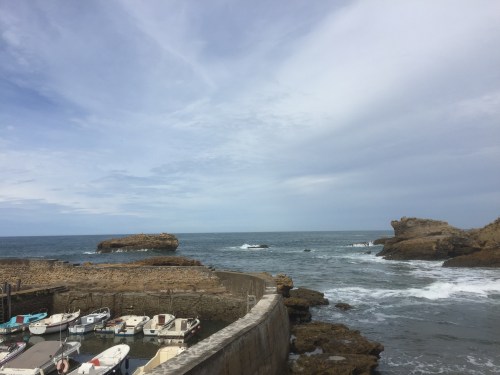
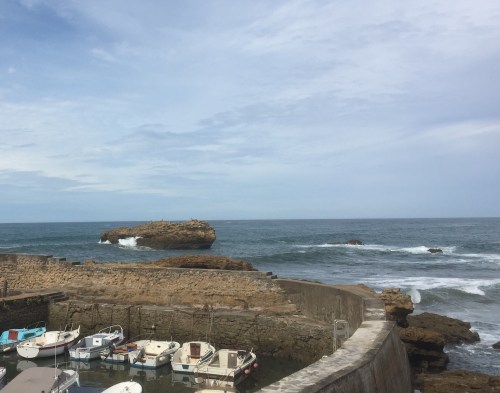
See this large rock just above the harbour in Biarritz? How does the sea make it to the shore when this rock is in the way?
The most obvious way is to go around it.
And that’s what most of the water does. It makes it way towards the shore, and back out to sea again by breaking against the rock and flowing around each side of it.
That’s one way to deal with an obstacle, with something standing in your way…..find a way around it.
But, wait, look at this…..
…the water has found another way as well.
It goes THROUGH the rock!
I suspect this has taken a very, very long time for wave after wave to make its way through a small crack in the rock, widening the gap slightly every time it passes through. But look at it now. Sometimes when a more substantial wave hits the far side of the rock it flows directly through the gap. Doesn’t happen every time. Just when the waves are big enough.
So, there’s the other solution. Keep going. Keep pushing up against the obstacle, looking for a gap, an opportunity, a way through, and once you find it, come back again and again. Each time, it’ll get easier. Each time the gap will get wider, the way will become broader.
Something else…..this is just beautiful to watch. Mesmerising even. Over the course of a few minutes you can see how the rock and the sea sculpt each other. It’s a delightful relationship.
Oh, and something else……Michel Serres, a French philosopher who died recently, used to describe human beings as “anticipation creatures”. I recently listened to an episode of one of my favourite podcasts, Onbeing, where the science journalist, Erik Vance, talked about “the drugs inside our head”. He was discussing the poorly understood but fundamentally important phenomenon known as the “placebo effect”, and one thing he said was that our brains are “prediction machines” (well, I hate the metaphor of “machine” applied to living organisms, but you get the point…).
Both Serres and Vance are talking about our incredible ability to spot patterns, so that we can predict the future. OK, not too far into the future, and not with 100% accuracy, but we don’t just notice the world, we anticipate it.
As I stood watching this phenomenon of the white surf gushing out of the mouth in the rock, I was quickly captured by the experience of anticipation, watching the swells on the surface of sea further out, trying to predict which would turn into waves big enough to pour through the rock.
The front door of the house where I live opens directly onto a south facing garden. You could say there is grass covering most of this part of the garden, but I tend to think “diverse living ground cover” is somewhat more accurate. You see, I don’t tend it as a “lawn” trying to get it all uniform and regular. I do cut it with a lawnmower, and if there are any particularly jaggy thistles or the like, I might dig some of them out. Apart from that, I leave it do its own thing. And it is always surprising me!
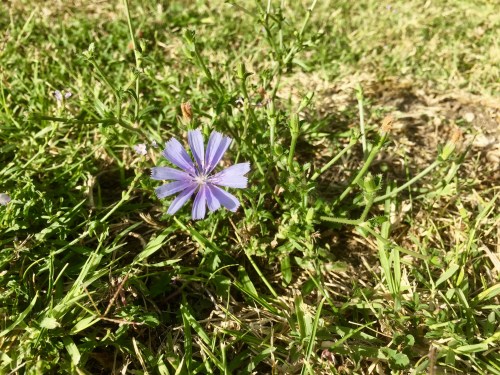
Yesterday morning I opened the shutters, stepped out, and immediately in front of me was this little display of flowers. Aren’t they beautiful?
Of course, I took a photo. Just as well, because by the evening I could find no trace of them whatsoever.
So, this morning when I went out I saw this….
A single flourish!
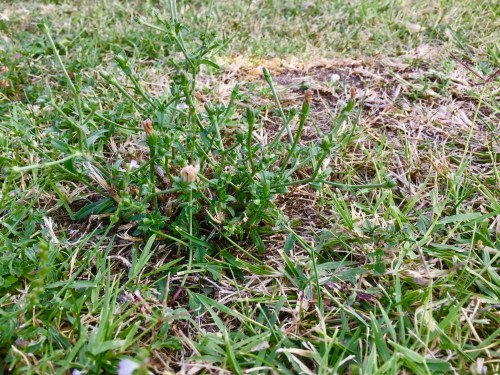
This time, I paid closer attention and went out again to see how it was doing at 3pm, by which time the shadow cast by the sprawling mulberry tree was covering this whole plant.
Here’s what I saw….
Like yesterday, the show was over!
Goodness! How brief! What a spectacular creation of petals and colour! And what a disappearance!
If you look closely you can see (sorry, slightly out of focus I notice) a small cluster of pale beige petals where the bright colourful display had been. How does this happen? How does this plant create and display with such a flourish (get it? “flourish/flowerish”!) and how does it bring the display to an end?
You know, I think we often have the idea that plants are pretty static…..well, they aren’t! They are dynamic, vivaceous, always changing, living creatures!
One more thing……this was a great real life example for me of how the Japanese valuing of impermanence works. That little flower has somehow just become a bit more extraordinary, a bit more special, to me!
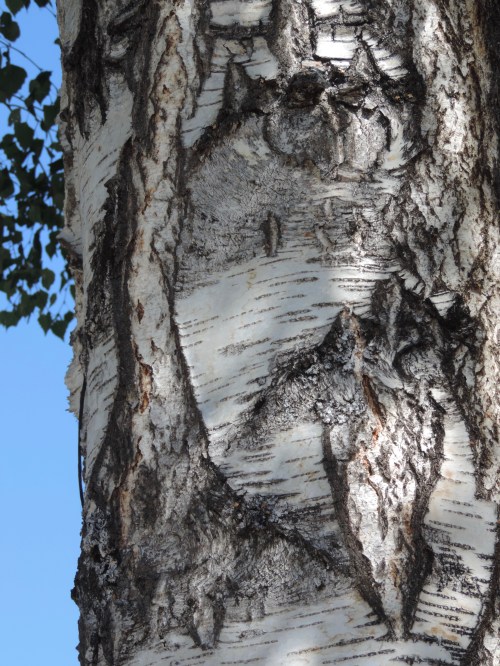
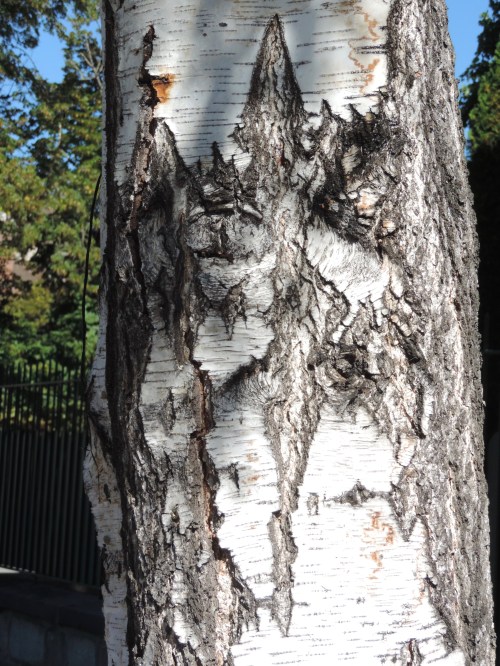
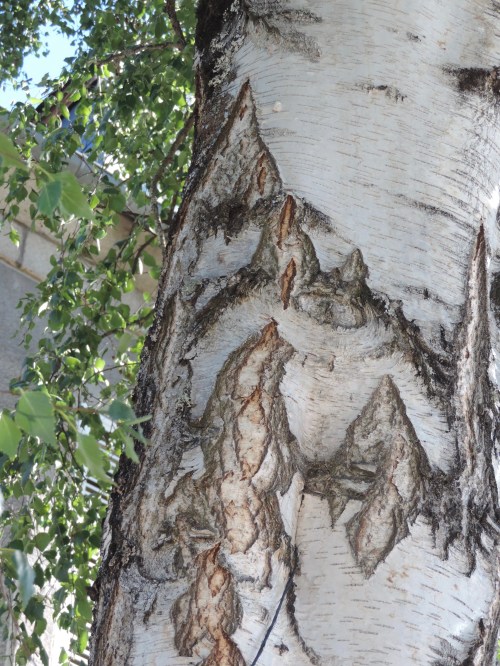
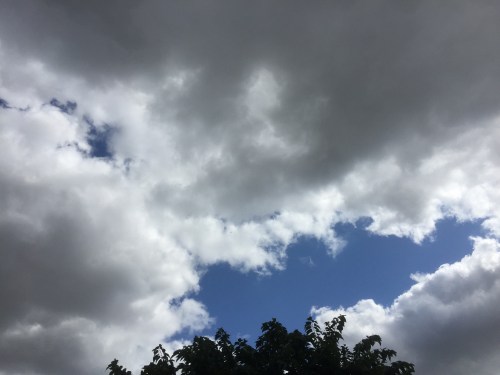
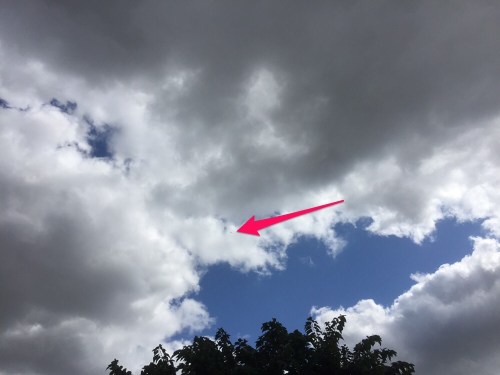
Sometimes we stumble across patterns which catch our attention. I think we humans have a tremendous ability to spot patterns. We see them in clouds, on pebbles, cliff faces, well, pretty much everywhere. Here are some on a single tree.
That first one looks like an owl to me. The next one looks like an angel.
And the third one, looks like one of those ancient Chinese drawings of mountains.
I suppose what we see is influenced by what we’re already familiar with, and I suspect it’s influenced by a host of other factors too.
But what particularly delights me about these serendipitous discoveries is that seem a kind of art. Not the kind of art a human being makes with a brush, or a pencil, or even a musical instrument, but the kind of art which we make by noticing. It’s the weaving of perception, memory and imagination, and it has the power to delight, to astonish, to move…..as all art can do.
It’s also an incredibly collaborative form of art. It’s the tree, the rock, the shell, the cloud, forming in constant interaction with its environment over time, coupled with the human perceiver.
Would it be art if no human noticed it?
I wonder.
That’s a bit like the old “does a tree falling in a forest make a noise if there’s nobody there to hear it”, isn’t it?
Well, it seems to me that this particular kind of “found art” is like seeing a rainbow. It wouldn’t exist without the observer.
I don’t want to wander too far down a philosophical road here….I just want to share a moment or two of delight. Enjoy!
Here’s a small crop of beans from the garden this morning.
First, let me say, I think they are just beautiful! Like gemstones….
Two things strike me – not one of them is identical to any of the others.
Every single bean is unique.
That’s a Law of Nature.
Secondly, there is no way to tell which one of these beans will grow into a plant, even if I plant them all at the same time, in the same soil, and tend to them all equally.
Life is unpredictable at the level of the individual.
That’s another Law of Nature.
The Universe has taken 14 billion years to create you. You are unique. You are special.
Only you can express your uniqueness, unfolding, growing, developing your one special life, one day at a time.
I’ll be sitting in my garden reading and I hear a very high pitched, very distant bird call. I recognise it immediately now, even though I’d never heard it before moving here five years ago. It’s a buzzard. Although the call is quite faint, it catches my attention every time. I’m sure that’s helped by how often it’s silent here surrounded by the vineyards. (Although on other days the machines of viniculture create quite a racket, and a nearby airbase sends up training flights some days more than others)
When I hear the call of the buzzard I look up and peer into the sky to try and locate the bird. It’s not always easy because very frequently they fly so high they appear as just small black dots.
I saw this particular one and whilst often the buzzards circle and swoop on invisible highways in the air, this one appeared to be completely still. It was just hanging there, the way I often see the kestrels do, although they do that much closer to the Earth than the buzzards do.
So I took a photo with my phone.
Can you spot the buzzard?
Hey, it’s a bit like a competition I used to do with my dad. One of the newspapers would print a photo from a recent football match but with the ball removed from the image. You had to place a cross right on the dead centre of where you thought the ball was. The person who got closest won the money. It was called “Spot the Ball”. Well, this is “spot the buzzard”.
Answer at the end of the post ………..
Once I found the buzzard I started to wonder how it could just hang like that in the air. I started to wonder how it could fly with such apparent little effort. I started to wonder why it cried that particular call. I started to wonder what the world looks like from up there. How much detail can the buzzard see? Why does it fly SO high in the sky?
Wonder.
Everyday wonder.
I’ve referred a number of times to the French phrase “émerveillement du quotidien” which I love so much. It pretty much means “the wonder of the every day”. I find that when I get one of those moments, those moments of wonder, that my day feels a better day.
I find that the wondering connects me to awe.
I feel awe….astonishment, delight in, admiration for, whatever it is I’m wondering about. Not least because the wondering doesn’t have any immediate answers for me. Well, obviously, sometimes, the wonder drives curiosity and I later go searching online or in books for more information about whatever it is I’ve been wondering about. But that’s something different, isn’t it? Curiosity and knowledge-seeking. There’s just something delightful, uplifting even, about the process of wondering which doesn’t immediately drive knowledge-seeking, but, instead, creates a feeling of awe.
And here’s what happens next. When the wonder blends with awe I feel myself “taken out of myself”. I have an experience of transcendence…..what Arthur Koestler described as an “oceanic” feeling. I feel an increased, and deepened, connection with whatever is “outside” me, whatever I’m paying attention to. I feel an expansion and a loosening of boundaries. I feel a diminishment of separateness and an enhancement of oneness.
So, I wasn’t surprised when I read yesterday about “spiritual emotions”, especially as they were listed as follows –
Wonder
Awe
Transcendence
What sets off the spiritual emotions for you?
Oh, and, yes, as promised, here’s how to find the buzzard………
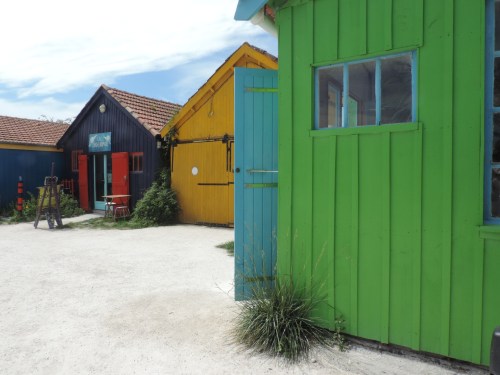
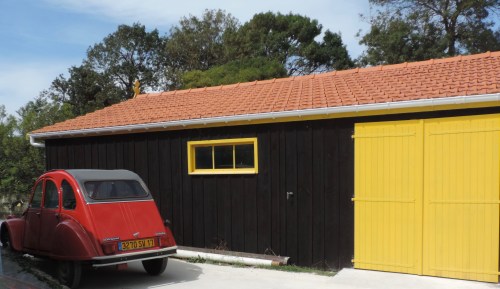
Don’t you find that an encounter with art often provokes? Well, I do. On a recent trip to the Ile d’Oleron I wandered amongst the gorgeous, brightly coloured old fishing huts which have been transformed into artists’ workshops. They look a bit like this….
Beautiful, huh?
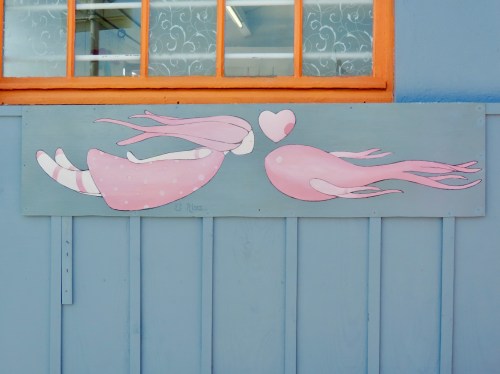
Let’s get back to the point of this post – the photo I used at the beginning. Here it is again, in case you don’t want to scroll back….
What I love about this image is that it depicts an encounter. A meeting of two creatures. Not two people, but a girl and a sea creature of some kind (not entirely sure what kind of sea creature!). Clearly, they are swimming towards each other. They have formed a relationship. A particular kind of relationship. A loving relationship. They are about to kiss. It feels like that. It looks like that.
So, that provoked two trains of thought for me.
First, about loving encounters, which create the most important kind of relationship in the universe – a loving relationship.
Why do I say that’s the most important kind of relationship? Because a loving relationship creates, and is created by, the formation of mutually beneficial bonds. These are a special kind of bond. They are “integrative”. They bring together people, organisms, energies, particles, every kind of phenomenon you can imagine, and, if they really do work in a mutually beneficial way, they create. They are the basis of growth, development and evolution. They produce novelty, unpredictably. They are the source of emergence, that phenomenon in the universe where what’s created could not be explained or predicted by examining only the parts of the previous state.
I do believe these are the most important kind of bonds we can create. At any level.
Second, about kisses. This image immediately reminded me of a passage in one of the physicist, Carlo Rovelli’s books.
The world is not a collection of things, it is a collection of events. The difference between things and events is that things persist in time, events have a limited duration. A stone is a prototypical ‘thing’: we can ask ourselves where it will be tomorrow. The world is made up of networks of kisses, not stones.
Isn’t that beautiful, too?
I love to think of the world this way. Not as a collection of events but as a network of events – “of kisses, not stones“.
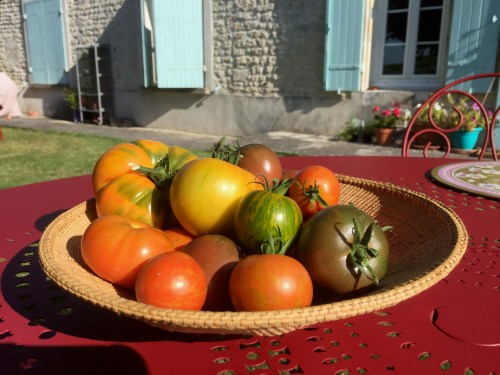
Here’s a small basket of the tomatoes we picked from our garden this morning.
What strikes you about these tomatoes?
Well, what strikes me is their diversity.
They are a huge range of sizes, colours and shapes, partly because they come from different plants chosen because they are different varieties.
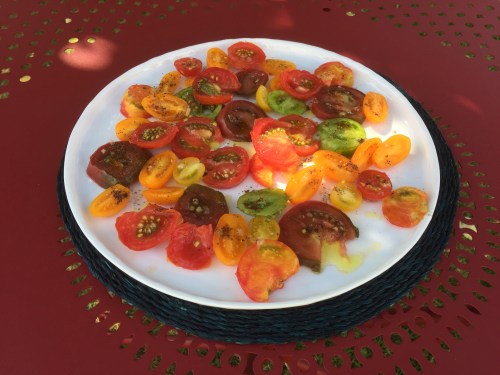
I SO prefer this to a packet of same-size, same-colour, same-variety tomatoes we can buy in one of the local supermarkets. Even just to look at….but also to taste! Here’s a simple plate from yesterday.
Only tomatoes, a drizzle of olive oil, a touch of salt and pepper. That’s it! Mmmmm….
I could leave this post right here. It’s enough, isn’t it, to celebrate colour, taste, freshness, locally sourced food, and the simple pleasures which make a day delightful.
But I’m not going to.
Because what strikes me about both of these images is the issue of diversity. We live in mass society – mass production, mass consumption, mass conformity. This last element is necessary to ensure the efficient workings of the first two. Without mass conformity, mass production and mass consumption go belly up. (yes, I choose my words carefully – he! he!)
There are enormous pressures to consume in this society, and equally enormous ones to produce. A lot of value is attached to both. Did you ever come across an old black and white comedy, “The Man in the White Suit”, about an inventor who creates a totally indestructible fabric? The lead character is a scientist whose discovery industry immediately tries to suppress, because it would mean people could have clothes which would last a lifetime…..and sales of clothes would plummet!
I remembered this old film the other day when I took my car to the garage to have worn-out shock absorbers replaced (ouch!). The mechanic told me that shock absorbers used to last 100,000 km but now they last only about 80,000 km. Guess that’s progress!
Jacques Ellul, who lived, researched, taught and wrote in Bordeaux, produced an astonishing analysis of mass society in his lifetime. I’ve just finished reading two of his main works (in English) – “The Technological Society” and “Propaganda“. Although both were published in the 1960s, they are extremely pertinent in 2019. He shows how a focus on “technique” – by which he means setting goals, then creating measurable processes to achieve them – brings a whole host of improvements and progress to human life, but, inevitably, is accompanied by widespread and deep de-humanisation. Plans, judgements, decisions, resources, all become grist to the mill of mass production and mass consumption. Mass society needs conformity, controls, rules, regulations, norms and standards. There is no room for “variance”, “diversity” or “uniqueness”.
He also showed how mass conformity is produced through targeted propaganda, focused on the “individual”. Now, doesn’t that seem a paradox? Don’t we tend to think of “mass” at one end of a spectrum and “the individual” at the other? Well, it turns out that apparent paradox is the key to mass control.
Long after Ellul published these works, the world saw the birth of a new politics, represented clearly by Ronald Reagan in the US and Margaret Thatcher in the UK. It was Thatcher who famously said “there is no such thing as society”. The new politics became known as “neoliberalism”. With the spread of neoliberalism society became increasingly atomised. The idea was that everyone was on their own and in competition with everyone else, and through “the market”, and a form of “social Darwinism”, the weak, the inefficient, the failures, would die off, and the strongest, “best”, people and methods would win the day.
It’s a toxic mix. Mass plus individualism.
But, hey, I hear you say, I AM an individual! I am NOT the same as everyone else! I’m not just a robot, a machine, a cog in a greater machine!
I hear you.
But here’s my take on that – individualism divides us. It sets us against each other and ignores what we share and what we have in common. It feeds the divisions, prejudices, hatred and fear of “the other” which have become all too common. But I don’t want to be just a data point in Cambridge Analytica’s memory banks. I don’t want to be a mere pawn of Facebook, Twitter, Youtube, Instagram….my details harvested to target me with highly crafted propaganda to make me conform, or to support a small group who have, and want to hold onto, riches and power.
How do I resolve that paradox? I sure don’t have it all figured out but I have some thoughts…..
I don’t think we need to subscribe to either of these extremes – a data point in the mass, or an individual ego, disconnected from the rest of the planet. I think there is a third option.
Uniqueness.
Isn’t that the same thing as individuality? No, I don’t think so. For a whole host of reasons, but, for starters, because “individualism” prioritises separateness and difference. It’s a form of what the English philosopher, Mary Midgely called “social atomism” – see her “The Solitary Self” and “Science and Poetry” for her analysis of this problem. Uniqueness, on the other hand, demands an examination of contexts, of circumstances, connections and environments.
To fully experience and understand the uniqueness of this moment, it helps to see it as a dynamic, changing-before-your-eyes, event. I am unique because of the myriad of connections and flows which make me who I am. I have emerged from a particular family with it’s family tree, in a specific place, at a specific time, and continue to grow and develop through a unique and personal chain of experiences which I weave into a story I call “being me” (or better “becoming me”!)
Every single day at work as a doctor I’d meet patients who came to tell me their own, unique, and personal, story. It’s how I got to understand them. It’s how I made diagnoses, offered treatments, therapies and practices to help them re-experience health again. No two patients ever told me the same story. Not in a lifetime of practice.
And here’s the key – the way I revealed their uniqueness (to myself, and often, to themselves too), was by uncovering the connections, the flows, the contexts, environments and events of their lives.
I never wanted them all to be the same. I never wanted them all to become the same. In health, as well as in sickness, every person turns out to be unique.
OK, this is a personal bee in my bonnet, but I have a hunch that if we tipped the scales a bit, away from a focus on the mass, away from a focus on the individual, and towards uniqueness, that we might begin to create a better world. Maybe it would draw us away from competition and division towards cooperation and connection.
Does this make sense to you?
I mean, it’s a bit of a leap from a basketful of tomatoes!
But before I go, here’s one of my favourite Mary Oliver poems, The Summer Day, which doesn’t use the word “uniqueness” but it seems to me to be all about it…
The Summer Day
Who made the world?
Who made the swan, and the black bear?
Who made the grasshopper?
This grasshopper, I mean-
the one who has flung herself out of the grass,
the one who is eating sugar out of my hand,
who is moving her jaws back and forth instead of up and down-
who is gazing around with her enormous and complicated eyes.
Now she lifts her pale forearms and thoroughly washes her face.
Now she snaps her wings open, and floats away.
I don't know exactly what a prayer is.
I do know how to pay attention, how to fall down
into the grass, how to kneel down in the grass,
how to be idle and blessed, how to stroll through the fields,
which is what I have been doing all day.
Tell me, what else should I have done?
Doesn't everything die at last, and too soon?
Tell me, what is it you plan to do
with your one wild and precious life?
In a recent article about advances in microscopy, a truly incredible innovation, the ability to look inside living cells will give us (according to the journalist who wrote the article)
Seeing the shape and structure of biological molecules is important because they are the cogs and wheels that make living things work. They work inside and between cells, which are the building blocks of human life.
“cogs and wheels”, huh?
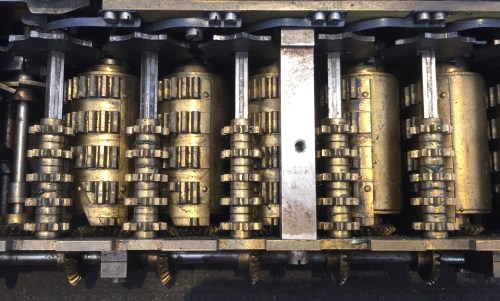
See that photo at the start of this post? That’s a photo of cogs and wheels. You don’t see these inside cells. Living creatures are not “built” from “building blocks” – walls and machines are.
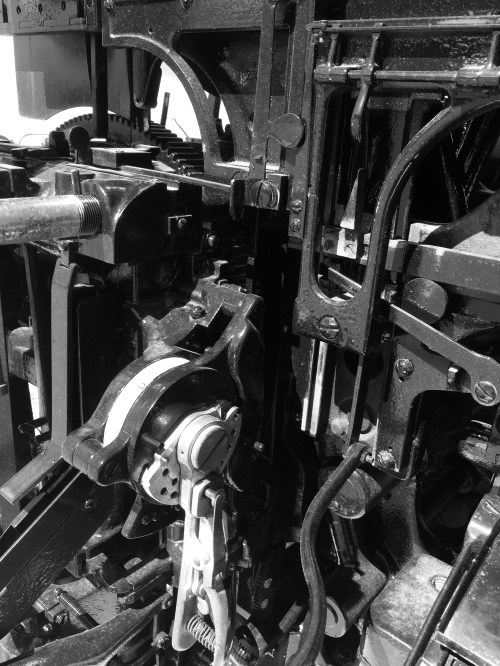
Here’s a machine.
Would you ever be fooled into thinking this was a living creature?
I don’t think so.
In fact, in the footage from this imaging technology that I’ve seen so far, the most amazing and striking thing is that everything you see is on the move. The inside of a cell is full of bustling activity and movement. Not cogs. Not wheels. More like even smaller creatures inside the living creature we call the cell. They seem more like what we see outside of the cell – in whole organisms, like in our own bodies – teeming communities of tiny creatures which we call cells, co-operating and collaborating to function as a whole.
The biologist, Lynn Margulis, developed the theory of endosymbiosis, which described how bacterial sized organisms may have evolved together to become the highly specialised structures inside each, and every, living cell.
In 1966, as a young faculty member at Boston University, Margulis wrote a theoretical paper titled “On the Origin of Mitosing Cells”. The paper, however, was “rejected by about fifteen scientific journals,” she recalled. It was finally accepted by Journal of Theoretical Biology and is considered today a landmark in modern endosymbiotic theory. Weathering constant criticism of her ideas for decades, Margulis was famous for her tenacity in pushing her theory forward, despite the opposition she faced at the time. The descent of mitochondria from bacteria and of chloroplasts from cyanobacteria was experimentally demonstrated in 1978 by Robert Schwartz and Margaret Dayhoff. This formed the first experimental evidence for her theory. The endosymbiosis theory of organogenesis became widely accepted in the early 1980s, after the genetic material of mitochondria and chloroplasts had been found to be significantly different from that of the symbiont’s nuclear DNA. [wikipedia]
We are not machines. Machines are not alive, and they don’t evolve. Crucially, machines don’t show “emergent properties“. They are predictable because they are not alive, and they don’t develop new, impossible to predict, behaviours and characteristics.
I think we do Life a huge disservice when we think of creatures as machines.
We are actually infinitely more complex, more amazing, more puzzling, more wonderful than anything that tired old metaphor can come up with.
So, can we move on please? And talk about Life without reducing it to something inferior – a machine.
I welcome constructive criticism and suggestions. I will not, however, tolerate abuse, rudeness or negativity, whether it is directed at me or other people. It has no place here. ANYONE making nasty comments will be banned.




 Heroes Not Zombies