Feeds:
Posts
Comments

Archive for the ‘philosophy’ Category

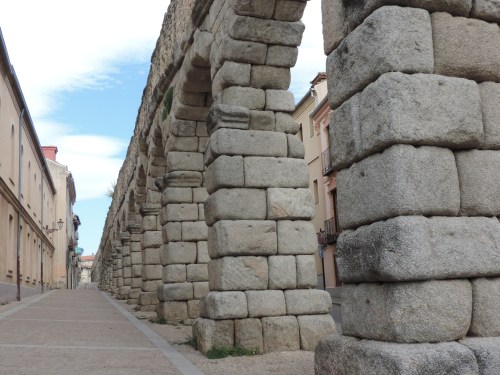
One of my most favourite cities is Segovia, in Spain. Perhaps its most striking feature is the Roman aqueduct. It begins as a pretty average sized wall, then column by column, arch by arch it gets bigger and bigger and bigger, straddling the town below until it reaches the old castle.

In this first part houses have been built on each side of it. I don’t think I’ve ever come across such an astonishing structure running right down the middle a street!
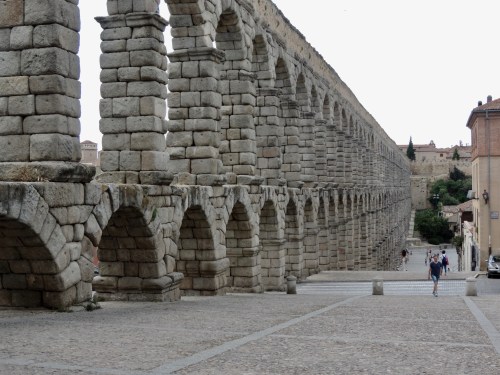
One of the first of the town’s squares lies at the foot of the aqueduct just as it reaches its greatest height.
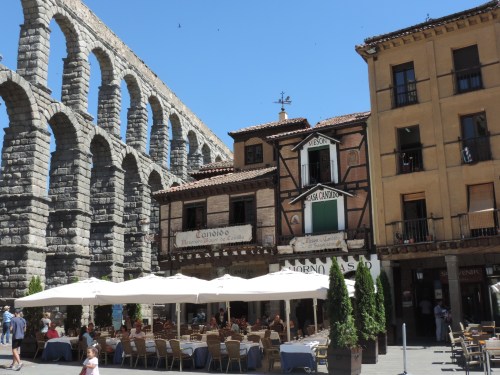
I find this SO inspiring! Here’s what it got me thinking last time I was there…..

Throughout my career as a doctor I saw time as linear. Perhaps because the second half of my working life was in a specialist centre for people with chronic (long term) conditions, I commonly heard patients tell me of the traumas which they had experienced prior to becoming unwell.

I was never someone who bought into a mechanical, linear view of human beings, or of life. Every patient I met convinced me that all these chronic ailments are multi-factorial. You could never say that “this” caused “all that”. But there was one question I frequently found revelatory.

“When were you last completely well?”

Sounds an easy question, huh? But, actually, it was often difficult, and took some time and conversation to find the time, perhaps even several decades ago, when the patient last felt completely well. I’d then ask about the year the patient moved from wellness to illness.

“Tell me about that year”.

It was often a year of significant trauma, or the culmination of many traumas. I don’t think that meant that the patient’s illness could all be attributed to that trauma, but it was a starting point in making sense of their experience and beginning to find the way forward.

Sometimes patients were clearly stuck with these unresolved hurts. Again and again they’d think about those times, feel bad about them all over again. Others were so traumatised that they were living lives of fear, continually looking ahead and wondering “what if….?” “what might happen?” “how will I cope if….?” and things like that.

In both of these scenarios I’d draw a straight line – and say, the left hand point of this line is your date of birth, the right hand, the date of your death. We know the first, and have no way of knowing the second. But right now, today, you are somewhere along that line. Where is your attention? Where is your focus? Because if it’s to the left of today, it’s in the past, and that doesn’t exist any more, except in your memory. If it’s to the right, it’s in the future, and that only exists in your imagination. You can’t have your attention in more than one place at a time, so what if you draw your attention into the present instead? How might that feel? And we’d then explore ways of living more in the present reality, than in the past traumas and future fears.

I think it was often helpful, but now it seems somewhat simplistic to me. Because I now see time is not as linear as I thought. In fact, seeing cycles and seasons of time makes rather more sense to me now. As I experience a place like Segovia I realise that the past doesn’t go away. It doesn’t disappear into memory. (and memory is not an artificial place anyway….it’s no dusty filing cabinet with the drawers all locked)

Rather the past is always present, always here, and always now. It fashions our every day. It colours our every experience. It sets the tone of today. It constantly challenges us to respond to it, to adapt. In fact, that’s how we learn isn’t it? By having an awareness of the past in the present? If we forgot and discarded everything we experienced how could we learn anything? We adapt by carrying with us the past into the present.

And although this is even more challenging, the future is here now too. Not least because the future is, in one sense, a “multiplicity of singularities” – a set of possible paths, which are, at least in part, fashioned by this present moment, and by each and every decision and action.

I don’t think the past goes away. I don’t think the old “time heals” is true in the sense that it makes the past go away. Instead I think we learn to adapt to it. When we become aware of the past in our everyday we have the opportunities to create new responses, new strategies of living under it’s influence.

OK, so, this is not where I thought this post would go when I pasted in those photos of the aqueduct! But here’s a related thought – how does the presence of the past in today, as we see in this colossal aqueduct stretching over Segovia, shape, fashion, influence, inspire, challenge, stimulate the thoughts, feelings and actions of the people living there?

And so, of course, even when the past isn’t as obvious as this aqueduct, how does it’s presence today influence our experience of today?

Here’s the final part of that story – we don’t heal just by shifting our focus, we heal by becoming aware, aware of the past AND the future IN this present day, and realising we can change how we respond to that. Realising our current patterns aren’t fixed. We can alter them.
Read Full Post »

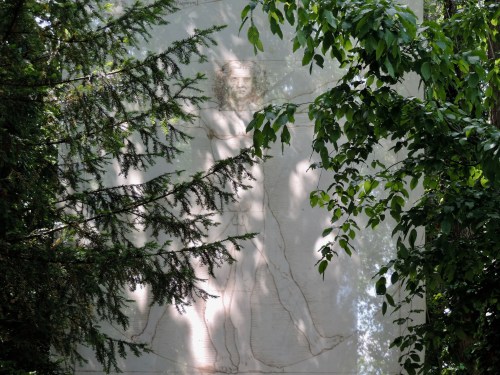
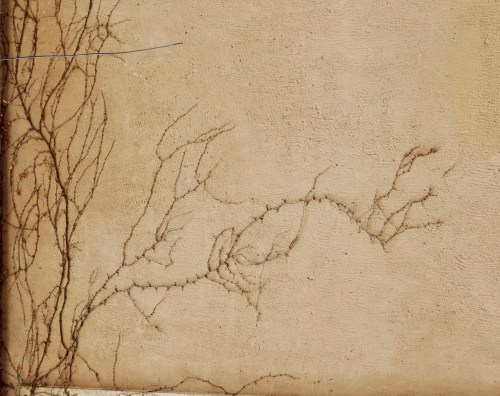
I noticed this on a wall recently. First, I find this beautiful. I find it very appealing. Second, it expresses one of the commonest, most fundamental patterns in the universe – let’s refer to it as branching.

Because I’m doctor, I often start by thinking about the human body, and in the body there are many, many examples of this branching structure. Perhaps the most obvious in the respiratory system. We breathe in air and it travels down the trachea (some people call the trachea “the windpipe”). After a short distance it branches into two tubes, one heading to the left lung and one to the right. From there on there, the pattern repeats, branching into smaller and smaller passageways, until, the smallest ones end in little bunches of grapes, called “alveoli” (OK, I know, they aren’t actually grapes! They just look a bit like that!) Similarly, the vessels which distribute the blood around the body, start from a big one right out of the heart, which branches into smaller and smaller vessels, the further away it gets from the heart, till in the tips of our toes and fingers, in the skin, the vessels become hair like (“capillaries”). The blood then gets back to the heart following a similarly patterned set of vessels (“veins”) coursing along the tiny ones, which join together to make bigger and bigger ones, till one big one channels all the blood back to the heart.

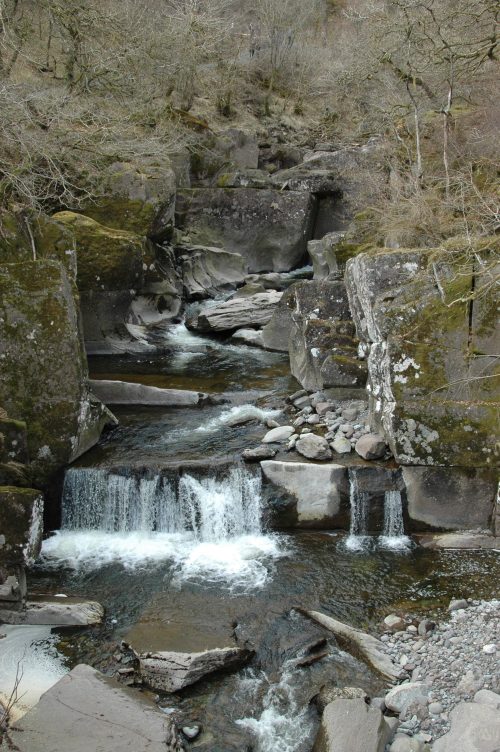
Does that pattern remind you of anything? The journey from mountain springs to river estuaries perhaps? Or trees!

Sometimes I wonder if that’s one of the reasons we find trees so appealing? That they echo one of our most fundamental internal structures.

Read Full Post »

This made me stop. It looks like two trees who got together a long time ago, and have continued to grow, relate, entwine, even dance and kiss together ever since!

The physicist, Carlo Rovelli, says “the universe is made up of networks of kisses, not stones

He also says

I think that quantum theory can make sense as it is: we just have to give up some cherished metaphysical prejudices and accept the deep relational aspect of nature that the success of the theory has revealed

Another physicist, Lee Smolin, says “the universe is a network of events”.

Asked about his theory he says

It’s a theory about processes, about the sequences and causal relations among things that happen, not the inherent properties of things that are. The fundamental ingredient is what we call an “event.” Events are things that happen at a single place and time; at each event there’s some momentum, energy, charge or other various physical quantity that’s measurable. The event has relations with the rest of the universe, and that set of relations constitutes its “view” of the universe. Rather than describing an isolated system in terms of things that are measured from the outside, we’re taking the universe as constituted of relations among events. The idea is to try to reformulate physics in terms of these views from the inside, what it looks like from inside the universe.


Aside from physicists, daily life begins to take on a different flavour altogether when we shift our focus from things to events, from objects to relationships, from separate items to connected contexts.

Try it for yourself, see what’s it like to focus more on kisses, relationships and events than on “stuff”.

Read Full Post »

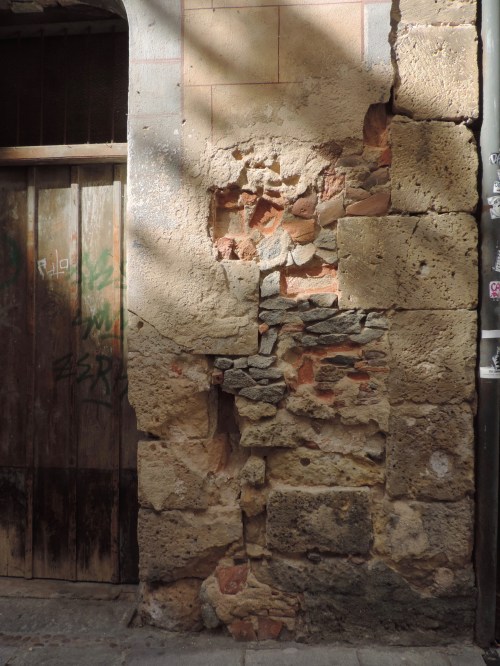
Do you know what I said just before I took this photo?

“Look at the light!”

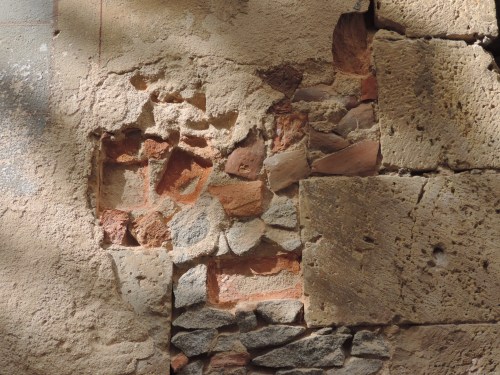
It stopped me in my tracks as I was walking down this narrow road. I took that photo, then I stepped forward and took this one –

I don’t know which one I prefer so I thought I’d share both.

I know, you’re thinking…..was it the light which caught your attention or the colours and shapes of the wall?

The truth is, I’m not so sure. But I do know that the first thing I said was “Look at the light!”, so there was something about the light itself which caught my eye. Of course, as I look at these images now I see the amazing, subtle colours, and the higgledy-piggedty (is that a word??) nature of the stones, bricks, tiles and mortar which have been put together to make this wall. Was it build like this from scratch? Or is this some kind of repair job? Does this particular section of wall have a story to tell, a history? What events has it experienced, and who made this wall like this anyway?

It’s easy to get lost in these questions which we have no possibility of answering….except with our imaginations.

But this is beautiful to me.

This is a moment of experiencing beauty.

It’s also a moment of experiencing light. And, to be frank, the photograph doesn’t capture that experience. You had to be there.

When I think about this dual experience of witnessing light, and what it illuminates, I remember an old essay written by C S Lewis. Oh goodness, I read that when I was a teenager. Can I remember it clearly? I think it was called “Meditation in a tool shed” – off to google it (actually, I shouldn’t use “google” as a verb like that. After all, I have “duckduckgo” set up as my default search tool) – I mean off to duckduckgo it!

Oh, yes, here it is! 

Gosh, it’s quite dated now. The references to “savages” kind of took me by surprise there! Still, the basic idea is still clear. In this essay, Lewis is thinking and writing about seeing a shaft of light coming into his dusty toolshed, then moving to look along the light itself and seeing the sky and trees outside. He uses this experience to juxtapose two kinds of experiencing – looking at an object, something “outside” of ourselves, and experiencing as a “subject”. Well, I don’t think he actually uses that language but that’s what I’ve always taken out of it.

There’s a difference between observing and experiencing.

We do both all the time of course, and the objectivity of observing continues to be debated, but nobody can deny what you experience as a subject. That’s all yours. Or, in my case, all mine!

I think of myself as a realist. I’m not convinced by the arguments that there’s nothing “out there”, that everything comes into existence only in the moment of being observed. After all, the universe has been around for a heck of a long time before human beings emerged to observe it! As best I know!

I’m not really convinced by the relativist arguments either….that there is no objective truth, that truth is different for each and every one of us. But it seems kind of obvious to me that my subjective, day to day, moment to moment, experience is unique. As is yours.

More than that, this subjective experience I have of my one unique life is inescapable for me. I can’t avoid it. I can’t stand apart from it and take another view entirely. That’s partly why I take these photos and write these words.

I’m just expressing my unavoidable uniqueness.

I should also stress, however, that I absolutely love it when others express their uniqueness too.

Go on….share what only you can share!

Read Full Post »

I reckon I come across something amazing every day. Maybe I’m easily amazed! But in French, the phrase, “l’émerveillement du quotidien” (the amazement of the every day), is one which has made its way to the core of my being. I don’t know if you’d call it a value, or a principle, but it shapes my life, moment by moment, day by day.

This photo is of something I noticed the other day, something which attracted my attention, then stimulated my thinking. That’s the kind of amazement I like best!

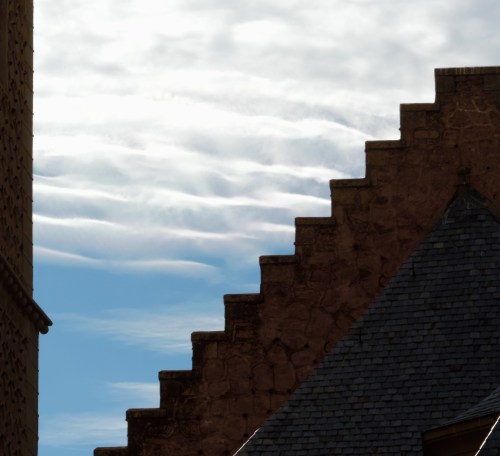
What I saw first was the sky. Just a bit of the sky between two buildings. The clouds looked unusual and pleasing, so I framed the shot, taking in the silhouettes of the buildings on either side of the patch of sky. I liked it the moment I saw it. And I clicked.

When I looked at the shot later it pleased me even more. Not least, I think, because of the contrasts. There’s the contrast between the blue and white of the sky, and the dark browns and grey/blacks of the buildings. But there’s another contrast too.

Look at the shapes.

There’s the shape of the stepwise construction of the building, the bricks laid, one by one, each one separate from the other. It’s like a stair case, isn’t it? A stair case you climb one step at a time. The shape, it seems to me, is typical of what we’d call “discrete”. Each step is distinct from, separate from, the others. And each one adds in a pretty linear, arithmetical way to the others.

But then there is the shape of the clouds. They look like waves. They emerge out of the invisible, out of the blue, each one becoming less distinct, less separate, than the other, till at the top of the image the waves merge into a patch of cloud, almost like waves disappearing into the sea.

I find that pleasing.

I find that appealing, attractive and it make me wonder. Isn’t that the essence of amazement? Of “émerveillement”?

I find that thought-provoking. It seems to me that the left hemisphere of the brain is great at seeing patterns, great at breaking the whole down into individual, discrete parts, great at constructing, building, step by step. Whilst the right hemisphere is busy seeing the whole, seeing the context, seeing the connections, great at finding what’s new, great at engaging with waves which emerge from the whole, (from the sky, from the sea, from the Earth) and dissolve back into it again.

How amazing. To have two brains working away at the same time, enabling us to see and appreciate this universe so uniquely.

Read Full Post »

There’s a very human tendency to view ourselves as outside the world. What I mean is that we feel we are IN the world, but we remain APART from it. We are dualists. We think “there’s me” and “there’s the world”.

How did we get here? Just parachuted into it? Dropped down from outer space? We talk about “Nature” or the “the natural world” as if that’s something other than ourselves. As if it’s a place we can visit, and then leave again.

But that’s all a sort of delusion, isn’t it?

There is no “me” separate from “the world” or from “Nature”. We didn’t land on Earth from an alternate universe, we emerged within it, live within it, die within it. There is nowhere else. (Or if there is, we have no way of knowing that)

Yet, this sort of division persists, doesn’t it?

In fact, it seems this is a crucial and necessary part of being human. Our brain has evolved the ability to create what some call, “a necessary distance” between the flows of energy, information and materials pouring through ourselves and the planet we live on.

We are great pattern spotters, we humans. We see patterns, analyse them, name them, categorise and label them, then we can re-cognise them very quickly. We create maps in our minds. We create a “you map”, a “me map” and a “we map”, as Dan Siegel says in “Mindsight”. These maps contribute greatly to our sense of self, as well helping us to recognise others and develop confidence and belief in our relationships.

Our linguistic abilities are used to create the names and labels and to think about whatever we are applying them to, as well as enabling us to communicate about them. We use words, symbols and metaphors to take these processes of analysis and recognition to whole new levels. These are some of our super-powers as humans. They enable us to literally, and metaphorically, grasp the world in which we live.

To do all those things requires us to step back from the flow of experience. We use this “necessary distance” to momentarily step aside, to enable us to see more clearly, understand more deeply. With this comes this sense that we are “apart”. That there is “me” and “The Other”. When, in reality, there is only ONE, and we live inextricably IN the flux and the flow.

I don’t like judgements. They stop thought. But we need them. It’s just we need to be able to let them go more easily than we make them as our understanding deepens, as we see more and more connections, envisage the contexts in which whatever we are examining exists.

So, it’s interesting to me, to take the old school philosophical spiritual practice of “the view from on high”, literally from time to time. To climb up somewhere, to take the time to gaze towards the horizons, to see the landscape unfolding in front of me. To see the “bigger picture”.

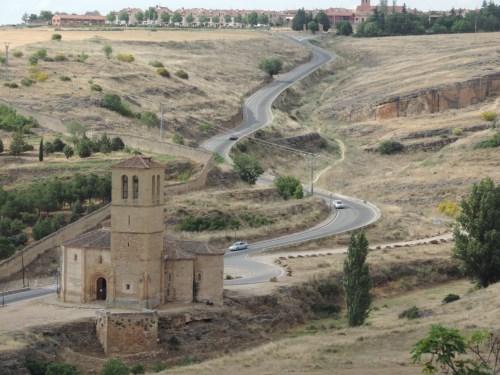
This photo is one I took the other day when standing outside the Alcazar in Segovia. I’m pretty sure that what caught my eye was the church. It seems to stand alone. Almost in the middle of nowhere. But as I framed the shot my eye was led from the church to the winding road which my mind then followed to the top of the hill. Up on the ridge I could see buildings. A lot of buildings. So not a church in the middle of nowhere at all. But still, a church set apart somehow. The curve of the road was immediately appealing and I made sure I included it in the camera frame.

Now that I look at this image I see, yes, the church, that physical symbol of the spiritual connected to the village at the top of the hill by a winding, beautifully curving road. You could argue the road leads to the church. Or you could see the road as leading from the church to the town where people live. In other words, you can see the church, the town AND the connection all at once. I find that immensely pleasing.

I don’t know if that will get you thinking about the place of the spiritual in human life. It might. Or maybe it will get you thinking about connections, contexts and the illusions of separateness?

Ah, before I go, one other thing……see the wall someone has built just to the left of the church and the road? Someone has claimed this piece of the Earth as their own and built a wall around it to strengthen their feeling of separateness. Most people live in the village on the ridge, or so it seems to me. Not many live behind the wall.

Oh yes, walls again. We are hearing a lot about them these days. Both literal walls, to separate Americans from Mexicans, or Palestinians from Israelis, and the toxic and divisive “US AND THEM” walls which divide “natives” from “immigrants”.

But it’s all one world, huh? We share the same planet, the same air, the same water, the same place in the evolutionary path of Life.

It’s a bit of a challenge isn’t it? To see differences and separations but to see them as inextricably connected in a bigger picture.

Read Full Post »

Do you get those experiences where something catches your eye, then when you stop to reflect on it, its significance gets deeper and deeper?

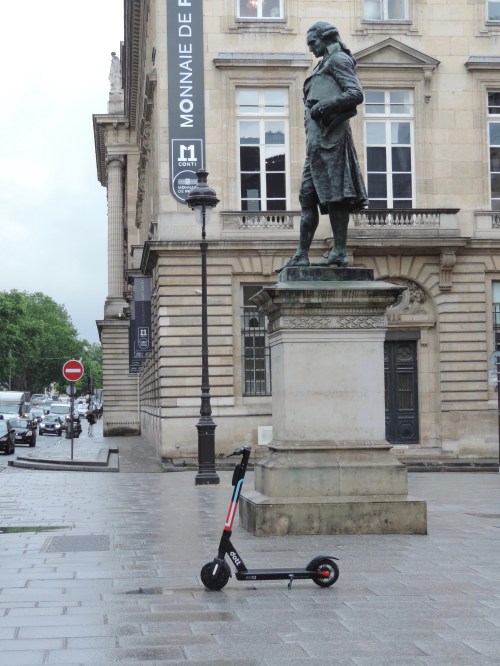
Last week I was in Paris, and on one of the rainy days was heading for a restaurant at lunch time but this scene caught my eye. Despite the fact it was raining, I stopped and took a photo. In fact, I took two….the first time my camera slipped as I pressed the shutter and I only caught the top of the scooter!

These electric scooters are everywhere in Paris just now. You can hire one using an app and drop it off anywhere you like. In fact, that’s become a bit of a problem. People are falling over them on the pavements and sustaining injuries, so the authorities are starting to consider new regulations to control them.

I took the photo because I thought it looked funny. To see this serious gentleman either looking down at the scooter somewhat disdainfully made me smile. Then I thought maybe he’s actually thinking about jumping down onto it!

When I got home, I decided to find out who this man is – turns out he is “The Marquis de Condorcet”, a leading Enlightenment thinker and writer, a mathematician and philosopher. One of his most deeply held beliefs was “progress”. He thought we humans, through learning and communicating with each other, would steadily increase our understanding of the natural, social and political worlds, continuously progressing and improving society. “However, Condorcet stressed that for this to be a possibility man must unify regardless of race, religion, culture or gender”

The wikipedia entry on him goes on to say this –

Condorcet was concerned with individual diversity; he was opposed to proto-utilitarian theories; he considered individual independence, which he described as the characteristic liberty of the moderns, to be of central political importance; and he opposed the imposition of universal and eternal principles.

He was a champion of diversity, equality and individual freedom. But he was also a champion of thinking – that progress required us to deepen our understanding of the world and of each other, comparing and reflecting on our individual experiences. He campaigned against slavery and for women’s civil rights.

So, it took an electric scooter to get my attention, but I’m glad I’ve discovered Condorcet. I think we could learn something from him about the importance of values, diversity and justice.

Read Full Post »

I recently visited the Chateau de Clos Lucé in Amboise, in the Loire valley. This is where Leonardo da Vinci spent the last years of his life. He was invited to live there by François I in 1516. The king provided Leonardo with a place to live, 700 gold ecus a year, and financed his works, in turn for the pleasure of his company and daily discussions with him. Leonardo only lived three more years, dying in 1519, which is why, on this 500th anniversary year of his death, the chateau is hosting a major exhibition of his work. (As an aside I find it fascinating and inspiring that Leonardo was given free range “to dream and work” – what kind of society could we have if we funded creatives and academics to “dream and work” together, without goals, funding applications or publication demands?)

There are a number of Leonardo quotations around the chateau and the gardens. This one caught my eye –

You know that medicines when well used restore health to the sick: they will be well used when the doctor together with his understanding of their nature shall understand also what man is, what life is, and what constitution and health are. Know these well and you will know their opposites; and when this is the case you will know well how to devise a remedy.

After a lifetime career in Medicine, I’m less sure now that medicines do “restore health to the sick”. I think it’s biology which restores health. Human beings are complex adaptive systems, and all such organisms have both “self-healing” and “self-making” capacities. The best medicines stimulate those natural processes of healing. The next best support the processes. Many of the ones we use reduce symptoms, or reverse an imbalance in the body, both of which are reasonable goals and acts, but are they directly involved in restoring health to the sick? Do you think that’s just semantics? I don’t. I’d have a hope for the future that we’d develop the treatments which really do support and stimulate the natural processes of healing, and that’s what Leonardo says, in other language, at the end of that quotation – “when this is the case you will know well how to devise a remedy”.

When what’s the case?

Oh, yes, understand “what man is, what life is, and what constitution and health are”.

Ah! Well, there lies both the problem and the signposts to the solutions…..

A couple of years into my work as a General Practitioner I started to wonder what health is. Nobody taught us what health is at university, and the clinical training of a young doctor focuses on learning diagnostic and therapeutic techniques – identifying pathologies and treating disease states. I went back and looked at my Clinical Medicine textbooks. I searched the index for “health” – no entries. Nope, not one. That set me off on an exploration, looking for an understanding of what health is. The medical school textbooks were no help. Oh yes, there was that old World Health Organisation definition –

“a state of complete physical, mental and social well-being and not merely the absence of disease or infirmity.”

But all that really does is substitute the word “well-being” for “health”. It does suggest health is multidimensional – physical, mental and social – and it does suggest health is something positive, not just the absence of disease or infirmity. But does it really take us much further that irritating “Brexit means Brexit”?

While researching the issue of the absence of health in medical textbooks, I discovered there was a kind of parallel anomaly….biology textbooks didn’t have a definition of life. Really? Well, yes, it wasn’t uncommon to find a biology textbook without the word life appearing in the index.

So what is life?

One of the more satisfying descriptions I read was from Maturana and Varela’s, living organisms demonstrate a “self-making” capacity, which they termed “autopoiesis” and that lead me down the path of the complexity scientists and their definition of “complex adaptive systems”. I still find that a good starting place.

That leaves us with two more areas to explore, according to Leonardo. What is man? and What is a constitution? Remember he was writing 500 years ago, and we would probably now say “What is a human?”, rather than “what is man?”. Let’s leave constitution aside for just now, as it’s pretty embedded in the issues of what is a human and what is health?

What is a human being?

There have been a couple of books published recently which put this question centre stage again. Douglas Rushkoff’s “Team Human“, and Paul Mason’s “Clear Bright Future“. Both of these books are concerned about the impact of technology on human beings and on our societies. Rushkoff says –

being human is a team sport. We cannot be fully human, alone. Anything that brings us together fosters our humanity. Likewise, anything that separates us makes us less human, and less able to exercise our will.

In other words, he focuses on the innate sociability and need to act co-operatively in human beings. I’ve heard Paul Mason say at least two interesting definitions of what is a human – human beings “use energy to counter entropy” – in other words we are a creative species. And human beings are “co-operative, imaginative and linguistic” – the combination of which makes us a unique species.

All of these ideas are interesting to me. And I find it refreshing that these questions are coming to the fore now. Surely this is a timely and positive response to the mechanical, data and statistics driven reductionism which is so utterly de-humanising.

I continue to explore what it means to be human, and I find some of the more impressive answers in the works of philosophers, from the classical schools to Spinoza, Bergson and Deleuze (to name just a few!)

Of course, I could write about this for hours! Ha! Ha! But I’ll stop here and leave the possibility that these are questions you might like to pursue for yourself.

Let me summarise – because I think this is a lifetime project as well as potentially the basis for a whole curriculum –

  • What is Life?
  • What is a human being?
  • What is health?

The answers which appear from those studies could, possibly, give us the remedies of the future – the ones which actually do “restore health to the sick” – and, yes, more than that, allow us to create healthier societies filled with people who fulfil their potentials, creatively, co-operatively, and artistically…..can I even say “spiritually?”

Read Full Post »

We’ve had a very hot, dry spell recently here in the Charente. Temperatures rising to the mid or high 30s (centigrade) each day which made the leaves of the plants curl up and wilt. Then this last week we’ve had rain, wind and storms. Yikes! What chance have they got?

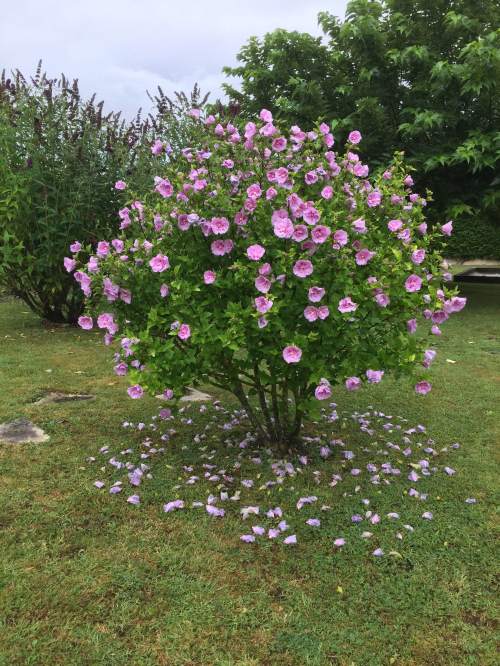
Well, look what all that varied weather has done to this bush in the garden.

First it suddenly bloomed, going from zero flowers to dozens of them over about 48 hours. Then the wind and rain has knocked off more than a few of them.

But when I walked outside yesterday evening and the bush caught my eye I was transfixed.

Just look how beautiful this is! Not just the bush itself but the way the fallen flowers have made a pinkish purple circular rug on the grass around it.

This is the kind of beauty which Nature makes.

In “The Great Work”, Thomas Berry talks about the interplay between discipline and wildness…..between order and chaos (or disorder). This is a great example, I think, of the beauty the wildness and disorder brings…..effortlessly.

Read Full Post »

We all live embedded in multiple environments, or contexts…..webs of connected flows of energy, information and materials. I wonder how aware we are of them? I wonder how conscious we are of the signals and messages we are receiving as we go about our every day activities?

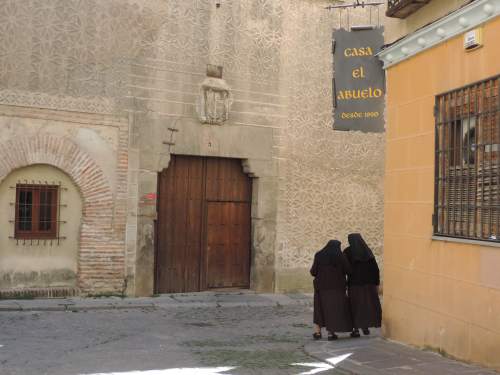
When I was in Segovia recently I took a couple of photos, which, with hindsight, I think say something important about one kind of environment – the cultural one. By that I mean the web of meanings and values which bathe a town, a city, or a region in waves of a certain kind….the kind which contribute to what someone means when they talk about “a way of life”, or “an identity”.

The first photo is of these two nuns walking around the corner of a building. Segovia has a history of convents, and many of them are still active.

The second is more secular.

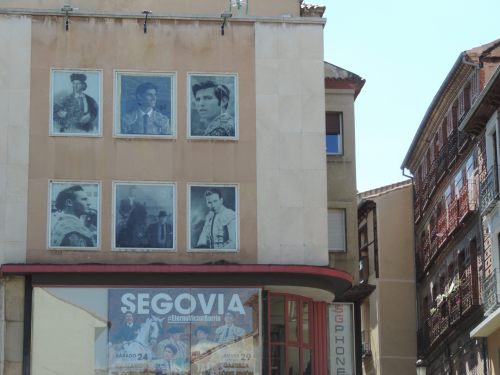
The matadors. Local heroes. Bull fighting evokes strong reactions in people, with some deeply attached to it, and others considering it barbaric. Whatever your reaction, however, you can’t deny this aspect of the cultural environment in a place like this, exerts a powerful influence on the minds and lives of the people who live here, and the people who visit.

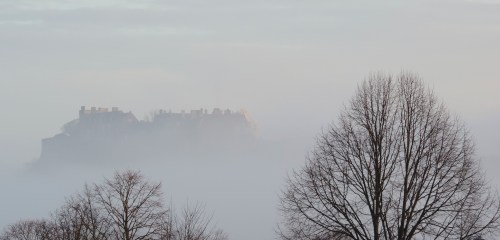
I was born in Scotland, in Stirling, the city on the edge of The Trossachs, an area rich in lochs, forests and hills. Stirling Castle stands on a rocky outcrop high above the town and casts its own historic influence on it, and on the people. My gran used to tell me that boys born in Stirling were “Sons of the Rock”. Is there any better example of how culture and place intermingle to create influential environments where ideas of how to live and who I am have their roots?

What is your cultural environment like?

Could you take a photo or two which would give someone else a sense of it?

Read Full Post »

« Newer Posts - Older Posts »