Feeds:
Posts
Comments

Archive for the ‘philosophy’ Category

textures

One of the keys of my approach to life is a phrase I encountered in a French book – “l’émerveillement du quotidien” – meaning, the amazing wonder of the every day.

Here’s an example.

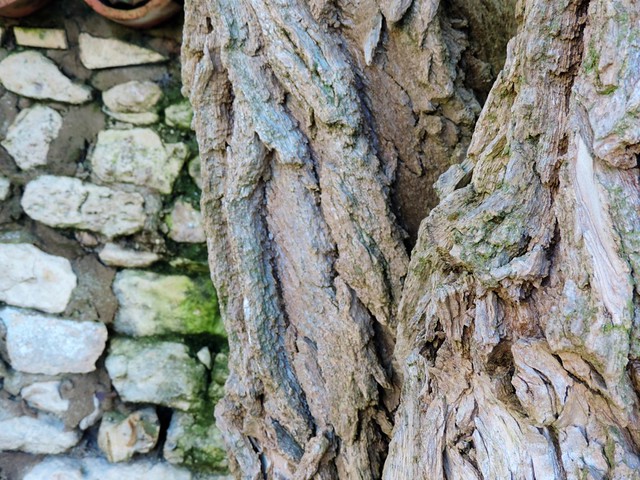
This one is texture.

Look at the incredible texture of the bark of the tree, and the way it plays in relation to the dry stone wall behind it.

Found an amazing textures today?

Read Full Post »

The cognac cellars

Becoming not being

You’ll see that phrase up at the top of the home page here, just underneath the heroes not zombies title.

Such a phrase can lead me off in many directions. For example, it brings a focus on verbs instead of nouns. Nouns are words we use to name things. We categorise with nouns. We put things into defined boxes and then argue about the purity of the box’s contents. Verbs on the other hand are action words. It’s harder to pin a verb down. It’s always changing. Every Sunday you’ll find a post here about a verb (put the phrase “A to Z of becoming” in the search box and you’ll find lots of them).

Becoming not being is about change, about transience and about process.

Eric Cassell says in his “Nature of Clinical Medicine

I say that “thinking about processes differs from thinking about a thing in at least four aspects. Process implies change, a direction of change, a rate of change, and a purpose, result, or outcome of change”

Who I am today is different from who I was yesterday, last week, last year. I am still me and the nature of change in a human being is of constant adaptation and evolution. It’s developmental. The cells in my body are constantly changing, some dying off, some being born. The connections in my brain are constantly changing – with every thought, every image, ever memory, every sensation.

I AM change.

There are many directions of change in the Universe, but the one which fascinates me most, is the one which underpins “The Universe Story“. If we start about the time when there were only Hydrogen atoms, and follow the change through to the emergence of Life, and on to the births of you and I, we see a direction of change – towards every greater complexity, from fairly simple atoms to complex adaptive organisms – and up into the emergence of consciousness. With this direction of change we see more and more diversity in the Universe.

The direction of change is towards ever greater connectedness and ever more uniqueness.

The rate of change is not constant. We see that with evolution. There are no smooth transitions from one life form to another. The changes occur in leaps. We see that in the development of a child. One day they can’t stand up, then from another day they can. One day they can’t walk. Then they can.

Change occurs in quantum leaps.

Cassell mentions “a purpose, result of outcome of change”. The thing with outcomes, is that they are only what you describe at the time you describe them. Outcomes lead to new changes. There isn’t a stopping point. You could say the same about results. So what about purpose? I think purpose is discovered, and/or created through narrative.

The narrative of change creates and reveals meaning in our lives.

The photograph at the start of this post, is of a cognac cellar. The barrels sit there in the dark for years as the cognac constantly changes, every year producing a unique new flavour.

Becoming not being.

Read Full Post »

I used to support this idea that you ‘write what you know.’ You hear that advice given to young writers all the time and even to kids in school. It’s one of the greatest disservices – even in elementary school, teachers ask students just back from holidays to write about what you did, what happened to you, what you know. What about what you imagine? The imagination is the richest tool you will ever have as a novelist and, really, as a person. Anybody can do research. To use your imagination is to use a gift of the gods. The imagination is really disrespected when you’re telling people over and over to write what you know. This idea that what you experienced in your backyard when you were 15 is more significant or more real is just not true. Lawrence Hill

I’m increasingly convinced that imagination is indeed a “gift of the gods” and that it is the “richest tool” any creative person can use, not just writers. 

In fact, I’m increasingly convinced that more imagination is needed to solve the problems and crises we face, to feel genuine empathy with others, to develop tolerance, and to re-enchant our dis-enchanted lives.

Read Full Post »

It’s often said that every action you take, every word you utter, maybe even every thought you have, ripples out into the Universe like the spreading waves on the surface of the water after you throw a stone into a pond.

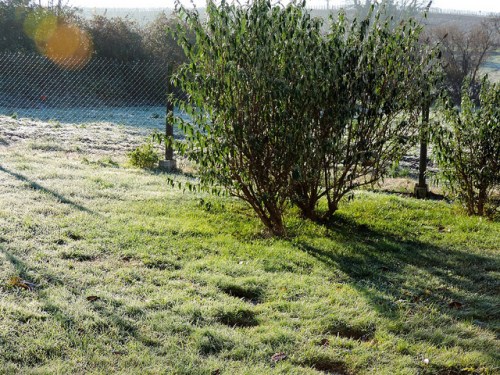
Take a look at this photo. I took it the other morning when I saw the grass was covered in frost and the sun was coming up.

You can see the sunlight is coming from the top left of the image and that the bush is casting a shadow towards the bottom right. You might think (rightly) that the land covered by the shadow will not be warming up as quickly as that which is in direct sunlight, so the frost will stay there longer. 

But look more closely. there is a whole circle of ground around the bush where the frost has gone. And that circle is on both sides of the bush – the sunlit side, and the shadow side.

More than the metaphor of the ripples on the water, I think this image reminds us how a living organism impacts on the world of which it is a part. 

It reminds me that all living organisms are “a part” of the Universe, not “apart” from the Universe.

It reminds me that our every day living influences and effects the place where we live, the environment in which we live, and that we interact in complex and surprising ways with the Universe.

It’s true, isn’t it? Every action we take, every word we utter, every thought we have, cascades “out” into the Universe.

Read Full Post »

UNESCO has declared 2015 as the “Year of Light” (“and light-based technologies”), so I thought I’d share a couple of thoughts about light.

For the last 52 Sundays I’ve published a post about an action to consider in the week ahead. To focus on actions, I’ve been writing about verbs. Verbs are tools for us. We use them to create the lives we experience. Verbs are doing words. They can’t quite be pinned down into one place or time. When we are doing something, we are experiencing continual change. Some even say that the best way to think of the “self” is not to think of self as a noun, but as a verb.

The practice of meditation invites us to investigate the flux of arising and passing events. When we get the hang of it, we can begin to see how each artifact of the mind is raised and lowered to view, like so many flashcards. But we can also glimpse, once in a while, the sleight-of-hand shuffling the cards and pulling them off the deck. Behind the objects lies a process. Self is a process. Self is a verb.

Verbs are our tools of becoming. Because we can choose our verbs and practice them, we can become active creators of our own experience.

I’m thinking of doing two things with the A to Z of Becoming series – develop them into a book which I hope to publish this year, and continue the Sunday series of posts about verbs.

This Sunday, I’m going to pick up on the UNESCO theme and think of verbs related to light. A long time back I figured that being a good doctor included practising three verbs related to light – lighten, brighten and enlighten. But now I think they are good value-grounded verbs which can add to anyone’s life.

So, this week you have three verbs to explore.

What or who lightens up your life? Can you find time to spend doing what it is that lightens up your life this week?

And what light do you shine in the lives of others? In your day to day interactions with others do you make their lives lighter, or darker (lighter or heavier maybe)?

What about brightening? To me, if you lighten someone’s life, you do something which eases any suffering they are experiencing. You help them to relax, feel less anxious, or down. To brighten someone’s life is to turn the light up in their lives. Think of sunshine, or of sparkling. Sparkling eyes brighten a day. Smiles brighten an exchange. Sharing a passion or an enthusiasm makes an experience more vivid. I’m thinking of brightening in those ways.

What can you do to brighten someone else’s life up this week?

And, how do you brighten your life? How do you add colour to it, richness or, variety? How can you increase the intensity of your experiences…..turn up the brightness…..hear, see, smell, taste, feel more vividly?

Finally, what about the idea of enlightening?

To enlighten is to understand better, to see something more clearly, to know what something means. How can you increase your understanding of another this week? How can you see something more clearly? We humans crave a sense of meaning and purpose. How do you make sense of what you experience this week?

There are lots of questions in this post, and I don’t expect you’ll explore them all in just a week, but maybe that’s why I’ve been thinking about them today. If this is to be a year of light, I can explore light in many ways over the coming days and weeks. I’ll do that with my camera, and I’ll do it with my journal. But mainly I’ll do it by coming back again and again to these three verbs – lighten, brighten and enlighten.

Here’s some amazing sunlight

sun

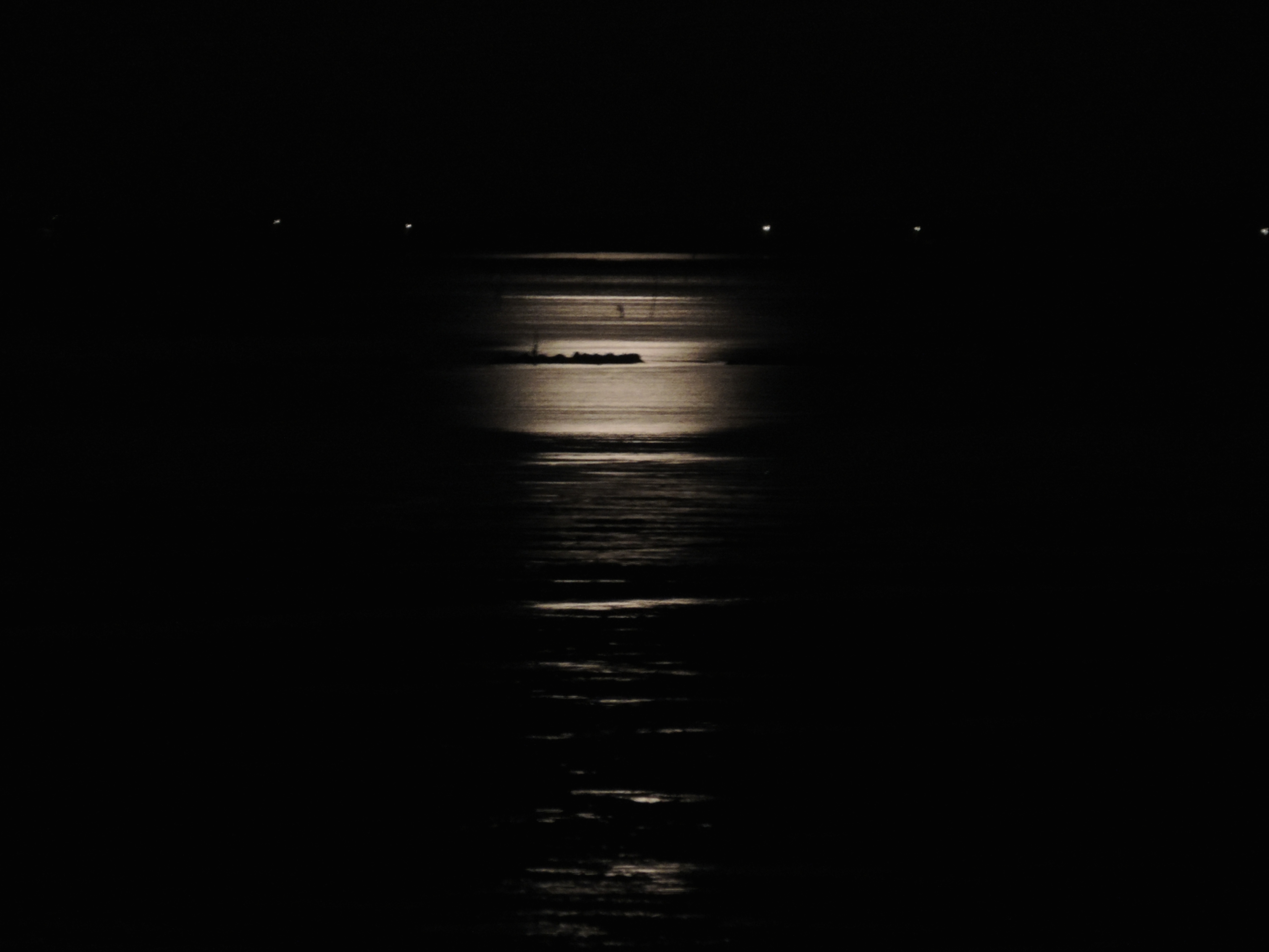
Some moonlight…..

moon

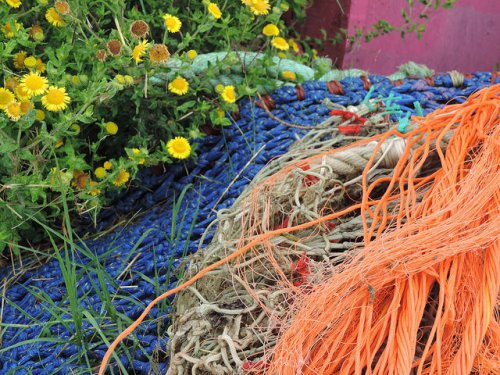
And some sparkles….

sparkles

Read Full Post »

January gets its name from Janus, the God who faces both ways, forwards and backwards, the God of gateways and doorways.

This is a good month to take the time to stand on the threshold of the new year, look back, and look forward, and see both which paths you’ve been following in 2014, and which new ones you might follow in 2015.

This door I photographed has clearly been doing its job for many years, and I love the way it has gradually evolved and changed. Clearly some of the panels needed to be replaced, but this is still the same door in the same doorway. It reminds me of the old philosophical question about a wooden boat which needs to have some of its planks replaced every year. By the time not a single plank from the original construction remains, can you still say it is the same boat?

So this month, is your month. And this is a month of the year you will have visited many times before (for me, this is the 60th January I’ve experienced), but every year brings a new January.

Every January, you think back to remember the moments from the year gone by, and you start to think ahead, to make plans for the year to come.

Every January, as you pass through your doorway, you’ll be crafting new elements onto the ones which were already there.

Maybe its an idea to take your time this month, allow yourself to reflect on 2014, and take a few moments to imagine how 2015 might be, imagine how you would like it be.

And amongst all this reflecting and planning, recognise that this a moment of passage, that January is a month for you to step, seemlessly, and deliberately, from last year into this one.


Read Full Post »

1st of January today. 2015.

Outside there is a frost on the grass, and up above a cloudless, blue sky. 

As the sun rises it starts to melt the frost.

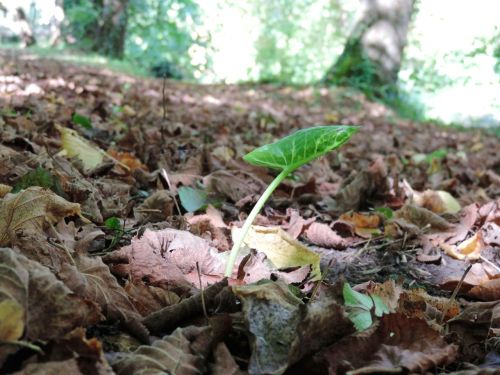
Here’s a leaf at the half way point.

Half frosted, half warmed and wet.

Like a yin yang symbol, lying there in the grass, reminding me of the cycles and rhythms of change, and of the beauty in difference and contrast, and stimulating me to think about 2015 gradually emerging from 2014.

Good morning.

Bonjour.

Bonne Année.

Becoming not being.

Read Full Post »

In the London Review of Books, Hilary Mantel has written an extremely thought provoking review of Brian Dillon’s “Tormented Hope: Nine Hypochondriac Lives”.

For some of us, the question ‘Am I ill or well?’ is not at all straightforward, but contentious and guilt-ridden. I feel ill, but have I any right to the feeling? I feel ill, but has my feeling any organic basis? I feel ill, but who am I to say so? Someone else must decide (my doctor, my mother) whether the illness is real by other people’s standards, or only by mine. Is it a respectable illness? Does it stand up to scientific scrutiny? Or is it just one of my body’s weasel stratagems, to get attention, to get a rest, to avoid doing something it doesn’t want to do? Some of us perceive our body as fundamentally dishonest, and illness as a scam it has thought up.


We understand, almost instinctively, the nuanced difference between disease and illness. As Eric Cassell put it so clearly – “illness is what a man has, and disease is what an organ has”. Or “illness is what you go to the doctor with, and disease is what you come home with”. However, both doctors and patients are caught up in the blurred boundary between these two concepts. For doctors, once a sensation is classified as a symptom, it becomes a signpost to a pathology (or it is dismissed as “psychological”). For all of us, though, we live with the possibility that any sensation might be a symptom. For the hypochondriac, every sensation might be a symptom. As Hilary Mantel says – 


In hypochondria, the whole imagination is medicalised; on the one hand, the state is sordid and comic, on the other hand, perfectly comprehensible. It is the dismaying opaqueness of human flesh that drives us to anxiety and despair. What in God’s name is going on in there? Why are our bodies not made with hinged flaps or transparent panels, so that we can have a look? Why must we exist in perpetual uncertainty (only ended by death) as to whether we are well or ill?

Am I well, or am I ill? Who decides?

Brian Dillon consoles us that ‘hypochondriacs are almost always other people.’ The condition exists on a continuum, with fraud at one end, delusion in the middle and medical incompetence at the other end; he is a benefits cheat, you are a hypochondriac, I am as yet undiagnosed.

One issue is symptoms, which are a particular way of classifying sensations. Are some more real, somehow, than others? Do they need accompanying physical changes in the body to be real?  

Many people are simply hyper-aware of bodily sensations, and so are driven continually to check in with themselves, examining visceral events as a man about to confess to a priest examines his conscience; like the believer scrutinising himself for sin, they expect to find something bad, perhaps something mortal. Forgiveness, and cure, are only ever partial and temporary; there will always be another lapse, some internal quaking or queasiness, some torsion or stricture, some lightness in the head or hammering of the pulse, some stiffness in the joint or trembling of the limb, or perhaps even an absence of sensation, a numbness, a deficit, a failure of the appetite.

A researcher called Kurt Kroenke has published many studies where he shows, time and again, that not only is the percentage of people listing symptoms which they have equal whether they are attending medical clinics, or are simply stopped in the street and asked, but the actual symptoms people complain of are the largely the same whether they are attending for health care, or just going about their normal lives. Clearly, not only are sensations not usually symptoms but symptoms do not equal disease.

Bodily, and psychic sensations are part of being alive. But we humans are compelled somehow to try to find the underlying meaning of everything..including sensations. Isn’t this the crux of the issue? Who gives meaning to your daily life, your lived experience, your sensations, thoughts, and feelings?

In the days before internet information and misinformation became available, patients often came away from a consultation with the feeling that they did not own their own bodies, that they were in some way owned by the doctor or the NHS. Now perhaps Google owns our bodies; it is possible to have access, at a keystroke, to a dazing plurality of opinion. There is an illness out there for every need, a disease to fit any symptom. And it is not just individuals who manufacture disease. As drug patents expire, the pharmacological companies invent new illnesses, such as social anxiety disorder, for which an otherwise obsolete formulation can be prescribed. For this ruse to work, the patient must accept a description of himself as sick, not just odd; so shyness, for example, becomes a pathology, not just an inconvenient character trait. We need not be in pain, or produce florid symptoms, to benefit from the new, enveloping, knowledge-based hypochondria. We are all subtly wrong in some way, most of the time: ill at ease in the world. We can stand a bit of readjustment, physical or mental, a bit of fine-tuning. Our lifelong itch for self-improvement can be scratched by a cosmetic surgeon with his scalpel or needle, our feelings of loss assuaged by a pill that will return us to a state of self-possession. For hypochondria, the future is golden.

It’s not just doctors who interpret your sensations now, there are interpretations everywhere, and some of them are deliberately invented for marketing purposes. 

Living involves experiencing sensations, and being human involves sense-making. Trying to understand what is happening now may be an inescapable part of Life. Deciding what meaning fits best is, ultimately, down to the individual – either by simply accepting the interpretation of an other, or by consciously, rationally, working it out in our own terms.

Entangled as they might be, the untangling of sensations is up to us.

Read Full Post »
I read a lot about complexity, and especially about complex adaptive systems, because it’s the most useful conceptual model I’ve found so far when I’m considering real life issues like health, illness, economics, personal growth (and so on!). An article entitled “Occupational Science and Social Complexity” by Aaron M. Eakman recently reviewed this model in the context of occupational science, and I thought I’d share a couple of the sections with you because he nicely clarifies some key points.

In the article there is a good summary of “characteristics [which] are common to complex systems”. He describes seven of them, and I’ve put in bold what I consider to be amongst the most important points to take on board –

1) Relationships between components of the system are non-linear,
meaning that a small perturbation may lead to dramatically large effects. By contrast, in linear systems the effect is always directly proportional to a cause.

2) Local rules affecting the relationships between components of the system lead to the emergence of global system order;

3) Both negative (damping) and positive (amplifying) feedback are often found in complex systems. The effects of an element’s behavior or the emergent behavior of the system are fed back in such a way that the element itself is altered.

4) Complex systems are usually open systems; they exchange some form of energy or information with their environment.

5) Complex systems are historical systems that change over time, and prior states may have an influence on present states.

6) The components of a complex system may themselves be complex systems. For example, an economy is made up of organizations, which are made up of people – all of which are complex systems.

7) Complex systems may exhibit behaviors that are emergent; they may have properties that can only be studied at a higher system level.

Think what these characteristics mean when you are considering a human being, an organisation, or a society. What are seeing are organisms or organisations which are undergoing constant, unpredictable change. You can guess how things are going to go, based on prior knowledge and experience of other situations which you judge to be similar, but you’re going to have to be constant alert to the fact that things are very likely to go some other way entirely, and you’ll need to adjust your choices accordingly.

In fact living creatures, particularly multi-cellular ones, like human beings can be thought of as a particular kind of complex system – a “CAS” (Complex Adaptive System).

Complex adaptive systems are special cases of complex systems which are adaptive in that they have the capacity to change and learn from experience. John Holland describes a complex adaptive system as a dynamic network of many agents (which may represent cells, species, individuals, firms, nations) acting in parallel, constantly acting and reacting to what the other agents are doing. The control of a complex adaptive system tends to be highly dispersed and decentralized. If there is to be any coherent behavior in the system, it has to arise from competition and cooperation among the agents themselves.

In other words, we don’t just constantly change, frequently in unpredictable ways, but we adapt – our changes are not entirely random, they are informed – informed by prior knowledge and experience and informed by constant feedback in the here and now.

That last point about coherent behaviour arising from “competition and cooperation” is a challening one. There are a lot of people who think that competition is THE key in understanding life and evolution. There are others who say, no, it’s cooperation which is the key. It seems the reality is, it’s both.

Complexity science eschews reductionism and determinism by focusing on the emergent properties of a system and the non-linear interactions of a system’s components. Complexity science recognizes that such systems cannot be understood simply by understanding the parts – the interactions among the parts and the consequences of these interactions are equally significant.

Modern Medicine is still stuck in the reductionist and deterministic paradigms. And the problem is they just do NOT reflect reality. We don’t just need the science which shows us how particular cells or organs work. We need the science which shows how what happens when active agents begin to compete and co-operate. We need to discover just how a complex system adapts, repairs, heals and evolves. The old idea of “fixing” the “wonky bits” only works (and only for a limited time) where the scenario conforms to reductionist and deterministic paradigms (in Acute Care for example)

One more thought provoking point from this article –

Finally, Byrne (1998) has asserted that as a basis for social action: Complexity/chaos offers the possibility of an engaged science not founded in pride, in the assertion of an absolute knowledge as the basis for social programmes, but rather in a humility about the complexity of the world coupled with a hopeful belief in the potential of human beings for doing something about it.

Byrne, D. (1998). Complexity theory and the social sciences. New York: Routledge.

I couldn’t agree more.

Humilty

and

Hope

Let’s proceed on that basis.

Read Full Post »

John Berger writes

Because true translation is not a binary affair between two languages but a triangular affair. The third point of the triangle being what lay behind the words of the original text before it was written. True translation demands a return to the pre-verbal. One reads and rereads the words of the original text in order to penetrate through them to reach, to touch, the vision or experience that prompted them. One then gathers up what one has found there and takes this quivering almost wordless “thing” and places it behind the language it needs to be translated into. And now the principal task is to persuade the host language to take in and welcome the “thing” that is waiting to be articulated.

Interesting, huh? That mechanical translation matches word to word then seeks to get the grammar correct, but is the original idea or meaning translated well that way?

As I begin to live in a country where the language is not my first language, I find that, at least in this first phase, I’m translating all the time. Reading or hearing French and translating it into English in my head to understand the meaning. But already there are phrases which seem to require no translation, and phrases that pop into my head fully formed in French. I’m guessing that gradually I’ll do less and less translation.

But actually although Berger is talking about translating a text from one language into another, I think maybe the same issues apply to all communication. I have an idea or a feeling to express, pick some words, some phrases. I’m translating it into written or spoken language. Aren’t I? Which leads me to wonder about the rich diversity of inner lives. I’m sure we all get that experience, from time to time, where we think that someone else seems to come from another planet. Where their worldview is so different from ours that we don’t even seem to be speaking a common language, despite the fact that a superficial observation would lead to the conclusion that we are indeed speaking the same language.

When Berger mentions the third point of the triangle, I suspect he is thinking of our inner lives. That leads me to three questions today.

  1. How can I know my inner life?
  2. How can I express or show my inner life?
  3. How can I know the inner life of another?

For me, the first involves practices of awareness and reflection, the second, creative acts, and the third requires ongoing dialogue. Isn’t it interesting that all three have no end? I will never know myself completely, never be able to fully express myself, and never fully know another. That makes me feel both excited and humble.

Excited because all that is an adventure, a voyage of discovery, and a constant stream of revelation and wonder. It is the ‘émerveillement du quotidien‘.

Humble because nothing can be known completely, fully or finally. Montaigne knew that with his ‘Que sais-je?

Over to you now. How do you answer those three questions? You, personally, in your own life?

  1. How can I know my inner life?
  2. How can I express or show my inner life?
  3. How can I know the inner life of another?

Read Full Post »

« Newer Posts - Older Posts »