Feeds:
Posts
Comments

Archive for the ‘philosophy’ Category

webdrops

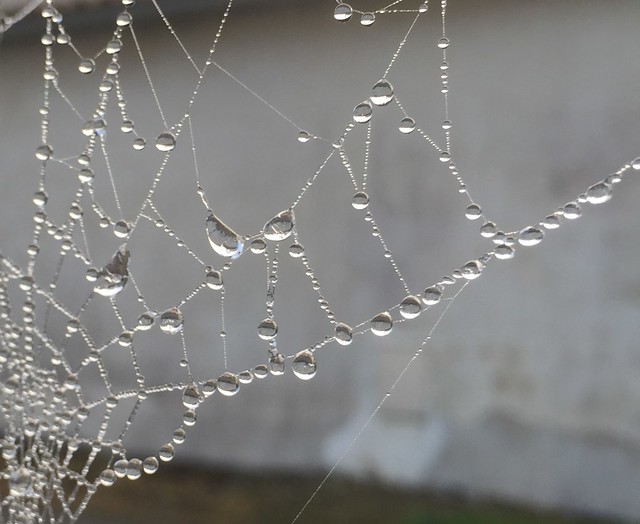
Why do I find the dew-soaked, rain-soaked spiders’ webs so appealing?

Three reasons, at least –

First, they are just so beautiful.

Second, each drop becomes a little lens, which shows the surrounding world upside down. Reminds me how everything we experience is through our personal lens, so our view of the world is always our unique, singular view.

Third, because the form/concept of links and nodes describes so well the phenomena of the world. Shifting our perspective from seeing a world of objects, to seeing a never-ending web of links, hubs or nodes, connections and relationships is exciting!

Read Full Post »

heart in the keystone

I read an interview with the author, Alexandre Jardin, in the new edition of Cles magazine . He was asked why he is optimistic about the future and the first reason he gave hinged around a word which was new to me –  bienveillance – so I looked it up.

It means benevolence, or kindliness.

In his interview he said he thought there was a reaction to the negativity and extremism of fundamentalism and far right politics, and that reaction had the quality of “bienveillance” – benevolence or kindliness.

He has initiated a movement/website called “bleublanczèbres” – I know, sounds strange, huh? Blue and white zebras? Even if you don’t speak French take a look and get a feel for it. The focus is on acting. On doing. Which is totally consistent with my focus this year on the verbs of becoming (search on my site here for “a to z of becoming”). If you scroll down on the bleublanczèbres.fr site you’ll see a whole host of projects. Every project offers you opportunities to get involved and the things you can do are divided into three categories – things you can do if you have a minute, things you can do if you have an hour, and things you can do if you have a day. I love it. He describes the over all project as not a “think tank” but a “do tank”.

Whether you go and look at that idea or not, I think a good takeaway for today would be to ask yourself how you can ACT with benevolence or kindliness to the others you meet or share some time with (at home, in your neighbourhood, or at work or school) today. How about we put benevolence and kindliness at the heart of whatever we are building – make it the keystone.

Try it, and see what it feels like.

Alexandre Jardin seems to believe we can grow the amount of “bienveillance” in the world by our actions. I think he’s right.

As Gandhi said

We must become the change we wish to see in the world

Read Full Post »

difference

Wouldn’t it be great if difference was seen to be something interesting, attractive, even beautiful?

If we could not just respect and tolerate difference, but encourage it and celebrate it?

Wouldn’t it be great if we didn’t try to make everyone the same?

Read Full Post »

swans at the weir
So, I saw these two swans standing calmly on the edge of the weir and I thought maybe one was saying to the other “dinnae fash yersel” – or don’t worry/don’t get upset……..and how that attitude then turned out to be typical of this part of the world.

Not long after moving to the Charente region of France I was in the Orange shop trying to organise a phone line, broadband, a French mobile….and the assistant was on her computer trying to set me up with a new account. Something went wrong and she had to phone for help. After a few minutes of clicking here and there and conversing with her support line, she said “Soyons Zen” and finished her call. “C’est ça”. That was it sorted, our account was created and off we went.

I liked the phrase “Soyons Zen”, which means something like “Let’s be Zen”, or “Let’s stay Zen”. I think that little exchange says so much about the quality of life in this part of the world. Repeatedly I’ve found people helpful, friendly and not inclined to get agitated or upset easily. Maybe I’ve just been lucky, but the Charente river has the reputation of being a calm, flowing river through these parts.


the Charente

One of the nearby villages is Segonzac, which is a signed up member of the “Cittaslow” movement.

I do think there’s something about this environment which seems to generate this attitude to life.

Which makes me wonder…..how much does our physical environment influence the way we experience life?

Read Full Post »

barometer

In the second part of the A to Z of Becoming, V stands for the verb “vary”.

I found this photo of an old barometer in my collection and it really captures something about the natural function of variation. A barometer is pretty constantly moving, responding continuously to the rising or falling of the atmospheric pressure. I’ve always thought it quite funny that one of the words on these old barometers is “variable” because I tend to think, when it comes to weather, when is anything other than “variable”?! But then, that’s probably down to my experience of living in Scotland for 60 years! I’ve never lived in a country where the weather is the same, day in, day out.

The truth is Nature is constantly varying because all of Nature is a dynamic phenomenon. And the Universe so loves diversity!

But there’s an interesting aspect of human experience, which is “tolerance”. All of our sensory systems have a tendency to tolerance. That is, when something new comes along we notice it, but once its been there for a bit, we stop noticing it. How often have you had the experience of suddenly becoming aware of a noise just when it stops?

Not quite the same as tolerance, but in some ways related, we also tend to move to the “back of our minds” the routines of our lives. This can lead to living on auto-pilot (or as I say in this blog, living like a zombie).

It’s good that a lot of things are dealt with on auto-pilot. What on earth would life be like if we had to think about every breath we take, if we had to initiate every beat of our hearts, if we had to actively, consciously digest all our food, and so on…..? What on earth would life be life if we had to be consciously aware all the time of every single sensory signal our body picks up, second by second?

But the problems come when we default our whole lives to auto-pilot. What happens then is that we tend to just keep repeating the same behaviours, having the same thoughts, feeling the same feelings, and, ultimately, neither making choices, nor creating any life anew.

So, it’s also good to disrupt the default, to break the routines, and raise our conscious level to higher state of awareness.

One way to do that is to vary something.

Walk a different way to work. Choose something different for breakfast. Read a different newspaper. Deliberately introduce a variation to your “normal” habits.

Go on, try it. Vary some things this week and see what that feels like.

Read Full Post »

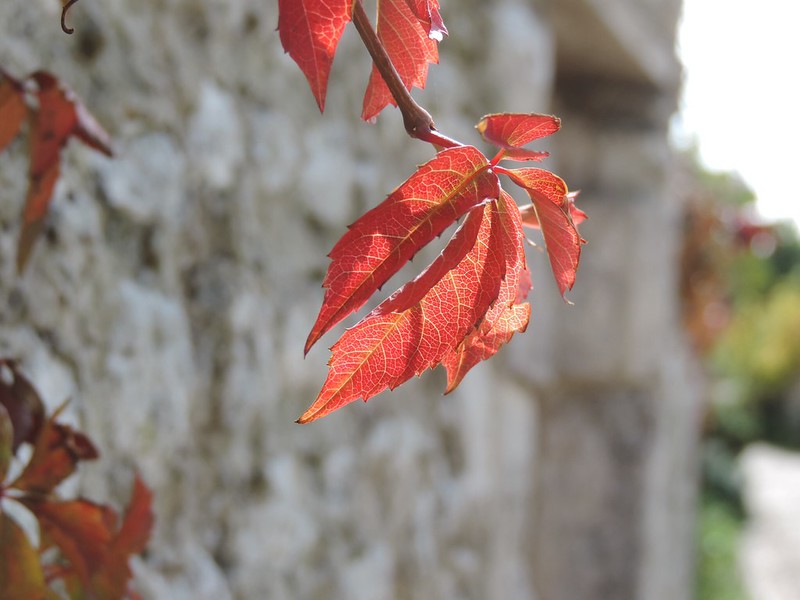
creeper

One of the most striking characteristics of living organisms is change.

These little leaves I photographed in the garden at the weekend are gone now. (which reminds me of the importance of taking a camera everywhere and not hesitating to use it!)

I’m particularly conscious of change just now because I’ve just moved country. Maybe you’ve done that before, maybe even many times, but it’s a first for me. I don’t mean simply travel and holidays, I mean to actually relocate, to go and live in another country entirely, maybe especially in a country where the language is different.

But change has always fascinated me. The byline of this blog is “becoming not being”, not just because I have always resisted being pigeon-holed, or categorised, but because I really don’t think any human being can be understood as an object frozen in time.

That’s just not reality.

The more there is change within a system or organisation, the more we recognise it as “dynamic”, and is there any more dynamic phenomenon in the Universe than a conscious human being? Not only are all of our cells constantly changing, not only is our heart constantly beating, our lungs constantly filling and emptying, our complex immune systems and endocrine systems altering moment by moment, but our minds are never still.

It feels to me there is a constant flow of a life force through me. It never ceases. When it moves on, this physical me will have moved on, but the me of ideas, of thoughts, of creative expression, of ebb and flow between me and the others who share, or have shared, parts of this life with me, that will, in some ways, continue to flow.

Human beings live in both a constantly changing physical universe (some parts of which change very slowly indeed), and in a rapidly changing, shimmering, universe of consciousness. Really, is there anything in the Universe which changes as much (as constantly) as a human being?

As Heraclitus said so long ago, you really can’t step in the same river twice.

That’s why, as a doctor, it didn’t make sense to me to try to categorise patients. It didn’t make sense to me to reduce a person to a diagnosis. A person is a constantly changing, flowing, growing, developing phenomenon, not an object to fitted into a category, to be measured and classified.

Becoming not being………it’s about the reality of constant change.


Read Full Post »
In the second part of the A to Z of Becoming, T stands for Trust.

ok

Trust?

Trust in the Universe, God, another person? Trust that, as the sign above declares “everything is going to be alright”?

Trust will mean something different to different people, but for me, it’s about a mixture of confidence, hope and experience in the processes of resilience and adaptability.

I don’t trust predictions. I don’t trust outcomes. I don’t trust politicians’ promises, drug companies’ claims, the certainties of the arrogant.

What I trust is that as I live this life I learn and develop skills which enable me to cope with what comes my way. More than that, I learn to trust that it is worthwhile thinking the best of people, and expecting them to be friendly or helpful. Expecting, at least, that the next person I meet will not wish me harm. That doesn’t mean that they won’t harm me. What I trust, is that I will cope if they do, that I’ll learn something from the experience, and that I’ll learn something about them.

Trust for me involves hope, and it does involve a kind of faith….the faith that the Universe is developing consistently towards ever greater complexity, ever greater integration, and ever deeper consciousness. Trust in the growth of diversity, uniqueness, and the extending network of links and bonds.

I trust that every day I will be amazed, or surprised, or inspired by something….and I am!

What does trust mean in your life? How do you experience trust? And what does trusting add to your life?

Read Full Post »

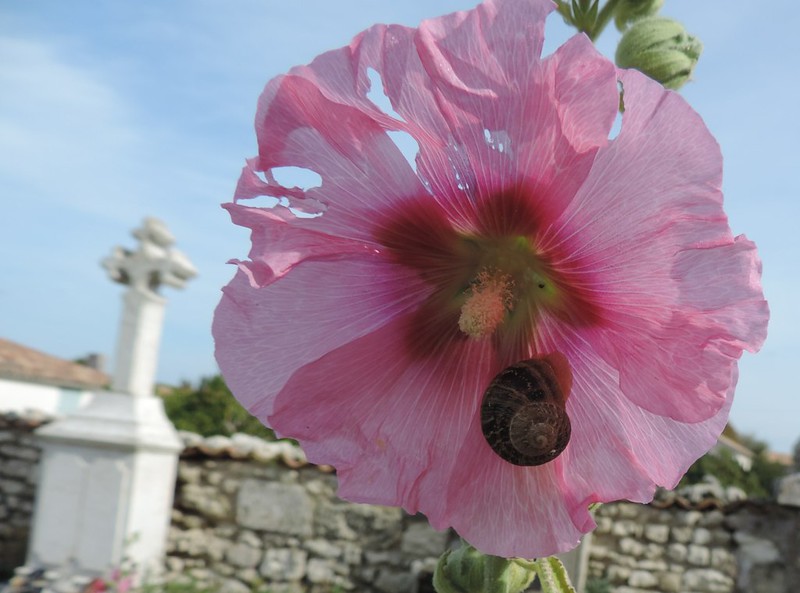
hollyhock

I recently stumbled across a reference to the paradigm of “relational science”. I hadn’t seen that term before but here are a list of characteristics of “relational science” with each one compared to its “Cartesian” counterpart.

  • PROCESS vs substance
  • BECOMING vs being
  • HOLISM vs atomism
  • RELATIONAL ANALYSIS vs either/or split analysis
  • MULTIPLE PERSPECTIVES vs dualistic objectivism/subjectivism split
  • COACTION vs split interaction
  • MULTIPLE FORMS OF DETERMINATION vs efficient/material causality

If you’d like to read about this in more detail google “Fundamental Concepts and Methods in Developmental Science: A Relational Perspective” – which is an article by Willis Overton and Richard Lerner. In that article the authors write –

As a derivation from these relational categories, the relational developmental systems paradigm characterizes the living organism as a spontaneously active, self-creating (autopoetic, enactive), self-organizing, and self-regulating nonlinear complex adaptive system. The system’s development occurs through its own embodied activities and actions operating in a lived world of physical and sociocultural objects, according to the principle of probabilistic epigenesis. This development leads, through positive and negative feedback loops created by the system’s action, to increasing system differentiation, integration, and complexity, directed toward adaptive ends.

Some of this language might be familiar to you from other posts I’ve written on this site, but I’ve never seen them pulled together as “relational science” or come across the concept of “relational developmental systems” before.

If change is the pervasive phenomenon which it seems to be, it makes much more sense to focus on process instead of arbitrarily separated parts. In terms of health, I think this means we need to understand the processes of repair, resilience and effective functioning of healthy organisms, not trap ourselves in the limited focus on pathological change within tissues or organs.

A focus on becoming instead of being also undermines the outcome based approaches to care which are so prevalent. Health is a dynamic, lived experiences, not a series of fixed states.

Multiple perspectives allow to understand illness much more fully – again, not limiting ourselves to the pathological changes within cells, tissues and organs, but taking on board the subjective phenomena of illness (pain, stiffness, breathlessness, dizziness, weakness etc), as well as the narrative of the person who is ill through which we make sense of the experience, and beyond all that, to situate the individual person’s illness within the contexts in which they live – their relationships, family, genes, work, social and environmental conditions etc.

Co-action shows that change comes about not least from the interactions between individuals. This knowledge gives us the opportunity to shift the perspective of health care from that of a doctor treating an object, to that of a doctor and a patient co-creating better health for an individual.

Last but not least, all of this thinking leads us to a consideration of the emergent nature of change in living organisms – which means we can never be completely certain how things are going to go in any individual situation. Something which, surely, should bring some healthy humility to the practice of Medicine.

You’ll see this is all entirely consistent with the features of complex adaptive systems, and of integral theory. And it is also utterly consistent with my blog byline of “becoming not being” which I first encountered in the study of Deleuze’s work.

I really think this “relational science” explains reality much better than the old, reductionist, mechanistic, linear paradigm which is still so prevalent.

Let me finish this post with a re-iteration of Overton and Lerner’s excellent summary –

the living organism as a spontaneously active, self-creating (autopoetic, enactive), self-organizing, and self-regulating nonlinear complex adaptive system


Read Full Post »

Autumn leaves

Hugs

heart in the keystone

I find Plato’s three “transcendentals” of Beautiful, Good and True a very fruitful concept to explore. When I first read about “integral theory” I was very taken by Ken Wilber’s four quadrants of the single-subjective, plural-subjective, single-objective and plural-subjective, and really liked the way the beautiful, the good and the true could be mapped onto that. (read a little more about that here)

Yesterday as I was looking through my photographs of autumn leaves I was enjoying finding the ones I considered to be the most beautiful.

The day before I was listening to a radio discussion about fairness. The concept of fairness seems to be innate, and the panel discussed a video of an experiment which seems to show how fairness is indeed innate in primates.

Last week I was struck again by the observation that most people seem to visit a doctor to make sense of something. In the Medical World, we refer to that making sense as ‘diagnosis’, and I’ve long since preferred to think of it as an understanding. Making sense of a pain, an itch, a dizziness, of anxiety or whatever, involves the co-creation of a credible story by the doctor and the patient working together.

As these three strands came together for me this morning, I got to thinking of the beautiful, the good and the true once more and two things occur to me.

Firstly, all three of these qualities are dynamic and relative. None of them are fixed. And none of them are universal at the level of the individual or particular. What is beautiful to me, might not be experienced as beautiful by you (on the other hand, we might agree!) And I don’t see beauty as a category either – at least, not as a yes or no kind of category – not as an either/or way of thinking. It’s not a box to tick.

Secondly, for me, I think the Good has a strong element of fairness. We tend to think of Justice as being about fairness, and it strikes me that I can ask myself how fair my judgements and actions are, as a way of considering how good they are. I do also think that the quality of integration is a key characteristic of all complex adaptive systems i.e. all living organisms, so an action or choice is better if it is more integrative (if it increases the mutually beneficial bonds between the well differentiated parts)

Thirdly, I see Truth as being about sense making. In some ways, the sense I make of my experience is the truth of it.

So, my current exploration of the beautiful, the good and the true, centres around wonder (émerveillement), fairness and integration, and sense-making.

I discover beauty through wonder. I am motivated to promote fairness and integration in the world. I make sense through the creation of narratives.

Read Full Post »

Right through to the vieux port

Herman Daly, senior economist at the World Bank, 1988 – 1994, who is a Professor at the School of Public Policy, University of Maryland, writes in the current issue of “Resurgence” magazine, about the need for a steady-state economy. He argues that the current pursuit of growth is neither sustainable, nor sensible, pointing out that there has been no growth in the quantity of the physical material of the Earth since it was formed, but that it continues to grow, evolve and develop despite that. This is an interesting perspective. It shifts the agenda towards evolution and development rather than acquisition and consumption and challenges us to think about qualities not just quantities. I was particularly struck by his closing sentences though –

So, in closing, I will only mention what seems to me to be the deeper issue. Is Creation the purposeless, random consequence of multiplying infinitesimal probabilities by an infinite number of trials, as taught by the reigning paradigm of scientific materialism? I say Creation with a capital C advisedly, and certainly not in denial of the well established scientific facts of evolution. Rather it is in protest to the metaphysics of Naturalism that everything, including evolution (by random genetic mutations selected by a randomly changing environment), is ultimately happenstance. It is hard to imagine within such a worldview from where one would get the inspiration to care for Creation, which of course Naturalists would have to call by a different name – say, “Randomdom”. Imagine urging our fellow citizens to work hard and sacrifice to save “Randomdom”! Intellectual confusion is real, but the moral nihilism logically entailed by deterministic materialism (Naturalism), uncritically accepted by so many, is probably the bigger cause of environmental destruction.

It’s one of those strange synchronicities of life that the new issue of Resurgence came through my letter box two days after writing a post about connections which provoked a discussion about randomness in the universe.

And, just to complete the synchronicity experience, I was discussing medical practice with a friend and colleague this week, where we agreed that “co-creation” was the way to go. There is a shift in the way doctors and patients relate to each other, and maybe one of the best ways to understand that, and develop it, is to consider one of the characteristics of all living organisms (as seen through the lens of complex adaptive systems) – that is the characteristic of “co-evolution”.

Co-evolution is a term used to describe how every organism inextricably exists within a context or environment, and as it is an open, dynamic system, there is constant exchange of energy and information which produces complex patterns of linked changes. Think how a group of human beings settling to live in a particular part of the world begin to change the physical environment by living in it, and how the physical environment in which live influences the way they live.

Co-evolution is a creative process, and isn’t this the characteristic which runs right through the entire story of the universe? Isn’t it the story of Creation? Aren’t we the co-creators?

Read Full Post »

« Newer Posts - Older Posts »