Feeds:
Posts
Comments

Archive for the ‘philosophy’ Category

Celtic knots

I’ve always found Celtic knots attractive. I think they are both beautiful and fantastic symbols of important characteristics of reality – the indivisible inter-connectedness of everything, and the dynamic, flowing qualities of Nature.

Alan Watts, that great teacher of Zen principles, talks about the reality of inter-connectedness in one of his essays. He says –

interdependence and virtual identity with all other forms of life which the divisive and emboxing methods of our current way of thought prevent us from experiencing……….The so–called physical world and the so–called human body are a single process, differentiated only as the heart from the lungs or the head from the feet………..our intellectual and scientific “establishment” is, in general, still spellbound by the myth that human intelligence and feeling are a fluke of chance in an entirely mechanical and stupid universe—as if figs would grow on thistles or grapes on thorns………wouldn’t it be more reasonable to see the entire scheme of things as continuous with our own consciousness and the marvelous neural organization which, shall we say, sponsors it?
 I love that word he uses – “emboxing”. I’ve never seen that word before. Maybe he invented it, but it’s great. The way we label and classify after focusing on only certain aspects of any phenomenon separates and divides. It puts whatever we are looking at into a box. When we apply this technique to ourselves we divide ourselves from the Nature, from the Earth, and even from the Universe.
Dividing ourselves from Reality produces a dangerous delusion. As Watts says, “wouldn’t it be more reasonable to see the entire scheme of things as continuous with our own consciousness and the marvelous neural organization which, shall we say, sponsors it?”
I particularly like his reference to the human body – because if we really did understand ourselves as intimately and inextricably connected to the universe then maybe we’d stop classifying whatever is not “us” as “them” or “it”. Then we would have a chance to create a world which was more like the human body – made of well-differentiated parts which relate to each other in mutually beneficial ways – the reality of integration, not the delusion of division and separateness that seems to result in exploitation, plunder, killing and rape.

Read Full Post »

Honey bee

Swan reflecting

cogwheel

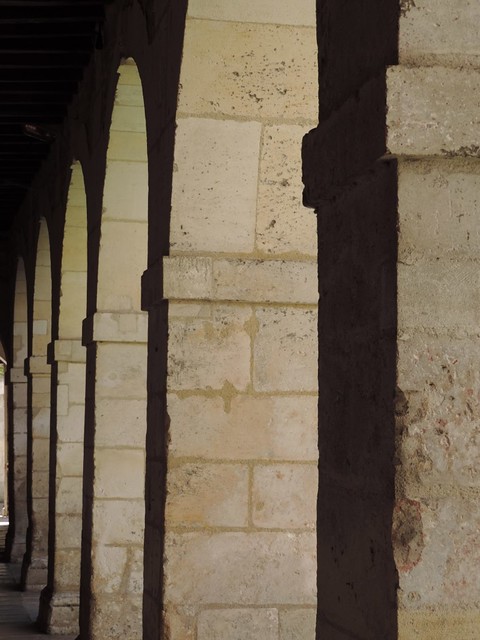
arches

Alan Watts wrote, in his collection of essays, “Does it matter?”

an enormous amount of current intellectual, philosophical, and even scientific discourse strikes me increasingly as absurd. It is an attempt to translate a nonlinear and multidimensional system of vibrations into a linear (alphabetical or mathematical) system of symbols; and it just can’t be done

Human beings have learned to do amazing things using mathematics, technology and our advances in materialist, reductionist sciences. But these advances tend to fool us into thinking that we can approach all of Life with the same ideas, concepts and methods. Alan Watts nails this error with his usual focused clarity. He wrote that back in the 1960s but 50 years on we are still making the same fundamental mistake.

Living organisms are not machines. Natural ecosystems are not elaborate mechanical technologies. We can’t squeeze open, dynamic phenomena into the same mechanical models which work in the fields of engineering and technology.


Read Full Post »

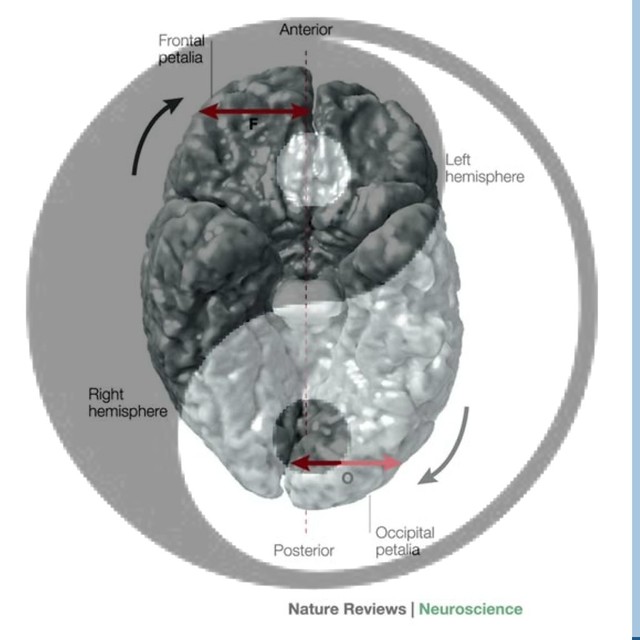
left hemi right hemi

In “The Secret Life of Pronouns”, the psychologist, James Pennebaker discusses two different kinds of thinker – categorical or dynamic. I hadn’t heard of this distinction before but in the briefest of nutshells –

A categorical thinker is someone who tends to focus on objects, things, and categories. The opposite end of this dimension are people who are more dynamic in their thinking. When thinking dynamically, people are describing action and changes

That sounds very familiar to me. In fact, its got a lot in common with Iain McGilchrist’s left and right hemisphere approaches to life. The left hemisphere RE-presents reality to itself, labelling, listing, naming, categorising. Whereas the right hemisphere focuses on what he calls “the between-ness”, connections, relationships, or the whole.

For the last few months, I’ve been sharing on this blog a series of posts under the title “The A to Z of Becoming” where I take one verb each week for you to think about, and play with. I deliberately chose verbs because I think it’s the “doing words”, the “action words” which determine the kind of life we experience. This is partly in tune with William Glasser’s Choice Theory, and partly with Deleuze’s focus on change, or difference, which provided me with the fundamental principle of this blog – “becoming not being”.

So, there is something insightful about this distinction, but, the way my mind works, I also find myself balking at the “two value” use of “or” – I SO much prefer “and”! (Which is something I picked up from the General Semanticists, before I even heard of Deleuze.

So, maybe now I can be more aware of when I am thinking categorically and when I’m thinking dynamically (and, yes, I DO have a preference!)

Read Full Post »

As I was walking in a forest the other day I came across this –


new growth in the forest

I often feel a kind of thrill seeing new growth like this. It’s the emergence of Life on Earth. This little seedling might well grow up to be one of the great trees of this forest. How does it do that? How does this one little seed begin to sprout, begin to reach upwards through the decaying leaves on the forest floor, and seek out the sun, the air, and the rain?

And then a little further on, I find this tree….


tree

Don’t adjust your screen – it’s the right way up!

Look at these twists and curves and corners, as the tree reaches first this way, then another. Who could predict which way any of these branches would grow? Who could predict what this tree would look like today if they were seeing it back when it was one of those little seedlings pushing its way towards the light?

I see this everywhere.

I saw it every day with every patient I ever met. Who could have predicted how this person would be today, what life they would be living, and how they would be experiencing it?

Nobody.

That’s what gets me about the irrational arrogance of those who claim to know. Those who claim certainty. I am never convinced by those who claim they know what the results will be of a particular treatment for a particular individual. They can throw the term “evidence based” about as much as they like, but if they think that label gives them some magical ability to predict the future for individual human beings, then they are quite likely to be mistaken.

I don’t like the irrational arrogance of certainty in any area. I don’t like it in politics, matters of belief, wordview (religious, atheistic or scientistic), in economics, or any other human domain. Life is not predictable. Living organisms cannot be properly understood if represented as mere objects. All living forms are dynamic, open, complex systems. All are unique and together they are diverse. Commonalities matter, but so do differences.

If there is one thing I always doubt, it’s certainty.

But then, like Montaigne, I’m fond of saying “mais, que sais-je?” (“but what do I know?”)

Read Full Post »

2000 years ago, Seneca wrote about the shortness of life, but how modern his advice sounds. This particular passage actually made me laugh out loud…..

you must not think a man has lived long because he has white hair and wrinkles: he has not lived long, just existed long. For suppose you should think that a man had had a long voyage who had been caught in a raging storm as he left harbor, and carried hither and thither and driven round and round in a circle by the rage of opposing winds? He did not have a long voyage, just a long tossing about.

So my white hair and wrinkles don’t speak of my life, just the time I’ve been around here on Planet Earth! How often do we have that experience that life is not so much a journey, more a “long tossing about”!

Sticking with the journey idea, I also really love this thought –

Just as travelers are beguiled by conversation or reading or some profound meditation, and find they have arrived at their destination before they knew they were approaching it; so it is with this unceasing and extremely fast-moving journey of life, which waking or sleeping we make at the same pace — the preoccupied become aware of it only when it is over.

A core value underpinning this whole blog is choosing to live, choosing to be aware of our constant becoming, choosing to be aware of the “émerveillement du quotidien” – the wonder and amazement of the every day.

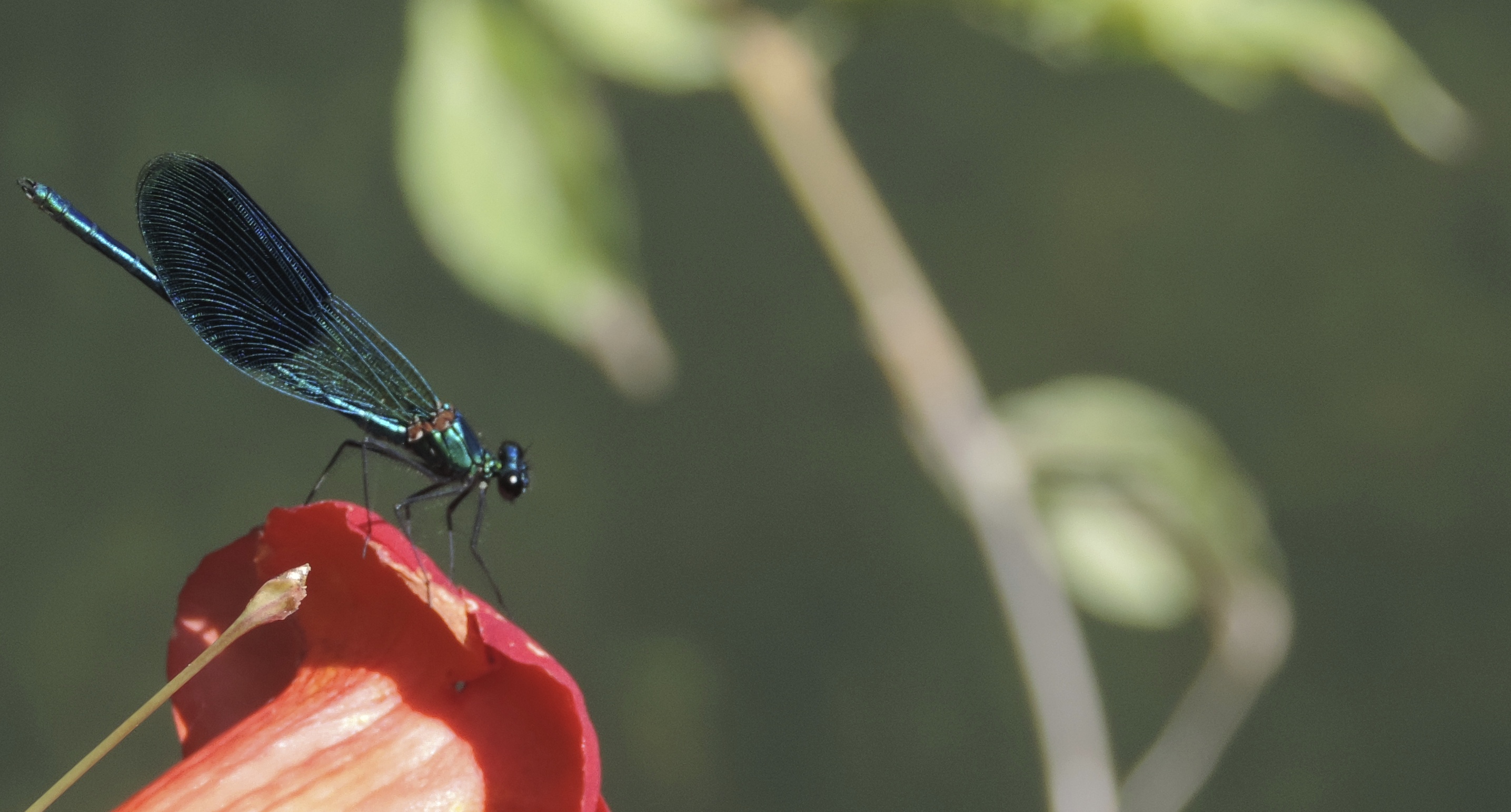
dragonfly

Read Full Post »

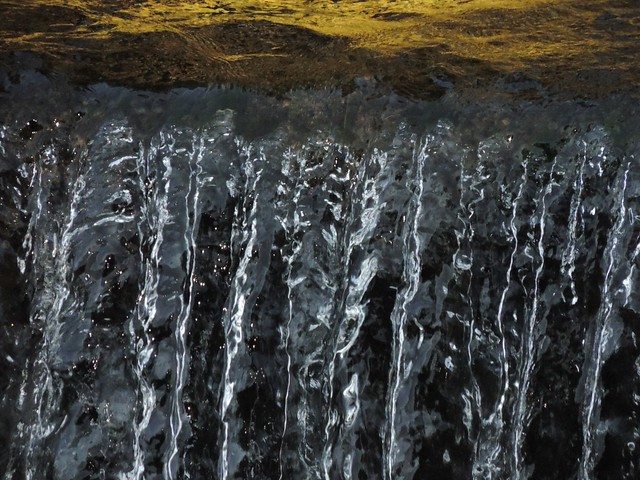
Water over the weir

If you use a fast shutter speed on your camera you can make the water flowing over a weir look like it has momentarily become solid. The water in this photo almost looks like icicles. It’s beautiful and it catches our attention but it misrepresents reality.

Movies are made of millions of single images like this. We run them past our vision so fast that we think we are seeing a moving image. But we aren’t. We’re seeing a series of still images, one frame after another.

Philosophers including Bergson and Deleuze have pointed out that reality is not like this. It’s not made up of discrete moments all stitched together. Instead reality flows…….continuously and unceasingly. Isolating a single moment is wonderful but it can trap us into thinking that life is made of single moments.

To begin to experience life differently, begin to notice the flow, and be aware of when you are isolating a moment in that flow.

Becoming not being.

Life flows.

It’s not like the movies.

Read Full Post »

John O’Donohue used to talk about “invisible nearnesses” –

He said “…the mountains, particularly in Connemara, are huge dark mountains. There’s a lot of moisture and a lot of rain and a lot of mist. And some mornings you’d get up, and the fog would’ve come half way down the mountain, rendering the top of the mountain invisible. You’re in the presence of the mountain, and half the mountain has vanished. It’s there, but not visible to the eye. And I often think that it’s a wonderful image of the imagination, that image. In other words, that there are around every life a series of huge nearnesses, a whole invisible world that we can’t see with the eye but that is absolutely crucial to who we are. And I think that the imagination is the faculty that brings you in touch with these presences that are around your life. That’s where I think the divine, and the soul, and the magic of the world between us all, the world of betweenness – that’s where they all reside. And that’s where the imagination loves to dig its furrow and to disclose these hidden, oblique kind of presences.

Every morning for the last few years, when I’ve been at home, in Stirling, I’ve looked out at a mountain – Ben Ledi, but sometimes it’s not there.

rainbow no mountain

Recently, it wasn’t just invisible, the way John O’Donohue describes it, but there was a rainbow there instead! I immediately remembered his idea of “invisible nearnesses”, so I browsed around and found the original text I remembered from his film, “Anam Cara”.

Now I read that again, I’m struck by another of his points – “the world of betweenness” – and how that is exactly what Iain McGilchrist talks about when he describes the right hemisphere of the brain’s approach to the world.

Read Full Post »

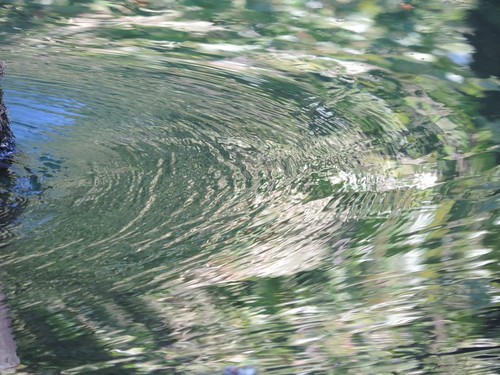
Water swirling round corner

One of the most beautiful and mesmerising sights in the world is, I think, flowing water. This photo captures a flow of water around a post at the beginning of a weir. Flow is a very important concept to me.

Giles Deleuze‘s radical philosophy emphasised difference and change to the extent that he called on us to change our priorities from the old Greek ones which still dominate our reductionist science.

He emphasised difference instead of identity. Championing uniqueness, and the special-ness of the present moment, over categorisation, essences and identity. I am a one off, not one of a kind.

He emphasised change over objects. His philosophy is a philosophy of becoming.

As it says, in the byline to this blog……becoming not being.

These ideas have been with us for centuries. In the West, it was Heraclitus who said you can’t step in the same river twice. In the East, Taoism emphasises the Way, and Japanese culture, for example, reveres the transient (as we see magnificently in the annual cherry blossom celebrations)

Read Full Post »

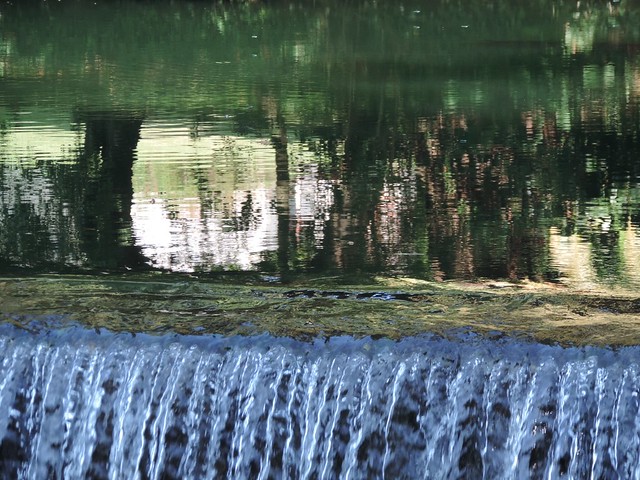
Reflecting above, plunging over

Constant reflection.

Some people talk about mindfulness, others about awareness, yet others about living consciously. Whatever term you use, the practice of reflecting on what is happening now enhances Life.

“Now”, is, however elusive. It’s that moment that disappears over the edge from the future into the past, just as you look at it.

This image stimulates these thoughts in me……how a life can be lived by being aware, reflecting as it happens.

Becoming not being.

Heroes not zombies.

Read Full Post »

image

That’s the statement I came across in an interview with a “new realist” philosopher the other day. I’m not going to get into what on earth is “new realist” here just now but when he was asked if science (or more precisely Physics) had proven that the universe had no purpose, that it made no sense?

Well that’s a claim we often hear from people who claim the only reality is physical, the universe is random, and evolution isn’t “going anywhere”. This isn’t a world view I’m attracted to.

My understanding is that human beings exist, and that we all have consciousness and subjective experience. Values are important to us. For example, you can look at that photo above and describe it according to its botanical classification. I look at it and see a beautiful image. It’s the beauty of the image which strikes me.

This philosopher said that science is the study of objects, whereas for human beings it was often something not at all like an object which brought meaning to life. The example he gave was democracy. He said what colour was democracy? What were its dimensions? Science has no answer to these questions. Because democracy is not an object, it’s something which gives lives meaning.

I don’t know about you but that certainly gets me thinking. What about the “sciences” which don’t deal with objects? Like economics, or psychology, or “social sciences”?

Then I got to thinking about health and how, as a doctor, I needed to understand the body in a scientific way. I needed to know what to measure when, and what to do with the results. But I also needed to understand the lived experience of a person. When they talked to me about pain, about an itch, about nausea or dizziness, they were not talking about objects which could be measured. And what about the narrative…..how a person experienced and made sense of their illness?

So, there is something helpful in this idea of science being the study of objects. It helps us see the relevance of science and the absurdity of scientism (which claims ultimate and absolute authority for the “truth” as revealed by science.

Objects are an important part of reality, but they sure aren’t everything that exists!


Read Full Post »

« Newer Posts - Older Posts »