Feeds:
Posts
Comments

Archive for the ‘philosophy’ Category

Untitled

What was/is your experience of school?

David Richard Precht, the German philosopher argues that our schooling system continues to be based on the industrialism of about 100 years ago. We still seek to teach sets of facts to all children of the same age, and then test their ability to recall those facts in examinations leading to qualifications. The intention of the education is to produce compliant workers and consumers who will conform to the demands of industrial society.

He argues that we are not fostering creativity, emotional intelligence or relationship skills which enable communities and teams to work together, and individuals to develop and express their unique talents.

He draws his ideas from philosophy, from neuroscience (NOT materialist neuroscience which seeks to reduce all human experience and cognition to identifiable areas of the brain), and from an understanding of how society has changed over the last few years.

Many of his recommendations are in line with teachings from people like Montessori and Steiner, so he can be understood to be part of a more child-centred, holistic movement in education.

I found myself agreeing with much of what he had to say in a recent interview published in Cles magazine (“Notre école est un crime”). He points out that asking children to sit still for an hour and pay attention is not a good starting point – most children, and indeed most adults, are able to concentrate on one topic for about 15 to 20 minutes (which is why TED talks do so well, and why youtube is the new television), and that one thing we know about health is that sitting still isn’t good for you!

He thinks schooling de-motivates learners and that the average 12,000 hours of education leading to the “Bac” qualification in Europe are experienced as pure boredom by most children.

He also thinks we are not teaching the right kind of skills for the 21st century – we need more innovation, creativity, diversity, the ability to use the internet to gain knowledge and to connect with others, more emotional intelligence and a greater ability to form and grow healthy relationships with others.

His proposals include moving away from classroom curriculae to a more project-based system of education which is by its nature multi-disciplinary and encourages children to pursue their own curiosity.

What do you think? How would you change the educational system?

Read Full Post »

Bay of Biscay

I did a search the other day to see if I could find the origin of the French phrase “l’émerveillement du quotidien” (the amazing everyday) because its a concept which I’ve taken to heart so passionately that if anyone asks me for advice about how to live a good life, how to be happy and healthy, I’ll pretty much always begin by saying they should approach every single day with an attitude of wonder and joy – “l’émerveillement du quotidien” (one good way to do that is to use the “first and last” method)

Well, I haven’t managed to track down the origins yet, but if you put the phrase into a google image search, guess what? MANY of the photos which come are mine!

So, whatever the origins, I guess I’m one of the world’s leading protagonists of “l’émerveillement du quotidien”!

This photo is one I took while on holiday on the West coast of France – it’s a great example of how amazing an everyday view of the sea is. Look at the range of colours! It’s gorgeous, and remarkable!

Read Full Post »

in the sea at sunset


 There is no out there which can be known in any way other than from in here

Read Full Post »

Celtic knots

I love Celtic designs. I suppose I’ve grown up with them all around me, although what exactly is a Celt? And how Celtic am I? (As far as I know part of my ancestry goes back through Orkney to Scandinavia, and part goes back for centuries here in Stirling then maybe from northern France before that – my own ancestral Celtic knot!)

I think that apart from their sheer beauty, I like their intricate looping interconnected-ness.

There’s something of this kind of knot which is mandala-like and something about it which captures similar themes to the yin-yang symbol, but I feel more deeply in tune with these Celtic designs.

This one is on a gravestone in Inchmahome Priory on Inchamhome Island in the middle of the Lake of Menteith.

Which traditions of drawing touch you most deeply?

Read Full Post »

Big rock beach

I noticed this huge rock on a beach recently (OK, I agree, how could you NOT notice it!?)

I suppose I was a little surprised that some people had chosen to sit right in front of it……were they hoping to shelter from the wind? Or were they seeking some shade from the sun? Or, maybe, just maybe, they were working up to having a go at shoving it out of the way?

I’m guessing a LOT of people have wondered about moving that rock. I mean, there it is, sitting RIGHT in the middle of beach! So, why hasn’t anybody done it yet?

Then I got the answer – it’s down to “structured procrastination” –  as John Perry describes it –

All procrastinators put off things they have to do. Structured procrastination is the art of making this bad trait work for you. The key idea is that procrastinating does not mean doing absolutely nothing. Procrastinators seldom do absolutely nothing; they do marginally useful things, like gardening or sharpening pencils or making a diagram of how they will reorganize their files when they get around to it.

So maybe the people sitting on the beach there are doing some marginally useful things instead – like increasing their vitamin D levels by sitting in the sunshine, or measuring the temperature to check for global warming, or counting seagulls to for an RSPB environmental monitoring project, or……..

Or maybe this is not about procrastination at all, maybe it’s about being fully paid up members of the slow movement, like Christopher Richards, the founder of the International Institute for Not Doing Much (Christopher, thanks for sending me an email a few years back, I think my reply might be heading your way soon).

What an inspiration for slowness……..watching a rock change!

Hope you’re able to enjoy a nice slow holiday this summer (and if you haven’t figured out how to use structured procrastination to actually book that holiday up yet, check out John Perry’s book, “The Art of Procrastination” – just make sure you’ve got “Buy with 1-click” switched on)


Read Full Post »

There’s a classical teaching about living life to the full which says to embrace each experience as if it is the very first time you are having this experience (which is true…..every experience you have today is for the first time). This is quite like the mindfulness or awareness teachings which tell us to be fully present, as fully aware as possible, as much as we can. This, in fact, is the essence of “heroes not zombies” – it’s about waking up, living consciously and not on autopilot all the time.

There’s another teaching which says to embrace each experience as if it is the very last time you will be having this experience (which is also true……you will never have exactly the experiences you have today ever again).

I find both these teachings come to mind as the sun rises and the sun sets (or Earth Falls and Earth Risings?). Have you ever seen the movie, “City of Angels”? (an American re-make of Wim Wenders, “Wings of Desire”) There are beautiful scenes there where the angels all gather on the beach each morning to experience the sunrise. To be quite honest, I’m not out and about experiencing sunrises all that often, but the other end of the day, sunset, is an equally entrancing event.

If you are ever somewhere where you have an unobstructed view of the sun setting, you’ll likely see that you aren’t experiencing the sunset alone. I was lucky the other day to watch some spectacular sunsets from Biarritz, watching the sun sinking below the horizon of the Atlantic Ocean (and, no, I didn’t see any green rays)

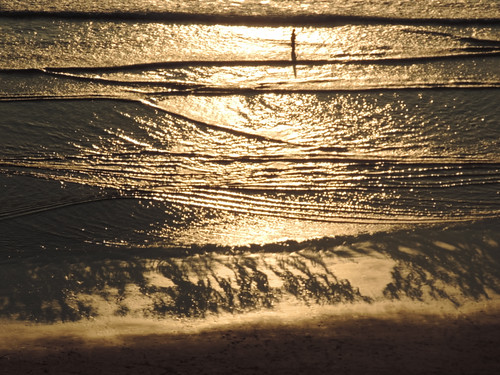
The play of the light on the waves and the wet sand were amazing…..


Sun set light on surf

Low sun on sand

Sunset Biarritz

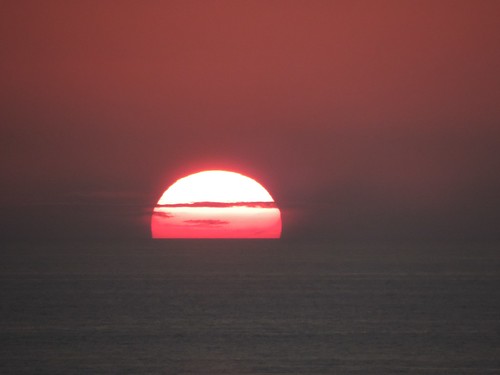
Setting sun up close


Live life fully today – living every single experience for the first time and the last time.

Read Full Post »

IMG_0607


Over the first half of this year, I’ve written a post every Sunday under a series title of “The A to Z of Becoming”. I’ve picked 26 verbs and shared some thoughts about focusing on one verb a week as a way to consciously engage with the process of change in our lives.

We change all the time – as Henri Bergson says, in “Creative Evolution”

for a conscious being, to exist is to change, to change is to mature, to mature is to go on creating oneself endlessly

This process of “creating oneself endlessly” is largely an unconscious one, but we can engage with it consciously by making choices about what we DO. It’s our actions which create our selves and our world.

As Game of Thrones fans will know

Words are wind

Or to consider Bergson again….

we are, to a certain extent, what we do, and that we are creating ourselves continually

Our lives are creative processes of unceasing change, and consciousness gives us, uniquely in this universe (as far as we know!) the opportunity to escape from passivity and automaticity. We are not objects. We are not things. We are not zombies. Unless we choose to be……

Heroes, are the protagonists of the stories. Each of us is the hero, or protagonist of a unique story, a story untold by any other being in the history of the universe and a story which will never be told again by anyone else.

Heroes are “action heroes” – WE are these “action heroes” if we choose to become aware of the actions we take every day.

You can find a post on each of the verbs in that word cloud above by searching for the it using the search box on this page, or find the whole series by searching for “a to z” (use the quotation marks as well as the phrase)

Read Full Post »

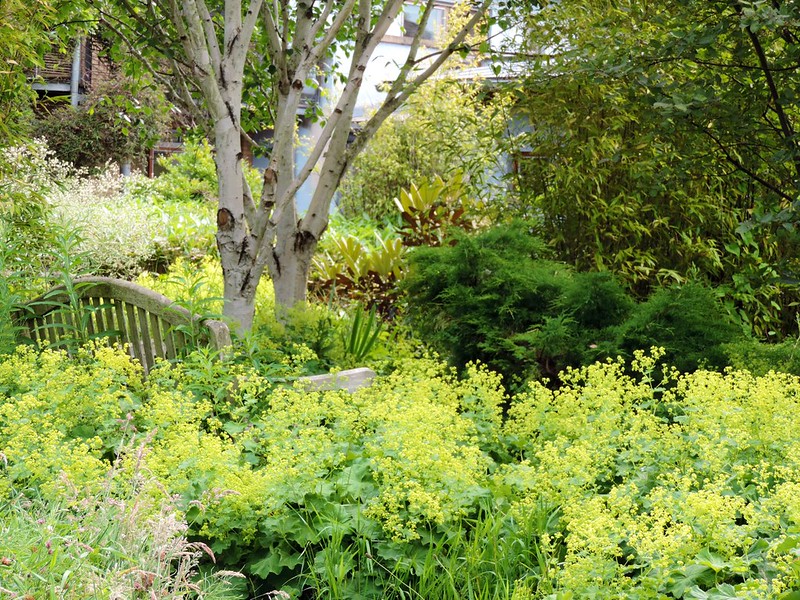
A seat in the garden

I took this photo the other day in the garden at the Centre for Integrative Care. It provokes certain thoughts for me, because in this view I see an abundance, a flourishing, a diversity of green Life and I see a place to facilitate its full enjoyment, a place to pause, to slow down, to be present.

So, here’s what I’m thinking today……Life is for living, and that living has at least two important aspects – the full enjoyment of Life, and the creation of uniqueness.

Whatever other reasons we might find for being here, we all, moment by moment, have the opportunity to fully enjoy this Life – that captures for me the sense of émerveillement du quotidien which I often to refer to, that sense of wonder, of seeing and experiencing everything as if for the first time and for the last time. It captures the teaching about slowness, of mindfulness and of being present in the NOW.

If there is one quality of Life I’d focus on it’s change. Change is constant. Nothing, but nothing, stays the same. Life is a continuously unfolding, creative, emergent process. We are creative creatures. We create our perception of reality. We c0-create our daily experiences with others, and with the world in which we are alive.

So, when I look at this photo I see these two phenomena – a full enjoyment of the flourishing diversity of Life, and the creative expression of the Universe.


Read Full Post »

I’ve often thought about the question attributed to Albert Einstein (although I think he didn’t actually ever pose it!)

The most important decision we make is whether we believe we live in a friendly or hostile universe

Whether he said it or not, it’s still an interesting question which highlights how our beliefs inform our choices. If we believe the universe is hostile then we see ourselves in a constant battle for survival, if we see it as friendly then we call to it for support, and if we think it is neither then maybe we make choices based on the essential meaningless and randomness of life.

OK, I think that is too simplistic and in fact there are no clear answers to this question, but I do think the useful point is about influences. I do believe your choices are informed by your beliefs. Simple, everyday beliefs. Is it safe to walk down this street? Are strangers likely to attack you? Are your friends likely to act in your best interests? And so on…..

All this came to mind this morning having listened to Jim Carrey’s speech at the Maharishi University. Here’s the ONE minute edit…..

(you need to click the link to see the video for this one. Go on, do it now, then come back and read the rest)

So, here’s the key point to think about just now – are you making your choices based on love or fear?

Fear is the main weapon of persuasion in the world, but you don’t need to make it the basis of your life.

What choice will you make today if that choice is to be based on love?

What choice would you make instead if you are basing it on fear?

What are you going to choose?

Read Full Post »

I reckon we often think about time as a line. We stand at a point on the line and we call that point the present. Everything from the start of the line up to that point is the past. It’s behind us. And everything from that point to the end of the line is the future. It’s ahead of us. In fact, I’ve used just this idea many times in the consulting room.

It’s neat.

But it’s not a good model of reality!

Time in many ways is a more cumulative process. We grow, not by leaving the past behind us. Every moment emerges from the accumulated past. The past is always within us, always present. It’s probably more like the rings of a tree. Each day grows out of all the other days.


Emerging branch


Henri Bergson puts it this way, in his “Creative Evolution”

……the past grows without ceasing, so also there is no limit to its preservation. Memory, as we have tried to prove, 1 is not a faculty of putting away recollections in a drawer, or of inscribing them in a register. There is no register, no drawer ; there is not even, properly speaking, a faculty, for a faculty works intermittently, when it will or when it can, whilst the piling up of the past upon the past goes on without relaxation……..the past is preserved by itself, automatically……The cerebral mechanism is arranged just so as to drive back into the unconscious almost the whole of this past, and to admit beyond the threshold only that which can cast light on the present situation or further the action now being prepared—in short, only that which can give useful work.
He is saying that we select elements of the past (memories) which might be useful to us in the present. He’s describing something ideal there, explaining something about the mind, but it is really more complex than that, isn’t it? Quite often, it seems, some memory is evoked seemingly against our will, and without it being at all clear that its becoming conscious in a helpful way. But in those moments, in those experiences, we have the opportunities to learn a lot about ourselves.
To what extent do we operate on a kind autopilot ( a major theme of this heroes not zombies site ), with the past memories, habits, loops, paths, somehow running our whole lives?
Not that we can act without these influences. Here’s Bergson again…
it is with our entire past, including the original bent of our soul, that we desire, will and act
Just to put this in context, when he refers to our entire past, he includes what we brought into this world when we were born, not just our accumulated experiences of this life. One common fascinating aspect of that view is our common experience of behaviours and traits which we see in our children or ourselves which seem identical to those of certain predecessors….a father, grandmother, great grandparent, or some other relative who was never alive at the same time as this child.
We don’t have to operate only on autopilot of course. We can develop our understanding of ourselves, become more aware of our present moment, of our choices and why we are making them, and create some small spaces (the neuroscientist’s “necessary distance”) between what comes up and what we do……we can learn to respond rather than react, and in so doing grasp that opportunity to become the active author of our own story.
To become heroes, not zombies.

Read Full Post »

« Newer Posts - Older Posts »