Feeds:
Posts
Comments

Archive for the ‘philosophy’ Category

Is change like a series of steps….

The Stairway to...

or a continuous flow, like a river….

river


Bergson writes, in Creative Evolution

The apparent discontinuity of the psychical life is then due to our attention being fixed on it by a series of separate acts : actually there is only a gentle slope; but in following the broken line of our acts of attention, we think we perceive separate steps.

So, reality is continuously changing. It really is a flow of becoming…….

Read Full Post »

According to a government report workers who retire early risk “boredom, loneliness and poverty“.

Well, that’s something to look forward to, huh? Strange report – probably part of a fear campaign to try and keep people in employment for longer. What are they suggesting, actually? It’s better to retire later? Or that if you are working, even on a minimum wage, zero hours contract in your 60s and 70s you will avoid “boredom, loneliness and poverty”?

I suspect this kind of thinking says more about how we live than it does about the respective benefits of employment and retirement.

Funnily enough, I just stumbled over this quote from Goethe –

“A man should hear a little music, read a little poetry, and see a fine picture every day of his life, in order that worldly cares may not obliterate the sense of the beautiful which God has implanted in the human soul.”
― Johann Wolfgang von Goethe

I’ll be continuing to do that once I start my early retirement next month! And much else besides. I’m anticipating that the post-employment years will include lots of discovery, creativity, personal development and fun.

Meantime, here’s a little music

and a little poetry

Tell me, what is it you plan to do
with your one wild and precious life?

– from Mary Oliver’s The Summer Day

and

Here’s a fine picture

glorious seedhead


Read Full Post »

Remember Maslow’s hierarchy of needs?

Maslow identified what he called a hierarchy of needs which motivate human beings, starting with survival needs, such as food, drink and shelter, then moving upwards to social needs (relationship needs) of connecting and belonging, to esteem needs of being recognised and respected. Beyond that he postulated being needs, as opposed to these “deficiency needs”, which became evident as self-actualisation, something he thought wouldn’t happen until the lower needs were met.

This hierarchy has been criticised and its certainly not the case that human development follows any rigid, layer by layer, step-wise progression. (I think integral theory provides a more interesting way of looking at old hierarchies – from an integral viewpoint its not so much a hierarchy at all as layers which grow on top of each other with every layer continuing to exist)

Well, Gary Lachman, in his Secret History of Consciousness, mentions the writer, Colin Wilson, once researching the history of murder and finding something curious.

At first it seemed murders were mainly committed for gain – food for example. Then other types of murder appeared, which involved murderers protecting their lifestyle, their homes or their property. Towards the end of the nineteenth century the sex crime emerged (think of Jack the Ripper) where the murder was a kind of sex act in itself. In the twentieth century he noticed the emergence of murders for fame – to become known, and then towards the end of that century the appearance of the “motiveless murder”, the unpredictable, random killing sprees.

Wilson was struck that there was a parallel here with Maslow’s hierarchy – food, the home, sex, self-esteem –  and where did that lead to? Murder as a creative act? Murder as an act of self-actualisation? Wilson rejected this idea, rightly claiming that crime is not a means to self-actualisation. Criminals try to grab what they want, instead of putting in the time and effort to self-actualise. They will murder a celebrity to gain celebrity for example.

He posed the interesting question in relation to this discovery – was murder a kind of Jungian shadow, reflecting the level of development of human consciousness? If so, it might be further evidence that we are indeed moving as a species to a new stage of development, towards a focus on self-actualisation and creativity.

Wow! That’s quite a leap, huh? But certainly a thought provoking one!

Read Full Post »

One of Henri Bergson’s concepts is that evolution is a creative process.

Bergson saw life as an immense current of consciousness, a spiritual force, brimming with potentialities, penetrating matter and organizing it, “colonizing” it, as it were, in the service of increasing its own freedom. Matter, resistant to life’s impulses, impedes its advance and scatters its energies. Yet, as he argues in Creative Evolution, this current of consciousness seems to have been successful in at least three attempts to gain a foothold on matter: in the plant world; in the world of the insects; and in the vertebrates, who have so far culminated in ourselves.

He says

The vegetable world has fallen asleep in immobility…..In the world of the insects, specifically in the ants, what life gained in social organization and cooperation, it lost in initiative and independence; here instinct rules supreme…..the ant shows little in the way of intelligence, being completely dominated by instinct

Hermitage

beetle

flycatcher

If in plants and insects life has “stalled,” in the vertebrates there still remains the possibility of setting free “something which in the animal still remains imprisoned and is only finally released when we reach man.”8 For Bergson, humankind is the front line of evolution, the tip of the élan vital’s advance, the being in which the life force has most successfully organized matter to its own end of increasing its knowledge of itself and its freedom

Read Full Post »

Maya Angelou was wonderful with words. You’re probably coming across some of them just now as the internet spills over with memories and thoughts about her provoked by the news of her death.

Here is one of my favourites

My mission in life is not merely to survive, but to thrive; and to do so with some passion, some compassion, some humor, and some style.

I especially like this one because I just don’t accept the sole point of living is to make it to the end. Is a Life survived for a number of years something you’d aspire to? Isn’t the sole goal of survival ultimately 100% doomed? (Nobody makes it out of here alive!). You can spend a life like a robot, or, in terms of this blog, like a zombie, on some kind of autopilot, surviving, but there’s something else you can do. You can thrive. You can flourish. You can express the uniqueness you are in this universe, and become what only you could become. You can live with passion, fully engaged with the wonder of the everyday (l’émerveillement du quotidien), you can connect, feel, respond, use your imagination to put yourself in the shoes of others, you can laugh, live with a twinkle in your eye, and you can do it with beauty, grace and, yes, style.


Read Full Post »

DSCN0338

There is an astonishing amount of information from the environment flooding into your brain every single second. Think just about the information picked up by your sensory organs. All the sounds your ears can hear, all the light, colours and shapes your eyes can see, all the scents your nose can smell, all the textures your body can feel, all the flavours your tongue can taste. All of these, plus all the information being sent to the brain from within your body, plus all the information generated by your brain itself (your thoughts, memories, imaginings), are continuously flooding through the billions of neurones in your brain.

Why doesn’t that overwhelm us?

I’m nor sure anyone can fully answer that question, but at least we do know we have two ways of dealing with all these continuously changing information flows.

One way handle it is to use our brains as filters or valves.

William James, the psychologist said

one function of consciousness is to carve out of the vast sensory environment—what he called the “blooming, buzzing confusion”—a manageable, edited-down version. Only a limited amount of information reaches our conscious awareness, and for the very good reason that the majority of it is irrelevant.

The “blooming, buzzing confusion”….nice phrase!

He thought that

consciousness selects from the world at large elements that are of particular value and interest to it

In other words, consciousness enables us to “edit” the information flows, to focus on what is of “value and interest” – that, of course, opens up a whole other can of worms about how we decide what is of “value and interest”, but let’s leave that for another day.

Henri Bergson, the philosopher, argued that the brain’s function

was to act as a kind of “reducing valve,” limiting the amount of “reality” entering consciousness.

He said

“The brain is the organ of attention to life,” and the part it plays is that of “shutting out from consciousness all that is of no practical interest to us

Same idea as James…..the brain, or consciousness at least, as an editor, or a valve. In both cases the idea is that we reduce the full flow of information and pay attention to only part of it.

Iain McGilchrist argues that this is primarily the function of the left hemisphere – which “re-presents” the information flows to the brain.

There are great benefits to be had from being able to abstract information from the vast rivers washing through our brains, to be able to focus, and to concentrate on, just a subset, or a part of the world. We use this ability to both “grasp” and manipulate the world…..to exert our will on it, to exert control.

The downside is that we can begin to forget that we’re doing the editing in the first place. We lose sight of the filters and valves and think that what we “see” is all there is.
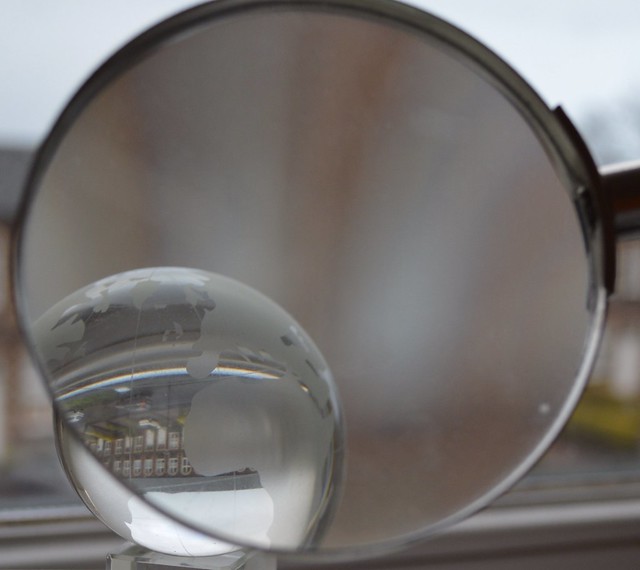
Attend

As Gary Lachman says in his “Secret History of Consciousness”

Yet one drawback to the brain’s highly efficient ability to focus on necessities is that it “falsifies” reality, which, as Bergson earlier argued, is in truth a continuous flow of experience…….The mind constantly takes snapshots, as it were, of reality, which enables it to orient itself amidst the flux. The problem is that science, which takes the most comprehensive snapshots, makes the mistake of confusing the photographs with reality itself.
This is exactly the problem Iain McGilchrist describes in “The Master and His Emissary”.
We have another way of knowing which is different from this editing, filtering, re-presenting way. We know by seeing connections, by experiencing the whole. Bergson describes that as intuition. A good example of that is how you answer the question “How are you?” You can ask yourself, “How is my energy today?” and you will come up with an answer instantly. You don’t have to edit, filter, or quantify anything, you know it holistically, or “intuitively”.
I’ve seen the same function again and again when visiting patients. Instantly, even before anyone speaks or before any “findings” are discovered, an experienced doctor knows he or she has to act quickly. The consultant who taught me Paediatrics, said on my first day at work with him that his aim was to teach me “how to recognise an ill child”. I thought that a strange comment at the time, but that’s exactly what he did. That recognising is a holistic, intuitive function which comes with experience.
Here’s Lachman again, in reference to Bergson
Just as we have an immediate, irreducible awareness of our own inner states, through intuition we have access to the “inside” of the world. And that inside, Bergson argued, was the élan vital
The neuroscientist Wolf Singer who looks at the problem of “binding” – of how the brain puts all this information together, says
there is a process in the brain that is itself antireductionist and is concerned with creating wholes out of parts, and hence with giving meaning to our experience.
I suspect this is exactly what McGilchrist highlights as the main function of the right hemisphere.
Isn’t it amazing that our brain can enable us to know in these two amazing ways? To edit, and to bind together; to filter, and to see patterns which enable us to discern meaning?

a strange turn

Inchmahome Priory

Read Full Post »

IMG_1548

We have developed a strange way of thinking about the relationship of human beings and Nature. In fact, that very sentence is an example of how we think. There’s us, human beings. And there’s Nature. They are different. We separate ourselves out from other forms of Life, and from all the other ways Life manifests itself in Nature. We think we are not the same as other creatures. Maybe a bit like apes, maybe a bit like other mammals, but certainly not like flowers or trees. And even if we identify with LIFE in its multitude of forms, we still think of ourselves as separate from the other forms of Nature – earth, rock, water, wind, energy.

But we don’t stop there. We don’t just consider ourselves separate from, and in some way outside of, Nature. We tell ourselves Nature is there for us to exploit, to consume and to control. We think of being in a constant battle with Nature, wrestling with its power and its potential to do us harm. We conceive of the evolution of Life as a perpetual competition, a striving to survive, and only the strongest will win that battle.

But what kind of lives does that kind of thinking create for us? What kind of Nature does that attitude bring into existence? What daily experience do we have when we live from that perspective?

Over the last hundred years, physics has shown us that there are no separate, discreet, irreducible “particles” which are the “building blocks” of reality. We have begun to understand (or maybe rediscover) that any sense of separateness is a creation of the human mind. In particular we use our left cerebral hemisphere to filter and re-present the phenomena of reality to ourselves. This gives us a view which declares boundaries, and which creates the impression of separateness. As we explore the connections, the bonds and the relationships we begin to experience Life quite differently. And as we take on board the phenomenon of integration – of the creation of mutually enhancing bonds between well differentiated parts – we begin to see how co-operation is the basis of evolution, at least as much as, if not more than, competition.

So we can change our focus, taking on board Einstein’s question of whether or not we think of the universe as a friendly place, and then we see in Nature not just the inter-connectedness of everything, but how this Earth is perfectly created to sustain and develop Life itself. How everyday life is only possible because of the innumerable beneficial links between ourselves and others, between ourselves and other species, between ourselves and those who have lived before us, and between ourselves and the rest of the Universe from which we emerge.

The image above is a path. I think it is beautiful and shows an intimate relationship between human beings and trees. Here’s another path, quite different from that one, but which also makes me think about the paths we create as we live in this world.

DSCN1239


Maybe it’s time to create a better path? A more “natural” path?


Read Full Post »

poppy field

The local robin

a wish

daisy
I came across this phrase of Emerson’s the other day

Tis curious that we only believe as deep as we live.

And the first thing I thought was “Tis curious that we only live as deep as we believe”! But then I decided to track it down and see it in its context. It comes from his “The Conduct of Life” in the section where he writes about beauty. There are some real gems in that piece of writing.

Our books approach very slowly the things we most wish to know. What a parade we make of our science, and how far off, and at arm’s length, it is from its objects! Our botany is all names, not powers: poets and romancers talk of herbs of grace and healing; but what does the botanist know of the virtues of his weeds?

Can we really know about plants only by treating them as objects to measured, weighed and classified? And what happens when we apply that approach to human beings too?

We should go to the ornithologist with a new feeling, if he could teach us what the social birds say, when they sit in the autumn council, talking together in the trees. The want of sympathy makes his record a dull dictionary. His result is a dead bird. The bird is not in its ounces and inches, but in its relations to Nature; and the skin or skeleton you show me, is no more a heron, than a heap of ashes or a bottle of gases into which his body has been reduced, is Dante or Washington.

The bird is not in its ounces and inches, but in its relations to Nature”. Wow! How true is that? And isn’t that exactly where our present approach often falls down? We fail to see what we are studying in its “relations”. 

The motive of science was the extension of man, on all sides, into Nature, till his hands should touch the stars, his eyes see through the earth, his ears understand the language of beast and bird, and the sense of the wind; and, through his sympathy, heaven and earth should talk with him. But that is not our science. These geologies, chemistries, astronomies, seem to make wise, but they leave us where they found us.

and

Science in England, in America, is jealous of theory, hates the name of love and moral purpose. There’s a revenge for this inhumanity. What manner of man does science make?

These last two passages raise a subject we don’t hear much about, but I think we are beginning to hear more now, and will hear even more in the years ahead. It relates to Einstein’s famous question about the Universe….

Is the Universe friendly?

And it also relates to Iain McGilchrist’s point about the two different approaches to the world from our two different cerebral hemispheres. If it’s true, which I think it is, that we create the world we live in through what we pay attention to, what our values and beliefs are, then what kind of world do we create from this detached, materialistic scientism?

What is life like for someone who sees things that way? And what’s life like for someone who sees things the way Emerson is suggesting? Do you think the Universe is a hostile place, that everything happens by chance, and nothing has any meaning?

What I share here in this blog is just my experience, just snippets from the life of me, how I experience life, what stimulates my thinking, my passions, my imagination. But it’s the way I approach the world which creates this particular world I’m living in and sharing with you.


Read Full Post »

It’s very common for us to say something like “My head is sore”, or “My stomach aches”, or even “I have a rash” when we experience one of those symptoms. So who is it who has this head, stomach or rash? This way of talking confirms our feeling that we “have” a body, but that our bodies are not us. Stop and think about it for a moment. Are you your body?

You might answer that your body is part of you but it isn’t YOU. That the you who has this body is maybe your mind?

But then we do the same thing with our minds too, don’t we? We say “I’ve lost my mind”, or “I’m out of my mind with worry”. Who is the “I” who is referring to this mind?

So your body isn’t you. Your mind isn’t you. But both your mind and your body are a part of you.

The physicalist approach to this claims that this “you” which you experience is an illusion. It’s just something your brain makes up.

But stop and think about that one for a moment. If “you” are an illusion, who is having this illusion?

This is what Mary Midgley is exploring in her latest book, “Are you an illusion?”

I highly recommend you read it. It’s short, and it’s an easy but deeply thought provoking read.

She asks of those who write the books claiming that only the physical is real, and that the subjective sense of self is an illusion

Unkind observers sometimes enquire who, in that case, actually writes the books that expound this doctrine? Do the brain cells really do this work on their own?

She quotes the neuroscientist, Susan Greenfield, saying in an operating theatre, “This was all there was to Sarah, or indeed any of us…..we are but sludgy brains” and Colin Blakemore saying “The human brain is a machine which alone accounts for all our actions” and she responds

Thus if we want to understand why (for instance) Napoleon decided to invade Egypt or Russia, what we need is not – as we might think – some knowledge of the political background and of Napoleon’s state of mind, but simply facts about the state of his brain, which alone can account for his action.

Does the claim that you are only your brain cells, or only your DNA, ring true for you?

The materialist credo rules that thoughts, not being physical, cannot cause physical events. And as we know from every activity of our lives that thoughts actually can and do affect those events – that they are often all too effective, producing practical results in the world even when we wish they wouldn’t – this doctrine puts materialism into a radical conflict with reality.

This is the nub of it for me. These materialist beliefs don’t only not ring true, they don’t adequately explain reality. So why are they so prevalent? One of the authors she draws on to answer this is Iain McGilchrist who has shown us how the left and right hemispheres of the brain work together to produce and integrated understanding from their two very different ways of approaching reality. She quotes him saying

Mind has the characteristics of a process more than of a thing; a becoming, a way of being rather than an entity

This is almost identical to the way Dan Siegel and the Interpersonal Neurobiologists put it – “the mind is a process of regulation of energy and information flow”.

She hits the nail on the head time and again. Let me finish with this one

The bizarre anti-self campaign which is the main subject of this book is surely intended, among other things, to put us off taking notice of everybody’s inner life: to persuade us that this is a trivial, contemptible subject by the simple device of pretending that it isn’t there.


Read Full Post »

Do you ever wonder why we are here? Or are you someone who thinks there is no answer to that question because the Universe is totally random and meaningless?

When the Universe created human beings, it created consciousness, and with consciousness came some new abilities – a combination of the ability to wonder (to be amazed by, to be in awe of, to have that émerveillement du quotidien), the ability to enjoy (to experience a wide range of sensations and subjective experiences), and the ability to care for (to look after, and to nurture).

Walking in the garden at the hospital where I work today brought all of that home to me….


Clematis

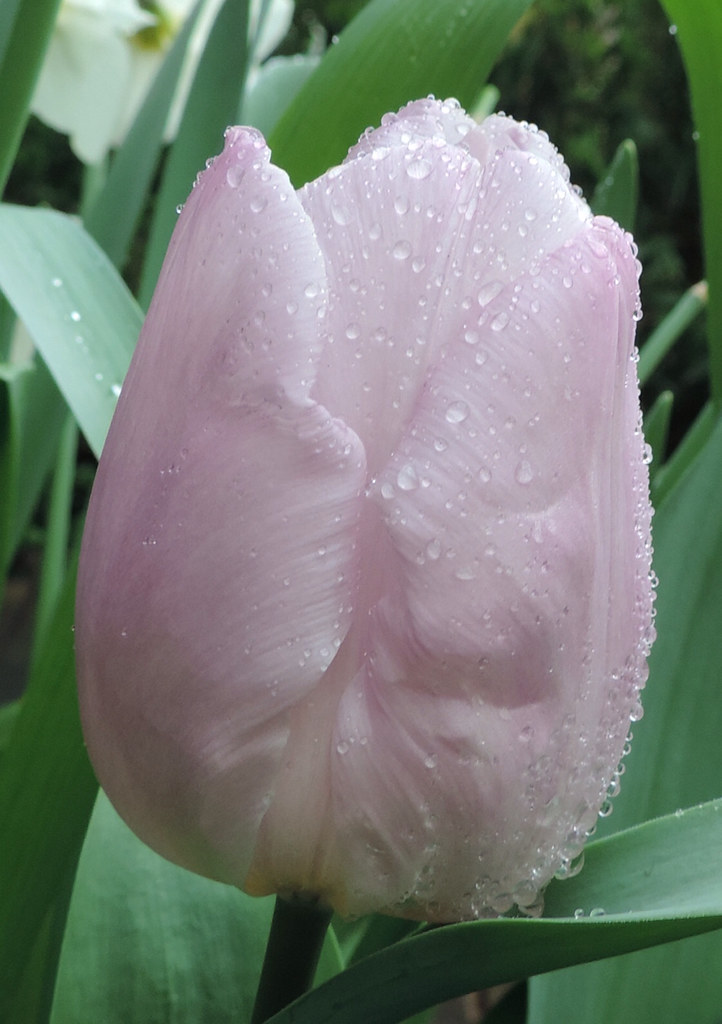
Tulip and rain

Read Full Post »

« Newer Posts - Older Posts »