Feeds:
Posts
Comments

Archive for the ‘philosophy’ Category

In Mary Midgley’s excellent new work, “Are You an Illusion?”, which sets out strong arguments against reductionist materialism, one of the issues she raises is about the competitive basis of the physicalist approach so dominant in the world today. The Neo-Darwinist emphasis on “survival of the fittest” is too simplistic alone to explain evolutionary change. This is not a new argument of course, but one of the points Mary Midgley makes is about how before the emergence of this theory, the more dominant strain of thought was magic….which was based on attraction. She quotes Marcilio Ficino

“All the power of magic consists in love…..The work of magic is the attraction of one thing by another in virtue of their natural sympathy. The parts of the world, like the members of one animal….are united among themselves in the community of a single nature. From their communal relationship a common love is born and from this love a common attraction, and this is the true magic….Thus the loadstone attracts iron, amber, straw, brimstone, fire; the Sun draws leaves and flowers towards itself, the moon, the sea.”

This general assumption about the importance of attraction is surely just as rational a place to start from as the contrary one, popular today, that the universal force is competition.

Thought provoking.

Imagine how the world would be if we put love and attraction at the heart of our thinking instead of how to succeed at the expense of others?

Read Full Post »

Orange sky from Pointe Rouge


In the A to Z of Becoming, P is for Pause.

A pause is a break, a temporary stopping. I first encountered the concept of the “bardo” in the Tibetan Book of Living and Dying, where it was helpfully described as a space where enlightenment could emerge. The meditation teaching in that book is to become aware of the space between two thoughts, and gradually to practice increasing that space. In daily life the suggestion is to become aware of the space (or bardo) which occurs before an emotion arises eg anger or fear.

So, let’s look at two types of pausing.

The “pause of now” and “the long pause”.

The “pause of now”. One way to consider what goes on in our minds is to think of two default brain states – “reactive mode” and “responsive mode”. In reactive mode our minds work almost like reflexes. Someone or something “touches our buttons” and off we go, into a real state of anger, anxiety, fear or some other learned pattern of thought, feeling and behaviour. In this reactive mode we can feel entirely the victim of other people and of circumstances. It can feel as if we have no choices, that our happiness is entirely at the mercy of others. We are on automatic. We are in “zombie” mode. The responsive mode arises as we become aware of the early changes, recognise them, understand what is happening, and then make a choice about how we want to respond. So if we frequently find ourselves becoming angry or anxious when a certain person speaks to us, then if we can become aware of the reaction starting to happen, we can pause, then choose how to respond – sometimes we will choose to respond angrily, or anxiously, but sometimes we won’t. We will be doing the choosing as we open up this “necessary gap” and in the “pause of now” we gain flexibility, confidence, tolerance, autonomy, and move away from a victim or zombie way of living.

One of the easiest practices I know to begin to develop the skill of creating this pause to shift from reactive mode to responsive mode is Heartmath (see a simple introduction here). The first two steps of “quick coherence” in Heartmath are known as “getting neutral”. It’s a variant of “count to ten”, and it works. The more you practice it, the more quickly and powerfully it works.

There’s another kind of pause though, and it’s not the kind of pause which happens just over a few seconds, or at best few minutes. I got this idea from reading about the concept of “the long now“. We hear a lot about “living in the moment”. Maybe you’ve read “The Power of Now” by Eckhart Tolle? If not, then maybe you’ve read elsewhere about the idea of being present, instead of spending your time on the past or the future (which might focus your thoughts on grief or anxiety). But when you stop to think about it, “now” hardly exists. This present moment has become the past by the time you’ve said “this present moment”. Henri Bergson, the French philosopher introduced the concept of “duration” to allow us to think differently about time (instead of splitting it up into moments, like frames of a movie), but his work can be quite hard to understand. Here’s a short summary of his duration idea –

Instead, let us imagine an infinitely small piece of elastic, contracted, if that were possible, to a mathematical point. Let us draw it out gradually in such a way as to bring out of the point a line which will grow progressively longer. Let us fix our attention not on the line as line, but on the action which traces it. Let us consider that this action, in spite of its duration, is indivisible if one supposes that it goes on without stopping; that, if we intercalate a stop in it, we make two actions of it instead of one and that each of these actions will then be the indivisible of which we speak; that it is not the moving act itself which is never indivisible, but the motionless line it lays down beneath it like a track in space. Let us take our mind off the space subtending the movement and concentrate solely on the movement itself, on the act of tension or extension, in short, on pure mobility. This time we shall have a more exact image of our development in duration.

One other concept I found easier to grasp was the idea of the “long now” – which, I suppose, in even simpler terms could be thought of as “now-ish” (reminds me of how Italian friends would often use the term “15 minutes” which if you used your watch to measure would produce huge frustration because they didn’t mean a number of minutes, they just meant a “piece of time” (of around 15 minutes in size!).

Drawing on these ideas of time, I think we can usefully propose “the long pause”

The long pause is a space, a few minutes, hours, days, or even weeks. I think a holiday often is a kind of a pause. It lets you step off the treadmill, get some distance between your working life and the rest of your life and provide a vantage point from which to see things more clearly, or a place from which to allow a new pattern of thinking, a new set of decisions, some new habits, or, yes, even enlightenment, to emerge.

So, here’s your verb for this week – pause.

Practice pausing in the moment to move from reactive mode to responsive mode, and build into your life some long pauses, some “time out” – daily, weekly, monthly, annually.


Read Full Post »

Door restore

This restored door in Pézenas reminded me of the story the ship whose planks were gradually replaced one by one until none of the original planks were left. Was it still the same ship?
And what about our ever changing bodies with new cells replacing old ones every day so that very few cells remain after a few years…..yet we are still ourselves. Aren’t we?

This miracle of perpetual change which allows a sense of continuity and consistency.

Read Full Post »

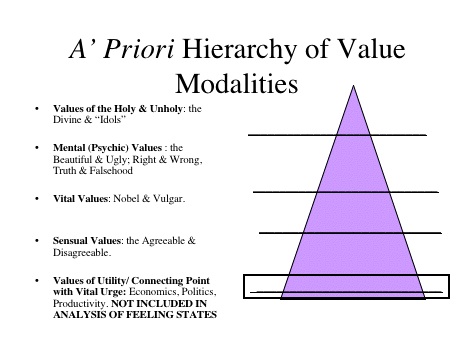
You might be familiar with Maslow’s “hierarchy of needs”, but perhaps more interesting is Max Scheler’s “hierarchy of values”.

IMG_0572

At the base of this pyramid are feelings of bodily sensations such as “a tickle, an itch, a fragrance, a taste, pleasure, pain, hunger, thirst, intoxication”. These are sometimes referred to as feelings of “utility” – because the “usefulness” of a sensation is the extent to which they are “agreeable or disagreeable”

Above these feelings of utility are “vital feelings” – which are those of the lived body as a whole – “health, vigor, strength, tiredness, illness, weakness, advancing age”

Then he describes those psychic feelings which have an ego quality – “happiness, sympathy, enjoyment, sadness, sorrow, anger, jealousy” – those which generate our values of beauty, truth and justice.

At the top of the pyramid are “holy feelings”, which come with a kind of dissolution of the ego – “bliss, awe, wonder, catharsis, despair, shame, remorse, anxiety, pangs of conscience, grief” – none of which can be reasoned with, but, rather are “heart-felt”

It can take a wee bit to get your head around this, but I do think it’s worthy of exploration.

Read Full Post »

It’s Burns Night tonight, but I’d like to share the opening verse of a poem by another old Scottish poet, Thomas Campbell. From his, ‘The Pleasures of Hope’…..

At summer eve, when Heav’n’s ethereal bow
Spans with bright arch the glittering hills below,
Why to yon mountain turns the musing eye,
Whose sunbright summit mingles with the sky?
Why do those cliffs of shadowy tint appear
More sweet than all the landscape smiling near?—
‘Tis Distance lends enchantment to the view,
And robes the mountain in its azure hue.

first thing this morning


Although this turns around the French idea of the “view from on high“, in some ways, it’s the same idea. How often does it seem that it’s the distant mountains which catch our eye when we look at a landscape? I know that’s what catches my eye first. Every single day I look out of one of the windows of my flat and look for Ben Ledi. Unless there is mist, or the clouds have come down in front of it, it’s Ben Ledi I see first.

I like this idea of Campbell’s that the ‘distance lends enchantment to the view’, and I think our everyday often lacks enchantment, so maybe here’s an easy way to increase it…..look to hills, folks!

Read Full Post »

Rain lenses


Look carefully at these raindrops and see what you can see within them.

There are all kinds of theories about reality and how we experience it, but in this Age of Modernity, the object, what’s “outside”, what can be measured, what is “physical” has gained almost a monopoly over what is accepted as “real”.

What a patient’s tests or scans show are believed to represent what’s really wrong or right. What a patient reports, relates or describes of their experience – their symptoms, their personal narrative, is often dismissed by researchers as anecdote, or by clinicians as unimportant – “I’m happy to tell you your results are all normal” (“now go away and stop bothering me with your complaints!”). Somehow the lived experience of reality has become less relevant than the measurement of reality. The object trumps the subject.

Yet that objective, physical reality can only be experienced by, can only be measured by, the human subject.

So, in this dialectic, is there some way to grasp reality, to know what is REAL?

I’m not about to solve this one here, but one way of approaching this which appeals to me a lot, is to ask the question “what are these the two poles of?” “Inside and outside of what?” Or to put it another way……If the subject and the object are two sides of the coin, what’s the coin?

Is it the continuous process of becoming which we see everywhere in the universe? Is it the vital force, the Life force, the universal spirit from which all form emerges?

Can we take a perspective on reality which sees BOTH the inside and the outside as valid and important?

That’s why I don’t accept the proposed duality of mind and body, and any understanding of a patient is incomplete without exploring both.

Read Full Post »

jupiter over ben ledi


When I looked out of the window this morning I saw a bright star shining over Ben Ledi.

My Starwalk app tells me that what I was looking at was Jupiter, and it was sitting smack in the middle of the constellation Gemini. It was too light to see any of the constellation but you can see how easy it was to see Jupiter.

There’s a saying in French about taking a view from on high (vue d’en haut). The meaning is pretty clear. When you think what it is like to look out over a land or seascape from a cliff or hilltop, you get the idea. In other words, its about taking an overview, seeing the bigger picture, seeing things in their context.

Iain McGilchrist describes how the left and right hemispheres approach the world differently. The left tends to focus in on things. It’s like using a telescope or microscope. It’s great for seeing the details and analysing them. It’s a kind of digital approach. The right however gets first claim on all the information flowing into the brain. It takes the overview, the more holistic, analogue approach. In some ways, you could say our right hemisphere is well designed to allow the view from on high.

The French take a variation of the view from on high, and include the concept in the expanded one of a “view from Sirius”. Sirius is the brightest star in the sky (the planets might look brighter but they aren’t actually stars).In 1752, Voltaire wrote a story entitled “Micromegas” about a giant from Sirius traveling across the universe and coming to Earth to have a look around. Not only does the view from Sirius include the idea of an overview, but it also captures the idea of everything being seen or experienced for the first time. When you travel to a new land, the everyday reality can seem strange and new, and stimulates your curiosity.

So, when I look out and I see the bright shining Jupiter over Ben Ledi, it sets off my thoughts about taking the “view from Sirius” and takes me into the day with a sense of wonder, of open-ness, and of being able to see the bigger pictures.

Taking a look from higher than Ben Ledi, but not as high as Jupiter or Sirius shows us just how thin the biosphere is…..its a pretty thin layer in the scheme of things!

biosphere


Read Full Post »

Rays of light

In the fields of holistic and integrative medicine people often talk about taking a body/mind/spirit approach. The body and the mind aspects are pretty uncontentious. But what about “spirit”?

For many people the word spirit conjures up either organised religion, or non-denominational ideas like spirit beings, beliefs about life after death, or reincarnation, and so on. But is there a spirituality which isn’t supernatural?

Think of the idea of the “thin spaces” for example, where you feel connected to something greater than yourself.

In fact, I do think this is a key to the concept of spirituality – connection – connection to something greater than yourself. There’s a great pdf about integrative medicine (download here) across on the humanmedia.org site which includes a page on spirituality. They say it is

a means of connection and/or self-reflection through which one finds comfort, purpose and inner peace.

Not a bad definition, and it highlights both the key ideas of connection and of purpose. We are meaning seeking, meaning creating, beings. We do that through stories, through seeking patterns, by joining things up……and that gives us our myths, our beliefs and a sense of purpose. It’s pretty hard to live a life with no sense of purpose.

The Humankind document goes on to say that spirituality includes the qualities of

compassion, humility, generosity and simplicity

I wonder if thinking about qualities such as these helps us to see spirituality as something essentially integrative – in the sense of it being that which connects and pulls the body and the mind together……

Back to the idea of spirituality including a sense of being connected to that which is greater than yourself – remember this little RSA Animate video of Jeremy Rifkin’s fabulous talk on “empathic civilisation”? No? Click through and watch it now.

What does spirituality mean to you? What part does it play in your life?

Read Full Post »

fractal cloud


Ursula Le Guin, in the introduction to her selected short stories, “Where on Earth”, says

I had been writing realistic stories (bourgeois-USA-1948) because realism was what a serious writer was supposed to write under the rule of modernism, which had decreed that non-realistic fiction, if not mere kiddilit, was trash. I was a very serious young writer. I never had anything against realistic novels, and loved many of them. I am not theory-minded, and did not yet try to question or argue with this arbitrary impoverishment of literature. But I was soon aware that the ground it offered my particular talent was small and stony. I had to find my own way elsewhere. Orsinia was the way, lying between actuality, which was supposed to be the sole subject of fiction, and the limitless realms of the imagination.

How liberating! How inspiring! Of course, all fiction is a work of the imagination, whether you call it “realism” or not, and, actually, isn’t Life, which can only be lived from the perspective of the subject, also a work of imagination? Or at least, it’s a work of finding that path between “actuality” (the objective Real), and the “limitless realms of the imagination” (how we subjectively interpret and experience that Real)?

I also love her phrase “arbitrary impoverishment of literature”. Why indeed should we limit ourselves to “realism”, especially if that same realism ignores, or worse, denies, the inclusion of the imagination?

Finally, I like that phrase “the ground if offered my particular talent was small and stony”. Isn’t it true that for each of us, our particular talents flourish in quite different environments, or on quite different paths?

Read Full Post »

As we come towards the end of another year, there are many articles and programmes looking back over 2013, and looking forward into 2014. In the socio-economic world what we hear about most is “growth”. Concern about whether or not there has been “enough”, and how we can all strive to produce more. Every single country in the world is measured in terms of the “growth” of its economy. Very little growth, bad marks. Increasingly more growth, good marks!

But growth of what? And for what?

Growth of consumption. That seems to be one marker. Consumption of what? Doesn’t matter. Stuff. Just, the more consumption, the better. Growth of “activity”. That’s another. But what kind of activity? Just activity. Busy turning financial derivatives into even more complex products to sell others. Busy making stuff. Busy moving stuff. Just activity.

Why? Why is more consumption and more activity good no matter what is being consumed, no matter what activities are being carried out?

Is it to produce more and more wealth for less and less people? Because that’s the sure and certain trend we are seeing.

Meantime we are seeing two other forms of growth. Growth of the number of people alive on the planet. Growth of the amount of finite resources we are taking out of the planet. Growth of the number of drugs people take every day. Growth in long term diseases and cancer.

Something isn’t going right, don’t you think?

Marc Halévy, in his “Prospective 2015 – 2025”, [ISBN 270331017X] takes this whole issue by the scruff of the neck and points out with stark clarity that we are just not on a sustainable path. More than that, we seem to be caught in a communal delusion, that this current path of ever more consumption by ever more people is a good thing – in fact THE good thing – THE criterion on which to judge the health of any economy.

This is just crazy. It makes no sense.

Marc suggests an alternative and he captures it in a simple French phrase – “la jouissance de la frugalité”.

These aren’t the easiest words to translate into English (help me out here if you are good at translating!) – but you get a bit of the sense of “jouissance” from the french phrase “joie de vivre” (which, interestingly, is one of those phrases we English speakers use directly as it is). It’s something to do with pleasure, joy, delight, satisfaction, something life enhancing. It’s, fundamentally, about quality. And “frugalité” isn’t exactly “frugality” as we would say in English. In fact, frugality isn’t a word which is used much by English speakers any more, but Benjamin Franklin had it as one of the most important of his virtues. It doesn’t mean something inadequate, or poor. It isn’t about poverty. But it is about “less”…..a kind of making the most of whatever it is you have…..

We can find this suggestion in the “sweetness of life”, and in the “slow movement“.

It’s about more quality for less consumption. It’s about living in the present, savouring, enjoying, mindfully experiencing every single moment.

Once you apply that personal principle to the universal, then you stop to ask yourself at each level. Does this enhance my life? Does it enhance the life of the human species? Does it enhance Life on Earth? Does it enhance the Universe?

Enhance might not be the best word, but I hope you get the idea. We need to shift our focus from more, more, more numbers and stuff, to deeper, greater, more impactful quality of living.

We need more of “la jouissance de la frugalité”

fishermen Lake of Menteith


Read Full Post »

« Newer Posts - Older Posts »