Feeds:
Posts
Comments

Archive for the ‘philosophy’ Category

I suspect “beauty is in the eye of the beholder” is not the last word on beauty, but I don’t deny that there is a subjective element to beauty. What I find beautiful, you might not, and vice versa. So here’s my invitation to you – tell me, or show me, what you find beautiful and I’ll share with you what I find beautiful.

Today, I came across this photo of a tiled roof in a village in Southern France. This is a very typical roof for this part of the world. I find it beautiful. I’m sure there are many reasons why, but I want to pick out and explore just one of them today – diversity.

What I see whenever I look at a roof like this is that the tiles are all different. As opposed, of course, to them all looking identical. I love how they are different colours and shades. I love how some of them have lichens growing on them, and some don’t. I love how they are not all the same size (they are pretty much the same size but it isn’t exact) and I love how they sort of fit in a higgley-piggedly way!

In other words the characteristic which I find so beautiful about these roofs is that the tiles are so diverse.

Diversity is beautiful.

Nature loves diversity. Left alone you don’t get permanent mono-cultures in Nature. Instead you get the display of vast networks of relationships between widely diverse elements, all of which contribute to the success, to the survival and the flourishing, of the whole.

I also love diversity even in tiles because it gives them more “character” – you can distinguish one individual from another. I like that more that factory produced, machine made, production line sameness – don’t “mono-culture” and “mono-tony” have the same root? Isn’t that maybe why I an averse to “mono-polies”?

I’m not a fan of imposed conformity, of the industrial, capitalist age of mass production and mass consumption. I love to see artisans at work here in France…..people with a lifetime of skill, learned by daily practice over years, taught by the most skilled ancestors and passed on to enthusiastic younger generations. I saw a great initiative in France recently where a small town invited two groups of people to a local building every Wednesday – retired people with a skill (an iron worker, a woman who used to sew for a fashion house, a stained glass worker, and others), and children aged about 12 years old. The children were learning these practical skills from these now retired skilled workers during their regular Wednesday time off from regular schooling. Both the retired skilled craftspeople and the children were loving it – it brought joy and meaning into their lives. It also connected the generations and gave both groups a different view of the other generation. Yes, it’s very small scale. There were only a handful of people in each group. But I don’t think that should put us off. Something doesn’t have to be “mass” and “standardised” to be successful. There’s nothing to stop any community taking this idea and fashioning it into their own practical project.

In my local town of Cognac there are several “Boulangeries” (Bakers) and they are ALL different. They might all include a core range of similar products, including baguettes and croissants, for example, but they all do it differently. Each baker has his or her own skill and experience, own strengths and weaknesses, and I know which one to go to for different types of bread, which make the croissants the way I enjoy them, and which make the best patisserie (like eclairs, and other cakes). Here’s the thing – I don’t buy all those different products in the same boulangerie. Yes, I know, you might prefer the “convenience” of a standardised, one stop shop, and that’s your right to enjoy that. But for me, acquiring this local knowledge then using it to find just what I want, when I want, enriches my life.

Diversity – it’s beautiful and enriching.

Read Full Post »

I’ve been fortunate to have had the chance to visit Japan on a number of occasions. One of the things I always loved to do there was to visit temples and shrines (if I understand it correctly there are buddhist temples are shinto shrines). I’m not a Buddhist and I know only a bare amount about Shinto but I found these places to be what some would call “sacred” places. They feel sacred because they feel special, they stir something inside which surpasses wonder and appreciation of beauty. They are amongst those places in the world where the boundary between the material world and the spiritual world seems thin. I have had similar experiences in stone circles in Scotland, and in the cloisters of old monasteries in southern Europe.

What makes a place a sacred space? For you, I mean. What places in the world have you had experiences of stepping into somewhere enchanting, somewhere which stirs energies deep within you?

This photo is of a particular part of a particular place, but I want to focus on it today because every time I return to this image it calms me, it soothes me, it draws me out of myself and into a deeper connection with the whole. Let me just draw your attention to the elements (which I think are repeated in some form again and again in these Japanese temples and shrines).

There is running water. I do think this is a key element – not that you need running water to make a place sacred but in the context of these Japanese places it seems to be essential, and I love it. I love that the running water isn’t dramatic and showy like so many huge city centre fountains in France and Italy (although I must say I DO like those fountains too!). I like how it really demonstrates a continuous flow. It seems to me that this is the basis of all Life – continuous, always changing, but somehow also always constant, flow. We understand water so poorly, yet without it nothing of what we know would exist.

There are rocks and often one or more of them form a basin for the water to pour into. The rocks have age, they bring the past into the present, and they expand the range of time available to us as we stand in front of them. Have you ever stopped to wonder where rocks come from? Well, that’s a whole other story, but a truly fascinating one.

Lying on the rock are two strips of bamboo which are bound together to create a rest for the bamboo ladle. The ladle is used to scoop out some water and pour it over your hands…..a ritualised cleansing. I wonder if all religions have this element? This use of water to “cleanse” as part of a spiritual experience?

There is also a small sprig of flowers……Japanese flower arranging creates great beauty by simple and sparse combinations of plants. It inspires both wonder and delight. But the flower isn’t the only plant there…..there’s also moss. Now, moss has a particular special place in Japanese gardens and spiritual places. It’s revered in ways I haven’t encountered anywhere else in the world. Are there other cultures which revere moss? I would say it’s my encounters with moss in Japanese gardens and temples which completely changed my opinion of it. I love it now. I only saw its beauty once I had encountered it in places where it was revered. Isn’t that interesting?

This image still works for me, and I hope it brings you some delight and joy as well.

Here are my leaving thoughts – What places feel special this way for you? Do you have photographs of them? Did you paint them? Or write about them? How might you create such a special place for yourself? What elements would you like to include? And, don’t you think your life could be enriched by encounters with such places?

Read Full Post »

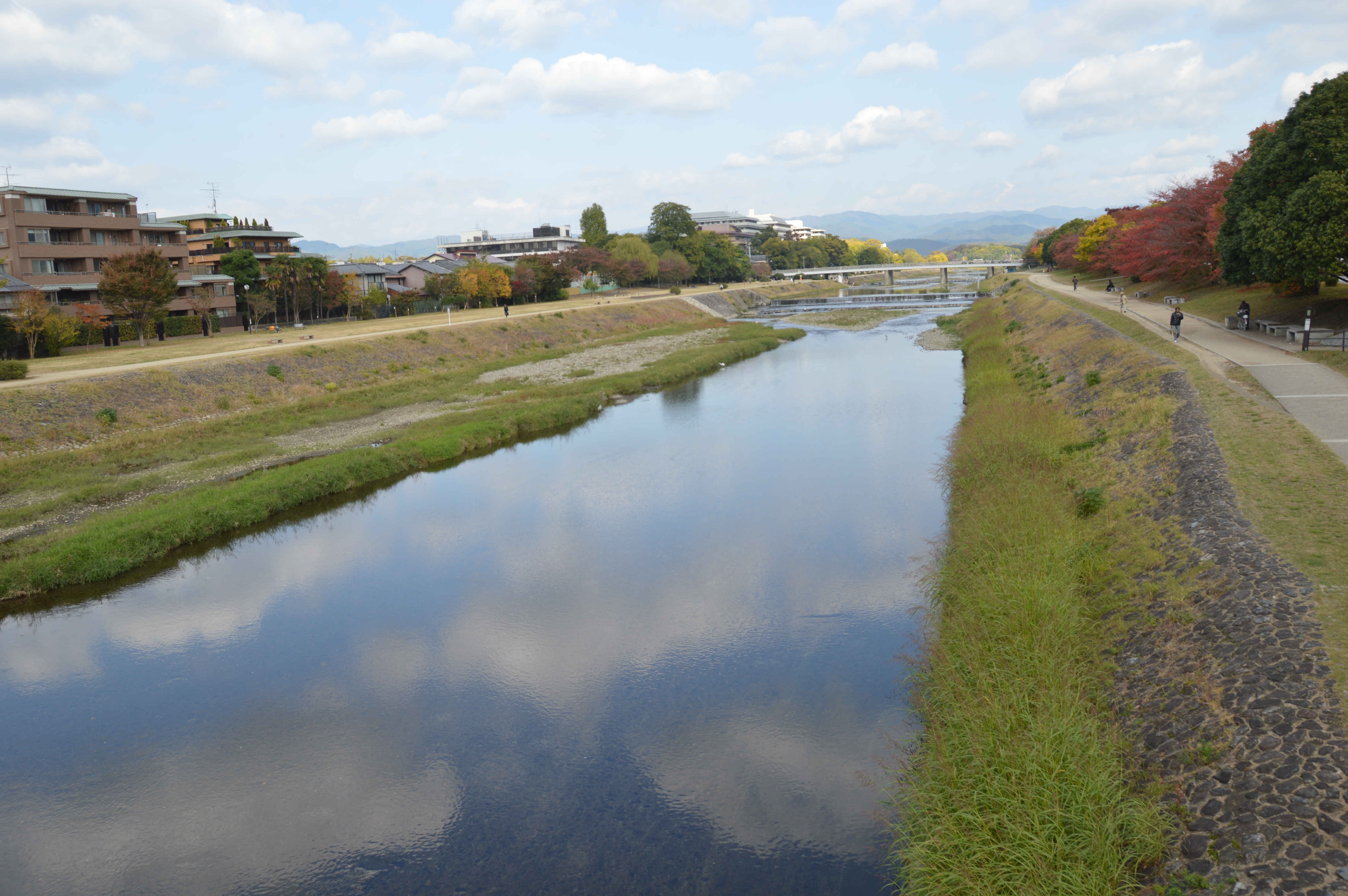
This is the Kamo River which flows through Kyoto. I took this shot because I liked the colours of the trees on the bank, and the reflection in the river of the clouds floating on a blue sky. I still like it for those reasons. However, I’ve found that, in the many years since I took this photo, that I’ve returned to it over and over again. I’ve used it to illustrate what I think are some of the most fundamental lessons of the universe.

On one bank you see trees, and a pathway running between the trees and the river. The trees are diverse. They are different species, different shapes, and different colours. For me they represent diversity and a “natural” habitat. You could argue they represent “wildness” – that universal force which continuously strives for growth, difference and diversity. It’s a “multiplicity”, not a “mono-culture”.

On the other bank you see houses, hotels and offices. This is the built environment. It is planned, constructed and ordered. Yes, I agree, the buildings are not all the same, and there is a saving grace in the Kyoto architecture. In some parts of other cities the buildings really are “cookie cutter” in their shape and construction. Let’s say this represents a second universal force – that which organises and builds.

Thomas Berry, in his “The Great Work”, describes these two forces beautifully and points out that an excess of “wildness” produces destruction, chaos and disorder….things can fall apart, whilst an excess of “discipline” produces too tight limits, narrow boundaries and a level of organisation which makes life impossible. I see this story represented in this photo.

Right down the middle of these two forces we see a calm, harmonious, “integrated”, flowing river. This is the “sweet spot”, that place where the interplay of these two great forces produces both Life and beauty. In this photo, there is even a bridge connecting the two. The bridge is a connector, and it’s through the creation of “mutually beneficial bonds between well differentiated parts” that we experience “integration”, harmony and growth.

You can think of a life journey sailing down this river, sometimes veering off towards more organisation, and sometimes off to the other bank to find diversity and wildness. As we navigate our way between these two opposites, we experience a full life, a rich life, a life of depth, meaning and purpose, a life of beauty and joy.

The final thing I’d say about the universal lesson I see in this photo is that it encourages us to appreciate the “whole”, not to judge one bank as “good” and the other as “bad”. After all, if we only had one bank, we wouldn’t have a river……we wouldn’t have a life.

Read Full Post »

I love this photo of a tree in winter. Without its leaves you can see how the tree has a classic structural pattern – a pattern which we call “branching” – no doubt in reference to where we see this most – in trees!

This is a pattern we see in many, many places. You can see how water runs down the mountainsides in small streams which gather together into larger streams, then rivers, until one big river makes its way down to the sea. You can also see it at the coast where rivers form an estuary. You see it in root structures under the ground, as well as in bushes and trees above ground. And, perhaps more for me because of my lifetime work as a doctor, you see this pattern throughout the human body – in our circulatory system, in our lymphatic system, in our urinary system, nervous system, our liver, and especially in our lungs.

So when I see an image like this I see something “universal” – something fundamental. It gives me a glimpse of some of the underlying structure of the world. And I find it beautiful. I love how seeing this in the tree brings to mind all those other locations – out in the countryside and within the human body – so that the single tree elicits a broader and deeper reality.

Mind you, we mustn’t get carried away and think that this is the only kind of structure we find in the universe. Of course it isn’t. It’s just one of THE main ones. Equally, or maybe even to a greater extent, we uncover the patterns of networks and webs.

And in those places where we find a beautiful merging of both of these core forms.

Deleuze and Guattari clarified this best for me when they described these two structures as “arboreal” and “rhizomal”.

Take a look around you and see where you can spot them. It’ll help you to become more aware of how often you use these structures when you think, and when you try to make sense of your world.

Read Full Post »

When I look at this photo I think “This is what life feels like, and this is what life really is”.

What I mean is this – look at those bubbles (I’m going to guess that when you looked at this photo the first thing you noticed were the bubbles). Each one looks perfect, and perfectly separate from the rest. Each bubble is distinct, different in size, different in location, different in the exact way it reflects the light, and also, although you can’t see this in a still photo, each moving along its own distinct, and different path (there are hints of that in the flows of water currents which you can see creating that marbling effect between the bubbles).

We feel like this. Separate, distinct, different. We feel, and we are, unique. There are no two of us with identical characteristics, identical stories, living in exactly the same time and place having exactly the same experiences. We have a membrane which seems to separate us from the rest of the world. On the outside, that membrane is our skin. On the inside it’s mucous membranes lining our lungs, our digestive system and our urinogenital system. Inside, and within, that, is our immune system, a distributed network of cells and chemicals which recognise “foreign” substances and protect us from their potential harm.

But actually, we are not separate. Those membranes are porous. They are not impermeable. And that’s for a very important reason. They enable us to connect. They enable us to interact with others and with the rest of the planet. They enable us to ingest nutrients, inhale oxygen, expel waste materials and exhale carbon dioxide, amongst many other exchange processes. So, to see them as simple barriers or borders is wrong. They do distinguish what is “me” from what is “not me”, but they enable my life by enabling these, and multiple other connections and flows.

Look again at these bubbles. Where do they come from and where do they go? They emerge from the water itself, and they dissolve back into the water they emerged from. So do we. We emerge within the rest of this “natural” world, come into existence for a brief period of time, then we dissolve back into the great web of being from which we came. In the part between birth and death, that part we call life, we don’t disconnect from that great web. We live in communion with it. We live as part of it, not apart from it.

Life is flow – flow of molecules and chemicals, flow of energy, flow of information. Our existence is a delicate but distinct dynamic interplay of those flows, creating the appearance of separateness and difference, but never disconnecting from, or existing apart from, the whole.

Our lives are distinct and beautiful, but they are not separate.

Read Full Post »

Why do we open up? Why do we “unfurl”? As I wrote the other day, my word of the year is “épanouissement” – which means to flourish, to blossom, to fulfil – we follow that path by uncurling, unfolding, unfurling, just like these ferns. And why do we do that? Because, just like these ferns suggest – it enables us to connect.

Opening up, vastly increases our chances of making meaningful, healthy, nourishing connections. Closing down does the opposite.

There are times we need to enfold ourselves, to close down, curl up like a hedgehog for defence, but actually, much, much more, we need to do the opposite. Because without making connections we die.

We do not exist in isolation. Even if it feels like we are being asked to do exactly that during this pandemic, what we’ve discovered is that it isn’t possible. None of us can live without the vast world wide web of others…..without whom we wouldn’t have shelter, food, water, comfort or care. It’s the natural state of affairs – connectedness. And connections aren’t worth much unless they act as channels of exchange – of materials, energies and information.

When I look at this photo, I don’t just see two ferns unfurling, opening up, but I see two ferns touching gently, almost as if they are having their first kiss.

Isn’t this what we need to grow in our world? Not grow our consumption of “stuff”, nor grow our production of waste. We don’t need to grow our destruction of ecosystems. We’ve been doing that all too well. It’s time to change course, isn’t it? To grow our connections, our “integrated” connections – the ones which enable mutually beneficial relationships to thrive. We need to grow our capacity for care and creativity. We need to grow our passion for love, tolerance and acceptance. And to do all that we need to open both our minds and our hearts.

Read Full Post »

My word for 2021 is a French word – épanouissement. Translated into English it has various connotations but basically it means “blossoming” or “opening up”. It’s also used in psychology to refer to the development of the personality, or the self – it means “fulfilment”, or, more specifically, “self-fulfilment”. It can also be used in the description of someone’s face, as when their face “lightens up”. You get the idea?

This peony which I saw in Ueno gardens in Tokyo many years ago captures this notion for me by somehow conveying motion within a still image. Because the beautiful petals are unfolding and opening up in a spiral manner, this looks a bit like one of those little windmills you might have played with as a child. As a physical pattern this spiralling, whether in an opening up, or a closing up, speaks to us of movement. It’s not as static as some other geometric patterns appear.

That element of motion conveyed by this flower’s petals is, I think, an essential part of the whole concept of “épanouissement” – in other words, it’s always a work in progress. It’s not a goal, at least not as an end point, or an “outcome”. It’s a ongoing, growing, developing, evolving, ever-changing phenomenon. And that’s exactly what I think the development of the Self is like.

We are not fixed entities with identities held in aspic. We are not separate, not unconnected, not static. Rather we emerge from within the vast web of Life, never leaving that web, but developing a coherent sense of Self within it, a sense of Self which never stands still, and which, ultimately ebbs back into the great web itself.

Here’s the exciting extra part that you and I can access – consciousness. We have Will and we can make choices. We are “agents”. We are the “co-creators” of reality. We can do that consciously, and deliberately, or we can drift, reacting rather than responding to every change and signal which comes our way. When we wake up, become more aware, then we can choose how to respond, moment by moment, day by day, year by year.

So, here we are, still in the throws of this pandemic, but we have not stopped changing. The thing is – we are now more aware of our inter-connectedness, our inter-dependence, not just with other human beings across the entire planet with all of Life, all of Nature, all of The Earth, as active, living members of Gaia.

So what does that mean for our “épanouissement”? For our “unfolding”, our “self-fulfilment”, our “flourishing”? How are we going to blossom now?

Those are some of the questions that float around in my head these days. These feel to me to be some of the most important questions for me to answer now. This pandemic has challenged our values, our aspirations and our modes of living. How do we want to evolve all three of those? Our values; our aspirations; our modes of living.

Read Full Post »

This pandemic with its lockdowns (or “confinement” as we call it in France) has been, and continues to be, tough for a lot of people for many reasons. It’s the biggest global disruption of our way of life that most of us have ever experienced. So many “normal”, “everyday” and “routine” activities and experiences disappeared over an incredibly short period of time. Apart from the disruptions of work, family and social life, we’ve seen an end to “mass” everything – no crowds of spectators at sporting events, no theatre or cinema audiences, no music concerts, no festivals…..well, I’m sure you can add to that list.

However, there have been two positive developments which I’ve read that many people have experienced – one inner, and one outer which enhances the inner. Pardon? Let me explain.

With the shrinking of our horizons, physical and social, many of us have been spending more time in contemplation – yes, maybe deliberate meditation or other such exercise, but, also a more general reflection. A kind of reassessment and revaluing. It’s given us the time and space to become more aware of our habits and routines and ask if we want to re-establish them when the time comes (when the pandemic is over).

What patterns of behaviour, what modes of living, what activities have been disrupted that I don’t want to re-establish? That I want to let go off.

What new patterns, rituals, activities do I want to create instead? What new ways of living do I want to begin?

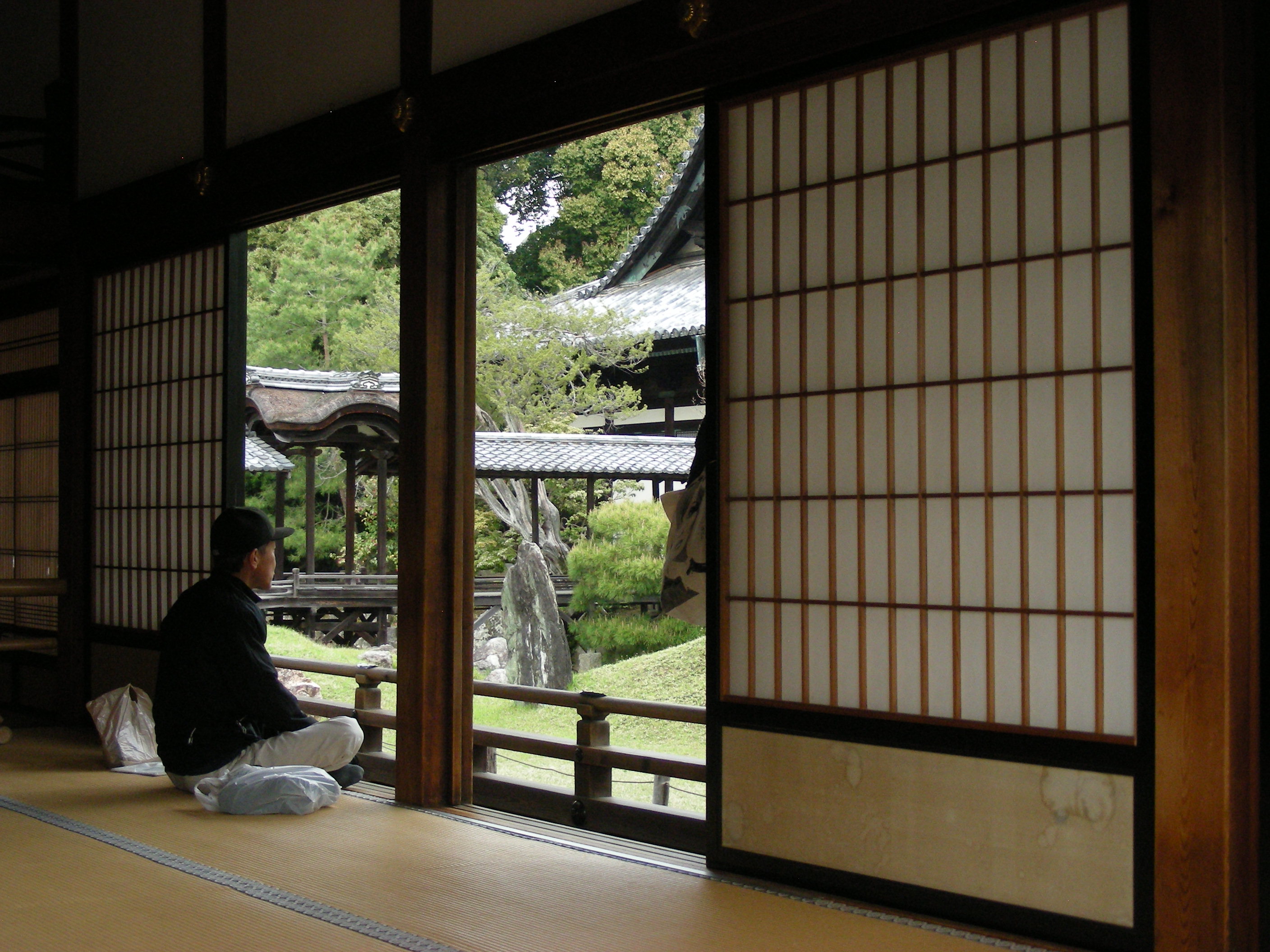
This un-asked for, and, frankly, pretty unwelcome, pause, is a real opportunity for both awareness and change. You don’t need to have a meditation space, like the man in this photo, to do that, but maybe there’s something inspiring in this image anyway? Maybe it would be good to create, if possible, a place, a space, which we find is conducive to contemplation and reflection? Or maybe we can do that wherever we are?

That’s the inner – this is an opportunity to develop our inner selves – to pay some more attention to our physical and mental health and our lifestyles. To become aware of our habits of thought and feeling and ask ourselves if we want to develop along different paths now.

The second is about what we call “Nature”. You know, I’m a bit uncomfortable about talking about “Nature” as if Nature is a thing, and more than that, as if “it” is a “thing” “out there”. We are part of Nature, not apart from Nature. But then, we’ve sort of forgotten that, as a species, and maybe that’s one of the problems which has brought us to this pandemic. So, maybe this is a great time to reconnect, to re-engage, to re-orientate ourselves with regard to the “natural world”.

I’ve found that noticing the cycles of the flowers, the vegetables, and the trees, has become something I am much more aware of now. I’ve found that I’ve noticed many more species of birds in the garden. I’ve noticed that when I’ve had the chance a walk in vineyards, in amongst some trees, or along a sandy beach on the Atlantic coast, then I feel a huge boost. That shouldn’t be a surprise. I’ve written before about the recognised benefits of spending time in the natural world – to the extent that some people now talk about “Nature Therapy“.

There is something truly life enhancing about becoming more aware and more engaged with “the natural world” and from “forest bathing” to spending time in open spaces we know that such activities boost the chemicals in our bodies and minds which influence our immune system, our moods and our thought patterns.

So, connecting better to the “outer” enhances the “inner”.

Again, you don’t need a beautiful Japanese garden like the one in this photo, (although, isn’t that gorgeous?) – but I recommend taking advantage of this time and space to develop your inner self, and your connected self, by grabbing or creating every opportunity you can get to do so.

Contemplation and Engagement with the Natural World.

Read Full Post »

In many ways this is a very simple photograph. What do you see?

Having ignored the “rule of thirds” in my composition, I’ve put the cherry blossom bang, smack in the centre of the image. It’s literally right in front of your eyes. It’d be pretty hard to respond to the question “what do you see?” without referring to the cherry blossom, don’t you think.

But I’ve long since had a fascination for appreciating the whole over the parts, and in this photo, I think it’s equally difficult to ignore the presence of the “background” – the bamboo – even though I’ve blurred that background for the purposes of contrast.

When I look at this I definitely see “cherry blossom in front of a bamboo forest” – well, I was there at the time, and I remember that. You might not be aware that the bamboo is part of a whole bamboo forest, but you can certainly see bamboo stretching in all four directions to every edge of the image.

This insistence on seeing both the foreground AND the background to have full appreciation of the scene, is consistent with my desire to always take into consideration contexts and environment when I encounter anything. For example, in my work as a doctor, a patient would “present” to me their symptoms, and with my knowledge, plus any relevant physical examination, and, if necessary imaging or tests, then I would make a diagnosis – probably the diagnosis of a “disease”. A “pathology”. But that was never enough. I had to see the presence of this foregrounded disease in the context of the backgrounded personal life story. I had to “situate” the disease into the time, place and meaning of this individual’s life. If I wanted to understand, not just the “illness” as the whole experience of the patient, but how it came about, what impact it is having, and how it might change this person’s perception of themselves and their life, then I had to see them “whole”, not limit my focus to the the “presenting” parts.

I think this same principle applies throughout the whole of life. If I want to understand anything about my life, about others, about this planet we all live on, then I need to see the “whole”. It’s not good enough to reduce reality to a data set, a package of characteristics and elements. I always need to consider the connections, the relationships, the contexts and the multiple layers of environment and meaning. I know that doesn’t sound as quick and easy as focusing just on a part or two, but, hey, who said reality could ever be reduced to what was quick and simple without losing all understanding? Not me.

Read Full Post »

Apparently we are the only creatures on the planet to create works of art. I know, you’ll have seen some painting done by a chimpanzee or an elephant, but they aren’t exactly spontaneous acts of self expression or interpretation are they? No, Art is something unique to being human. There are many examples of “wall art” or “cave art” in France, discovered in recent years but painted some tens of thousands of years ago. It seems that even way back when our ancestors were nomadic hunter gatherers supposedly spending most of their days on the survival needs of food, water and shelter, they still had time to create astonishingly complex art, and, for some reason, often carried them out in the most difficult locations deep underground.

I’m using the term “art” here as broadly as I can, but I mean the kind of art which included drawing and painting. I’m not excluding the fabulous arts of sculpture, of music, of storytelling, poetry, dance, and so on, but, for today, I’m focused on visual art.

For me, Art is an experience. I don’t regard Art as an object, or a collection of objects. It’s an event. It’s an engagement. It’s a moment where we connect to what is greater than ourselves. It stirs our emotions, sparks our imaginations, and stimulates our empathy……we connect to the artist and/or the world as experienced by that artist.

Every work of art was created in a particular place at a particular time, and I mean that not just in the externals of geography and history, but in the internals of a personal life story, an individual, subjective, lived experience. So when we encounter that work of art at some other time, in some other place, we experience a (sometimes) powerful connection with the artist, with the life of the artist. I put “sometimes” in brackets there because it’s certainly not the case that all art has a powerful effect, and I’m not even clear about what it is that makes the difference. I do know, however, that the power of art is dependant on both the person creating the art, and the person experiencing it.

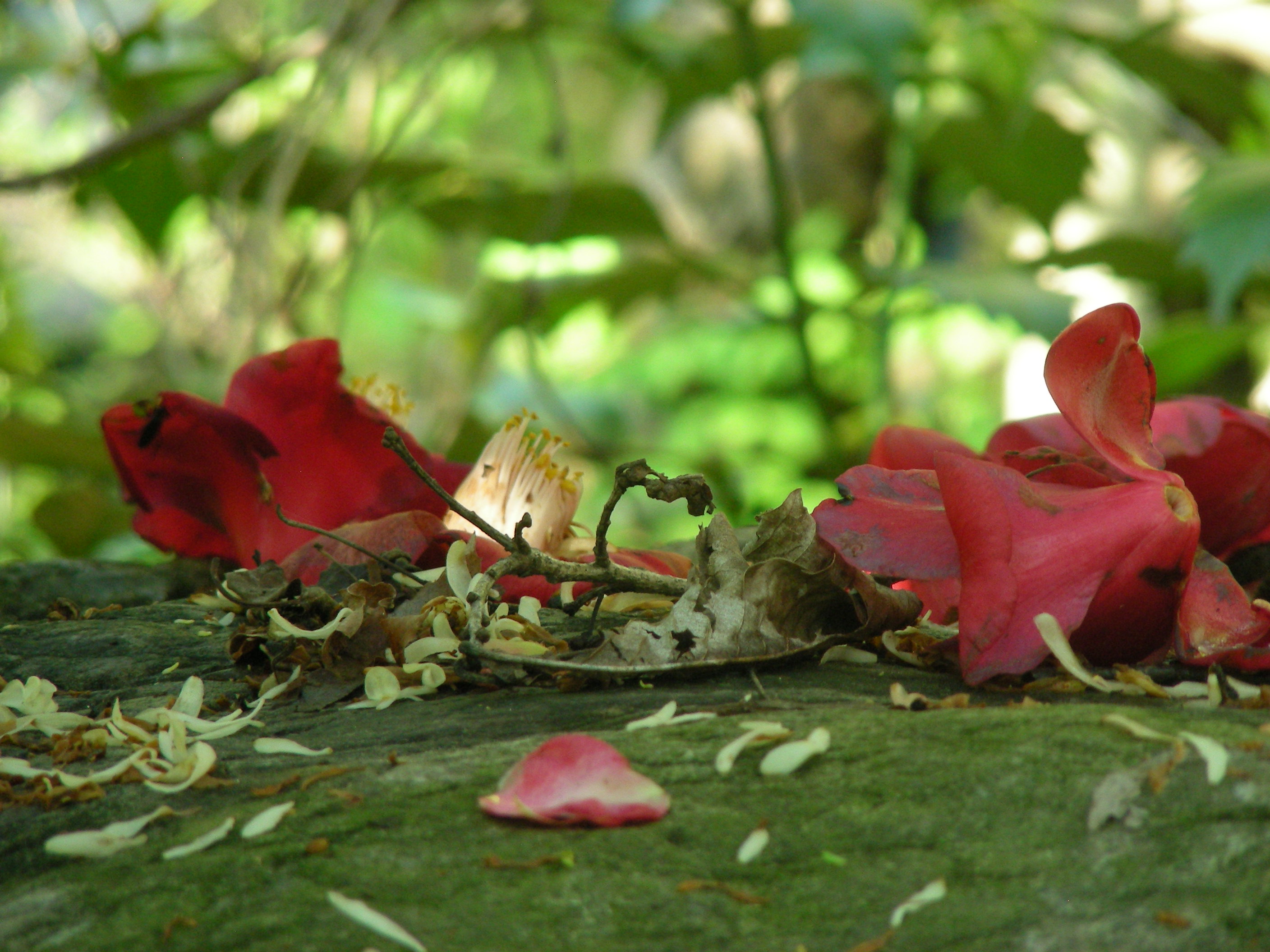
All this came to mind when I looked at this old photo I took in Japan many years ago. It just looks like a work of art to me. It reminds me of the classic traditions of “Still Life” (which I find such an odd term because no life is still), or, as it is called in French “Nature Morte” (which translates as “Dead Nature” – nope, can’t say I like that any better!). The twig, the leaf, the petals and the stone all look as if they have been arranged in the most beautiful way.

But here’s the thing….I don’t think this was created by human hands. I just stumbled upon some fallen parts of plants, lying on a stone in a garden, crouched down, framed it, and took this shot. OK, so maybe I’m the artist. Maybe the work of art is the photograph. But what I mean is that so much of everyday Nature looks like a work of Art. Creation, the cycles of birth and death, the seasons and the weather, the light, the water and the air, the myriad of diverse lifeforms everywhere, all adds up to an infinite number of opportunities to encounter deeply moving Art.

Because this moves me, this image. Yes, I know, I have a set of memories connected the to event of taking the photograph, which you don’t have, but there’s something about the colours, shapes and nature of the elements in this arrangement which I find deeply moving……which stir in me, memory, imagination and wonder, which provokes joy and delight, which makes me amazed to be alive in this, this most astonishing, small blue planet, we call Earth.

In an image like this, the artist I connect to is Planet Earth.

Read Full Post »

« Newer Posts - Older Posts »