Feeds:
Posts
Comments

Archive for the ‘photography’ Category

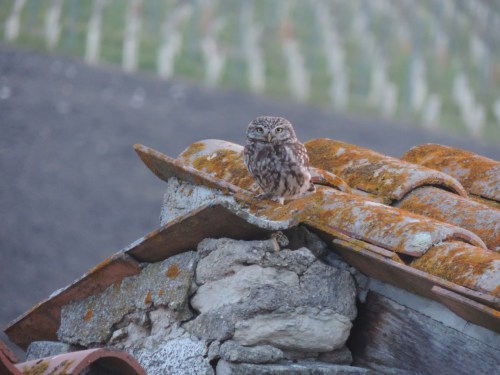
This year a new bird has taken up residence in a neighbour’s barn. He’s a “Little Owl”, and, yes, that’s his common name. His scientific name is “Athene noctua”. The “Athene” part goes right back to the belief that this owl had a special connection with Athena, and the “noctua” part comes from the Latin for “Minerva”, who was the Roman equivalent of Athena. As such, this little creature has long been held to represent wisdom and knowledge…..pretty much just what we need more of in our world.

I’ve watched him come and go and the other day there noticed he wasn’t alone. Seems he and his mate have a nest up high behind the roof beams at the back of the barn. He’s a pretty wary creature though so it’s been hard to get a decent photo. However, yesterday, looking out of the window of my study, I could see him sitting on a nearby roof. I slowly raised my camera to my eye, taking care not to make any sudden movements which might attract his attention, even though I was inside my house, and he was outside on the roof. I zoomed in, focused, and pressed the button. I can’t say I really clearly saw what I was getting a picture of, but when I uploaded it to my computer I realised he had totally clocked me.

He is looking directly at me!

How does one living creature possess that knowledge? How do we know that we are being looked at? I bet you’ve had an experience where you are sitting reading a book or having a coffee and, suddenly, you become aware that someone is looking your way. You look up, catch their eyes, and they either hold their gaze, or, more commonly, quickly look away.  I’ve often wondered how that works. What are we picking up? It’s not about casting our eyes around the world and just noticing someone else’s direction of gaze. We seem to be able to detect something, and it also seems this is a talent which is not exclusive to human beings.

This isn’t the first time I’ve had this experience with an animal. Here’s a photo I took one Spring day when the first lambs were in the fields.
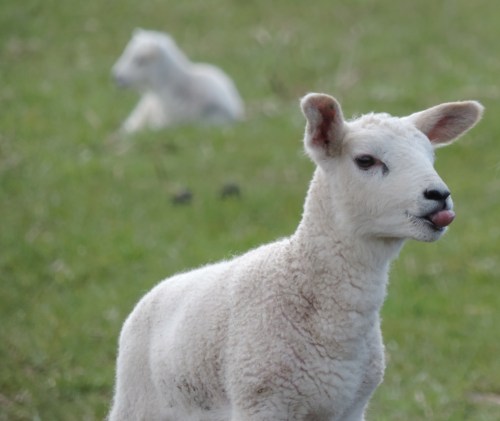
Tell me this little one hadn’t clocked me!
 

Read Full Post »

Quite a lot of people, me included, are saying this pandemic is throwing a light on certain things – how fragile our systems of health care and social care, how poor the safety nets are, how interconnected the world is, how the instincts to collaborate and connect are so strong in human beings, how much we humans move around the Earth……[add you own here]

But today I stumbled across some old photos of reflections and I realised that the reflections are a different sort of light.

A direct light brightens and maybe even makes more clear the object it is shining on. That’s useful. Though it immediately brings to my mind that question I have about Scandi-noir crime drama – why does the (usually female) detective always go down into the basement or the abandoned warehouse at night, all alone, with just a torch to light up little bits of the room? Well, I suspect I know the answer to that one already.

Reflections are different.

They turn things upside down.

They give us an unusual and different take on reality, which lets us see beyond what the light is illuminating.

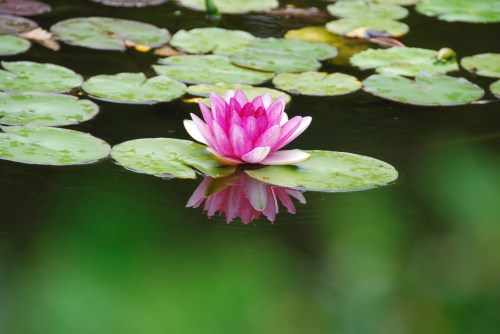
Look at this one, for example –

lily leaves on a still pond which is reflecting the blue sky and some clouds.

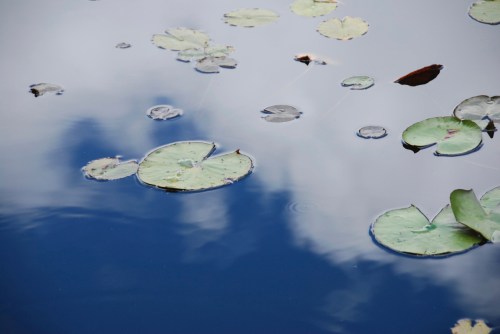
Or this one –

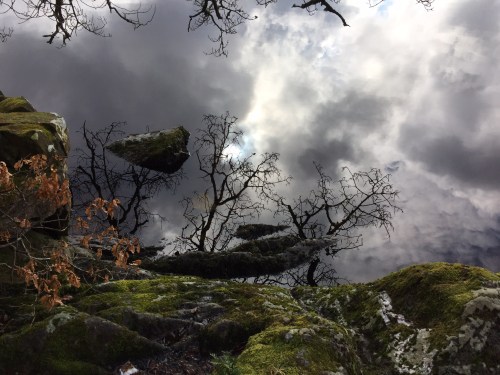
the edge of a Scottish loch where the still water is reflecting the clouds

Or, this one –

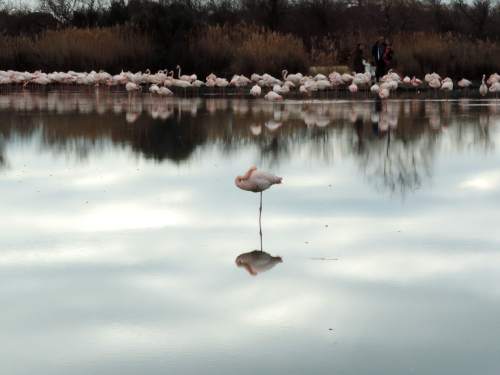
the solitary flamingo doubled by the water’s surface

In all these cases the reflection does something special I think.

It literally turns something upside down which immediately makes us look more carefully.

It changes our perspective whilst keeping our default one. In other words, it increases our perception and understanding by doubling our perspectives.

It shows us connections we were happy to ignore as long as we focused solely on the central subject. It connects the sky to the water, the water in the clouds to the water in the loch, for example, reminding us of these cycles and links and interconnections which are the most fundamental characteristic of Nature.

It increases our experience of beauty. Each of these photos could have been beautiful without the reflections, but I think that including the reflections make them exponentially more beautiful.

All of which brings me to my main thought today – shining a light on something helps us to understand it, promotes analysis and clarifies what has been obscure or forgotten. Reflecting adds in something completely different – it promotes our perception and understanding by changing our perspective, highlighting the connections, and increasing our senses of wonder and delight.

“And not or” is my moto – analyse and reflect. Actually, as I write that sentence I’m reminded of Iain McGilchrist’s Divided Brain thesis and how the left cerebral hemisphere is great for zooming in, analysing and cataloguing, while the right seeks out the connections, the specific and the unique.


Read Full Post »

There’s no doubt this is a very challenging time for very many people. This pandemic is shining a bright light on many problems which we’ve collectively tolerated or ignored.

For me, perhaps THE most impressive feature of this crisis is how human beings are connecting and caring about each other. I know, you might think that’s an odd thing to say when we are all being told to “self-isolate” and practice “social distancing”, (I don’t like either of these phrases, preferring “physical distancing” for the latter, and “sheltering” for the former) but you’ll have seen people on balconies singing, shouting to each other, clapping to salute the health care workers. You’ll have seen people offering their talents and creativity online with free lessons, concerts, publications. You’ll have seen hundreds of thousands of people volunteering to make sure neighbours are safe and nourished. You’ll have seen health care workers, drivers, emergency workers, people who work in the food production and supply chain, and many, many others giving 100% to keep others safe, to heal, to nourish, to support.

You’ll have seen that scientists and researchers around the world are publishing and sharing their work freely and widely without barriers between nations and peoples. We human beings are absolutely brilliant at learning from each other.

We all live on the shoulders of giants.

There is an outpouring of love, of care, and of compassion. Maybe more on a global scale than I’ve seen at any other time in my life.

I’m not naive. I know there’s a lot of evil, cruelty, injustice and selfishness too. But I just want to a take a moment today to celebrate our human ability to make connections, to care, to love, to learn from each other, and to collaborate.

I hope we build the next phase of our lives together on those principles.

Read Full Post »

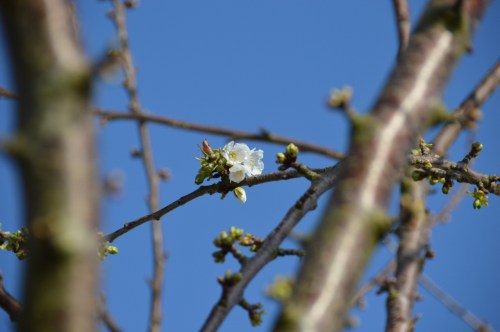
The first cherry blossom appeared in the garden this week. I love this time of year when the bare, sleeping trees, awaken, produce buds and start to unfurl both flowers and leaves. It’s surely one of the most powerful phases of the annual cycle of nature.

There’s a wild plum tree in the corner of the vineyard next to the garden and this week, it too, has started to produce its blossom. Every day when I step outside I look at these two trees, one to my left, and one to my right, and each time I look I see more flowers. It never ceases to amaze me and it never passes me by.

I think a lot can pass us by in life. Either because we are too busy (occupied) or too distracted (pre-occupied). That’s one of the reasons why I love the appearance of the blossom. We are sensitive to change and so it’s hard not to notice that these two trees look different every day just now. When there isn’t such obvious change we sort of tune things out, don’t we? We stop noticing because it’s all so familiar.

Well with this pandemic we’re all noticing change now, aren’t we? (Maybe not all of us, we’re still seeing footage of crowds of people carrying on as if nothing is any different) So, maybe that’s one way for us to get something positive out of this crisis……maybe it’ll help us to wake up, to reflect, to notice and to wonder.

If you’re living in one of the countries which is restricting movements and everyday activities you’ll have a bit more time on your hands now as well. I’ve seen lots of articles online about how to fill the time, how to avoid boredom. There are loads of articles about movie and long form fiction streaming services, ebooks, virtual museum tours, live concerts online and so on.

There’s another opportunity which comes with this time of waking up, noticing and finding more time on our hands….it’s the opportunity to ask ourselves about priorities and meaning. How am I living my life these days? Is there anything I’d like to change? Do some things seem less important now, and others way more important than we had realised?

We have the opportunity to that collectively too. This is a time to create, to invent, to have new ideas, and to share them. This is a time to put out into the world the behaviours we want to see more of….to love more, to care more, to share more, to tip the scales back from quantities to qualities. It’s a time to think and talk about what kind of societies we have and how we want to share this one small planet with each other and all the other creatures which live here.

Is it a time to shift the balance from competition and selfishness to co-operation and compassion?

I think it could be.

What might we begin to see blossoming if we started to make some of these changes in our lives?

Read Full Post »

With all the “social distancing” that is going on, and being urged upon us, I thought it might help to remember this line from Saint Exupery’s “The Little Prince” –

The important things in life you cannot see with your eyes, only with your heart.

I don’t really like the term “social distancing” because I think we need each other now more than ever.

What’s important during this pandemic is to reduce the time you spend in the same physical space as other people. The more physical contacts you have, the more chance you will catch this virus and spread it to other people. A French official put it well the other day when he said – don’t think how can I avoid catching this, think how can I avoid spreading it to everyone else?

I think that’s a useful flip because people spread this virus without having any symptoms, and while, chances are if YOU get this virus then it won’t be serious, for about one in every five people it will be. Reducing your physical contacts now is the most caring thing you can do.

But that does NOT mean to minimise your relationships.

More than ever this is a good time to tell the people you love, that you love them.

Now more than ever this is a good time to share…..to share thoughts, to share feelings, to share our stories.

We humans are perhaps THE most social of all creatures. We die without social contact. So let’s pay attention to that and increase our communications. Phone more, text more, FaceTime, or Skype more, blog more, instagram more, WhatsApp more…….whatever means you have at  your fingertips use them now.

Have you seen any of the video clips online of Italians or Spaniards on their balconies? Singing, cheering, banging pots and pans…….all saying “we are here, and we are in this together”.

As we minimise our physical contacts for now, let’s over-compensate for that, by increasing our “invisible” ones, the ones we can see only with our hearts.


Read Full Post »

Before the Mulberry tree in my garden gets its leaves each year it casts wonderful shadows on the grass. I was thinking about them when I started to read the book “Penser comme un arbe” (Think like a tree) by Jacques Tassin. He starts out by setting the evolutionary scene where we humans evolved in the trees and reflects on how much the human body is constructed using tree-like patterns. Like the one you can see in this shadow. Our circulatory system which carries the blood all around our body branches and branches just like this, splitting into ever smaller arteries and capillaries, then coming back together the way a river gathers all the streams which feed it, along ever bigger veins until it connects the blood to the heart and the lungs again.

Our lungs are like this. Branching first into left and right, then into the different lobes, down the bronchi and bronchioles to open out like bunches of grapes in the alveoli.

Trees are the lungs of the Earth, cleaning the air of pollutants, gathering up CO2 and emitting Oxygen. Interesting to think of the respiration of a person and the respiration of the planet using similar patterned structures (OK, up to a point, the trees don’t have lobes and alveoli, but their leaves provide the maximum contact with the air, just as our alveoli do that job too.)

Our lymphatic system, so crucial to our body defences uses the same “arboreal” pattern, just like the circulatory system.

Our nervous system too, with the continuously branching structures of nerves and the way each neurone in the brain reaches out to contact thousands of others.

There is something magical about our relationship with trees, isn’t there? It really does us good to be amongst them, to look at them, to contemplate them, to smell and touch them. The Japanese “forest bathing” has been studied to show the beneficial effects on our immune systems of substances emitted by the trees in the forest.

Jacques Tassin talks about studies which show the beneficial effect on children with ADHD of spending some time in the forest, and, perhaps even more surprising, the calming effects on the heart rates of people contemplating images of trees…..in other words, we get a benefit from just looking at them, even when we can’t be physically present with them.

So, I thought I’d share a few photos I took in a Cedar Forest just north of Aix en Provence.

Enjoy!

Finally, look at the tree right in the middle of this shot. The sign by the path was labelled “Candelabra Tree”.

Do you have any favourite trees?

Read Full Post »

It’s so many years since I read The Tibetan Book of Living and Dying that I can’t remember how old I was at the time, but the concept of the “bardo” really struck me and stayed with me ever since.

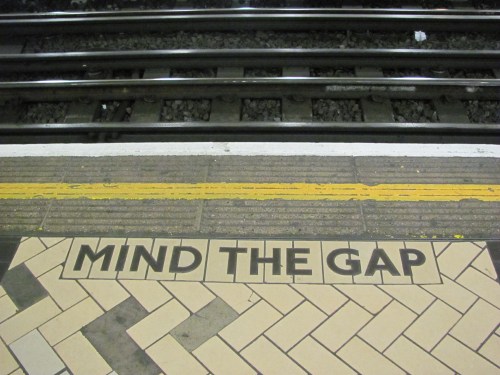
The bardo is the gap (if I understand it correctly). It’s the gap between the in breath and the out breath. Do you ever notice that gap? Try it. Don’t try to change it, just try to notice it.

Then, here’s something harder, try to notice the gap between two thoughts.

Have you ever noticed how thinking is so incessant?? How our minds constantly run from worry to worry to memory to concern to plans to, just, well, thinking…….it’s like it never stops. But no single thought goes on for ever does it? So they all must have a beginning and an end, just like stories do. Is there any space in between? Are their any periods at the ends of your thoughts, or has all the punctuation disappeared?

This time, this time of Coronavirus, is, for many of us, a bardo.

I live in the Charente region of France. Since Tuesday midday daily life has tangibly changed. All the cafes, bars, restaurants, cinemas, theatres, have closed. All shops apart from “essential” shops, have closed. Nobody is allowed the leave the house without a signed form, an “attestation”, stating why you are going out – and it has to be one of the limited, allowed reasons.

It sounds like Sunday around here.

Sundays near my house have always had a deep quietness. You know how you can tell it’s snowed before you look outside? Because the snow damps down all the sounds? Well, it’s sort of like that, but different……it’s an absence of most of the sounds of human activity. It’s been sounding like that every day since Tuesday. I guess we’re in for a “month of Sundays”. It’ll be a blue moon next!

This bardo, this pause, this suspension of the routine is waking us up to a lot of things. Or, at least, it’s giving us the opportunity to waken up to them. It’s giving us the opportunity to reassess what is important to us. And one of those things is love and connection. Have you seen any of the videos of Italians or Spanish people out on their balconies in the cities? Clapping, singing, making a noise together? We need to be connected. We are intensely social creatures. OK, maybe a lot of that has to shift online just now, because we are confined to our houses, but it still strengthens the importance of our relationships.

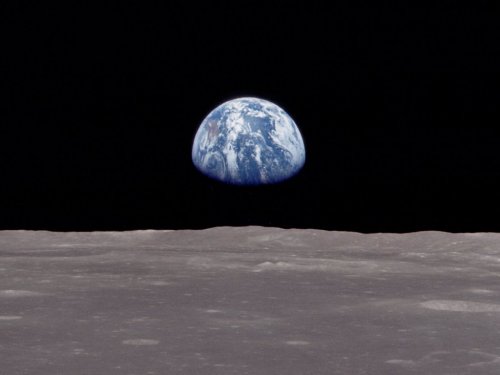
It does something else too. It shows us that we really do live on the one, single planet. Remember the “blue marble” image?

There are no real borders.

There are no real boundaries.

We humans just make them up.

We are connected. We breathe the same air, drink the same water, eat food grown in the same soil.

Maybe it’s time to think again about how we do that.

Of course, I understand, that this is not a bardo for everyone. The health care workers in particular are facing and already dealing with exhausting, increasingly demanding challenges. But maybe that too can be a lesson learned. Maybe we should pay health care workers more than we pay footballers, bankers and “celebrities” for example? And there are plenty of other people working hard to keep us fed and safe too.

Maybe it’s time to change the system, away from grab and hoard to valuing, savouring, caring and sharing?

Hey, there’s plenty to think about……just –


Read Full Post »

When I took this photo I was attracted to the white flowers, but when I looked at it on my computer it seemed to me that the white flower in the middle of the shot had turned into a butterfly.

When I looked closer, it hadn’t.

But like some of those optical illusions, once you’ve seen it, you can’t unsee it! So, now whenever I look at this image the first thing I see is a white butterfly, which transforms itself before my eyes into a flower. Given that perhaps one of the key characteristics of butterflies is transformation, that seems strangely appropriate.

OK, I know butterflies don’t transform into flowers, or vice versa. Well, not directly anyway. (You could argue that everything which exists on Earth is made from the same atoms which have made everything else) However, just seeing that has taken this image to a new level for me.

In a few short moments I can let my mind follow the path of a butterfly, its eggs, its caterpillar stage, its chrysalis, and on to a new butterfly. And I can let my mind follow the path of the flower, the insects which come seeking sweetness, the pollen spreading, the new seeds forming and scattering, a green plant shooting up through the dark earth, and a new flower stretching out its petals under the warmth and light of the Sun.

And it all seems WHOLE. I see an intertwining of Nature’s cycles and rhythms unfolding before my mind’s eye.

I hope you can too.

Read Full Post »

I took this photo recently when visiting the Caumont gallery in Aix en Provence (before France closed down!).

I was attracted to the light shapes on the wall of the building opposite. The one on the right looks like a cocktail glass, but the other two are vaguely like kanji – which, given that the gallery had a special show of Japanese prints, is highly likely!

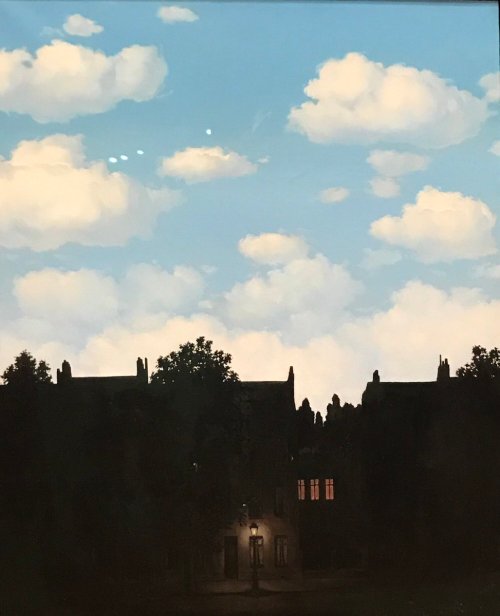
When I look at the photo now I’m reminded of two things – a famous painting by Magritte

And, a photo I took in the New Carlsberg Museum in Copenhagen of ancient biblical scripts written in Aramaic and found in Palmyra.

The room with the scripts showed the letters projected across the images on the walls as a soundtrack played of someone speaking words in Aramaic from the book of Genesis. That was one of those moments where the hairs on my arms stood up on end and my eyes got watery.

I have long since had a love of words. I have hundreds of books. I read all the time, often several books at once. I love stories and I am insatiably curious. When I qualified as a doctor I bought a complete set of Encyclopaedia Britannica with my first month’s salary. I know wikipedia might have surpassed that now but I can still get the thrill of serendipity by leafing through its pages and falling down a knowledge rabbit hole. At work I looked forward to every Monday morning because I knew it was the start of a week where patients would come and tell me their stories. Every single one of them unique.

I taught in Japan at one point and tried to learn a little Japanese. I didn’t get very far but I am still enthralled by their three alphabets – yes THREE! I chose to emigrate from Scotland to France when I retired to have the experience of living in another language and I’ve got a little collection of favourite French words for which I can’t find any direct English translations, or where the English translation feel somewhat inadequate. I love that. (Emerveillement would be my first example!) I’ve also been trying to teach myself Spanish over this last year, just because I’ve discovered Spain since moving to South West France, and have had a number of fabulous road trips there (I’m using the Duolingo app).

Words, and stories.

I’m also quite an avid reader of poetry, and I recently heard a fantastic interview with the American poet laureate, Tracy K Smith, on Ezra Klein’s podcast. Highly recommended!

With more and more of us having to put our normal lives on hold and stay at home I think this is a great opportunity to explore more books, more poems, more stories, words and art. Are you finding that too?

Read Full Post »

There’s one thing this pandemic is showing us – we all share the same world.

We all live in this Earth together. What begins in one place quickly affects all the other places.

This infection will run its course, and it will fade away, but I think it’s pretty likely there will be other episodes like this.

Modern medicine often boasts of its success in conquering bacteria. With the invention of antibiotics we had begun to focus on “non-communicable” diseases instead – heart disease, cancer and so on. But we never really had the equivalent of antibiotics for viruses. We have some (as in HIV treatment for example) but we still can’t treat the vast majority of viruses. Maybe one day we will have the treatments. But look what’s happened with antibiotics….. because we’ve been misusing antibiotics in farming and in treating viral diseases which don’t respond to antibiotics, they are losing their power. We need a different model of health care.

Is there a Health Service in the world which has enough resiliency and adaptability built in to cope with these waves of illness? It doesn’t look like it, though it was pretty amazing to see the Chinese building whole hospitals in six weeks. For most of the world these services are run on a bare minimum (or below) basis. The truth is we don’t have enough doctors, enough nurses, enough hospital beds, enough equipment. And that’s what this particular virus is revealing. Although only a small minority of people will get seriously sick with it, the actual numbers overwhelm the hospitals and services very quickly. And once they get overwhelmed then everyone who gets ill loses out.

This pandemic is revealing other things too – it’s not only health care which is threadbare and inadequate. From the globalised “supply chains” of goods, to the daily vulnerability of workers, families and small businesses, resilience and adaptability are seriously  lacking.

I know that for now the priority is to try to slow the spread of this virus and to treat and care for as many of the sick as possible, but soon it will be time to ask ourselves what we can do to make a better world.

  • What are we going to have to do to adapt?
  • What can we do to be more resilient?
  • How can we look after each other better?
  • What should we change?

How about we explore these questions together in the days and weeks ahead?

Meantime……from midday today I’m in lockdown here in the Charente. France has closed all the bars, cafes, restaurants and all “non-essential” shops, and now it’s quarantined most of us in our houses. I’m not afraid but life is not going to be “normal” for a long time. So, here’s one thing I can do – share my beautiful photos, my daily “émerveillement”, and my caring heart more often.

I’ll be posting more regularly from today.

Read Full Post »

« Newer Posts - Older Posts »