Feeds:
Posts
Comments

Archive for the ‘photography’ Category

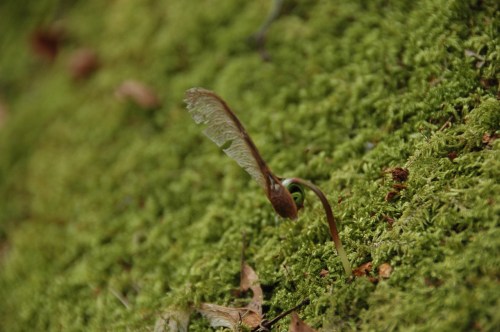
You know these seeds which helicopter down from the trees? Strangely one-winged and decidedly “wonky” looking?

Well, maybe humans wanting to make something which would be carried on the wind wouldn’t design it like this, but, hey, Nature’s designs are the best!

So, sometime, maybe last autumn, this little seed spirals its way from a tree, who knows which tree, and tumbles and flies and skips and zigzags its way through the air, to land here, on the forest floor. Then, a few months later, who knows how it knows, it wakes up, yawns and starts to stretch, feeling that Spring is around the corner.

And look at it now!

Out of the pod uncoils a long stem, probing down through the moss to find nutrients, and begin to grow itself into a tree!

I mean, do you ever stop and consider something like this?

Have you any idea how it happens?

We can’t even tell if an individual seed is alive or not, is viable or not, until it wakes up and begins to develop. Isn’t that incredible? That we can’t even tell if it alive or dead? Nobody can.

Then how do the cells start to divide and “differentiate”? That means start to develop into the different cells which will produce all the different parts of the tree.

One of my most favourite and most memorable lecturers at Edinburgh University was the Professor of Anatomy, Professor Romanes. He used to start a lecture with a box of coloured chalks and one of those giant rotating blackboards which gave you one screen after another. By the time he finished he’d produced what were no less than works of art showing each different kind of cell, each different kind of tissue, in a different colour. We were transfixed.

He gave a series of lectures on embryology taking us through the various stages of development of a foetus from a fertilised egg cell to a ready to be born baby. I remember thinking at the time, and those thoughts are still with me, “how on earth does that happen?”

I mean, how on earth does a single fertilised cell divide and multiply and differentiate to produce all the organs, all the tissues, all the parts of a human body, and every one of them in the “right” place?

It utterly amazed me.

It still does.


Read Full Post »

This is a photo I took while travelling to the north of Scotland a few years ago.

Both the dark foreground of the land and the foreboding rain-filled clouds in the sky could make a scene like this oppressive.

If both what’s right at our feet and right above our heads is gloomy and threatening it’s hard to stay positive and calm.

But look! That’s not all there is to this scene. There’s the crack in the clouds, the long strip of bright silvery light with sunbeams pouring down onto the water and making it glow. The water surface dazzles like the Sun itself.

Beyond the light a whole palette of colours emerge in the sky, shade after shade of blue.

In a bright blue sky, none of this would be visible.

In a completely overcast sky, none of this would be visible.

This is life, this is the world we live in.

There is always foreboding and darkness, and there is always hope and light.

The incredible thing is, they are often here at exactly the same time and place.

Read Full Post »

We humans are great at spotting patterns. We join things up, put features together, make connections to create and see forms, structures and behaviours. We’ve done it for centuries, gazing up into the night sky and joining the dots with invisible lines to make constellations which we can find, follow and associate with time and place. We’ve used that skill to navigate, to know when to sow and when to harvest, to find our place in this world and to wonder and dream about the infinite universe.

There’s one particular kind of pattern that we are really, really good at spotting – a face.

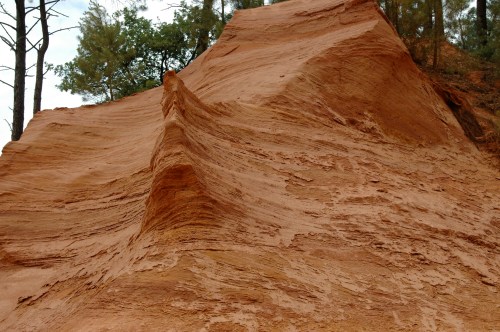
We have a whole area of the brain dedicated to spotting and recognising faces. We see them……even where there aren’t any human beings! Like in the ochre forest outside Roussillon in the South of France. As I wandered around it, I saw faces everywhere. Do you see them too?

Read Full Post »

Coronavirus, epidemic, pandemic, deaths, school closures, travel bans, hospitals overloaded, patients in the corridors, floods, fires, plagues of locusts, hurricanes, tornados, earthquakes, snowstorms, climate change, immigration, deportation, walls, cancer…….

It’s not hard to make a list of threats, to find things to be afraid of.

Every headline screams – be afraid, be very afraid!

“Prepare for the worst and hope for the best”

Sounds good advice, huh? Said this way around the first thing to do is focus on the worst, then once you’ve done that you might get around to dragging up a bit of hope. Said the other way around you hope first, but what you do, what actions you take, are determined by imagining the worst.

Is this a good way to live?

Imagining the worst every day? Feeling fear every day? Feeling anxiety every day?

Maybe not, huh, but isn’t it just common sense? Isn’t it just “sensible”?

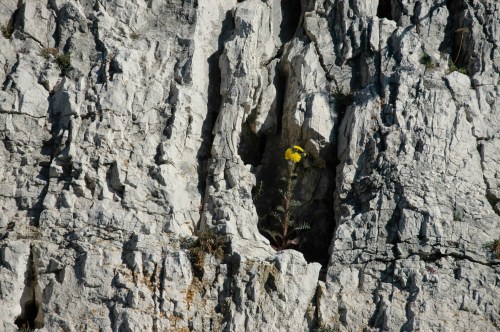
One day I was out walking along the Mediterranean coast and I looked up at this immense grey rocky cliff and a patch of yellow caught my eye. I zoomed in with my telephoto lens and took this photo. Wow! Look at this single, beautiful yellow flower. I was about to write “delicate, little flower” there but stopped myself because “delicate”?? I don’t think so. How did that little seed, blown there by the wind, or dropped by a bird, find enough to sustain it, enough to keep it alive, enough to make it burst out of its shell and stand tall and reach for the yellow sun and spread its petals to say to the world “Here I am” “I am alive”.

People die without hope. I’ve seen it. Many times.

If my mind is flooded with daily fears, if my thoughts swim in an ocean of dread, what kind of day is it going to be today? What kind of life will I experience? And what if this is “my one wild and precious life“? Is this how I want to spend it?

What’s the alternative?

Denial? Delusion? Escapism? I suppose so…..but I think there are better options –

“Hope for the best, and adapt”

If we start the day with hope, make our plans based on hope, then we set off positively. If obstacles appear, accidents happen, luck runs out, then we can adapt. I used to commute from Stirling to Glasgow on the train every day to go to work. I never set off thinking “maybe I won’t get there”. I never went to Queen Street Station after work thinking “maybe I won’t get home”. I never planned for the worst, then got round to trying to hope all the dreadful things wouldn’t happen.

Well, I didn’t always get there, and I didn’t always get home. One day the G8 Summit was held in Gleneagles. The authorities closed Stirling down. No trains. No buses. Motorways blocked. I didn’t get to work that day. One day at work it started to snow. It snowed and it snowed and it snowed. By the time I finished work there were no trains leaving Glasgow. The buses were all full, then there were no more buses because the motorway was blocked. I found a hotel room using my smartphone, stayed the night, and next morning, stopped off in Marks and Spencer for a new shirt on my way to work.

Many, many times, trains were cancelled or ran late. Many times the train would stop in the middle of the countryside for half an hour, or an hour, or sometimes, even longer. The journey wasn’t always as straightforward as it should have been. But I still never set off thinking “maybe I won’t get there”.

So that’s one way……

“Hope for the best, and adapt”

Here’s another –

“Look for the good and adapt”

This isn’t quite the same because it isn’t based on a starting point of hope. It starts with an intention. An intention to seek, to be curious, to be on the look out for what delights, and what amazes. To find “L’émerveillement du quotidien“. Because it’s always there. There will always be beauty to discover, music to excite or delight, scents and flavours to savour, textures to relish. There will always be acts of kindness, acts of courage and acts of love. You can see that all the time. In how many terrorist attacks do we see the cruelty of one person, followed by the courage, kindness and love of many, many others.

What if every day I look for the good, and when obstacles, accidents, infections, bad luck come my way, I find a way to adapt?

I look at that flower, flourishing (because that’s what flowers do, isn’t it, they flourish?) in what looks like barren adversity, and I think, well, that’s amazing, that’s beautiful, that’s life.


Read Full Post »
I’m writing a book just now about “and not or”.

“And not or” is a concept I’ve been exploring for some time and I thought it was time to start writing down some of my discoveries more systematically because I thought that would help me to think and, hopefully, take my understanding to a new level. Well, I’m in the midst of all that and, so far, what I can is…..I’m really enjoying it! Hey, that strikes me as a pretty good reason to write….to enjoy it. When I say I enjoy it, I don’t just mean it is pleasurable. I mean I feel it adds value to my life and helps me to make more sense of it. It’s fulfilling.

I’ve also been browsing through some old digital photo libraries of mine and re-discovering images I haven’t thought about for years. I think that because I’m so immersed in the “and not or” idea of my book that I’ve developed a different perspective from the one I had when I took these photos, so now I contemplate them through that new lens. I think this particular image is a good example of that.

What do I see when I look at this photo?

I see two hills. One is dark and the other light. I immediately think of the yin yang symbol, with its dark half and its light half. Isn’t that pleasing? To see BOTH the dark and the light hills in the same scene?

I see the reflections of the two hills in the astonishingly calm surface of the loch. Clear, clear reflections, one dark and one light. Isn’t it delightful to see the objects and their reflections in the same scene? I think of the connections between the conscious and unconscious parts of our minds. How what lies below our consciousness, emerges into consciousness as a kind of reflection, at night, in dreams, and in the waking hours, in our emotions and thoughts.

I see within the reflections two boats. A black boat with a light cabin in the middle of the reflected dark hill, and a white boat in the reflected image of the light hill. Each boat has its own beautiful mirror image beneath it in the water. This symmetry of reflections reminds me of the fractal nature of the universe, with patterns and images cascading through time and space.

I see brightly lit sky and heavy rain-laden clouds above the loch, and I see the dark shoreline, grassy, and mossy and earthy, in the foreground. I love this spread of earth, water, air and light and this one image.

I see the activities of humans, the little boats, some for fishing, some for pleasure, and the machinery on the raft in the middle of the loch. And towering over these little boats and equipment, are the magnificent, rocky hills, standing like quiet giants, watching what lies at their feet.

This is like a kind of meditation for me. As I explore this AND that AND these AND those and see the connections, the reflections, the symmetries and patterns, my mind and my heart slow down to match the pace and the rhythm of the scene.

I hope you get a similar experience.

Read Full Post »

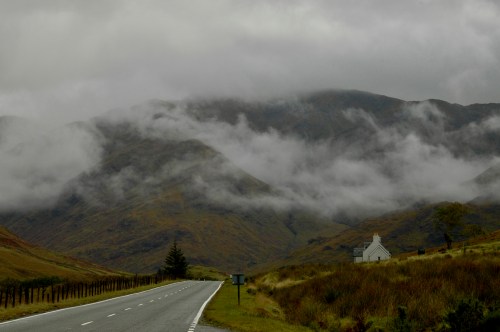
I can’t remember if I took this photo as I was on my way towards the mountains, or I was leaving them behind me. So, I thought I’d imagine it both ways.

I remember leaving home for the first time when I was 18. Leaving to catch the train to Edinburgh where I was about to start six years at university learning Medicine. As I walked down the empty road I had the sensation of suddenly leaving my body, soaring high up into the sky, and looking back down at what seemed a tiny figure walking along the road. In that instant I felt very small and very alone. I turned and looked back. Even my house seemed small now. As I look at this photo I’m reminded of that day, even though this is not a photo of my house, nor of the road I walked down. It’s just that as my eye is drawn back down that deserted road past a tiny white house, that I see the centuries old mountains standing there, as still and as familiar as ever, but obscured today by insubstantial, wispy clouds of water, thoughts and memories.

The past fades behind us as the clouds of time veil the once clear outlines of our memories. But the past is still there. Still exerting its gravitational pull. Still anchoring us, reminding us of roots, and ancestors and belonging.

I sit here today looking forward. Sometimes I see the future looming large ahead and I strain my eyes to make it out, but it hides, or is hidden, behind my anxious thoughts of what if, and what if not, and who knows? These ever changing thoughts and concerns floating in front of my destination. Or my destiny? Walking along a clear, straight road without knowing where it will lead, when it will turn, or dip, or rise.

Maybe the years and experiences which have shaped me give me a new confidence now. An acceptance of not knowing. A humility from not being able to predict. An excitement about the mysteries and wonders which, undoubtedly, lie ahead.

I find myself looking forward to these moments when I’m able to look back. And I love how I my attention can float, like those wispy clouds in front of the immense unknowns of the mountains, allowing me to appreciate the past, the future, and this flitting, yet eternally present moment.

Read Full Post »

The phrase “everything is connected” immediately appeals to me and strikes me as true.

The first thing I think of is the human being.

Although I was taught Medicine in parts, learning about cells, tissues, organs and even systems separately, it was an almost unspoken given that all the parts were connected. In Second Year of Medicine at the University of Edinburgh, one of the main subjects was Anatomy and we were put into groups of six to spend a year dissecting a human body. Our guide was a three volume textbook, “Cunnigham’s Manual of Practical Anatomy”, along with “Gray’s Anatomy” (probably the most beautiful textbook I ever possessed). I was a bit overwhelmed with the sheer number of pages in these texts and asked one of the tutors “Which bits of this book do we need to learn?” He replied, “Which bits of human beings do you think patients will ask you about once you’re qualified?” “Ah, you mean we have to learn it ALL?” He smiled and walked away.

It would be a full two years after that before I met an actual live patient, but, hey, they don’t teach Medicine that way any more do they?

I don’t remember a single lecture about holism, but somehow it was a core value for me right from the start. However it was over a decade after graduation before I came across “Psychoneuroimmunology” and “Psychoneuroendrocrinology” which were fields of study looking at the connections between the Mind, the Nervous System, the Endocrine System and the Immune System. I think that’s where I first encountered a more holistic science, one focused on “systems” not “parts”.

It was much, much later when I encountered “Complex Adaptive Systems” and both “Chaos Theory” and “Complexity Science”. Somehow I think we are still in pretty early days of developing the sciences of the connections. But it sure still excites me!

As a GP I also had to be aware of the individual patient’s connections between themselves and the rest of the world….their relationships, their work, their housing, their family and so on. Those are threads you never quite get to the end of. I think that makes us humble, that knowing that we will never know all there is to know.

Sometimes it seems to me that our minds are like fractals, vast webs of mirrors reflecting similar patterns of reality to each other. Actually, as I write this I remember “Indra’s Net” – where every drop reflects every other drop. I think we humans are great at spotting patterns, and regularities, and that, combined with our ability to use metaphors and symbols enables us to appreciate the incredibly rich, dense nature of reality.

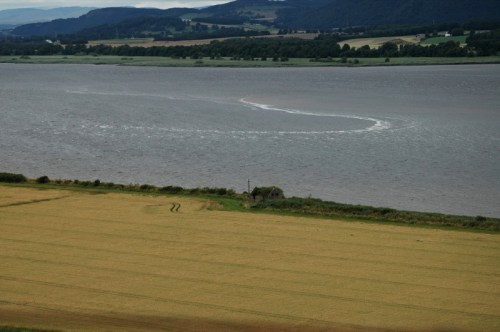
When I saw this shape on the surface of the water I wondered if it had been caused by a boat, or was it something lying on the river bed? But look at the shape drawn by the farmer who has been working this field. What a gorgeous echo of the shape on the river. One of the things that happens when we appreciate these connections is an experience of beauty and wonder intimately entwined.

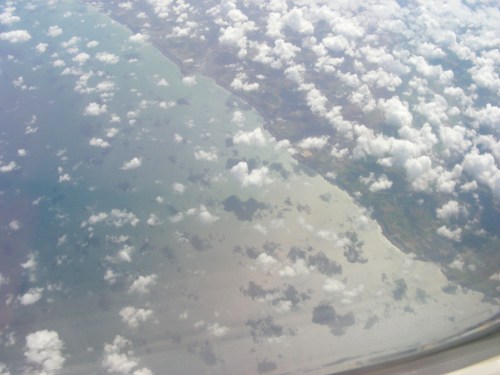
One time when flying over the English Channel, I looked down and saw the shadows of the clouds on the water’s surface just before the coast. Ooh, that still pleases me so much to contemplate this image! I love the fragility and impermanency of the little clouds. I love the even more ephemeral nature of their shadows on the Channel. And I love that transition of density of the clouds from the area above the water to the area above the land, how you can see in that the dynamic, ever moving dance of the land and the water and the air. Magic!

What connections have you spotted today?


Read Full Post »

I don’t think of myself as a separate object any more. There is a constant stream of materials, energies and information flowing into me. I ingest some when I eat, I breathe some into me when I inspire. Heat, light, sound, gravity, and many other energies I can’t detect, influence and shape me, some stimulating my senses, some influencing the flow of fluids and elements around my body and into and out of my cells. The way my body and brain have evolved allows my whole being to interpret all these flows, to make sense of them, attach values to them, to allow me to respond and react.

I am changed.

Second by second, minute by minute, day by day and year by year, I am changing. Not a single cell remains the same over my life time. The idea of an “internal environment” is quite an old one now, but more than ever we understand that this is a dynamically changing environment, not a fixed one.

We process all these streams and flows. We create new cells, break down some molecules, make some new ones. We make new connections in our brains, strengthen some feedback loops in our body and weaken others. We make sense of now in the light of the past and the myriad of possible futures.

Then these streams continue on their way. We breathe out certain molecules, subtly changing the mix of gases in our immediate environment. We radiate heat, make noises, and we act.

We send out materials, energies and information into the universe every single moment of our lives.

These flows influence, disturb, change and shape our environment, other people, and all the other forms of life we share this planet with.

So, sometimes, I think it’s a good idea to pause, take stock, reflect, and ask ourselves – what shape are the waves that I’m making?

Because these shapes repeat and echo and ripple out way, way beyond the worlds we can imagine.

What kind of world do we create when we send out angry waves? Waves of fear? Waves of kindness? Waves of joy?

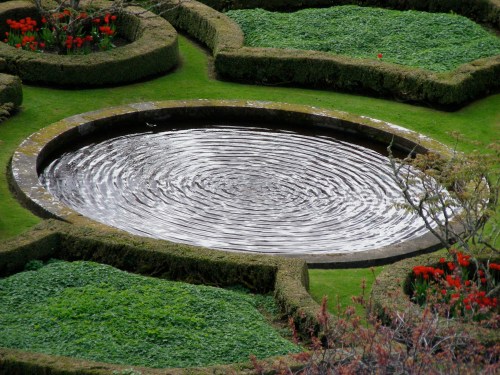
I was thinking about this today because I came across this photo I took at Dunrobin Castle many years ago. The concentric shapes of the ripples in this fountain completely fascinate me. It’s mesmerising. Alongside that, I heard from a couple of people in the last couple of days how much they enjoy my blog posts, and how they have been reading them for years. I didn’t know that. Like any author who publishes a book, I don’t tend to hear from my readers. Yes, I know, some of you hit the “like” button, or make a comment, but I have realised before that only a tiny minority of readers do. And that’s how it should be. After all, when I think of all the books I’ve read and enjoyed in my life, how many of those authors (even just the living ones! 😉 ) have I contacted to let them know that? Almost none.

I know people blog, and tweet, and put posts on Facebook for many reasons, but I think it’s always important to wonder about what shapes the waves are that we are sending out into the world. They will travel further and for longer than you think.

I hope I’m sending you some waves of wonder, some waves of joy, some waves of kindness and some waves of beauty. Because that’s my intention.

Read Full Post »

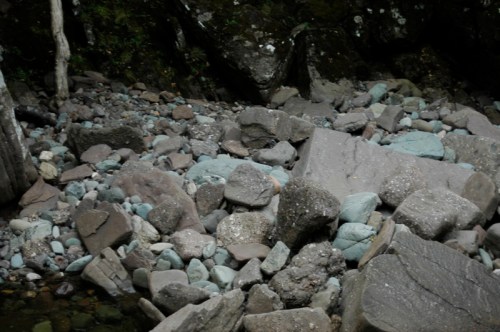
Look at these rocks, dropped here by the river. What caught my attention were the colours. It’s too easy to dismiss rocks as grey and just move on. When I stopped to contemplate them I then started to notice the range of sizes and forms. Some are on the way to becoming pebbles, others are rocks way too heavy to lift. I’m not sure I can even begin to describe all the different shapes.

This, to me, is simply beautiful.

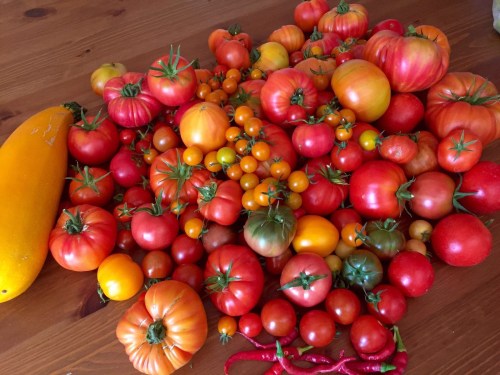
So is this…

….the harvest of tomatoes from my garden with their astonishing variety of shapes and colours, and, take it from me, tastes! (Oh, and, yes, I know that one on the left isn’t a tomato. There are some chilli peppers in this shot too!)

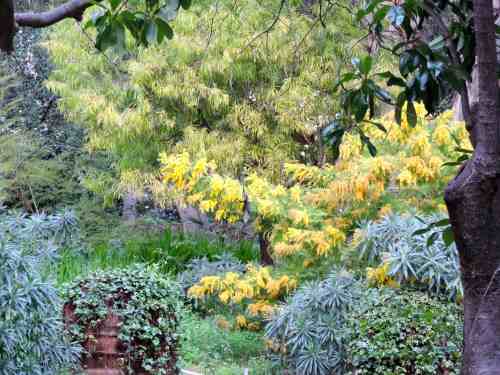
and this…

The Hanbury Botanical Gardens in Ventimiglia – one of my most favourite gardens in the world exactly because of the beauty which emerges from diversity.

Even when you stop to look at the sea (don’t tell me the sea is blue) you can’t help but notice the incredible range of colours and shades. It’s all the more beautiful for it.

Diversity is natural.

Uniqueness is everywhere.

Variety is all around us.

The world is all the more beautiful for its absence of mono-cultures.

I wish our societies were more welcoming, not just tolerant but communities which encouraged uniqueness, which relished the rich and beautiful phenomenon of diversity.

Read Full Post »

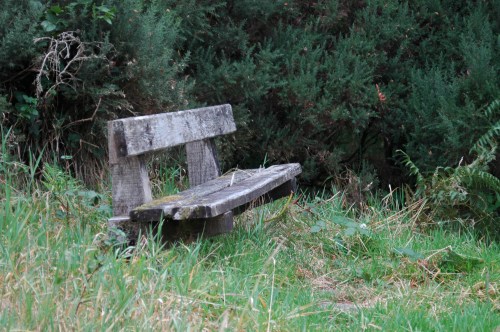
One of my favourite walks is to the Bracklinn Falls just outside of Callendar in Scotland. At the top of the hill there is this old, rather neglected bench with a view stretching miles across the countryside. There’s something wild about this bench isn’t there? It isn’t neat, polished or even painted but I find it all the more appealing for that. Actually, I took this photo many years ago so I wouldn’t be surprised if the bench wasn’t even there any more. After all, nothing lasts forever, does it?

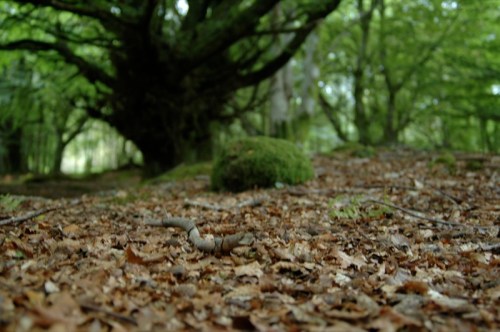
To get to this bench you have to walk through a forest. Well, the path runs along the edge of a forest, but it’s such an appealing forest that I can never resist stepping off the path and making my way through the trees instead.

The forest floor here is amazing. I laid down on my stomach and took a few photos, partly to get the view from the ground, but also to feel that whole body connection to the organism of the forest. Forests aren’t just a bunch of trees after all. Recent discoveries about tree communication has completely changed what we know about them. The term “Wood Wide Web” has been coined to capture this idea of a highly networked community of living organisms, constantly exchanging materials, energy and information between them. It’s really wonderful to immerse yourself in an environment like this.

Once you leave the forest behind, the path crosses a patch of open land and suddenly the horizons are the far ones, not the ones just in front of your nose. That feels almost like breathing to me. Inhaling and exhaling. Turning my attention from what is close to what is far. Feeling the closeness and connectedness of the forest, then feeling the expanse and openness of the distant hills and the countryside laid out at your feet.

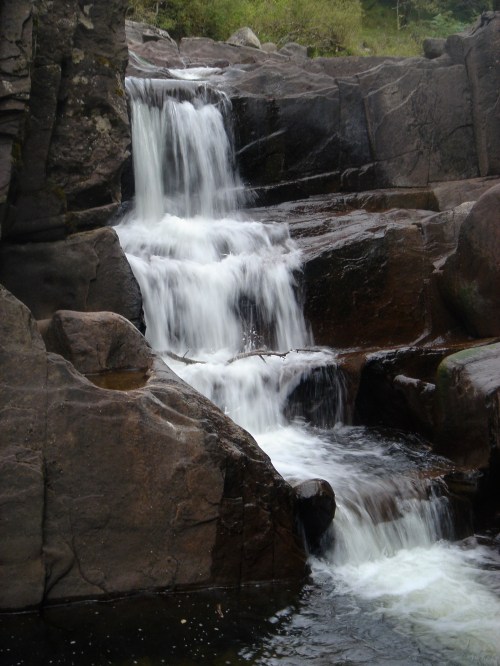
Once you pass the bench, the path enters another forest which immediately feels different from the previous one. The path begins to snake downhill amongst the trees and I am surrounded by something else – the roaring of the waterfall. You can’t see it from the start of the path. In fact, you can’t see it until you are all the way down through the forest, but with each step the noise gets louder and louder. You know it’s coming, but, somehow, it’s still a surprise when you see it.

I can spend ages there.

Everywhere you look you can see how the water has smoothed the surfaces of the rocks and shaped them into exquisite forms. The rocks wouldn’t be the way they are without the water, and the water wouldn’t be like this without the rocks. It’s an intense, lively, creative relationship. Like most waterfalls, this one is best when it’s been raining. The noise is louder, the speed of the water is greater, the volumes are turned up to max, and you can just feel the power.

It feels like a Life Force. It feels like the energy is throbbing through the whole forest, coursing through your body. It makes you feel intensely ALIVE.

I’ve read many times about the importance of being present, of paying attention to the here and now. It’s a good teaching. In the forest, in the gaps, at the side of a waterfall, it all falls into place. Nature creates an attentiveness and repays your attention with LIFE.

There’s a word for this kind of attention and I think it’s IMMERSION.

It’s good to be immersed in Life.

Read Full Post »
« Newer Posts - Older Posts »