Feeds:
Posts
Comments

Archive for the ‘photography’ Category

I reckon I come across something amazing every day. Maybe I’m easily amazed! But in French, the phrase, “l’émerveillement du quotidien” (the amazement of the every day), is one which has made its way to the core of my being. I don’t know if you’d call it a value, or a principle, but it shapes my life, moment by moment, day by day.

This photo is of something I noticed the other day, something which attracted my attention, then stimulated my thinking. That’s the kind of amazement I like best!

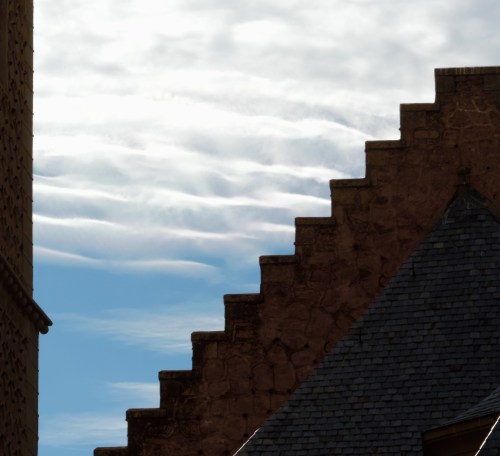
What I saw first was the sky. Just a bit of the sky between two buildings. The clouds looked unusual and pleasing, so I framed the shot, taking in the silhouettes of the buildings on either side of the patch of sky. I liked it the moment I saw it. And I clicked.

When I looked at the shot later it pleased me even more. Not least, I think, because of the contrasts. There’s the contrast between the blue and white of the sky, and the dark browns and grey/blacks of the buildings. But there’s another contrast too.

Look at the shapes.

There’s the shape of the stepwise construction of the building, the bricks laid, one by one, each one separate from the other. It’s like a stair case, isn’t it? A stair case you climb one step at a time. The shape, it seems to me, is typical of what we’d call “discrete”. Each step is distinct from, separate from, the others. And each one adds in a pretty linear, arithmetical way to the others.

But then there is the shape of the clouds. They look like waves. They emerge out of the invisible, out of the blue, each one becoming less distinct, less separate, than the other, till at the top of the image the waves merge into a patch of cloud, almost like waves disappearing into the sea.

I find that pleasing.

I find that appealing, attractive and it make me wonder. Isn’t that the essence of amazement? Of “émerveillement”?

I find that thought-provoking. It seems to me that the left hemisphere of the brain is great at seeing patterns, great at breaking the whole down into individual, discrete parts, great at constructing, building, step by step. Whilst the right hemisphere is busy seeing the whole, seeing the context, seeing the connections, great at finding what’s new, great at engaging with waves which emerge from the whole, (from the sky, from the sea, from the Earth) and dissolve back into it again.

How amazing. To have two brains working away at the same time, enabling us to see and appreciate this universe so uniquely.

Read Full Post »

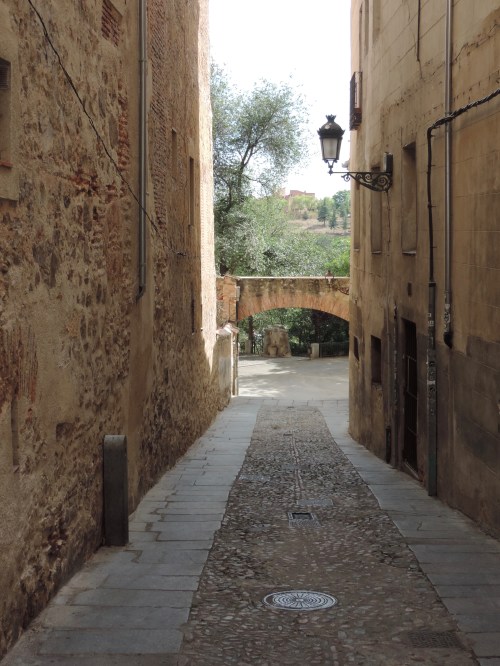
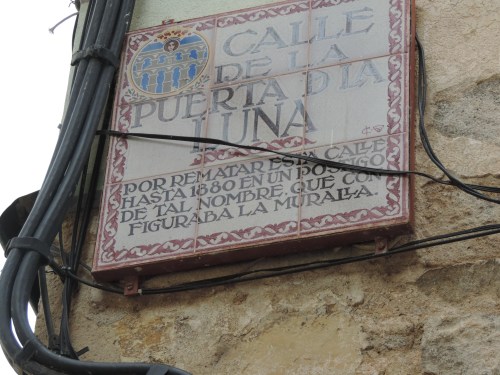
This small street in Segovia doesn’t look like much but up on the wall is this plaque –

Now, my knowledge of Spanish is very limited but I can see this is the name of the street – it’s the street of the door of the moon. The “Door of the Moon”! Oh, now, doesn’t that change things? What a name!

I’ve had a bit of a hunt online but I can’t find out much information about this street, or about the “door of the moon”, but I did discover there is also a “door of the sun” (of course!). When Segovia was a fortified town it had a wall around it, and to gain entry there were a number of “doors”, some of which were I think just wooden gates, and, as best I can tell, “the door of the moon” was one of those gates.

I haven’t come across any stories associated with these doors yet, but if any Spanish speaking readers here are inspired to do a bit of investigating I’d be delighted to hear what you discover!

For me, this is just such a romantic name. It inspires. It activates my imagination. Does it active yours?

See what a name can do? Doesn’t it whet your appetite for some stories? The stories which explain, or give meaning to, whatever has been named.

Read Full Post »

There’s a very human tendency to view ourselves as outside the world. What I mean is that we feel we are IN the world, but we remain APART from it. We are dualists. We think “there’s me” and “there’s the world”.

How did we get here? Just parachuted into it? Dropped down from outer space? We talk about “Nature” or the “the natural world” as if that’s something other than ourselves. As if it’s a place we can visit, and then leave again.

But that’s all a sort of delusion, isn’t it?

There is no “me” separate from “the world” or from “Nature”. We didn’t land on Earth from an alternate universe, we emerged within it, live within it, die within it. There is nowhere else. (Or if there is, we have no way of knowing that)

Yet, this sort of division persists, doesn’t it?

In fact, it seems this is a crucial and necessary part of being human. Our brain has evolved the ability to create what some call, “a necessary distance” between the flows of energy, information and materials pouring through ourselves and the planet we live on.

We are great pattern spotters, we humans. We see patterns, analyse them, name them, categorise and label them, then we can re-cognise them very quickly. We create maps in our minds. We create a “you map”, a “me map” and a “we map”, as Dan Siegel says in “Mindsight”. These maps contribute greatly to our sense of self, as well helping us to recognise others and develop confidence and belief in our relationships.

Our linguistic abilities are used to create the names and labels and to think about whatever we are applying them to, as well as enabling us to communicate about them. We use words, symbols and metaphors to take these processes of analysis and recognition to whole new levels. These are some of our super-powers as humans. They enable us to literally, and metaphorically, grasp the world in which we live.

To do all those things requires us to step back from the flow of experience. We use this “necessary distance” to momentarily step aside, to enable us to see more clearly, understand more deeply. With this comes this sense that we are “apart”. That there is “me” and “The Other”. When, in reality, there is only ONE, and we live inextricably IN the flux and the flow.

I don’t like judgements. They stop thought. But we need them. It’s just we need to be able to let them go more easily than we make them as our understanding deepens, as we see more and more connections, envisage the contexts in which whatever we are examining exists.

So, it’s interesting to me, to take the old school philosophical spiritual practice of “the view from on high”, literally from time to time. To climb up somewhere, to take the time to gaze towards the horizons, to see the landscape unfolding in front of me. To see the “bigger picture”.

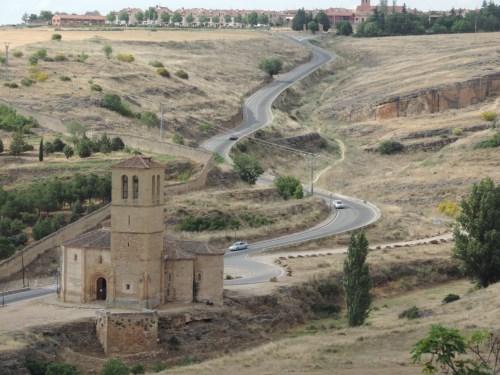
This photo is one I took the other day when standing outside the Alcazar in Segovia. I’m pretty sure that what caught my eye was the church. It seems to stand alone. Almost in the middle of nowhere. But as I framed the shot my eye was led from the church to the winding road which my mind then followed to the top of the hill. Up on the ridge I could see buildings. A lot of buildings. So not a church in the middle of nowhere at all. But still, a church set apart somehow. The curve of the road was immediately appealing and I made sure I included it in the camera frame.

Now that I look at this image I see, yes, the church, that physical symbol of the spiritual connected to the village at the top of the hill by a winding, beautifully curving road. You could argue the road leads to the church. Or you could see the road as leading from the church to the town where people live. In other words, you can see the church, the town AND the connection all at once. I find that immensely pleasing.

I don’t know if that will get you thinking about the place of the spiritual in human life. It might. Or maybe it will get you thinking about connections, contexts and the illusions of separateness?

Ah, before I go, one other thing……see the wall someone has built just to the left of the church and the road? Someone has claimed this piece of the Earth as their own and built a wall around it to strengthen their feeling of separateness. Most people live in the village on the ridge, or so it seems to me. Not many live behind the wall.

Oh yes, walls again. We are hearing a lot about them these days. Both literal walls, to separate Americans from Mexicans, or Palestinians from Israelis, and the toxic and divisive “US AND THEM” walls which divide “natives” from “immigrants”.

But it’s all one world, huh? We share the same planet, the same air, the same water, the same place in the evolutionary path of Life.

It’s a bit of a challenge isn’t it? To see differences and separations but to see them as inextricably connected in a bigger picture.

Read Full Post »

I’ve recently realised I have a dual speed approach to photography.

First of all, something catches my eye and I stop to take a photograph. Normally, I don’t spend long over this part. I see something. I stop in my tracks. I get my camera or phone out of my bag, frame the shot, and click. Photo taken. That’s the fast part.

Secondly, I upload all the photos I’ve taken that day, or that week, onto my computer. Then I make a first pass, deleting the ones which are just awful, and adjusting others, cropping, straightening, lightening, deepening…whatever seems to need done. That takes time. It’s the first phase of the slow part. As I do that, certain images strike me more than others do, and I mark them as “favourites”.

Thirdly, and this might happen, days or even weeks afterwards, I browse through them, or find myself searching out a particular photo because I’ve been thinking about something and that image has come to the front of my mind. I pick out the one I’m looking for, or I pick one that strikes me in that moment, and begin the fourth stage.

Fourthly, I upload the photo to my wordpress account and paste it into a new post. Then I take my time to look at it more closely and write what thoughts arise. This is the final slow part.

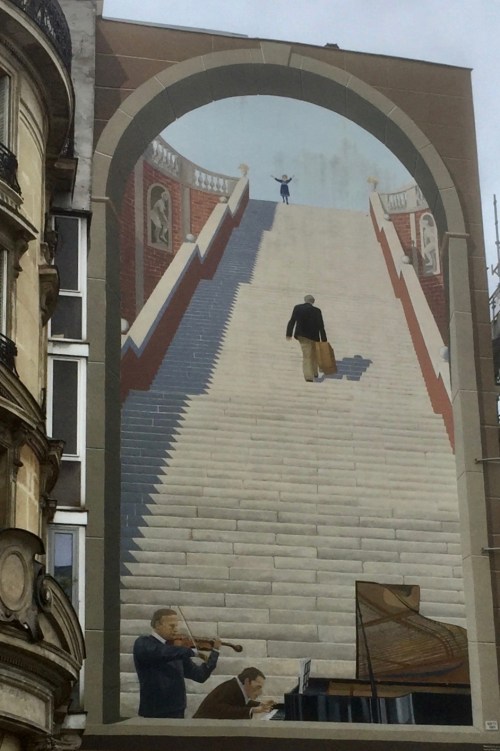
Here’s an example. I was in Paris for a few days a couple of weeks ago and one of the days as I was crossing a road I noticed this huge mural above the shops. I stopped (deciding not to cross with the green man yet!), took out my camera, framed the shot and clicked, then I continued on my way. Once I returned home I uploaded all the photos and when I saw this one I cropped it a bit to focus on the artwork itself. Then I inserted it into this post. The thoughts which have arisen included what I’ve just written about the dual speed nature of my photography, which, strangely, are a set of thoughts about thinking about this photo…..a kind of meta-view……an overview, if you like. Then I returned to the image itself.

This image intrigues me. It’s a huge flight of stairs. I was exploring Paris at the time and that always involves a LOT of walking and a LOT of stairs if you use the metro. I checked my phone and it told me I’d climbed 14 flights of stairs that day! Wow! In that sense, this image was a great motif – this is what a visit to Paris entails – lots of steps! By the way, have you ever climbed the steps up to Sacre Coeur? That’s quite a climb. Or made your way up the crowded Spanish Steps in Rome? Or have you climbed any of the long stairways in Edinburgh up to the Old Town? (You’ll have figured out by now I’m remembering some of the long stairways I’ve climbed. I could add a lot more, but I’ll leave you to add your own).

I’m of a certain age, so a particular piece of music pops into my mind at this point. Yep, Led Zeppelin, ‘Stairway to Heaven’.

And then I return to the image…..

Could the musicians be playing ‘Stairway to Heaven’? If not, what might they be playing?

What other characters are in this mural? There’s a young girl at the top. She’s looking pretty happy and welcoming, and there’s the central character, the man with the suitcase. I realise I’ve immediately identified with the man with the suitcase. Isn’t that something we do quite a lot? Identify with the hero? The central character in the story? Isn’t that how we make sense of our lives actually? Telling ourselves the stories where we are both the author and the main character? Which gets me wondering about the stories we tell. Maybe the man’s suitcase is full of stories? Maybe he’ll be telling some of them to his child (that is his child at the top isn’t it?) once he gets to the top. I suppose there are a lot of life stories about uphill struggles. And lots which are about things “all going downhill” too!

One of my greatest joys throughout my working life was to hear people’s stories, the stories of the patients who came to see me. I never heard too many. Maybe I could even say I never heard enough of them? I loved to sit and listen to them.

Hey, the other night there I watched the movie “Hector and the Search for Happiness“. Seen it? I recommend it. I laughed! And it’s gently thought provoking too. Well, one of the lines in that movie is “Listening is loving”. I liked that line.

I get the feeling that this man is coming home, don’t you? The girl looks like she’s gesturing “welcome back!”

But wait, there are two other characters in the image. Near the top of the stairs there are two statues, both of which seem to have just come to life, and are about to step out from their little platforms. Doesn’t it look like that? I mean, they could just be two statues, each captured in an action pose, but I don’t get that impression. It looks like they are starting to move. Are these two goddesses? If they are, then what are they about to bring into this man’s life, into his story?

What do you think?

……well, this is what I mean by dual speed photography – from noticing to contemplating.

I recommend it.


Read Full Post »

Do you get those experiences where something catches your eye, then when you stop to reflect on it, its significance gets deeper and deeper?

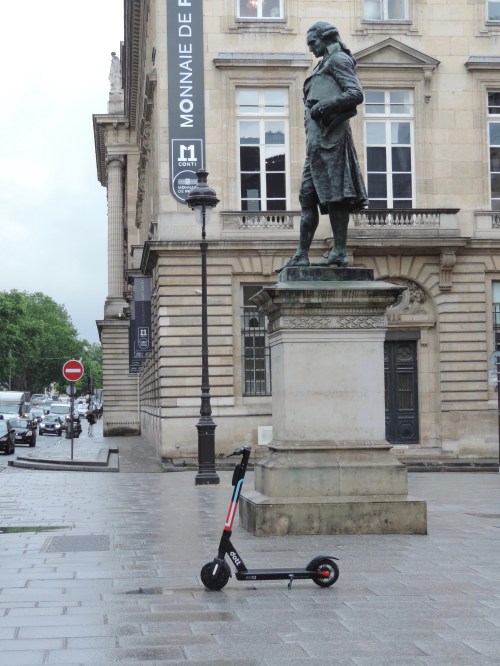
Last week I was in Paris, and on one of the rainy days was heading for a restaurant at lunch time but this scene caught my eye. Despite the fact it was raining, I stopped and took a photo. In fact, I took two….the first time my camera slipped as I pressed the shutter and I only caught the top of the scooter!

These electric scooters are everywhere in Paris just now. You can hire one using an app and drop it off anywhere you like. In fact, that’s become a bit of a problem. People are falling over them on the pavements and sustaining injuries, so the authorities are starting to consider new regulations to control them.

I took the photo because I thought it looked funny. To see this serious gentleman either looking down at the scooter somewhat disdainfully made me smile. Then I thought maybe he’s actually thinking about jumping down onto it!

When I got home, I decided to find out who this man is – turns out he is “The Marquis de Condorcet”, a leading Enlightenment thinker and writer, a mathematician and philosopher. One of his most deeply held beliefs was “progress”. He thought we humans, through learning and communicating with each other, would steadily increase our understanding of the natural, social and political worlds, continuously progressing and improving society. “However, Condorcet stressed that for this to be a possibility man must unify regardless of race, religion, culture or gender”

The wikipedia entry on him goes on to say this –

Condorcet was concerned with individual diversity; he was opposed to proto-utilitarian theories; he considered individual independence, which he described as the characteristic liberty of the moderns, to be of central political importance; and he opposed the imposition of universal and eternal principles.

He was a champion of diversity, equality and individual freedom. But he was also a champion of thinking – that progress required us to deepen our understanding of the world and of each other, comparing and reflecting on our individual experiences. He campaigned against slavery and for women’s civil rights.

So, it took an electric scooter to get my attention, but I’m glad I’ve discovered Condorcet. I think we could learn something from him about the importance of values, diversity and justice.

Read Full Post »

jan17

In January each year I like to make my own calendar for the coming year. Maybe it’d be a better idea to make it in December so it was ready to go in January, but that’s not what I tend to do.

The way I do it is to select twelve images from my photo library, one for each month of last year. I select them first because they are images I’m really happy with. After all, I’ll have to look at each of them for a whole month at a time for the next year. If I find I’ve more than one to choose from then what I do next is select the image which evokes the strongest memories for me. That way I’ll recall, month by month, a beautiful, wondrous, or amazing experience throughout the year. Each image evokes memories, but also inspires me.

I find this is a way of harvesting the experiences of one year to inspire the choices I’ll make this year.

It’s really easy to find and collect your own photos. Of course, you don’t need to make an actual calendar. You could simply select and collect twelve images into a separate album on your phone, your pad, or your computer. Or share them on Instagram or Facebook. You choose. Oh, one other tip – file names – as I save each image into the “2017” folder I name it “Jan17.jpg, Feb17.jpg” and so on. Makes it way easier to organise and use them in the future.

I’m a great one for “and not or”, so I make a special album/folder of the twelve images and keep that on my desktop. I use those images to make a physical calendar, browse through them from time to time, and use them on various posts and sharing platforms through the year. The service I use for the physical calendar is Redbubble. It’s not cheap, but it’s really fabulous quality and their service is fast. There are plenty of other web based services out there, or you could print your images at home and make your own calendar by hand. There are also photo print machines in various outlets but I’ve never tried any of them. Have you?

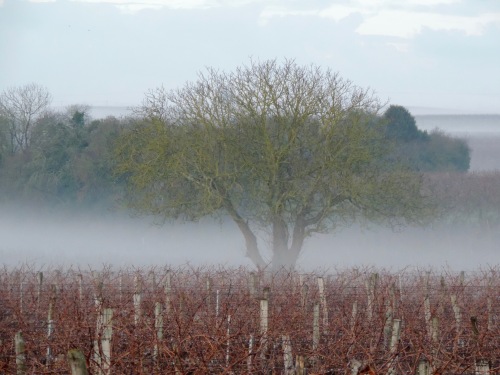
The image above is my January image. I took it one foggy morning in the vineyards which surround my house. Isn’t it gorgeous? Reminds me just how beautiful winter can be, and how amazingly wonderful trees are.

Here’s February –
Feb17

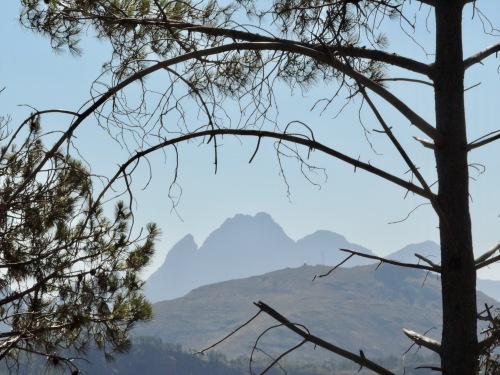
In February 2017 I spent some time with my friends who live in Capetown. We took a few trips and one of my really favourite areas was Franchhoek. It’s like a French enclave in the South African countryside. As I now live in France the unique blending of French and South African culture in Franchhoek really appealed to me.

Mar17

In March I returned to Scotland and had a day out in the Trossachs. Stopping at the side of one of the many lochs I was astonished by the brilliant reflections of the sky in the absolutely still water. This shot includes the rocks at my feet as well as the reflections of the overhanging trees and the clouds above me. It’s quite a disorienting image and that’s what I love about it. Really draws me in to work out just what I’m looking at.
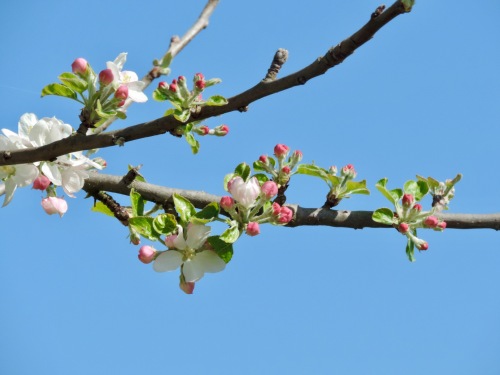
Apr17

April is the time of blossom in my neck of the woods. Cherry trees, plum trees, almond trees….it’s a beautiful time of year. I can’t look at these blossoms without feeling a surge of new life and creativity. At the same time, I’m reminded of the Japanese veneration of the cherry blossom time of year. The cherry blossom doesn’t last long so it heightens our awareness of the inextricable links between beauty and transience.

May17

Last May we were blessed with an abundance of sweet peas. The previous year we sowed a number of seeds but they really didn’t come to much. This year, they were everywhere! That was a lesson. Take your time. Sow your seeds and let Nature nurture them on her own timescale.
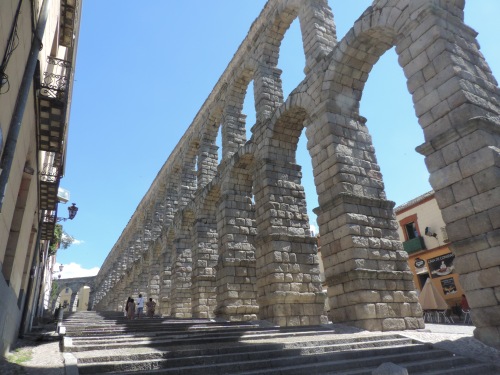
Jun17

For my birthday in June we took a trip to Segovia in Spain. We’d visited there the previous year and loved it so much we decided to go back. It’s about an eight hour drive from our house to Segovia so we stopped off in Saint Jean de Luz just this side of the French-Spanish border on the way. Clearly one of the most astonishing things about Segovia is this Roman aqueduct which took water from the hills right into the town centre. The Romans, huh? They knew how to build structures which would last for centuries didn’t they? Long after their empire had gone anyway. I wonder how long what we build now will last…….
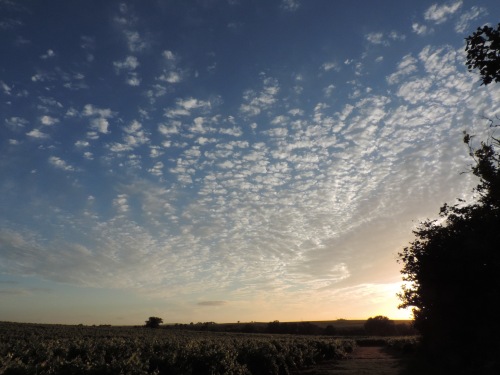
Jul17

One of the delights of this house is the “open outlook”. Years ago one of my Dutch friends told me how important it was for her to have “a long view”. She felt that these long views opened up your heart and your soul to the world. I think she was right. I’ve stayed in places where the only view was of the buildings on the other side of the road. I know what I prefer. This particular shot, which I took from the garden in July, is just one of the many photos I’ve taken of the clouds. I could look at clouds for hours. They are endlessly fascinating, constantly changing, and often utterly beautiful. Cloud watching. I recommend it.

Aug17

In August we had a day trip to Rochefort but it was a rainy day. It’s easy to get down on a rainy day and wish the rain would just go away, (unless you live in a drought area, when you might welcome a good downpour!), but you can get some great photos on cloudy, rainy days. These magnificent umbrellas were strung across the main street on market day. Well, you couldn’t really not take a photo, could you?
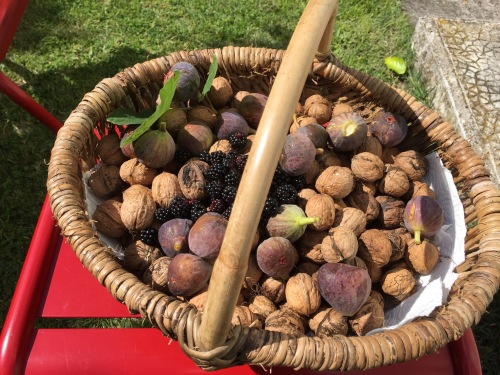
Sep17

September is a great time to go foraging around here. We took a basket with us and came back with these walnuts, figs and berries. How lucky were we?!

Oct17

There’s a barn owl, or a pair of barn owls, who live in my neighbour’s barn and for the past couple of years, they’ve laid eggs in a nesting hole in the house, above the front door. This year, though, three kestrels turned up and fought the owls for the box. I couldn’t bear the thought of them actually catching one of the owls to closed off the empty box with cardboard. I was a bit sorry not to see the owls so frequently after that. However, in October, one night at sunset, I spotted this little owl perched up on the plum tree. From her shape and call I reckon she was a tawny owl. Lovely photo though, don’t you think?

Nov17

In November we had our first ever trip to Scandinavia, with a few days in Copenhagen. Loved it! I’ll definitely go back. I chose this photo because it’s off the Rundetaarn – I’ve really never, ever seen anything like this. Built as an observatory the internal path is wide enough to drive a carriage up. Now there’s a road I’d never traveled before!

Finally, December –
Dec17

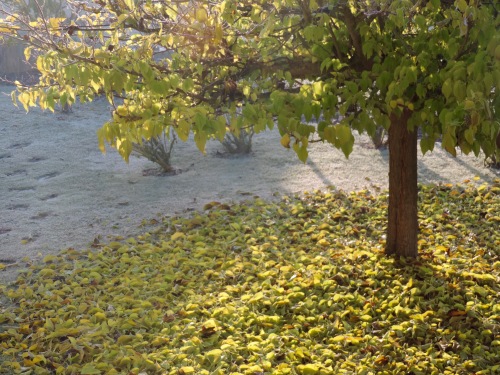
The mulberry tree in the garden begins to shed her leaves gradually, but then one day, usually after an overnight frost, she suddenly sheds most of them, laying this astonishing carpet around her feet. The leaves are so varied in size and colour that I just love taking my time and raking them up. It’s my November/December meditation exercise!

I hope you’ve enjoyed these twelve images and that I’ve inspired you to delve into your photo library and find your own dozen – whether you go on to make a calendar or not.

Read Full Post »
We’ve had a very hot, dry spell recently here in the Charente. Temperatures rising to the mid or high 30s (centigrade) each day which made the leaves of the plants curl up and wilt. Then this last week we’ve had rain, wind and storms. Yikes! What chance have they got?

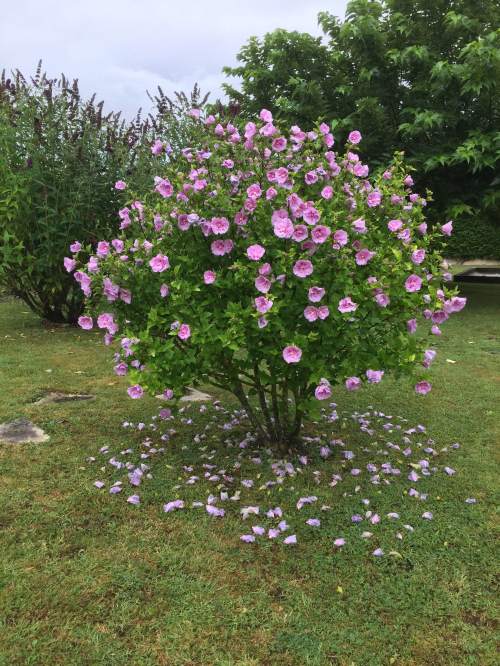
Well, look what all that varied weather has done to this bush in the garden.

First it suddenly bloomed, going from zero flowers to dozens of them over about 48 hours. Then the wind and rain has knocked off more than a few of them.

But when I walked outside yesterday evening and the bush caught my eye I was transfixed.

Just look how beautiful this is! Not just the bush itself but the way the fallen flowers have made a pinkish purple circular rug on the grass around it.

This is the kind of beauty which Nature makes.

In “The Great Work”, Thomas Berry talks about the interplay between discipline and wildness…..between order and chaos (or disorder). This is a great example, I think, of the beauty the wildness and disorder brings…..effortlessly.

Read Full Post »

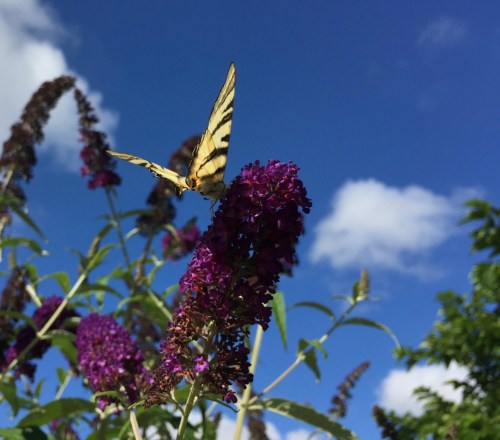
Every year I’m amazed to watch the butterflies appear in the garden the very same day the buddleia bushes flower. I’m convinced they both appear at exactly the same moment. No idea how that happens! Are the butterflies just hanging out around the corner somewhere waiting for the blossoms to appear, then zip round as fast as they can the moment that happens?

However it happens, it’s a delight to see so many varieties of butterfly (and the hummingbird moths, which are incredible creatures!), to watch how they fly in such utterly unpredictable directions, how they spread their wings in the sunlight, or close them up so they look like little leaves.

But here’s one thought which comes up for me time and time again when I see butterflies….they make me more aware of the cyclical nature of life. These little creatures have such different life stages, so different you wouldn’t realise they were stages of the same life. Do we think of them as having a beginning and an end? Starting with an egg, progressing through their caterpillar stages, becoming a chrysalis, then emerging as a butterfly which lays eggs, then dies. Is that the life?

I suppose we do all think of ourselves as having a beginning and an end. But where do we begin, and where do we end?

It depends on whether or not you want to reduce a person to just a physical body. My physical body began with a single fertilised egg and this body will die.

But what about ME?

Do I really think I’m only a physical body? Don’t I have a sense of something immaterial too? A consciousness? A sense of Self? A personality? Characteristics, behaviours, values, beliefs, creative acts, destructive acts? Is there anything I can do which doesn’t ripple out into the world beyond me?

When I look at Rodin’s “The Kiss”, or “The Thinker”, what do I see? The product of the imagination and creative skill of the man called Auguste Rodin. When I listen to music composed and performed by people who are long since dead, isn’t there something I’m sharing there which only they could have created? Aren’t these great works of art the ongoing ripples of unique human beings? Or do you think these are just their footprints? (It doesn’t seem that way to me….these works seem full of life and the potential to continue to create and send out ripples into the universe)

And what about those characteristics, quirks or tendencies that I have which others in my “family tree” also exhibited, even perhaps before I was born? Anyone who explores their genealogy encounters remarkable “coincidences”, talents, life events, behaviours which echo down through the generations. Weren’t those threads present even before the egg which became me even existed?

I think it’s inadequate to narrow a person down to a physical body.

But even if we did, there is still the fact that the body changes continually. It never stops. There is a constant turnover of cells, new beginnings, new endings, every hour of every day. There is a continuous exchange of energy, materials and information between my body and my environment, and we all share the same environment, the same atmosphere, the same air, water…..we are all made from the same molecules, all created from the same “star stuff”.

So it seems to me that beginnings and endings are everywhere……wherever, and whenever, we happen to look.

But it also seems to me that they are nowhere. They just don’t exist. We all emerge from, and dissolve into, the great cycles of the universe.

Beginnings and endings are just where we choose them to be. But we can always make a different choice. We can always take a broader view, a bigger view, a longer view, a more holistic view.

I’m reminded of a song from my school days….it’s by Jeff Beck, and it’s called “Hi Ho Silver Lining” – he sang this truth right there in the opening line of this song…in the first five words……

Read Full Post »

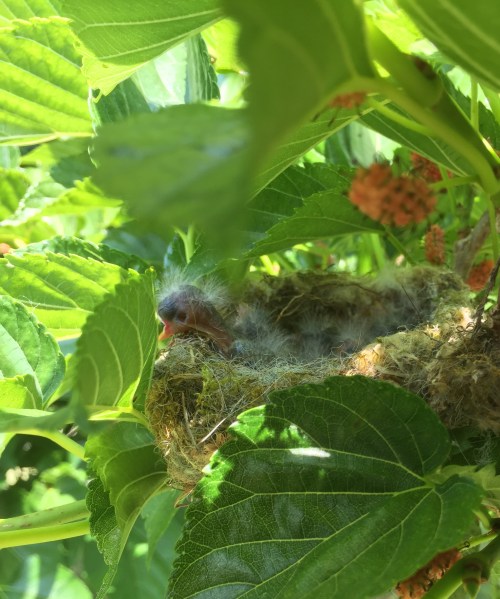
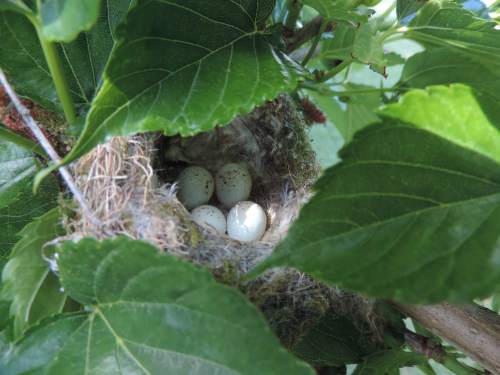
A couple of little finches have built an astonishing little nest almost at the very end of one of the branches of the mulberry tree. The next looks pretty precarious but actually it’s well hidden amongst the leaves and it’s brilliantly woven. Just how do they do that? How do these tiny little birds gather bits and pieces from around the garden and actually weave them into these tight, sturdy nests? I mean how do they manage that with just their beaks? And where do they get their knowledge from? I can’t see that they learn it from any older birds. Is it actually programmed into the DNA sequences of their genes? Really? Isn’t that utterly mind-boggling? I’ve read similar musings about spider webs. Because every single web, and every single nest, is created in a unique circumstance. A new circumstance of time, place, wind, rain, sunshine, heat, cold…..I could go on. So even with a DNA coded programme for web creation, or nest building, each creature has to adapt that knowledge to the present circumstances. Honestly, I’m amazed!

But my amazement doesn’t stop here, because after finding about four little light blue eggs in this nest a wee while back,

Now they’ve all hatched, producing these chicks. What on earth do they look like? This is one of them about a week old. Now, about two weeks old, they are starting to develop feathers. If I understand it correctly, within the next two, or three weeks, they’ll fly. You get that? They will fly! From emergence from the egg to FLYING in about four weeks.

Now, embryology has always fascinated me. Probably my most favourite teacher at Medical School was the professor of anatomy who drew the stages of development of the human embryo on a giant blackboard using a pack of multicoloured chalks. Wow! How impressive was that! Sheer works of art, lecture by lecture. Sadly, we didn’t have mobile phones in those days, so none of us were able to capture those blackboard works. But I do still have them in my memory. Beautiful as they were I still remain utterly astonished that the cells of an embryo can replicate and differentiate and move into entirely the correct places to develop a human being with all the organs, tissues and networks of systems which form the new born child. When I look at this tiny chick I think the same. I think how on earth does the fertilised egg develop this head, this beak, these eyes……and now, the beginning of feathers and wings. And within two weeks from now these chicks will launch out of this nest and fly. How long does it take for a human baby to walk by him or herself? This little bird takes a month from “birth” to flying.

If you don’t find that astonishing and amazing…..well, you do, don’t you?

We take so much of our lives for granted. There’s so much we don’t know and don’t understand. But, can I recommend this?

Take a moment or two to reflect on how one cell (an ovum), joins with one other (a sperm), to become ONE cell which almost immediately becomes two, which become four, then eight, then sixteen……and hour by hour, day by day, a unique creature emerges, with millions and millions of cells, different kinds of cells produced from the original ONE, producing a body, with eyes, a mouth, all the necessary organs……You don’t have to go any further. Just consider any stage along this path and wonder.

Doesn’t it make you feel awe?

Doesn’t it make you feel humble?

Just allow yourself to enjoy that for a moment or two.

It’ll shift your perspective on the world.

Read Full Post »

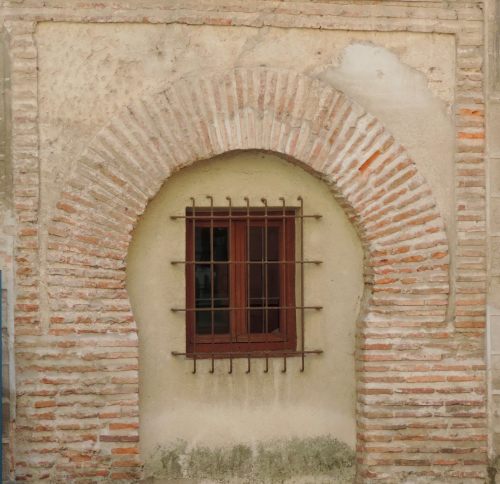
I see this sort of thing a lot when I look at old buildings in either France or Spain. This one is in Segovia.

What’s the first thing you notice?

The window?

Or the window in an arch?

See, when I look at something like this I really get to wondering….how did this come about? Did the original builders build a nice big entrance way, two verticals and a horizontal? Building a frame like a picture frame for an entrance? Maybe not….well, maybe not exactly anyway, because it looks like exactly the same bricks have been used to make the archway and some of the bricks seem to run between the two frames….the square frame and the arched frame. So maybe the original builders built an arched entrance and surrounded the arch with a frame?

But then it looks like somebody decided not to have an entrance there after all and filled in the space.

Then somebody else thought, hey, wait a minute, I’d like a window here and put in the window….but did they fit bars around the window at the same time?

So, has this window, this barred window, emerged over many years from a wall which was built in the space formed by an arched doorway?

And what was the thinking behind each of those steps in the development?

Make an entrance, an attractive, obvious entrance…..then block it up…..then make a window, but not one for letting that much light in, and certainly not one somebody might climb into, or out of…..was that, is that, a problem around here? People climbing in and out of windows?

Bear with me here but because I worked as a doctor for almost forty years this image sparks my thinking about patients and the problems they talked about in the consulting room. They’d bring the equivalent of this window….let’s say they’d talk about a pain (instead of a pane….ha! ha! sorry!)…..and I’d ask about the pain, asking them to describe it….its features, its characteristics, its exact location, what surrounded it, or accompanied it……and then I’d want to know how it arose. Tell me when it wasn’t there. What was there before it? What was happening when it began? And so, gradually, what a first glance might be a simple symptom turned into a unique, never before told, story…..and that’s where I began to understand what the problem might be.

Read Full Post »

« Newer Posts - Older Posts »