Feeds:
Posts
Comments

Archive for the ‘photography’ Category

twelve-project-day-twelve

Day twelve of the “twelve project”, the final day.

Over the last twelve days, starting on Boxing Day, I’ve uploaded one photo I’ve taken from each of the twelve months of 2016, then created a post about that photo, one per day. Here’s the final image, this one from December.

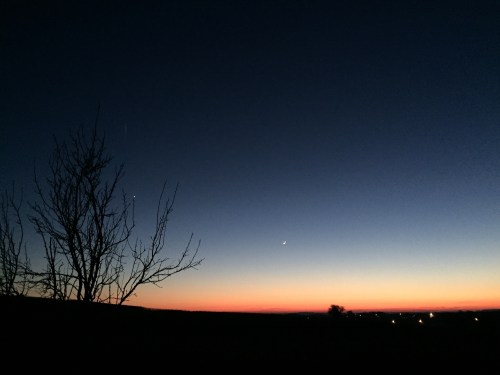
I think its particularly appropriate to finish this project with a sunset. One of advantages of living here is that there are many, many spectacular sunsets. It’s really not unusual to be so caught by the colours in the sky at sunset that we stop whatever we were doing and either open the windows to get a better look, or dash out into the garden to climb on the wall and gaze at this most wonderful, most extraordinary, most ordinary of natural phenomena.

You might think that we’d get used to it, see a sunset like this and just think, “that’s the sun going down”. But we don’t. When I lived in Stirling I looked out from my second floor apartment to some of Scotland’s mountains, in particular to Ben Ledi. I swear that every single day it looked different to me. I never ever tired of it. It never became so familiar that I stopped noticing it. It’s the same with these sunsets here. I’m sure it would be the same if I lived on the coast and looked out onto the sea. The sea, equally, is different every time you look at it. I think that’s why artists like Cezanne painted the “same view” so many times (Mont Sainte-Victoire in his case) – because he was entranced by how different even a mountain could look every day, or, indeed, every hour of the day.

But there’s more to this image than the colours of the sunset. If you look carefully you can see the Moon and the planet Venus. I adore those early evening planets and stars and I am more aware of the current phase of the moon than I have been at any time in my life. The skies here are pretty dark. Those little lights you see at the bottom right of the photo are from the houses in the next village. So, you can see, there isn’t a lot of “light pollution”. That means that once it gets really dark I can see the Milky Way very, very clearly, and I can see stars I’ve never seen before.

And there’s one more thing in this photo. To the left you can see the branches of the Mulberry Tree which grows in the garden here. I just love that tree. I love following its seasons, from buds in the Spring, to the rich cover of huge leaves which I shelter under in the heat of the Summer, to the abundant mulberry berries which are the strangest looking berries I’ve ever seen, to the pleasure of raking up the leaves in the Autumn, and the striking shape of the bare branches in the Winter.

For all of these reasons and more, this is a great image to end the year with. It’s good to be alive.
Read Full Post »

Twelve project Day eleven.jpg

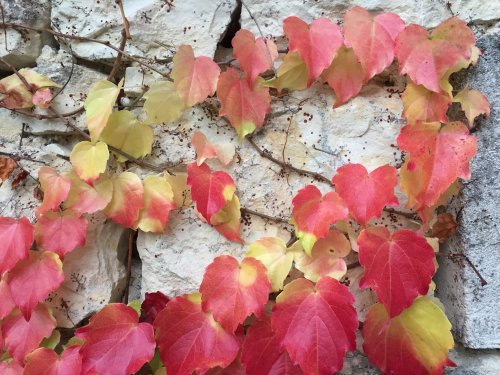
On a wall which runs the full length of one side of my garden grows a plant which isn’t like any other plant I’ve ever seen. It’s name in English is “Boston Ivy”, and its a kind of vine. One of my friends calls it “mile a minute” referring to its speed of growth.

One of the things I like most about it is its complexity. At different times of year its shape, colour and appearance is completely different. Right now in the winter when it’s lost all of its leaves it is a web of stems, creepers and woody trunks. In the height of the summer its lusciously green and is literally a-buzz with bees while providing protected hidden spaces for blackbirds to build their nests. There’s a point in the summer where the seed pods all pop and the sound of millions and millions of the pod shells falling through the leaves to the ground sounds for all the world like a waterfall. The first time I heard it I actually went to look for where the water.

But it’s in the autumn when the leaves turn these glorious shades of red, yellow and gold. It’s breathtakingly beautiful. Then once the leaves fall the plant reveals its gorgeous little bluish black berries on bright red stalks. The birds come in their dozens for those!

Having lived here for two years now I see every one of these phases in the context of the ones which came before and the ones still to come. It’s a very physical experience of the reality of stories, or better, of storied reality.


Read Full Post »

twelve-project-day-ten

Day ten of my “twelve project” brings me to this photo which I took in October last year. It’s a picture of the river Charente as flows through the town of Jarnac, which is about a half hour’s drive from the village where I live.

The river gives its name to this whole region, the “Charente” and it flows to the Atlantic passing through the neighbouring region of the “Charente Maritime” on the way. But the river does more than give its name to this region. It is symbolic of, or maybe more accurately, it creates, the pace of life here. People say it flows steadily and calmly, just as you can see in that photo. I’ve been here just over two years now and I’ve never seen it churned up or terribly disturbed. It might happen sometimes but I’ve never ever seen it. Normally when you walk along its banks or look down from one of the bridges, it looks like this.

I encounter the river most commonly in three different towns. My “home town” of Cognac, half an hour to the East in Jarnac, where this photo is taken, and half an hour West to Saintes. In all three of these towns the Charente looks like this. Yet in each of these towns it is also unique and different, because a river isn’t just the water, it’s the banks and the land around the water.

I think it’s not just that it is calming to watch the water flowing so steadily, it slows you down. It slows you down by capturing your attention so that you stand and gaze at it for a while, or you are drawn to wander along one of the miles and miles of footpaths which follow its course, and as you wander it seems the river is keeping pace with you. It’s wandering too. Or is it the other way around? Do we unconsciously fall into step with the river? It slows you down another way too, because when it flows this way the surface is typically highly reflective. Look at the reflections in this photo. It was the sparkle of the sunlight on the lily leaves which initially caught my attention this day, and it was only just after that that I noticed the reflections of the little clouds floating by. It inspires you to reflect.

I love rivers. I grew up in the town of Stirling in Scotland. The River Forth winds its way towards, through and beyond Stirling like a great ribbon, or maybe a snake. You can see it best from Stirling Castle. Standing at the castle gazing down to the Old Bridge, following the curves of the river with my eyes as I look towards the Ochil Hills is one of my strongest memories. It’s one of those scenes which embeds that place in my identity.

I love the symbolism of rivers, how they are never the same two days in a row. As Heraclitus said “you can never step in the same river twice”, reminding us that every moment changes and every moment is unique. I love how you can’t look at a river without imagining both where it has come from and where it going to. It’s like a story. It is present in front of you now, but it brings into this present moment, the past, from the springs in the hills, through its journey of days or weeks, and it holds within it all the potential to become the river it will become as it flows towards the sea.

I can’t think of rivers without thinking of the incredible water cycle of the Earth. How the rivers flow to the sea, how the wind and the sun lift the water into the air, how it condenses to make clouds which then dissolve into rain on the hills and the mountains to create the streams which flow together to create the rivers again. I like that I can see at least part of that in this photo with both the river and the clouds sharing the same space in my picture.


Read Full Post »

twelve-project-day-nine

In September, the ninth month, our walks through the surrounding countryside brought a bonus. Fruition.

We have a number of paths to choose from when we go out for a walk, but all of them involve partly wandering through the outskirts of a village or two, partly walking down quiet roads between the villages, and mostly walking through, or around, vineyards.

This year we discovered that one of the paths between the vines leading back down the hill towards our house passes a handful of fig trees and a couple of walnut trees. In September the figs ripen and the walnuts fall to the ground. These are all wild trees growing beside the grassy paths which traverse the vines. And these paths are quiet paths. I can’t remember the last time I passed anyone else walking along them. This happy discovery meant that preparation before setting off on the walk changed a little bit. As well as putting on walking boots I’d put a couple of plastic bags in my pocket.

Every day, if we wanted, we could bring home a harvest of figs like the ones in this photo. Have you ever tasted fresh, wild figs? Delicious! When I was a boy growing up in Scotland the only figs I tasted were in a biscuit called a “fig roll” – that was the kind of biscuit you only ate when you were desperate and there were only kind left in the biscuit tin. I could force one down, but I didn’t really enjoy them. Well, fresh figs are NOTHING like “fig rolls”! Yet another experience which shows me the difference between what is natural and fresh, and what’s been processed and manufactured.

And fresh walnuts? Walnuts used to be my least favourite nut. They often seemed dry and tasteless, but fresh walnuts, picked up from the ground and eaten straight away are moist and delicious. Can you see a couple of them lying on the table in front of the figs?

There was one more treat I could pick up on my September walks – blackberries. The field next to my garden has a hedge running along two of its four borders, and both of those hedges are full of blackberry bushes. I didn’t include them in this photo but they made a great addition to the morning cereal bowl.

So, here’s my gratitude for the ninth month – the fruits and nuts which made my morning walks extra specially delicious!

Read Full Post »

twelve-project-day-eight

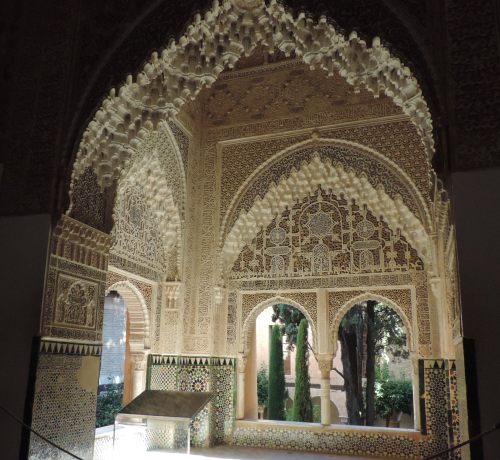
Day eight of the Twelve project takes me to August 2016 (I’ve selected one image for each month of 2016 and I’m posting one a day for twelve days). The big thing for me in August was my first ever visit to Spain. The Spanish border is just four hours drive from where I live in France so you can leave first thing in the morning and have lunch in Spain. I’m not going to write about that whole trip and all the places I visited here but I’ve selected this one image because it captures one of the main threads of that story.

This photo is taken in the Alhambra in Grenada. If you’ve ever thought of making a “bucket list” of places you want to visit before you die, then I highly recommend putting the Alhambra on that list. It’s best to buy your tickets in advance (here’s the official site for buying them online) and you have to select both the date and the time you want to visit. There are a limited number of tickets for each half hour period of the day to manage the flow of visitors. Here’s the number one tip – buy tickets for the 0830 entrance – its the first entrance of the day before it starts to get too busy and way too hot.

This one photo reminds me of several of the things I loved best about my visit.

The shapes of the windows and doors. There are so many in the Alhambra and Generalife site. You can wander from room to room as you wish, unless you are on an organised tour in which case you have to go with your chosen crowd. I prefer to explore freely. Every room you enter has beautiful, enticing windows and doors. You’re drawn to them, both to look through to see what’s on the other side, and to pause and admire their shape, design and decoration.

The decoration – there are just the most astonishing patterns in the stonework and the plaster everywhere. They reminded me of the Celtic knots and Pictish patterns on the ancient stones in Scotland but they are different from both of those. One glance at them captures you. They are beautiful at that very first look, but then you’re drawn into them, exploring more of the detail and noticing how the patterns both repeat and evolve. If you look at the walls, archways and frames in this photo you won’t see a single area left unadorned. The whole place is like that. Room after room. But look down too under the double window and to the left of it….see the mosaic pattern of the tiles? That’s the other major design feature here, the tiles. There are so many different tiles creating so many different patterns in so many different combinations…..the diversity, the creativity, the workmanship….breathtaking.

Through the double window here you can glimpse a garden and that’s one of the things I loved best about the Alhambra….the courtyards and gardens, with trees, flowers, bushes, fountains, pools, paths and benches. The fact that the windows and doors are all wide open to the outside spaces breaks down the boundaries between the inner and outer parts of the palace.

Light and shade – the shadows, the reflections, the contrasts of light and shade are as varied as the patterns on the tiles and walls. I don’t know if they designed the place to give you that experience of light and shade but I’ve never seen anything like it anywhere else.

I know there are many, many, beautiful places to visit in the world. Too many for any of us to experience in one lifetime. But despite the crowds the Alhambra made a huge impact on me. A lot of my photography is of Nature  but this was one of the places where it was the unique creativity of human beings which was almost overwhelming.

We humans really can create the most beautiful, varied, delightful world when we work together with focus and determination.

Patience and persistence – I’d say these are two of the skills I learn to practice every day living in the Charente – and those are the very two skills needed to create beauty. Slowing down, paying attention to the details and enjoying every single moment to the full.

Read Full Post »

twelve-project-day-seven

Day seven of the twelve images over twelve days, one photo from each of the months in 2016 – Happy New Year to you, by the way (I’m writing this on the 1st of January 2017)

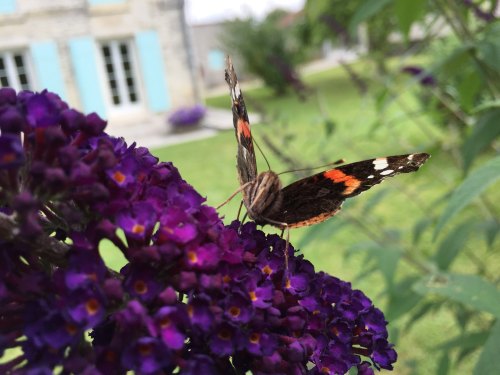
We have a number of buddleia bushes in our garden. Most of them produce these amazing purple flowers (one produces white flowers) which butterflies and hummingbird moths just love. I like to sit close to these bushes where I am surrounded by dozens of these beautiful creatures. The wings of the hummingbird moths are so fast that they emit a deep buzzing sound so you know when they are around, but the butterflies are completely silent.

I can watch them for ages. I love to see them up close like in this photo. You can see them delicately slipping a long proboscis into the centre of each little flower. They are so quick and so accurate. And of course their wings are painted so gloriously.

The butterflies stimulate two trains of thought for me – unpredictability and change.

I’ve tried to see if they work around a bush in any kind of methodical way but I can’t see that they do. Every move seems totally random. They’ll be selecting one little flower after another to explore, then suddenly they fly off into the air, zigzagging around, up, down, left and right, then might settle again on the exact same flower they had just left, check out a different part of the bush or fly off to a neighbouring bush. There’s just no telling where they are going to go next. Their whole movement seems to embody randomness. It’s quite something.

Then if you stop to think about how the butterfly you can see is only one stage in a cycle of astonishingly different forms you realise very quickly why they are the symbols of metamorphosis and change. From egg, to larvae (caterpillar), to pupae (chrysalis) and the beautifully winged creature. A life of the most incredible phases and changes. As far as I know nobody has managed to explain how this cycle of change came about. We change throughout our whole lives, and our bodies change a lot, but not as much as these butterflies. Maybe our most astonishing changes are on the inside – our psyche and and our spirit?

Then when I get thinking about these butterflies and wonder where they go when the buddleia are not in bloom I find that many of them are migratory, traveling between Africa and Europe, cycling back and forth between very specific locations. How do they do that? How do they find their way over hundreds, no thousands, of miles? But wait, it’s even more amazing, because for some of them the journey is long it takes several generations of them to complete it. Now how do they do that? How does the great great grandchild of the butterfly which left my garden find its way back to my garden when its parents and grandparents had never ever lived here?

So, here’s what the butterfly in this photo is the symbol of for me – curiosity and the unfathomable depths of our human lack of knowledge and understanding?

So much to learn, so much to discover, so much to understand.


Read Full Post »

Twelve project Day Six.jpg

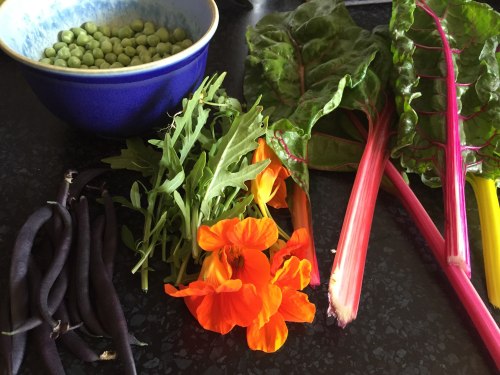
Day six of my twelve images, one for each month of 2016, (the twelve project) brings me to June. Look at this – gathered over a few minutes from the potager, our vegetable patch in our garden. I’ve lived in a second floor apartment for many years, but since moving to France I’m living in a house with a garden. The potager isn’t large but in this part of the world a wide range of plants thrive outside without.

Every vegetable is a revelation. Look at the colours! Sadly, what I can’t share with you are the tastes, but believe me the tastes are every bit as intense, varied and impressive as the colours. Have you ever tasted vegetables which were literally minutes ago still growing in the soil a few yards away? They are different. I didn’t realise radishes had a nippy, peppery taste until I ate the ones which were straight out of the ground. Fresh peas are a totally different flavour from frozen or tinned ones. And that rainbow chard you can see on the right hand side there? I’d never come across that before but isn’t it a fantastic colour? Cut into ribbons and added to a stir fry they are a revelation. The rocket leaves are as peppery as the radishes. I hate bland, tasteless rocket leaves. They seem such a pointless thing to eat, but fresh leaves are zingy. I could go on….you don’t see in this photo some of the other great tasting veggies which matured a bit later than June….the tomatoes which grow in abundance in several different varieties, red, yellow, striped…..the courgettes, oh, the yellow courgettes, totally delicious….and later yet, the squashes, pumpkins, butternut squash and so on…..

There’s something else which has happened from experiencing this food. I’ve become more aware of the seasons, looking forward to certain foods at particular times of the year, I mean in the local markets and supermarkets too, not just from the garden.

I’ve begun to strongly favour food which is as fresh, as little travelled and as little processed as possible. In the markets and shops I look at the origin of the food now and opt for the what’s been grown close over what’s come thousands of miles.

I’m enjoying salads and salad vegetables more than I’ve ever done before. When I was growing up in Scotland salads were dull, boring and tasteless. A couple of lettuce leaves, plus a tomato and some cucumber chopped up and maybe some cheddar cheese. Here in France people have a few salad leaves (mainly varieties of lettuce….yes there is more than one kind of lettuce! Who knew?) with a sprinkling of vinegar and oil dressing, almost with every main meal. Just on the side. It’s delicious. In fact, there’s a restaurant in Bordeaux, “L’Entrecôte”, which has no menu but serves everyone salad leaves with their own special dressing and walnuts sprinkled through them as a starter, and steak and chips as the main to everyone. You can’t reserve a table and there is a queue stretching along the pavement outside every lunchtime and dinnertime seven days a week.

I’m enjoying a simpler level of food preparation and a larger range of foods than I’ve ever done. When the food is fresh and locally produced it tastes so good it doesn’t need much preparation.

And, here’s the final thing. I’m eating most of my meals outside for about four or five months of the year. Both in the garden, and when out and about.

I moved to France from Scotland to savour a different lifestyle. Climate and food are two of the biggest influences on that lifestyle. I think this photo from June captures some of that.

Read Full Post »

twelve-project-day-five

The photograph I selected for Day Four of the Twelve project reminded me of one of the days when colour and light grabbed my attention. Day Five’s photograph was taken the day that a noise I’d never heard before made me stop what I was doing and open the front door to find out what was on earth was happening.

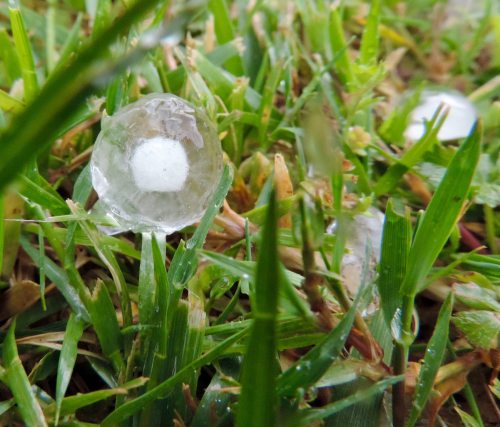
The noise started suddenly and seemed to completely fill the world. It was a clattering, hammering, thundering noise, like the heaviest of heavy rain but with a harder quality to it. When I opened the door I saw chunks of ice falling everywhere. When it hit the garden table and chairs it played them like a set of drums. When it hit the grass it bounced back up a couple of feet before landing back down again – the grass was covered with white pieces, not like snow, not like frost, but as if a giant bucket of white marbles had been poured out from the sky. I could here a very strange noise which was the sound of the hail tearing through the leaves of the mulberry tree and all the other plants in the garden. Leaves, and bits of leaves, were flying everywhere. I held out my hand and was immediately stung by hailstones.

There was nothing to do but wait till it passed. Of course I grabbed my camera and took some video clips to record both what I could see and what I could hear. It lasted about fifteen minutes, then it stopped, as suddenly as it began. I wandered out and started to look more closely at the ice particles.

Every single one of them was different.

There were ragged, irregular ones, round ones, opaque ones, transparent ones, some which looked like small sculptures and they were a huge range of different sizes. I photographed many of them.

This one particularly caught my attention because it looked for all the world like an eyeball, which was spooky to say the least.

I look again at these photographs and I’m astonished at the diversity. I read many times that no two snowflakes are identical but to see that played out around my feet in these ice particles made that fact all the more powerfully real.

Water. It’s just water. How incredible that it can form into what appears to be an infinitely large range of shapes and sizes.

And what power! I wrecked havoc in the vineyards around here. In a neighbouring village the storm lasted twice as long as here – half an hour – and in that time it destroyed the entire year’s vines.


Read Full Post »

twelve-project-day-four

Day Four of the Twelve project – 12 images, 12 months, 12 posts over 12 days.

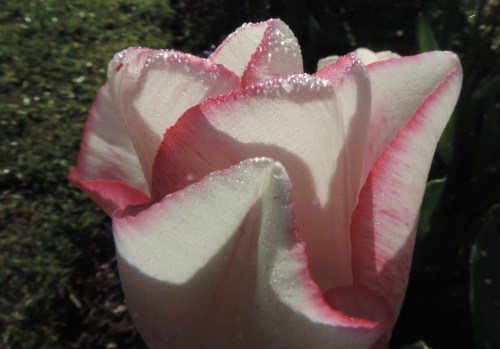
In April the garden filled with colour as the bulbs we planted months ago shot up and expressed themselves with fabulous flowers. There’s an old saying about “March winds and April showers bring forth May flowers”, but Nature is never as predictable as that. Nature doesn’t use protocols or obey a limited set of strict rules. But there’s still something in that old phrase, not least a call to remember that wind and rain are necessary factors in the seasonal cycles of plants.

I start every day by stepping outside into the garden. I open all the wooden shutters to let the light in through the windows and I turn my gaze to the garden, the field, the vineyards and the sky. Colour catches my eye. A splash of white, red, yellow or blue. I’m drawn towards it. So on this April morning I was drawn to this particular flower and as I bent forwards to look more closely it took my breath away.

The water droplets beaded along the edges of the pink-fringed petals caught the morning sun and sparkled like precious jewels. The shadows of one petal inside another gave me the impression that light was actually emerging from within the flower itself. The delicate pattern of the pink on the white petals looked as if the flower had been lightly dipped into red paint, some of it running slightly from the edge down into the rest of the white petals.

It looked brand new. Freshly made.

Here in this one flower I could see the emergence of the alchemy of Nature working with the four elements – creating its green stalks and white petals from the earth, drawing the energy of the fire of the sun to grow and unfold itself, gathering the elements from the air to forge them into substance, and all with the life-giving power of water.

And maybe more than anything else, it is utterly beautiful. A true work of art.

How lucky are we to be surrounded by such magic and beauty.

“L’émerveillement du quotidien” – the wonder of the everyday.

Read Full Post »

twelve-project-day-three

Day Three of the Twelve project – 12 images, one for each month of 2016, used to create 12 posts, one each day for the 12 days of Christmas.

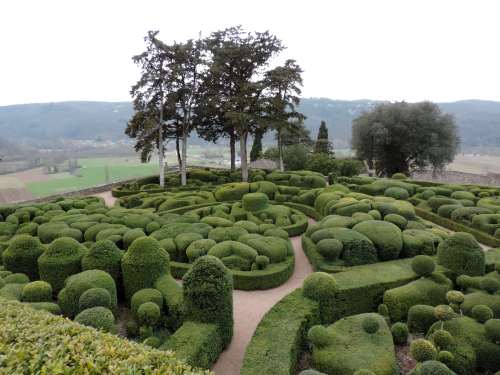
In March 2016, I visited Marqueyssac gardens in the Dordogne. This wonderful place has several, vastly different areas, from woodland scattered with art works, to winding rocky paths on the edge of a cliff, to this astonishing area of topiary.

I’ve seen lots of topiary elsewhere but usually its the odd bush shaped like an animal, or a small planting of bushes shaped into pyramids or spheres, but here…..well, for a start there are more shaped bushes here in one space than I’ve ever seen before, and, more interestingly, they retain a fundamentally organic form. They don’t just look like bushes fashioned to appear like something else. They retain the diversity you usually associate with Nature. The way they grow together also gives a strong impression of a community, or, from a little further back, a whole organism.

This was my inspiration this year for my writing about the two universal forces – whether we think of them as the forces of chaos and order, of wildness and discipline, or of flow and structure, we find them at work everywhere. And here, in Marqueyssac we see how something utterly entrancing emerges when we get a true integration of these two forces.

This has been such a year of divisions. Dualistic, or binary, thinking seems to be on the rise – you have to choose sides. One is good, the other is bad. You can choose science or art, reason or emotions, right wing or left wing….and so on. When we do that with the fundamental forces we end up emphasising order and control at the expense of freedom and wildness, or we choose structure over flexibility, but actually, in the universe, the greatest beauty, and the release of the greatest potential comes when we aren’t forced to choose one at the expense of the other.

I think the clearest way to think about integration is to consider the relationship between our heart and our lungs. They are completely different organs, grown from distinctly different (“well differentiated”) cells. The heart works best as a heart, and the lungs work best as lungs. Neither would do so well if our body chose between them and supported only the heart, or only the lungs. Turns out that the heart can’t be at its best without the lungs, and the lungs can’t be at their best without the heart. They work together for their own, and for each other’s mutual benefit.

That’s the definition of integration which I like best – the creation of mutually beneficial bonds between well differentiated parts.

And that’s what I see when I look at Marqueyssac gardens – discipline and wildness, structure and chaos, beautifully integrated.

Even without any of these thoughts, these gardens would have been wonderful to visit. Take your time. I spent about three or four hours there and could probably have spent longer (if I’d started earlier!) What an experience! It stays with me, not simply as a memory, but as an inspiration, a series of images, a stimulus to my imagination and my thought.

Places like these are the special places on the Earth – they act as our muses. They lift our spirits, and reach deep down into our souls.


Read Full Post »

« Newer Posts - Older Posts »