Feeds:
Posts
Comments

Archive for the ‘photography’ Category

Day Two February.jpg

Over twelve days, starting on December 26th, I’m selecting one photograph from each month of 2016 and sharing it here with you. My choices are based on the images themselves, plus what they represent about my life here in France.

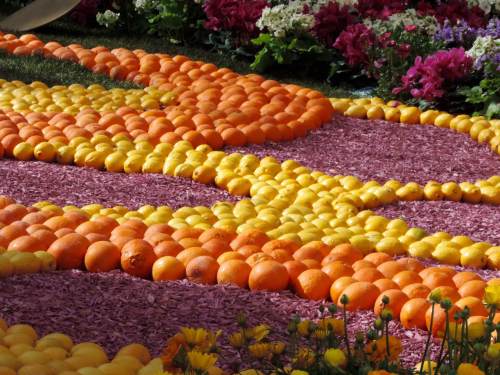
Down in the bottom right hand corner of France, the region in the south east which borders onto Italy, is a town called Menton. I’ve visited it a few times in my life and have always liked it. I like its fabulous synthesis of French and Italian culture. I love the colours of the buildings, the views of mountains and sea, the variety of cafes and restaurants, and the ease with which you can pop over into Italy and back. Once a year, the town of Menton holds an event called the Fête du Citron. It lasts for three weeks with a parade through the town each Sunday, a night parade midweek, installations of sculptures made from oranges and lemons, and various other events. In 2016 the theme of the event was “Italian cinema”.

I’ve never seen such immense sculptures made from fruit. They are absolutely astonishing. Some are the size of buildings, some are pulled through the town during the parades, and all are simply, astonishingly colourful and beautiful. But here’s what made the biggest impression on me – the celebration.

Maybe it’s because of the shocking and disturbing terrorist attacks and the appalling stories of brutality and oppression reported in the news in this era but to see thousands of people parading sculptures, no, whole scenes, made from orange and yellow fruit, through the streets of the town, with the buzz of the admiring crowds, the loud Italian movie theme music, the marching bands, the street dancers, the joyous smiles and laughter on the faces of participants and spectators alike…..it was SUCH an antidote to all that horror. This celebration. This delight in dressing up, singing, playing music, dancing, creating works of art, this enjoyment of the spectacle, is such a unique human experience. Yes, it seems some humans have a very mean-spirited, anti-life approach to living, but here was a great example of that opposite pole. Here was a celebration of beauty, colour, music, art, storytelling, dancing, singing, and laughing together.

Uplifting.

Life-enhancing.

Joyous.

Wow, am I grateful to have been able to participate in this celebration of being human.

February 2017, the 84th Fête du Citron will have a theme of “Broadway”. It’s likely that, like this year, about a quarter of a million people will visit and share the celebrations.
 

Read Full Post »

Day one January.jpg

Towards the end of the year we tend to come under the influence of Janus, the god of beginnings and endings, who is usually represented as having two face, one facing back, and one facing forwards. That’s where we get the name of the month “January“. He is also god of gateways, doorways and transitions. As I transition from 2016 into 2017 I decided I’d look back over the twelve months of the year and select one photograph I’d taken for each month. I’d choose on the basis of liking the photograph as an image, but also because that moment in my life was a special moment, a day I want to remember because it was an “ordinary day” where it felt “extraordinary”.

I’ve been living in France for a couple of years now so I thought this would also be an opportunity to share something of my experience of the quality of life I’ve been blessed to find here.

Here’s my moment from January.

I’m living in rural France, in a traditional Charentaise style of house at the end of a short road which becomes a trail through the surrounding vineyards. Having lived in a second floor apartment in Scotland for many years before moving here, living in a house with a garden on the edge of the countryside is a huge change for me.

Maybe on the main differences is how much I notice Nature now. There are a lot of birds around here, and many of them are species I’ve never seen before. I’m learning not just what their names are, but what their French names are too, and I’ve bought a beautiful huge book about the birds which live in this part of France. Sometimes its their movement which catches my eye, the way they fly over the garden, or the way they hop back and forth between the trees, the bushes and the grass. Sometimes its a flash of colour, a splash of blue, or yellow, or red. Sometimes its their song or their call which grabs my attention and I scan the landscape to see who it is who is calling.

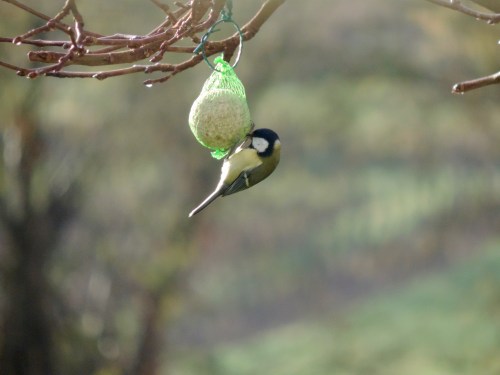
I discovered that you can buy bird food in the local garden centre, so I bought a bag of these “fat balls” and hung them from the mulberry tree which had shed all its leaves at this time of year. I found that if I hung the balls from the branches, it was mainly beautiful tits and finches which came and clung on to the netting while pecking away at the food.

Look at him. Isn’t he beautiful? Life astonishes me. Every day. I look at a little creature like this and I’m in awe. I wonder at the diversity of Life, at the emergence of Life in the creation of the Universe. I wonder at the beauty we can see wherever we look. It delights me.

Thank you, little bird, for sharing this part of the world with me.

Read Full Post »

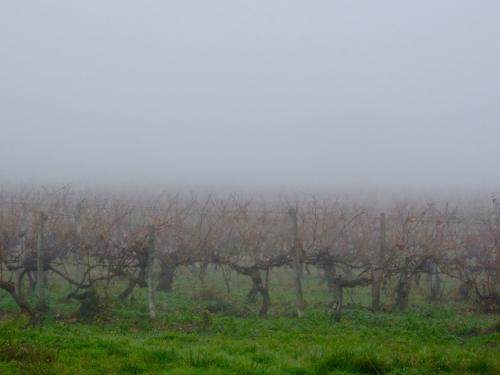
vine-fog

I stepped outside to open the shutters this morning and was stopped in my tracks by the fog. Yes, of course, I SAW the fog when I opened the door, but it was the SOUND of the fog which stopped me.

I stood there and thought “Is this Sunday?” (It isn’t, it’s Tuesday), because in this part of the world, sundays have a very particular sound – a sound of silence. But this was different. It was like the sound of snow. Except it wasn’t. When you stand outside in the snow the world has a distinct quality of silence. A kind of muffled silence. This silence was different from that. It wasn’t a silence which muffles, it was a silence which made the world clearer.

How can a silence, a fog, make the world clearer?

I didn’t have an answer to that question so I did what I usually do. I got my camera and took a couple of photos. Don’t the vines look like dancers in this photograph? Doesn’t the grass look richly green? The fog brings the foreground closer. Ah, yes, maybe that’s the answer. By hiding the distance with a veil, the fog has concentrated my attention on the near. The here. The now. The present.

I listened for a few moments. Nothing. Silence. No wind, no rustling of leaves. Then the sound of a pigeon with its squeaky wings flapping above me. But I couldn’t see it. Silence again. Then out of nowhere a flock of maybe thirty or so starlings, rushing from one tree I couldn’t see to another. A sudden appearance, as if from nowhere, and gone again in a second, to nowhere else.

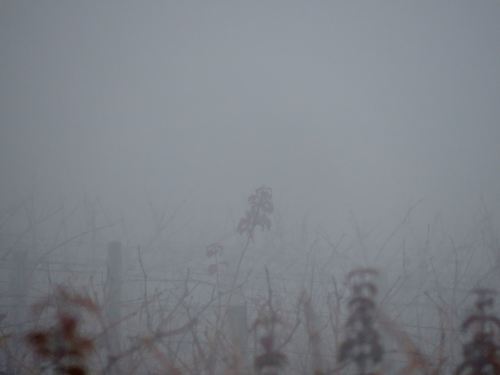
I peered over the fence and thought I could see a solitary bird perched on one of the vines. I zoomed in my camera lens and saw it was this –

foggy-view

A few late leaves, still standing strong, reaching upwards to a sun we couldn’t see. (“We” being the leaves, the vines and me) Isn’t there something strangely beautiful about such a view? The lack of detail makes the details which I can see even more powerful. Not vivid. But powerful.

Oh, what a delight. What a blessing.

Thank you, Fog, for this intensity, for this moment which made me feel so alive, so filled with the delight and wonder of the sounds, the sights, the scents, the coolness, of here and now – what a present!

Read Full Post »

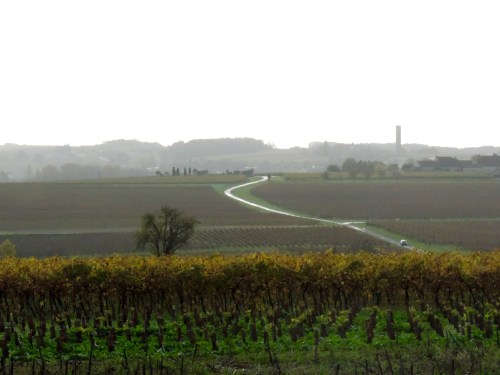
road

I was out for a walk recently and took this photo. The winding road lit by the morning sun caught my eye. The road draws us along it, doesn’t it? We instantly, and largely unconsciously, follow its path through the vineyards, turning at the top of the hill to disappear over the top and behind some trees. Yet beyond that lies another hill, less distinct in this light, with a tower standing high on the right. What is that? What’s over there? Where does this road go?

It feels like there is a story here in the making. It feels like we are being encouraged to look into the future, to see what “lies beyond”. That’s such a great thing to do. Our brain thrives on novelty. The right hemisphere, in particular, is always on the lookout for the new, always paying its broad attention to the world around us, sensitive to changes, to new sensations, and seeking to connect us to them.

The other side of that metaphor however is “who laid that road?” Because if I want to go and explore over that hill and see what’s there, chances are I’ll automatically, without thinking about it, follow exactly that path. And there’s something else we all do every day. Follow the paths that others lay for us. We hear a lot these days about propaganda, about the slant on reality pushed by mass media owned by a handful of people, and rumours, lies and conspiracy stories spread through social media. Which all raises the question, “how am I to make my way through this life?” “Whose stories, whose paths, whose directions, am I going to allow to determine the paths I’ll take?”

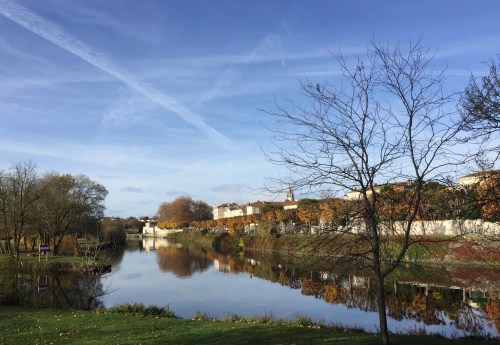
charente-at-saintes

Here’s another image. I took this one while walking to the Saturday market in a nearby town. This is the Charente river. It looks like this pretty much anywhere you encounter it as it flows through this region (which is also called “the Charente”). It flows with a kind of ease. It rarely looks turbulent. People in this area use it as a metaphor for a way of life. No, maybe more than that, people in this area are influenced by the physical appearance and behaviour of this river in a way which encourages them to live “the slow life”, or, as is often said around here “soyons zen” (“let’s be zen” – relaxed, chilled out, calm).

I think I prefer the metaphor of the river to that of the road. The road seems more fixed somehow. Heraclitus famously said it isn’t possible to step into the same river twice. That’s so clearly true because you can see the water flowing by and you know it’s not exactly the same river now as it was even a few minutes ago. That teaching applies to everything in life of course. Even if a tarmac road isn’t all that different from day to day, you’ll never repeat exactly the same experience of travelling that road.

The river forks at this point where I took the photo. You can see some of it heading off to the left, whilst the rest heads to the right. Life is very like that too. We come to these natural branches, these forks in the road, and we have to choose which one to follow. I think its true that there isn’t necessarily a right choice and a wrong one, and if we at least choose consciously we can feel more “in the flow” in our own life.

Finally, look up into the sky of this photo of the river. There’s a third metaphor about travelling through a life. The contrails in the sky show us where the planes have been (approximately….these trails move and begin to disappear from the instant they are created), but they don’t show us where the plane is going (well, only very vaguely). This reminds me of how we make sense of life by looking back. We understand the present moment in the light of our life so far, the experiences we’ve had, the decisions we’ve taken.

As best I understand it we also make sense of the present moment by factoring in the possible futures we can imagine, so maybe all three of these metaphors have something to contribute – the road, the river, and the trails in the sky…..


Read Full Post »

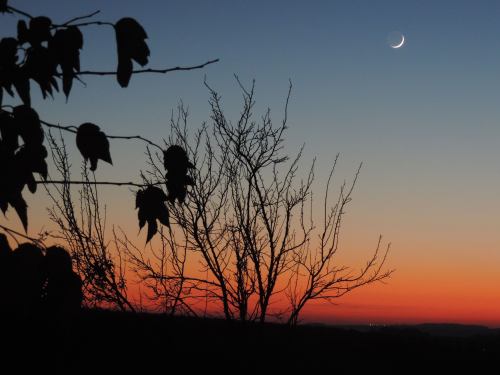
autumn-moon

The other evening the faraway glow of the sunset and a tiny sliver of moon both caught my eye at the same time. So I stepped outside with my camera.

I’ve got some shots of just the sunset, just the moon, and the sunset and the moon in the same frame, but this one includes the foreground and I love it all the more because of that.

Here I can see the last leaves of the mulberry tree in front of the now bare plum tree with the silvery sliver of moon hanging high above them as the sun, which has by now sunk below the horizon, casts such a gorgeous palette of reds, oranges, tobacco and yellow, and the lights of the neighbouring village begin to twinkle before the stars do.

I love the setting sun, and I love the dawn. I love that rhythm of day becoming night, and night becoming day. I love that we can’t pin either the dusk or the dawn down to a precise time, in the way that the meteorologists tell us the exact time of the sunset and the sunrise. I love how the light disappears so slowly and reveals just some of its diversity which is hidden in the white light of noon. I love how it reappears in the same way it disappears but in an entirely different place.

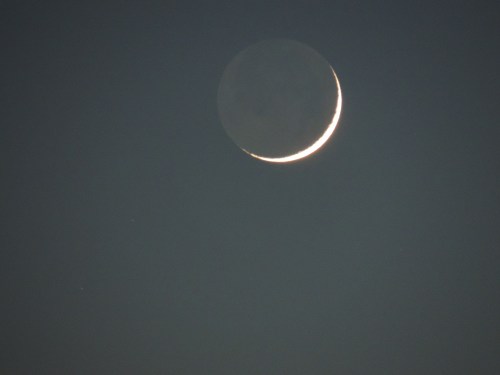
I love the phases of the moon. Look closely and you can see the whole moon in this photograph. Here’s a close up which shows you that more clearly

first-phase

This isn’t a fantastic shot, but it’s handheld and spontaneous. It does show the whole sphere of the moon and the white crescent is more obviously the reflected white light of the sun than we sometimes realise. But just think how this photo was taken at the same time as the one above. That deep, deep red light of the setting sun caressing the Earth, and that radiant, dazzling white light of the now hidden sudden bouncing off the Moon.

I love the autumn too. Like the Spring it’s a season which makes you more aware of the rhythms of the Earth, and in particular, more aware of the constant nature of change.

So in this one moment I see the rhythms of the seasons, of the sun and of the moon.

I rather like that!

Read Full Post »

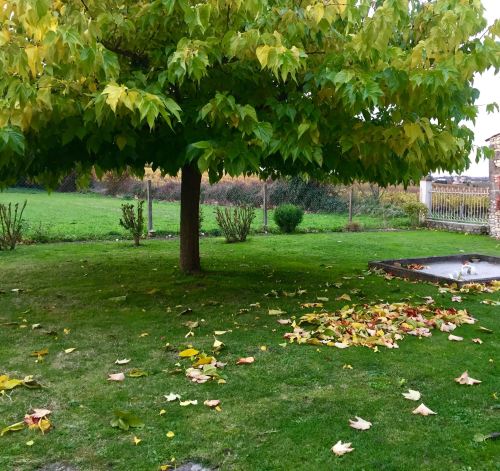
gathered-leaves

In this season the leaves begin to fall and one of my daily activities is to rake them up. Before I moved to France I lived in a second floor apartment so leave raking wasn’t part of my life. I’ve found that I really enjoy it. It gives me great pleasure. I know it’s not the same as a zen monk raking his stones, but there is something of that quality to it. I don’t rush it and the sweeping movements with the rake feel strangely relaxing. It’s also really pleasing to gather the leaves into a heap, then to scoop them up to take them away to the “déchetterie” for composting another day.

I am constantly amazed by the variety of shapes, sizes and colours, and often pause to look at a leaf more closely, to turn it over in my hand and feel its texture.

Once I’ve finished raking it feels like having tidied up, or cleaned a room. It’s satisfying. You can immediately see the results of your efforts.

The other morning I opened the front door, unlocked the shutters and stepped outside to see what I’ve captured in this photo. During the night the wind had worked differently from usual. Instead of scattering the leaves everywhere it had gathered them together into this heap under the tree. I hardly needed the rake that day. I just had to scoop up the leaves with my hands.

I remember years ago I used to read an American magazine entitled “Wired”, and they had a regular column of “new words”, neologisms which people were starting to use. One which really impressed me at the time, and has stayed with me ever since, was the word “pronoia”. You know the word “paranoia”? Which means the delusion that the world is conspiring against you. Well “pronoia” means the delusion that the world is conspiring to help you out!

I had a real sense of pronoia the morning I took this photo……

As I sat down to write this post I remembered a thought which has been attributed to Einstein, although I believe there is no record of him ever having actually said it.

“I think the most important question facing humanity is, ‘Is the universe a friendly place?’ This is the first and most basic question all people must answer for themselves. For if we decide that the universe is an unfriendly place, then we will use our technology, our scientific discoveries and our natural resources to achieve safety and power by creating bigger walls to keep out the unfriendliness and bigger weapons to destroy all that which is unfriendly and I believe that we are getting to a place where technology is powerful enough that we may either completely isolate or destroy ourselves as well in this process. If we decide that the universe is neither friendly nor unfriendly and that God is essentially ‘playing dice with the universe’, then we are simply victims to the random toss of the dice and our lives have no real purpose or meaning. But if we decide that the universe is a friendly place, then we will use our technology, our scientific discoveries and our natural resources to create tools and models for understanding that universe. Because power and safety will come through understanding its workings and its motives. God does not play dice with the universe,”

Well, even if he never actually said it, it’s still an interesting thought to turn over in your head for a bit, isn’t it? So many people live as if the universe is harsh and hostile and they need to struggle against it, to overcome it. Yet others believe the universe couldn’t care less and that everything that occurs is completely random and meaningless, even an individual life. But there is this third option, which is that the universe is actually a creative, “friendly” place. If you think that way, then every day becomes filled with wonder and delight. Every day you encounter something, or someone, astonishing.

I prefer the third stance. I think there is too much beauty and elaborate complexity in the universe for it all to come down to either malign intent or apathy. There’s something amazingly wonderful about a leaf, a season, an ecosystem, a bird, a person…..I’ll never tire of being amazed by, and trying to understand, my daily life.

Read Full Post »

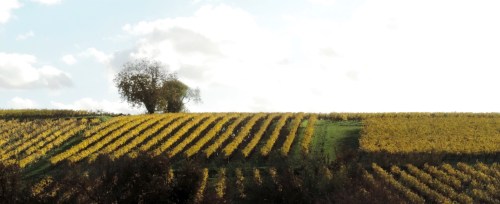
hilltoprowstree-on-hilltopwires

I’ve lived here for two years now, so this is the third time I’ve seen the vineyards turn golden like this. The vines are fascinating all year round but in this season they are particularly beautiful.

I was just recalling some of the thoughts I’ve had which have been directly inspired by this countryside. The landscape around here looks just like this. It is so different from the wild mountainous landscape of Scotland. But once the grapes are harvested, the processes involved in turning them into cognac are very similar to the ones used to turn barley into whisky. The culture of blending, tasting and savouring cognacs is very, very like that of whiskies with each distillery producing distinct flavours depending on the ground on which the plants were grown and the work of the master blenders in the distillery. Two or three hundred years ago some of the distillery workers from Scotland came to this part of France and applied their knowledge and skills from whisky production to the local cognac.

The vineyards around here are old. There’s a noticeboard just outside this village telling the story of how in the 1700s particularly hardy vines were brought here from America to improve the local crops. The vineyard where the noticeboard sits is called “the field of experiences”, or, probably a better translation would be “the field of experiments” (I think I prefer the “experiences” over “experiments”, but that’s just me).

From these two little discoveries I realise how the distinct, unique character of this environment has been influenced by other parts of the world, other peoples, other plants. Nothing exists in isolation.

The “vignobles”, or vine workers, are busy all year around. The harvest was completed last month and one of the next tasks is tending to the individual vines, to remove any less healthy ones, any which have passed their best. I was startled by this work the first day I encountered it because it can involve using a tractor with a type of drill attachment to dig out certain plants. It sounds more like roadworks than fieldworks. Throughout the year the vine workers tend to each plant over and over again. Every single vine is pruned by hand. That’s another thing which surprised me. I don’t think farmers attend to each plant individually in a field of grain. I’m not sure that would be possible. But these vines are not like fields of grain. They are, more obviously, rows of individuals. From a distance, as in these photos, it is hard to see them as individuals, but to the vine workers every single plant requires their full attention.

That balance between the one and the many is something which is often at the front of my mind. I thought of it often in my work as a doctor, always mindful that even if this next patient was bringing me a story of a particular disease or disorder, they were always more than “another case of…..”. They were always a unique individual who required my full attention.

One final thought, before I finish today…..I’ve learned that although the landscape around here features vineyard after vineyard, that each vineyard too is different. One of the most important differences is the soil. Take a look at this map –

cognac-map-big

Each of these coloured areas produces a completely different flavour of alcohol. The large distilleries which produce their own distinctive blends of cognac will select certain amounts of grapes from certain regions, knowing that the flavours of each region are very different. Those differences have a lot to do with the different soil types, and a lot to do with the micro-climates created by the particular landscapes and locations.

I often wonder about our relationship to the physical world. How the environment, the water, the climate, the shape of the landscape, all influence us, how we, as human beings respond to and, in turn, shape the very environment in which we live.

We hear quite a lot about “identity politics” at the moment. Over the summer I read a piece of research which investigated the beliefs and attitudes of young French people to explore what influenced their identity. The conclusion was that the strongest influence on their identity was geography. They felt French because they lived in this part of the world called France. Not because they belonged to a particular race or religion, but because they lived in this land. That gives me hope.


Read Full Post »

I want to share three photos with you today.

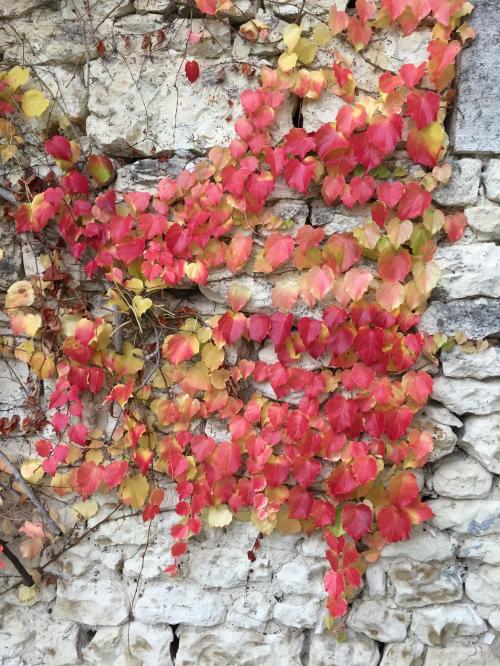
There is a large stone wall along one side of the garden where I live. It is covered with a plant called “Boston ivy”. In the winter it is bare…just a web of brown creepers clinging tightly to the stonework. In the summer it is a dense, deep green. Towards the end of summer millions of seedpods hidden behind the leaves, pop open in the last sun of the day, cascading down through the vine creating a sound that is for all the world like a waterfall.

But at this time of year, the change are at their most striking. The leaves turn golden, yellow, and a whole spectrum of reds –

red ivy.jpg

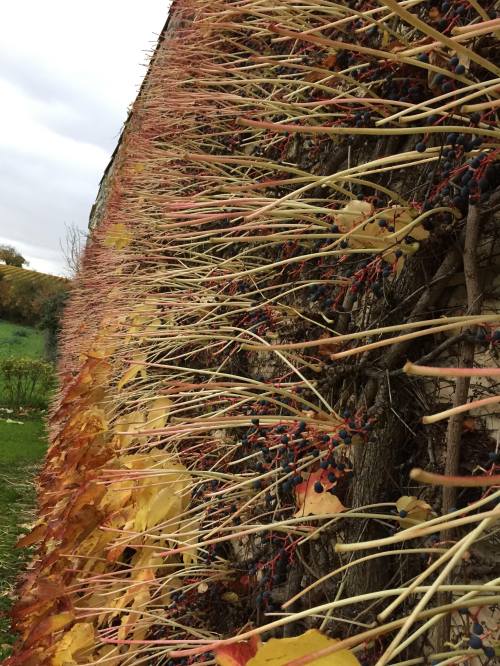
Then as the leaves fall, they reveal a forest of yellow stalks to which they were attached –

stalks

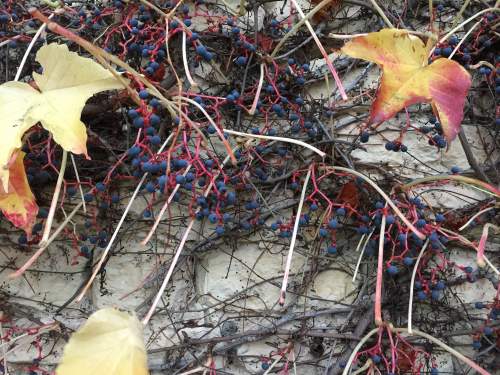
I’ve never seen anything like that in any other plant. After a while, all the stalks will fall to the ground too. But as the leaves fall away, they reveal the dark purple berries which hundreds of birds seem to desire – at least it seems that way to me as I see how busy they are every day just now.

berries.jpg

I think the red colour of the stalks which hold the berries is astonishing.

Such variety! Such variation! Such daily change! Something new to see and to enjoy every single day…….

Read Full Post »

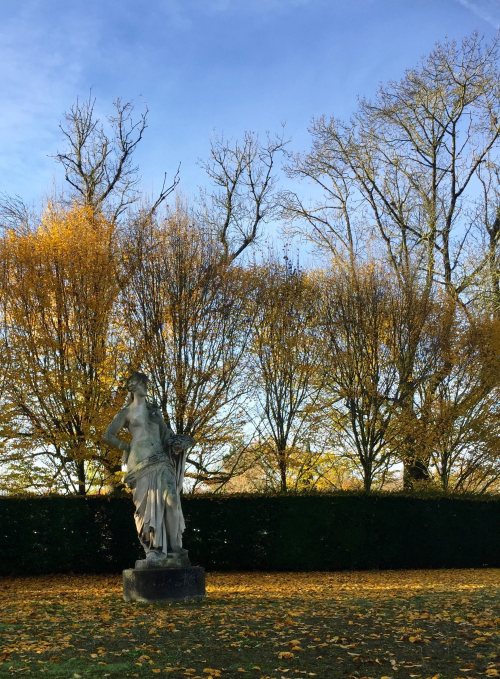
goddess-of-the-garden

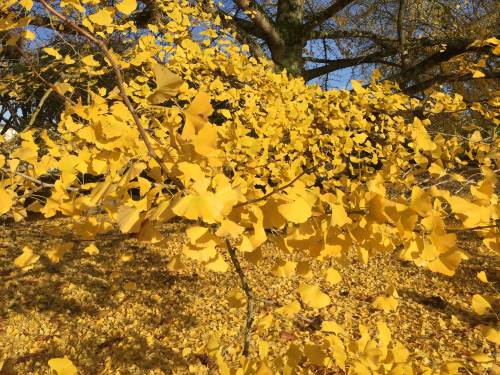
I stumbled upon a goddess in the gardens today. She looks well pleased now she’s finished painting all of the leaves yellow.

I think she’s every right to be pleased. She’s done a fantastic job!

ginkoes

Read Full Post »

img_5663

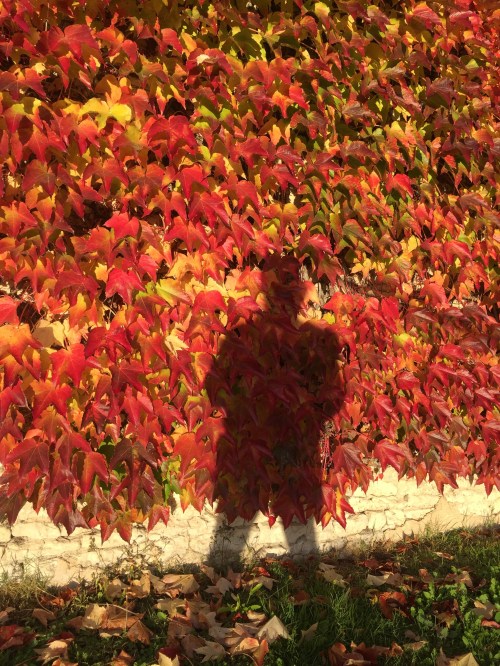
I stood with the morning sun at my back and gazed at the leaves of the vine which covers the high wall at the edge of my garden here in the Charente.

This is my third autumn living in France and from the Autumn Equinox I’ve been anticipating the glorious sight of these leaves. I can’t look at it too much. It captures my attention and utterly delights me.

This third time round strengthens my awareness of the cyclical nature of the seasons. Time no longer feels linear to me. It’s beginning to feel more like a spiral.

As I prepared to take this photo I noticed my shadow and instead of changing the direction of the shot, I consciously decided to include the shadow. Shadows pass much more quickly than seasons do but laying the one transience over another multiplied the effect for me.

I’ve written before about transience, and how it is celebrated in the Spring at the time of the cherry blossoms in Japan, and those memories and ideas popped up in my mind as I prepared to take this photo.

As I look at the image again now, I’m drawn more to ponder how my experience of time has changed in these last two years. The Charente in France has a snail as its logo to represent the “slow life” which is characteristic of this region. That’s one of the reasons I moved here. Slowness, in this way of thinking about it, increases awareness. A “slow life” involves taking the time to savour, to relish, to delight in the everyday – the air, the colours of Nature, the birdsongs, the flavour of vegetables grown in your own garden – you get the idea.

But I realise now that time has changed for me in other ways too. It’s not just that it passes more slowly. I’m more aware of the seasons now than I have been at any other time in my life. We had quite a cool and wet Spring, but from the Summer Solstice, the temperatures shot up and stayed in the high 20s, low 30s (centigrade, my American friends!) pretty much every day up to the Autumn Equinox which came with mists and cooler morning air. When autumn comes the vineyards which stretch in every direction from my garden turn golden, yellow, brown and red. It feels like living in a work of Art.

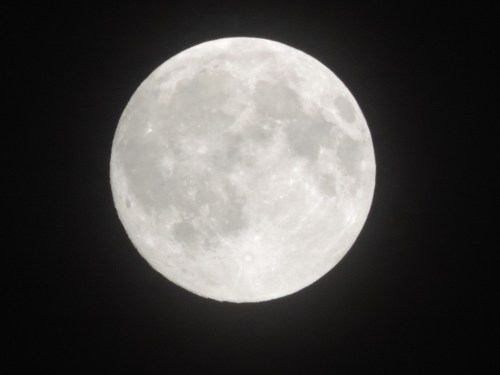
There are two more rhythms I’m aware of. My every day begins with my opening the blue wooden shutters which cover every window of the house, and ends with my closing them again. The shutters need to be opened and closed from outside, so my day starts with my stepping out into the morning, and ends with my gazing up at the stars. And there’s the final rhythm I’m aware of – the moon. Tonight is a full moon, a “super moon” apparently. I’ll look forward to seeing it.

dscn6732

How do you experience the passing of time? What rhythms are you aware of?

Read Full Post »

« Newer Posts - Older Posts »