Feeds:
Posts
Comments

Archive for the ‘photography’ Category

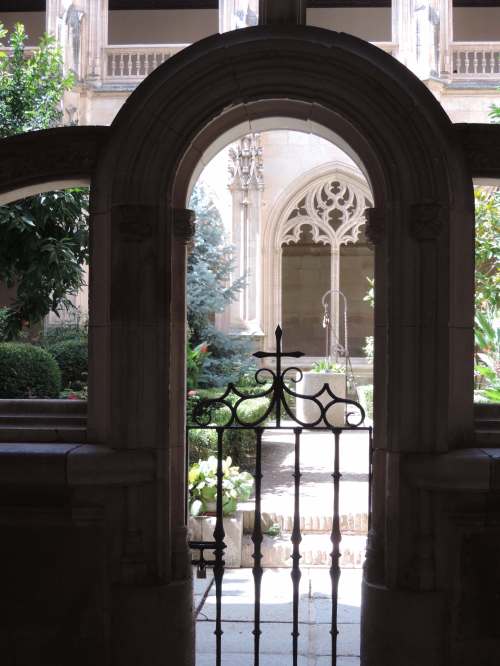
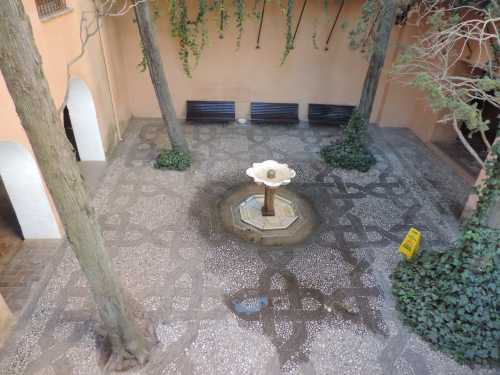
gate to cloister toledo cloister small cloister alhambra cloister simple cloister

I can’t remember when I first encountered a cloister or an inner courtyard. Part of me thinks it was in Marrakech where I stayed in a restored ryad. I loved how you could walk around the sheltered edges of the square, how there were places to sit, and how there were two other, what I think are essential, features – trees and water (either a fountain, or a well).

So, here are a number of photos from my trip to Spain last week. There are three kinds of courtyard/cloister here – very Christian, very secular, and very Islamic. Isn’t it interesting how these three different traditions have the same core features whilst they are distinctly different?

I think one of the reasons I adore these spaces so much is that induce a desire to slow down, pause for a while, and turn within.

Of course we don’t need these types of spaces to do that. I often recommended Julia Cameron’s “artist’s date” practice to patients – scheduling some time to spend by yourself doing something you don’t have to do.

When I came back home I listened to the latest episode of Onbeing, an interview with Mirabai Bush, about the importance of contemplative practice. During that interview there was a mention of the “tree of contemplative practices” which brilliantly illustrates the diversity of contemplative practices through the varied traditions in the world. I hadn’t realised there were so many.

We all need to find some way to be still and become aware. Maybe you have your own favourite ways, favourite places, or practices. Or maybe you’d like to explore some by clicking through on the links in this post……or maybe you’d just like to sit and gaze at one of these photos for a while and see where that takes you?
Read Full Post »

illuminate

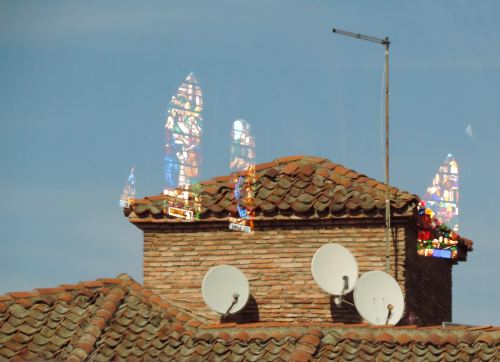
I stepped out through the back door of the cathedral in Segovia and onto a large paved terrace surrounded by stone lions. When I turned to look back to the tall arched doorway I noticed that the plain glass doors which hung in the doorway perfectly reflected the buildings across the street. I took a photo.

When I loaded up the photo later I noticed that there were some strange lights above and on the roofs and when I zoomed in I saw more clearly that behind the reflection of the tiles and the satellite dishes some of the cathedral’s stained glass windows shone through the glass door.

That got me thinking……

Here in this one photo is an interesting idea. For centuries the church has created the images and the stories to tell people what the world is like, what life is like, and how they should live. With captivating art and gripping stories it presented a particular view of the world. More than that, really, because in presenting that view and spreading it so widely, it created a reality for the people who lived in it.

But look at those satellite dishes.

Who is creating the images and the stories now? Who is telling people what the world is like? What life is like? And how they should live?

Who is presenting a view, and spreading it so widely, that it’s creating the reality for those who live in it?

With the rapid development in communications technology, with powerful mobile phones, connected computers, the internet, social media, memes, images and videos which “go viral”, some writers say we have created a whole new layer of the environment in which we live – the “noosphere” (the sphere of human thought). The truth is we’ve always had a noosphere. We’ve always lived, we humans, within this environment of human thought.

There are the image creators and the story tellers who fashion the patterns in this environment, and in so doing, they influence many others.

We have a choice. We can be the image creators and the story tellers, or we can be passive consumers. If we choose to be passive consumers, whose world, whose idea of the world, are we choosing to live in?

If we choose to be the image creators and the story tellers, what images shall we share? What stories shall we tell?

Read Full Post »

image

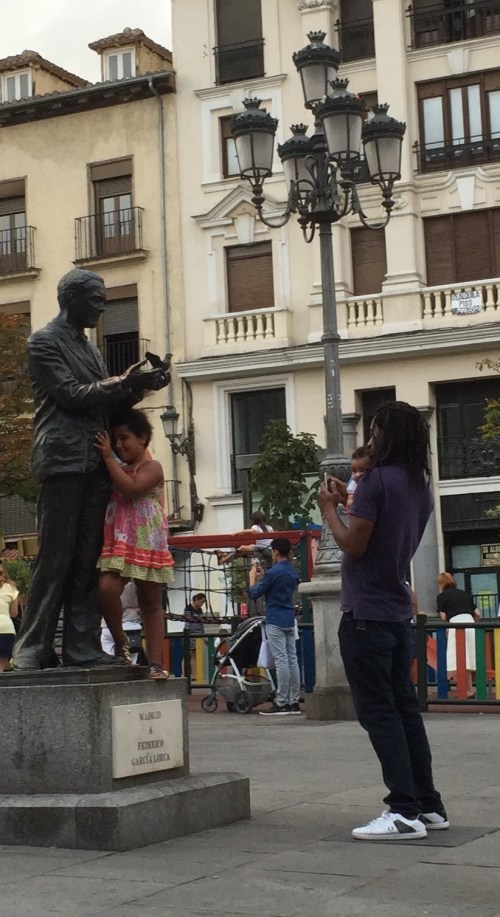
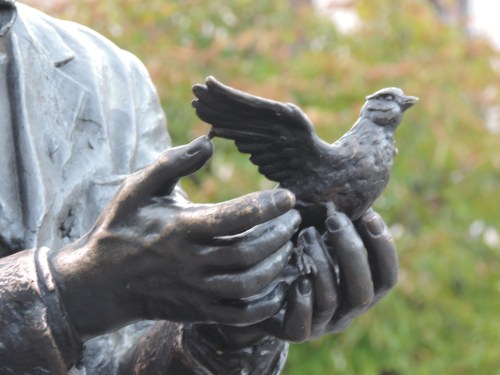
There’s a statue of the poet, Frederico Garcia Lorca, in the Plaza de Santa Ana in Madrid which has just become my favourite statue in the world.

He’s standing holding a little bird in his hands and what makes it such a magical piece of art is how children respond to it. They love it! I’ve been sitting in the square these last two evenings, enjoying a glass of wine and delighting in the sheer joy and fascination that this statue inspires. Lots of adults have their photos taken next to him, some take the photos with their own selfie sticks, but it’s the little children who really caught my attention. They gaze up at him and the bird. They ask to be picked up so they can touch him, or they climb up and hold his hands or stroke the bird. It’s beautiful.

image

It’s obvious why his hands and sleeves are so shiny…..so many little hands have held them.

“I will always be on the side of those who have nothing and who are not even allowed to enjoy the nothing they have in peace” Lorca


Read Full Post »

surfing

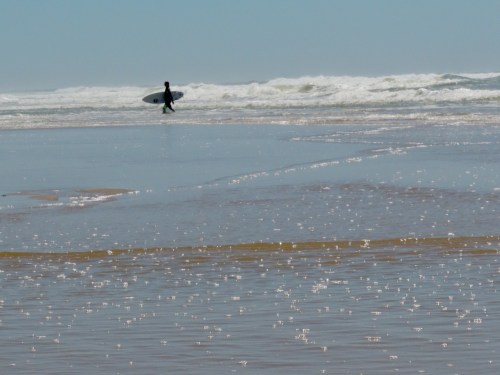
Lots of us love a trip to the beach, don’t we? I love the sound of the surf, the surge of the water, the breaking of the waves on the sand, and the rush of noise as the water flows back into the sea. It’s like breathing. It’s like the ocean is breathing. Have you ever taken a little time to watch the waves and see if you can spot any patterns? I’m not a surfer but I guess the surfers learn to read the waves in a language I don’t know.

I was lying on my back on the sand and I looked up and saw a number of seeds passing by high in the sky, blown along in invisible currents of air. I wondered where they had come from, and where they would end up.

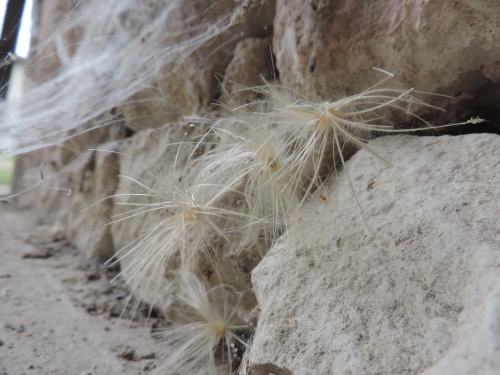
When I got back home I noticed these in the garage –

windseeds

Now I don’t for a moment think these are the same seeds! Sure, they are also windblown seeds but I really don’t think these are the ones which passed overhead at the coast making their way inland…..but probably not to my garage. But where did these ones come from? And is this the end of their journey? In my garage?

All this got me wondering about the things we do, the thoughts we think, the words we utter and write. I’ve often thought that all we do, think and say in life sets off and has effects we couldn’t predict, couldn’t have expected, and didn’t intend. I’ve tended to use the metaphor for waves for that. Like when you throw a stone into the water and you can’t tell what ripples will emerge or what effects those ripples will have elsewhere in the pond.

Others have used the story of the butterfly, haven’t they? You’ll be familiar with that I expect. How chaos theory shows that small changes in the initial conditions can result in massive differences in the outcomes, and how the story of a butterfly flapping its wings in one part of the world can result in a hurricane elsewhere.

But these seeds, blown in the wind, strike me as another powerful metaphor for these truths about our world. The connectedness of everything…..how nothing occurs in isolation, how because of the nature of connections and openness of systems we can never contain causes and effects in simplistic terms, and, so of course, how that means that unpredictability is the essence of life. How no-one, not even an “expert” can know exactly how the future will pan out.

So, these seeds might set off from a plant somewhere on the planet, cross seas, cross lands and end up either growing into a flower, a bush or a tree somewhere distant, of landing somewhere where there is no soil (like in my garage)…….or maybe that’s not the end of their journey if I, a human being, pick them up and release them.

If our actions, words and thoughts are like that, then maybe the best we can do is choose the good ones, the loving ones, the kind ones, the nurturing ones……so that wherever they end up they might contribute something positive to our world.


Read Full Post »

diversity potager

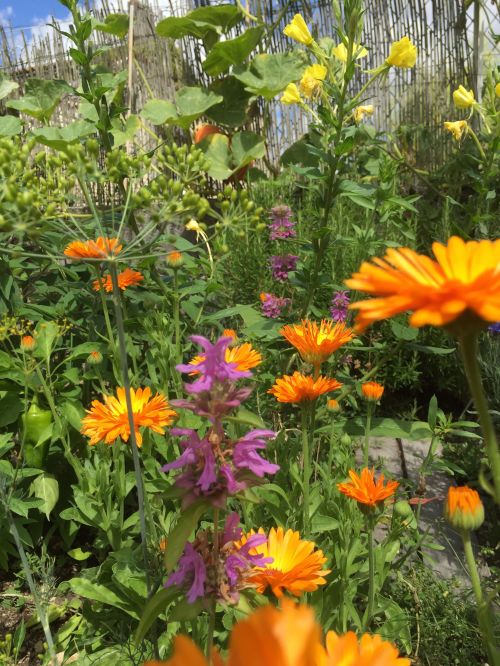
Here’s a small corner of our potager. I took the photo because the beauty of the abundant diversity caught my eye.

When I look at it now I realise that different people will see different things when they look at this.

Some might see competition – survival of the fittest – as each plant fights all the others for the most sun, the most water, the best nutrients from the soil. When the world looks like that its full of fighting, of winners and losers, of the pursuit of self-interest. In such a world is there ultimately one winner? One species of plant which beats all the rest and eliminates them from the competition?

Some might see chaos – unruly, disorder, no control. Does such a world need to be tamed? Does it need to be ruled, ordered and managed to produce….to produce “outcomes” – and what will those outcomes be? Who determines them? Who measures? Who manages? Who controls?

Some might see beauty and diversity – as I do – each plant expressing its uniqueness to the full, flourishing amongst the others. When the world looks like this, it looks like a community. It looks like a living, growing, healthy being. Gaia. Nature.

I see uniqueness here.

I see flourishing here.

I see community here.

I see beauty here.

What do you see?

Read Full Post »

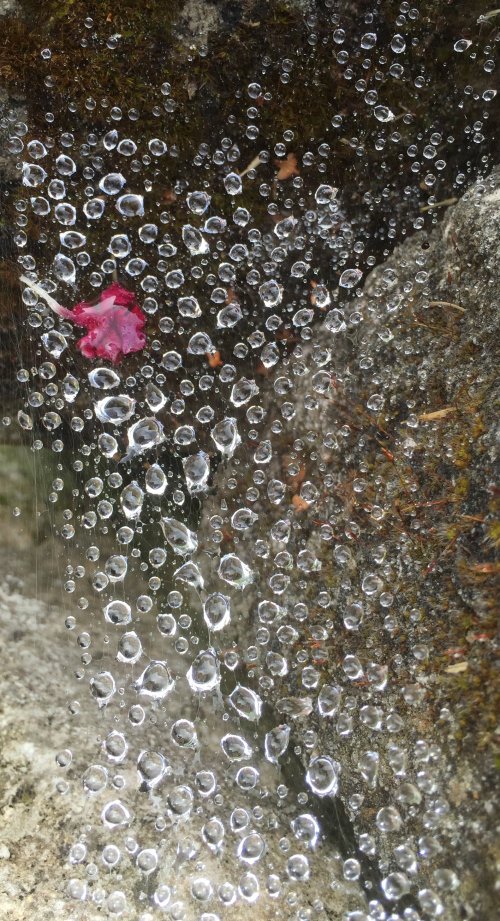
petal web

Thomas Berry and Brian Swimme who developed the new story of the universe talk about three core values which seem to be embedded in evolution. It’s a really interesting and different take on evolution. The story we have heard most over the last hundred years or so is one of a random, harsh, competitive universe full of “stuff” or materials which somehow have stuck together to make ever more complex objects which can each be studied and understood in isolation from each other.

That story never resonated with me and it can be argued it has more to do with the dominant politico-economic model of capitalism and “the market” than it has with science.

The three values Berry and Swimme articulate are differentiation, subjectivity and communion. Their claim is that take away any one of these three and the whole universe as we know it collapses. Brian Swimme also claims that we can use these three values to check if our actions are in harmony with the evolutionary direction and activity of the universe. In other words they can be considered as fundamental values which help us to assess and judge our behaviour and that of others (including politicians and economists).

Differentiation.  The universe started differentiating from its earliest moments. We don’t look around and see a homogenous mush – we see clusters, or “objects”. But the universe doesn’t just produce what Swimme calls “articulated constellations of energy”. It produces UNIQUE articulated constellations of energy. No two galaxies, no two stars, no two creatures are identical. Producing uniqueness turns out to be a key universal value.

Subjectivity. Everything has an inside. Even the simplest atoms are self-organising, self-maintaining phenomena. The particles within the atom are held together and organised by the atom itself. This self-organisation reaches its most complex in human beings. We are all “autopoietic” – we are “self-making” creatures. We self-defend, self-organise and self-maintain. Yet this interior “self” remains unknowable. We can’t see it, can’t define it, can’t pin it down. This interiority is what enables us to see every object as a subject.

Communion. Thomas Berry used the word “communion” to describe the relationships which exist everywhere. Nothing exists in isolation. Everything is connected to other things. We all live in a vast web of relationships.

This all leads to Berry and Swimme describing the universe as an “communion of subjects”, or as a “communion of differentiated subjects”.

Try this idea out for yourself. What does the world look like through this lens? What sense do you make of life which part of a “communion of subjects”?

When considering any political policy, any scientific description, any choices you might make, what happens when you set them in the context of  the three values of “differentiation, subjectivity and communion”?

For me, I experience a shift from fear to curiosity, from senselessness to meaningfulness, from isolation to belonging…..how about you?

Read Full Post »

far horizons

The country where you live now…..have you lived there all your life?

What about your parents? Or their parents?

According to the UN one in every thirty people lives in a country other than their birth country in the course of their lifetime.

That’s true for me. After retiring from clinical practice in Scotland two years ago this month, I sold up and moved to the Charente in France, which is where I live now. I had an ambition to live in another country for a long time and retirement gave me the opportunity. I didn’t want to just live in another country, I wanted to learn another language and to live in the culture of that language. I find it not only enlarges and deepens my experience of the world, but it changes my perspective on my birth country and culture too. It’s not a matter of one being better than another. It’s about the difference.

I guess I’m now a migrant.

I hadn’t really thought I was until the “Brexit” vote (don’t get me started!), but I now know I’m like millions, yes, millions, of Europeans who are born in one country and live in another. The EU project emphasises what they call the “four freedoms” and they are all freedom of movement – freedom of movement of capital, goods, services and people. What the people who promoted Brexit seem to want is to take away only one of those freedoms – the freedom of movement of people. They seem to prefer only the freedom to make money.

I read an article in a French newspaper recently where the writer questioned the policies which divide people who migrate into two categories – “economic migrants” and “refugees” – and asked who decided it was more noble to flee from war and violence than it was to try to escape death from hunger. Not all migration, of course, is about escaping from anything. Migration can be stimulated not just by fear, but by curiosity.

Migration has, of course, become a huge issue because of the surge in mass migration produced by the US and Europe destroying other states and bombing their cities. Is it any surprise people want to escape Afghanistan, Syria, Iraq, Libya and so on? But migration is what human beings do. As a species we’ve done that since we were hunter-gatherers and there have been huge waves of mass migration throughout history. Without those waves we wouldn’t have the diverse countries we have now.

I feel it’s time for us to tell a new story of migration – both of migration to escape something and migration for a better, deeper or larger life.

None of us need to go back many generations to find ancestors who were born in one country then moved to another. Maybe that’s the place to start…..tell the stories of our migrant ancestors, and tell the stories of our own migrations.

Read Full Post »

two

In the Spring of 1784, Armand Marie Jacques de Chastenet, marquis of Puységur, discovered that Victor Race, one of the peasants who worked on the marquis’ land, had pneumonia. The marquis had become interested in the work of Mesmer and “animal magnetism” so decided to see if he could help Victor back to health using this new method.

Victor fell into a trance and began to speak. But to the astonishment of his master, he didn’t speak in his usual patois, but in perfect learned French instead. Not only that but he talked about subjects that an illiterate peasant couldn’t have known about.

What happened next is even more astonishing. The marquis and Victor became a therapeutic couple. The marquis would ask an ill person about their symptoms….he’d “take the history of the patient”, and, in trance, Victor would pronounce the diagnosis and prescribe treatments.

Neither of these men were able to carry out the acts of healing by themselves, but together, they could.

This was one of the first recorded episodes of “lay mediumship” in Western civilisation.

I think that’s a remarkable story and I know of other instances from within my own lifetime where such astonishing collaborations occurred.

But even setting aside the somewhat “supernatural” aspect of these tales, isn’t there something like this going on in every therapeutic act? Isn’t every therapeutic act a collaboration between the patient and the therapist. Without each other they can’t achieve healing, but together, they have the chance to become something unique and greater than either of them. Together they can gain a greater understanding, and together they can find answers they couldn’t find alone.

I think we forget that in modern medicine, thinking that the doctor can do it all by him, or her, self. Thinking that one person has all the answers, ready made, so to speak.

There can be some of the most astonishing examples of magic happening when two people form a bond and work together for a common purpose.

Read Full Post »

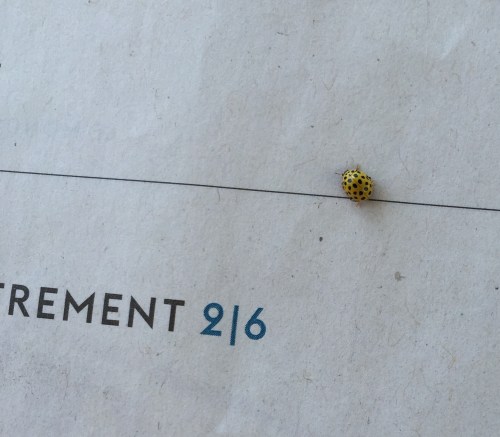
ladybird yellow

I was sitting under the mulberry tree last saturday afternoon reading the newspaper when this little creature landed right in front of me. In an instant I was back in the real world. Let me explain….

I think that when we are reading, particularly if we are reading something which engages us fully, then we become absorbed into a different world. It’s a world partly described by the author, and partly created by my (the reader)’s memories and imagination. It’s not that that world isn’t real, but it’s highly subjective and intensely personal. Nobody else has my memories. Nobody shares my imagination. Nobody is having an identical experience to me. I might be transported by the words and my thoughts to far away places or far away times….real or imaginary.

But when this startling, attention-grabbing, little creature lands right in the centre of my vision, I leave that place and time and return to here and now.

I read an article by a French philosopher recently who argued that human beings can never experience the real because we always bring our memories, our imaginations and our processing of the sensory signals from the world to all of our experience. What we live is our subjective creation of the real. I’m not sure what I really think about that. I understand the point he is making but I something nags at me….maybe it’s that there is no real for we humans to experience other than the real that we humans experience. Oops, that sounds rather peculiar doesn’t it? What I mean is, is there any “real” “out there” which doesn’t include us? Isn’t the universe whole? And doesn’t the universe include us? So an imagined universe without us is less real, not more real, isn’t it?

Oh, I didn’t set out to go down that path. Where I meant to go was a different story altogether. Pokemon Go was released in France last week and in the papers I read a report of over a 1000 people rushing around the public garden in Bordeaux trying to find a rare Pokemon creature. Over a 1000 people! Rushing around a park looking for something that doesn’t exist! Well, only as a digitally manufactured creation. The makers call this “AR”, for “Augmented Reality” and the reporter who wrote the piece about the crowd in Bordeaux said that it was a delight to see so many happy people, their faces beaming with anticipation as they rediscovered the childhood delights of play. Wow! Very positive Monsieur Journaliste! But does something like Pokemon Go genuinely augment reality?

But then, I’m wondering again….isn’t this just a contemporary example of how the human imagination interacts with the rest of the universe to produce the “real”, irrespective of whether you are going to use the word “augmented” or not?

Maybe these technologies are bringing people together, stimulating delight and pleasure, creating a brand new world. Maybe.

I think my reality is augmented every day by the world around me. This little yellow ladybird made my day  different and made it feel special to me.

Don’t we augment our reality through curiosity and paying attention, by delight, wonder and being prepared to be amazed?

I think it does…….


Read Full Post »

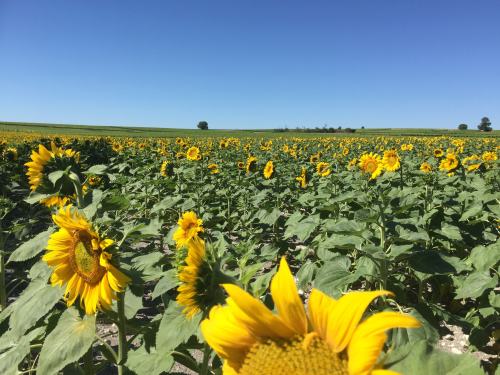
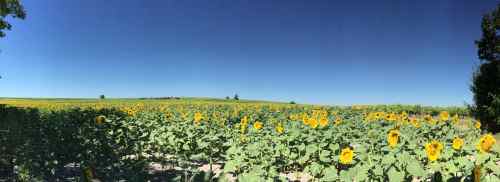
fields of gold

Fields of gold….this is what they look like where I live. Aren’t they spectacular? And don’t they go so well with a wide blue sky?

wide field

The first year I came to live here I kept driving past them thinking, must stop and take a photo sometime, but, somehow, I always had something more important to do. “I’ll catch them next time I pass by” I thought. But I didn’t. And when finally I decided to make a special trip out to photograph them, they were gone. Or almost. Heads down and turning brown. Just didn’t have the same appeal. So I missed them. Didn’t take long to miss them. It turns out they don’t look like this for very long.

I learned that lesson.

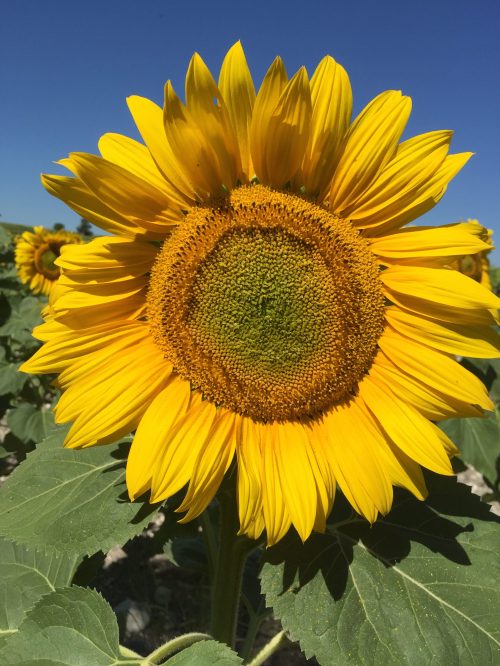
So when this caught my eye recently……

individual

….I pulled over and took a few photos.

As I stood looking out across the field up to the top of the hill I recalled the scene on the beach at dawn in the movie, “City of Angels”, and I thought, “How amazing that this field of little seeds transforms into a carpet of tall green stalks and leaves, which, one day (or at least it seems to happen in one day), the sun comes up and these glorious golden flowers unfold to greet it, bathing their petals in its rays which warm their rich, abundant crops of seeds.”

Flourishing.

How flower like.

I believe we are here to live like that. To flourish. To reach up, unfold, respond to the sun, the rain, and the wind. To emerge and to engage with a full becoming….becoming the unique and singular creatures which we are, and to express our uniqueness in full awareness of our communion with the rest of nature.

There are terrible stories around just now. Stories of acts of cowardice and killing. How are we to respond to them?

With fear? Closing down? Making our lives smaller?

Or with LIFE? Opening up, living our lives to the full?

Maybe I can learn from the sunflowers. Maybe I can stand up, radiate with the beauty of the life force which surges through me. And flourish.

Let me use that astonishing capacity which I share with all human beings – the ability to make conscious choices.

I choose to relish this moment, this day, this present, because if I put it off, I might miss living altogether.

I choose love instead of hate.

I choose to create instead of destroying.

I choose to be grateful for this “one wild and precious life“.

I choose to share my delight.


Read Full Post »

« Newer Posts - Older Posts »