Feeds:
Posts
Comments

Archive for the ‘photography’ Category

pink

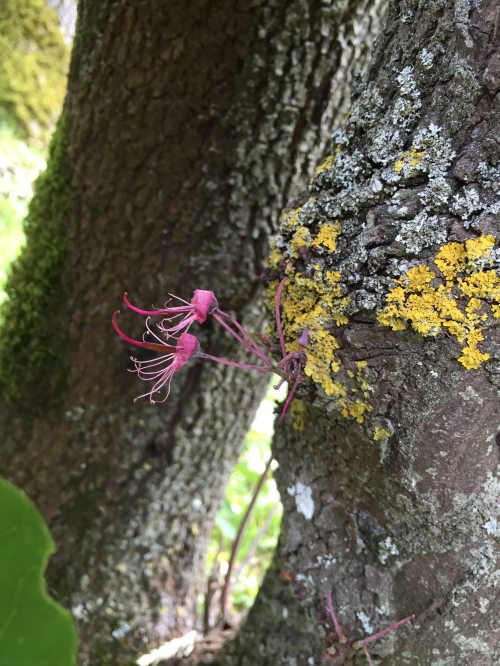
As I walked between the trees at the side of the Charente in Jarnac this caught my eye.

I don’t think it was only the pink and yellow colours together which grabbed me. It was the surprise at seeing this delicate flower growing right out of the trunk of the tree. Now, I’m not a botanist, just someone who is insatiably curious, so I don’t know what this flowering plant is. But I’m pretty sure it isn’t a usual part of the tree it’s growing from. There weren’t any other flowers like this further up the tree.

As usual, an image like this sparks a few trains of thought.

How do we notice what we notice?

Difference.

Isn’t it usually difference which catches our attention?

One of the commonest kinds of difference which we notice is movement. By definition, motion is difference. It’s a change of place in time. It’s the flight of the barn owl from my house to my neighbour’s barn. It’s bats flying round and round the garden at dusk. It’s the sudden appearance of light and shadows as the sun appears from behind a cloud.

Another common difference to catch our attention is sound. Any sudden new sound. The wailing of a siren in a city street, the alarm call of a blackbird which has just spotted a cat, the distant church bells striking noon. The sounds we don’t hear are those which are constant. We only notice them when they stop.

What’s new is different too. We’ve got two cerebral hemispheres, and the right one, in particular, is wired to seek out whatever is new. The left might seek the familiar, but the right is attracted to novelty.

So maybe that’s another reason I noticed this strange and beautiful pink flower growing out of the tree trunk. I’d never seen anything exactly like it before.

Not least because I don’t know what this flower is, I don’t know what the nature of the relationship is between the flower and the tree. Is it parasitical? Is the flower gaining something from the tree, but not contributing anything? Or is it commensal, with both the flower and the tree benefitting from the relationship?

One of the keys to creative development and growth is integration. Integration can be defined as “the creation of mutually beneficial relationships between well differentiated parts”. In other words, it’s when there is a bond, a good, healthy, mutually supportive bond, between two very different organisms or objects.

I’d like to think this image represents that. It certainly increases my awareness of such an idea.

Integration isn’t just about the relationship of course. It’s about the well differentiated parts as well. And that brings me back to the idea of difference.

When we are surrounded by attempts to force us into pre-determined moulds, by monocultures of chain stores and pressures to conform, it can be hard to express our differences in a positive way. There’s so much fear these days of “the other”, of strangers, immigrants, of other races, other genders…….

How different might the world be if we pursued integration instead…..by not only tolerating, but celebrating difference, and finding ways to create mutually beneficial relationships between them?

Might be beautiful. Might be surprising. Might be attention grabbing.
Read Full Post »

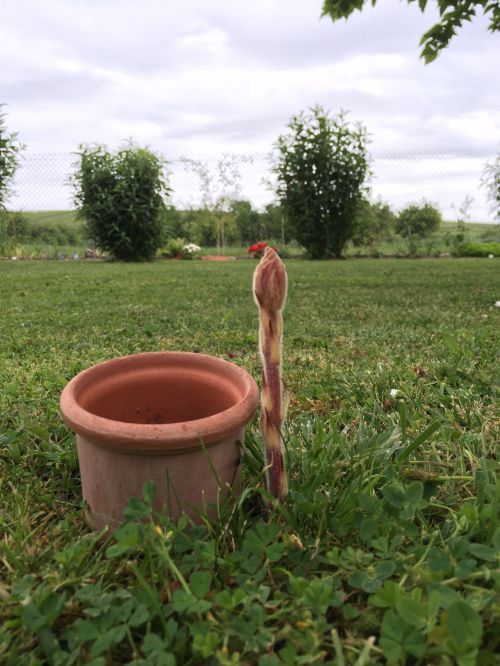
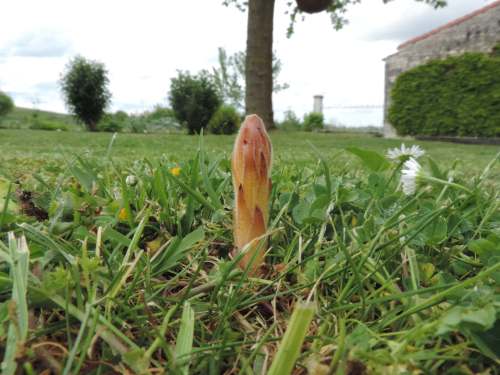
On May 10th this suddenly appeared in the grass one morning. I definitely didn’t notice it before so I think it emerged overnight.

May10

What is it? I had no idea. So I decided to wait…..

May19

May 19th, 9 days later. Still no idea what it is but I put a little flowerpot next to it to stop me accidentally kicking it over or mowing it down when I was cutting the grass. What was it going to do next? Unfurl like a fern? Reveal itself as an asparagus? I’d just have to wait a bit longer…..

May25

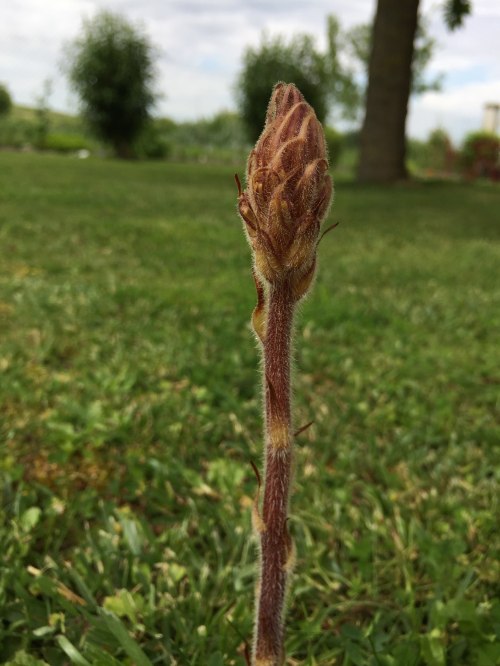
May 25th. A further six days on. Wow! Look how tall it’s grown! I still can’t tell what’s going to happen next. I’ll wait another week….

June2side

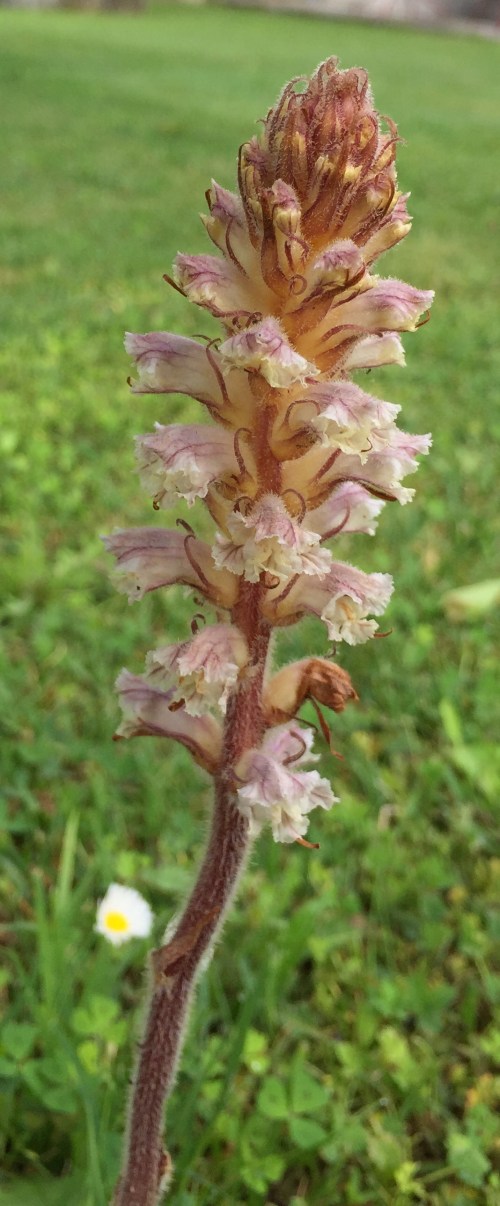
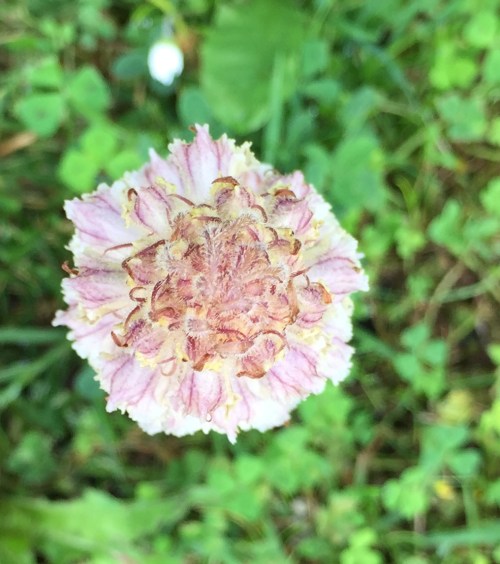
June 2nd. Oh look at these beautiful, delicate flowers it has revealed now! I took a photo from above too….

June2above

Well, that’s been worth waiting for, don’t you think?

I still don’t know what it is. The app on my iPhone, “Plantnet”, suggests it is a “Broomrape”. But maybe one of you has better botanical knowledge than I do and can either confirm that, or make a different suggestion?

Becoming…..it’s the only way to find out what anything “is”. See that tagline at the top of my blog? “Becoming not being”? Life is an emergent, dynamic process, constantly developing, changing, growing. Isn’t it just beautiful and awe inspiring to watch?

Read Full Post »

hailstone

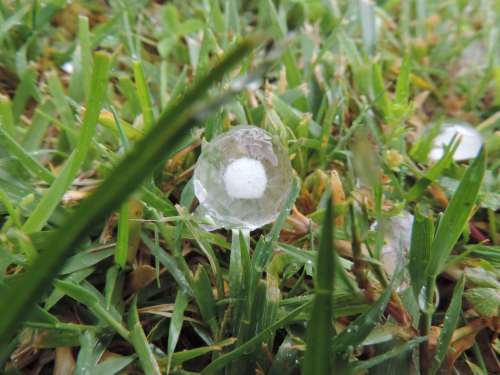
The other day I heard a strange noise and looked out of the window. The grass was covered in white balls. I opened the front door and as I did so the hail began to fall much harder. The white balls were bouncing back up a couple of feed from the ground they were hitting it so hard. It didn’t last long. Just a few minutes.

Once it had stopped I took a wander to have a look. (And of course take some photos).

Look at this one. Yep, it’s a hailstone but what thoughts spring to your mind when you look at it.

The first thing I thought was that it looked like an eyeball. That was a strange feeling….to look at it and feel like it was looking right back at me. Have you ever tried that? Just looking right into someone else’s eyes (it’s best if they’ve already agreed to do this!) for a few minutes. Just looking, without smiling, without saying anything, without making any faces. It is powerful. Very powerful.

The next thing I thought was that it looked like a cell, complete with a nucleus. Got me wondering for a few moments about the first cells on Earth. Where did they come from? Well, not from the sky in a storm, as far as I know….or did they??  No, I’m pretty taken with the idea that the first cells (of the kind we are made of) were created by other cells getting together and specialising to perform different functions. So some became ribosomes, and some became mitochondriae, others formed the boundaries, the cell walls, whilst others became nuclei.

How did that all happen?

And how does it continue to happen? Every day, these billions of cells in our bodies containing this incredibly elaborate, interconnected set of elements, none of which would be a cell without the others.

And, no, I don’t know where the first cells came from either – the simpler ones without all these amazing parts….

Then I wandered around taking a few more photos and quickly came up against the old teaching that there are no two snowflakes the same. Well, I can tell you, I looked at a lot of hailstones. I picked several up. I photographed a few of them. But I never found two the same.

Don’t you think that’s astonishing?

That these ice particles fall in their millions from the sky, all of them not long formed out of cloud particles, and no two of them are the same.

Uniqueness. Isn’t that one of the most fundamental qualities of our world?

OK, one last thought….as I held a hailstone in my hand, it didn’t take long for it to melt into water. Well, there we go, that ages old cycle of change and transformation. That deep rhythm of the beating heart of the world. Ice to water, water to vapour, vapour to clouds, clouds to water again to fall as rain, or turn to ice and fall as hail, seeping away into the dark earth, slipping between between the blades of grass, to make its way to the underground waterways, emerging as springs, streams, rivers and finding its way back to the sea to be warmed by the sun again, whipped up by the wind again, and rise again to become clouds.

Oh, I just love that. Don’t you?


Read Full Post »

really

Karol Sikora, a well-known “cancer doctor”, just said this

It doesn’t make much difference whether you are one of the people who get cured or not

He was talking about cancer care in “the NHS” (as a Scot, it bugs me every time when people refer to “the NHS”, as if there only was one). I suspect he was saying things in a controversial way to promote his new book, but this particular sentence really caught my attention.

He’s referring to how organisations and systems can be managed to work “efficiently”, and I think this probably applies to most health care systems around the world. We’ve developed a way of delivering health care as if individual patients don’t matter. Protocols are created based on the statistics from research into the experiences of groups of patients. I’ve even heard a young doctor say they were told that if a patient takes an evidence based drug and it doesn’t work, then either they haven’t taken the drug or they are lying. These are the kinds of things which happen when doctors take their eye off the ball.

When we base health care on management systems designed for industries which produce physical objects to sell, then, it seems, statistics become king.

It doesn’t make much difference whether you are one of the people who get cured or not

Really?

In what way does it not make much difference? To the individual it makes all the difference in the world. To the doctor? Shouldn’t it matter if this individual gets cured or not? Isn’t that an irreducible fundamental of all medical codes of behaviour? It’s always this patient, this very patient I am dealing with right now who has the right to the best possible care I can provide.

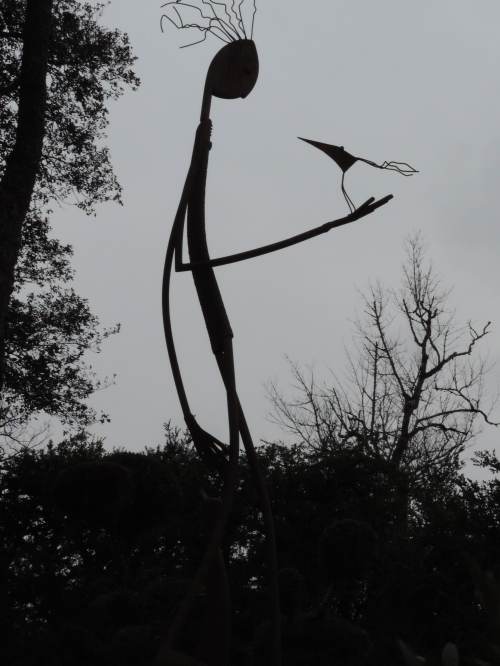
I struggled a bit to find a photo to go with this post then stumbled across this one of a sculpture I saw recently in a garden. It seems to capture that sense of caring for the individual. And it seems the character’s hair is standing on end. Maybe the little bird just told him what Karol Sikora had said!

We can’t accept this way of delivering health care, can we?

This story also made me think of those pretty pointless statistics you can see every day on billboards at railway stations, telling you what percentage of trains arrived on time this week. Should we deliver health care by aiming at percentages of patients properly cared for? Or should we deliver health care by always, I mean always, giving the very best care and attention to every single patient in every single interaction?

Read Full Post »

niche

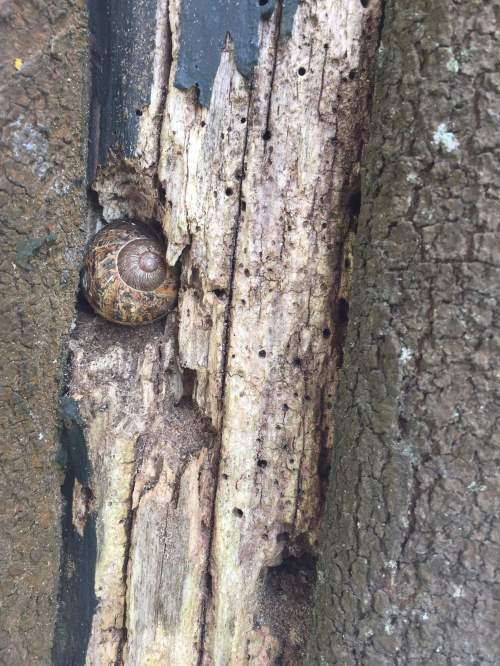
I happened across this little snail in a tree the other day. It immediately caught my attention and got me thinking.

Look at it…..

Doesn’t it look a perfect fit for that space? Doesn’t it look like it fills the space it’s living in quite completely? Doesn’t it look like it’s adapted well to where it’s found to live?

So what about you?

Hans Georg Gadamer, in his “Enigma of Health”, discusses ideas of health and refers to the concept of “fitness” – but not just the fitness of an athlete – the overall concept of “fitness” – when something is just right, when it just fits well. There is something in that idea which speaks to us of health. When we are in the groove, in the flow, in harmony….when everything falls into place……

What would you say about the fitness of your life? How well do you fit your life? How well does your life fit you?

Then I thought about how this snail seems somehow to be living fully or completely within its niche. And I wonder what you’d say about that?

We all live with certain boundaries, limits, “the hand we have been dealt”, influences from Nature and nurture, from the past and from the future, which set the parameters of our potential lives. Aren’t those parameters immense? Aren’t they almost infinite? But do we stretch ourselves out to fill our available life-space as well as we can? There’s something there about flourishing I think. Not just growing and developing, or being “the best you can be”, but of constantly expanding, flexibly adapting, to manifest ourselves, to express our uniqueness in our own vast life-space.

Adaptation. That’s such a good word. I find some people use it in a negative way as if adapting is about compromise and being less than you could be, but I don’t see it that way. Adaptation is how we grow, how we develop, how we live. Adaptation is how all of Life emerges and flourishes. I think we can get caught up in military and/or capitalist metaphors too much, thinking about the world in terms of competition, territory, power, and aggression. But actually, although all those things do exist, seeing the world that way often goes hand in hand with ignoring the co-operation, collaboration, compassion and kindness which also exists.

And when it comes to adaptation, there’s a lot to be said for negotiating your life-space, rather than killing for it!

If integration can be defined as the creation of mutually beneficial bonds between well differentiated parts, then adaptation becomes a process of a living in a way which maximises the abilities of you and I to explore and inhabit our personal, unique, life-spaces.


Read Full Post »

rose

Of course, an ordinary passerby would think my rose looked just like you. But my rose, all on her own, is more important than all of you together, since she’s the one I’ve watered. Since she’s the one I put under glass, since she’s the one I sheltered behind the screen. Since she’s the one for whom I killed the caterpillars (except the two or three butterflies). Since she’s the one I listened to when she complained, or when she boasted, or even sometimes when she said nothing at all. Since she’s my rose.
Antoine de Saint-Exupéry, The Little Prince

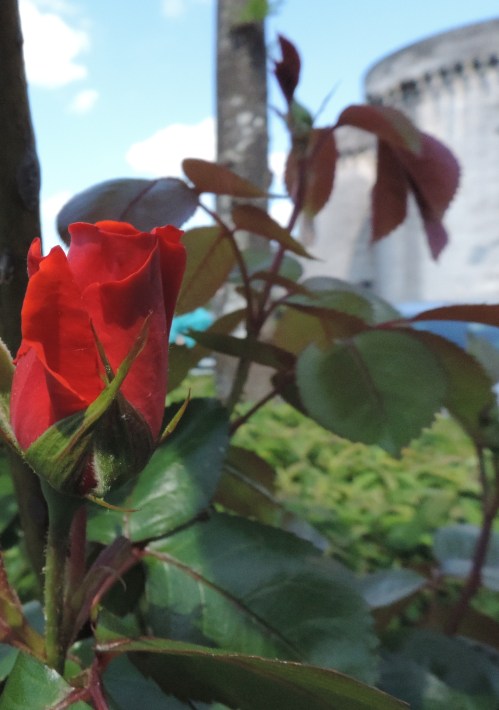
A rose….but not just any rose.

Saint-Exupéry writes about a rose which the Little Prince cares for, and also writes about a fox with whom he forms a personal relationship. When talking about the fox, he uses the word “taming”, but in both cases he is describing the creation of personal relationships.

For each and every one of us, we experience life personally. We experience everything from our own, unique, subjective viewpoint. As we do that, we form particular, personal connections. You and others will feel differently about particular places, particular creatures, even particular trees and flowers.

It’s the same for us with people. The more we connect to someone, the more special we feel they are to us.

It seems to me that this is one of the best ways to improve the quality of our lives – make connections, form caring bonds…..make life personal.


Read Full Post »

last blossom

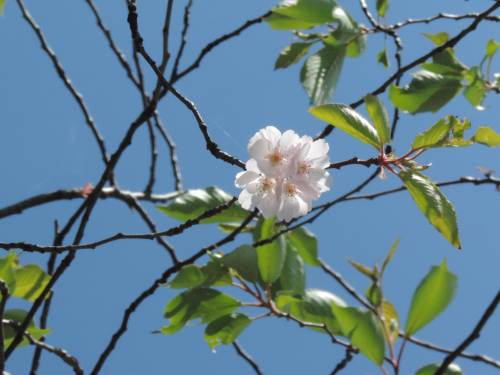
Strolling through Cognac yesterday along the banks of the Charente, we saw this cherry blossom. It’s the last blossom on the tree, and maybe the last cherry blossom I’ll see this year.

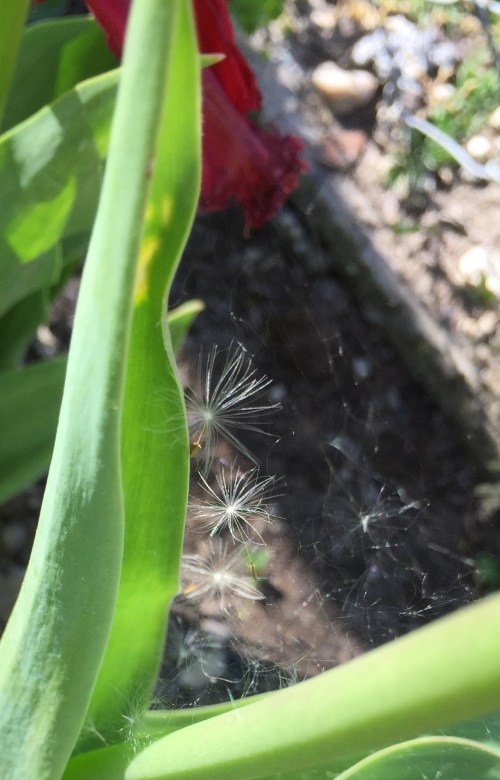
Zooming in showed a delicate thread created by a spider

hanging by a thread

“Hanging by a thread”, I thought.

Today becomes yesterday faster than we expect.

This moment becomes that moment in the blink of an eye.

This moment, this very moment, right now, won’t last and it won’t be coming back.

The ancient Greek philosophers proposed two exercises to improve the quality of life. We can sum them as “first and last”.

The first part of that is to remind yourself that every experience you have today is going to be unique. It might have many similarities to experiences you’ve had in the past, but, in reality, the experiences you have today will be yours for the very first time. You will never before have had the conversations you are going to have today. You will meet people you’ve never met before….even the ones who are familiar to you will have changed a bit since the last time you met. Every plant you see, sound you hear, scent you smell is for the first time. Yes, there may be many previous events or occurrences which seem very similar, but actually your experience today, this very moment, has never come around before. It’s a first.

The second part is the part which came to mind when I saw this cherry blossom. Because change is the only constant, every single moment you experience today will only happen once. This is your one and only chance to fully experiences the moments of today.

If you knew that this is the very last time you will experience today, wouldn’t you make sure you make the most of it? Wouldn’t you “seize the day”?

Well, it is the last time.

We talk a lot about living in the present, but the present is so fleeting. It’s so quickly replaced by another present. I like that. It means that every present moment is brand new. Every present moment is mine to experience for the very first time. And it’s mine to experience for the very last too. So, I won’t let it pass me by without noticing, without savouring, relishing, enjoying, immersing myself in, delighting in, being curious about, exploring, engaging with…….[add your own verbs here]…….loving this first and last moment.

Read Full Post »

water angel

OK, I know I’m just using my imagination here, but don’t you think you can see a water angel in this iris?

She’s wearing a long robe, reaching up with both her arms and facing left as if she’s climbing up the yellow part of the flower…..

So you see her?


Read Full Post »

seedweb

In “Deux Idées de Bonheur”, Luis Sepúlveda says that he’s come to understand that happiness and wellbeing are a web or network of relationships, between ourselves and others, between ourselves and what is around us, between ourselves and Nature.

I like that. It seems very true to me. We all exist with an intricate and infinite web of connections. None of us exist without any relationships. We all have, or have had parents, we’ve all encountered many, many others over the course of our lives, people we’ve been taught by, looked after by, friends, rivals, people we are related to through genes and marriages. We all live our every day lives in a web of others who produce, transport, prepare and sell the food we eat. Others who make the clothes we wear, who make every object we handle in an ordinary day. We live with others with whom we share our stories, co-create our values, our purposes, our reasons to get up every morning.

And we are in an intimate and unceasing relationship of exchange of energy, information and substances with the natural environment. The air, the water, the soil, the way we work the land, change the landscapes, warm the atmosphere around the Earth.

The other dimension of these vast webs is time. Our lives are all like stories….we are continually describing and telling the present as it emerges from our personal and our shared past, and which, moment by moment, is already in the process of becoming the future.

Happiness and wellbeing are not states, not independent, self-sustaining, isolated characteristics or “data points” to be measured. They are experiences which emerge out of a web of moments, within a network of connected people and events.

They are qualities of life, not permanently present, but always in the process of creation, like an intricate cloth of threads woven across lifetimes.

Read Full Post »

tulip opening

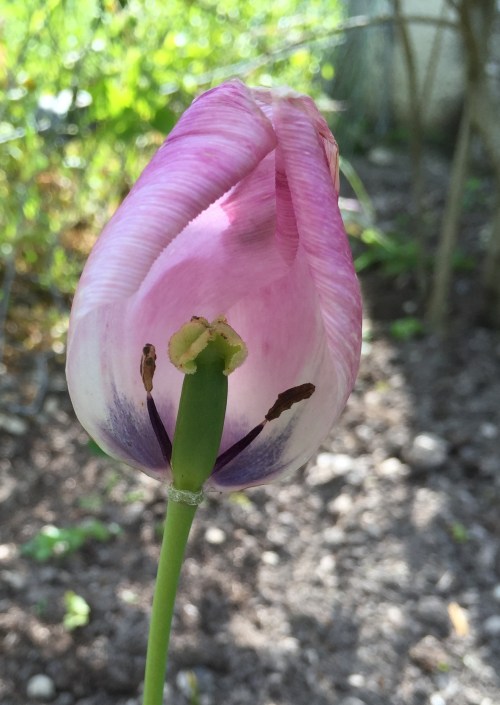
I noticed this tulip the other day. Like most flowers, as the petals begin to fall off at some point. In this case, with the sun shining through the remaining petals, the tulip opened up to reveal its “inside” and I’m not saying that this made it even more beautiful then when it had all its glorious petals in place, but wow, there’s an enticing beauty here all the same.

Doesn’t it draw you in even more deeply?

It certainly caused me to pause, take a photo, and wonder for a few moments about the incredible complexity and delicacy of the inside of a flower…..

Truly, a revelation.

Read Full Post »

« Newer Posts - Older Posts »