Feeds:
Posts
Comments

Archive for the ‘photography’ Category

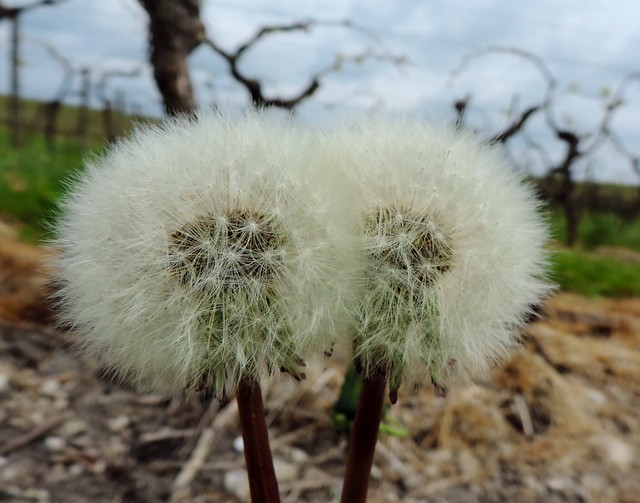
Twins dandelions

What might health care look like if we base it on the values which emerge out of a prioritisation of difference?

Uniqueness.

Whilst a knowledge of pathology and the natural history of diseases aid a good diagnosis, a focus on disease is not a focus on a person, or on health. Even when running a specialist clinic, such as an Asthma Clinic, every single patient who attends is unique. Their asthma symptoms will be specific to them – the circumstances where their asthma is most troublesome will be specific to them – the strategies they have found bring greatest ease will be specific to them – and, crucially, their narrative will be unique. Where asthma appeared in their lives, and when, will be part of that narrative. What impact it has made and how they have responded to that impact will be part of that narrative. How the asthma will progress will also be part of that narrative. This latter part is unknowable, as the future is always an emergent phenomenon in a complex living organism. It cannot be accurately predicted. Last, but not least, each individual has a personal world view created by their genes, their nurturing, their life experience, their connections to others and so on – everything which influences values, beliefs and attitudes. Understanding that world view will help the patient to make sense of the asthma in their life, and understanding that world view is essential in helping them to choose therapeutic interventions as well as adaptive strategies. Whatever the general, the shared, or the common, all the findings, test results and so on, need to be re-integrated into the context of this unique human being’s life.

Diversity

Because every patient is unique, the interventions which a particular patient finds beneficial will be specific to them. One-size-fits-all is a terrible approach to health care. Every single treatment protocol has an end point, and none of those end points can encompass benefit and a good outcome for each individual patient who goes through that protocol. So, what happens to the patients who make it all the way to the end of the protocol and are still suffering just as much? What does the doctor do with them? If we make only certain treatments available then there will always be patients who get no relief from their suffering. We need a diversity of treatment options, approaches and techniques available if we are to find the best, most effective treatment for every single patient.

Are protocols compatible with uniqueness and diversity? Can truly individualised health care be delivered by protocol? Can health care which actually relieves the suffering of every single patient be delivered by protocol? This might be extreme, but I’ve a feeling we should trash the protocols. Let’s get back to sound, clinical judgement which is flexible and focused ultimately on the needs of the individual who is in the consulting room here and now.

Tolerance

This goes with diversity. If there are a plurality of needs, and a plurality of solutions, with both being deeply affected by the world view of the individual, then we need to genuinely tolerate, in a non-judgemental way, those differences. There is no place in health care for rubbishing a patient’s experience and world view. Whose life is it anyway? Who is a professional to say that they know what the best life choices are for a patient? A professional should be caring, empathic, compassionate and supportive. Not judgemental, superior or authoritarian.

Integration

There is no such thing as a cure. Other than the cures which the body achieves. Human beings have the most incredible bodies. One way to think of a human body is to see it as a complex adaptive system. Complex adaptive systems have a number of characteristics but one of them is a self-healing capacity. The only healing which occurs in the natural repair, defence and growth of the living organism. It does this not least through integration – through the creation of mutually beneficial relationships between highly differentiated parts. All health care should be directed towards an increase in integration. Any treatment which impedes integration, impedes healing.

Flourishing

A lot of health care seems limited and disappointing to me. Sure, nobody wants to suffer, and a doctor’s duty is to relieve suffering. If we can do that by enabling a patient to get a handle on what’s happening, supporting them in the creation of a more meaningful narrative, whilst easing suffering and reducing difficult and limiting symptoms, then we are doing a good job. But is it enough? Is it enough to reduce the symptoms and stop there? Is it enough to support a patient through an acute illness but then stop when it comes to an end? Or if we really want HEALTH care, don’t we need to think beyond disease? Don’t we need to think about flourishing? About assisting an individual to grow, and, yes, to flourish – to feel well, to feel able to become whatever it is they have the potential to become?

If we begin to think about health in its fullest sense and in its greatest diversity, then we need to think beyond institutionalised health care systems. We need to think about what we can do to maximise the chances of people experiencing the best health they can – and that will take us into thinking about society, the environment, the economy, and indeed everything which is involved in creating the conditions for the health of human beings.

Read Full Post »

strawberry

With the current dominant world view, there is an enormous tendency to focus on “mass” – mass production, mass consumption – and to focus on quantities – GDP, profit, numbers “in work” etc. This all seems to drive core values of conformity and uniformity. We have ever more protocols and algorithms which are supposed to deliver “evidence based outcomes”. We find one-size-fits-all policies in health care, education, economics and politics. Difference is described as “variation” to be eliminated and “integration” is about forcing people with different values and beliefs to conform.

What values and what kind of world view might develop from a positive prioritisation of difference?

A shift from the general to the particular. 

Human beings are brilliant at spotting patterns, classifying them and naming them. We categorise by moving quickly from specific instances to general characteristics. We do that by stripping away the context and homing in on one or a few characteristics. By doing so we quickly lose sight of the individual, of the reality of the uniqueness of every person, every experience, every organism. And we quickly lose sight of the whole.

If we keep our eyes and ears open for the differences, then we take these generalised patterns which we spot and then consider how this particular instance fits, or doesn’t fit into those generalities. In other words we do what Iain McGilchrist describes in his “Divided Brain” – we perceive with the right cerebral hemisphere, analyse and classify a part of that with the left, then hand that analysis back to the right for further integration.

A shift from quantities to qualities.

“Lies, damned lies, and statistics”? Does the total number of people with jobs mean very much? Or is the nature and content of those jobs important? Does it matter if the jobs are zero-hour contracts, or full-time, more than minimum wage contracts? Does it matter if the jobs are to manufacture chemical weapons, or chemotherapy?

In health care, in education, in politics or society, because these are human institutions, its the quality which matters, not just the numbers.

A shift from seeing the world as composed of fixed objects, to seeing the world as a complex system which is continuously growing and evolving.

A shift from conformity to diversity.

Should we all have the same beliefs, the same values and make the same choices? If I choose one modality of health care when I am ill, and you choose another, is that a good thing? Or is it better that we both receive the authorised treatment which the protocol demands? Nature thrives on diversity. Monocultures are not natural.

A shift from a focus on parts to a focus on connections.

When we focus on parts, we tend to reduce what we are considering to objects. But no object exists in isolation. Everybody, every creature and every “thing” on our planet has a history. We all emerge out of what already exists. In the here and now we are inextricably linked to who and what is around us. Our left cerebral hemisphere is great at focusing on the parts. Our right is fabulous at focusing on the connections – the “between-ness” (to use Iain McGilchrist’s term)

A shift to integration.

Integration is the creation of mutually beneficial relationships between well-differentiated parts.

Think of the human body. A heart is distinctly different from a liver. To be healthy we need both, and we need both to be working in ways which maximise the health of the other. Our heart and liver are not in competition. They are not fighting it out to see who survives – only the strongest? Instead, they function best by integrating. I think we can see the same principle at work everywhere – or at least in all complex systems, from living organisms, to families, societies, cultures and environments.

A shift to seeing the flow of change

Nothing stays the same. We have cycles of growth and cycles of destruction. We see change which describe as growth and maturation, from (in the case of human beings) single cells, a spermatozoon and an ovum, to a fertilised egg, which grows into a foetus, a child, and then a fully grown adult. to And from the first moments of the Universe until now we see not just change in terms of growth and maturation, but a direction of change which we call evolution – we see an increase in complexity from the first hydrogen based stars to human beings with consciousness.

Whether in terms of maturation, or evolution, what we see is flourishing – the coming to fullness of all a being can be.

So, here’s my starting list of values

  1. Uniqueness
  2. Diversity
  3. Tolerance
  4. Integration
  5. Flourishing

What might the world become if we prioritised these values?

Read Full Post »

Quiet

In my A to Z of Becoming, Q stands for Quiet. I’m thinking and writing about difference just now, so, naturally, it occurred to me this morning that where each of us go to be quiet is likely to be different.

Why be quiet?

Don’t get me wrong, I love conversation and music as much as anyone, but we all need times to just be quiet. Quietness can be calming. It can help us to let go of some of the loops which have established themselves in our minds. It can help us to be present. I know “mindfulness” is all the rage, and, for me, being “mindful” is about being aware and being present.

When we quiet our minds, our emotions and our bodies, we create a little distance from the automatic habits which dominate so much of our daily lives.

Quietness also facilitates reflection. It lets us see things differently and consider them more consciously.

But where can we best find quiet?

Some find it out in Nature, as I did in Aubterre sur Dronne (where I took that photo above)

Some find it in the forest…..

Mirror, mirror

Some find it at the coast…..

just sitting

Some find it in a church….

church

Some find it in a temple…..

kodai ji kyoto

Some find it in a garden…..

A seat in the garden

Sometimes we can find it in our own homes, in a favourite seat, or at a particular window…

window view

How about you?

Where are the places where you can experience being quiet?

Read Full Post »

face

No two faces are identical.

Ever.

No two sets of fingerprints are identical.

Ever.

No two pairs of eyes are identical.

Ever.

Have you ever wondered about that? Maybe when you are at a Border Control in an airport, or maybe when you are looking for someone you know in a crowd?

Not only is every single one of us in the world unique, but we are unique in the time dimension too. There has never, ever, been someone with an identical face, identical eyes, and identical fingerprints to you. And there never, ever, will be in the future either.

Human beings are not clones. We are not units of production. Not physically, and certainly not narratively (is there such a word? We each have a unique story to tell….the story which says who we are, what we experience and what sense we make of it all)

Difference is one of our essential characteristics.

Might that be important?

Read Full Post »

rose

In Saint-Exupéry’s “The Little Prince”, the little prince talks about the rose he has been looking after.

“To be sure, an ordinary passer-by would believe that my very own rose looked just like you, but she is far more important than all of you because she is the one I have watered. And it is she that I have placed under a glass dome. And it is she that I have sheltered behind a screen. And it is for her that I have killed the caterpillars (except for the two or three saved to become butterflies). And it is she I have listened to complaining or boasting or sometimes remaining silent. Because she is my rose.”

Can you ever “park” the personal? Can you ever set aside the “subjective”?

In “The Little Prince”, the rose which the prince looks after means so much more to him than any other rose. Isn’t this an essential truth about one of the ways in which we experience difference in this world? We develop personal relationships. We don’t just form personal relationships with other people, but with other creatures, with certain plants, trees, even with certain inanimate objects. Children often form intense attachments with particular objects – a blanket, a teddy bear, a soft toy. Does this phenomenon disappear? Or do we just move our attachments to other “more grown up” objects – a pen, a car, a favourite cup?

Could you make a list? Could you describe the people, places, creatures or objects which you are particularly attached to? The ones which mean the most to you? You’ll find that your list is very specific – and very different from anyone else’s.

Read Full Post »

acer

What caught my eye here?

Sure it was the redness of the leaves of the acer, but, what made them even more eye-catching was where the tree was growing, in the midst of luxuriant greenery.

The red contrasts with the green strikingly, so the acer does not just stand out because of its redness, but because of the environment in which it is growing. Had this acer been growing in a forest of acers, it would still have been striking, but this particular one, this individual tree growing in the village of Aubterre-sur-Drone, really captured my attention because it was growing amongst such green plants.

This highlights two important principles related to a focus on difference – contrast and context.

When we focus on difference we become more aware of both contrast (just how different this particular whatever is) and context (exactly where we are seeing the existence of whatever it is).

In other words, to really focus on the difference is not to see something in isolation, but in its relatedness. Contrast is a comparison between something and something else. Context is the place and the time where the something is being observed.

I think this is a point we often miss when we think of difference because there is a tendency to think that if we concentrate on individual uniqueness, we are isolating something, or somebody. I don’t think that is true, or at least, not necessarily true. To really see the uniqueness of anything we have to see it in its connectedness – in its situation, in its particular time and place, in its relationships to “other”.

To see you in your uniqueness, in your difference, I have to hear your story. I have to explore some of the myriad of links and connections you have in the world.

If I try to see you in isolation, I won’t fully see you.

Read Full Post »

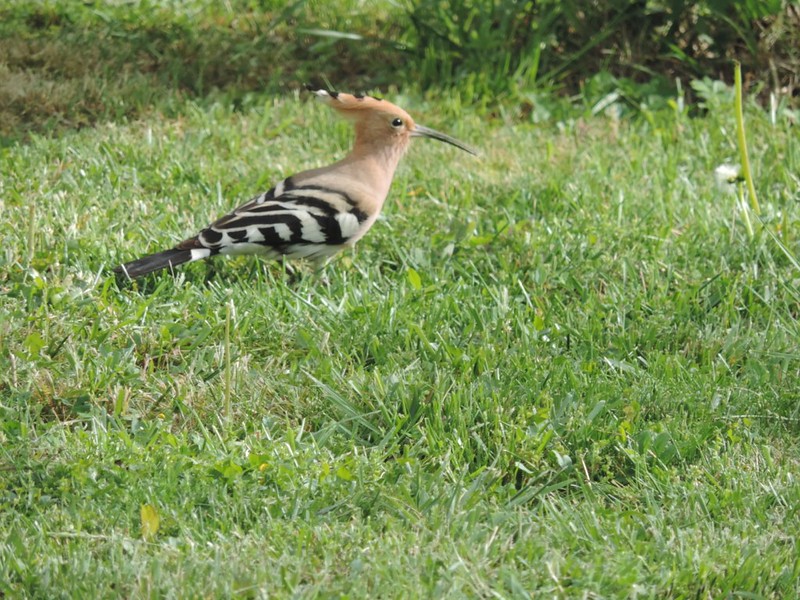
hoopoe

If we are to prioritise difference, we have to start noticing it more.

One way to notice difference is to spot the unusual. This is one of the easiest ways because its the very fact that what we are seeing is SO different which catches our attention.

I’ve seen some interesting and different species of birds in my garden here in the Charente, but yesterday look what appeared!

I have never, ever seen a bird like this!

It seems it is a “hoopoe” – nope, I hadn’t heard of it either. But isn’t he spectacular?

Only the one, not a pair, and certainly not a flock. He pecked around and had a bit of supper then flew off. Maybe I’ll never see a hoopoe again, but it was a sheer delight to see one this time!

What is unusual is often striking. And what is striking catches our attention easily. The pleasure and delight can be maximised by allowing your attention to be caught and then lingering awhile – spending a few minutes just watching, noticing, enjoying.

Has anything unusual caught your attention recently?

Read Full Post »

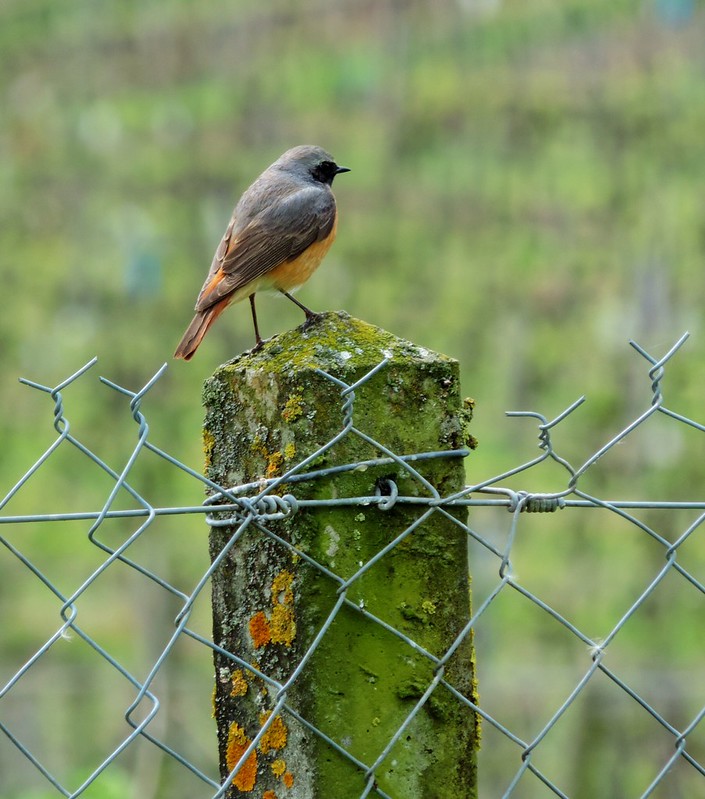
Redstart

For many weeks I’ve noticed a Robin in my garden, but recently this little guy has turned up.

At first I thought he was maybe a different Robin, or maybe a Bullfinch (I’m not an expert in birds!) but I’ve just discovered he is a “Redstart” with his red breast, black mask and white skull cap. I’d never even heard of a “Redstart” before but apparently they are from the Robin family – you can see similarities with the more common Robin, but he is clearly different.

We live in a society which prioritises sameness. Mass production, mass consumption, standardisation, health care by protocol, science based on abstraction and categorisation.

We do have a lot in common, and that’s partly how we connect to others – shared interests, preferences, values and so on.

I was aware throughout my practice as a doctor that every single person I saw had some things in common with others who I had seen, but who also was unique – different from every other person I had seen. I’d make a diagnosis – chest infection, diabetes, asthma, psoriasis etc by prioritising the signs and symptoms which I had learned were associated with those diseases, but then I had to pay attention to the person and ask who this was who had this disease, ask how it appeared in their particular life, how it affected them in their unique way.

What I’m wondering just now is what might the world be like if we prioritised difference instead of sameness?

What would health care look like if we prioritised the uniqueness of every patient AND every practitioner?

What would the economy be like if we prioritised the uniqueness of each member of the population?

What would education be like?

What would society be like?

Are there certain underlying principles which would come to the fore if we prioritised difference?

I’m going to explore those questions here over the next few days.

Read Full Post »

The dominant idea in our society seems to be one of control. From the economy, to society, to health and education, those who hope to improve matters have been seduced by a certain philosophy (typical of what is referred to as “scientific”) which is based on measuring starting points, setting end points and employing the tools to control the process of moving from the one to the other.

Actually, in “open systems”, which are “complex” (based on multiple non-linear relationships between the parts), this idea fails to match reality.

We cannot completely measure or control living systems.

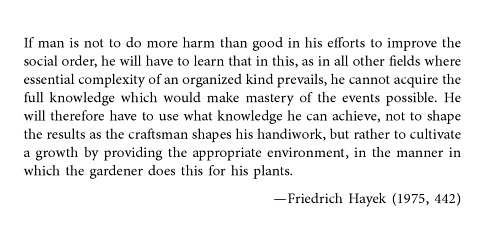
The economist, Hayek, put it this way –

So, here’s the question – what is an “appropriate environment”?

What sets the conditions for health? For the creation of healthy individuals, healthy societies and healthy economies?

Read Full Post »

St George de Didonne

I took this photo of my son and his children on the beach at Saint George de Didonne recently. It so happened we were the only people on the beach at that point.

In my A to Z of Becoming, P can stand for Pause.

I wonder how you make the pauses in your life?

In the part of France where I live now Sundays are still a very different day of the week. Shops close – even the supermarkets – and the pace and feel of a Sunday is distinct. In many societies we have lost that regular point in the week where we can step off the treadmill, relax, sit back, reflect, or do whatever we need to do get a bit of space again in what so often is an over-stuffed busy week.

Holidays can be a time to pause too. A few days in the year where we can just step out of our routines and get the chance to re-connect to ourselves, our values and our priorities.

A time of pause gives us the chance to make conscious choices because it creates a space – in turn, this gives us a chance to shift our perspective and see our lives in their contexts.

So, maybe it would be good to work out where you can create your opportunities to have pauses. And maybe you should allow yourself to enjoy one sometime very soon!

Read Full Post »

« Newer Posts - Older Posts »