Feeds:
Posts
Comments

Archive for the ‘photography’ Category

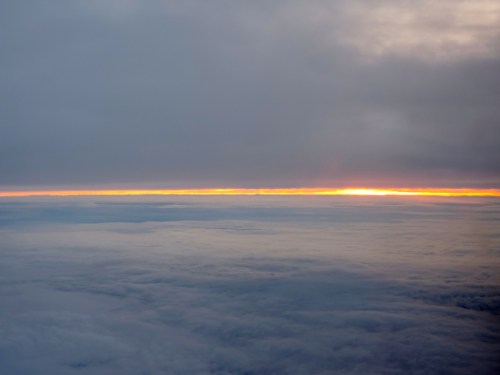
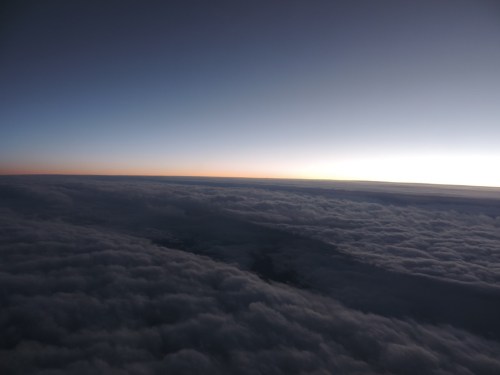
From the plane window I saw the brightening sky before the dawn. Those deep contours in the clouds create such a strong impression of solidity, even though they are simply water particles hanging in the air.

Now, as dawn breaks, it looks so familiar, and yet so different from the usual dawn, because it’s the sun breaking through between the levels of the clouds, not between the clouds and the surface of the Earth.

Read Full Post »

Edinburgh lights

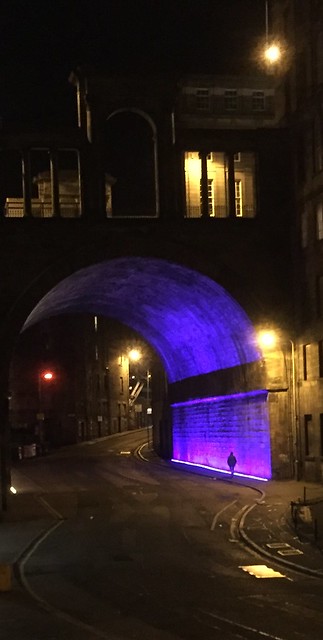
I often take photos of the light, of sunsets, sunrises, of shafts of sunlight and of moonlight, but I don’t often take photos of artificial light.

However, last night, in Edinburgh, I turned round and saw this……..I couldn’t resist.

See how good an iphone shot can be? All I have done to the original image is to crop it.

Yet again, photography is a vehicle for meditation and contemplation for me. The more I look at this photo, the more I see, and the happier I feel.

Read Full Post »

path

In the A to Z of Becoming, C can stand for Choose.

We choose all the time. Unconsciously. We choose what to eat, where to eat it, what path to follow to any particular regular destination (like the workplace), and so on, and on.

Every day is filled with choices about what we want to put energy into, what we want to focus on, and what we want to do in the next minute.

A lot of these unconscious (or minimally conscious) choices are created through habit. If you have ever attended a course or conference which runs over a number of days or weeks, you’ll have noticed how quickly people find a particular seat to occupy every day they attend. Most of our eating choices are largely unconscious. There will be certain meals you eat frequently, certain drinks you ask for in cafés, certain shops you shop in, even particular brands you stay “loyal” to.

As I’ve written about other unconscious actions, there is nothing wrong, per se, in their being unconscious, but I find life changes when you make conscious choices. Making a conscious choice does not require you to actually make a different choice. You might still choose a particular beverage, a particular routine or whatever, but the deliberate act of bringing your choice to awareness and saying “I choose to do this” can be incredibly empowering, affirming, and heighten your experience of whatever you have chosen.

Give it a go.

Bring some of your routines and habitual choices up into your consciousness this week, and either actively choose to stick with them, or choose an alternative.

See how it feels.

Read Full Post »

yellow and blue

I think it is often difference which catches my eye.

i think difference is beautiful.

Sameness quickly becomes, well, sameness.

This simple photo is beautiful, not just because the blue sky is beautiful, and the yellow lichen on the tree is beautiful, but also because of the contrast between the blue and the yellow, and the contrast between the smoothness of the sky and the roughness of the branches.

Mass production and mass control seems to have a different ethic from this – uniformity and the “elimination of variation”.

Here’s to a celebration of difference, of uniqueness and of diversity.

Read Full Post »

textures

One of the keys of my approach to life is a phrase I encountered in a French book – “l’émerveillement du quotidien” – meaning, the amazing wonder of the every day.

Here’s an example.

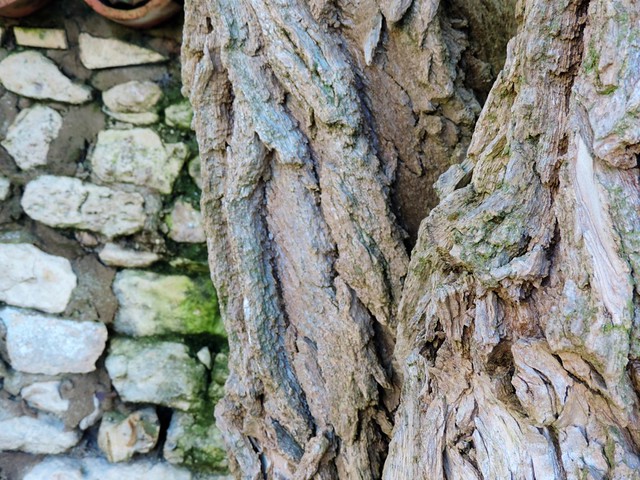
This one is texture.

Look at the incredible texture of the bark of the tree, and the way it plays in relation to the dry stone wall behind it.

Found an amazing textures today?

Read Full Post »

open

We have two ways of functioning as human beings. Automatic, unconsciousness ways where everything seems to happen without our having anything to do with it, and aware, conscious ways where we become active. It’s not that one of these ways is good and one is bad, but I think we’re missing out if we aren’t active enough.

The A to Z of Becoming verb series here is about considering the ways in which we can become active and exploring what that then feels like to us. This week let’s explore breathing.

Breathing is an automatic function for us. We don’t have to stop and choose to breathe in or breathe out. But when we turn our active attention to our breathing, watching to see the rhythm of our in breaths and our out breaths, we find that the pattern changes. Even without trying to alter it, just paying attention to it alters it. Try that for yourself and see.

Breathing can also, to a certain extent, be an active choice for us. We can choose to hold our breath and dive under the water to see what lies on the sea bed. We can choose the speed and depth of our breathing and in a way impose our active choice onto our default automatic function.

When we become actively engaged with our breathing at least two things happen. One is that whilst we are carrying out that activity (be it an activity of awareness, just noticing our breath, or be it a chosen pattern of speed and depth of breaths) then we are altered for the duration of that activity. Changing our pattern of breath alters our heart rate for example. It alters the chemical balance in our blood and in our cells as we change how much carbon dioxide we breathe out and how much oxygen we breathe in. It changes our brain cell activity and rhythm. It can alter our mood, our thoughts, our feelings. But, secondly, repeated sessions of active breathing change the underlying default patterns.

Let me put my doctor hat on again for a minute, and tell you about one scenario which I encountered a lot as a doctor and where I showed patients how this phenomenon of active breathing could change an underlying chronic problem.

Many people chronically over-breathe. It’s called hyperventilation. The pattern is of fairly shallow, fairly fast breaths. When this pattern occurs during sleep, the person wakes up feeling not so great……maybe headachey, tired, vaguely unwell, maybe with tingly or numb hands or fingers, or with crampy, achey limbs. You don’t know that your body is in the hyperventilation pattern overnight, but a clue it might be can be found in noticing the breathing pattern from time to time during the day. Most times when you look, you see your breathing is fairly shallow and fairly fast.

The proof of the pudding is in the eating as they say, or in this case, in the breathing. If you get someone to take a few minutes to do some diaphragmatic breaths (click through here to read the detail if you need it). And get them to do this three or four times a day. What will happen is that the underlying unconsciousness pattern will become disrupted and that disruption continues right through the night whilst the person is asleep.

I thought it was an odd thing when I first read about the sleep studies which showed this phenomenon, but time and again I found it made a big difference for many patients. Making an active choice to breathe differently a few times each day, alters the default, automatic pattern right through the 24 hour period.

Active breathing. You certainly don’t need to be doing it all the time, but taking a few moments, or minutes to do it a few times each day sort of resets your whole system.

Read Full Post »

There is no more difficult art to acquire than the art of observation, and for some it is quite as difficult to record an observation in brief and plain language (William Osler)

The “art of observation” – interesting phrase. It’s not just a matter of looking then? Or of gazing whilst your mind is elsewhere? I think we often forget that observation is both an active and a creative process. It’s not the same as measuring. But it always involves some level of “abstraction” ie we focus on certain elements or characteristics. We simply can’t “take in” all the sensory stimuli and information which is streaming our way at any particular moment. We sift, we categorise, we discard, we focus.

Telling someone else what we observe often reveals these processes which alter what there is to be observed. Recording too little, hides too much. Recording too much, overwhelms with detail and we run the risk of not being able to see the wood for the trees.

A want of the habit of observing conditions and an inveterate habit of taking averages are each of them often equally misleading (Florence Nightingale)

Florence Nightingale adds another two aspects to the issue of observation – two common faults she said – one of failing to “observe conditions” which I take to be either a failure to observe the context, or a failure to observe the phenomena of the illness. And secondly, the “inveterate habit of taking averages”. When it comes to the individual, averages are of little use. They can blind the observer to the unique present situation.

Read Full Post »

The cognac cellars

Becoming not being

You’ll see that phrase up at the top of the home page here, just underneath the heroes not zombies title.

Such a phrase can lead me off in many directions. For example, it brings a focus on verbs instead of nouns. Nouns are words we use to name things. We categorise with nouns. We put things into defined boxes and then argue about the purity of the box’s contents. Verbs on the other hand are action words. It’s harder to pin a verb down. It’s always changing. Every Sunday you’ll find a post here about a verb (put the phrase “A to Z of becoming” in the search box and you’ll find lots of them).

Becoming not being is about change, about transience and about process.

Eric Cassell says in his “Nature of Clinical Medicine

I say that “thinking about processes differs from thinking about a thing in at least four aspects. Process implies change, a direction of change, a rate of change, and a purpose, result, or outcome of change”

Who I am today is different from who I was yesterday, last week, last year. I am still me and the nature of change in a human being is of constant adaptation and evolution. It’s developmental. The cells in my body are constantly changing, some dying off, some being born. The connections in my brain are constantly changing – with every thought, every image, ever memory, every sensation.

I AM change.

There are many directions of change in the Universe, but the one which fascinates me most, is the one which underpins “The Universe Story“. If we start about the time when there were only Hydrogen atoms, and follow the change through to the emergence of Life, and on to the births of you and I, we see a direction of change – towards every greater complexity, from fairly simple atoms to complex adaptive organisms – and up into the emergence of consciousness. With this direction of change we see more and more diversity in the Universe.

The direction of change is towards ever greater connectedness and ever more uniqueness.

The rate of change is not constant. We see that with evolution. There are no smooth transitions from one life form to another. The changes occur in leaps. We see that in the development of a child. One day they can’t stand up, then from another day they can. One day they can’t walk. Then they can.

Change occurs in quantum leaps.

Cassell mentions “a purpose, result of outcome of change”. The thing with outcomes, is that they are only what you describe at the time you describe them. Outcomes lead to new changes. There isn’t a stopping point. You could say the same about results. So what about purpose? I think purpose is discovered, and/or created through narrative.

The narrative of change creates and reveals meaning in our lives.

The photograph at the start of this post, is of a cognac cellar. The barrels sit there in the dark for years as the cognac constantly changes, every year producing a unique new flavour.

Becoming not being.

Read Full Post »

When I started the A to Z of Becoming, the first verb beginning with an A was Attend. (Click through on that link to read the original post)

This week I want to explore the difference between passive and active attention. What I really mean can most easily be understood from that common expression – “that caught my attention”. We experience our attention being “caught” all the time. Whether it’s caught by a loud bang, a bright light, a word or a phrase we hear or read, what we experience is suddenly noticing.

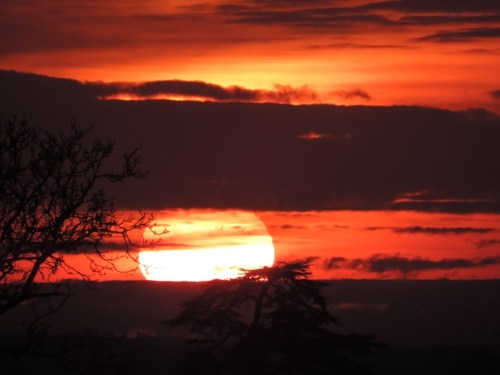
What caught my attention and led me to take the above photograph was the colour of sky at sunset. I noticed the red sky, picked up my camera and went out into the garden to take the photograph.

What caught my attention next was the bright spot of light you can see shining up there in the top left of the image. 

What is that?

So, then I took out my iphone, opened up the Star Walk app, and held the screen towards that part of the sky I had photographed.

Venus. That bright light is Venus. I then noticed (on the app) that several other planets were in the same vicinity, some of them having already disappeared below the horizon with the setting sun, and some of them not shining brightly enough yet to be visible in the red light.

What happened there was that my attention was caught, first by the red sky, then by the shining “star” (which turned out to be a planet). The whole experience was extended by following the curiosity which my attention had provoked. And I extend the experience further again now, as I write this.

We’re often not that aware of what is catching our attention because we don’t linger with it. We become aware of something, then we quickly start to think about something else. So, how can you become an more active player and influence what your mind is paying attention to?

Here’s an exercise you can do to find out what keeps catching your attention.

Take a notebook and write continuously without stopping to think what to write for either a period of time, or until you’ve filled a number of pages. I’ve seen several variations of this exercise and suggest you choose the one that best fits for you. Either fill three, or more, pages of A4 size, or write continuously for 30 minutes, or a period time you can fit into your schedule (I’d suggest it needs to be at least 15 minutes)

The rules are, do it every day, don’t stop for a second as you write, and don’t read what you’ve written. Do this for 30 days, then read the whole lot. You’ll be surprised when you find some of the things that keep coming up. Some will be obvious to you, but I bet there will be others which really surprise you. These repeated phrases, topics or whatever, are what has been catching your attention this last month. (If 30 days is too much for you, try it for 7, or for 10 days. Set your target in advance and don’t read anything until that target has been reached)

As you reflect on what you’ve written, you can make some choices. You can choose to stop paying attention to something, or you can choose to actively look out for something else. In other words you can engage actively with your attention, setting yourself up to have your attention caught more frequently by whatever it is you’d like it to be caught by.

We are never fully aware or completely present for long, but the act of choosing to attend to something in particular, again and again, begins to influence our passive, less conscious reactions too.

We can gradually begin to experience more of what we choose to experience.

Read Full Post »
air and water

water and fire

air water and fire

air water fire earth and Life

Read Full Post »

« Newer Posts - Older Posts »