Feeds:
Posts
Comments

Archive for the ‘psychology’ Category

According to a government report workers who retire early risk “boredom, loneliness and poverty“.

Well, that’s something to look forward to, huh? Strange report – probably part of a fear campaign to try and keep people in employment for longer. What are they suggesting, actually? It’s better to retire later? Or that if you are working, even on a minimum wage, zero hours contract in your 60s and 70s you will avoid “boredom, loneliness and poverty”?

I suspect this kind of thinking says more about how we live than it does about the respective benefits of employment and retirement.

Funnily enough, I just stumbled over this quote from Goethe –

“A man should hear a little music, read a little poetry, and see a fine picture every day of his life, in order that worldly cares may not obliterate the sense of the beautiful which God has implanted in the human soul.”
― Johann Wolfgang von Goethe

I’ll be continuing to do that once I start my early retirement next month! And much else besides. I’m anticipating that the post-employment years will include lots of discovery, creativity, personal development and fun.

Meantime, here’s a little music

and a little poetry

Tell me, what is it you plan to do
with your one wild and precious life?

– from Mary Oliver’s The Summer Day

and

Here’s a fine picture

glorious seedhead


Read Full Post »

I don’t understand synchronicity but when it happens its always striking and exciting.

About a week ago I bookmarked a transcript of an RSA talk by Guy Claxton, and yesterday I sat down and read it. It’s a fascinating talk about what he terms “glimpses” (what others have termed spiritual or enlightenment experiences). I’ll let you read the full talk yourself, but in that talk he referred to W B Yeats’ poem, “Vacillation”, where he describes just such an experience –

My fiftieth year had come and gone
I sat, a solitary man
In a crowded London shop
An open book, an empty cup
On the marble table-top
While on the shop and street I gazed
My body of a sudden blazed
And, twenty minutes, more or less
It seemed, so great my happiness
That I was blessed, and could bless

Then, later the same day, I was researching the lifespans of different organisms (I’ll tell you why another time) and picked my copy of Richard Fortey’s “Life” off my shelf. I have a beautiful Folio edition which is a complete joy to hold. Imagine my surprise when on page 22, in his first chapter, where he is describing his early experience of an expedition, he writes about having a dispute with his colleague, then waking to a beautiful, perfect day and he says “The joy of such moments healed any differences between us. Like W B Yeats –

My body of a sudden blazed
And, twenty minutes, more or less
It seemed, so great my happiness
That I was blessed, and could bless

I don’t know how that happens. Do you? How do I read the identical passage of poetry in two such different, totally unconnected places within a few hours of each other?


Read Full Post »

Remember Maslow’s hierarchy of needs?

Maslow identified what he called a hierarchy of needs which motivate human beings, starting with survival needs, such as food, drink and shelter, then moving upwards to social needs (relationship needs) of connecting and belonging, to esteem needs of being recognised and respected. Beyond that he postulated being needs, as opposed to these “deficiency needs”, which became evident as self-actualisation, something he thought wouldn’t happen until the lower needs were met.

This hierarchy has been criticised and its certainly not the case that human development follows any rigid, layer by layer, step-wise progression. (I think integral theory provides a more interesting way of looking at old hierarchies – from an integral viewpoint its not so much a hierarchy at all as layers which grow on top of each other with every layer continuing to exist)

Well, Gary Lachman, in his Secret History of Consciousness, mentions the writer, Colin Wilson, once researching the history of murder and finding something curious.

At first it seemed murders were mainly committed for gain – food for example. Then other types of murder appeared, which involved murderers protecting their lifestyle, their homes or their property. Towards the end of the nineteenth century the sex crime emerged (think of Jack the Ripper) where the murder was a kind of sex act in itself. In the twentieth century he noticed the emergence of murders for fame – to become known, and then towards the end of that century the appearance of the “motiveless murder”, the unpredictable, random killing sprees.

Wilson was struck that there was a parallel here with Maslow’s hierarchy – food, the home, sex, self-esteem –  and where did that lead to? Murder as a creative act? Murder as an act of self-actualisation? Wilson rejected this idea, rightly claiming that crime is not a means to self-actualisation. Criminals try to grab what they want, instead of putting in the time and effort to self-actualise. They will murder a celebrity to gain celebrity for example.

He posed the interesting question in relation to this discovery – was murder a kind of Jungian shadow, reflecting the level of development of human consciousness? If so, it might be further evidence that we are indeed moving as a species to a new stage of development, towards a focus on self-actualisation and creativity.

Wow! That’s quite a leap, huh? But certainly a thought provoking one!

Read Full Post »

Maya Angelou was wonderful with words. You’re probably coming across some of them just now as the internet spills over with memories and thoughts about her provoked by the news of her death.

Here is one of my favourites

My mission in life is not merely to survive, but to thrive; and to do so with some passion, some compassion, some humor, and some style.

I especially like this one because I just don’t accept the sole point of living is to make it to the end. Is a Life survived for a number of years something you’d aspire to? Isn’t the sole goal of survival ultimately 100% doomed? (Nobody makes it out of here alive!). You can spend a life like a robot, or, in terms of this blog, like a zombie, on some kind of autopilot, surviving, but there’s something else you can do. You can thrive. You can flourish. You can express the uniqueness you are in this universe, and become what only you could become. You can live with passion, fully engaged with the wonder of the everyday (l’émerveillement du quotidien), you can connect, feel, respond, use your imagination to put yourself in the shoes of others, you can laugh, live with a twinkle in your eye, and you can do it with beauty, grace and, yes, style.


Read Full Post »

DSCN0338

There is an astonishing amount of information from the environment flooding into your brain every single second. Think just about the information picked up by your sensory organs. All the sounds your ears can hear, all the light, colours and shapes your eyes can see, all the scents your nose can smell, all the textures your body can feel, all the flavours your tongue can taste. All of these, plus all the information being sent to the brain from within your body, plus all the information generated by your brain itself (your thoughts, memories, imaginings), are continuously flooding through the billions of neurones in your brain.

Why doesn’t that overwhelm us?

I’m nor sure anyone can fully answer that question, but at least we do know we have two ways of dealing with all these continuously changing information flows.

One way handle it is to use our brains as filters or valves.

William James, the psychologist said

one function of consciousness is to carve out of the vast sensory environment—what he called the “blooming, buzzing confusion”—a manageable, edited-down version. Only a limited amount of information reaches our conscious awareness, and for the very good reason that the majority of it is irrelevant.

The “blooming, buzzing confusion”….nice phrase!

He thought that

consciousness selects from the world at large elements that are of particular value and interest to it

In other words, consciousness enables us to “edit” the information flows, to focus on what is of “value and interest” – that, of course, opens up a whole other can of worms about how we decide what is of “value and interest”, but let’s leave that for another day.

Henri Bergson, the philosopher, argued that the brain’s function

was to act as a kind of “reducing valve,” limiting the amount of “reality” entering consciousness.

He said

“The brain is the organ of attention to life,” and the part it plays is that of “shutting out from consciousness all that is of no practical interest to us

Same idea as James…..the brain, or consciousness at least, as an editor, or a valve. In both cases the idea is that we reduce the full flow of information and pay attention to only part of it.

Iain McGilchrist argues that this is primarily the function of the left hemisphere – which “re-presents” the information flows to the brain.

There are great benefits to be had from being able to abstract information from the vast rivers washing through our brains, to be able to focus, and to concentrate on, just a subset, or a part of the world. We use this ability to both “grasp” and manipulate the world…..to exert our will on it, to exert control.

The downside is that we can begin to forget that we’re doing the editing in the first place. We lose sight of the filters and valves and think that what we “see” is all there is.
Attend

As Gary Lachman says in his “Secret History of Consciousness”

Yet one drawback to the brain’s highly efficient ability to focus on necessities is that it “falsifies” reality, which, as Bergson earlier argued, is in truth a continuous flow of experience…….The mind constantly takes snapshots, as it were, of reality, which enables it to orient itself amidst the flux. The problem is that science, which takes the most comprehensive snapshots, makes the mistake of confusing the photographs with reality itself.
This is exactly the problem Iain McGilchrist describes in “The Master and His Emissary”.
We have another way of knowing which is different from this editing, filtering, re-presenting way. We know by seeing connections, by experiencing the whole. Bergson describes that as intuition. A good example of that is how you answer the question “How are you?” You can ask yourself, “How is my energy today?” and you will come up with an answer instantly. You don’t have to edit, filter, or quantify anything, you know it holistically, or “intuitively”.
I’ve seen the same function again and again when visiting patients. Instantly, even before anyone speaks or before any “findings” are discovered, an experienced doctor knows he or she has to act quickly. The consultant who taught me Paediatrics, said on my first day at work with him that his aim was to teach me “how to recognise an ill child”. I thought that a strange comment at the time, but that’s exactly what he did. That recognising is a holistic, intuitive function which comes with experience.
Here’s Lachman again, in reference to Bergson
Just as we have an immediate, irreducible awareness of our own inner states, through intuition we have access to the “inside” of the world. And that inside, Bergson argued, was the élan vital
The neuroscientist Wolf Singer who looks at the problem of “binding” – of how the brain puts all this information together, says
there is a process in the brain that is itself antireductionist and is concerned with creating wholes out of parts, and hence with giving meaning to our experience.
I suspect this is exactly what McGilchrist highlights as the main function of the right hemisphere.
Isn’t it amazing that our brain can enable us to know in these two amazing ways? To edit, and to bind together; to filter, and to see patterns which enable us to discern meaning?

a strange turn

Inchmahome Priory

Read Full Post »

Diving for silver?


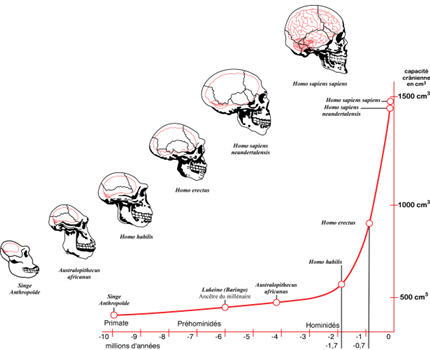
It seems we didn’t evolve into human beings in a smooth, seamless way, but more with a pattern of great leaps and long, slow changes.

One of these great leaps was in the growth of the size of the brain. One of our pre-human ancestors, Homo erectus,  had much smaller brains than we do, but over the course of 200,000 generations (2 million years), their brain size roughly doubled in size, taking them up to about the same size as brain as we humans have (since about 500,000 years ago).

As Stephen Oppenheimer states, rapidly increasing brain size was a key feature that set humans apart from the walking apes that lived before 2.5 million years ago. Since then our brains have trebled in volume. This increase was not gradual and steady: most of it came as a doubling of volume in Homo erectus 2 million years ago. The greatest acceleration in relative brain size occurred before 1.5 million years ago – early in our genus. Modern humans – and Neandrathals – living before the last ice age 20,000 to 30,000 years ago had bigger brains than do people living today. (from)

Interestingly, brain size in humans hasn’t increased over the last half million years (indeed it’s shrunk a bit!), but what has happened is rapidly increasing asymmetries in the brain. It’s not just that our massive cerebral cortexes are asymmetrical, but within each area of the brain there are highly specialised areas. In other words, its a story not just of an increase in size, of adding more and more neurones, but of complexity.

Here’s one of the puzzles about evolution though – how on Earth did brains evolve so quickly? You might say 2 million years doesn’t seem that quick but look at the speed of change.

cerveau_evolution


This is why some people refer to the growth of the human brain as the second “Big Bang”…….although I do like the idea of a “Great Leap”!

Read Full Post »

I’ve been familiar with Maslow’s hierarchy of needs for some time, but I’ve recently discovered I was only aware of part of his schema.

His idea was that we have many needs which motivate us to act and to choose how to act, and those needs are, to some degree, prioritised with the more basic needs demanding attention before “higher” needs emerge.

His most basic needs are those related to physical security – the needs for food, drink and shelter. Without food, without drink and without shelter we are unlikely to survive.

All human beings need love. We need relationships. If you think that’s not true, pause for a moment and ask yourself why solitary confinement is used as a punishment in prisons, or why “sending to Coventry” ie enforcing social exclusion has historically existed as a community punishment. These love and relationship needs are about emotional security. In Maslow’s hierarchy, first you need to attend to your physical security, then your emotional security.

However, he isn’t finished there. Next up is self-esteem, without which we don’t feel we matter. This is closely bound up in our sense of identity, our “worth”.

So far, so good, and this is where my familiarity ended. But in fact there is a whole other level above these needs in Maslow’s description.

All of these needs so far can be thought of as “deficiency needs”. They are based on “lack” and meeting them is useful to us, so they can be thought of as “utilitarian”, or as about “getting” things.

Above this, Maslow describes “being needs”, which are ends in themselves. They are about “giving”, and are more creative than utilitarian. Being needs are those related to purpose, value and meaning. These needs, he says, “express an overflow of our own being”.

It is these “being needs” which make us “fully human”.

When we recognise that animals occupy only the lower rungs of Maslow’s ladder of needs – those for sustenance, shelter, and some form of social life (but of course not all animals belong to groups) – we can see what this means. We are only fully human when we pass beyond these, as the being or meta-needs that lie ahead can be pursued only by us, or by beings like us ……. As far as we know, no animal wonders why it exists. Or, to put it another way, we are the only animals that do, and that wonder is precisely the threshold between our being only animals and being fully human. (Gary Lachman)

Read Full Post »

Orange sky from Pointe Rouge


In the A to Z of Becoming, P is for Pause.

A pause is a break, a temporary stopping. I first encountered the concept of the “bardo” in the Tibetan Book of Living and Dying, where it was helpfully described as a space where enlightenment could emerge. The meditation teaching in that book is to become aware of the space between two thoughts, and gradually to practice increasing that space. In daily life the suggestion is to become aware of the space (or bardo) which occurs before an emotion arises eg anger or fear.

So, let’s look at two types of pausing.

The “pause of now” and “the long pause”.

The “pause of now”. One way to consider what goes on in our minds is to think of two default brain states – “reactive mode” and “responsive mode”. In reactive mode our minds work almost like reflexes. Someone or something “touches our buttons” and off we go, into a real state of anger, anxiety, fear or some other learned pattern of thought, feeling and behaviour. In this reactive mode we can feel entirely the victim of other people and of circumstances. It can feel as if we have no choices, that our happiness is entirely at the mercy of others. We are on automatic. We are in “zombie” mode. The responsive mode arises as we become aware of the early changes, recognise them, understand what is happening, and then make a choice about how we want to respond. So if we frequently find ourselves becoming angry or anxious when a certain person speaks to us, then if we can become aware of the reaction starting to happen, we can pause, then choose how to respond – sometimes we will choose to respond angrily, or anxiously, but sometimes we won’t. We will be doing the choosing as we open up this “necessary gap” and in the “pause of now” we gain flexibility, confidence, tolerance, autonomy, and move away from a victim or zombie way of living.

One of the easiest practices I know to begin to develop the skill of creating this pause to shift from reactive mode to responsive mode is Heartmath (see a simple introduction here). The first two steps of “quick coherence” in Heartmath are known as “getting neutral”. It’s a variant of “count to ten”, and it works. The more you practice it, the more quickly and powerfully it works.

There’s another kind of pause though, and it’s not the kind of pause which happens just over a few seconds, or at best few minutes. I got this idea from reading about the concept of “the long now“. We hear a lot about “living in the moment”. Maybe you’ve read “The Power of Now” by Eckhart Tolle? If not, then maybe you’ve read elsewhere about the idea of being present, instead of spending your time on the past or the future (which might focus your thoughts on grief or anxiety). But when you stop to think about it, “now” hardly exists. This present moment has become the past by the time you’ve said “this present moment”. Henri Bergson, the French philosopher introduced the concept of “duration” to allow us to think differently about time (instead of splitting it up into moments, like frames of a movie), but his work can be quite hard to understand. Here’s a short summary of his duration idea –

Instead, let us imagine an infinitely small piece of elastic, contracted, if that were possible, to a mathematical point. Let us draw it out gradually in such a way as to bring out of the point a line which will grow progressively longer. Let us fix our attention not on the line as line, but on the action which traces it. Let us consider that this action, in spite of its duration, is indivisible if one supposes that it goes on without stopping; that, if we intercalate a stop in it, we make two actions of it instead of one and that each of these actions will then be the indivisible of which we speak; that it is not the moving act itself which is never indivisible, but the motionless line it lays down beneath it like a track in space. Let us take our mind off the space subtending the movement and concentrate solely on the movement itself, on the act of tension or extension, in short, on pure mobility. This time we shall have a more exact image of our development in duration.

One other concept I found easier to grasp was the idea of the “long now” – which, I suppose, in even simpler terms could be thought of as “now-ish” (reminds me of how Italian friends would often use the term “15 minutes” which if you used your watch to measure would produce huge frustration because they didn’t mean a number of minutes, they just meant a “piece of time” (of around 15 minutes in size!).

Drawing on these ideas of time, I think we can usefully propose “the long pause”

The long pause is a space, a few minutes, hours, days, or even weeks. I think a holiday often is a kind of a pause. It lets you step off the treadmill, get some distance between your working life and the rest of your life and provide a vantage point from which to see things more clearly, or a place from which to allow a new pattern of thinking, a new set of decisions, some new habits, or, yes, even enlightenment, to emerge.

So, here’s your verb for this week – pause.

Practice pausing in the moment to move from reactive mode to responsive mode, and build into your life some long pauses, some “time out” – daily, weekly, monthly, annually.


Read Full Post »

Feather

Burrrrr


When you look at these two photos, do you think, like I do, that the first one looks “soft” and the second one looks “spiky” or “sharp”?

I don’t mean in terms of photographic quality, I mean, in terms of sensations.

When I look at that feather, I think it looks soft. When I look at the burr, I think it looks prickly.

But isn’t that odd?

These are photos. I’m using my eyesight to perceive them, not much touch sensory organs. I cannot feel their softness or their sharpness. But that’s the first thing that comes to my mind when I look at them.

This is what we do all the time.

We are constantly bathed in information, some of which we detect with our sensory systems of vision, hearing, smell, taste or touch. We use our brains somehow to direct attention towards some of those inputs and away from others. So sometimes what we notice is a sound, and at other times, a colour, or a light.

But we are not unidirectional. We don’t process only one type of information at a time. We use all our ways of knowing and we put the results together to create a unified, whole perception. So I can look at this feather, and think “soft”, or at the burr and think “spiky”, even though my eyes cannot experience those qualities.

The one way of knowing cannot be reduced to another. There are always multiple ways of knowing. What we are really great at is synthesising those ways to gain a greater understanding of what we perceive than we could ever achieve by using only one way.

On a different level, this is what Iain McGilchrist has highlighted in the different ways our two cerebral hemispheres approach the world. Our two hemispheres allow us different ways of knowing. How much more fruitful, however, to synthesise their activity, and to use our whole brains?!

Read Full Post »

I was struck by a recent study looking at how much psychosis patients with schizophrenia (SZ) experience on anti-psychotics.

At each follow-up assessment over the 20 years, a surprisingly high percentage of SZ treated with antipsychotics longitudinally had psychotic activity. More than 70% of SZ continuously prescribed antipsychotics experienced psychotic activity at four or more of six follow-up assessments over 20 years. Longitudinally, SZ not prescribed antipsychotics showed significantly less psychotic activity than those prescribed antipsychotics . . . the condition of the majority of SZ prescribed antipsychotics for multiple years would raise questions as to how many of them are truly in remission.

In other words, not only do most patients with schizophrenia who are prescribed anti-psychotics continue to experience psychosis, but those who aren’t prescribed them experienced “significantly less psychotic activity”. What makes this study particularly unusual is that it was conducted over 20 years. This is highly unusual but more real life than the vast majority of studies which are quoted to give a drug “evidence based” status. Maybe it’s just not a good idea to keep somebody on the same drugs for decades?

That got me thinking about a related issue of prescribing drugs to healthy people to try and prevent disease. Think about statins for example. I found a good summary here.

Experts calculate that to save one life, or avoid a non fatal heart attack or stroke, you would need to treat 11 high-risk patients for 10 years.To save a life or avoid cardiovascular morbidity among low-risk patients the number you need to treat increases to 23. But different studies have looked at different types of patients and have yielded different results, so it is difficult to know if this pans out.US researchers estimate that for every 100 people without known heart disease who take statins for five years, 98 would see no benefit, and only one or two would avoid a heart attack that they might not have otherwise

Just read that last phrase again “for every 100 people without known heart disease who take statins for five years, 98 would see no benefit, and only one or two would avoid a heart attack that they might not have otherwise”. Seriously? Is this a great way to a healthier life, if you don’t already have heart disease? Well, for 98 out of 100 people, the answer is “no”. And what about the one or two who might avoid a heart attack? Nobody wants a heart attack, but time and time again, a “non-fatal heart attack” is a turning point for people. They make serious decisions about life style and change direction. They re-assess what is important to them, and if they stop smoking, cut back on their alcohol consumption and/or start exercising for 30 minutes a day, then the health benefits they will experience go way, way beyond the reduction in heart disease risk which a statin would bring.

We just can’t go taking one drug after another to avoid one disease after another, can we?

Doesn’t it make more sense to only take medication for short periods when it is really necessary, and to start to lead fuller, healthier lives right now, no matter what our current state of health?


Read Full Post »

« Newer Posts - Older Posts »