Feeds:
Posts
Comments

Archive for the ‘psychology’ Category

shadow of an empty seat

No straight lines are to be found in the natural world……..Leonard Shlain has pointed out that the only apparently straight line in the natural world is that of the horizon, but of course that too turns out to be a section of a curve……..Straight lines are prevalent wherever the left hemisphere predominates. Iain McGilchrist. The Master and his Emissary

playing under the moon

By contrast the shape that is suggested by the processing of the right hemisphere is that of the circle, and its movement is characteristically ‘in the round’, the phrase we use to describe something that is seen as a whole, and in depth. Iain McGilchrist. The Master and his Emissary

Circular rainbow


So, if the left hemisphere prefers straight lines, and straight lines don’t really occur in nature, and the right hemisphere prefers to see things in the round, then why not go out this weekend, and see how many round shapes you can see? Strengthen seeing with your right hemisphere!

lily pond

through the round window

Read Full Post »

mitsudomo

Dan Siegel defines the mind as “an embodied process of regulation of energy and information flow”.

Flow is such an attractive and useful concept. If you’d like to read more about it start here.

I like Dan’s definition of the mind because he refuses to turn it into a measurable, objective entity. He describes it as a process – which seems so much more accurate to me. It is a continuous, dynamic, ever changing phenomenon. Not only is it a process however, it’s a process of regulation. He says it regulates energy and information flow.

I think this concept of the mind can be extrapolated to cover the whole organism. Whatever it is that self-regulates, self-defends, self-repairs (in my opinion we can usefully call it “the vital force”) is a process of regulation of energy, information AND materials. Because that’s how all our cells communicate and co-operate – by exchanging energy, information and materials.

So, let’s just consider another of Dan’s concepts. He defines a healthy flow of regulation as having five qualities which he remembers with the acronym FACES.

  • Flexible
  • Adaptive
  • Coherent
  • Energised
  • Stable

A healthy organism has flexibility. Rigidity is one of the two main patterns of dis-order and dis-ease. It uses that flexibility to be adaptive. In other words, as the world changes around it, the healthy organism can change with it in an adaptive way, a way of helping the organism to not only survive, but to grow, to thrive. Healthy organisms are also coherent – all their parts and systems are working synergistically, in harmony with each other. In the absence of energy, organisms become, literally, lifeless. Energised is a key characteristic of all living organisms – you might also use the word vitality to describe the degree to which an organism is energised. Finally, there is stability. Not the stability of stasis, but the stability of coherence. You are you. You were you when you were 10 years old, and you are you now. Almost everything about you has changed between then and now but you still have a stable sense of self – you still know you are you and not someone else! Stability comes hand in hand with identity.

Read Full Post »

This is NOT a post about diets!

We use the metaphor of weight as a measure of value. If we “give more weight” to one side of an argument than another, then we are saying we value that side more. What weight do we give to a certain piece of evidence for example?

Well, here’s a fascinating study by psychologists who were studying the embodied nature of metaphors. Here’s what they did, and what they found…

  • In the first study, European participants were asked to guess the value of various foreign currency in euros. Some were given a heavy clipboard on which to mark their estimates, and others a light clipboard. Those who held the light clipboard estimated, on average, lesser values.
  • In a second study, subjects were asked to estimate the importance of college students having a voice in a decision-making process involving grants to study abroad. Participants with the heavy clipboard felt that it was more important for students to have a voice.
  • In a third, subjects were asked to report whether they liked their city after reading a biography of the mayor and indicating how they felt about him. If they carried the heavy clipboard, there was a relationship between their estimation of the mayor and that of the city, but not if they carried a light clipboard. In this case, the importance of their feelings about the mayor weighed heavier on their evaluation of the city if the clipboard was heavy


Interesting, huh? Reminds me of a study I read years ago where the researcher gave the study subject a drink to hold while they went up in an elevator. The subjects were asked to give their opinion of the researcher at the end of the “test”. Those who had held a warm drink, rated the researchers as more friendly and warmer, than those who held a cold drink.

Still think the body and the mind are separate?

Read Full Post »

waterfall

Flow is one of my favourite verbs.

As with all words, there are various nuances, or aspects to it.

Maybe you see this word and think “Go with the flow” – as in, don’t resist, don’t fight, don’t challenge, just go along with everyone else. (but look what water can do, just by flowing over rock…..)

water and rock

Of maybe you hear it as a call to relax, take it easy, tune in to the effortless.

feather heart

But those aren’t what I think of when I think of flow – instead I think of Czikszentmihalyi, the positive psychology pioneer, who researched “flow experiences” and published them in his book of that name. He was referring to those times when it feels as if everything is flowing beautifully, everything is coherent….it’s a peak experience, and he found that it was most likely to occur when we are in the process of achieving some challenge we’ve set ourselves. So it often involves a lot of effort to develop the necessary skills, and then as we use those skills, in what can appear an almost effortless way, we have that feeling of complete harmony.

I also like the ideas of flow which emerge when you think about how water behaves. In fact, I like that so much I did a whole photographic project on it and turned it into a book and a website – come and see here.

Read Full Post »

Swan cruising

Goldie Hawn said in an interview the other day

There’s so much left. You know if you lose wonder, you’ve lost everything, so I can’t tell you what I’m going to be wondrous about tomorrow, but I live now, and what I’m living right now is the world of wellness, helping as much as I can, being the voice and the creator of more applications and more ways to access happiness.

Yes! Wonder, or the “emerveillement du quotidien” gives daily life a constant quality. And “living right now” is the only way to really live.

Goldie was talking at the World Economic Forum about her MindUp project – a programme her Foundation has created based on mindfulness practices and positive psychology. I like her emphasis on neurobiology and her focus on children and schools.

Read Full Post »

mitsudomo

So, I was told this week I was the most calm person someone had ever met, and asked how did I manage that?

This isn’t the first time. Not by a long way. So the truth is there is something about who I am which allows me to emit a sense of calm. When I was a young hospital doctor (25 years old) and in charge of a Cardiac Arrest Team, the other team members would commonly say that once I arrived on the scene, everyone felt their anxiety level dropped and everyone felt more calm. I never understood how that happened, because my heart would be banging away in my chest and I would feel that bucket loads of adrenaline were storming around my body. But somehow, what I emitted was calm.

However, what occurred to me in response to the question this time was, I’ve learned that calm and ease occur more naturally when we focus on the present. I sometimes say to people that suffering occurs in the gap between fantasy and reality, by which I mean, when we are wishing how things were, instead of experiencing how they are, then we suffer…..regrets, relived hurts, anxieties or fears. The way I practice, and have practiced now for many, many years (this is the year I turn 60), is to fully focus on the person who is consulting me right now. Whether it is for 90 minutes, 20 minutes, or, when I was a GP, only 10 minutes, that piece of time is always fully for this person who is with me. I will listen attentively, engage with them fully, and be completely present. My mind doesn’t wander off to the patient before, or the one about to come next. But whenever that person leaves the room, I let go. And the next patient walks in, and again, I’m fully present with this new person.

What struck me as I thought about that was “what a great meditation practice!” “what great mindfulness practice!” Repeatedly, gently, returning to the present. So maybe that is at least one of the reasons I still absolutely love daily clinical practice. If I’m ever feeling not so great, then a busy clinic gives me a lift. If I’m feeling a bit weary, then the clinic boosts my energy.

I owe a debt of gratitude to my patients over all these years. See what a lot of good they’ve done me!

(And I’m sure it’s a two way benefit. I’m told that all the time.)

Read Full Post »

jupiter over ben ledi


When I looked out of the window this morning I saw a bright star shining over Ben Ledi.

My Starwalk app tells me that what I was looking at was Jupiter, and it was sitting smack in the middle of the constellation Gemini. It was too light to see any of the constellation but you can see how easy it was to see Jupiter.

There’s a saying in French about taking a view from on high (vue d’en haut). The meaning is pretty clear. When you think what it is like to look out over a land or seascape from a cliff or hilltop, you get the idea. In other words, its about taking an overview, seeing the bigger picture, seeing things in their context.

Iain McGilchrist describes how the left and right hemispheres approach the world differently. The left tends to focus in on things. It’s like using a telescope or microscope. It’s great for seeing the details and analysing them. It’s a kind of digital approach. The right however gets first claim on all the information flowing into the brain. It takes the overview, the more holistic, analogue approach. In some ways, you could say our right hemisphere is well designed to allow the view from on high.

The French take a variation of the view from on high, and include the concept in the expanded one of a “view from Sirius”. Sirius is the brightest star in the sky (the planets might look brighter but they aren’t actually stars).In 1752, Voltaire wrote a story entitled “Micromegas” about a giant from Sirius traveling across the universe and coming to Earth to have a look around. Not only does the view from Sirius include the idea of an overview, but it also captures the idea of everything being seen or experienced for the first time. When you travel to a new land, the everyday reality can seem strange and new, and stimulates your curiosity.

So, when I look out and I see the bright shining Jupiter over Ben Ledi, it sets off my thoughts about taking the “view from Sirius” and takes me into the day with a sense of wonder, of open-ness, and of being able to see the bigger pictures.

Taking a look from higher than Ben Ledi, but not as high as Jupiter or Sirius shows us just how thin the biosphere is…..its a pretty thin layer in the scheme of things!

biosphere


Read Full Post »

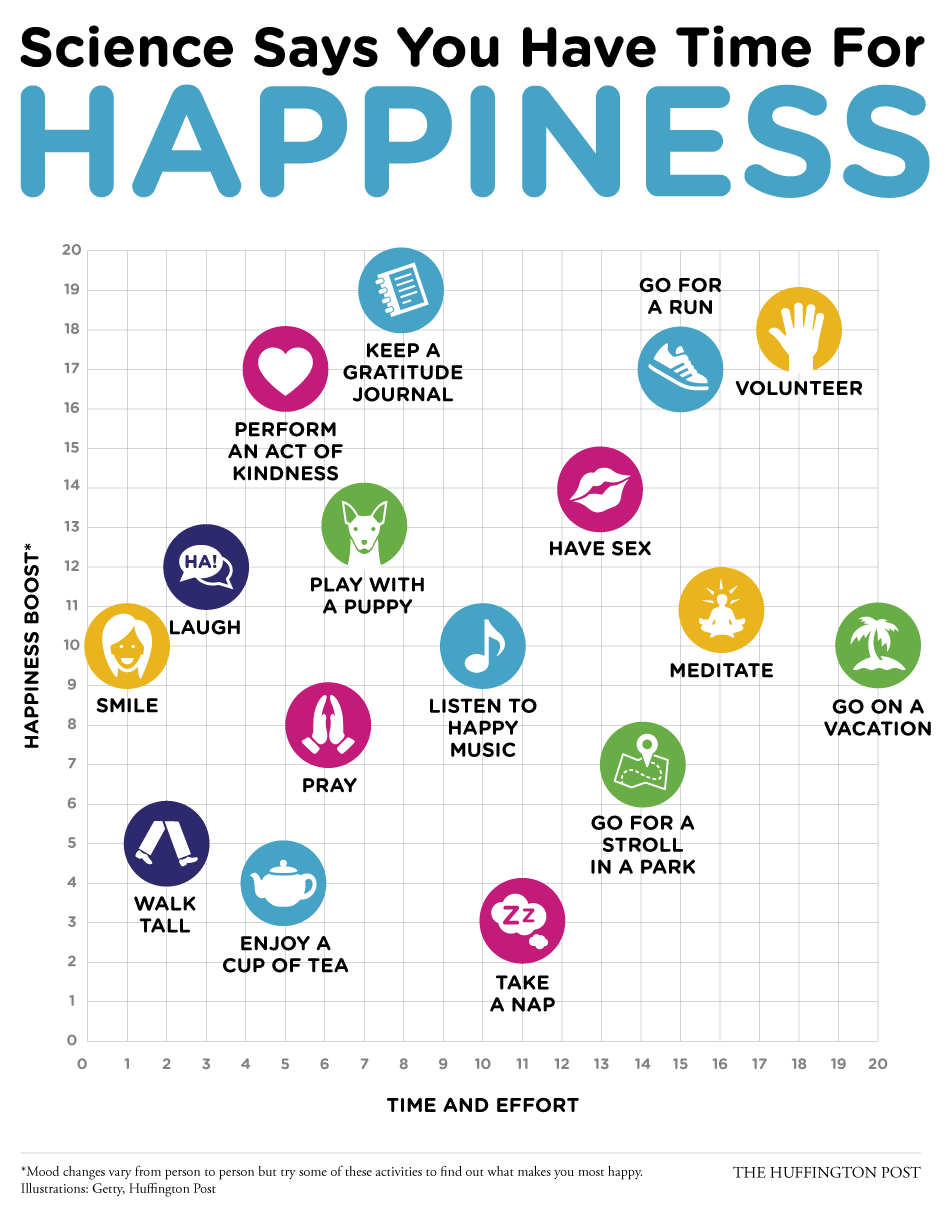
I’ve read a lot of books about happiness, but this little article on the Huffington Post really caught my attention with this simple and useful infographic. Click through on the link to the Huffington Post in that sentence to find the links to the studies backing the creation of this image.

2013_HappinessMatrix

Nice, huh?

Good to see how you can easily boost happiness simply by smiling (warning: the smiles have to be authentic – artificial smiles don’t work!) And I am really struck by the power of gratitude, and by performing acts of kindness.

So, how about just taking those three, and trying them out for the next few days. Start a gratitude journal and write in once a day, maybe preferably at night before bedtime……just list, and write a sentence or two about, whatever you experienced today that you feel grateful for, or write about who you are grateful to, and why. Set out each day to perform at least one act of kindness, or, even better, see if you can speak kindly and act kindly all day long. Finally, play some music which makes you smile, or look at some photos which make you smile, or delve into your memory banks for moments in your life which made you smile.

Read Full Post »

Here’s an interesting article about patients with dementia.

It focuses on interaction. This particular piece gives examples from America where Catholic and other Christian care homes introduced regular services of prayers and hymns, and showed how these old traditions connected with the patients when other forms of care didn’t. I don’t think this means that Catholic or other religious people have, or can have, a better experience of dementia than others, but I do think it highlights yet again the need for carers to be non-judgemental. Where a person has strong religious beliefs, engaging with them through their lens of understanding can really bring about surprising changes.

But what I especially like about this article is how it highlights three things – the need for compassion, the need to remember that all human beings are individuals, and the need to enter into active engaged relationships.

Like anything else in medicine, helping someone suffering from dementia requires understanding, compassion, and dedication. Care needs to be tailored to each patient’s personality, life history, and stage in the development of the disease. When this is done well, new possibilities open up. What might have been an atmosphere of regret and hopelessness centered on the disease’s relentless progress can be transformed into an upbeat outlook that celebrates abilities, rejoices in moments of recognition, and looks to the future with hope.

and

We simply do not know what is transpiring in the mind of another person. It is all too easy to place all the blame on the dementia patient, lamenting and even despising their disability. But were we to do so, we would be letting ourselves off the hook a bit too soon. Awareness, understanding, and affection are not merely the outputs of some inner dynamo. They also emerge in response to what others do, say, and feel. In some cases, unresponsiveness may say less about a patient’s disability than a failure on our part to offer something worth responding to.


Read Full Post »

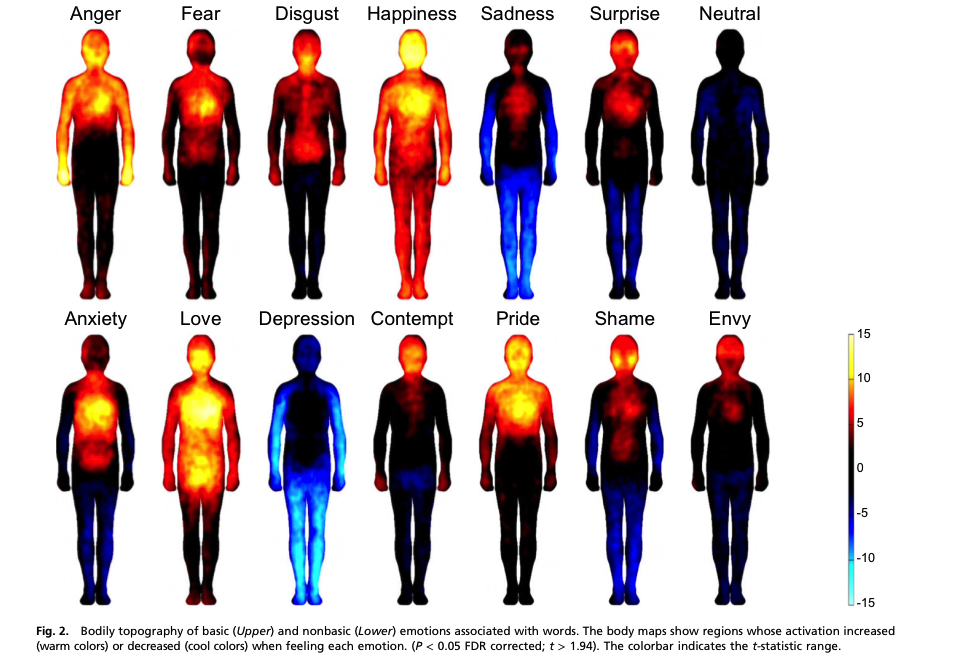
Here’s a fascinating study of 700 people asked to record what happened in different parts of their bodies when they experienced different emotions.

You’ve probably come across the idea of embodied cognition and embodied metaphors (briefly, we now know there are neural networks around the hollow organs of the body, especially the heart and the intestines, revealing that we don’t do all our cognitive work inside our skulls! and that metaphors like “heart broken”, “heart to heart”, “gut feeling” and so on, demonstrate how we experience the whole world through our whole being – body and mind)

This particular study is a self-reported one – it does not show physiological body changes, rather a representation of what people say they experience subjectively. Look at the beautiful summary image they produced –

embodied


How well does this show the shutdown experience of depression, the fist clenching of anger, the whole body experience of happiness, the links between anxiety and fear, or between shame and disgust, or between envy and contempt?

Another thing that strikes me about this is the degree to which the shutting down in depression is focused in the limbs – which makes me wonder about the links we are discovering about the healing power of exercise.

Interesting, huh?

Read Full Post »

« Newer Posts - Older Posts »