To live is so startling, it leaves but little room for other occupations….[Emily Dickinson]

…..gazing through one of my kaleidoscopes – enjoying this present moment
Posted in from the dark room, perception, photography, psychology, tagged vfs on March 20, 2012| Leave a Comment »
To live is so startling, it leaves but little room for other occupations….[Emily Dickinson]
…..gazing through one of my kaleidoscopes – enjoying this present moment
Posted in from the living room, life, psychology, science, tagged vfs on March 4, 2012| 1 Comment »
When you stop to think about it, there’s an awful lot going on inside your brain that’s nothing to do with thinking. Well, when I say nothing to do with thinking, I don’t exactly mean that….after all, everything is connected to everything else in there. What I mean is that conscious thought and reasoning is only a small part of the function of the brain and the mind. Some of that is about sensory and motor function – your brain processes a lot of signals from the sensory nerves and a lot of those signals don’t make it as far as conscious awareness. Your brain also processes a lot of the muscle activity of your body…everything from voluntary movements eg picking up a pencil….to involuntary effects like heart rate and rhythm.
One interesting aspect of what goes on in the mind is emotions – by “mind” I do not mean “brain” – I mean the extended, embodied network of nerves and chemicals which are involved in “mental processes”. Emotions occur below the level of consciousness and some of them we become directly aware of and can think about, but others seem to occur in what Freud and Jung described as the “unconscious”. In fact, “depth psychology” is all about trying to work with all this material which lies either wholly or partly inaccessible to conscious, rational thought.
We have tended to hold rational, cognitive thought, at the highest level. As if it is best to think things through, and not to trust our feelings. But is that the best strategy?
Here’s a fascinating article on this subject from Jonah Lehrer writing in Wired.
…..from the lab of Michael Pham at Columbia Business School. The study involved asking undergraduates to make predictions about eight different outcomes, from the Democratic presidential primary of 2008 to the finalists of American Idol. They forecast the Dow Jones and picked the winner of the BCS championship game. They even made predictions about the weather. Here’s the strange part: although these predictions concerned a vast range of events, the results were consistent across every trial: people who were more likely to trust their feelings were also more likely to accurately predict the outcome. Pham’s catchy name for this phenomenon is the emotional oracle effect. Consider the results from the American Idol quiz: while high-trust-in-feelings subjects correctly predicted the winner 41 percent of the time, those who distrusted their emotions were only right 24 percent of the time. The same lesson applied to the stock market, that classic example of a random walk: those emotional souls made predictions that were 25 percent more accurate than those who aspired to Spock-like cognition.
The explanation given for this is…
Every feeling is like a summary of data, a quick encapsulation of all the information processing that we don’t have access to. (As Pham puts it, emotions are like a “privileged window” into the subterranean mind.) When it comes to making predictions about complex events, this extra information is often essential. It represents the difference between an informed guess and random chance.
One important aspect of this study was that just guessing about a subject you knew nothing about, and cared nothing about, didn’t produce the same results. But if you really care about something, and are knowledgeable about that subject, then learning to be aware of, and trust, your feelings can produce better results than relying on logic and reason.
This reminds me of a Heartmath technique called “Heart mapping” where you make a “mind map” about your project, then, get coherent, then ask your heart what more does this project need, and create a second, complementary map – a “heart map”. Between them, you have a more holistic map of your project – one which captures both practicalities and values.
It’s reassuring to learn that our feelings are actually such potentially powerful and useful tools.
Posted in from the living room, health, life, personal growth, psychology on February 12, 2012| 4 Comments »
I’ve been collecting positive emotions recently. The Heartmath technique involves re-creating the heart felt, positive feelings you experienced in your life. So what are these heart felt, positive emotions? I’ve read a number of authors who write about positive emotions – from the perspectives of positive psychology, Heartmath itself, neurobiologists, mindfulness practitioners and so on.
What’s emerged is a short consensus list. Ten of these twelve feelings are mentioned by all the authors I read, all were mentioned by more than one author.
Contentment – pretty self-explanatory
Gratitude – it’s easy to establish a gratitude practice….worth doing at least once a day. What do I feel grateful for?
Hope – no life worth living without it?
Interest – I am insatiably curious. I’m never far away from interest!
Love – unconditional preferably
Pride – not what comes before a fall, but those moments when you know you’ve done well, when you are pleased with what you’ve achieved
Amusement – laughter is the best medicine
Compassion – it builds bonds
Sexual desire – again, pretty self-explanatory
Joy – just sheer pleasure and delight
Inspiration – those moments when you feel just, well, inspired!
Awe – or, as I prefer in French, émerveillment
What I really recommend is creating your own personal resource book of these feelings. Jot down in a few words, and/or gather photos, which capture your own personal experiences of these emotions. You can then draw on these feelings as you need them.
Posted in from the dark room, from the living room, personal growth, photography, psychology, tagged discovery of the unconscious, psyches on January 30, 2012| Leave a Comment »
The buildings opposite me fell down in the storms recently. At the weekend, I looked out of my window at the site which is now being cleared and saw this…..looks like the top of a tree breaking through the puddle and the ice!

Just the way my mind works, I guess, but I’ve been re-studying Jung recently, and been musing a lot about the significance of the discovery of the unconscious. How strange to become aware that most of what goes on in my head remains below the level of conscious thought…..what exactly is this “me” that contains so much I’ll never be able to consciously consider…? And how strange to think about a “collective unconscious” out of which our psyches grow…..
Posted in from the consulting room, from the reading room, health, neuroscience, psychology on December 19, 2011| 3 Comments »
Last year I studies Interpersonal Neurobiology with Dan Siegel, whose book, Mindsight, I highly recommend. He teaches around the essential triad of brain, mind and relationships and understanding the links between these three turns out to be tremendously illuminating. On the relationship front, Dan draws on his training in attachment theory and demonstrates the links between early nurturing and personality later in life – particularly in connection with how we form relationships.
Sir Harry Burns, the Chief Medical Officer of Scotland, highlighted in a brilliant presentation earlier this year the key importance of early years in determining future health and health behaviours.
On top of this comes this research from the University of Minnesota demonstrating –
“Your interpersonal experiences with your mother during the first 12 to 18 months of life predict your behavior in romantic relationships 20 years later,” says psychologist Jeffry A. Simpson, the author, with University of Minnesota colleagues W. Andrew Collins and Jessica E. Salvatore. “Before you can remember, before you have language to describe it, and in ways you aren’t aware of, implicit attitudes get encoded into the mind,” about how you’ll be treated or how worthy you are of love and affection.
Wow! during the first 12 to 18 months! How important is love? You can’t over emphasise it.
You might be thinking yikes, if it’s set in the first 18 months, what hope is there? Well, it turns out we can have lots –
The good news: “If you can figure out what those old models are and verbalize them,” and if you get involved with a committed, trustworthy partner, says Simpson, “you may be able to revise your models and calibrate your behavior differently.” Old patterns can be overcome. A betrayed baby can become loyal. An unloved infant can learn to love.
Posted in from the consulting room, health, psychology on October 18, 2011| 4 Comments »
Deric Bownds highlights the conclusions of an interesting book about psychological change – “Timothy Wilson’s new book “Redirect: The Surprising New Science of Psychological Change.”
The part which caught my eye was the conclusion –
Wilson uses the thought-provoking metaphor of “story editing” to describe the ingredient common to many of the successful interventions he reviews. They alter the narratives people tell themselves about their world and their place in it: Is it safe or threatening? Do I belong or not? Am I capable or not? During sensitive periods, people’s storytelling can be redirected and the change can build on itself over time. Amend the opening sentence of the story of your transition to college, or to a new job, and the arc of your story may be entirely different from what it would have been otherwise. This helps explain why seemingly simple interventions, such as writing about a traumatic experience, or volunteering for a humanitarian cause, improve health and well-being. They give people an organizing narrative that puts their lives in an optimistic context.
Well that’s certainly my experience. That’s the focus of our everyday work at the Centre for Integrative Care in Glasgow – helping people to write new narratives of their lives (or what I’ve described as helping people to become the heroes of their own stories)
Posted in books, creativity, education, from the living room, from the reading room, life, narrative, psychology, writing on September 11, 2011| 1 Comment »
I’m a great fan of stories. In fact, I think we understand ourselves and others by using narrative, and the central way in which I work as a doctor is to hear people’s stories, and help them to change them from stories of being stuck or in chaos, to stories of flow, and flourishing and growth.
I’m also a great fan of fiction and the importance of the imagination. I vividly remember Ian McEwan writing this, about this day, ten years ago…
If the hijackers had been able to imagine themselves into the thoughts and feelings of the passengers, they would have been unable to proceed. It is hard to be cruel once you permit yourself to enter the mind of your victim. Imagining what it is like to be someone other than yourself is at the core of our humanity. It is the essence of compassion, and it is the beginning of morality.
So, this recent article in the Guardian caught my eye, “Reading fiction improves empathy, study finds”. There are a number of studies described in this article, and it’s introduced me to something called “the pyschology of fiction”, and, specifically to the work of Keith Oatley. If I wasn’t so insatiably curious I wouldn’t keep finding these amazing new worlds to explore! One of the studies described in the article compared the effects of reading Harry Potter with the effects of reading Twighlight. They used a new measure – “Twilight/Harry Potter Narrative Collective Assimilation Scale”! Don’t you love that? Look at this conclusion from that research –
“The current research suggests that books give readers more than an opportunity to tune out and submerge themselves in fantasy worlds. Books provide the opportunity for social connection and the blissful calm that comes from becoming a part of something larger than oneself for a precious, fleeting moment,” Gabriel and Young write. “My study definitely points to reading fulfilling a fundamental need – the need for social connection,”
and read this fascinating comment by Keith Oatley
“I think the reason fiction but not non-fiction has the effect of improving empathy is because fiction is primarily about selves interacting with other selves in the social world,” said Oatley. “The subject matter of fiction is constantly about why she did this, or if that’s the case what should he do now, and so on. With fiction we enter into a world in which this way of thinking predominates. We can think about it in terms of the psychological concept of expertise. If I read fiction, this kind of social thinking is what I get better at. If I read genetics or astronomy, I get more expert at genetics or astronomy. In fiction, also, we are able to understand characters’ actions from their interior point of view, by entering into their situations and minds, rather than the more exterior view of them that we usually have. And it turns out that psychologically there is a big difference between these two points of view. We usually take the exterior view of others, but that’s too limited.”
Spot on. He really nails the importance and value of fiction as a tool for building empathy. We reduce the place of the Humanities in our education system at our peril!
Posted in from the consulting room, health, life, perception, psychology on August 25, 2011| 2 Comments »
I got thinking about sensations the other day. Patients talk to me every day about their sensations – pain, dizziness, nausea, itch, numbness and so on. The medical concept of such sensations is “symptoms”. Interestingly, not a single one of these symptoms are objective. Nobody can know them, experience them or measure them apart from the person who has them. But what are they? According to psychologists, sensations are the effects of sensory stimuli, and perceptions are our awareness, or understanding of them.
So, are sensations in the mind?
Well, that’s not where we tend to situate them. We situate them in the body. Pain is usually described as being felt in particular parts of the body. Pain in the leg, an itchy arm, a numb patch on the back of the hand….and so on. That suggests sensations are in the body, not the mind. But what about phantom limb pain? A sensation which is specifically located in a part of the body which no longer exists?
Where do doctors look for a problem when someone describes a sensation? The part of the body the sensation “belongs to”. If someone has chest pain, doctors go looking at the chest and its contents for an explanation of the pain. If they can’t find any abnormalities there, then the focus shifts to the mind – “it’s not in his chest, it’s in his head”. In other words, in the absence of physical pathology in that part of the body, the explanation given is a disorder of the mind.
Do you find this an adequate understanding?
I don’t.
It seems to me that sensations are phenomena of the person, and shouldn’t be attributed to either the body or the mind. They should be situated in a person’s story, because it’s the narratives we tell ourselves and others which create not only a sense of self, but all of our sensations too. Sensations may have locality, but that doesn’t make them the markers of pathology. They can be the expressions of meaning.
If you’re not sure what I’m on about here, check out this post. And if you’d like to read more about the idea of meanings behind sensations, you could start with the excellent “Why do People Get Ill?” or “Meaning-full Disease“.
Posted in from the reading room, health, narrative, psychology on August 23, 2011| Leave a Comment »
One of my favourite lines from Bob Seeger is “I wish I didn’t know now what I didn’t know then”.
However, I was a little startled by a piece in the “i” newspaper last week about drugs which can wipe out memory. Here’s a jpeg of the bit of the article which really took me aback….
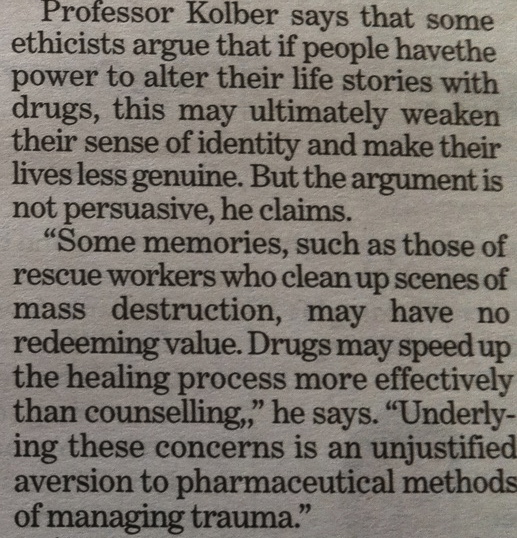
I don’t know about you, but as best I understand it our memories are a key part of the stories we tell ourselves and others to create both a sense of self, and to make sense of our lives.
Who’s to say that a painful memory has no value. A painful memory will probably always be a painful memory, but our responses to painful episodes can be the important foundations of who we become.
Before I go…..here’s the song in question (performed by Toby Keith)
Posted in from the consulting room, from the living room, health, life, personal growth, psychology, tagged flow on July 18, 2011| Leave a Comment »
Maxwell Maltz, a plastic surgeon who lived and worked in the US, studied the relationships between self-image, self-esteem and personal growth. He wrote “Psycho-cybernetics” in 1960 [ISBN 978-0-671-70075-1]. He uses a distinct language and set of concepts, which seems very 1960s to me, but the underlying understanding of human behaviour, the connections between the mind and the body, and the ways people can be helped to grow, strike me as being very true. I particularly like his emphasis on the importance of imagination and how we use it to create a self-image, and in so doing, how that sets our embodied mind (not a term he uses) off to get on with delivering according to the interpretation of reality we give it.
I like the last chapter of “Psycho-cybernetics” especially, where he says –
…the body itself is equipped to maintain itself in health; to cure itself of disease……in the final analysis that is the only sort of “cure” there is.
I’m still amazed how little this is understood. So many people, health professionals included, are caught up in the delusion of pathology and drugs. Health is not absence of pathology. Drugs don’t “cure”……they just manage disease. If there’s any healing going on, it’s the natural processes of the body which are responsible. The best drugs can do is modify disease, and in so doing modify illness, whilst we hope healing takes place in the background.
It might be an old concept to think about healing energies, but I like the way Maltz puts it –
This élan vital, life force, or adaptation energy – call it whatever you will – manifests itself in many ways. The energy which heals a wound is the same energy which keeps all our other body organs functioning……whatever works to make more of this life force available to us; whatever opens to us a greater influx of “life stuff”; whatever helps us utilize it better – literally helps us “all over”
I think, and I hope this is the way Medicine will develop – by understanding better just how people get better, and by studying the methods and techniques we can use to genuinely stimulate and support healing. It’s not the dominant paradigm yet, but I’m going to bet it will be!

 Heroes Not Zombies