Feeds:
Posts
Comments

Archive for the ‘science’ Category

You’ll be familiar with the idea the “canary down the mine” where a canary in a cage was carried down into the mine by the miners to give them early warning that the air conditions were deteriorating. Well, I just read an interesting variation on that tale in a French magazine called “Nouvelles cles”. The article was about Christophe Perret-Gentil, a biologist who became a herboriste. It began by telling an amazing story of a group walking in the woods in the Luberon very early one morning. They were learning how to recognise the different birds from their songs and to measure the quality of the environment through those sounds, when suddenly all the birds went quiet. Their expert leader, Christophe Perret-Gentil, commented that it was totally unprecedented for this to happen and stated that something serious, some “great event” must have occured somewhere on the planet. The following day, the group were amazed to read about the terrible earthquake in China which had killed many thousands. It had occured at precisely the time the birds fell silent.

Now I don’t know what to make of a story like that. It does remind me of the tales of the animals reacting to the approach of the tsunami before people became aware of it. Fascinating.

However, what actually interested me more was why this man was out counting bird songs in the first place. When he became a “herboriste” he thought about how to identify the plants which were of the highest quality and he knew that it couldn’t be done by measuring levels of anything in a lab. He thought about the indicators of a healthy environment and came up with an idea about birds. It’s quite a simple idea but he’s elaborated it into a detailed scoring system.

He goes to an area where a producer is growing plants which he might want to buy and from early in the morning he notes the range and variety of bird species living there. He has a whole classification system developed, with various levels of significance, from the common, indigent birds, through to the presence of endangered species. The more rare, or more endangered species scoring higher. This gives him an overall assessment of the health of the local ecology. He says it is difficult to actually see a lot of birds, but that it was easy to learn their songs so he charts the health of the environment by identifying the population of birds present as he hears them sing.

There’s something beautifully poetic about this method, and something entirely rational too. At a scientific level it draws together biology, ecology, ornithology, and botany, and at a human level it draws together music, observation, that brilliant human capacity to spot patterns and relate them to each other. Christophe then takes these threads and weaves them into a story which gives him a knowledge about quality, not mere quantity.

Read Full Post »

The contemporary French philosopher, Luc Ferry’s book, “What is The Good Life?” (ISBN 978-0226244532), is an interesting but quite difficult read. I’m not sure I’ve really grasped the whole of his argument, but it seems to involve developing awareness of the “singularities” in life, by which he means the unique, particular events, which draw our consciousness out to farther horizons so we see the transcendent in the immanent.
I won’t rehearse the detail of his arguments here, but the final section of the book considers the idea of two “modernities” as (apparently) described by Ulrich Beck in his “Risk Society” (ISBN 978-0803983465) (another one for the reading list). I haven’t come across this before and I think it was a particularly interesting take on the progress of science and society.
Ferry describes three ages of science, with only the latter two covering “modernity”. The First age was a time where the “contemplation of the order of the world and comprehension of the structure of the cosmos” were linked. The consequence of this link was that knowledge and values were intrinsically connected, “in the sense that, in itself, the discovery of the intimate character of the universe implies an emphasis on certain practical aims for human existence.” The Second age began with the Enlightenment, and, he says, was characterised by an indifference to values – “science describes what is, it does not speak of what should be”. This age, says Ferry, has only begun to decline in the last few years of the twentieth century. I’ve certainly read a perspective like this before, but the next stage is where it gets especially interesting. If you read my post about “Metaphors we live by”, the contrasting of an “objectivist” position with a “subjectivist” one (this latter exemplified by the Romantic focus on feelings and passions) does, I think, describe these two contrasting worldviews. In fact, as Luc Ferry also points out, there is a reaction against science from people who are still more attracted to the agenda of the Romantics. The point he goes on to make is one I haven’t read anywhere else. It is that the Third age (or second “modernity”) is characterised by self-criticism or self-reflection.
His argument is this – in the Enlightenment thinking scientific rationalism –

….promised to free people from the religious obscurantism of centuries past and at the same time to provide them with the means to make themselves, in Descartes’ famous phrase, into the “masters and possessors” of a universe that they could use and exploit at will in order to realise their material well-being.

This way of thinking easily contributed to the politics of democracy and nation-states –

The chief business of the new scientifico-democratic nation-states was the production and distribution of wealth. However, we are now witnessing a significant change because –

Today it is no longer nature that engenders the major risks for humankind, but scientific investigation; thus it is no longer nature that we have to tame, but rather science. For the first time in history, science furnishes the human species with the means for its own destruction

Even if we don’t feel threatened by the potential harms of nuclear and chemical technologies, we are afraid of what might happen if they were to fall into the hands of terrorists. “Control of the uses and effects of modern science is slipping out of our hands, and its unbridled power is worrisome.”

This “process without a subject” in a globalised world of technology that no worldwide governance has yet managed to control makes the framework of the nation-state and, along with it, the traditional forms of parliamentary democracy seem strangely cramped. No republican miracle caused the clouds of Chernobyl to stop at the frontiers of France. For their part, the processes that govern economic growth and the financial markets no longer obey the dictates of the people’s representatives, who now struggle to keep the promises they have made to the electorate.

It’s interesting that he wrote this about seven years ago, before we experienced the current crisis in the world economic system.
What does he advocate, in terms of the project to spread the good life amongst human beings?

A re-integration of values and knowledge, and, especially a renewed focus on what’s special about human life as a part of nature, not apart from it. This strikes me as very true.
There’s definitely a part of me drawn to the Romantic values of the subject, to a respect for feelings and a belief that a life without passion is a life only half lived (at best!), but there’s also a part of me keenly drawn to science. (It’s just that I find the current flavour of materialistic scientism desperately empty and unsatisfying). I think that’s why I’m drawn both to the Lakoff and Johnson “experientialist” idea, and this idea in Luc Ferry’s book about the scientific method developing through self-criticism and self-reflection. Both are attempts to understand what it is to be human, fully immanent within nature, but with a constant capacity for transcendence.

Read Full Post »

“Metaphors we live by” written by Lakoff and Johnson. (ISBN 0-226-46801-1) ……..
I often muse about what makes a human being, human? Or what makes a human being fully human? Consciousness is clearly one of the characteristics. Language is another. And imagination is a third. Perhaps it’s because I’m interested in these phenomena that some time back I bought “Metaphors we live by”. Our ability to handle metaphors and symbols intrigues me, and I wanted to understand better how we use metaphors so the title caught my eye. However, when I flicked through it, it struck me as a bit technical and even dry. I thought it was a book about linguistics, an area of study which does interest me, but one which I find can be difficult to grasp. So I put the book aside in my giant collection of “interesting books to get round to reading one day”. I’m not quite sure I pulled it off the shelf recently. Oh, yes, actually I do remember why, but the explanation is going to have to wait till another post. (cryptic, huh?) I guess that old adage of there being a right time for everything must apply to books, because this time, I started into it and couldn’t stop. I’ve marked it up. I read and re-read chapters. I’ve skipped to the back, delved into the middle, read it from cover to cover. I find it compelling and convincing. And I can’t figure out why I didn’t take to it first time round.
It’s actually an incredibly difficult book to summarise. Usually when I write a review like this I paste in a few passages from the book to illustrate what it’s like. But I’ve collected so many passages I find it hard to pick only a few!
Here’s the gist of their argument. By studying human communication they claim to have discovered that metaphors are not simply a word or language game, but much more fundamentally, they are conceptual. By that they mean we think in metaphors, we understand using metaphors, and, indeed we understand the world and our place in it through metaphors. I didn’t need convinced about that. I already thought that metaphors were the basis of thought. However, they take the whole project to an entirely different level by studying the types of metaphors which are most prevalent in our thinking and communicating. With way too many examples to share here, they illustrate clearly and convincingly that the basic, fundamental metaphors we use haven’t appeared randomly, but are developed out of our interactions with the physical and the cultural worlds in which we exist. In other words, they are develop from our interactions with time and space, and our interactions with other people and creatures. This, I think, is the key. It allows them to develop an argument they call “the experientialist myth”, proposing it as a better way to understand life than the opposing myths of “objectivism” and “subjectivism”. (Time for a quote or two from the book)

The myth of objectivism reflects the human need to understand the external world in order to be able to function successfully in it. The myth of subjectivism is focused on internal aspects of understanding – what the individual finds meaningful and what makes his life worth living. The experientialist myth suggests that these are not opposing concerns.

Within the myth of objectivism, the concern for truth grows out of a concern for successful functioning. Given a view of man as separate from his environment, successful functioning is conceived of as mastery over the environment. Hence the objectivist metaphors KNOWLEDGE IS POWER and SCIENCE PROVIDES CONTROL OVER NATURE.

The principal theme of the myth of subjectivism is the attempt to overcome the alienation that results from viewing man as separate from his environment and from other men. This involves an embracing of the self – of individuality and reliance upon personal feelings, intuition, and values. The Romanticist version involves reveling in the senses and feelings and attempting to gain union with nature through passive appreciation of it.

The old myths share a common perspective: man as separate from his environment.

The experientialist myth takes the perspective of man as part of his environment, not as separate from it. It focuses on constant interaction with the physical environment and with other people. It views this interaction with the environment as involving mutual change. You cannot function within the environment without changing it or being changed by it.

Do you get the idea? It’s a kind of division between the rationalists and the Romantics, with the claim that metaphor builds a bridge between reason and the imagination and gives us a third way. One which neither denies objective reality, not gets lost in subjective relativism. In the process, this “experientialist” way, shows how there are no Absolute truths out there discoverable without an understanding based on cultural systems, but keeps the project of the imagination and feelings grounded in our interactions with the world.

Objectivism takes as its allies scientific truth, rationality, precision, fairness, and impartiality. Subjectivism takes as its allies the emotions, intuitive insight, imagination, humaneness, art, and a “higher” truth.
The proportions of our lives governed by objectivism and subjectivism vary greatly from person to person and culture and culture. Some of us even attempt to live our entire lives totally by one myth of the other.

How do you think it is for you? Are you more drawn to objectivism’s allies, or subjectivism’s?

I find both main strands of their case very convincing. The more you look for it, the more you become aware of the pervasiveness of metaphor, and the more you study it, the clearer it becomes that conceptual metaphors are grounded in our experiences and interactions. Their experientialist myth appeals to me much more than either of the other two older myths. It strikes me as more true. I also think it allows a much more robust defence against scientism than romanticism ever did.

Read Full Post »

Human history, as best we know, dates back around 200,000 years. For 190,ooo of those years we were hunter-gatherers and for the last 10,000 we’ve had agriculture.

I suppose I’d read about the hunter-gatherer phase long since but the significance of it never really struck me, and certainly the fact that so much of human history was in that phase was something that really didn’t register. For some reason, I’ve stumbled upon a number of different references to this in recent reading. I was musing about what characteristics have been to the fore in the two phases, and I wondered if the hunter-gatherer phase demanded a greater focus on co-operation, whilst the agriculture phase led to ownership and competition. But maybe that’s too simplistic. These thoughts have been around for me during these crises of recent times – the economic, environmental and political ones. There’s a feeling just now that we could be witnessing the crumbling of whole global system, and it leaves us wondering what might emerge to take its place. Which characteristics are we going to need to deal with these current, and future challenges?

I don’t have the answers in place, but here’s a couple of interesting articles to throw into the mix. First off, I read a post on Deric Bownd’s blog. He titled the post “Civilisation has caused the decline of human health“. Well, that caught my eye! He was referring to a presentation by Ann Gibbons at an Americal Assoc. of Physical Anthropologists meeting. 72 researchers studied the data on the remains of 11,000 individuals who lived from 3,000 to 200 years ago in Europe. Here’s the conclusion –

…the health of many Europeans began to worsen markedly about 3000 years ago, after agriculture became widely adopted in Europe and during the rise of the Greek and Roman civilizations. They document shrinking stature and growing numbers of skeletal lesions from leprosy and tuberculosis, caused by living close to livestock and other humans in settlements where waste accumulated. The numbers of dental hypoplasias and cavities also increased as people switched to a grain-based diet with fewer nutrients and more sugars…After a long, slow decline through the Middle Ages, health began to improve in the mid-19th century. Stature increased, probably because of several factors: The little Ice Age ended and food production rose, and better trade networks, sanitation, and medicine developed… But take heed: Overall health and stature in the United States has been declining slightly since the 1950s, possibly because obese Americans eat a poor-quality diet, not unlike early farmers whose diet was less diverse and nutritious than that of hunter-gatherers.

So a bit of a mixed picture but an interesting analysis of the impact of agriculture on our species.

Then I read an article in the Independent on Friday. The article was subtitled “Scientists explain how altruism evolved over 200,000 years of conflict”. This piece described the work of Samuel Bowles, of the Santa Fe Institute in New Mexico who is challenging the common “Darwinian” theory that altruism is not a characteristic which would be selected for (the “selfish gene” theory) Bowles argues that during the time of hunter-gatherer tribes –

Warfare was sufficiently common and lethal among our ancestors to favour the evolution of what I call parochial altruism, a predisposition to be co-operative towards group members and hostile towards outsiders.

He argues that selection worked on groups, not just individuals and the groups which developed this “parochial altruism” did best. He does admit this is not the only possible explanation for altruism –

[The] willingness to take mortal risks as a fighter is not the only form of altruism… more altruistic and hence more co-operative groups may be more productive and sustain healthier, stronger, or more numerous members, for example, or make more effective use of information

Other scientists are supporting this challenge to the selfish gene theory, arguing that selection effects on groups may be more apparent in a species like humans because our species is a “cultural” one.

It’s interesting to take this longer view of human history. Such a change of perspective can help you see the wood for the trees I think. In particular I find this stimulates my thought about the relative merits of co-operation vs competition (as well as stimulating my thought about how we feed ourselves!)

Read Full Post »

If someone has an infection caused by a particular bug, and the doctor prescribes the best, most appropriate drug to kill that bug, what does the drug do?

The correct answer is “it kills the bug”.

The incorrect answer is “it cures the infection”.

You see, bugs and infections are not the same thing. Certainly a bug may “cause” an infection. You don’t get TB without the TB “bacillus” being involved. The TB bacillus can be isolated and grown in a laboratory, but it isn’t an infection until a person has it growing inside them. That might sound totally obvious but you’d be surprised how little doctors and patients think about this. There is no doubt that discovering the role of microbes in causing infection was a breakthrough in understanding and the availability of drugs to kill bugs is a real boon but the problem is thought often stops there. How do we help an individual to recover after the bug has been killed? Exactly how does a person repair their damaged body after an infection, and how can they increase their chances of defending themselves more effectively against future infections? How do we reduce the burden of infection on populations? Antimicrobials are only part of the solution, not the whole solution.

This is not a new thought. I’ve recently become a fan of Cabinet magazine (a magazine based on the idea of wonder rooms) and in the current issue there’s an article about Professor Max Joseph von Pettenkofer, a Bavarian chemist-apothecary who lived from 1818 until 1901 (when he shot himself in the head). He was a very colourful character who disputed the theory that germs cause infections. Koch and Pasteur’s discoveries were convincing the world that the cause of infections were microbes but Pettenkofer thought their theories were simplistic. He maintained that infection involved the interaction of three factors – factor x – germs, factor y – some condition of the region where the infection occurred, and factor z – susceptibility on the part of the patient. To prove his point, he conducted a very public, very dramatic experiment where he had a fresh culture of the germ which caused cholera (called at that time the “comma bacillus”) prepared in a laboratory. He then drank enough of this culture to kill a village and survived. (He claimed he did not suffer from the cholera at all but he did have stomach pains and some diarrhoea for a few days.) Despite this performance nobody was convinced. Pettenkofer ended up committing suicide. However, his conclusion that the way to prevent cholera was through sanitation to deal with factor y – the condition in the region, was actually spot on.

There’s a lesson here about the limits of reductionism. The simplest explanations are attractive, but in the real world, are often just too, well, simplistic. And there’s also a lesson about “this or that” or “black or white” ways of thinking. Often “and” is a better explanation than “or”. Narratives need not cancel each other out. They can complement each other and produce a greater, instead of a lesser, understanding.

Read Full Post »

Can we have confidence in bankers? Can we have confidence in politicians? We have a wee phrase in Scots “A hae ma doots” (“I have my doubts”). Well in the middle of this breakdown of trust and confidence in our economic and political institutions, along comes a piece of research from Edinburgh University which has performed a meta-analysis of surveys and studies into fraud and malpractice by scientific researchers. Here’s the conclusion –

On average, across the surveys, around 2% of scientists admitted they had “fabricated” (made up), “falsified” or “altered” data to “improve the outcome” at least once, and up to 34% admitted to other questionable research practices including “failing to present data that contradict one’s own previous research” and “dropping observations or data points from analyses based on a gut feeling that they were inaccurate.” In surveys that asked about the behaviour of colleagues, 14% knew someone who had fabricated, falsified or altered data, and up to 72% knew someone who had committed other questionable research practices.

As the author points out, everything we know about scientific fraud tells us that it is grossly under-reported. These figures are pretty certain to be underestimates. To what extent, we don’t know. But even as they are, they are worrying. Scientists make great claims for themselves as the discoverers of “The Truth”. I’m always wary of people who claim only what they know or believe is true. However, let’s accept the hypothesis that the scientific method is THE best method for uncovering the truth about reality. The trouble is, there’s no such thing as “the scientific method”, there’s only what “scientists” do, and scientists, surprise, surprise, turn out to be as human as the rest of us. This study is of deliberate, conscious, admitted knowledge of fraudulent or questionable practice. The rates found, even if accepted as accurate (which would be foolish), are worrying. Add to that all the actions which are unintentional, unconscious and/or kept secret and what does that make you think? Can we trust scientists to be the beacons who show us the Truth, the whole Truth and nothing but the Truth?

One particular phrase certain struck me – “In both kinds of surveys, misconduct was reported most frequently by medical and pharmacological researchers.” – is that because these particular researchers are more honest than others, admitting their behaviour more? Or is it because such practice is more frequently found in medical and pharmacological research than it is in other areas?

“Evidence Based Medicine” (EBM), is undermined by the “evidence” produced by these researchers.

Read Full Post »

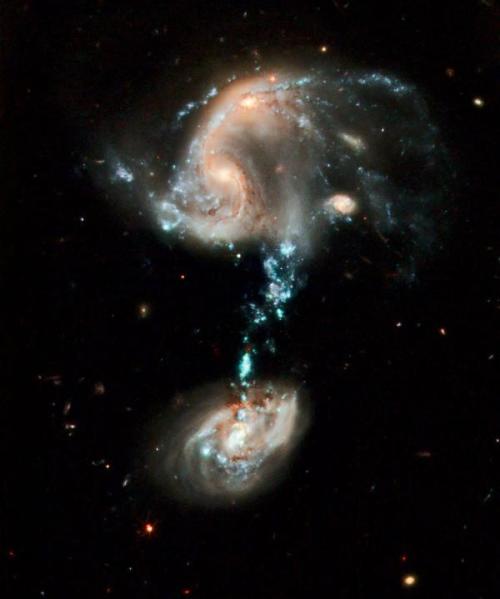
galaxy

This is not the usual sort of thing for me to post but I just came across this photo from the Hubble telescope and I’ve gone back to it again and again. It’s awe-inspiring. It’s amazing. It’s wonderful.

It’s a couple of galaxies interacting 200 million light years away from here. Between them is this “fountain” of new stars. The distance from the bottom of the lower galaxy to the top of the upper one is 100,000 light years!

Breath-taking

Read Full Post »

I came across an excellent article about epilepsy recently. There’s a common belief that a seizure is a kind of chaos of the brain. In fact, it’s the opposite. A seizure is where the complex patterns of electrical activity in the brain break down and are replaced temporarily with a single big co-ordinated pattern.

A normal brain is governed by chaos; neurons fire unpredictably, following laws no computer, let alone neurologist, could hope to understand, even if they can recognize it on an EEG. It is what we call consciousness, perhaps the most mathematically complex phenomenon in the universe. The definition of a seizure is the absence of chaos, supplanted by a simple rhythmic pattern that carries almost no information.

I was especially struck by that last phrase – “a simple rhythmic pattern that carries almost no information”. We have a strong tendency to think it’s the ordered, clear patterns which convey information, and that when there is no clear pattern, that there’s no clear information. Interesting how it’s the opposite!

I then came across this interesting study of the zone between order and chaos. There’s a place between order and chaos which scientists describe as “edge of chaos” (otherwise known as “far from equilibrium”). It’s a difficult place to hold, easily tipping into some form of order, or some form of chaos, but it’s found everywhere in complex systems.

Self-organized criticality (where systems spontaneously organize themselves to operate at a critical point between order and randomness), can emerge from complex interactions in many different physical systems, including avalanches, forest fires, earthquakes, and heartbeat rhythms.

Well it turns out this is exactly how the brain performs best – and here’s why –

Due to these characteristics, self-organized criticality is intuitively attractive as a model for brain functions such as perception and action, because it would allow us to switch quickly between mental states in order to respond to changing environmental conditions

If you are too structured, too ordered, too stuck in your ways, it’s harder to adapt when things change.

Interesting……complexity means it’s hard to predict what will happen, but this fine balance between order and chaos turns out to not only Nature’s favourite, it’s a great survival strategy. I suspect one of our biggest challenges in the world now is to learn how to be more adaptable and not so reliant on rigid structures and patterns.

Read Full Post »

Where does your mind exist? There’s a longstanding “common sense” view that it’s inside your skull. But, it’s becoming apparent, that is far from the whole story. Yes, of course a lot of what we call the mind is related to brain activity and the brain is indeed inside the skull, but many researchers are discovering that just as the brain does not exist in isolation, neither can cognition, behaviour, a sense of self, for example, be understood solely on the basis of brain processes. If we want to understand the mind we have to consider the body in which the brain is embedded. Phrases such as “embedded mind” and “embodied mind” capture the essence of this view, and the more you think about it, the more your realise the importance of the incredible network of connections between the brain and the rest of the body.
I get frustrated by doctors and scientists who act as if we can divide a human being into two components – a body and a mind. Especially when they then use this arbitrary and false dichotomy to actually recommend treatments for people’s illnesses. The “embodied mind” concept binds the body and the mind inextricably. That makes a lot of sense to me. I’ve never met a mind without a body, and the only bodies I’ve met without minds have been in the mortuary.
However, some thinkers, scientists and researchers have pushed the idea of “embedded minds” a stage further. (the difference being that “embodied” is exactly what it says – “in the body”; whereas “embedded” argues for a broad contextual understanding which situates the mind in it’s multiple environments). Andy Clark, who promotes the concept of the “extended mind” is one of the writers who has taken this furthest.

I have three of Andy Clark’s books. The first one I read was “Being There” (ISBN 0-262-53156-9), which was given as a key reference in “Smart World” by Richard Ogle . That book deals with the concept of the “embodied mind”.

Might it not be more fruitful to think of brains as controllers for embodied activity? That small shift in perspective has large implications for how we construct a science of the mind. It demands, in fact, a sweeping reform in our whole way of thinking about intelligent behaviour. It requires us to abandon the idea (common since Descartes) of the mental as a realm distinct from the realm of the body; to abandon the idea of neat dividing lines between perception, cognition, and action.

Being There describes how this concept evolved and lays out the implications of the model. Six years later he published “Natural-born Cyborgs” (ISBN 0-19-517751-7). Here he challenges us to consider just how we, as human beings, extend ourselves outwith the bounds of our physical biology.

For what is special about human brains, and what best explains the distictinctive features of human intelligence, is precisely their ability to enter into deep and complex relationships with nonbiological constructs, props and aids. This ability, however, does not depend on physical wire-and-implant mergers, so much as on our openness to information-processing mergers.

He tracks the evolution of these interactions

….from speech and counting, morphs first into written text and numerals, then into early printing, and on to the revolutions of moveable typefaces and the printing press, and most recently to the digital encodings that bring text, sound and image into a uniform and widely transmissible format…..they constitute, I want to say, a cascade of “mindware upgrades”
What matters most is our obsessive, endless weaving of biotechnological webs: the constant two-way traffic between biological wetware and tools, media, props, and technologies. The very best of these resources are not so much used as incorporated into the user herself. They have the power to transform our sense of self, of location, of embodiment, and our own mental capacities. They impact who, what and where we are. In embracing our hybrid natures, we give up the idea of the mind and the self as a kind of wafer-thin inner essence, the human person emerges as a shifting matrix of biological and nonbiological parts. The self, the mind, and the person are no more to be extracted from that complex matrix than the smile from the Cheshire Cat.

I particularly like this phrase from his concluding chapter in that book –

Our most significant technologies are those that allow our thoughts to go where no animal thoughts have gone before. It is our shape-shifter minds, not our space-roving bodies, that will most fully express our deep cyborg nature.

In his most recent book, “Supersizing the Mind” (ISBN 978-0-19-533321-3), he reproduces the original article which he wrote with David Chalmers, where they both laid out this concept of an “extended mind”. That article alone is worth reading, and, in fact, he recommends you read it first before reading the rest of the book. He juxtaposes the concept “BRAINBOUND” with “EXTENDED”.

According to BRAINBOUND, the (nonneural) body is just the sensor and effector system of the brain, and the rest of the world is just the arena in which adaptive problems get posed and in which the brain-body system must sense and act.
Maximally opposed to BRAINBOUND is a view according to which thinking and cognizing may (at times) depend directly and noninstrumentally upon the ongoing work of the body and/or the extraorganismic environment. Call this model EXTENDED. According to EXTENDED, the actual local operations that realise certain forms of human cognizing include inextricable tangles of feedback, feed-forward, and feed-around loops; loops that promiscuously criss-cross the boundaries of brain, body and world. The local mechanisms of mind, if this is correct, are not all in the head. Cognition leaks out into body and world.

Why is all this important? Well, I think Andy Clark puts it well himself –

This matters because it drives home the degree to which environmental engineering is also self-engineering. In building our physical and social worlds, we build (or rather massively reconfigure) our minds and our capacities of thought and reason.

This is the why this way of thinking so exciting. How does our physical environment shape not just our patterns of thought, but our whole sense of personhood? How does it limit, or potentially expand, what we think we are and what we think we can be? Our social world is a fundamentally narrative one. So what are the stories we are told in our societies? And what stories do we choose to tell each other? How does this narratively-constructed world both shape our sense of personhood, and stimulate our imaginations to become something more than we are now?
If all this seems a little esoteric for you, read David Chalmers foreword to “Supersizing the Mind”. You’ll immediately grasp the everyday-ness of all this as he talks about how getting an iphone has changed his life, and, further, how the use of notebooks, and visual cues, can maintain independent living in patients with Alzheimer’s way beyond what would be possible were they to rely on the minds inside their skulls!

Read Full Post »
My daily working life is that of a doctor. That only tells you a little because Medicine is a very broad subject and doctoring can require extremely different sets of skills. Sometimes I muse about just what is the job of a doctor? Or what makes for a good doctor? I’m pretty sure it involves trying to understand people better. I’m also pretty sure it involves helping people. It involves never thinking you know everything or that you are definitely right! (I know that’s a surprising conclusion but there’s a difference between being decisive and being certain…..read the linked post for more on this). I think it’s also a common experience that a good doctor is one who gives a damn ie one who cares. However, the specifics of the working life of a doctor depend a lot on the context of the doctor’s work. I made myself a “human spectrometer” to clarify this point.

Human spectrometer

Most health care is created around systems. There are whole departments defined on the basis of their focus on a system – Neurology, Urology, Gastroenterology etc. The focus of a doctor in that department is a particular system of the body. He or she becomes expert in the diseases and disorders of that system and acquires the knowledge, tools and experience to intervene, to either resolve, or to manage those disorders. Some doctors specialise more than this. Move left a little from the system on the spectrometer. We have both medical and surgical specialists who focus on one particular organ, or part of a system, like liver specialists, hand surgeons, and so on, and following that path further left we have biochemists and geneticists who concentrate on the functions right down at cellular, or intracellular levels. Jumping to the other end of the scale, there are the epidemiologists and the Public Health doctors who consider disease at a population level. I’m a great admirer of the work of Prof Richard Wilkinson who makes clearer than anyone else I know just what an impact inequality has on population health. The knowledge, skills and experience he needs to do his job are quite different from those of the hand surgeon. Move left again along the spectrum from the right hand side. There are doctors who focus on families, whose everyday lives involves working with whole families, or parts of families. Then there’s me. Right there in the middle. There are lots and lots of doctors like me. Our days are spent largely in consulting rooms with individual patients. Our approach is a generalist one, not a specialist one. We focus on the person. The skills, knowledge and experience needed to do this kind of daily work is holistic, narrative-based and focused on the ability to listen, to communicate and to understand at an individual level.

So each doctor needs the skills and the knowledge appropriate to their practice but there’s something else all doctors share. We are all trying to relieve suffering.

Suffering isn’t a word you’ll find in medical textbooks (just like you won’t find the words “health” or “healing” in textbooks of clinical medicine either!) but it’s our raison d’etre. You can judge me by it. I judge myself by it. When I go to work any day, I want to relieve suffering. If I interact with a patient and don’t feel that I’ve contributed to a relief of their suffering by my involvement and my actions then I don’t feel I’ve done my job. Dr Eric Cassell’s book, “The Nature of Suffering”, deals with this issue beautifully. He says in this book, and in his others, that he changed his clinical practice by deciding to focus on the issue of the patient’s suffering. In fact he explicitly asks his patients to tell him about their suffering as a powerful way of allowing them to set and declare their agenda and for him to focus his care where it matters. In that book he shows how suffering might lie in an individual patient, but it might lie in their relationships, their family, their workplace or community. You could, in fact, ask that question at any point on the “human spectrometer” above. Just where on the spectrum does the suffering lie?

However, human beings have a complex relationship with suffering. It might even be extolled as something good – “No pain. No gain” “I have to suffer for my art” I’ve read more than one book which considers the place of a serious illness in an artist’s life and puts forward the hypothesis that it was their suffering which enabled them to produce their distinctive, great art. I recently read David Lynch’s book, “Catching the Big Fish; Meditation, Consciousness and Creativity” (which I highly recommend actually!) where he powerfully refutes that argument, claiming that Van Gogh might have had the chance to produce even more and even greater art if he hadn’t had all that suffering to cope with in his life. Suffering gets a good press in many religious teachings as well as in a certain kind of New Age thinking. There are many spiritual practices based on inflicting suffering on the body and there’s even a belief in destiny, or Fate, or karma, which states that if you are suffering it’s because that’s what your soul requires. Even the “quest story” of Arthur Franks, as exemplified in Lance Armstrong’s “It’s not about the Bike” shows how suffering can be a path to growth and development.

I’m not denying any truths which lie in those beliefs. Nor am I claiming to know better. But let me be very clear, as far as I know, nobody, given the choice between a path of suffering and one of bliss, chooses suffering. We only choose suffering if we can see no other way to get to where we want to be. If we can find another way that doesn’t involve suffering we’ll choose it. So, yes, maybe my job involves helping people to make the most of their suffering, or to even get something good out of it, but, my first priority, my prime motivation is to do my best to relieve it.

Whether I can help relieve someone’s suffering or not, the inextricably related goal I have is to help that person to have a good life. The point of relieving suffering is to enable a person to experience a good life. But as suffering is an inevitable thread that winds its way through all lives, a doctor’s job is to help people to have a good life, whether they are suffering or not.

Doctors are not the only people to help others to lead good lives of course, but I do think a doctor who loses sight of this goal, loses sight of what it is to be a doctor.

PS Now you’ll be thinking “ah, but what is a GOOD LIFE?” Me too! (I’m working on a post about this but here’s an earlier one to be going on with)

Read Full Post »

« Newer Posts - Older Posts »
