Feeds:
Posts
Comments

How we respond

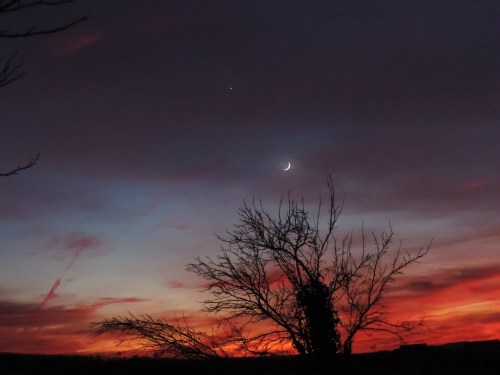
I’ve seen many fabulous sunsets in my five years here in the Charente, and I never, ever tire of them. A glimpse out of the window, catching sight of the fabulous colours spreading across the sky from the western horizon, always, always gets me up for a better look. I either open the window and lean out to see more of the sky, or, more frequently, I step outside, with, or without a camera in hand. I took this photo of one of the sunsets I saw this week. It was one of the longest, deepest, widest sunsets I’ve ever seen and I took many photographs. But I also stood for a while simply watching it.

The more I watched the more absorbed I became. It really felt as if the glow in the sky was being replicated with an inner glow. As if my heart, my soul, was resonating with the setting sun as it painted the sky with fabulous pinks, reds and purples.

I also noticed, as you can, that there was a sliver of the Moon up there, and at just about the 11 o’clock position to the Moon was Venus.

We humans have at least two astonishing characteristics. We create and handle symbols, and we tell stories.

Venus and the Moon are symbols of feminine energy, and amongst the many other themes, nurturing and nourishing are two of the fundamental themes of femininity for me. They represent the Mother, who creates and gives birth to her children, who feeds them with her milk, feeds them with the food she prepares, and who nourishes not just their bodies, but their minds, their hearts and their souls. So, when I see this combination of Venus and the Moon in the sky it stirs my gratitude for, and my awe at, the creation of Life in this Universe, the nurture and nourishment which literally grows each baby’s body, brain, heart and spirit, and for the incredible importance of Love in bringing Life into being, in sustaining, and developing each living being.

It’s beautiful. And it’s easy to remember the stories of Venus, the Goddess of Beauty and of Love, who we embed into our every single week by naming one of the days “Vendredi” (or, “Viernes”) although in English, we’ve disguised that connection by switching to the Norse goddess, Frigga, and calling that day “Friday”. It seems incredibly apt to be experiencing the resonances between the beauty of the setting sun and the Goddess of Beauty.

Doesn’t the experience of beauty so often stir our feelings of love?

But there’s more, because the silhouetted tree in this photograph is a plum tree without its leaves. The Moon, which constantly changes, which constantly measures and influences the cycles of the tides and which has given we humans a sense of time cycling rather than running along in a straight line, is sitting there above the plum tree, in its winter phase. Seeing them both together turns my thoughts to rhythms, to seasons, to the constantly changing nature of time, to the cycles of activity and dormancy, to the cycles of hibernation and growth and flourishing. And, that, is beautiful too.

My point is, however, what about you?

What do you see when you look at this image?

What feelings, thoughts, memories, hopes, and desires does it conjure up?

Because the truth is, no two of us ever have exactly the same experiences. This moment, this image, this experience, will be unique for each of us because every one of us brings a unique response. I know, there are shared themes, common aspects, to the experience, but when we slow down, allow our personal thoughts, feelings, images and stories to rise to consciousness, then it becomes something incredibly special.

What a gift it is to be alive. How astonishing it is to be a human being living in this immense universe.

The wall fell down

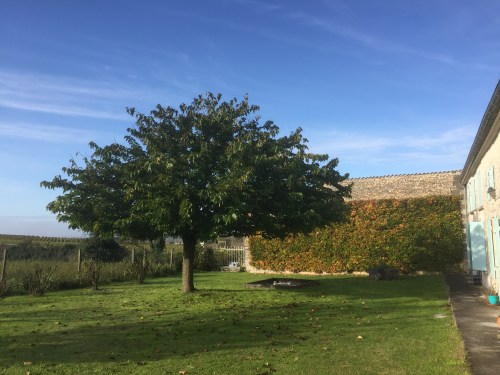
Last weekend we heard a tremendous noise. It was like thunder, or maybe an earthquake, but the storm hadn’t arrived yet, and we’d felt no earth tremors. When we went outside to look we saw this…..

(and for comparison, this is how the wall looked before it fell)

My first thought was thank goodness nobody was hurt. Quickly followed by remembering how many times in the last five years I’ve stood at the very top of a tall ladder trimming this vine. So, lucky it didn’t fall while I was doing that!

Practicalities aside, I’m quite surprised by the strength of the emotional impact of this collapse.

It feels like a huge loss. Over the seasons, I’ve watched the phases of this incredible vine, from leafy green, to reds and golds, to the phase where the leaves fall and the bright yellow stalks are left behind, to the purple berries on bright red stems becoming more obvious as the leaves and stalks fall. I’ve heard the sound like waterfall as the millions of seed pop out from their capsules and cascade down the wall in late summer. I’ve heard the really loud buzzing choir of thousands of bees gathering the pollen in peak summer. I’ve seen the blackbird pair make their nest and spend several minutes hopping around the grass trying to figure out where they’d put it. I’ve seen the handful of nests left behind in the winter. I’ve seen flocks of starlings descend on the purple berries. In short, the collapse of the wall, taking the vine with it, feels like the collapse of an ecosystem. And ecosystem which became part of my everyday experience. That feels like a tragedy. But, probably, the wall will be rebuilt, and, in time, the vine will recover. On the other hand, maybe the neighbours will decide not to build such a big wall after all. What then? We’ll see.

It also feels like an ending. Maybe because we are rushing towards the end of a decade, in the midst of environmental, social and political upheavals, but I happen to be reading an edition of a French journal which is featuring “collapsologie” – the phenomenon of “collapse” and the various experts and thinkers who are reflecting on it. So, probably my current reading heightens my sensitivity to this wall collapse feeling like an ending. But added to that, our landlord sold the neighbouring field earlier this year and now someone has started building a house just on the other side of the fence. So I can see heaps of stones and earth on two sides of the garden now. It feels like these last five years of open, tranquil living might be about to end. Of course, what comes with endings are beginnings…..so my mind turns now to “what next?”, “where next?” and “how to live?” (as it often does, to be honest). This mixture of endings and beginnings sure feels unsettling, as, I suppose does all change. There are the gradual changes which we only really notice in looking back, but there are the more substantial, sudden, or at least, relatively quick ones, where it all feels more acute, more powerful, more vivid.

So, I was a little surprised, a couple of days later, when I looked at the remains of the wall, and saw blue sky, and, somehow it seemed brand new. Somehow I knew I’d never quite seen that extent of blue sky in that direction before. It inspired me to take a photo –

Then later that day, after sunset, when I went out to close all the shutters (which has been part of my ritual of living since I moved here five years ago, shutting the old wooden shutters on all the windows at night, and opening them all to let the sun stream in, every morning). I looked up and the sky was absolutely clear. A deep, wide, all-encompassing black, studied with millions of sparkling stars. I’ve seen that many nights in my time here. We are right at the end of a village and there is very little light pollution, especially after midnight when the single street light goes out for the rest of the night. I looked up and reflexly spotted the small handful of constellations which I know so well, and have known even since I was a teenager. Then I looked at the sky where the wall had been and I saw a vertical line of bright stars. I immediately thought they must be part of a constellation but it wasn’t one I’d ever seen before. I know it won’t be a “new” constellation, just formed, but it was new to me. In fact, I think this might be the first time in my life I’ve spotted a constellation I didn’t know the shape of before I looked. Do you know what I mean? It’s one thing to see the shape of a constellation on a star chart then to seek it out in the night sky, but this was the first time I remember seeing a group of stars in the sky and thinking “that must be a constellation”. What a thrill!

It turns out the constellation is “Aquila” and I’m pretty sure I’ve never ever heard of it. It means “The Eagle”, the bird which carried the thunderbolts of Zeus. Usually, according to what I’ve now read, it’s visible fairly high in the sky in the summer, but at this time, in midwinter, you only get a glimpse of it just above the horizon before it disappears for the night.

Wow! What a mix of emotions indeed! This wall collapse has certainly got me thinking about the whole “constellation” of feelings of loss, sadness, disturbance, and uneasiness, combined with thoughts of the future, of potential, of possibility, of discoveries and experiences still to come, of the unpredictable, messy complexity of life here on Earth.


The nest

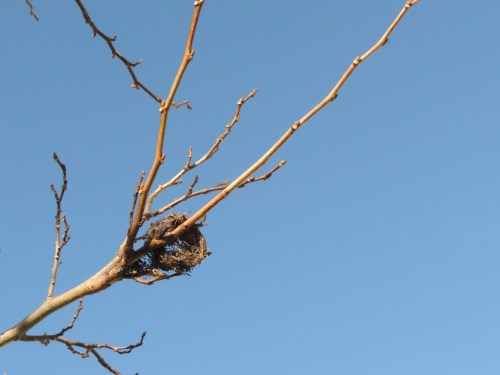
Now that the mulberry tree has shed its leaves I can clearly see this little nest. It’s about the size of a saucer. For the last three years a tiny bird (I don’t know what it is….it’s so quick and timid I’ve not managed to get a good look at it) makes a nest like this in the mulberry tree.

One year I noticed there were four chicks in the nest, and frankly, I was amazed that even one chick could stay in such a flimsy looking small nest without falling out. Then one day I found all four of them on the grass at the foot of the tree. They’d ALL fallen out! I carefully lifted them, one by one, and popped them back in again…..which wasn’t easy! When I checked a couple of days later they had all gone. I’m presuming they all flew off because I saw no trace of them in the garden. The year before that I found several tiny eggs lying around the garden, and I never knew whether little chicks had hatched out of them before they were discarded or whether the eggs had fallen out of the nest at an early stage. The eggs were completely empty and clean and I had the feeling they’d been discarded after hatching.

This year the bird made its nest almost at the very end of a branch and every time the wind blew the branch moved a lot! I was convinced any chicks inside would be thrown out of it some time soon. But the nest was too high for me to see inside, so, I didn’t see any chicks this time around.

There are a number of things amaze me about this.

I wonder…is it the exact same bird which comes back to make a nest in this tree every year? Or do one of the chicks return to build it? Or is it a completely different bird every time?

I wonder….why on earth does this bird build such a tiny, flimsy nest in such apparently precarious (although well-hidden) places every year?

Each year this is a lesson for me – stop judging! You don’t always know best!

Whatever I think of this bird’s nest building skills and choices, it seems each year, year after year, eggs are laid, chicks hatch and they fly away when they are ready. So, it works, huh? Nature is such a great teacher in humility isn’t she?

As Montaigne would say “Que sais-je?” (What do I know?)

Every single story

A few days ago I was in Copenhagen and visited the Glyptoteket. I don’t think I’ve ever seen a better presentation of sculpture. It’s a beautiful building with a winter garden in an inner courtyard and it has a permanent exhibition of the most astonishing, gorgeous marble sculptures. Like most museums, it puts on temporary exhibitions, and while I was there, they had one called “The Road to Palmyra”. It is astonishing!

This is new ground for me. I don’t know much at all about that part of the world, or about its history and culture. I was quite blown away by room after room. It still amazes me to read about great cities of the past which have either disappeared, or shrunk down to a tiny fraction of their size in their heyday. Palmyra is one of those cities. At one time it was a meeting place of cultures and peoples, with all kinds of beliefs, values and artistic preferences. That’s all long gone. One of the world’s great cities invaded and destroyed, never to recover. (In fact, you’re probably aware of the destruction of parts of the city by ISIS fighters in recent years. Yet another blow to a once great culture). I still can’t get my head around the fact that today’s great cities might one day be forgotten. That doesn’t seem possible, but history tells us it’s not only possible, it’s pretty inevitable.

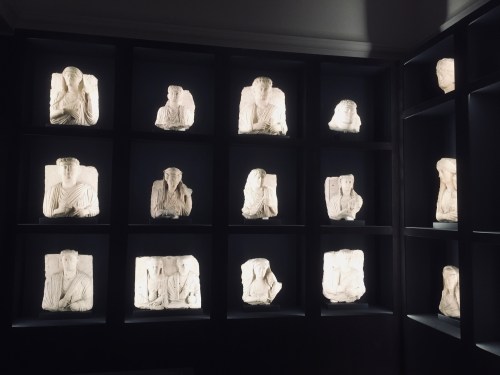
I could write a lot about this museum but I wanted to share this one photo with you. I took it in a room dedicated to how the people of Palmyra remembered their dead. Around the walls, each in his or her own little cubby hole, there is a bust or a carving representing someone who died. My first thought was, how wonderful to be able to look at these likenesses, to be able to see the faces of these people who once lived on this planet. How much more is added to the commemoration of their lives by these sculptures? I’m used to seeing gravestones with simple inscriptions – the person’s name, their dates of birth and death, maybe their age at death, and maybe, just sometimes a reference to their work, or their position in a family. But imagine seeing their likeness too? I know in some traditions, a photograph of the loved one is framed and fitted to the gravestone, and that, too, is probably powerful. But, I was left feeling……something is missing.

Yes, it’s great to see these sculptures and you can see how different they all appeared from each other. But I realised what I really wanted, and what I couldn’t get (in the vast majority of cases) were their stories.

I love the unique stories that we have to tell each other. I’ve said this before, but I really did look forward to each Monday of my working week because I knew someone would walk into my consulting room and tell me a story I’d never heard in my life before. Of course, that didn’t just happen on Mondays, and it didn’t just happen occasionally, it happened again and again, every day of my working life.

My life has been filled with stories. I delight in them. I am moved by them. I am amazed by them. I am honoured to have had the opportunities to listen to so many of them. How else could I get to know a person? How else could I get to understand a person? How else could I help a person to cope, perhaps to heal, and even to grow?

What else do we have to give each other in this world?

How wonderful to be able to tell our unique and personal stories. To share them with each other. To enable each other to tell them.

How poor would my life have been without these stories?

I feel that’s more important now than ever. We are in danger of replacing stories with data, of replacing stories with labels. Data which de-humanises us and replaces our stories with algorithms. Labels which de-humanise us and which are used to demonise “the other”.

Our personal stories connect us. I’ve always found I feel more compassion and empathy for the people I get to know and understand when I hear their stories. Stories help us make sense of people, of ourselves, and of our world.

Here’s my intention for 2020 – to tell my story, to share it with others, and to savour the opportunities to hear the stories of others.

I came across a Royal College of General Practitioners document recently – “Fit for the Future” – It is a vision of General Practice in the UK for 2030. There is a lot in it that I’d support but one of the statements is this –

An overhaul of the GP-patient record into a personalised ‘data dashboard’, accessible by healthcare professionals across the NHS, and that will draw on data from the patient’s genomic profile and wearable monitoring devices.
Now, maybe you read this and it excites you, but it made me stop and think “Hang on a minute! A ‘data dashboard’?”
I remember a line from the English philosopher, Mary Midgely, in her book, ‘Wisdom, Information and Wonder’.
One cannot claim to know somebody merely because one has collected a pile of printed information about them.
She wrote that back in 1989, and it’s clear that, since then, we have, to some extent, replaced the piles of printed information with hard drives full of data. But the point remains the same – you won’t know somebody just by looking at data.
One of my roles when I worked at the ‘NHS Centre for Integrative Care’ in Glasgow was to train young doctors in holistic practice. They’d be allowed to spend as long a consultation as they wanted with a patient then they would come to “present the case” to me. In other words, they’d consult their notes (often several A4 pages of notes) and tell me what they’d learned about the patient. At times what they actually communicated to me were detailed descriptions of the patient’s symptoms. Sometimes so many symptoms in such detail that the amount of information was quite overwhelming. By the time they’d finished I would find myself saying “Well, you’ve told me a lot but I don’t know who this person is'” I had no picture of the patient, their life, how illness came into it, how they’d coped, or the effects the illness had had on them, their family and their friends. A holistic case history is not a “pile of printed information”.
Data, or information, as Midgley pointed out, makes “much better sense when [it has] a context”. The context is revealed by the story. I don’t see how you fully understand a person without hearing their story.
Yet, one junior doctor told me she was being taught elsewhere “Never believe patients. They lie all the time. You can only believe the data” (meaning the results of investigations). That appalled me. What kind of Medicine can we practise if we think “patients lie all the time”? What kind of Medicine can we practise if we distrust their personal, unique stories, but trust only in “data”?
Now, I’m not saying that data isn’t useful. It can be. It would be daft to ignore that. But putting data up front and centre to the point where it replaces the relationship and the story? That’s my fear. That someone will think, “all we need is good algorithms and they will deliver all the right answers once we feed the data in.”
I’m sceptical. It doesn’t seem rational to me. It doesn’t seem realistic to me. And it risks shoving aside human values and the crucial importance of relationships.
Then, just yesterday the UK Health Secretary, Matt Hancock, put forward an aspiration for every newborn child in the UK to have their genome sequenced.  Interestingly, a poll of doctors revealed – “>2000 responses. Only around 10% of doctors would find genetic data more useful than postcode in planning the care for a newborn baby.”
I think we have to claim the ground for the importance of the unique human story. If, as doctors, we fail to consider the environments and circumstances of an individual life, we will fail our patients.
Data without contexts has some use, but it is not a full understanding of, or even a “knowledge of”, a patient.

Red shift

I get the chance to see a lot of lovely sunsets in this part of the world. I find them compelling. Every time. I just catch a glimpse of pink in the sky and I’m up looking out the window for a better look, then, as often as not, picking up my camera and heading out to the bottom of the garden.

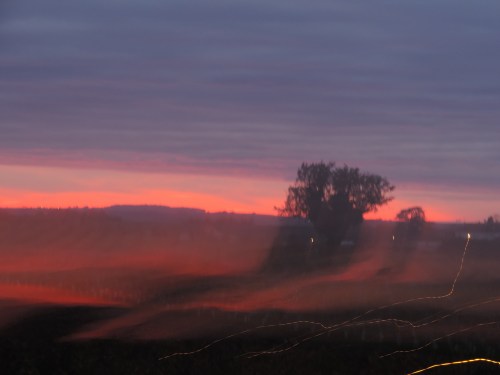
Well, the other evening there, I just framed the shot, but as I pressed the camera shutter release I slipped a bit. When I checked the LCD screen at the back of the camera I could see the picture was very, very blurred, but decided to keep it and look more closely once I’d uploaded it onto my computer.

Look what I saw…..!

Well, I know, you could argue this is a mistake. You could argue that I failed to capture the sunset as it “really” was. But I absolutely love it.

See how the red colour pours over the vineyards as if it is a pink fog (there wasn’t any fog there.)!

It’s like a painting….a watercolour with the water seeping over the canvas.

It seems transcendent to me – transcendent in the sense that the boundaries are dissolving. There are no hard edges. No barriers. No limitations. It looks fluid, flowing, dynamic, evolving before my eyes.

I started by thinking I’d made a mistake.

But it turns out I’d made something unique. Something I’d never made before. Something very, very pleasing.

What does that say about “perfection”?

What does that say about “creativity”?

What does that say about “serendipity”?

When I saved the image to my hard drive I started to name it, and, without really stopping to think or consider, I named it “Red shift”.

PS that title takes me right back to 1974 and album by Peter Hammill….The Silent Corner and the Empty Stage

Funny the way the mind works…….

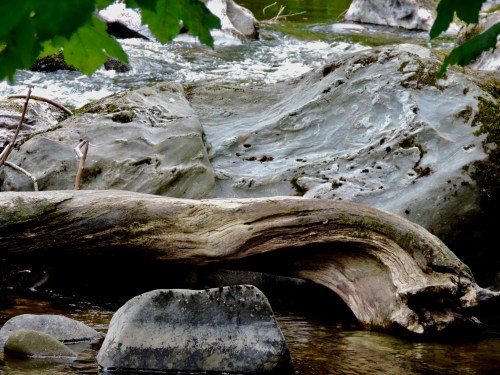
I took this photo over five years ago but it’s still one of my favourites. One of those photos I return to and spend some time with. It does more than please me. It brings back memories of that day. It activates connections I have deep inside. It inspires me.

What do I notice?

Well, the largest part of the image is taken up with rock, and just look at that rock! It flows and it folds as if it is pliable. But, take it from me, that rock feels as hard as ….. well, rock! It must take aeons to shape it like this. What shapes it? I’m not a geologist but it seems pretty obvious to me that the major creative force here is water. See the river rapids just beyond it? That lively, foamy, energy-charged flow of water? That’s the main sculptor here. Moment by moment, day by day, year by year, era by era, it persists, crashing against the rock, flowing over it, caressing it, smoothing it, shaping it.

There’s something else in that interaction of rock and water which is not so obvious from this image…..the water and the rock change each other. The content of the water is changed by the elements washed out of the rock. The direction, the speed and the force of the water is changed by their encounter.

The look directly in front of the rock at the log…..this log which is the remains of a tree which fell who knows how long ago and who knows where? It looks like it has been carried downstream to here. Is this where its journey ends? It too has been shaped by the river. It brings its own structure, its own patterns, but it now reflects the flow of the water and the markings on the rock it lies next to.

Each of these, the river, the rock, the tree, are interacting with each other, exchanging atoms and molecules, intermingling their energies, influencing and shaping each other.

In front of the tree is more water, this time less energetic, less white and foamy. This time pooling more peacefully, almost resting between the tree and some smaller rocks. And look at that rock in the front of the photo….a striped rock, a history of millennia running right through its middle, reminding us just how ancient this world is.

When I look at that striped rock I see a hint of a baby elephant. Now there’s one creature which has never been known to stroll through the forests of Scotland! But that’s how we function, we humans, isn’t it? We are continually being influenced by and interacting with everything we see, everything we hear, smell, taste and touch, and by all those invisible flows of microbes, molecules, and energies that continuously shape us, just as we shape them.

That’s what this image leads to, for me ……. a sense of the Life Force, the Creative Force of the Universe …… active, dynamic, flowing, shaping, influencing and interacting.

That delights me.

What do you see here?

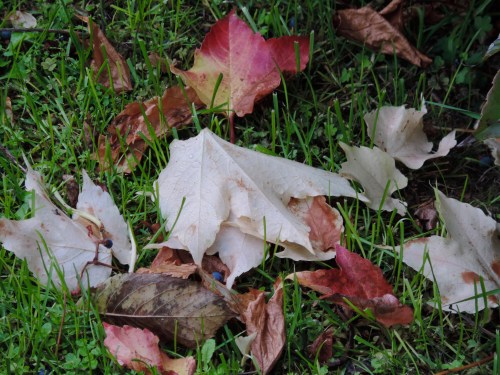
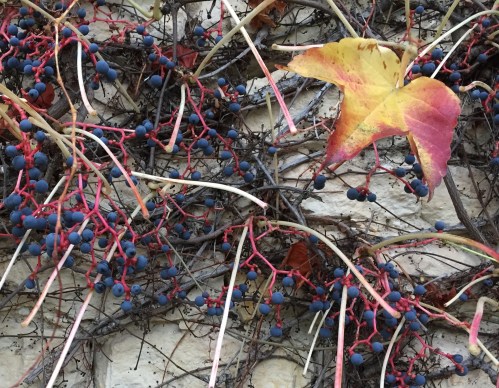
Autumn leaves? Some turned partially red, some now brown and dusky, others as white as bones…..

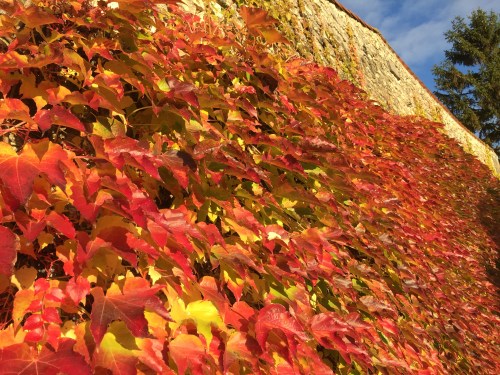
People talk about leaves falling at this time of year, but do they fall, or are they pushed? Or do they jump? I’m not a botanist and I don’t know the answer to that question but I do wonder about it….especially when I look at this wonderful “Boston Ivy”, or “Faux vigne”, which covers the huge wall along one side of the garden.

Isn’t it glorious when it’s at the peak of the transition?

Well, I’ve seen hundreds of photos of red, yellow, golden and brown leaves over the years but I never get tired of them. Like sunsets and rosy dawns they are magnets for me. They draw me outside to have a better look. But look what happens next with this particular plant…..

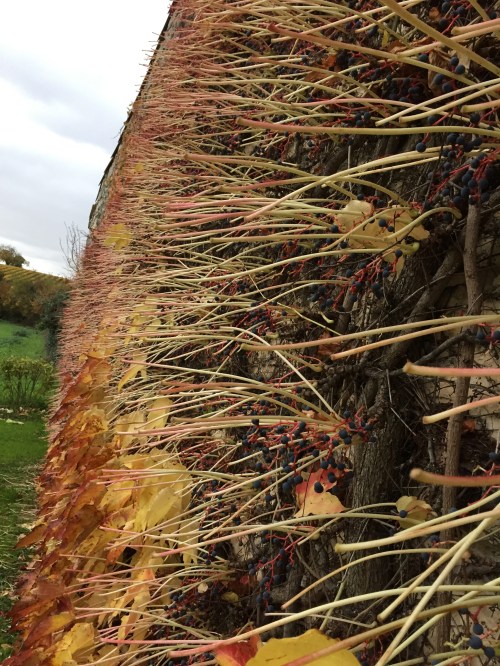
These are the stalks which connected each leaf to the rest of the plant. A few days on, and these stalks will be lying on the ground in heaps. How does that happen? How do the leaves leave the stalks, and then, the stalks leave the vine? I don’t know. It amazes me. I’ve lived here for five years now this month, and every year this unfolding sequence of leaves changing colour, leaves falling to reveal all the stalks, then stalks falling to reveal ……..

…purple berries on bright red stalks……well, I just love it.

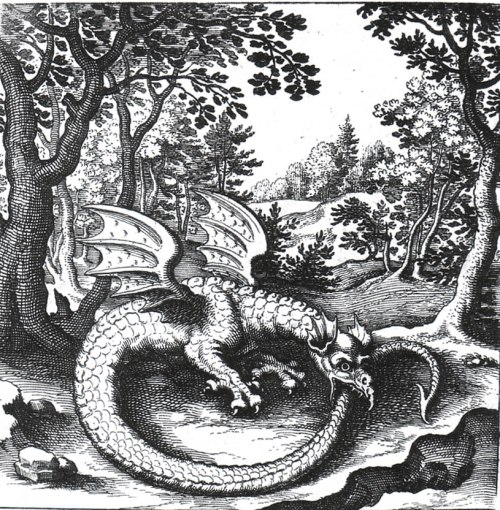
If you go back to the first photo in this post you’ll see a couple of purple berries lying there in amongst the leaves…and, remember, each of those berries contains the seed/s of new plants, so in that one image I see something like the alchemical image of the snake which swallows it’s own tail (the Ouroborus)

Nature, seen, this way, isn’t linear…..the past, the present and the future all there in the one moment, the one image…I feel the rhythms, see the cycles, experience the connectedness of everything.

As T S Eliot wrote, in The Four Quartets –


Time past and time future
What might have been and what has been
Point to one end, which is always present.


(read the poem here)

A perfect day

What does your perfect day look like?

“Perfect” – there’s the problem right there……just what is “perfect”? Hard to say, really, but I’m pretty sure it always means something better. Better than what? Better than what is?

There’s something unreal about perfectionism, isn’t there? Something unachievable. It’s always just out of reach (or sometimes it seems way out of reach!)

I like blue skies.

I like beautiful rosy pink dawns and tobacco or scarlet sunsets.

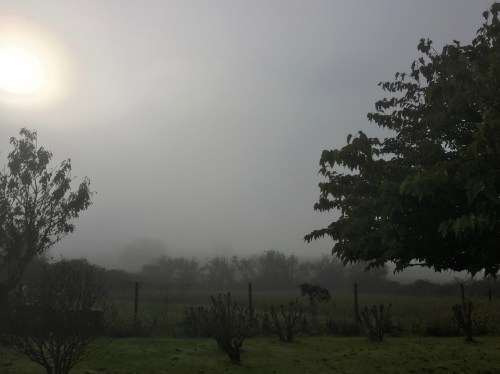
This photo is of none of those things – no blue, no pink, no sepia hues, no deep crimson reds. It’s grey. Grey and dark greens shading into black and that one bright, bright white circle in the sky…..the Sun, struggling to make itself known, veiled in mist and cloud.

But it’s beautiful, don’t you think?

When I stepped outside I could hear the mist. Well, what I mean by that is I could hear what the world sounds like around here when there is a thick morning mist hiding the vineyards and the neighbouring villages. Like snow, the mist is a muffler. It produces a particular kind of silence. I can’t quite put my finger on it and define just how the misty silence differs from the silence of a bright sunny Sunday morning here in the Charente. The Sunday morning silences are recognisable too. If I didn’t know what day of the week it was, I reckon I’d be able to tell from the particular quality of the silence around here on a Sunday morning. But this silence, this autumnal misty silence, is different from that. Maybe it’s because the mist disguises the sounds, whereas on Sunday mornings, there just aren’t the sounds to be disguised?

So I look up and I see where the Sun is. I can’t see the Sun. It’s not distinct, but I absolutely know where it is….strongly filtered through the watery veil lying thickly on the ground. And I think “How beautiful” “What a moment!” To stand here, looking in every direction and seeing only a shallow foreground of grass, trees and bushes, but knowing, from memory, what lies beyond them. To stand here, in silence, listening. To stand here, in silence, knowing that the Sun up there is probably going to make most of this water evaporate and reveal itself in all its fiery glory again, maybe in an hour or so, maybe a little longer.

Unexpectedly, I think “How perfect”.

I don’t know what makes a day a perfect day, but maybe it’s any day when I become fully aware, fully present in this moment and this place.

Maybe a perfect day isn’t an unachievable, unreachable, figment of the imagination, but a day with a moment, or several moments, where I feel it’s just so good to be alive, where I find myself saying “thank you”.

“Thank you, I feel blessed to be alive”.

Who am I, really?

I came across a discussion about identity recently, and as identity politics and populism seems to be to the fore in many countries these days, it got me thinking – who am I, really?

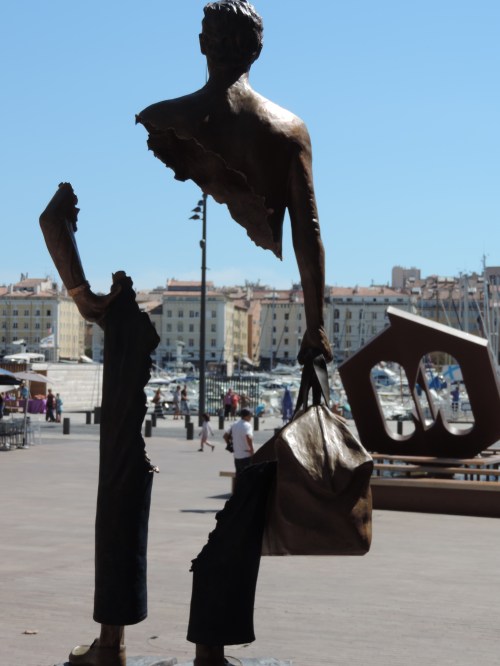
A few years ago I was in Marseille and these incredible sculptures were installed around the “Vieux Port”. They really grabbed my attention. Here’s just one of them (see the photo at the start of this post) showing what I immediately perceived as a person. He’s not all there, of course, but we fill in the gaps to make him whole, don’t we? Well, it struck me that that’s what we do all the time.

At least once a week in my consulting room a patient on their first visit, after telling me their story over the course of an hour, would say “I’ve never told anyone what I’ve just told you. Never.” And they’d often add “I feel you know me so well”. It was good feedback, and it reassured me I was on the right track and had established a good therapeutic relationship. But I often thought, “Actually, I only met you an hour ago, and I think it takes a lifetime to get to know someone. I think we can spend most of our lives with a partner but we never really completely know them. I’m still getting to know myself, for heaven’s sake, and I suspect I’ll be doing that for the rest of my life”. Sometimes, I’d say that out loud, but other times, I’d just think it. I think it still.

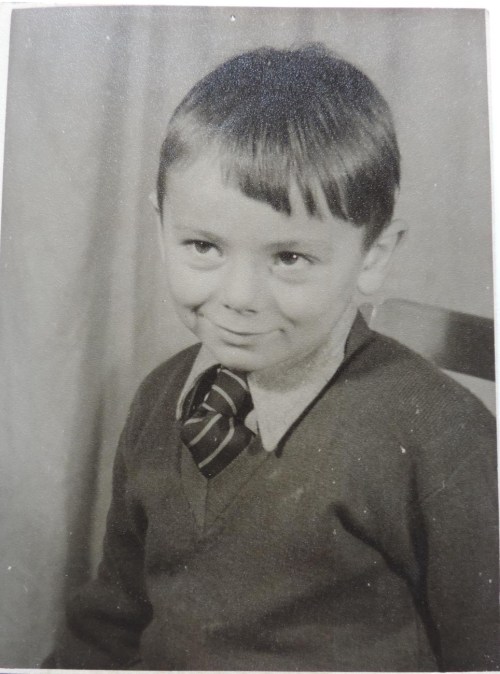
Here’s me at Primary school –

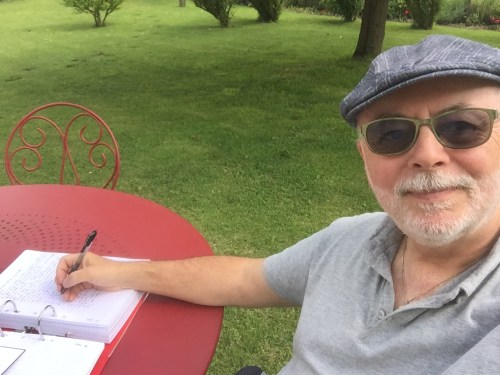
And here’s me about sixty years later –

Is this the same person?

From my perspective it certainly is! I have the experience of a continuity of Self. I know these are both photos of me, but, boy, have I changed!?

So, who am I, really?

Am I this body?

It’s pretty obvious, even from just those two photos, that this body has changed a lot over the decades. Our bodies are made up of over 30 trillion cells (a number too big for us to imagine, and that’s just an estimate because nobody has been able to count them). Almost all of these cells live much shorter lives than I have done. Some cells live only a few days, other weeks or months, and only a minority last a full lifetime. So, it’s pretty certain that only a minority of the cells in this body I have now are the same ones I had in that earlier photo.

Interesting choice of verb there…..”had” – do I have a body? If so, who is this “I” who has this body? I’m tempted to say, no, I don’t “have” this body, I “am” this body. But there’s the trap, huh? Because if the body is always changing, am “I” always changing too? Where does my sense of continuity of being come from? And I am more than my body aren’t I?

What more am I?

Scientists have discovered and put forward at least three other elements of identity by studying genetics, the “the human microbiome” and epigenetics.

For a while the “Selfish gene” idea gained a lot of traction. “The Human Genome Project” was completed in 2013 and there were great claims for it at the time – a bright new future of “personalised medicine” based on your gene sequences was heralded. Some claimed it would lead to the elimination of a host of diseases. Richard Dawkins, whose book entitled “The Selfish Gene”, popularised the idea that our essence, our core, the “real” “I” wasn’t the body, it wasn’t the mind, it was the double helix spirals of gene sequences….our DNA.

Things haven’t turned out the way the great gene believers imagined however. It seems we can’t be reduced to the level of chains of little molecules. We are more than that. What more?

Well, next up was an exploration of the cells which are part of us but aren’t us – all the bacteria, viruses and other micro-organisms which live on and in our bodies but don’t have the same DNA as we do. It turns out there are at least as many of them as there are “our own” cells. “The Human Microbiome Project” was launched four years after the end of “The Human Genome Project” and by 2016 a lot had been discovered, but it’s still not enough to pin down who we are.

Have these projects helped me to answer the question “Who am I, really?” Not really, but it does make me deeply aware of the fact that I’m not so much an object as some scientific models have suggested. I’m certainly not a fixed entity. Instead, it seems I’m a constant, lively, energetic flow of cells.

It makes me think I’m more like a river than a stone! I’m certainly not like a machine.

But wait, it gets more complicated yet – following on from the discovery of the “genetic codes” researchers discovered that not all the genes are active all the time. In fact they switch on or off all the time. They’re more like music than they are computer code. What presses the keys to play the tunes? What determines which genes are expressed, and when? It seems a whole host of “environmental factors” are involved. You aren’t determined by your genes. They only represent some kind of potential. Whether they become active or not depends on the life your live – the environment you live in and the events and experiences of your life.

We don’t know what all the factors are, or how they work….. “The Human Epigenetic Project” anyone? Well, what do you know? There IS “The Human Epigenome Project“! A consortium exploring at least one of the links between genes and the environment.

So, if my body isn’t all there is to me, if my genes aren’t all there is to me, if my microbiome isn’t all there is to me, then what else is there?

My thoughts? My feelings? My memories, dreams and imaginings? The stories of my life?

Tick “all of the above”. (There are volumes of books which have been, and are still to be, written on each of these)

But there’s a vivid red thread running through all these observations – connections.

Who I am, really, will never be answered by considering myself in isolation. It seems I am a flow. Constantly changing, constantly receiving materials, cells, energies and information from the world in which I exist, constantly sending out materials, cells, energies and information, and constantly changing myself and the world in the process.

My story is not just my story. It’s our story. You and me. Every relationship, every encounter, every exchange, shapes, changes and moulds me, and, you, and the planet we live on.

That excites me.

It’s a new story. It’s the story of evolution, of emergence, of connections, contexts and change.

The answer to “Who am I, really?” won’t be found by looking at smaller and smaller parts. It’ll be found in experiences, in performances, in events, in relationships and interactions. It’ll be found in the unique stories that only I, and only you, can tell. It’ll be found in what we share and how we relate.

Identity is fluid, relative and dynamic.

Maybe we should think of it more as what we share, than what divides us.