Feeds:
Posts
Comments

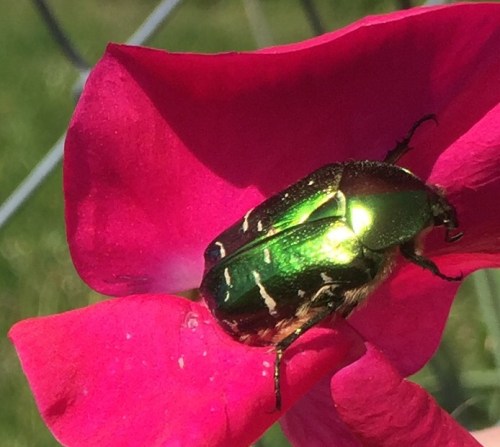
Spotting this little creature on the petals of this flower hooked me. I stopped, looked closely, drawn by the beauty of the sunlit metallic green colour, particularly against the red petals.

I was more than drawn to it. I was engrossed by it. It caught my attention and for a few moments I revelled in it.

I savoured the moments.

Then, of course, because this is what I do, I took a photograph.

This is one kind of attention.

It’s the kind of attention of the senses. It might be visual, as it was in this case. It might be a sound, like a bird song, or the chirping of a cricket. It might be a scent, like the honeysuckle bush I passed on my walk, or might be the taste of the fresh, juicy gariguette strawberries in the market, or the feeling of the cool morning grass on the soles of my bare feet.

There’s something that happens to the heart with this kind of attention….it slows down. And as it slows down, the “parasympathetic nervous system” becomes active (actually it’s not as linear as that. The world isn’t as cause and effect as we think), and the whole body relaxes, the pupils in the eyes dilate and softly focus. There’s a feeling of peace, joy, delight, ease.

It’s wonderful.

There’s another kind of attention which is the type associated with mental effort. The kind we need when we work with mathematics and logic. In that second kind of attention quite the opposite occurs in the body. The heart speeds up, adrenaline quickens the body, sharpens the mind, produces a very narrow, focused concentration.

We need both these kinds of attention, but sometimes, I think, we rely too much on the mental effort type, and not enough on the kind that melts us into the rest of the universe.
Many years ago I discovered the writings of a French philosopher called Gilles Deleuze. I found some of his writing really hard to understand but several of his basic ideas and concepts completely changed the way I saw the world. That “becoming not being” phrase at the head of my blog is one of them. That shift from seeing the world as a collection of separate objects to seeing that everything is connected and always changing was a radical shift for me.

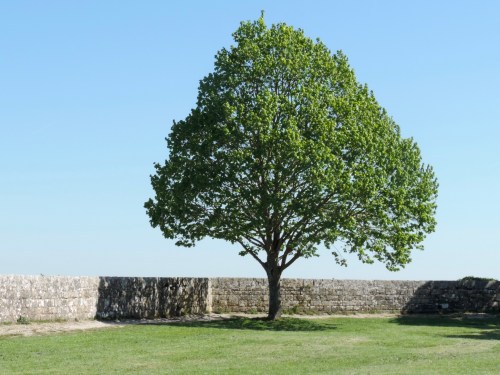
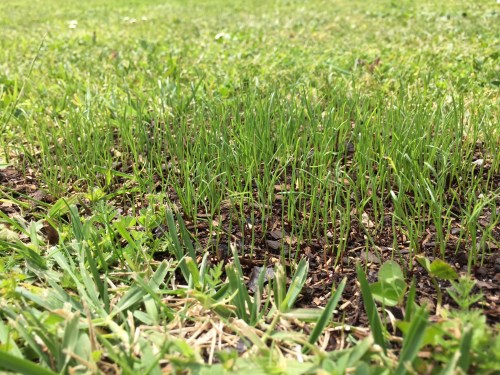
One of the other concepts was exploring the difference between trees and grass….what he termed “arboreal” vs “rhizomal” thinking.

You know the basic shape of the tree….a single stem or trunk which bifurcates again and again producing more and more branches and twigs as it grows upwards, and more and more roots and rootlets (is there such a word?) as it grows down into the soil, the one a kind of mirror image of the other.

This tree like form is everywhere. It’s the shape of our circulatory system as arteries branch out into smaller arteries which branch out into capillaries. It’s the shape of our lungs as the trachea bifurcates into bronchi which bifurcate into smaller bronchi, bronchioles (there is such a word!) and ultimately into alveoli.

We use it as a way of ordering and organising what we see in the world. It’s the most fundamental way of categorising and classifying the world. Everything is ultimately connected back to the single trunk or stem….the same original root, but everything exists in a separate category way out along the furthest branches, each ultimately distinct from, and separate from, everything else.

Grass is a rhizome. It doesn’t grow in this branching way from a single root. You can’t find the original stem or root of the grass. It’s like it has multiple points of origin, and each blade is connected to roots which then connect to other roots in a vast web or network. This rhizome structure is everywhere too. Because there is nothing which isn’t connected. The connections are multiple, diverse and ever increasing.

Two things became clear to me when I compared these two phenomena.

One was that the tree like view was produced by a sequence of “or” choices – at each division we say this is either this or that. The rhizome view is produced from a sequence of “and” choices. We don’t say “I’ll use either Facebook or Twitter”, we’ll use them both and connect them to each other. That’s what I do when I started to blog. I created my blog on WordPress but automatically connected every post to a tweet and a Facebook post. That way I could write once and share on several different platforms, for different audiences.

The other thing, which came after I read “The Master and His Emissary” was discovering how well adapted our left hemisphere is to the “arboreal” view of the world, and our right is adapted to the “rhizomal” one. We use the left to discriminate, categorise and classify. We use the right to see the whole by focusing on the relationships and connections.

How amazing that we have evolved this incredible brain with its ability to engage with the world in both tree-like, and grass-like, ways simultaneously.

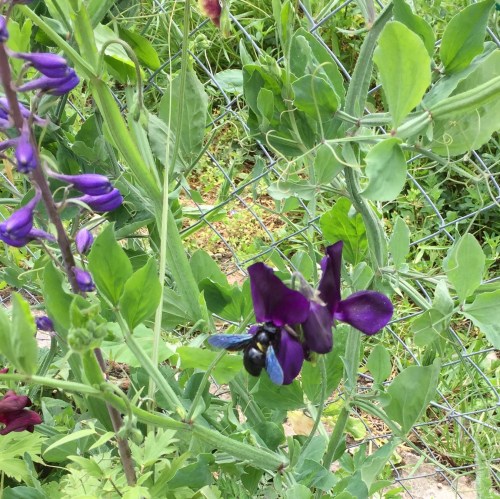
Look at this! I mean, just look at this! I know, it’s not one of my best, my sharpest photographs, but I was in the garden the other day and I heard this deep low buzzing sound. It wasn’t as deep as the humming-bird moths which will arrive when the buddleia bushes bloom later in the year, but it was a lot deeper than the various species of bees and wasps I usually hear in the garden. Luckily, when I turned to the sound I saw the source. This inch long jet black bee with iridescent blue wings. I quickly got my iPhone out of my pocket and did my best to snap a shot before the bee flew away. I have never seen anything quite like this. There were two or three of them buzzing around the flowers but they just never settled long enough to be able to focus a camera and take a nice close up (not yet anyway – I haven’t given up!).

I looked it up online and it seems this is a “violet carpenter bee”. Never heard of such a creature. What a thrill! What a delight! Made my day!

There’s an important lesson to learn here. I’m sure you’ll have come across “mindfulness”. It’s quite the thing these days. Mostly the term is used in relation to certain meditation practices and they are good ones. It seems that mindfulness meditation can have a lot of benefits, from easing depression and anxiety, to stimulating “neuroplasticity” (that’s the phenomenon of how the brain changes and develops itself). But even before the meditation practices were popularised Ellen Langer researched mindfulness in everyday life. She claims we can either go through life mindfully or mindlessly. Seems a clear choice, huh? How do we lead a more mindful life? Search for the new.

By new, she means what’s new to you. The trick, you see, is that every day is new. You have never lived this day before. Nobody has ever had, or ever will have, the same experience as you are going to have today. Once you are aware of that you can set out to be aware of what’s new.

Iain McGilchrist points out in “The Master and His Emissary” that our left cerebral hemisphere has a preference for what is familiar, whilst the right hemisphere thrives on curiosity – it leads us to seek out what’s new. His larger thesis is that we have become very left brain dominant in our present society and that some deliberate change of focus to the right brain might bring about a much more healthy, more integrated level of brain function.

I recently read a book by French author, Belinda Cannone, “S’émervieller”, which explores many of the ways we can bring a heightened sense of wonder and awe into our everyday lives. Bottom line is the same as Langer and McGilchrist say – seek out what’s new. And that’s exactly the experience I had the other day when this violet carpenter bee turned up amongst the garden flowers. Cannone gives various different examples of the places, times and activities which seem most likely to stimulate “l’émerveillement” (“amazement”) and the strongest one is “Nature”.

The thing is the natural world, especially the world of living forms, is constantly changing. Pretty much any time we spend in natural environments will be likely to gift us the delights of something new.

Let me just clarify what I mean by “new” in this piece. I mean it’s anything you haven’t seen before, heard before, smelled before, touched or tasted before. It’s also the newness of the present moment. You have never ever lived this present moment before, so what do you notice? Right here, right now. It’s also the encounter with anything you don’t know or don’t understand. These are the experiences which stimulate our curiosity and our drive to learn. They are the every day experiences of adventure and discovery.

From the Japanese art of forest bathing, to Richard Louv’s claim that we are suffering from “Nature-deficit disorder” which can be treated with a good dose of “Vitamin N” (Nature), to l’émerveillement, to mindfulness and neuroscience, it’s clear that one of the best ways to develop a healthier brain is to spend some time in Nature – whether that’s a forest, a beach, a park, or a garden. I recommend it.

You’ll be amazed.

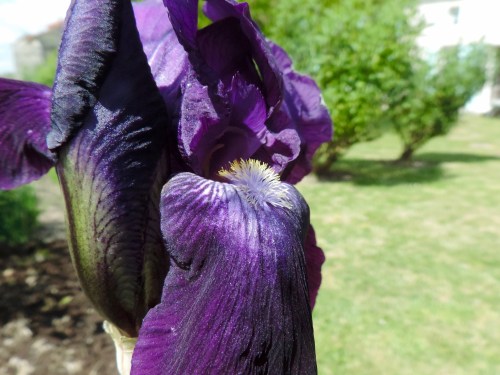
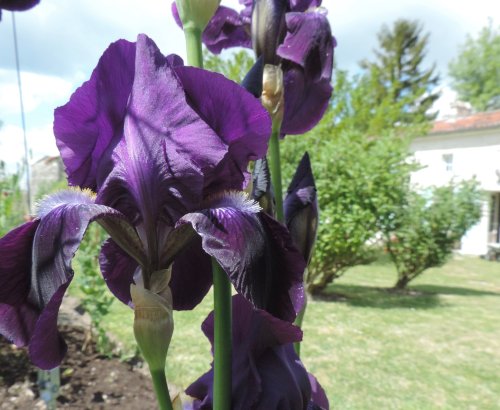
Irises are the most astonishingly beautiful and attractive flowers. Whenever I see them I think of the story ‘Iris’ by Herman Hesse where he wrote this –

He had a great love for this flower and peering into it was his favourite pastime; sometimes he saw the delicate upright yellow members as a golden fence in a king’s garden, sometimes as a double row of beautiful dream trees untouched by any breeze, and between them, bright and interlaced with living veins as delicate as glass, ran the mysterious path to the interior. There at the back the cavern yawned hugely and the path between the golden trees lost itself infinitely deep in the unimaginable abysses, the violet vault arched royally above it and cast thin, magic shadows on the silent, expectant marvel. Anselm knew that this was the flower’s mouth, that behind the luxuriant yellow finery in the blue abyss lived her heart and thoughts, and that along this lovely shining path with its glassy veins her breath and dreams flowed to and fro.

oh, I loved that the first time I read it and it’s stayed with me for over forty years now.

Iris, in Greek mythology, was the messenger of the gods. Her symbol was the rainbow, which in many cultures is the symbol of hope. But her main role was in carrying messages from one to another. She connected the sea to the sky. She was a bridge builder (not literally but in terms of making connections).

When I thought of her role in facilitating connections I thought of flow, of the to and fro of communication and I thought how much do we need that now? In a time where politics has become more about hate than love, where there are calls for more walls when we need more bridges, when there are demands to close down, isolate and see the ‘other’ as an enemy or a competitor to be defeated.

Oh, how we need Iris, to open peoples’ hearts and minds and to facilitate communication between them.

How we need her, the idea of her, the energy of her, the meaning of her, to create mutually beneficial relationships between different peoples with different ideas, different world views. To make the case for constructive co-operation rather than destructive competition and division….

I suspect a lot of us have a lot of music in our heads. Sometimes we start to hum a tune or sing a song and only after we’ve started do we become aware that we’re doing it. Then we might pause to wonder “why did that particular song, or tune, come into my head just now?”

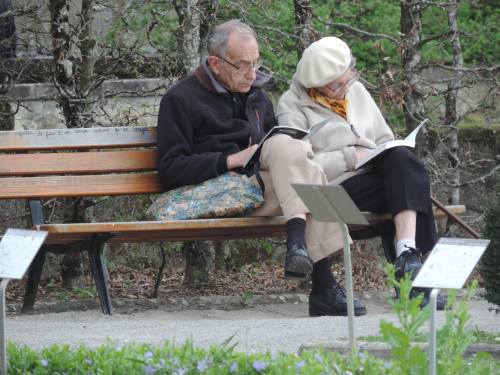
I find that when I look at some images something similar happens. Take this for example. I took this photo of an old couple sitting in a public park in Limoges a few weeks ago. They are both engrossed in their books. Their body positions and their physical closeness tell us they are close, that they are connected, as well as the fact that they are both enjoying reading in the park.

As I saw them, and as I looked at this image again just now, certain songs popped into my head and I could hear them as clearly as if I was playing them on a stereo.

This because of the line “You read your Emily Dickinson and I my Robert Frost. We mark our page with bookmarkers which measure what we’ve lost”

And, by the same musicians….


“sat on a park bench like bookends”

OK, so that example was a pretty obvious one, but sometimes the music which starts to play in our heads is not so easy to nail down. Sometimes we just enjoy that it’s there without even wondering “why this music?” “why now?”

I know I can use music to match or create mood, but this phenomenon of the music just seeming to appear has all the quality of somebody else hitting the “play” button. Even if that somebody else is also me!

What music started to play in your head today, and do you know why?

I listened to an interview with Yuval Noah Harari recently. I read his “Sapiens” some time ago and mostly enjoyed it, but I haven’t been tempted to read his more recent “Homo Deus”. This latter book looks ahead to consider how things might go as artificial intelligence and robotics develops apace. He argues that our technology could give us incredible powers, so that we may end up more like gods, but he also says things could go the other way and create an increasingly large class of people he labels as “useless”.

That “useless class” terminology is certainly a way of getting attention, but when he specifies what he means by it, there’s a lot in it –

“I choose this very upsetting term, useless, to highlight the fact that we are talking about useless from the viewpoint of the economic and political system, not from a moral viewpoint,” he says. Modern political and economic structures were built on humans being useful to the state: most notably as workers and soldiers, Harari argues. With those roles taken on by machines, our political and economic systems will simply stop attaching much value to humans, he argues.

He goes from there to imagine a future where this class spends its time on drugs and Virtual Reality games machines. Depressing, huh?

So, two things struck me immediately. Firstly, this connects to some of the debate about “Universal Basic Income” – the idea that every citizen should receive a monthly allocation because we are heading towards a system which will be “post-work” – robots and algorithms will take over most of the jobs and the increased automation will increase unemployment. Our current economic system will either be adapted to take account of that, or human beings will have to adapt to the current economic system. Or not. It’s this “or not” that Harari explores by describing the “useless class”. One question then is what do we value in society and how do we allocate resources to what we value? As a society.

The second thought was, what, if people don’t have jobs in factories, shops or offices, the only thing they’ll be able to do is take drugs and play VR games? What popped into my mind straight away were caring and creating.

Human beings are great at caring. Sure, we don’t do nearly enough of it, and we could sure do with developing our capacities to care, but take, as one example, the response to an earthquake, a storm, a flood, a terrorist attack. In all of those situations we hear story after story of human kindness, human sacrifice and human caring. With declining infant mortality and increasing life expectancy more and more people in the world are living longer and in need of more care. We won’t run out of opportunities to care for others.

Human beings are great creators. We are problem solvers, scientists, home makers, gardeners, cooks, and artists of all kinds – writers, sculptors, painters, musicians, dancers. We won’t run out of opportunities to create.

Thirdly, I’d argue, human beings are great learners. We have whole neural circuits primed to seek out what’s new or different. We have whole systems dedicated to learning skills, acquiring knowledge, understanding and making sense of things. We won’t run out of opportunities to learn.

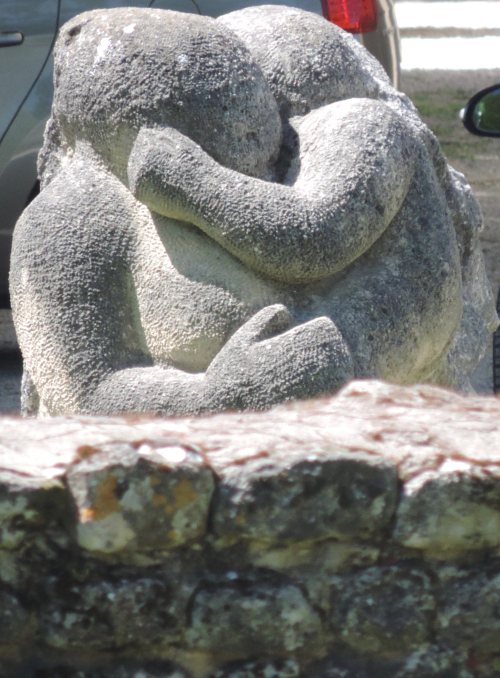
So, when I visited the town of Blaye recently, I saw this artwork in a car park. Isn’t it beautiful? Simple, and beautiful. Doesn’t it capture something about the human ability to care and to create.

Isn’t there an opportunity at this point in civilisation to change our focus away from grabbing and consuming, to caring and creating? And learning!

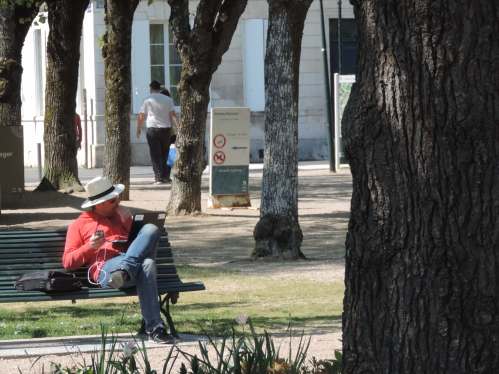
Walking through the town of Rochefort the other day I chanced across this man sitting on a park bench in amongst the trees with his smartphone attached to his laptop. He was wearing a sunhat suggesting he wasn’t here entirely by chance (there’s some evidence of forethought) and I wondered if this was a favourite spot of his. I also immediately thought “What a great place to choose to work”. I know we talk about flexible workspaces these days, so this got me wondering “what’s the best place to work?”

Of course the answer depends on the questions of what work you need to do, but I just wonder how aware you are of how the environment you are working in affects the work itself.

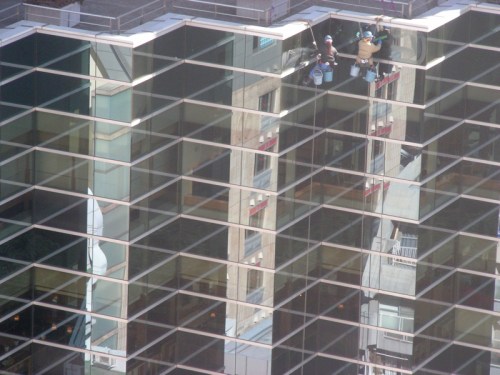
Here’s a photo I took from a high rise hotel in Tokyo –

Well, obviously this is a different kind of “outside working” – if your job is to clean windows, you’re not going to be short of work here! But I got to thinking of the people on the other side of the glass. In a big city like Tokyo you see thousands and thousands of office windows. When you look at night time you can see white shirted people sitting at row upon row of desks. That’s quite a work environment. I wonder how often the office workers look out the window and if they do, do they see the sky above, the thousands of windows opposite, reflecting their own windows, or the tiny cars and people rushing by on the roads way, way down below. Do window cleaners look down? Ha! I guess not everyone could do that particular job.

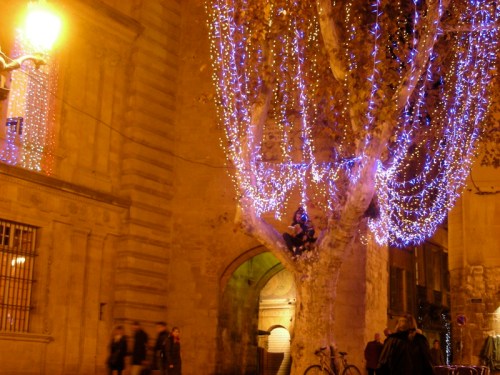
“Working outside” reminded me of what I think was a student in Aix en Provence one evening.

I’m not sure if this was his job, if he was studying, or if he was performing. I only noticed him because I heard his voice. He was reading his book out loud and I had to look up to find the source of the voice. When I was a medical student in Edinburgh my most favourite place to study was the Botanic Gardens. But I didn’t read the textbooks out loud!

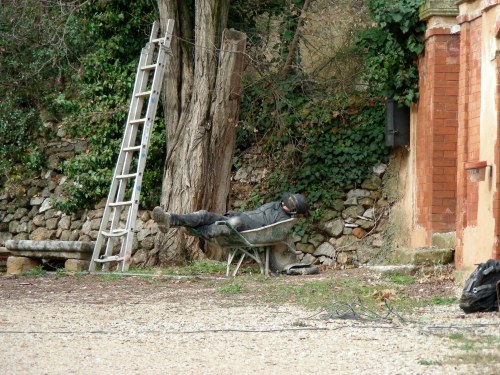
One more image came to mind while I was on this subject. Years ago we had a flat in a chateau just outside Aix en Provence and one week the proprietor was having roofing work done. One thing you quickly become aware of is that in France everyone stops for a lunch break. Arriving back from town one lunch time I found one of the workers having a post-prandial nap.

Now, I’ve always claimed that sleeping is one of my core skills. I think all those nights on call both in hospitals and in General Practice gave the opportunity to develop the skill of falling asleep quickly and waking up quickly. I, too, have fallen asleep in some surprising places, but never inside a wheelbarrow!

Well, back to my original question –

Where do YOU find you do your best work?

Do you have any particularly favourite places or environments?


Out walking I was attracted to the shape of this plant. I’m no botanist but I think this type of plant used to be known as an “umbellifera“, although I believe the classification system has been changed and botanists don’t use that term any more. Still, I quite like the name. It came from the observation that the form of this flower was of “umbels” which is from the Latin for parasols.

They look like the skeletons of upturned umbrellas.

In fact, each single “umbel” looks a bit like a starburst to me, and isn’t that one of the commonest, most pleasing forms we see in Nature? Who wouldn’t want a Life which shone like stars?

It reminds me of the Sun.

It looks like it’s reaching out in several directions at one.

It’s expansive, growing, developing, reaching out to the rest of the universe.
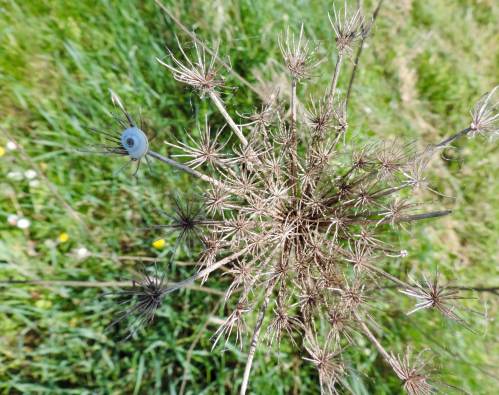
Then I looked a little more closely as I focused my camera and saw this tiny snail shell on the top left. See it? At about the 10 o’clock position?

And there, in that tiny shell, I see another of my most favourite forms – the spiral.

Oh, how I love spirals.

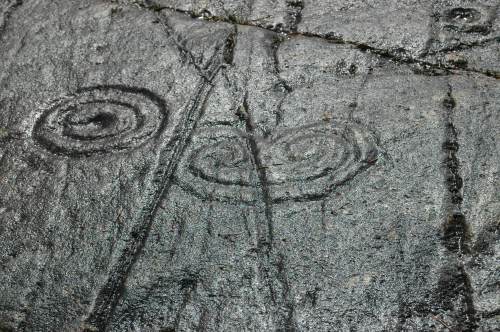
Is that my Scottish heritage, with its mix of Celt and Pict? I think of the Celtic knots, the triskeles, the Pictish stones. I think of the cup and ring markings at Achnabrek

But most of all I think how life stories are like that – how the path of a life is so much more like a spiral than a straight line.

Here, in this one little image, I see two of the most common, most beautiful of natural forms – the star and the spiral.

The shapes of Life? Or the shapes which give life its form?


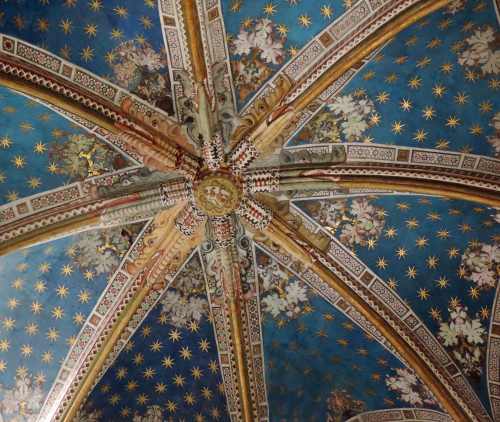
There’s an old ruined tower in the middle of one of the vineyards nearby. The other day there I went inside it, looked up, and took this photo.

My first thought was, wow, what a beautiful blue sky! How perfectly framed!

Then I thought, whoah, wait a minute, this is a metaphor isn’t it?

Because I’ve been thinking a lot recently about how we define who “we” are. I’ve been getting disturbed with all the xenophobic comments flying around the world these days. The people who say they don’t like “foreigners” and want them “to go back to their own countries”, or want to “close the borders” to protect “us” from “them”.

See, there’s at least two questions there. There’s how shall we live together? And who is included in that classification “we”?

Imagine you live in that tower. How big does your world appear? Where are your boundaries, your walls? If “we” are the people inside these walls, then “they” are the ones who live outside.

And don’t we all set our walls?

Don’t each of us feel similar to certain others, and maybe even connected to certain others, or maybe even in relationship with certain others?

Are those just the people who live in the same house as us?

Or those in the same street, the same town, or city, or nation state?

Or do we set the walls around those who are similar to us in some other way? Same sex, same religion, same ethnic group, born in the same nation state?

Isn’t the kind of world do we create for ourselves at least partly down to where we set those walls? How narrow we create our perspective? Or how wide?

How do you feel when you broaden your perspective? When you can see further, see wider, see deeper even?

I don’t know about you but I feel I breathe more easily. I feel my body, my mind, my soul, is nourished by the broader, more expansive view.

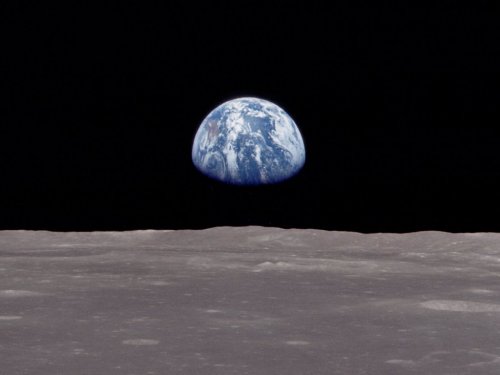
Let’s take this a wee step further and look at the famous “earthrise” image.

The earth rising over the horizon of the moon.

What if we think of “we” as being all of us who live on that beautiful, small, blue, white and green planet?

Because we do.

Every single atom in your body has previously been shared with other people, or other animals, or other plants, or other rocks or gases in this one small planet.

Every breath you take, draws in molecules from the same atmosphere as every other living, breathing form of life.

Every breath you breathe out contributes to that very same atmosphere.

We all share the same air.

We all share the same water.

We all share the same sunlight.

Don’t we all share the same earth?

Why divide it artificially into boxes? Little boxes marked “my country”, “my race”, “my family”, “my religion”?

If we are going to divide this planet up into these little boxes, then we still have to answer the question of how we can best live together – box to box. From within my walls, to you, within yours.

Here’s two short videos which changed my perspective on these questions…..


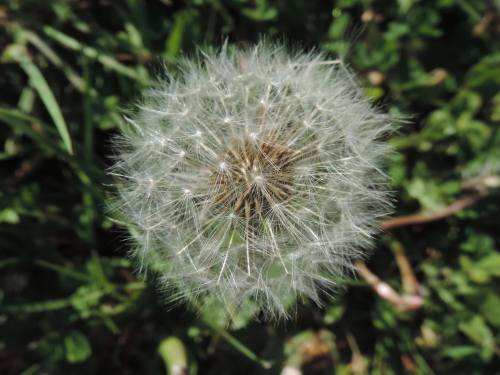
Common sense would tell you the world is made of things. We are objects surrounded by other objects. The left hemisphere of the brain is great at narrowing our focus so we can separate some of what we are looking at from its environment, and its connections. So I can stumble across this beautiful dandelion seed-head and focus the lens of my camera right onto “it”. Isn’t “it” gorgeous?

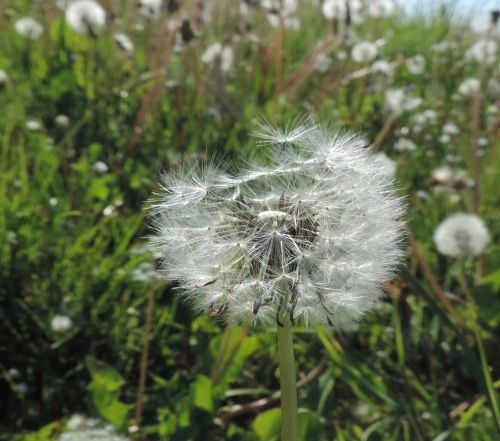
But then and object, or a thing, needs to have some kind of consistency for us to see it. I mean, look what happens a second or two later, when the wind blows –

It’s changed already! And why did it change? Because something happened. Some of the seeds blew away when the wind blew. So if I want to understand this “thing”, this “dandelion” that I’m looking at, I need to see more than what the first image can show me. I need to know that these plants we call dandelions have evolved a method of multiplying and thriving – they have created these astonishing little means of dispersal of their offspring, of their seeds. So when the wind blows, as it always does, these children of the parent plant will fly away to land somewhere else, maybe far away, maybe close by –

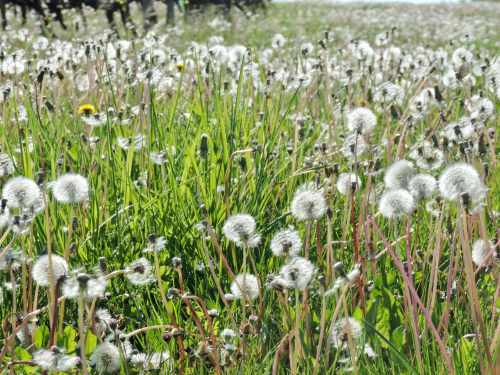
and then the cycle starts again with each seed germinating, pushing its roots down into the dark earth, and it’s leaves and flower up to reach the sun, and the bees and the butterflies and who knows how many other kinds of insects will come along and spread the pollen in the yellow flowers to fertilise them and produce these magnificent seed-heads again.

So this is what this object, this thing, called the dandelion does. And it’s hard to know to where to begin its story, but maybe we begin by following one single seed, blown on the wind. We don’t know which way the wind will blow, how far the seed will travel, whether or not the ground it lands on will enable it to germinate and whether or not it will be able to successfully grow into a green leafed, deep rooted, yellow flower and whether or not the insects will cross pollinate it with its neighbours, whether near or far, and produce seeds of its own.

So many unknowns.

But also, and here’s the point, so many happenings.

So many events.

So many occurrences.

This object, this thing, which we call a dandelion. Is it really reasonable to think of it as a thing? Or is it more useful to consider it as so many happenings.

That’s the point I heard the physicist, Carlo Rovelli, make in his interview with Krista Tippett, in an OnBeing podcast. Have a listen. He puts it more beautifully than I do. He says the universe isn’t made of stones, its made of kisses. (Not things, but happenings)