Feeds:
Posts
Comments

on reflection again

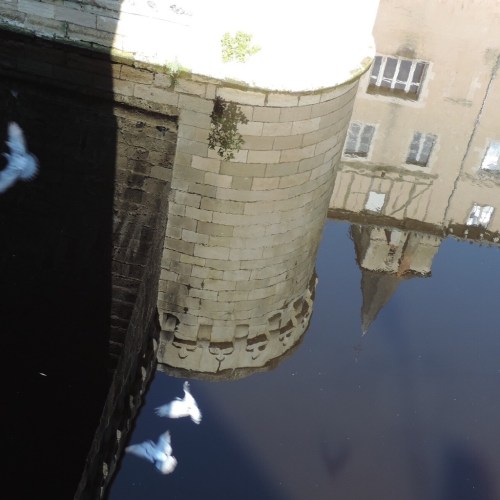
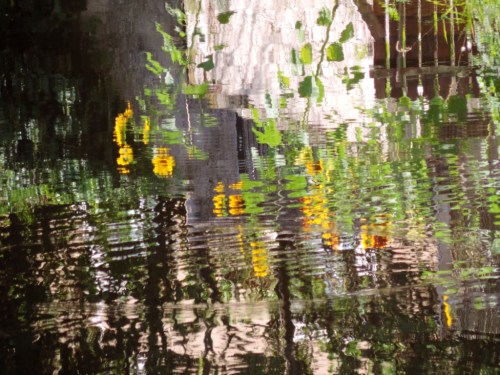
I enjoy taking photos of reflections. There’s something incredibly appealig about the world reflected in water.

This got me thinking though about how we reflect. After all when we are reflecting on something we don’t turn it upside down!

I think reflecting on something is more than just looking again. It’s more than remembering. It does involve looking at whatever it is from a new viewpoint.

That viewpoint either comes from time or distance or both. Or it comes from the way we develop new ways of seeing the world all the time, as we are affected by our every day events.

How often do you take time to reflect? And when you do reflect, are you aware of trying to see from different angles, different viewpoints, or through the new lens of the present?

I took this shot leaning over a bridge just as some birds flew over the water.

I love the quite disorientating nature of this image. It takes a moment to figure out what you’re looking at. Which way is up? What is this?

When we drift through life on autopilot (in full zombie not hero mode!) then we stop noticing.

The unfamiliar, the unusual, the unexpected then has great powers to wake us up and see (in full hero not zombie mode!)

Why not set out to encounter something different today?

Light and shade

passageway Angles-sur-l'Anglin

There are a lot of medieval villages in France and this passageway in Angles-sur-l’Anglin is typical.

Here’s what appeals to me about this view. I love the archway first of all. There’s something very appealing about the arch of a bridge or a passageway. I love the tunnel-like nature of the passageway too. You know the phrase about “light at the end of the tunnel”? Well, there’s light at the end of that tunnel and draws you towards it. You feel like you want to go that way, to follow the light.

Then there are the plants. Both the flowers up close (down on the bottom left of the photo), and those in front of the houses we can see in the light.

There’s an extra appeal from the easel someone has placed at the entrance. It stimulates my thoughts about creativity and about art, and so tunes me in to the aesthetic qualities of the scene. And it’s facing the other way! So there’s a mystery there. What is on the easel? You have to use your imagination to get the answer.

I also like the cobbles. I know it’s not much fun walking or cycling over cobbles but there’s something very pleasing about them and that got me wondering about the Japanese “wabi sabi” aesthetic which doesn’t try to make something “perfect”….or at least only perfect in the way that Nature is perfect. There’s something of that in the appearance of most of the buildings in these old villages. There’s nothing shiny or sparkly or gleaming about them, and that gives them a greater quality of age and having been lived in.

Finally, I like the contrasts of the light and shade. The one needs the other and together they make something that feels very whole and appealing.

south of Genté

I like the panorama function on the iPhone.

Here’s a shot I took yesterday standing at the viewpoint just above the village where I live.

There’s a long-standing philosophical concept referred to as the “view from on high” (or, variously, “the view from above“, or even, the “view from Sirius“) which I really like.

It refers to that ability we have to change our perspective. It’s not just about taking an overview so you can see better the context of whatever you are dealing with. It’s also a good way of managing stress.

When we are in a stressful situation it can become quite overwhelming. It can be difficult to “see the wood for the trees”! (another variation on this theme). Often the best way to defuse a situation is to pause, and see if we can put this issue into a bigger context. Doing that can reduce the intensity of the stress within seconds.

I think this works partly because it’s a way of changing our focus. Remember that what we focus on always gets bigger!

Sundial Saint-Savin

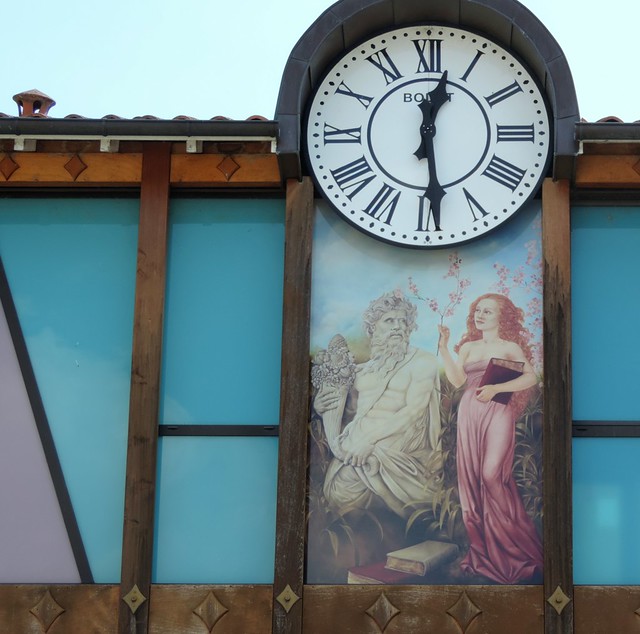
//embedr.flickr.com/assets/client-code.jsI don’t have an Apple watch. In fact, I don’t routinely wear a watch. Years ago, a Dutch friend of mine who I’d invited to Scotland to teach, told me on the train on the way to the venue that he’d taken his watch off several years ago, because he’d realised that the more often he checked his watch, the more anxious he felt. (We were on a delayed train and I was anxious we were going to be late, but he told me why worry, we’re not driving the train, and worrying won’t make it go any faster) However, these days with the smartphones, (I do have an iPhone), it’s never difficult to check the time. But if you are out and about I bet you’ll find some kind of timekeeper isn’t far away – whether it’s a digital clock outside a pharmacy, or a beautiful clock on some building.   Les Macarons de Montmorillon//embedr.flickr.com/assets/client-code.js

So, I’ve been wondering, what do you look at when you want to know the time?

And do you think that where you look influences how you feel about time? Do you like the precision of digital, the analogue of old clocks…..or sundials and calendars?!

circle of seeds//embedr.flickr.com/assets/client-code.js

There is something very beautiful about seeds, maybe especially the ones which disperse in the wind.

There’s something so delicate, light and insubstantial about them. Maybe that’s why children often think these are fairies when they float past in the wind.

Yet, they are bursting with potential. Full of promise and possibility, just waiting for a helping hand from a passing breeze to leap into the unknown, and hopefully find fertile ground somewhere.

This particular seed head seems even more delicate than most. And doesn’t that delicacy, that fragile impermanence make it all the more beautiful?

It does for me.

Plants of Creation

Creation

I saw this fresco on the ceiling in l’Abbaye de Saint-Savin. This is God creating night and day. What completely fascinates me is the plant – what is it? Do you know? Do tell me if you think you do.

If you look carefully it seems there is the faded remnant of another one just to the left. I’m assuming that the fact there are three heads to the flower is significant, but does this flower usually grow in such a manner?

Can anyone shed any light on this?

Taking a moment

Bench with tree or tree with bench

When did you last just sit? And where was that?

Do you have a favourite place to sit? And what do you do while you are sitting?

When I was a busy GP in Edinburgh I’d often drive through Holyrood Park on the way from one house call to another, or one clinic to another, and if I saw someone sitting on one of the park benches….just sitting….I’d get a sudden longing. I’d think “How great to be able to just sit”.

In our busy lives, we’re always doing. In the midst of that we are encouraged to “live in the present moment”, to learn to be “mindful”, learn how to meditate, learn to “soyez zen” (as I’ve heard it said so often in this part of France).

I know it’s important to be active but I also know it’s important to slow down sometimes (I have a whole series of posts on verbs…. Here’s one on slowing down) . Yes, maybe to meditate. Maybe to focus on my breathing. Maybe to day dream even.

Sometimes I go outside and sit down under the mulberry tree, listen to the birdsongs around me, look at the blues and greens and other colours in the world around me, breathe deeply and fill my lungs with the clear air, close my eyes and feel the warmth of the sun on my skin.

Sometimes I practice some form of meditation, sometimes Heartmath, sometimes I just let my consciousness flow, drifting from a sensation to a feeling to a thought.

I find some of my best ideas arise in those moments and I’m reminded of David Lynch talking about TM and diving for the big fish….

ideas are like fish. If you want to catch little fish, you can stay in the shallow water. But if you want to catch the big fish, you’ve got to go deeper. Down deep, the fish are more powerful and more pure. They’re huge and abstract. And they’re beautiful. Everything, anything that is a thing, comes up from the deepest level. Modern physics calls that level the Unified Field. The more your consciousness – your awareness – is expanded, the deeper you go toward this source, and the bigger fish you can catch.

(from David Lynch’s “Catching the Big Fish: Meditation, Consciousness and Creativity”)

Seriously, if you are busy doing all the time, you aren’t going to catch the big fish! Pull up a chair, sit on that bench, and “take a moment”. Who’d have thought it? Moments are there for the taking!


Not knowing

out there

The skies above this part of the world are often very clear so I’ve taken to star gazing at night when I can. Wherever I point the telescope it shows me more stars than I ever knew existed. It’s hard not to be humbled by the immensity of it all. But what struck me last night as I looked at the stars was how much I didn’t know.

It’s not a new thing for me to wonder about what I don’t know. I remember years ago reading an article in the British Medical Journal about medical education saying that all the best ongoing education starts with saying “I don’t know” – yet that was the one phrase we were all terrified to say as we our teachers singled us out to ask us questions on teaching ward rounds or in the lecture theatre. It’s a phrase which brought shame and condemnation. If you didn’t feel an idiot before you said it, you sure did afterwards! So, it was refreshing to read the opposite – to read the idea that only if you could say “I don’t know” could you open up the chance to learn something.

Many, many years later I came across the works of Montaigne, and was delighted to find that one of his most used phrases was “Que sais-je?” (not exactly I don’t know, but “what do I know” – still a humble admission of the limits of personal knowledge).

Throughout my career, although I practiced as a holistic doctor and was fortunate enough to work for much of my life in a service which prioritised time spent with patients, I often found myself saying to patients that even if they’d told me things they’d never told another soul (and that was a common remark made by patients), I thought it took a lifetime to try to really know yourself, let alone another person, so although I was about to share some insights with them about what was happening in their life, those insights were limited by the small amount I knew about them. You see, how much you know is always a relative term, but it surely is always (in the bigger scheme of things) a small amount.

When I posted yesterday about the Japanese lantern I had to check out on wikipedia just what those lanterns were and yet again I was faced by having to say to myself that I didn’t know enough about botany.

Strange that that awareness and the sharing of it is still something which comes with a discomfort, because, really, I believe that the world would be a much better place if we were all more aware of the fact that what we don’t know is always so much more than what we do know.

While I was writing this, Hilary (who didn’t know what I was writing about) read out a quote to me –

The problem with the world is that the intelligent people are full of doubts, while the stupid ones are full of confidence.

……Charles Bukowski

Earlier today, what provoked me to write this post was reading the following quotation from Parker Palmer on the Brainpickings site

What I really mean … is be passionate, fall madly in love with life. Be passionate about some part of the natural and/or human worlds and take risks on its behalf, no matter how vulnerable they make you. No one ever died saying, “I’m sure glad for the self-centered, self-serving and self-protective life I lived.”

Offer yourself to the world – your energies, your gifts, your visions, your heart – with open-hearted generosity. But understand that when you live that way you will soon learn how little you know and how easy it is to fail.

To grow in love and service, you – I, all of us – must value ignorance as much as knowledge and failure as much as success… Clinging to what you already know and do well is the path to an unlived life. So, cultivate beginner’s mind, walk straight into your not-knowing, and take the risk of failing and falling again and again, then getting up again and again to learn – that’s the path to a life lived large, in service of love, truth, and justice.

I couldn’t agree more.
Beautiful protection

lanterns

What do you call this plant? Japanese lantern? Chinese lantern? Physalis? Whatever name you know it by, isn’t it extraordinary?

I mean, what is this? Is it a fruit? Are these petals? Or leaves? Or what?

Well, turns out these are sepals forming a calyx – the sepals of a flower are a form of protection, but whilst they are usually green, and you probably don’t normally really notice them, in this particular flower they form this papery orange lantern.

Sometimes protection is just so beautiful!

By the way, I’m no botanist, so in Montaigne’s famous words “Que sais-je?” (“What do I know?”) – if you know more about this please share in the comments…..