
Webs are great for….catching things, right?
Like the colours of the evening sunlight…..
(Just another reason to stay aware and notice the amazing everyday)
Webs are great for….catching things, right?
Like the colours of the evening sunlight…..
(Just another reason to stay aware and notice the amazing everyday)
Posted in from the dark room, from the living room, life, photography | 1 Comment »

In 1911 Frederick W Taylor published the “The Priniciples of Scientific Management”. This approach to work had a profound influence, leading to the use of the term “Taylorism” to capture the essence of his message. It’s a message which still holds sway today. In fact, the term “Taylorism 2.0” is being used to describe the modern form.
It’s clear that Taylor’s idea of science was not that curious, exploratory discipline based on wonder, but the desire to control – the desire to produce pre-determined outcomes through systems created by measuring what could be measured.
Right there, in that text is his declaration of intent – one which chills me every time I read it!
In the past the man has been first; in the future the system must be first
If there was one thing I would say to try to improve health care, for example, it would be put the human beings first, and the system second – the system and the management created to deliver the system, should, in my opinion, be the servants of those human beings who are caring for, and trying to help, the other human beings (the patients).
Is it any wonder that professional satisfaction amongst doctors is so low when they’ve signed up to something they probably didn’t understand was “Taylorism 2.0”
So what is this “Taylorism 2.0”?
I first came across it in an article about workers in a French supermarket internet-ordering section. Let’s call it “click and collect” – in the UK, there are now many “click and deliver” services from supermarkets, but in France, the delivery bit doesn’t seem to have taken off yet. Instead you can order your shopping online, then you go to the “Drive” and pick up your order.
But what happens between clicking on the items you want on the web catalogue and finding your shopping at the counter in the “Drive” building of the supermarket?
Well, you have staff who are called “pickers” – they go round picking the products off the shelves – either of a supermarket (often a “hypermarket”), or from a warehouse (more commonly the former so far) – and collecting them into boxes ready to be handed to the customer when they turn up at the “Drive” counter.
These pickers are managed not just according to the principles of “Taylorism” – which involves measuring whatever can be measured and setting the targets and goals to be achieved i.e. the time taken to get a particular item from the shelf, the number of items an individual “picks” in an hour, in a shift, or whatever. As the article made clear every aspect of the job which could be measured was measured and monitored. Each picker has a portable device strapped to their wrist and receives the instructions for what to pick next from the computerised control office. The device shows exactly where they are at all times of the day, and measures the time taken for each and every action. What can’t be measured and monitored this way is the interaction between the staff and customers, so that is controlled by teaching them scripts which they have to learn by heart and stick to – you’ll know the kind of thing – “have a nice day”, “happy to be of service”, “thank you for waiting” and so on….
What takes all this measurement and control to the next level is not just the introduction of the new technologies which allow better monitoring and measuring, but the introduction of game theory.
Yes, you read that right. Game theory. The big new addition is “gamefication” – or how to introduce principles from cognitive behavioural psychology and game theory to get the most out of the workforce.
Just to give you a taste of this, it can include awarding points for numbers of items picked and delivered, numbers of customer orders completed, shortest times taken to get frozen goods from the shelf to the customer and so on. The points are fed back to individuals and teams and the scores are ranked. So an individual can see instantly at all times their best times, their highest number of order completions and so on….which inspires them to try to always get personal bests. But more than that, the team, or all the members of a particular shift will get collective scores and be ranked against other teams, other shifts or even other stores across the country – an enormous expansion of the “employee of the month” idea.
There can be a number or rewards attached to the rankings as extra incentives.
There’s a lot more involved than this but maybe this introduction will give you an idea.
So, what’s this got to do with health care?
Again, just as an example, let’s look at one particular system – the application of “QOF” (“Quality Outcomes Framework”) points in Primary Care in the UK.
General Practitioners have a substantial amount of their income pegged to their “QOF” points – these are points allocated for achieving particular targets on management-set protocols, mostly they related to the numbers or percentages of patients in a practice who have been entered onto particular disease registers, who have been asked about smoking habits, have had a BP check and so on, or the numbers of percentages of patients with specific conditions who have been prescribed the recommended drugs.
Not only does this prioritise the things in health care which can be measured at the expense of things which can’t (like communication skills, empathy, creation of therapeutic alliances, depth of understanding, caring etc) but it gamefies the whole system by awarding points, ranking individuals and practices, and rewarding points with income. So the doctors motivate themselves to try to achieve what the management want them to achieve.
Welcome to Taylorism 2.0 – where the system comes first – more now than ever before.
Posted in from the consulting room, from the dark room, from the living room, from the reading room, health, life, philosophy, photography, psychology | 1 Comment »

Beauty.
Pretty undefinable really, but obvious when we see it.
This is certainly one of the most beautiful sights I know – rain drops hanging from the buds of a flower.
I’m looking forward to these buds blossoming into full flowers too, because the scent of the freesia is, to me, one of the world’s most beautiful scents.
What beauty have you stumbled across today? Did you take the time to enjoy it? I recommend it.
Immerse yourself in beauty today – even if only for a few seconds (I recommend a LOT longer if that is possible!)
Posted in from the dark room, from the living room, life, personal growth, philosophy, photography | 1 Comment »
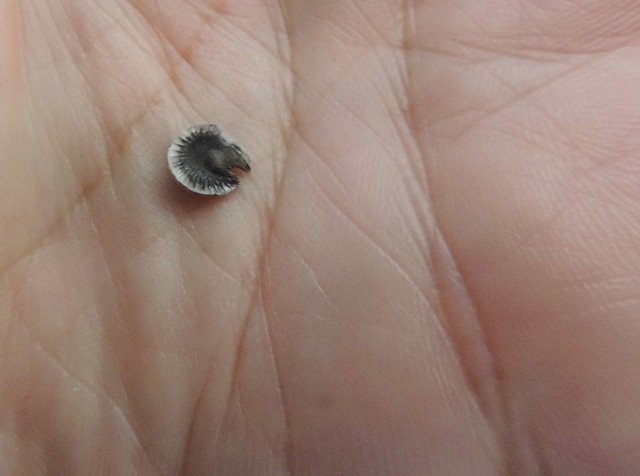
Let’s start here. This is a single seed. It looks like a little shell, or a fossil. Look closely and you’ll see a wee notch which makes it look almost as if it has a mouth, or a beak. Where did this come from? 
It came from here. When you peel back the covers of this seed head, the little seeds spill out very easily.
Look carefully at the middle. Can you see that ring of little hooks? Well each hook holds a single seed – right where that little notch was that we saw in the previous photo. Isn’t that incredible? How delicate, and how exact!
Would you like to see what it looks like before all the seeds spill out?

There you are. Wow! It’s like a bracelet, or a necklace. Densely packed seeds just bursting with life. What will they be when they grow up?

A flower as big as a house!
These hollyhocks, or “rose trémière” as they are called around here (I think I prefer the sound of the French name) are everywhere in this part of the world. And look how high they grow! They are really stunning.
We’ve gathered a few of the seeds this week and we’ll see if we can have even more flowers next year.

Could you have imagined such a tall, beautiful flower could grow from one of these tiny seeds?
Posted in from the dark room, from the living room, life, photography, science | 1 Comment »
What’s better?
To look up close……

Or to look far away……

Ok, so it’s a trick question.
It’s great to look at something like that mulberry leaf really close up – I mean, look at the veins and the structure of the leaf! Look at the stomata! What an incredible pattern! Then look at the colours, the shades of green….
But then, look up at the sky and see the clouds, layer upon layer with such rich shades of grey and blue….
The thing it, its best just to LOOK.
We spend so much of our lives on autopilot (zombie mode), that the world can literally pass us by, and in so doing we miss all these opportunities to be amazed at just how incredible it is to be alive, here and now, on this Earth.
Posted in from the dark room, from the living room, life, perception, philosophy, photography | Leave a Comment »

It would be easy to get lost in the petals of this flower.
Isn’t it just astonishing?
The curving shapes, the layers, the shades and tones of colour, the light and the shadows.
Sometimes, in our busy, bustling lives, it’s good to stop for a moment. Still the mind by focusing on just one small part of the world – in this case a single flower, close up. Just let yourself take the time to gaze, to explore, to wonder.
Flower meditations are easy to practice – you can do them just for a few seconds, or you can take a few minutes. It’s up to you.
Try it and see how you feel. Because as well as the flower itself being a great wonder, the engagement of your focus and attention changes what’s happening inside you as well…..and that’s the extra bonus of a flower meditation….becoming aware of what’s changing inside you.
Posted in from the dark room, life, personal growth, philosophy, photography | Leave a Comment »

What makes this rose special? (Ah, some of you will be looking at this saying, “that isn’t a rose, it’s a hollyhock!” But a hollyhock in France, and there are masses of them here in the Charente, is a “rose trémière”).
Well, it’s special to me, because it’s growing in my garden and I’ve become pretty fond of all these incredible flowers in this garden.
When I think of roses now I think of the story of the Little Prince, and in particular, the section of the story where he meets the fox, and learns the secret the fox has to tell him.
The secret, apart from the much quoted “what is essential is invisible to the eye”, is that we make individuals special to us by creating relationships with them. In the story, the fox asks the Little Prince to “tame” him, and I tripped up over that word a few times (even checked out all the possible means of the original French word “apprivoiser” that I could find). I don’t really like the word “tame” as it seems to include changing the creature which is “tamed” to make them docile, and subjugated in some way. However, in the context of the story, it is clear that what is meant is how we create special bonds by paying attention, caring for and looking after another, and that when we do that, that person, or animal, or plant, becomes special to us. He, she or it becomes unique.
That might not seem that comfortable a thought at first. After all don’t we like to think of ourselves as compassionate and caring, so we should be able to “care for” or “care about” pretty much anyone? Well, that may be true, but any potential we have to do that remains just that – a potential – until we create actual, real bonds with actual, real individuals.
In the story, the fox explains to the Little Prince that the garden full of roses shouldn’t make him sad that his rose is not as unique as he thought. His rose, in fact, is still unique, and how the Little Prince feels (or doesn’t feel) about all the roses in the garden even emphasises that point.
Here’s a nice reflection on this whole issue.
So, as we create a relationship with the particular – with this rose, with this creature, or with this person – we reveal their uniqueness. And as we continue and develop that relationship, they become even more unique, even more special to us. That’s one of the essential kinds of bonds we have to make to deepen our experience of living in this world.
And it takes nothing away from the fact that, potentially, any person, any flower, any creature can become special to us.
Posted in from the dark room, from the living room, from the reading room, life, personal growth, philosophy, photography | 2 Comments »
I live in a typical Charnetaise house –

Can you see those two little arch-shaped holes/windows up on the top left? Well, there’s been such a lot of hissing coming from there in recent nights, and a bit of research revealed that the noise is the sound of barn owl chicks (barn owls don’t hoot, they hiss!)
Today I thought I could just make them out when I stood under the mulberry tree, and with a lot of patience, a camera on full zoom maxed up to a 3200 ISO setting, I managed to get these photos –
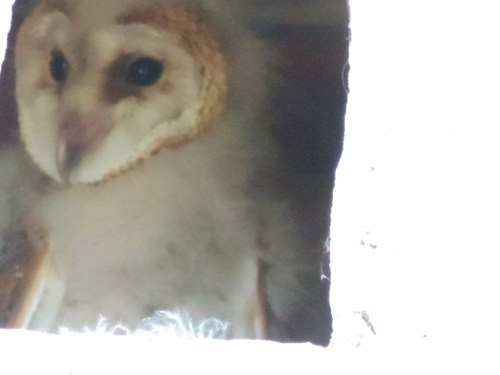
and

Wow!
I mean – wow!
OK, not exactly nature photographer of the year material but WOW!
This is just the kind of thing which makes an ordinary day an extraordinary day!
Posted in from the dark room, from the living room, life, perception, personal growth, philosophy, photography | 3 Comments »

In my twelve monthly themes, August is the month of travel.
I came up with this as the theme for this month because in France every August is the month of the “grand depart” – it’s the beginning of the annual holidays for thousands and the roads, airports and ports become very, very busy this month (starting this weekend)
I am a great believer in travel. I love to visit other places, encountering other cultures, traditions, foods, architecture, art and history, as well as other natural environments from the one I happen to live in. Where I live now is vine country and to visit a forested area, a mountainous region or the coast can be a stimulating change.
I think most of us also need a break now and again. We need to step out of the routines and habits and demands of our daily lives to be able to see them from “on high“. And we also need to rest.
I was taking photos of clouds the other day (as I do!) and I noticed this plane’s trail with a strange and clear break right in the middle of it and I thought – what a brilliant visual metaphor for August – travel AND taking a break!
So, where are you going to go? When are you going to take a break? Even if it’s just for a day, or a weekend, I think it’s important.
Posted in from the dark room, from the living room, life, personal growth, philosophy, photography, psychology | Leave a Comment »
I graduated from Edinburgh University, with my medical degree, in 1978. The next four years were my foundational training to become a General Practitioner (I still think “Family doctor” is a nicer title).
Here’s four of the core teachings which I received.
Don’t practice “a pill for every ill”.
There was an assumption that drugs should only be prescribed if you thought they were really necessary. If you issued a prescription at the end of every consultation you weren’t practising good medicine.
Underlying this teaching was to prescribe as sparingly as possible.
If you refer your patient to a man with a knife, he’ll use it.
There were two aspects to this teaching – firstly, that you shouldn’t refer a patient to a hospital consultant unless you expected that doctor to treat the patient with their particular specialist skills. Secondly, a specialist was likely to try to treat your patient using only the particular specialist skills they had.
Underlying this teaching was to refer to secondary care as sparingly as possible.
Don’t arrange an investigation/test unless you think the results are likely to change what you otherwise propose to do.
I was taught that most diagnoses could be made on the basis of a good medical history supplemented with relevant clinical examination. Tests were only for when you couldn’t do that.
Underlying this teaching was to test as sparingly as possible.
The doctor is the drug.
This was a big one. Back in the 1980s Balint’s teaching still influenced General Practice, and Balint proposed that one of the most powerful therapies a doctor could offer was him or herself. The doctor-patient relationship was the most important part of therapy. Active listening, understanding, compassion, care and good communication were the core daily tools, employed with a sound knowledge of the natural history of diseases, the risks and harms of various potential treatments, and the ability to help patients to understand what they were experiencing, what this illness meant in their lives, and what they might do cope and to become well.
Underlying this teaching was to pay as much attention to, and to spend as much time with, each and every patient as was possible.
Posted in education, from the consulting room, from the living room, health, life, philosophy, science | Leave a Comment »

 Heroes Not Zombies