Feeds:
Posts
Comments

Belonging

A human being is a part, limited in time and space, of the whole that we call the universe. He experiences himself and his feelings as cut off from the rest – an optical illusion of his consciousness.

Albert Einstein

What we consciously experience as individual is selected by our brains from a much larger field of consciousness.

William James

We aren’t separate, even if it seems that way. We never leave the environment into which we have been born. We are the continuation of the flows of reality which preceded us, which surge through us, and stretch forwards into a future where we become the memories held by others.

Einstein and James are making this point in these two quotations and it’s something I’ve been very aware of for a long time. We are much more deeply entangled in all that is than we realise. The reductionist mechanistic and atomistic models of the universe present us with a very distorted view of reality.

But there’s something else important in these quotes – we select out, or we “abstract” a limited portion of the whole to give ourselves the illusion of separateness.

This is a fascinating insight – it suggests our brains create our everyday experience by filtering, by sifting, and by selecting from the whole, and, in association with this, focused on that selection in a particular way.

In other words consciousness exists everywhere and our own unique experience of it is partial and temporary.

We are never disconnected from the Whole. We are never alone. We are never cut off or separated. It just appears that way in certain circumstances and at certain times. I think that’s why we should practice being connected, we should call to mind the reality that we belong.

What can you do today to experience some connectedness?
Just a thought….

I read two quotations yesterday about the nature of the universe. Both are by men who were physicists, astronomers and mathematicians (yes, both were active in all three domains).

The stream of knowledge is heading towards a non-mechanical reality: the universe begins to look more like a great thought than like a great machine.

Sir James Jeans

The universe is of the nature of a thought or sensation in a universal mind…..to put the conclusion crudely – the stuff of the world is mind-stuff.

Sir Arthur Eddington

If you’ve been reading my posts for a while you’ll know how allergic I am to the machine model of human beings, living creatures and the universe. We are NOT machine like and we shouldn’t treat others as if they can be reduced to an assembly of parts. Every single person is a unique irreducible whole. Nor should we treat “Nature”, the planet or the universe as machine like.

Understanding the universe as more like the phenomena of the mind than of a machine brings with it a whole other set of values. It encourages wonder, humility, curiosity, a delight in uniqueness and diversity.

In Medicine it leads us to remember that the subjective experience of reality of any human being can only be partially known, partially revealed through story and behaviour, never understood solely in terms of measurements, investigations and data.

Where does a thought begin and where does it come from? Seeing the universe as more like a thought undermines the common attempt to seek simple cause and effect. There are no clear beginnings. There are no simple causes and predictable outcomes.

Life and the universe are more complex, more nuanced, more creative, more multifactorial, more interactive and inter-relational.

Well, anyway, that’s how I see it…..just a thought…..

In our place

Creatures are not the passive playthings of necessity, but determining their environment as much as the environment determines them.

Iain McGilchrist

Think of the places on this Earth which mean the most to you….the places where you feel at home, the places which feel as if they are your origin places, where your roots lie, the places which feel special because what happened there was so important to you, or had such an impact, the places where you feel in awe of the beauty there, the places you love, and those which your loved ones love.

Stirling, in central Scotland, was where I was born, where I grew up, and where I learned, post university, to become a doctor. It’s a city steeped in history with the castle and the monument, two of its most prominent features on its skyline. But it’s also a city with a great river snaking through it. The River Forth winds and bends and loops its way through Stirling, heading towards Edinburgh and the North Sea. The Old Stirling Bridge was the only crossing point linking the Scottish Highlands to the Lowlands.

Stirling has been a meeting place, a market town, a Royal town, a town where people met from East and West, and from North and South.

My gran told me that boys born in Stirling were known as “sons of the Rock”, after the ancient rock on which the castle was built. I think that was a pretty powerful message to give to a child, conveying a deep sense of roots, of stability and consistency in the face of flow and change, a kind of constancy.

Those are qualities I own, and which others have remarked upon.

I wonder how much my environments shaped me, and how much I continue to contribute and influence in turn as we shape our world together.

I read a study today comparing children in pre-schools with different types of playground. The researchers looked at the state of their “biomes” – in other words, the health and diversity of their gut “flora” which, we know, plays an important part in the immune system.

The children whose school playgrounds were concrete and tarmac had poorer “biomes” than those whose playgrounds had grass and woodland ground cover eg heathers and blueberries.

This is yet another study, taking a slightly different angle on things time, which shows there is an immune benefit from time spent in natural environments.

Recently another study indicated that urban air quality is so poor in European cities that it’s probably responsible for many thousands of deaths every year.

We also know that Covid and other airborne diseases spread much more intensively in indoor environments where the air quality is poor – yet little seems to be happening to rectify that!

These are just some of the examples which show that if we want to get a handle on these waves after waves of viral and bacterial infections then we should address the condition of the environments we are living in.

Can we envisage a two pronged programme to improve indoor and outdoor air quality, hand in hand with increasing natural diversity in our urban environments and habitats.

More than survival

passing the light

The philosopher, Whitehead, wrote that there are three drives for us – to live, to live well, and to live better. I was reminded of an old post I wrote about light when I read that. Here it is –

Candle light reminds us how sharing light increases it. Have you ever lit one candle from another? When you do, the first candle doesn’t get any dimmer. By lighting one candle from another, you end up with more light.

I wonder what kind of light I bring into this world? You might like to wonder about what you pass on to others too, because, although we might not physically pass light to each other, we certainly pass our emotions, our attitudes, our way of being onto to those around us and spread them the way that light can spread.

Around the turn of the year, when I was thinking about my Life (with a capital “L”), I played with this idea of light and I thought, actually, what I try to do, as a doctor, can be captured in three verbs about light.

Firstly, I try to lighten others’ loads. I try to ease their suffering. If I didn’t achieve at least that, I’d not be much of a doctor. I hope that everyone I see has their life, or the burdens in their life, lightened a bit as a result of my care.

But that’s not enough for me. I don’t want patients to come back and just say they feel a little lighter. I want their lives to be brighter. By that I mean I hope their days become better days, more fulfilling, more colourful, brighter days. I hope for others, and I hope for me, that life becomes brighter, and by that, I really mean an increase in that “emerveillement du quotidien“.

But even that’s not enough for me. I hope, at best, to enlighten, to show new possibilities, to support and stimulate new growth. I just love when I hear that a patient’s life has become lighter, brighter and, yes, transformed – that they’re experiencing a personal enlightenment.

If you think about light this month, why not think of it as a metaphor, as well as a physical phenomenon? What metaphors of light seem most relevant in your life?

So, in answer to yesterday’s question about evolution being about more than survival, I think we have to take on board this perspective – that we are driven to do more than survive. We want to live well. And we want to move forward improving – to live more deeply, more beautifully. We want to savour every moment, to create, to share and to love.

The direction of the universe and of evolution is towards greater complexity and beauty, towards greater diversity and uniqueness. And every day we can play an active part in that.

Evolution

Whitehead, pointing out that inanimate objects last much longer in the world than living organisms, asks, “how did complex organisms with such deficient survival power ever evolve”…..”They certainly did not appear because they were better at that game than the rocks around them”.

Trees can live for hundreds of years, some bacteria for millions, so if survival is a key driving force behind evolution, how come a human life is still only 70 – 80 years, yet we presume ourselves to be THE most fully evolved creatures on the planet.

There’s definitely more to evolution than survival and reproduction. What do you think that is?

This is my song

Humble dazzle
of autumn:
these leaves
on the ground -
each one a page
in the book.
A poem that says:
I lived.
I was
a small part
of the whole
story - this
is my song,
this is my glory.

Gregory Orr

Isn’t that a beautiful poem? Autumn can be such a colourful season, and although there are still many golden, yellow, red and brown leaves falling to the ground, we’ve had our first frost here and really I think we should be calling this winter….maybe the seasons are becoming more interwoven?

But what this poem reminds me to do is see the individual in the crowd, pay attention to the particular which can be hidden by the general.

Each single leaf has lived its own life, fallen at this particular moment and landed on this specific piece of ground. Each leaf, like each and every living creature, sings a unique song, tells a singular story.

Every one of us lives this “one precious life”….it’s our glory.

Mistletoe

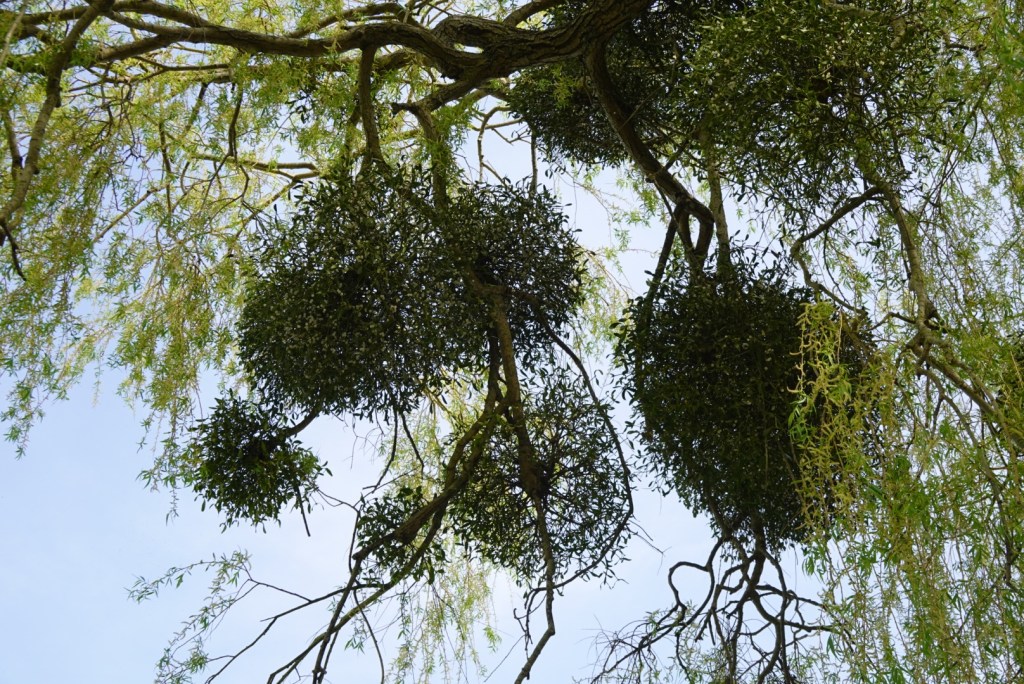
You can see lots of mistletoe around here throughout the year, but it’s significance is at a height at this time of year….Christmas.

The Romans associated mistletoe with peace, love and understanding, which seems especially relevant to me here where I live a few metres from a Roman aqueduct.

It has long been associated with male fertility in a variety of cultures and has been used as a medicine for a number of different complaints. It’s highly toxic….a feature which seems to be characteristic of so many different “medicinal” substances. I wonder why that is….why do we humans use poisonous plants to bring about healing? It seems a dangerous game and I often wonder how the first humans discovered that certain plants had both harmful AND beneficial powers.

We humans create a whole extra dimension of reality through our use of symbols and stories, seeing not just a cluster of leaves and white berries attached to a tree, but empowering those plants to turn our minds to love, to peace, to kisses and to protection from evil.

Uniqueness

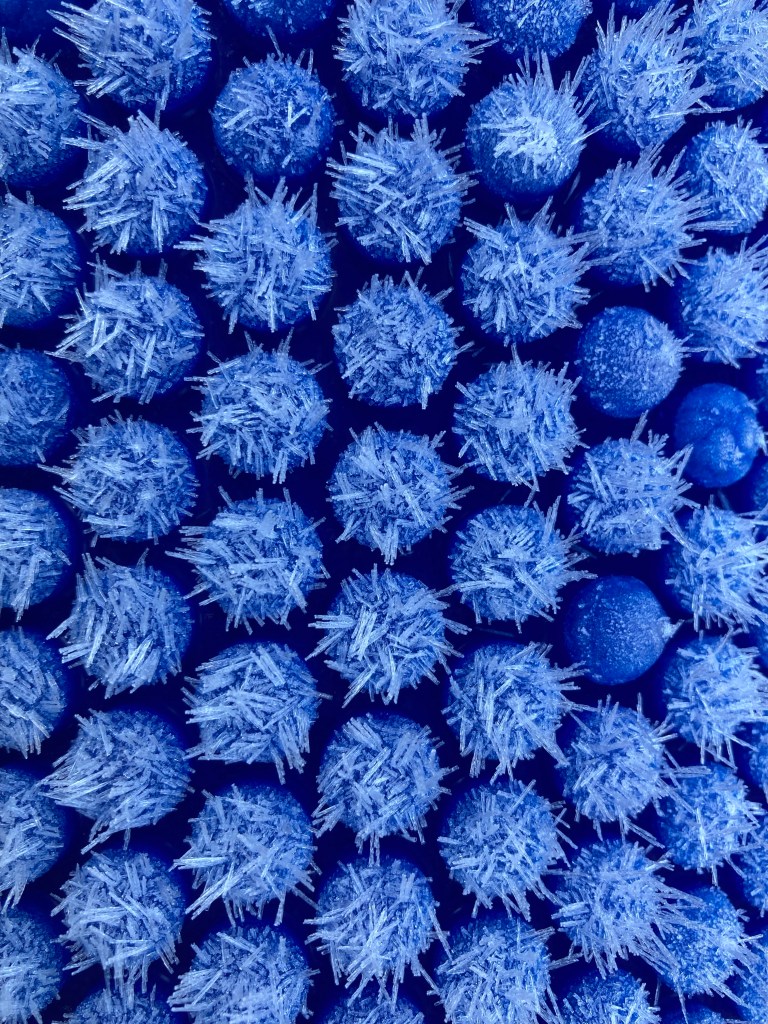
When the first frost of the winter arrived I went out to take photos before breakfast. Here’s one I took of the ice particles which formed on a plastic cover.

Aren’t they beautiful? I don’t think I could’ve dreamed up shapes like this. I’ve looked at this photo again and again, and if you’re a regular reader here, I bet you know what’s fascinating me….

This is one of those places where at first glance you think, oh look at all these identical clusters of ice! Then, immediately you notice differences and the closer you look, the longer you take over them, you realise…..there are no two exactly the same.

Yep, every single one of them is unique. Just like snowflakes. Just like each of us are unique. Just like every moment of every day is unique.

Isn’t that wonderful?

A Universal goal

To me, a universe with tendencies towards beauty, complexity, and the rich unfolding of uniqueness is already teleological

Iain McGilchrist. The Matter with Things

When I started to read philosophy books I came across the word, “teleology”, and I wasn’t sure what it meant. Best I know it refers to an end point, or a goal….so when something is described as teleological it means it has a purpose determined by its destination. Maybe that’s not an exact definition and I’m happy to be educated if you know better, but the destination doesn’t have to be a fixed, limited one….it can be like a “North Star” or “lode star”…. something to aim at.

So when I read this sentence about the universe, I read it as stating that the universe isn’t random and purposeless, rather it is moving forward in a particular direction…..it’s going “somewhere”, and that somewhere gives a clue about purpose.

So what’s the suggestion here? That, the direction, the “somewhere”, the purpose, is beauty, complexity and uniqueness. That’ll do for me.

I have my eyes and ears open for that every single day….to be awoken by, to be absorbed by, beauty, complexity and uniqueness, so that I stop, wonder, and savour, enriching my life and my soul.